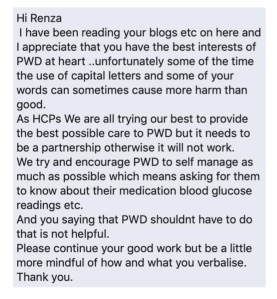
These days, I usually don’t show my glucose data online. When I first started Looping (about two and a half years ago), I regularly posted the flat CGM lines that amazed and surprised me. I also shared the not-flat lines that showed how hard my Loop app was working as temp basal rates changed almost every five minutes. The technology worked hard so I didn’t need to, and the results were astonishing to me. I shared them with disbelief. (And gratitude.)

I stopped doing that for a number of reasons. It did get boring, and I definitely recognise my privilege when I say that. I also acknowledge my privilege at being able to access the devices required for the technology to work. And there was the consideration that sharing these sorts of stats and data online inevitably lead to comparisons and competition. That was never my intention, but I certainly didn’t want to add to someone having a crappy diabetes day while I blabbed about how easy my day had been.

But today, I’m sharing this:

This was my previous 30-day time in range data from the Dexcom Clarity app on the day I arrived back home in Australia after returning from New York. (My range is set to 3.9mmol/l – 8.1mmol/l.) I’m not sharing it to show off or to boast. I don’t want congratulations or high fives. In fact, if anyone was to see this and pat me on the back, I would respond with the words: ‘I had very little do with it’.

I can’t really take credit for these numbers and would feel a fraud if anyone thought I worked hard to make this happen. Using an automated insulin delivery system full time means that I do so much less diabetes than ever before while yielding time-in-range data that I could once only dream of.

I want to share it, not to focus on the numbers (because it’s NEVER about the numbers!), but to explain what happens when diabetes tools get better and better, and what that means in reality to me.

Those thirty days included the following: End of year break up parties for work and other projects (four of those); ‘We-must-catch-up-before-the-end-of-the-year’ drinks with friends (dozens of those!); actual Xmas family celebrations (three of those over a day and a half– and I’m from an Italian family, so just think of the quantities of food consumed there). Oh, and then there were the three weeks away in NY with my family. Our holiday consisted of long-haul flights from Australia, frightful jet lag (there and back), a lot of food and drink indulgences, out-of-whack schedules, late nights, gallons of coffee, no routine, and more doughnuts than I should admit to consuming.

Add to that some diabetes bloopers of epic proportion that had the potential to completely and utterly railroad any best laid plans: insulin going bad, blocked infusion sets, sensors not lasting the distance, a Dex transmitter disaster.

And yet, despite all of that, my diabetes remained firmly in the background, chugging away, bothering me very little, with the end result being time in range of over eighty per cent.

This graph is only part of the story of why I so appreciate the technology that allowed me to have a carefree and relaxed month. Diabetes intruded so little into our holiday. I bolused from my iPhone or Apple watch, so diabetes devices were rarely even seen. Alarms were few and far between and easily silenced. I was rugged up in the NY cold, so no one even commented on the Dex on my upper arm. The few times I went low, a slug of juice or a few fruit pastilles were all it took, rather than needing to sit out for minutes or hours. Diabetes didn’t make me feel tired or overwhelmed, and my family didn’t need to adapt and adjust to accommodate it.

That time-in-range graph may be the physical evidence that can point to just how my diabetes behaved, but there is a lot more to it, namely, the lack of diabetes I needed to do!

As I spoke about this with Aaron, he reminded me of my well-worn comments about not waiting around for a diabetes cure. ‘You’ve always said that although you would love a cure, it’s the idea that diabetes is easier to manage that excites you. Ten years ago, when you spoke about what that looked like, you used to talk about diabetes intruding less and being less of a burden to your day. That is what you have now. And it is incredible.’

In a couple of weeks, the diabetes conference juggernaut will descend on Madrid for ATTD.

This one is all about new treatments and technologies in the world of diabetes and, in its thirteenth year, looks to once again be a busy and enlightening meeting.

There is so much on the program that focuses on user-led technologies and initiatives. I think it’s fair to say that PWD have long recognised that technology in diabetes is more than just the devices we wear on our bodies. We have long used technology for support and to connect to others who help us manage the day-to-day life of diabetes, and to learn and share. DIYAPS may be about the systems, but grasping the role of online platforms and support is essential in understanding the #WeAreNotWaiting movement as a whole.

It’s great that a number of PWD already know that they will be part of ATTD this year, attending satellite events run by different device and drug companies. Some are on the program and some will be there through other opportunities and work.

The more the merrier, I say! Different voices with different experiences sharing and learning is always a great thing. And having the opportunity to meet people in real life after only seeing them online adds another dimension to our peer support networks.

For European diabetes friends yet to secure a place at ATTD, there is another possible avenue in, but you need to be quick. Launching at ATTD is the new #dedoc° voices program. Although #dedoc°has its foundations in Germany it is truly an international community, involving people from all over the world. #docday° events (always a highlight at these conferences) involve diabetes advocates from across Europe and the US, and even the odd Australian, too. It’s great to see this new initiative is helping more advocates get a seat at the diabetes conference table as active participants.

APPLY NOW

If you want to be considered for the #dedoc° voices program, you need apply, which is super simple – just go here, where you will find out all about the program and how to throw your name in the ring! Applications close on Friday, so chop chop!

Successful applicants will have their travel and accommodation costs reimbursed, and will receive full registration to the conference.

Good luck. And hope you see you there.

Disclosure

I am an advisor to the #dedoc° voices program. I do not receive any payment for this role. 

I am an invited speaker at ATTD 2020. Lilly Diabetes is covering my travel and part of my accommodation so I can participate in the DOCLab advisory group meeting held during ATTD.

A very smart friend I met through Twitter, and has become a treasured IRL friend, says that when publicly telling our diabetes stories we may have opened a window into our lives, but that doesn’t mean we need to open a door. We get to choose how we protect ourselves and who we let in.

I choose to leave the window open and have come to learn over the years that as more and more people walk by, more people see what is going on inside. I know I can shut the window and draw the blinds any time I choose, and I did that for a short time at the end of last year. But mostly it is very, very wide open.

But having an open window to glance into doesn’t give anyone the right to yell that they don’t like what you see through the window, especially if I don’t ask. And certainly make sure that you have a good look and understand what you are seeing before you start to tell me that I am wrong about my decorating choices.

My window is on one side of the street. You can cross the road to avoid looking in. Or you can walk by, but not stop for a chat.

I choose what it looks like inside my window. I choose where the furniture goes, how it looks and feels. I live in it the way that works for me. I’m not a professional window dresser or decorator, just someone who knows what looks and feels good to me. I have never given decorating advice because I am not a professional decorator. Just a person living in this room that can be seen through that open window.

This blog is my open window. I welcome anyone who wants to peek inside. No one has to be here, but they’re welcome if they want to be. Some people might have a quick look and decide that it is all a little too frivolous or boring. They may think the things I get worked up about are a waste of time and that there are far better things to spend energy on. They may think it’s all naval grazing. They may think there are far too many pink stripes. That’s okay. It probably is a bit of each of those things, but it works for me. I sometimes write my thoughts on things in the broader diabetes world – and  that may not be your take. That’s okay, too. We don’t need to agree on everything. I’m here, narrating my diabetes and how that intersects with the rest of my life, the world around me, the people I love.

Sometimes, I do that with great vulnerability. I share stories that are painfully personal and sometimes very raw. I try to infuse humour in there because sometimes, living with diabetes hurts so, so much that I need to break that up with something amusing.

I write about those sensitive topics, as well as more general day-to-day subjects, and that is not a decision I make lightly. I do it for selfish reasons – I hope that by telling my story I might just find someone who has a similar experience who can share their wisdom with, and help, me. Another reason is that I don’t want anyone to feel the loneliness and isolation I have felt at times. Diabetes can be lonely. Diabetes on top of other really tough things, such as infertility and pregnancy loss, parenting, mental illness, distress, diabetes-related complications can feel isolating.

If you don’t like what you see in here, that’s perfectly okay. If I have said something factually incorrect, I would really like to know about it so I can correct it. You can tell me about typos (I know there are many) and eventually, I may get around to fixing them. If I have upset you, I would love to understand why and welcome that discussion if you’re comfortable doing that. You can leave a comment – anonymously if you would like – sharing your thoughts.

But don’t ever tell me that I need to change what you read here because you don’t like what you see. Don’t tell me that I need to moderate what I say, or the tone in which I choose to say it. I have chosen to open the window into my diabetes life. But I have not ever chosen to be told how to live that life.

Outside looking in.

Recently, the Australian of the Year was announced. This year, the gong was awarded to Dr James Muecke, an eye surgeon from South Australia, who was acknowledged for his work raising awareness of type 2 diabetes and its links to preventable blindness.

I didn’t really know of Muecke before the announcement, but clearly, he is very accomplished, and his work reaches beyond Australia’s borders. He co-founded social impact organisation, Sight for All, which raises funds to deliver vision-saving programs and eye health projects to people in under-resourced countries.

However, it is Muecke’s work in linking type 2 diabetes and blindness that received the majority of the media coverage, with (as can always be relied upon) some pretty average reporting. Interviews with and soundbites from the newly crowned Australian of the Year did focus on a simple and incorrect equation of sugar equalling diabetes, and this certainly did seem to concern a lot of people responding to what they were seeing online.

I sighed as I read through a lot of that commentary, dismayed as the calls to differentiate between the types of diabetes drowned out Dr Muecke’s award, with repeated bleats that ‘Sugar didn’t cause my/my child’s type 1 diabetes’.

Sugar didn’t cause anyone’s diabetes – it’s just not that simple. I appreciate wanting people to understand that drinking too much Coke isn’t why type 1 diabetes develops. But equally, I want people to understand that it isn’t why type 2 diabetes develops either.

Asking for clarification of the different types of diabetes isn’t always necessary because it doesn’t always matter. You bet that it does matter at times, but other times, it really doesn’t.

We see this time and time again. Think about the time that café in Sydney thought they were being cute by calling a dessert ‘Diabetes’, or the time that guy on that UK cooking show referred to something as ‘Diabetes on a plate’. Was this really the time to get all uptight because the difference between type 1 and type 2 diabetes were not specified? Were the calls to stop stigmatising type 1 diabetes by not clarifying that ‘our’ diabetes isn’t because we ate that dessert? Does it matter in these moments if the person stigmatising and misrepresents diabetes doesn’t point out which sort of diabetes?

It really doesn’t. If the dessert was called ‘type 2 diabetes’ or the recipe was ‘type 2 diabetes on a plate’, it still would have been wrong. It still would have been stigmatising.

And yet, every time another lousy comedian, or celebrity or chef makes a diabetes joke, or the media gets diabetes wrong, or the Australian of the Year explains diabetes in the wrong way, the predictable cries, and rapid soundbite responses only feed into the stigma, prejudices and misconceptions of type 2 diabetes.

We can do better – we need to do better. And we can, by being more thoughtful in our response to correct people getting diabetes wrong.

I should point out that this goes beyond people with (or parents of children with) type 1 diabetes. Lots of other diabetes stakeholders get into it too. Some health professionals trip over themselves in their endeavour to speedily demand clarification of type, (even when it is not necessary). This has always left me somewhat befuddled and wonder if they think this will win them brownie points with the cool kids on Twitter. Surely HCPs working in diabetes understand that sometimes putting ‘type 2’ before diabetes is not actually rectifying what is factually incorrect in the original statement. And that should matter, a lot more than the ‘likes’ from the type 1 diabetes Twitterati they seem so eager to impress!

We can get it right, and get it right quite easily. When the Australian of the Year announcement was made, the comms team at Diabetes Australia absolutely nailed the messaging, striking a balance between commending Dr Meucke for his award, acknowledging how wonderful it was to see the Australian of the Year platform being used to highlight the link between diabetes and diabetes-related eye disease (with a plug for KeepSight!), and adding a note to clearly and eloquently explain the complexities of type 2 diabetes, the role that genetics and other non-modifiable risk factors play in its diagnosis, and reminding people that type 2 diabetes is not caused by eating sugar.

I think the team got it right – the information was correct and accurate and did not in any way add to the stigma of diabetes. (Disclaimer: I work for Diabetes Australia and I’m talking about my colleagues.  Whilst I sometimes work with the comms team, they are all far smarter and better at communicating than I could ever hope to be. Which is possibly why they won’t let me near any of our socials. That, and they worry I’ll swear, or share an Effin’ Birds cartoon…)

Each type of diabetes – and there are many! – has its own complexities and some of the time we need to make sure that it is clear which diabetes we are talking about. But next time you find yourself about to take to the keyboard to correct some misinformation, ask if you are actually adding to that misinformation. And if you see someone demanding such clarification, ask them if they are aware they are contributing to type 2 diabetes stigma. Because I think a lot of the time that is exactly what is happening.

Complete digression, but the title of this post reminded me of these books, which anyone who has been around kids in the last 15 or so years would know about!

Edwin Pascoe, who works as a registered nurse and credentialled diabetes educator, has explored the uniqueness of sexual orientation (gay) among men with type 2 diabetes in his PhD thesis with Victoria University.

This is Edwin’s second post for Diabetogenic (read the first one here).

This weekend, the Mid-summa Pride March marks its 25th year of the LGBTQIA+ community and this year diabetes will be represented.  Edwin invites you to participate and march in what appears to be the first-time diabetes has been represented at such an event in the world. 

To get involved in this historic event and support LGBTQIA+ people with diabetes, please contact Edwin Pascoe on diabetes-education@hotmail.com


But first, read Edwin’s post.


They say that you can’t really know what it’s like to experience a particular-group of people’s world, unless you have been there yourself. The reason is that your vantage point restricts your line of sight.  You only get to see certain things and while people can explain these things to you, their gravity may remain elusive.

This line of sight is often further obscured by well-meaning comments directed at members of the Lesbian, Gay, Bisexual, Transgender, Queer, Asexual, Intersex plus (LGBTQIA+)

community, such as ‘aren’t we all the same’, which are often offered up when a person makes that leap of faith to come out as non-heterosexual to their health care practitioner.

In a sense LGBTQIA+ people are shut down in these conversations by such comments and blended into some kind of homogenised one size fits all approach: a far cry from patient centred care. To put it crudely, it’s nice not to stick out like dogs’ balls but there are times when its important, and even pivotal to explain your truth when speaking about matters as important as your health.

However, the influences among LGBTQIA+ people are so subtle and varied that they escape detection, by even the people who are affected by them – these are often described as incognizant social influences.

For many, the idea of sexual orientation having an influence on diabetes management does not make sense, so when this idea is challenged cognitive dissonance comes into play.

Cognitive dissonance is an internal psychological self-talk that serve to maintain some sort of order when beliefs are inconsistent. Internal beliefs shared by many HCPs are:

  1. They treat all patients equally
  2. Being gay (sexual orientation) is about sex practices, hence the word sexual orientation.
  3. Psychosocial factors influence people’s management of diabetes and so need to be considered in diabetes education.

However, these 3 factors clash and have, to this date, resulted in silence when it comes to talking about sexual orientation and diabetes as evidenced by a lack of research in the diabetes space within Australia and indeed the world. Silence, however, only serves to further perpetuate this silence.

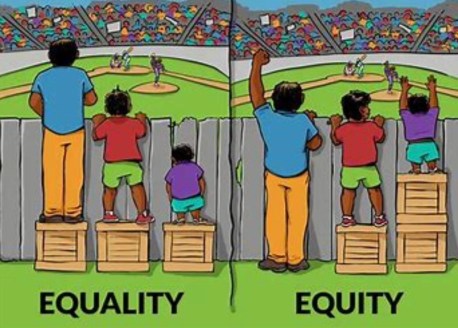
While point 3 is true, point 1 and 2 may not be the case. In point 1, many people in my study expressed that they treat all people the same which is probably true, but does that mean the people they care for receive equitable care or equal chance of access? Review this famous picture which makes it abundantly clear that we must do different things to achieve the same outcome.
There are myriad psychosocial factors that are unique to LGBTQIA+ people with diabetes, e.g. homophobia in sport, eating disorders such as binge eating disorder found to be at higher rates in gay men and stress (including depression and anxiety) and stress related behaviour (smoking, drugs e.g. amyl nitrate effecting eye health, alcohol).

Likewise support structures among gay men are generally quite different. For straight people their family will often be there to support them when required (e.g. taking them to an appointment, motivating them to take medicines and monitor or seek help and assisting them in an emergency.) For LGBTQAI+ seeking support can be problematic as they may be estranged from their family to varying degrees; provision by religious groups are absent for many gay men; and they may disengage from the gay community if they don’t meet image ideals that can exist.

Loneliness and isolation is a problem in the LGBTQIA+ community. In point 2, the belief that the discussion of ‘gay’ is synonymous with a discussion of sex, is quite pervasive but only represents one aspect of a person’s life. This obsession with sex of gay men has been represented in a multiplicity of discourses, from different powerful institutions in society throughout history like law, religion and medicine, that have directed that conversation, including endocrinology.

A German doctor by the name of Eugen Steinach in the speciality of endocrinology performed orchidectomies on gay males in the 1920s and transplanted them with those of straight males, in the belief that homosexual tendencies were rooted in the testicles. Various barbaric gay conversion practices were carried out up until recently; while time-lines are unclear due to wide spread secrecy, we know homosexuality was removed as a mental illness in 1992 in the WHO ICD classification system.

However, 28 years on, the legacy effect of this cruel regime remains ever present in medicine as reported by various Australian studies and case reports of homophobia.  There is a paucity of education within healthcare on matters of LGBQIA+ people and this is in part leading to ongoing ignorance.

In addition to this specialisation within medicine has meant that those who are well informed on LGBTQIA+ issues are usually far removed from mainstream medicine e.g. sexual health and mental health clinics, meaning possibilities for mentoring by colleagues and upskilling is reduced.

Again, LGBTQIA+ remain invisible as we don’t tend to record this information due to sensitivities around this topic. Generally, we use labels to denote difference but leave them out if they are part of the ‘norm’. This is problematic as the so-called norm is that which other things are compared to, while those labelled are counted as second to the norm – but at least they are counted.  However even more frightful are those that don’t receive the reward of that label – they are the invisible.

To put it in religious terms we could refer to this last group as the dammed. Therefore, it is those of the ‘norm’ that get to decide who gets counted and who do not. For example, we talk about women in cricket, why? to denote they exist and are unique as compared to the norm which are men. However, what would it mean if we didn’t label women in cricket? Would it render them invisible and we didn’t get to see their contribution? We don’t say men in cricket.

It is common to talk about men in nursing to denote they bring a difference to nursing, normally a female dominated profession. Of course, these labels are artificial but speak to power of words in healthcare and why LANGUAGE MATTERS.

Sexual orientation labels are however judiciously applied in medicine as there is a lot of anxiety around this. Anxiety arises from HCP who fear causing offence and LGBQIA+ people themselves who fear discrimination by HCP. Anxiety is often attributed to the sexual factors and as such attempt to adjust this medical gaze must be challenged and adjusted to above the waist to encapsulate the entire person because maybe only then, the laser sharp focus on sex and the judgment that goes with this may start to dissipate? It doesn’t mean we forget sex but that this only becomes part of the whole. This is important, as both the sexual practices and the non-sexual practices of people contribute to health in diabetes.

Sexual health education in diabetes for all people e.g. male, female, LGBTQIA+ and HIV is presently only rudimentary and for some non-existent. Our sensitivities in this are harming people with diabetes.

Straight people are spared the need to come out with a label as this is the norm. They have the freedom to flow casually into and out of conversations which encapsulate topics such as relationships and sex, which gay men must first censor or even disguise if it means coming out, if they want an answer to their question.

While the topics such as erectile dysfunction may be similar between gay and straight men, the psychosocial context of these are different which HCP must be attuned to if they are to develop a therapeutic relationship, but are they? While it is clear that there are some homophobic HCPs out there, for the most it’s a lack of awareness and nervousness about how to navigate this field.

Although it’s unclear why, in my study, gay men with type 2 diabetes attended allied health services 50% less than the general population in Australia e.g. diabetes educators, dieticians and endocrinologist. In addition to this those who didn’t attend, displayed an increase in complications and a trend towards glucose levels outside the range. This highlights 2 things here, one is that multidisciplinary care works and secondly that gay men disengage from these services that can help.  Allied health needs to explore ways to better engage LGBTQIA+ people through education and further research.

My packing-for-travel routine is pretty relaxed. We left for New York at 8am on Boxing Day and I started packing when we got home from our five millionth family gathering at about 10pm on Xmas night.

Admittedly, my laid back attitude to diabetes-supplies packing could be because I usually spend my time travelling surrounded by other PWD who are far better organised than I could ever hope to be. I know that if I run out of insulin, pack the wrong glucose strips for the meter I’m carrying or forget a charging cable, someone will be able to help me out. (I know this because these things have all happened. More than once. Way more than once.)

Anyway, I thought that I had done a pretty damn good job of throwing everything I needed together for New York, with back up supplies and contingencies. As we headed to the airport bright and early, still full of my mother’s Xmas zippoli, I felt comfortable that diabetes was going to be a relatively easy companion on this trip.

Turned out that I got it mostly right. Just not completely!

Issue one happened when I got a transmitter low battery warning the first week we were in NY. ‘Bugger,’ I thought, remembering back to the last time I recharged my Fenix G5 transmitter*. It was while I was sitting at breakfast one morning in Boston at ISPAD. I recalled that I definitely hadn’t had the transmitter plugged in long enough for a full charge. At the time, I thought I’d charge it fully the next time I did a sensor change…and then promptly forgot.

Of course, I had forgotten to pack the very specific charger required to recharge my Fenix. And I couldn’t for the life of me remember what it was called. ‘It has two little magnetic-y things on the side. And it’s kind of shaped like this,’ I said sketching a rough picture to the people behind the counter in about fifteen electrical stores around the city.

After getting nothing more than blank stares, I went directly to the source – Facebook – and sent a message to a couple of tech friends back home (including the bloke responsible for building the device). I had a response minutes later, placed an Amazon Prime order straight away and two days later my Fenix was charging on the kitchen counter in our apartment.

I had a re-batteried travel transmitter with me that I used in the interim (with layer upon layer upon layer of waterproof tape over the top of it because I had also forgotten to pack the resin needed to finish off that little device…),  but as soon as the Fenix was fully charged, I reset it and shoved it back into the still in situ sensor. Crisis mostly averted.

And then there was the run in with Dex sensors. I’d sited a new sensor a day or two before we left and took two spares with me. I usually get three weeks out of a sensor, so thought that if lucky I wouldn’t even need to change one at all during our time away. But if I did, I would be right and have another there … and a spare just in case.

Well, best laid plans and all… the original sensor failed after less than a week. The second sensor did too, and the third sensor was actually faulty – the needle scarily poking out the end as I released it all from the packaging.

I believe the word I used at that point was ‘Fuck’. Loudly. And then turned straight back to Facebook with this:

A few NY friends reached out and shared the post, and within an hour, I had organised to meet up with someone who could help me out. Thanks a million to Stacey for connecting us, and thanks two million to Caroline who rode into Manhattan with her ridiculously beautiful baby to drop off sensors to me and have a coffee. (Off topic, but Caroline and I thought this was our first-time meeting, but we realised later that we had met for dinner one night in New York back in 2011!)

I am forever grateful for the support I receive from my peers online – and being my back up plan because I am so crap at diabetes. I do promise to try to do better when getting myself organised for travel, but I know that I am still likely to get things wrong. Diabetes is a hard task master and demands a lot. Slip ups happen.

But there is always help at hand. I was off Twitter at the time, feeling particularly vulnerable after the brutal time on there at the end of the year. Thankfully I had Facebook to turn to and a huge group of diabetes friends there to help me out. But what if that wasn’t the case? This is why our online spaces must be safe at all times, and why that power imbalance between HCPs and PWD, and how potentially harmful that can be, needs to be recognised. We need to feel safe reaching out wherever our peers are for whatever support we need. I did that and that’s why this blogpost is called ‘Peer support on the road’ rather than ‘Loopless in New York’!

Back to the important things.

* I use a rechargeable G5 transmitter with my Dexcom, built by a very clever bloke in Australia.

I wrote a post a while ago called ‘You Do You’, (and revisited and expanded on it here). It’s where I wrote about how everyone should have the freedom to do diabetes whichever way they see fit. I’m pro-choice in all aspects of life*, especially when it comes to PWD choosing their own management tools.

And I think that people with diabetes should have the choice to BE the people we need to be. And the people we are. I touched on this on my post on Monday when I spoke about how I felt intimidated online because my opinions and thoughts, and the way I addressed issues, were not everyone’s cup of tea. I felt that I was being called out for being myself. And that wasn’t okay.

No two people with diabetes are the same; no two people with diabetes will have precisely the same management ideas and preferences, and no two people with diabetes will react and respond to situations in exactly the same way.

THAT IS OKAY.

Diabetes is messy, frustrating, weird, annoying, amusing (rarely, but sometimes), scary, boring and a whole lot of other adjectives. And how we react and respond to it is our own business and no one else’s. You BE you, because you have the right to do that.

You have the right to be as loud or as quiet as you want.

You have the right to be as bitter and angry as you need to be in the moment.

You have the right to celebrate and be joyful about your diabetes.

You have the right to call out things that upset you just as much as you have the right to commend the things that make you satisfied.

You have the right to step away from groups, situations, people who upset you.

You have the right to disagree with others. Having an opposing view does not mean that you are attacking another person.

You have the right to have an opinion on what you see in the world of diabetes – even if it is happening on the other side of the world. I was incredulous when it was suggested that I shouldn’t question something happening in a healthcare system of which we are not a part. (I may not use the healthcare system in the US or the UK or Italy or anywhere other than Australia, but I am allowed to comment on what I see being done in those places.)

You have the right to be passionate and not be told that is a character flaw.

You have the right to be emotional because diabetes is real in a way that only makes sense to those of us who are living with it or have a loved one living with it. I don’t know how to take the emotion out of this, so you bet I will be emotional at times. I don’t get to clock off at the end of the work day and not think about it.

You have the right to use the words and language that works for you when talking about your own diabetes and if anyone tells you that #LanguageMatters is actually preventing PWD from doing that, tell them to fuck right off. It’s not. It never was. It never will be, and anyone who says it is has missed the point of the whole movement.

You have the right to use the word ‘fuck’ or whatever else you want to use. Profanity helps some people and we shouldn’t be told to wash out our mouths if others don’t like us using those words. (Sorry, dad.)

You have the right to be the sort of advocate you want to be. Or to not be an advocate.

You have the right to share your experiences – even the ones that don’t shine a particularly positive light on health systems or HCPs. No one – NO ONE – should silence us when we turn to our peers to seek support, or talk about what is going on in our diabetes lives.

You have the freedom to talk about your own diabetes, especially in the diabetes online community which we created for this very reason – to be able to share our experiences, learn from each other, support our peers and build each other up.

So, this? This is me being me. This is me standing up and not going quietly. This is me saying that I will be the person with diabetes I need to be, because it’s the only way I can be true to myself and true to my community.

*Except vaccinations. I don’t believe in choice there.

When the diabetes community comes together, great things happen. And one of the greatest things I’ve ever seen has been Spare A Rose, Save a Child.

Most people now know the origin story of this annual campaign. The short version is that back in 2013, a group of US diabetes advocates came together to do something for the global diabetes community. Using Valentine’s Day to signpost the campaign, the idea was simple: ‘spare’ one rose on Valentine’s Day and donate the saving to Spare A Rose, Save a Child. That one rose saving was enough to provide a month’s insulin to a child in an under-resourced country. All funds raised would go directly to the charity Life for a Child.

It’s really important to understand where Spare A Rose started, and the community aspect of the campaign. This didn’t happen for any other reason than a group of people directly affected by diabetes wanting to help others who needed it: for the community; by the community. No one took credit, no one was the face of Spare a Rose, no one raved about their involvement or contribution. It was about the whole community.

That’s where you step in. Because Spare a Rose is a community campaigned, owned by everyone who has anything to do with diabetes, anyone and everyone can get involved. And there are lots of ways you can do that.

Obviously, you can donate. (Please donate!) That’s the first and most important call to action here! And it’s easy – as easy as 1 – 2 – 3!


But also, we need to get this outside the echo chamber of the DOC.

Change your twitter and Facebook profile pics to highlight Spare A Rose and tell people why you’ve done it – and encourage them to as well. (Twibbon has a super easy way to do that here.)

The Spare A Rose site has lots of different images and messages you can share. Of course, use your social media reach, but also print some out and leave them around your office or local café.

Share, share, share! Amplifying anything and everything you see about Spare a Rose helps get the message out.  I make no apologies that my SoMe feeds will be seen as if through rose coloured glasses for the next six or so weeks. Roses are lovely. Spare roses save lives.

Last year was the campaign’s most successful ever, raising a total of USD$56,340 / AUD$79,447 (or 12 months of insulin and education for 939 young people with diabetes). We have a target this year that I’m afraid to say out loud, because it is so audacious, but if there is one thing our diabetes community does, it is come together for those who need it.

So, please, #SpareARose (or two, or a dozen) and save a child. Seems like an awfully good way to start the year.

So, this is 2020? How are you going? I returned from overseas to a country literally burning and choked in smoke; a government that is refusing to accept that climate change is real; and a news organisation making up the narrative to suit themselves (arsonists are everywhere, apparently).

Bet you didn’t expect me to get so political before midday on a Monday!

Today is my first day back at work after three weeks of holidays in New York with my family. We spent the time basically relocating our Melbourne life to New York: finding a favourite café that served decent coffee, drinking great quantities of said coffee, wandering the streets, playing with (other people’s) dogs, warming up in bookstores and catching up with friends. It was the perfect way to farewell 2019 and welcome 2020.

As I have mentioned a million times before, I don’t do resolutions. You may not know this, but I live with diabetes, and that in itself gives me enough reasons to not reach goals and targets. I don’t need to add another list of things of which to fall short.

For the last three years, I’ve chosen a word that I’ve hoped would oversee and direct my way of thinking and acting for the year. As it turns out, that was a load of rubbish. Because each time, as I searched for the word that I wanted to guide me, the one I settled on went against the very grain of who I am.

The words were pause, focus and reset – and behind them was the idea that I would respond in ways that were really out of character; words that would silence or calm my natural responses.

But that’s not me. I walk towards things (usually at pace), I’m impulsive, I’m reactive. Sure, these may not necessarily be the best traits for a mindful, calm existence, and they can be exhausting, but welcome to my life: Hi, I’m Renza.

This year, I’m ditching the word idea, and using a phrase that better suits me, and that phrase is Stand Up.

We are living in a world that does not need people to be silent. Manners are all very important, but it is very possible to have manners and be polite, but still challenge things that we see as not right. We don’t need to be told how to think, how to feel, how to respond to something that upsets us. We don’t need to tone police ourselves – or others. We don’t need to accept what we are given.

And in the diabetes space, we don’t need people to be meek and mild. We need people who are disrupters and who speak their minds and who call out the bullshit. We definitely need to make sure that the voice of PWD is the loudest in the room, and that anyone who tries, even for a second on any platform, to tell us to pipe down is called out for it.

We do not need people to go quietly, and I am somewhat horrified that I did just that at the end of last year when I was feeling intimidated and vulnerable online. If I’m honest, I don’t recognise the person who switched her Twitter to private and wrote this thread to explain it to the people who were asking why.

Being angry is okay because there is a lot to get angry about in diabetes care. Not standing up means that we accept the situation for how it is. We can do it in a way that is nice and friendly, but sometimes it takes more than that. And that is okay.

I have never cared about being popular in the DOC or being considered one of the cool kids. I have never worried about follower numbers. I searched for this community because I needed support and I needed to feel part of something amongst people who were just life me. Other people with diabetes.

When I re-read my twitter thread from before Xmas, my heart broke NOT at what had happened; but at how I felt that the only way for me to stop feeling so unsafe was to turn away from the community – MY community. It was this tweet that set my tears running again:

I thought that if I had wandered into the DOC for the first time instead of the welcoming place it was, I saw PWD being challenged, I would have run away. THAT was what broke my heart – the very idea that I would not have discovered people like Kerri, Georgie, Cherise, Melissa, Mike, Dana, Grumps, David, Manny, Jeff, Mel, Frank, Alanna, Kelly, Ashleigh, Scott, Annie, Alecia, Bastian, Daniela and so, so many others. I don’t know how I would have navigated the murky waters of life with diabetes without those people: MY people for whom diabetes actually invades our DNA and the DNA of our loved ones. People there for the right reasons – not for the accolades, not for increasing follower counts. They are community-minded, open to opposing ideas and thoughts, and don’t consider themselves superheroes.

If I had have gone quietly, I would never have learnt from them; never had the support of people who understand; never had people like that at my back when I do stand up.

So, I don’t go quietly ever again. I stand up as I always have. I accept that doing that will send me into periods of advocacy burnout; I’ll deal with that when it happens, surrounded my friends and peers who get it.

So yes, this is 2020. I’m back. It’s really nice to see you here.

Each year, as we stop, look back and take stock, the reason that we are feeling so tired becomes apparent. This year is no different for me; my work travel calendar was the most intense it has ever been, with nine long haul trips, some for only a day or two. Combined with regular domestic travel, I can truly say that I have seen the inside of airports far too much. I stopped adding up the trips I did once I passed 100 walks down airbridges to board planes because it was making me weepy.

But on top of the usual exhaustion this year, there seems to be an extra element of fatigue that goes beyond what I’ve experienced before.

But first, let’s talk highlights, because there have been many of them.

The year kicked off with Spare A Rose and whoa, did we start the year with a bang! With the true philosophy of SaR at the forefront (an initiative for the community, by the community), we not only reached our rather audacious target, we smashed it! A cheeky and opportunistic little extra push saw a smiling Grumpy Pumper unleashed to the whole world for just a moment The DOC didn’t break, but the final tally of for the campaign meant that 939 kids in under-resourced countries would be receiving insulin for a year. Amazing!

My favourite issue, #LanguageMatters, only went from strength to strength, and the publication of this piece in BMJ, followed by this podcast, was a brilliant way  to get it outside of the diabetes echo chamber. The importance of language featured on the programs of major conferences such as ADA and #IDF2019 with stellar panels speaking about why it really does matter.

My diabetes turned 21 and tied up in all the emotion of that, my pancreas’ performance review didn’t go all that well. Maybe next year? (Unlikely.)

Possibly the most exciting, heart-warming, rewarding and humbling thing I did this year was co-facilitate a workshop in Manila with some of the most dynamic, compassionate and enthusiastic young diabetes advocates I have ever met. I’m thrilled have had a chance to catch up with a couple of the people from this meeting and can see the wonderful work they are doing in more than trying circumstances.

Peer support was never far away. One of my favourite digital campaigns came from Diabetes Australia (remember – I work there so consider my bias) with our The Lowdown campaign. What a brilliant way to showcase how a digital campaign can reach and connect people from all over the world, and encourage them to safely speak about a topic that doesn’t seem to get anywhere enough coverage. I spoke about the campaign’s success in a number of places this year.

My own personal peer support experiences happened all around the globe at conferences, advisory board meetings and other opportunities to see friends and colleagues with diabetes. These moments ground me and help me make sense of what I am seeing and hearing, and are critical for keeping me balanced.

A special shout out to these two peers and dear, dear friends: Bastian and Grumps. We saw each other an inordinate number of times this year, literally all over the globe, travelling on planes, trains and automobiles for our #DiabetesOnTour. I do think we should launch a calendar of the 2020 pics. (Admittedly, we may be the only ones remotely interested in that idea.) When I talk about my diabetes tribe, it’s friends like these two. We’ve celebrated through some pretty amazing things this year, stood up to elevate the lived experience over and over, and also counselled each other through the tough bits. We’ve held post-mortems of long days, sitting in hotel foyers and bars, trying to make sense of what has happened, working out how to always improve, and plotting and planning more and more and more. I am so grateful to them for being the scaffolding holding me up when I’m away from home and feeling overwhelmed.

So, now the reason for that elevated exhaustion…

When I first wrote about advocacy burnout back in January this year, I had no idea at the time that it would set the scene for a difficult and sometimes troubling theme for the year. I get tired and overcome at times throughout the year, but 2019 was different and I’m not really sure why.

There were moments this year where I did honestly wonder how much more energy I have to stand up over and over again to a lot of what I was seeing. I don’t like using war and battle analogies in diabetes, but I did feel that I was fighting a lot of the time. Diabetes advocacy is a tough gig to begin with. Adding burnout on top of it makes it seem shattering.

Being attacked by HCPs for daring to voice my thoughts and challenge their behaviour, or getting it from certain, more confrontational parts of the diabetes community, or having industry reps tell me I don’t know what I’m talking about for daring to suggest that maybe their lame attempts to simulate diabetes in gameshow-style gimmicks at conferences could be better directed at actually engaging and listening to PWD all added up.

Or perhaps it was the repeated examples of ‘diabetes for laughs’…and realising that we are a long way away from HCPs truly being allies in our daily encounters with stigma.

Or perhaps it was feeling that we needed to justify just how important the #LanguageMatters movement, and the decade of work we’ve done really is. I can’t even begin to tell you how upsetting this little incident was.

It added up and several times I’ve felt overcome. I feel like that today. Which is disappointing because on measure, the highlights, the positives and the amazing community should overshadow the negative encounters.

And that is why I’m taking a break from Diabetogenic. I need some time away from feeling as though I want to analyse what is going on and comment on it. I have a wonderful holiday planned with my gorgeous family where we will see friends and wander wintery streets, rugged up in pompom hats. And then, will warm up once back in Australia to finish recharging my seriously diminished batteries, ready for a new year that’s already shaping up to be so, so busy.

Until then, I hope you have a wonderful holiday season, celebrating however you see fit. Thanks for popping by. And I’ll see you in 2020, clapping my hands and raring to go!

Follow Diabetogenic on WordPress.com

Enter your email address to follow this blog and receive notifications of new posts by email.

Read about Renza

Archives