There’s a social media…thing…at the moment: Yes…but*. It’s designed to show the contrast between the glitz and glamour of perfectly curated socials feeds for the reality of life.
In fact, these days, diabetes to me is more ‘Yes…and?’.
I’m exhausted thanks to the relentlessness of diabetes? Yes…and? Of course that’s the case. Diabetes demands so much of us.
I’m over the daily grind of diabetes? Yes…and? What else is to be expected? Diabetes bores the shit out of me.
I’m burnt out thanks to diabetes? Yes…and? Who isn’t? In fact, tell me you’re not burnt out at least some of the time and I want you to speak to me as though I’m five years old and teach me your ways.
I ripped out a sensor on my arm because I walked into a doorframe? Yes…and? I still have no spatial awareness of my body. Or doorframes.
Someone said something stigmatising about diabetes? Yes…and? People are idiots and don’t understand diabetes. (Although I probably will call that rubbish out because people don’t get a free pass to be stigmatising arses.)
Diabetes technology is in equal measure brilliant and imperfect? Yes…and? Two things can be true at the same time.
Some bloke (who doesn’t actually live with diabetes) is being an arsehole to a woman with diabetes who is highly respected and trusted in our community? Yes…and? Bullies in the community have existed forever, and will forever, and misogyny online is sadly alive and well.
I had three hypos before lunch? Yes…and? Sometimes diabetes just chooses violence.
I nailed my time in range yesterday and today it’s rubbish? Yes…and? Yesterday’s diabetes has never accurately predicted today’s diabetes.
A healthcare professional referred to me as ‘non-compliant’? Yes…and? People continue to confuse judgement for healthcare.
Another miracle cure has appeared in my inbox? Yes…and? Scammers gonna scam.
A diabetes organisation says people with diabetes are at the centre of all they do? Yes…and? Until I see evidence of PWD actually having an ability to influence, holding leadership positions in the organisation and being genuine partners and not props, it’s just tokenism wrapped up in a catchy slogan.
I have diabetes, and I’m kicking goals today? Yes…and? Those things have never been mutually exclusive.
I have diabetes, and I’m struggling today? Yes…and? Those things aren’t mutually exclusive either.
Social media has finally caught on that life isn’t all shiny and perfect? Yes…and? Welcome to diabetes. We’ve kinda known that forever.
*Of course, nothing is really new. Artist Anton Gudim has been creating ‘Yes, but’ cartoons for years now, with far more finesse and creativity than any content creator jumping on the bandwagon.
I’ve started this post a dozen times over the last ten days as I’ve tried to put together a personal reflection on the life of my friend Bastian Hauck. If you’re in the #dedoc° or broader diabetes community, you will undoubtedly have seen some truly beautiful messages and tributes. What more can I say that hasn’t already been said?
What I really want to write about is my friendship with Bastian in all its glory, which to be honest wasn’t always glorious. He referred to me as his sparring partner because I was the one who challenged him and pushed him to think in different ways. I was the one who asked him to stop and take a beat before making a decision. I was the one who told him when I thought he was out of line. I was the one who asked him to listen and try to see others’ perspectives.
When we’d speak, regardless of who called, the first thing I’d hear from him was a question. ‘Renza?’ he’d say. I don’t know who else he was expecting, but the inflection in his voice rose. Making sure I could hear him. ‘I’m here,’ I’d say. And we’d talk.
Our ‘quick chat?’ messages that preceded calls were lies. It became a habit to send each other a message as soon as we eventually hung up with the minute count of our call. ‘58 minutes!’ I’d write. ‘Why can’t we have quick calls?’ ‘Let’s not change that,’ he once replied.
Bastian was one of my closest friends. Despite living on opposite sides of the world, I spoke to him more than any of my friends nearby. Thanks to crazy travel schedules, we’d see each other four or five times a year. But it was in between those in-person catch ups that we’d spend hours talking about #dedoc°. I can’t count the number of times we’d talk each other of ledges after some particularly annoying incident. He’d explode over an encounter with someone and want to start an all out war with them. ‘Don’t give it air, Bastian,’ I’d urge him. He’d rant and rage and tell me in detail what he intended to do to make the situation right and confront them. I’d ask if it were really worth the effort. Eventually, he’d calm down. Just in time for me to blow up at the nastiness of online interactions, and then it would be my turn to rant and rave. And he’d tell me not to worry about them and remind me of my advice to him: ‘Don’t give them air’.
One of the last messages I sent him asked ‘How have we managed to do this for so long and just get things done?’ What I didn’t add was: ‘How do I keep getting things done now?’
A year after he met, he came to Melbourne for the 2013 IDF Congress, and had dinner at our home with a group of global advocates. He spoke frequently about that dinner, mostly because the following day he was taken to the outer suburbs of Melbourne to see kangaroos. Monique Hanley, if you’re reading this, you were a hero to him for organising that trip!
That was one of the things about Bastian. He held on to those sorts of memories and shared them over and over. Kangaroos? Just jumping around the place? And he got to see them? Amazing! I can’t tell you the number of times I heard him say ‘And the next day after dinner at your house that wonderful woman Monique took us to see Kangaroos’. ‘I know, Bastian’, I’d say. ‘I was at the dinner. At my house. I introduced you.’
Our stories in the diabetes world have been so intertwined. This week people keep sending me photos of us on stage at different conferences, the #dedoc° logo behind us. ‘Bastian, make sure the #dedoc° branding is there. Bright. We want people to know it’s #dedoc°,’ I’d say. ‘We want people to hear the stories, Renza,’ he’d reply. ‘Yes…but also that #dedoc° made that possible’. My comms hat is never far from planted firmly on my head. It annoyed the crap out of him. I didn’t care.
And people have sent me videos and recordings of interviews and podcasts we did together. I snapped those shut before they started. Because how is it possible that Bastian’s voice – that voice I’d hear three or four times every week at the end of the phone – is now only there in old recordings?
I regret every time I told Bastian to talk less. ‘You don’t need to go over that again,’ I’d say as we were prepping for a #dedoc° symposium at one conference or another. ‘Get off the stage and let the speakers speak!’ But he just wanted to yell from the rooftops about the #dedoc° community and how far we’d come. And the allies who helped us there. And mostly the incredibly #dedoc° voices who were family. He couldn’t stop talking about it!
We’d do EASD TV each year and when we finished our interview he’d always ask me ‘How do you do that soundbite thing?’, referring to the succinct way I’d answer a question, with grabs that I knew would make it to the promo for the video. I’d laugh and tell him, ‘By saying as few words as possible, but making those words count. Fewer words, Bastian.Say less!’ Now I wish I’d let him ramble on and on.
The last time I saw Bastian was in Vienna last year at EASD. It was not an easy conference. We were managing a difficult situation at #dedoc°. He and I disagreed on how to deal with it, and I returned home feeling frustrated, angry and exhausted. ‘Renza, you need to step back from this one,’ he said. I knew he needed to feel in control of something – anything – at a time when so much of what was going on in his life was big and scary and way beyond his control.
And so I did. I stepped back. And there were a couple of months where when spoke and sent messages there was, undeniably, a discomfort in our words. It didn’t last long. He recognised the tension. He apologised, I did too. I think we both knew that we couldn’t waste time being wary around each other. There was too much to do. There was not going to be enough time. We were trying to steer #dedoc° to safe waters.
And there’s a sailing analogy, because there always are in conversations with Bastian. He wound in the fact that he was a sailor into every conversation he could. ‘When I was on the big boat last summer in Copenhagen…’ he would begin. And I’d try not to laugh because it wasn’t enough for him to mention he had a boat. He had to mention that he had a big boat, suggesting (rightly) the existence of a small boat. God forbid he said it out loud at a conference or in a room with our beautiful friend Amin. He and I would glance at each other, or send a message, desperately trying to not laugh. Amin…one of Bastian’s closest friends. My heart breaks for him too right now.
It was the weekend before last that I spoke with Bastian for the last time. ‘It will be a quick conversation.’ I was told by his friend who was organising the call. ‘I understand,’ I said, thinking that perhaps we would actually have a short call. Maybe now was the time we changed things.
But Bastian had things he needed to say to make sure I understood what he wanted for #dedoc°. ‘Bastian,’ I interrupted. ‘You’ve done enough’. ‘Shut up, Renza,’ he pushed back. Now’s not the time to tell him to watch himself, I thought, so I listened. I listened to his voice and his words and took notes, interjecting only to promise to follow up.
And then it was time. ‘I’m sorry I didn’t come to see you,’ I said. He said he was too. I know he really wanted us to say goodbye in person. I couldn’t make it work. And I think that, selfishly, I didn’t know that I could face everything.
Instead, just as we had done countless times before, we said goodbye to each other on a phone call. ‘Thank you for everything’. I said. Or did he say that? Perhaps we both did.
And then I sat there, looking at the timer on my phone. Forty minutes. Our quick call, on the day he died, went for 40 minutes. I smiled through my tears. I guess we didn’t change it after all.
There’s an urge we have when someone we know dies. We desperately try to hold onto our connection to them. In a world of social media, we want to show the world that connection – how we knew the person. How we met them. How we existed within their orbit.
Bastian’s orbit encompassed so many people. How lucky we all are to have known him.
But his passing isn’t about us. No matter how many photos we have with him.
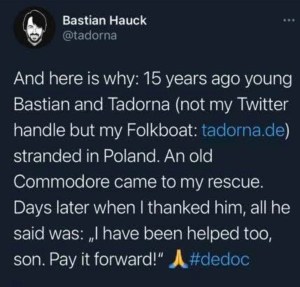
Bastian’s favourite saying was #PayItForward. It was one of the core principles upon which he built #dedoc°. It is why #dedoc° has always been a platform upon which others stand and shine. Bastian never wanted #dedoc° to be about him, or for #dedoc° to be the story. It was always about elevating others with diabetes. Making sure the platform was sturdy enough to hold as many as possible. That was how he wanted to #PayItForward.
This is the story of where that saying came from, in Bastian’s own words from a very old tweet.
Perhaps the best way to honour Bastian is to remember these words and look to how we can support others, just as he did for so many. And take a back seat while doing so.
Go well, my dear friend. Thank you for showing up.
Recurring themes in diabetes recur for a reason: they impact people with diabetes. And stigma is one theme that you will hear people with diabetes speak about a lot. A. Lot.
Last week at the World Health Assembly in Geneva, there was much discussion about stigma – both within the diabetes and in other health condition spaces.
Stigma harms everyone. It goes without saying that there is no good form of stigma.
When speaking with people from other health organisations, it was interesting to learn that many see diabetes stakeholders as being leaders in addressing stigma.
There was a lot of interest in how we had come as far as we have. I shared what I knew and what I’ve been involved in and there was awe at the number of different activities that have involved so many stakeholders.
I agree that we are making strides in addressing diabetes-related stigma. But I’m afraid I wasn’t quite as enthusiastic as the people I spoke to who seemed to think that we had it all sorted. That’s sadly not the case. Every single week I hear from people with diabetes about the stigma they are experiencing, and the discrimination they have to deal with because of diabetes.
Last week, I found myself cringing at the airport when a security guard mentioned that perhaps if my diabetes was better managed I could stop using the devices attached to my body. He knew, you see. His niece has diabetes and she doesn’t need one of those machines.
I was too tired after hours of travel to do anything more than roll my eyes and say ‘That’s not how diabetes works’, and suggest that he doesn’t offer strangers unsolicited advice. I wondered if he had the same level of comfort telling someone wearing a pacemaker what to do to better manage their heart condition. Probably not.
And I snapped a sassy response on the Instagram page of one of my favourite bakers when someone suggested that dipping rhubarb in sugar was a one way ticket to diabetes. As if that’s all there is to this highly complex condition.
I’m tired and yet the stigma I deal with seems quite superficial when compared with that of many of my diabetes brothers and sisters living in other parts of the globe.
Diabetes stigma is real. It is harmful. It needs to end. And we all have a role to play in getting us to that end. I say that knowing that sometimes it’s too exhausting to do anything – and that’s perfectly okay. The full time job of managing diabetes is more than enough. Busting stigma shouldn’t also be on our to do list.
But if you have time, if you have the energy, if you have the will, there are some easy things you can do.
Sign the pledge to end diabetes stigma. You probably already have, especially if you’ve been hanging around here for a while. So perhaps, you could spend five minutes sharing the link to the pledge, or finding someone you know hasn’t signed it, and asking them to. It takes under a minute.
If you’re doing any sort of diabetes advocacy about stigma, circulate the International Consensus Statement to End Diabetes Stigma. Evidence matters, and this document brings together 51 experts across 18 countries. It was published in the Lancet and it is an excellent foundation for any work in the stigma space.
And if you want to see a video of joy, watch the one linked below. This is a compilation of what happened at the Summit to End Diabetes Stigma held in Jaipur in March this year. I assure you that amongst the colour and vibrancy you see in the video, there were difficult discussions, impactful panel sessions and plans for how to make real change.
My new friends from last week were impressed with what’s been done in the diabetes space, and I agree – the community has done so much already. But we’re not done. There’s a lot more to do. We’ve come this far because dedicated people have worked collaboratively. Community members have shown up to share their experiences. I’m so pleased to be part of these efforts. And will keep rolling up my sleeves as we address what still needs to be done.
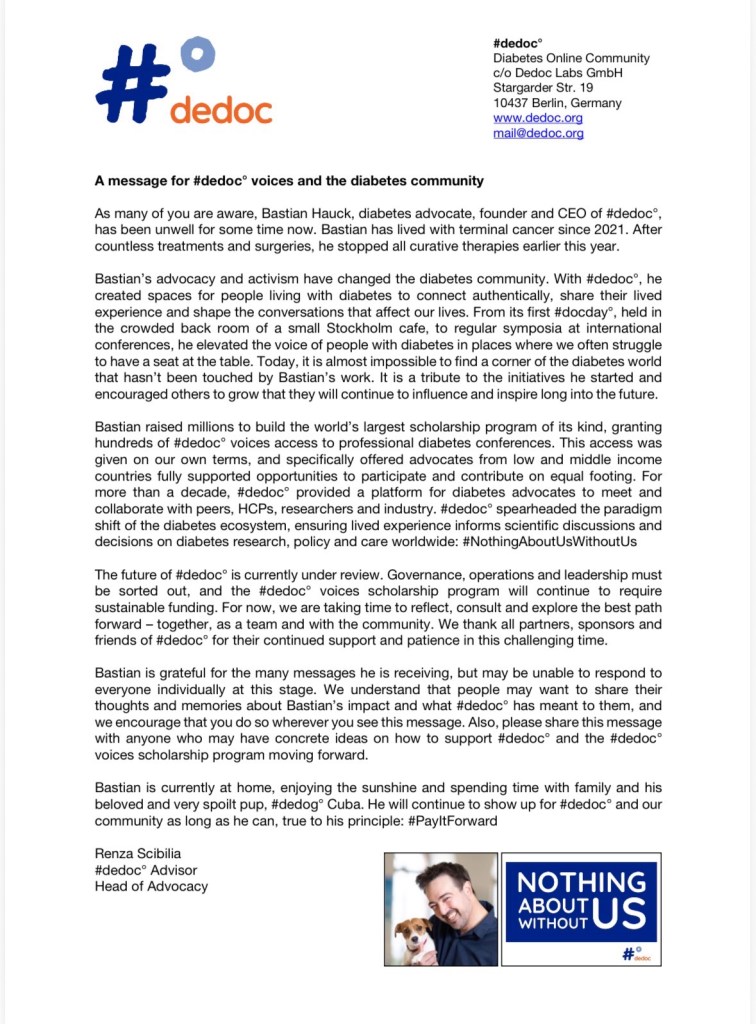
This post is full of those words, as is the announcement you can read in full below. I wrote those words over the weekend with such sadness and the heaviest of hearts.
There are few people in the diabetes community who don’t know the name Bastian Hauck. I’ve known Bastian for almost fourteen years now. We met at a European Bloggers Summit, hosted by J&J who, at the time, was the distributors of the Animas Insulin Pump. I don’t know why I was invited, but I am forever grateful I was there, because I met some of the most important people in my diabetes world at that meeting in Berlin.
Bastian was one of those people. He spoke about his adventures sailing around the world in a (small) boat. Not remotely relatable to me, but nonetheless, we became friends and since then, we have worked together in the diabetes advocacy space. The weekly #dedoc° tweetchat premiered the same week as the weekly #OzDOC tweetchats. (Remember those days?)
When Bastian started thinking about a program to bring people with a diabetes to diabetes professional conferences, he spoke with me about it at length. Any time we found ourselves in the same place, he’d share his thoughts and from there we tried to shape what would become the #dedoc° voices scholarship program. That program was launched in 2020, and since then, hundreds of people with a diabetes have been the recipients of a scholarship. The program is so precious and important, and it all happened because Bastian had an idea and didn’t stop working until he made it happen.
Bastian and I haven’t always agreed on things. In fact, there have been many occasions where we have come from polar opposite sides of an argument. In my role as an advisor to #dedoc°, I provide my advice, and he then does what he wants. Sometimes his decision ends up being fine, other times, he has realised that his decision was, perhaps, not the right one. I am pleased to say that I have screenshots of messages from him and videos of him saying. ‘Renza was right’. Damn, straight she was! (I write this knowing he is reading this and laughing/grimacing.)
Bastian’s big picture thinking will be his legacy. I’ve just used a word that he doesn’t like and has forbidden the #dedoc° team from using. But on this space, he doesn’t get to tone police my words. His refusal to stop until community is centred and valued is the reason that organisations such as ATTD, EASD and ISPAD now have dedicated roles for people with lived experience of diabetes. It’s the reason that so much global advocacy has happened the way it has – because the #dedoc° scholarship program provided opportunities for people to come together and build their ideas. This is, indeed, a legacy, and one of which I hope he is incredibly proud.
For the last few years, Bastian has been living with terminal cancer. During this time, I’ve listened to him share his experiences, his frustrations, details of his treatments, the positive moments. And, heartbreakingly, the moments where the news he has been given is incredibly confronting. Now is one of those times.
And so, please read the below message. It is for the #dedoc° voices and the diabetes community more broadly. It has been shared across #dedoc° channels, and I would encourage everyone to leave a message, if you’d like.
Our community has been built on the actions of giants, and one of those giants is Bastian Hauck. How fortunate so many people are to have benefitted from the community he has built and the opportunities he created.
I’ve celebrated 28 years of diabetes in Rome by travelling all the way from Australia with enough insulin to last me ten days. I’m away for twenty-two days.
You see the problem.
I saw the problem when I was a quarter of the way into the long journey, changing my Pod. ‘Hmmm,’ I said when I saw the very limited insulin supply in my kit bag. ‘Not smart’. (These were not the words I actually said, but there’s no need to share the expletive-laden rant from the Qantas lounge.)
By the time I boarded, I’d sent out an SOS to three or four #dedoc° voices friends, and by the time I got to Singapore, my WhatsApp was full of kind offers of assistance, a prescription for insulin and a messages of ‘let’s meet up for coffee while you’re here. I’ll bring the insulin!’.
‘Our community is everywhere!’ I messaged Ana from Team #dedoc° after she checked in to make sure that I was okay. And it’s true. This is a real community of people who know each other and have each others’ backs. They reach out to their networks and together, the global coverage of #dedoc° friends is so very vast.
It should surprise no one that community is often the way to deal with whatever diabetes has to throw at us, or, in this case, to overcome my shortcomings. It certainly hasn’t surprised me.
A couple of weeks ago I was in Jaipur for the Summit to End Diabetes Stigma. It was the largest gathering of people with diabetes at a professional diabetes conference, facilitated and supported by #dedoc°. As I stood on the stage, looking out into the bursting conference room, I was overwhelmed by the faces of diabetes friends from the #dedoc° community. A community of dedicated advocates with only one thing in mind – to improve outcomes for people with diabetes in their communities. And I was reminded of what it is that #dedoc° offers – a platform on which others stand. No ownership; just the avenue to bring people together and centre lived experience. How lucky we are to have that. And so, it’s community I’m celebrating, along with my 28 years of diabetes. A balancing up-side in the shitshow that is diabetes.
Happy diaversary to me!
She’s looking far too relaxed for someone who packed 10 days of insulin for a 22-day trip.
You might think that a diagnosis of a new chronic health condition would be easier to navigate for someone with my understanding and knowledge of healthcare. And that with last year’s diagnosis of psoriatic arthritis (because it had been a while since I’d added a new autoimmune condition to the stable), that I would apply the same attitude that has worked with T1D.
I did do that. And it hasn’t worked. My first mistake was ignoring the very simple and basic fact that psoriatic arthritis is not type 1 diabetes. Most people probably would have realised that and not made assumptions. I am not most people.
I’ve been quite humbled by the overall experience.
I don’t have answers yet to how to manage this new(ish) condition. The pain is still persistent. The meds I was first prescribed did nothing other cause constant low-level nausea. I wouldn’t call it debilitating (the pain gets that designation at times), but it was unpleasant enough to make me feel bleurgh (technical term) a lot of the time. And to question whether drinking coffee was a good idea.
I have a limit to what I can take, and impacting my love of coffee hits that limit pretty quickly. I persevered for about six weeks with the meds and then decided that I’d had enough. The nausea wasn’t subsiding and the pain hadn’t improved at all. I had been told that it could take up to three months for the meds to impact the pain, so the fact that my hands still hurt pretty much every day wasn’t completely unexpected. I weighed up the pros and cons, and decided that I wasn’t prepared to add constant nausea and eating struggles to daily pain. And so, we went back to the drawing board.
At this point, I learnt about the rather technical little dance that needs to happen when it comes to the escalation of psoriatic arthritis drugs. From a rheumatology perspective, I have to give it three months before stepping up the ladder to the next type of medication. From a dermatology perspective, it’s only one month.
So, that meant I needed to see a dermatologist to prescribe the next drug. He announced that I had ‘failed drug 1’ and therefore would be able to try drug 2. After mentioning my failure three times, I politely interrupted and asked if we could perhaps reframe the conversation to say that the drug had failed me. I’m sure he rolled his eyes as I muttered something about language mattering, but he handed me a new prescription anyway.
But of course, it was never going to be a simple switch. My rheumatologist agreed that I’d been right to stop drug 1 due to the constant nausea. But she suggested we try an injectable version of it before stepping up to drug 2. Also, drug 2 is good for the psoriasis side of things, but less good for the arthritis side of things. ‘Keep that one in your back pocket for now,’ she said. We had a very brief discussion about the practicality of taking the injection, but we both kind of sped through that because we figured that twenty-seven years of T1D meant that injection technique and hygiene wasn’t something needing much attention.
I opened the first box of drug 1.2 on a Sunday night. In the box was one pre-filled, single dose syringe. I have never been needle-phobic, so, I wasn’t prepared for the involuntary gasp when I removed the cap from the syringe. The needle was not ‘just like an insulin sub-cut’ as I’d been reassured by the pharmacist and rheumatologist. It was significantly longer with a smaller gauge (smaller gauge = thicker needle). It looked scary. And needles do not scare me.
I sighed, pinched the skin on my leg where I could find a decent amount of fat and poke in the needle, pushing down the plunger, muttering ‘ouch’ for no good reason because it actually didn’t hurt. Appearances can be deceiving when it comes to needles.
This was all about four months ago now. Has it helped? Nope. Not at all. In fact, the side effects have been even worse. My weeks have taken on a new pattern: injection on Sunday night. Monday – Thursday: constant nausea (absolutely no appetite) plus exhaustion to the point of needing a late-afternoon nap. Friday: start to feel better. Saturday and Sunday: back to feeling normal. And then it starts all over again.
Meanwhile my hands still ached.
So, we’re moving onto a new drug. Will there be side effects? Maybe. Will I see an improvement in the pain situation? Maybe. Will I feel like I have some semblance of control over my health again? Who knows?
I don’t ever remember feeling this way with diabetes. Insulin just … worked. I mean, sure, there is the too much/too little thing that we all know about, but it does what it is meant to do. It lowers glucose levels.
But this has been entirely different and I feel quite naïve thinking that I was simply going to be given a drug to treat this ailment, said drug would fix said ailment, and then I’d just keep on taking it.
All of this has happened alongside managing diabetes and other health things that are constantly there. I’ve been fortunate that I’ve managed to find great healthcare professionals (albeit one who needs some work on his use of the word ‘failure’). My rheumatologist is absolutely delightful and understands my frustrations. I like a doctor who doesn’t tell me to push through or simply accept the lousy things. I appreciate her listening to what I want and knowing my priorities. And I like that she understands that this isn’t my first rodeo when it comes to chronic health conditions.
And yet, even with the great HCPs, and the drug options and the understanding a lot about health and healthcare I remain completely at a loss and humbled, because right now, I am not getting better. And being in pain is hard.
Apparently, there are half a dozen different drugs for me to try. And each one needs at least three months of trialling to see if it’s going to work. I don’t want to do the maths and think about how long it could take to find something that actually helps.
Who knew that all it would take for T1D to seem easy was a new autoimmune condition? Or perhaps it’s just that almost twenty-eight years of T1D-wrangling has lulled me into believing I know what I’m doing. I guess it’s all relative. I know that really, I am generally #NotGoodAtDiabetes (let me count the ways), but compared to dealing with this new condition, I’m actually brilliant. How utterly humbling.
Sunday is Feminist Christmas*. It’s the day that social media feeds turn pink and women get celebrated with morning teas (organised by women) and the lady folk are handed a cupcake (made by women) to shut us up and make us forget that women continue to live in a world designed and defined by patriarchy.
Isn’t that a joyful start to this article? I’ll wait while people shift uncomfortably and refer to me as an angry/difficult woman.
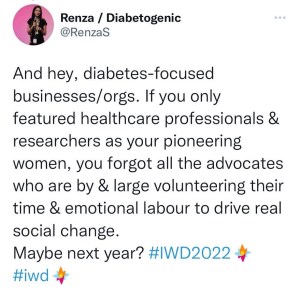
In the coming days in the diabetes world, you’ll see posts pointing to women in the diabetes landscape. These women are generally remarkable and doing great things. But oddly, rarely are the women whose faces appear on a social media carousel actually living with diabetes. A few years ago, I pointed out that while we should be recognising the clinicians and researchers improving our lives, women with diabetes are completely ignored.
So, a little hint to anyone who is putting together content for next week: don’t forget to also highlight the women with lived experience of diabetes who are actually doing so much of the work in our community. Those grassroots initiatives that continue to be life saving and life changing are very often powered by women with diabetes. And, as is often the case, these women do this work on a volunteer basis. All while managing a very demanding chronic health condition on top of all the other work women do.
Back when Twitter was less of a hellscape.
In the meantime, you should all register for this year’s DiaLeb Annual Diabetes and Women Panel. This is the 7th year and I’m very excited to be on the panel with two remarkable women living with diabetes, and another two women with loved experience of diabetes. Be quick! It’s tomorrow!
Click to register
Seriously, women with diabetes are brilliant. we deserve way more than a cupcake. But I’ll take one all the same if some bloke would like to organise it.
So what has been occupying your minds over the first few weeks of the year? Well, for a while there (and still), mine was trying to understand the veritable PR disaster of the Adelaide Writers Week (AWW). Niche? Yes. Relevant to diabetes? Also yes. In a roundabout way.
Let me set the scene. A writers festival in Australia was cancelled after one of the speakers had her invitation rescinded. The simple explanation of this is that the speaker, academic and author Dr Randa Abdel-Fattah had made some comments on social media that were deemed controversial by the AWW Board. More concerning, they connected these comments with the shootings in Bondi in December last year, effectively associating Dr Abdel-Fattah with the shooters. I’m actually not here to comment on Dr Abdel-Fattah, other than to say her treatment was appalling. There has been a lot of commentary, and if you’re not from Australia (or are from Australia but somehow managed to miss it) simply google AWW for details of what happens when decisions are made without consultation or understanding of the affected community.
I specifically want to focus on one part of the whole saga and that is the decision makers responsible for the PR nightmare. The Board of the Adelaide Festival (who is also responsible for the AWW) made the decision without the support of AWW director, Dr Louise Adler AM or her team. Dr Adler, in a letter published in the Guardian after she resigned from her role highlighted that the board was ‘composed of individuals with little experience in the arts ‘, which lead to decisions being made without cultural context and an absence of understanding consequence.
Even before I’d read Dr Alder’s compelling and commentary, the conversations I was having with friends and family were homed in on the same themes. We knew that the other writers at the festival would withdraw from the festival, one by one. We knew that Dr Adler had been treated terribly. And we were waiting for the gaslighting that would come from the Board, and anyone else involved in the decision making.
We knew, because we are a family of artists. My husband is a professional musician. My daughter is studying writing and journalism and has a part time job writing for a local newspaper. I studied music at university. Our friends are musicians, composers, writers, film makers, makers and journalists. We’d had discussions with many of them about how the Board’s lack of understanding of the arts sector, the way the community would respond, and how the community would be impacted. The words I used were ‘They have no skin in the game’, and by that I meant that not only couldn’t they see what was coming, they could also walk away relatively unscathed. Their careers were unlikely limited by their involvement in the decision and even though the entire board resigned, I would bet that it hasn’t made a dent professional standing or income.
Yet it wasn’t the arts scene that was the focus of my thoughts when I considered the AWW board, the decisions they made, the lack of insight into community response or the inevitable and highly predictable fallout.
It was, of course, diabetes.
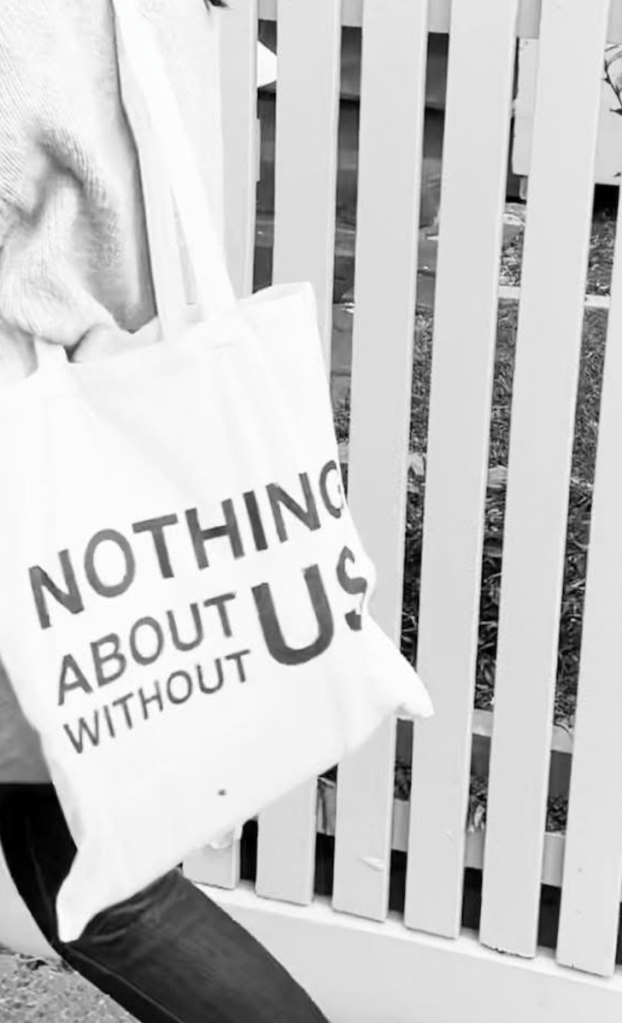
I found myself wandering around the house and on daily walks muttering ‘Nothing about us without us’ with a growing frustration that this lesson keeps having to be learnt the hard way.
It may be different communities and different contexts, but we’ve seen similar incidents play out just like this in the diabetes world for years. People with diabetes are not included in decision making processes. But then sit there, watching the fall out.
The process is the same. The positioning from the people making decisions is the same. Think about some pretty ridiculous diabetes decisions in recent years and think about who made them, and who wasn’t consulted. Think about the fallout from a particularly nasty diabetes campaign that adds to diabetes-related stigma. It’s with disbelief that I think back to campaign discussions when I was told outright that offending and upsetting people with diabetes when a campaign launched was the price to pay because we weren’t the intended audience, as if we would be magically shielded from the stigmatising messaging. And that it was an unintended consequence in efforts to inform the general public.
Those gaslighting me weren’t going to be in the firing line next time someone made some horrid comment about diabetes. It wasn’t their weekend that was going to be ruined when some smartarse in a supermarket queue or café said something about sugar causing diabetes or personal responsibility or how diabetes is a ticking time bomb.
When a decision is made that directly impacts people’s lives, surely those people should be in the room, at the table and have their voices heard the loudest. Surely. It’s so frequently not the case when diabetes decisions are made. It wasn’t the case when the AWW Board decided to cancel Dr Abdel-Fattah’s speaking engagement.
And so, the AWW was cancelled after almost all the writers on the program withdrew and the Board resigned. Interestingly, most of the Board members sit on other boards, so their status as ‘leaders’ and ‘decision makers’ doesn’t seem to be too impacted. Meanwhile, those writers have lost one of the few (and seemingly shrinking) opportunities to meet to share ideas and celebrate their community. Their incomes have been impacted. The chance to get their work in front of an audience has disappeared.
Nothing about us without us. It seems that this little catch phrase has been ignored too often, unless being used in convenient and cute attempts to demonstrate (usually lacking) community engagement. Instead, maybe it’s time to put us on boards and in leadership and decision-making positions. Maybe it’s time to actually listen to the people who know. Because our skin? It’s the one in the game more than anyone else’s. Raw, exposed and in the firing line.
It’s been a hot minute, hasn’t it. And by ‘hot’ I mean sweltering here in Melbourne. While my friends in the northern hemisphere are sharing snow photos, we’ve been dealing with days in the high 30s and 40s. (For my US friends – we hit almost 120°F this month. It was not nice.)
Anyway, now that the weather discussions are over, let me wish you all a belated happy new year. I’d like to say that I hope that your start to 2026 has been gentle and kind, but instead, picture me gesturing wildly at the world and shaking my head in despair.
I finished up 2025 feeling pretty damn exhausted and burnt out. But, really, who wasn’t feeling that way? There was a lot of good stuff that I could look back on, but the never-ending travel wore me out. I feel compelled to say that I know I am fortunate to do the work I do, and I love my job. Being able to work with people in the diabetes community who are making real change is a gift every single day. I would just be so happy if someone could find out a way for Australia to not be a 30-hour trip away from most of the places I need to visit.
I was lucky to have a three-week break over the Christmas/New Year period where I travelled no further than 5kms from my house, and I’ll have had a 10-week hiatus before I next find myself in an airport. Both of these breaks feel like a luxury!
But as we gear up for 2026, it’s undeniable that the global health world is in a mess and diabetes is not immune to that. I’m really pleased that some of my work will involve addressing issues that are important to people with diabetes. I’m beyond honoured to have been invited to give the Anita Carlson lecture at this month’s Psychosocial Aspects of Diabetes (PSAD) Conference (even happier that it’s being held in a regional city in my state and I only have to drive for an hour to get there!). I’ve called my lecture ‘Building Diabetes Healthcare from the Ground Up’ and it’s given me an opportunity to imagine just what diabetes healthcare could be if people with diabetes were actually centred and involved in its creation.
Next month the first Global Summit to End Diabetes Stigma is being held in Jaipur, India. Can you imagine hundreds of people with or working in diabetes coming together in one place to come up with meaningful and real strategies to end stigma? For disclosure purposes, this event is being funded via a grant from Breakthrough T1D (I work there), and I am involved in the planning of the event. It feels like a culmination of a lot of efforts highlighting the impact of stigma to get to a place where the diabetes world is ready to collaborate to end it. I’m so thrilled to be working for the organisation that has recognised that.
For me right now though, there is an overarching feeling that the world really is burning. While the US gets a lot of our attention, diabetes healthcare and access to insulin and care remains incredibly lacking in other parts of the world. As always, the most vulnerable in our world are impacted the most negatively. I don’t know about you, but a lot of the time I feel helpless.
Now it’s February, you may have once again seen that the annual Spare a Rose campaign has started. I think this is the fourteenth year of the campaign. I think back to what the diabetes community was like when Spare a Rose first started, and honestly, it feels very different to what we have today. I don’t know if a campaign like this would be started in today’s community. In fact, sometimes I find it harder and harder to find community and advocacy these days, as “influencer culture” takes hold.
And so, it’s worth remembering where Spare a Rose came from and the intentions behind it. It was a group of advocates in the US who wanted to give back somehow. I should point out that the advocates who started Spare a Rose had already given so much to the community. Many of them have taken a back seat to front-facing advocacy efforts but their legacies live on, even if fewer and fewer people see how they shaped the DOC. It’s diabetes advocates who have driven this campaign over the years and made sure that it has remained in the view of people with diabetes.
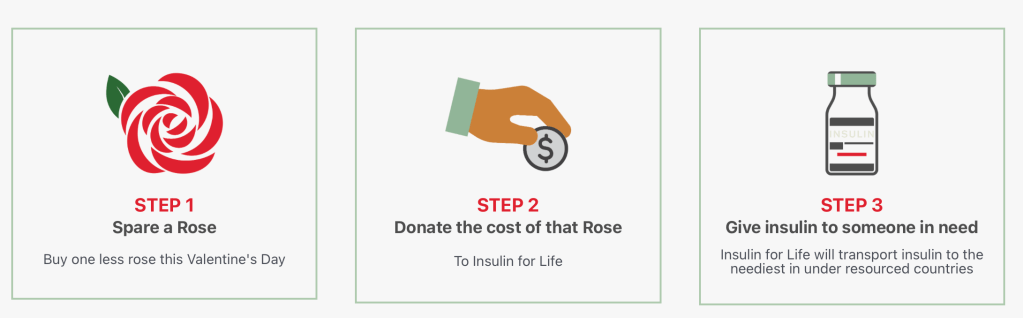
I have always loved the simplicity of Spare a Rose. The donation being asked for is small – US$5. For those needing a refresher, the idea is to give your loved one eleven rather than twelve roses and donate the saving to the campaign. In our house, we forgo flowers completely and recognise that empty vases are a small price to pay for making a donation to the value of a year’s worth of insulin.
I know that many are doing it tough these days. I also know that a lot of people who would have donated without a second thought in the past are unable to do so now due to changes of circumstances in so-called high-income countries.
But if you can support Spare a Rose by making a donation, please do. All funds go directly to the brilliant charity Insulin for Life, and each contribution makes a difference to a person with diabetes in a low-income country. If you can’t make a financial contribution, please share the website across your networks. Someone else in there might be able to donate. Every single dollar counts.