
I woke up this morning with that unpleasant and disagreeably familiar feeling. Ever-so-slight nausea, furry mouth and a desperate need to go to the loo. Why was I high? I grabbed my meter and a lovely number in the low 20s appeared for me. ‘Eff you, diabetes’ I thought.

I rushed to the loo, brushed my teeth, drank two glasses of icy-cold water. And grabbed my pump to see a completely dead, black screen. ‘What the eff?’ (Second f-bomb for the morning and I’d been awake for a total of five minutes. It was shaping up to be a good day.) I pressed buttons, trying to wake my pump up. Maybe it was having trouble getting the week started too. Nothing. Completely and utterly blank and unresponsive.

Blankety blank.

I rummaged around for a spare battery and located one in my diabetes supplies bag (seriously, every contingency is catered for in that bag!) and changed batteries. It responded with a lovely sounding ‘Boo-beep!’ and fired into action.

I primed, bolused, checked for ketones (too little to be too concerned about), drank more water and started my getting-ready-for-work routine.

Crisis averted, but how long had my pump been dead? And did it alarm? And if it did, how did the whole household not get woken by it? (And the neighbours for that matter. Living in inner-city Melbourne means we almost live on top of each other!) The alarm on the pump is loud, constant and downright annoying until it is silenced with a button push (or new battery). It wakes everyone – people and pets alike.

There was no low battery alarm before bedtime last night, so I had no warning this was going to happen and I slept like a log, not waking for anything until the alarm went off this morning. Is it possible that my pump had died just after I went to bed and I was insulin-free for 8 hours? Surely not, given the negligible ketones in my blood this morning.

I’m putting in a call to the pump company today because I don’t think that this is okay. There needs to be a much longer warning period for a dying battery.

Now I’m at work and I have that slightly fuzzy-head feeling that comes from high sugars. I’m guzzling water and checking my sugars (and ketones) regularly, trying not to over-bolus in a desperate attempt to get by BGLs back into single figures.

A dead pump. In 13 years of pumping that’s never happened. Diabetes – and diabetes therapies – have a way of making sure you never get complacent. Effing diabetes. (That’s number three…..)

I don’t deal with stress particularly well. I shrink away.

I don’t eat; simply unable to stomach the thought of food or drink and getting through the day with water and gagging on whatever I force down.

I also go to ground, staying at home, not wanting to engage with anyone, switching off online, not blogging or posting to Facebook or Twitter or Instagram.

Recently, I caught up with one of my best friends after a (very unusual) three week break. ‘What happened?’ she asked. ‘The last time we saw each other you said you weren’t feeling great and then I didn’t see you for three weeks and you didn’t respond to my messages.’

I stopped and thought about it. And realised it wasn’t her that I was trying to avoid – why would I? She is nothing but supportive and wonderful and lovely. It was me.

‘I’m sick of myself,’ I heard myself saying. ‘I am sick of what’s going on. I’m sick of the diabetes burnout I’m experiencing. I’m sick of it all. I just want to disappear.’

I wonder if that is what I am trying to achieve when I am dealing with a stressful situation.

I stop eating and see and feel myself shrinking away.

I stop standing tall, instead wrapping myself in blankets and jumpers, folding into myself and taking up less space.

I stop seeing people so I don’t have to hear myself talking.

I limit my online presence, making my cyber-self withdraw.

Am I trying to make myself disappear somehow? Shrink away from the world and my problems?

I want to take up less space, not fill a room, curl into a corner of my bed. I want to be small. And insignificant. Because what I am dealing with seems so big – too big – and momentous. I want to be less weighty because the problems are bearing down on me.

I see this clearly when I emerge from the fog. As I stretch and look for sunlight and see people and engage again, I find my voice and start to feel bigger. Literally and figuratively.

Last Friday I attended a couple of sessions of the Health Professional Symposium coordinated by Diabetes Australia – Vic and Baker IDI. The packed program covered a variety of topics including cognitive function in children with type 1 diabetes,musculoskeletal complications of diabetes and a panel discussion about whether lifestyle interventions are an effective approach in diabetes management.

The two sessions of particular interest to me were around diabetes in the hospital setting. The first, from DNE Sue Wyatt (Alfred Hospital), focussed on improving diabetes management in hospitals (including discussions about outcomes, policies and procedures) and the second was from dietitian Anita Wilton who discussed food services in hospitals.

To me, both sessions highlighted the problems faced by many people with diabetes when we are admitted to hospital – whether it be for a planned stay or emergency visit. The outlined policies and procedures do not take into account that people with diabetes have different levels of understanding, knowledge and self-management, and the ‘one-size-fits-all’ approach is, I believe, actually detrimental to diabetes care (indeed, diabetes self-care), emphasising the artificial environment experienced when in a hospital setting.

There needs to be a balance between what we as people living with diabetes need when we are in hospital and how we fit into the ‘rules’ and regulations enforced in hospital.

And one issue of particular concern is what happens to our insulin (and other medications), delivery devices and other management tools (BGL meters etc.). At the Alfred Hospital, insulin and delivery devices are taken from the patient. Obviously, this isn’t the case with pumps, but pens and syringes are removed from the person with diabetes and locked away. This is the policy and according to Sue Wyatt, in only one case has this been challenged to the point where the patient was allowed to hold on to their medications.

Unsurprisingly, this doesn’t sit well with me at all.

I raised my hand during question time to ask about how we manage the different needs of the person living with diabetes and hospital policies and procedures that, in this case, go against everything I believe in when it comes to patient empowerment. The answer I received was all about protecting the nurses in the hospital setting and whilst I completely understand and respect the need for that, where was the discussion about protecting the rights of the patient? At no point, when I am a patient, do I give up those rights. I understand that there will be times that people with diabetes are unable to administer their own insulin, but for many, that is not the case. As they are recovering from surgery or sitting in A&E dealing with whatever they are dealing with, managing their own medication is not only possible, but frequently the best option.

In my case, I have never been an inpatient and unable to administer insulin (after calculating doses and entering the correct information into my pump). Being able to address high BGLs and correct accordingly, bolus at the exact time I am eating or treat a low immediately have actually meant smoother management whilst in the hospital setting rather than relying on an already-far-too-busy nurse.

Obviously, it is essential that hospitals have policies and procedures in place, but at the same time, the primary concern should be what is best for the patient. If the talk around patient-centred care is to be taken seriously (and not just perfunctory jargon to make people believe they are talking the politically correct language and saying the right things) then we need to make sure that the patient and their best interests are actually being contemplated.

At no time are my best interests being considered if I am asked to hand over all the things that I need to manage my condition, whatever the setting.

I am employed by Diabetes Australia – Vic. I was not involved in the planning or presenting of any sessions at this event.

I’m tired.

Today, I woke in a great mood after a good night’s sleep. The weekend had been relaxing and lovely – family, friends, food and gorgeous weather on top of it all. Plus, I bought a new necklace with a pineapple on it. It was a good couple of days!

I was standing at my favourite café near work, waiting for a takeaway coffee and thinking that the barista was a magician as I watched his choreographed movements, filling takeaway cups with perfectly brewed caffeine.

‘This good day is about to get better,’ I naively thought, the taste of that first sip of coffee so close.

And then, I checked my email and ‘bam’. There it was.

A discussion about not distinguishing between type 1 and type 2 diabetes in a setting where it really is not relevant. I sighed.

And realised how tired I am.

Nearly thirteen years ago, I was employed to run a very small and, at the time, somewhat tokenistic type 1 diabetes program for a diabetes organisation. Thanks to a very supportive CEO and me being a pushy little thing, the program grew and grew and now, incorporates a dedicated team doing some incredibly good work for people living with type 1 diabetes.

One of the reasons for the program’s success is that we have been very clear about defining it as a program for people with type 1 diabetes, making sure the information we provide is targeted and relevant to the people we are trying to reach. We acknowledge each and every day that people with type 1 diabetes have specific information requirements and then we go about providing that information in the way people want.

In exactly the same way, a couple of years ago, we realised that the information for people with type 2 diabetes was completely forgetting the changing face of the type 2 diabetes community. There are more and more younger people being diagnosed with type 2 diabetes and the information we had was very much for an older audience. Hence, Generation T2 – a new program for 18 to 39 year olds with type 2 diabetes.

There are times that it is important to distinguish between the diabetes and there is no louder advocate for that than me.

But there are times that it is irrelevant. Yet, people still get angry – even when it really doesn’t matter if the type of diabetes is defined.

I am tired.

I am over this argument and this discussion.

Last week, the government handed down a budget that is going to hit the hip pockets of people with diabetes like never before. All people with diabetes will be affected – regardless of type.

During the World Diabetes Congress we heard of places around the world where the cost of insulin is so prohibitive that there are people dying because they cannot afford to buy the drug they need to stay alive. Slow, painful, horrible deaths because they cannot afford to buy insulin. Just think about that for a moment.

Here in Australia, there are people who cannot afford to use an insulin pump despite desperately wanting to because they cannot afford private health insurance or qualify for the Insulin Pump Program to assist with cost of purchasing the $9,000 (plus) device.

These are the issues that we should be fighting for and getting angry about. These are the issues that are important. Access to healthcare – a basic human right for all people – ALL people with diabetes – is what the topic should be; not whether or not the Channel 10 news forgot to say type 1 (or 2) before the word diabetes.

I am a card carrying member of the diabetes community. I am proud of this community and I am pleased to have a voice within it.

But we need to stop the finger pointing and the name calling and the blaming. How can we expect people outside of our community to get it right if we can’t? Why is it more important for people to understand the how and why we got this condition as compared with the how and why we’re trying to live and manage with it?

I am proud of the Australian diabetes community, but it is here that I hear this attitude more than anywhere else in the world. This discrimination is not helping us – it is harming us. Does it matter if people don’t really understand the different types of diabetes? I get it. It’s annoying, it’s frustrating; it’s constant. But really; does it matter?

This is a first world – a first class – problem.

And I am tired. I am saying it’s time to stop. Enough!

DBlogWeek5

It’s the fifth annual Diabetes Blog Week, with thanks to the lovely Karen Graffeo from Bitter~Sweet Diabetes. Today it’s diabetes in pictures. Come back tomorrow for the last instalment, and in the meantime, check out #DBlogWeek and follow along!

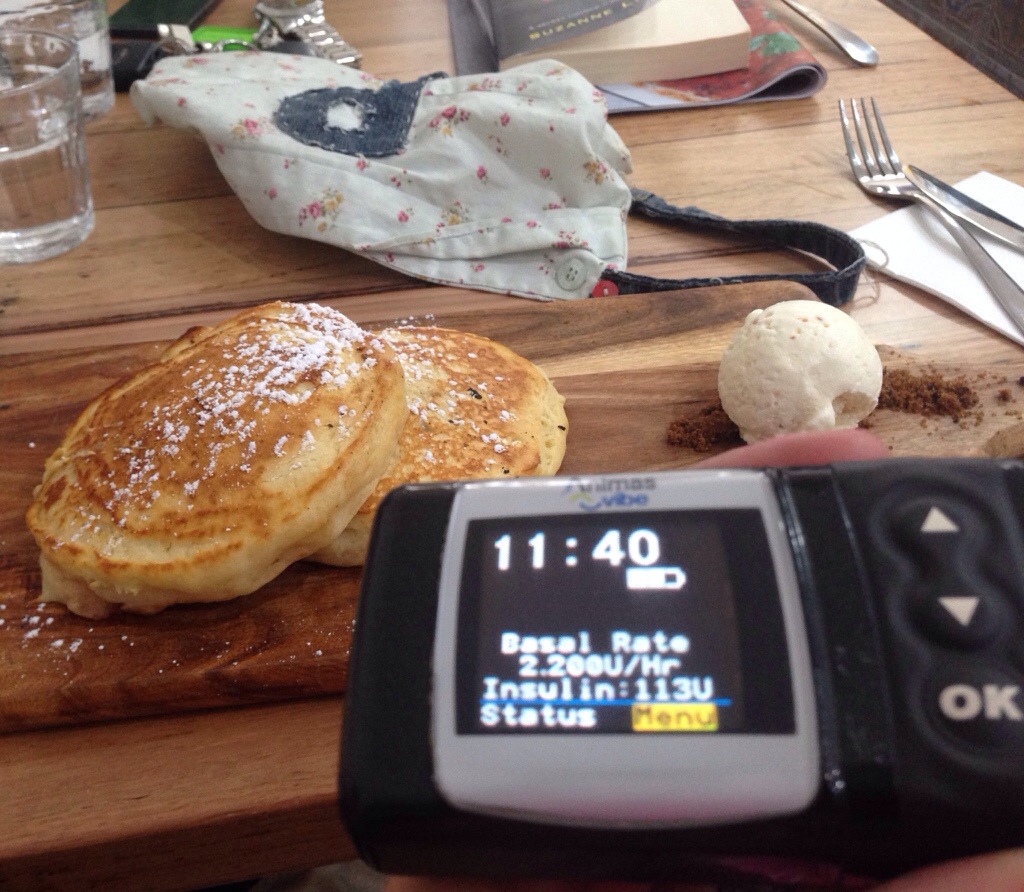
It’s Saturday and this morning, I had to work for a short while at a diabetes event. And when I was done, there was only one way to celebrate the real start of the weekend. With these:

20140517-154054.jpg


A new cafe has opened up in my ‘hood serving amazingly good coffee and this fabulous dish. Yes – the doughcakes are delicious. They’re fluffy and light and filled with strawberry jam, which  oozes out onto the serving board in a most pleasing way. But the most exciting thing? The bacon ice cream. Yes. Bacon. Ice. Cream.

Has there ever been a better nod to the DOC than this very dish? The only way it could be better if it was served up by unicorns.

So yes. I can eat that, and thanks to that nifty little pump thing, insulin takes care of all the carbs.

There seems to be a little bit of a theme to my Saturday Snaps for Diabetes Blog Week. Last time this was the prompt, I wrote (and snapped) about cupcakes. Apparently, when it comes to pictures of diabetes, it’s all about the food for me!


DBlogWeek5

It’s the fifth annual Diabetes Blog Week, with thanks to the lovely Karen Graffeo from Bitter~Sweet Diabetes. Today we’re talking about some of the sneaky things we do to make life with diabetes a little easier. Come back tomorrow for the next instalment, and in the meantime, check out #DBlogWeek and follow along!

Oh diabetes, you are a hard task master! There is much to do, so anything I can that makes life that little bit easier is a blessing!

Some of my ideas are just plain stupid, some of them actually make my life with diabetes run a little smoother. Others, I guess, are just habit now. So here is how I manage some of my day-to-day diabetes tasks.

  • Insulin prescriptions are kept in the fridge next to my actual insulin supply. This way, I always know where the next prescription is, can easily check if it’s in date, making it easier when it’s time to fill a new prescription.
  • When I open the second to last bottle of insulin, I call my pharmacy and put in an insulin order. I used to do this when I opened the last bottle, but that kinda didn’t work so well for me when I dropped the bottle. And then stepped on it. In a pair of boots. Smashed to smithereens insulin bottle (and insulin) not useful at lowering BGLs.
  • Spent pump lines are brilliant for tying up roses!
  • Ugly, (but effective) bandages work as a pump holder/holster under sexy dresses (and don’t roll down my leg).
  • I keep a box of Golden Circle pineapple juice by my bedside. Easier to drink when it’s at room temperature and great for middle of the night hypos when the thought of eating anything is just beyond me.
  • But for when I am happy to eat something, I make sure that the jelly bean jar on the bedside is always full. I hate having to get out of bed to get food to treat a hypo!
  • Thanks to diabetes, my handbags are huge! So to make finding my meter easier, it’s always housed in a bright purse.
  • An in another nod to the huge handbag, I have my diabetes contingency purse that takes care of pretty much any diabetes emergency: pump out of insulin? No problem! Open vial of insulin at the ready. Ripped our pump line on door? Stupid, but doesn’t matter! I have a spare line. Cartridge in pump jammed? Never happened, but if it did, not a problem. Spare one in purse. Pump completely died and not wanting to work ever again? Shitty, but manageable with syringe and insulin.
  • As I walk out of the consulting room for my endo (or other HCP) appointment, I head straight to the receptionist to not only settle the bill, but also make the follow up appointment (or the next couple) and the date is entered straight into my calendar, with a one week out alarm to remind me. That way, no need to call to make an appointment – something that always gets put off!
  • Pathology tests that are needed for medical appointments are scheduled in my iPhone calendar for two weeks before the appointment. No point in showing up to discuss results if the tests haven’t been done!
  • I have made sure I have never-ending referrals for my endo and ophthalmologist. Just ask your GP and if they won’t do it, find a GP who will!

I’m sure that there are lots of other things and I’ll add them as I think of them. I am really excited about today’s prompt for #DBlogWeek because it’s hearing tips, tricks and life hacks from other people with diabetes that make MY life with diabetes easier. Can’t wait to learn lots of new things.

The ultimate in Friday office dancing – Nancy Sinatra and ‘These Boots Are Made for Walking’.

DBlogWeek5

It’s the fifth annual Diabetes Blog Week, with thanks to the lovely Karen Graffeo from Bitter~Sweet Diabetes. Today we’re writing about mantras that help us get through the tough diabetes days. Come back tomorrow for the next instalment, and in the meantime, check out #DBlogWeek and follow along!

Those days that diabetes and I are on the same page, playing by the same rules, singing from the same hymn book are dreamy. They are the days that my CGM graph is a pretty, straight line with numbers that don’t move much and everything diabetes-related behaves. I love those days. I live for those days!

Unfortunately, there are the other days (and let’s admit it – there are many of them) when diabetes and I are not only on different pages, but we’re reading completely different books. We’re playing by rules from different games altogether and singing different tunes in different keys from different performers. I hate those days.

Those are the days that giving in, giving up and admitting defeat seems like a good idea.

But that is not an option. Because there is tomorrow. And the day after. And the day after that. And in each of those days, diabetes will be there.

As clichéd as it sounds; as Pollyanna-ish it makes me feel, I tell myself there is always tomorrow.

Each day I get to wipe the slate clean and start again. And that next day? That day may be one of the days when everything plays nice. That’s what I believe in. That’s what I hope for.

The very hope of tomorrow.

DBlogWeek5

It’s the fifth annual Diabetes Blog Week, with thanks to the lovely Karen Graffeo from Bitter~Sweet Diabetes. Today’s we’re writing about the emotional side of diabetes. Come back tomorrow for the next instalment, and in the meantime, check out #DBlogWeek and follow along!

There is a dark place in my mind that is locked most of the time. Usually, I manage to keep it closed away and it remains hidden.

And when I am feeling strong and robust and life is moving along at its usual pace without too many problems, I am not tempted to go to the dark place, to open the door and examine what’s hidden.

But when I am feeling vulnerable – for whatever reason – and my defences are down, I peek. Stupidly, I go in, treading carefully, cautiously looking around. To the dark place.

The dark place is the fear that lives inside of me about diabetes. It’s the fear of today, of tomorrow. And of the unknown. It scares me and it scars me. It makes me feel fragile; breakable. And highlights how broken I am.

In the dark, I feel the relentless-ness and the never-ending-ness and the overwhelming-ness of diabetes that I usually simply expect – and accept. Suddenly, the day-to-day and more-than-manageable tasks that I need to do seem impossible, daunting, too big to contemplate.

The dark place is quiet, the only sound is my amplified heartbeat.

I’ve learnt to breathe slowly, see the dark place for what it is, allow myself time to visit, accept what is there and then close the door. I come back and face the light and life and the people I love. I go to work, I see my friends, I bake, I drink coffee, I listen to music. I look like I am living my life – and I am. But when I’ve visited the dark place, I am scared and look over my shoulder. I feel oppressed and fatigued. It takes me a while to fully come back – sometimes only a day or two, sometimes longer.

This is my emotional side of diabetes. This is the dark place. This is the exhaustion of diabetes.

black


DBlogWeek5

It’s the fifth annual Diabetes Blog Week, with thanks to the lovely Karen Graffeo from Bitter~Sweet Diabetes. Today’s prompt is to write a poem. Come back tomorrow for the next instalment, and in the meantime, check out #DBlogWeek and follow along!

I found today’s prompt a little difficult. Poetry is not my strong suit. I thought of perhaps writing a comical limerick, but The Grumpy Pumper beat me to it – even his post title is poetic! (Also, I was having trouble getting past a first line of ‘There was a girl from Nantucket….’)

Anyway, I thought perhaps I’d try a Haiku because I’ve always found the format so beautiful and magical. The economy of being able to convey something evocative and gorgeous in seventeen syllables is a remarkable skill, one that, unfortunately, I don’t possess.

Diabetes lives

My body, my bones, my mind.

Always. Forever.

DBlogWeek5

It’s the fifth annual Diabetes Blog Week, with thanks to the lovely Karen Graffeo from Bitter~Sweet Diabetes. The first topic for the week asks us about the diabetes causes and issues that really get us fired up. Here’s what I have to say! Come back tomorrow for the next instalment, and in the meantime, check out #DBlogWeek and follow along!

I am not in any way foolish enough to believe that what I write on this here little blog or the work I do as a diabetes consumer (patient) advocate has the ability to change the world.

But I am confident enough to believe that my messaging is strong and that I generally stay on topic.

There are many things that I feel passionate about when it comes to being a diabetes advocate, but nothing more so than who is in charge of driving the diabetes bus. And that is the person with diabetes.

There is so much written about patient-centred care. Google it and you’ll come up with a…well a google of links. But despite much of it talking the talk, I’m not sure that it really walks the walk. The idea of patient-centred care is often at odds with policies and procedures of healthcare settings making it difficult for the person with diabetes (or other medical condition) to really be in the driver’s seat.

For the person with diabetes to be truly in control (and I’m not talking control in the sense of their BGLs, I mean in the sense of decision making) everyone needs to really subscribe to the model where the patient is smack bang in the middle of the picture, directing traffic, and making the ultimate decisions.

This doesn’t mean that it is done in isolation. No. It’s the exact opposite really.

It means that with support from HCPs, from diabetes organisations, from peer groups and from the health system, the person with diabetes is armed with all the information needed, given the right guidance, shown all the choices. And then, with all of this, they make a decision as to what they believe is the best thing for them. Nothing is withheld, everything is discussed, all options are in the table and considered.

I have too often had the options taken away from me. While I am pretty good at standing up for myself, it is exhausting at times to have to fight for my care to be the way I want it to be. And it’s frequently when we are at our most vulnerable that we have to fight the hardest. Hospital admissions (planned or emergency), times of extreme diabetes burnout or when we’re struggling to stay on track are the times that we often need to stand up for ourselves…even if we don’t have the energy, the inclination or the desire to.

When push comes to shove if I am charged with dealing with this condition 8,736 hours a year, then I AM driving this bus. The role of the support team around me is to give me suggestions and options about how to navigate, but then let me decide if I’ll turn left or right. And come along for the ride – even if they don’t necessarily agree with the road I’ve chosen.

Today, I’ve also written a post at the Diabetes Australia – Vic blog about another cause close to my heart – The Diabetes Stigma Project. Have a read!

Follow Diabetogenic on WordPress.com

Enter your email address to follow this blog and receive notifications of new posts by email.

Read about Renza

Archives