Last week, Australian social and mainstream media was abuzz with exciting news of a diabetes breakthrough. This filtered through to international media.

Labelled as an artificial pancreas, the new device was covered in online and print newspapers, as well as television news bulletins. The reason for the excitement at home was because Australia is the launch market for this new technology.

Exciting stuff!

Well, yes and no.

The device in question was not really an artificial pancreas. Rather, it is the next generation integrated pump/CGM system to be launched globally.

Technology advances are really important and we should get excited about them, and their promise of improving the lives of people with diabetes.

But reporting honestly and correctly is also really important.

Let’s be clear about the device that was launched last week. It is a pump with a CGM. The real advance is that together they have the potential to predict hypos and turn off insulin delivery, thus (hopefully) preventing hypos.

This is, indeed, an advance in technology.

This is not, however, an artificial pancreas.

There are a number of problems when diabetes advancements are not communicated effectively and correctly. Firstly, the way the reports read last week, this technology would eradicate hypos completely. As far as hopes for diabetes go, living hypo-free is surely something we would all dearly love.

But while this tech MAY help in reducing hypos, it’s certainly not going to eradicate them.

There are still problems with sensor accuracy that need to be addressed before we can be comfortable in saying that CGM technology (whether purely as a ‘warning system’ for impending hypos or being combined with a pump that will switch of insulin administration) removes the risk (and associated fear) of low blood sugar.

Whilst this technology is a step in the right direction, it is not an artificial pancreas. It is not the holy grail.

Diabetes still needs attention, still needs research, still needs funding, still needs donations. We are not there yet, and any report that even suggests that is, I believe, detrimental to continued efforts looking to further improve diabetes management.

All of us who are communicating in any way about diabetes have a responsibility to be truthful, honest and, as much as possible, devoid of sensationalism.

Get it right when we are taking about it and hopefully the mainstream media – who, let’s be honest, have an incredibly rudimentary knowledge base when it comes to diabetes – will hopefully follow suit.

I am really excited about the potential of this new pump and GGM combination and I am fully aware that it may be of significant benefit to many people living with diabetes. I know just how beneficial CGM technology is.

But tell it like it is. Report responsibly. And keep the understanding of what living with diabetes – and the technology we use – real.

This is just so beautiful! Enjoy for your Friday and have a great weekend.

Click

The sound the applicator of my CGM made as the introducer needle pierced the sensor through my skin made me wince. It’s an involuntary response and not because of pain. The little pinch I feel as the needle shoots in is so insignificant it doesn’t really warrant a response.

My last sensor fell out in bed on one of the first nights of our holiday. The next morning as I removed the spent sensor from the transmitter, I decided that I wouldn’t put in another sensor straight away. And then after a few days of enjoying having one fewer device stuck to my skin, I decided that because I was spending so little time alone, I really didn’t need the safety net of a CGM. Plus I had no plans to try to tighten up basal rates or make any other adjustments.

More than five weeks and no CGM.

But the afternoon after we returned from New York, as Aaron was getting ready to go to a gig, I realised that jet lag would possibly be sending me to sleep before he got home. And I’d been chasing hypos all day – continually going low just as I thought I had managed to get on top of things.

I knew that it was time to get hooked up again to my CGM. I needed my safety net back.

So, I pulled out a fresh sensor, swabbed the back of the transmitter and with a click, the new sensor was attached firmly to me.

The clicking sound hit me with a force that surprised me. I actually felt it in the pit of my stomach – a sinking feeling. I felt my breathing quicken. What’s going on? I thought. I checked the site where the sensor had gone in and where I had fastened the transmitter. It looked fine. There was no pain.

I stood in the mirror, my top tucked under my chin and there, staring back at me, was the reason for this sudden unease. Two medical devices. My cannula on my right side, the pump tubing snaking its way up my chest to the middle of my bra where my pump was neatly tucked away, and my CGM sensor and transmitter just to the left side of my belly button.

I could suddenly feel the numbers, I could feel the data, I could sense the information that would soon be available to me. I could feel the vibrating of the alarms.

And the feeling of burnout – that darkness that lives at the pit of of my stomach – sprang to life after having lived quite dormant for a few weeks.

I felt overwhelmed and my sensor wasn’t even transmitting data yet! In fact, I hadn’t even hit the ‘start sensor’ button on my pump yet.

I sat on the bed and breathed deeply before grabbing a piece of paper and pen. I started to make a list of reasons to not get overwhelmed and distressed about reconnecting to my CGM.

2015/01/img_0549.jpg

I re-read the list and started to feel calmer. But I was surprised at just how sudden and intense the reaction was. I couldn’t really make sense of it either. I love this technology. I love the information it gives. I use a device that is incredibly accurate and reliable. I do feel safer when I have a sensor attached. And I know that, given the cost of running a CGM, I am very fortunate to be able to use it.

So why was I feeling dread instead of reassurance?

I’m not sure; I’m really not.

Later that night, I crawled into bed. It was still light outside – jet lag had indeed hit me! The kidlet was reading in her room getting ready to sleep. Aaron wasn’t home yet and still wouldn’t be for a while.

I started to read and before long, my eyes felt heavy and just as I was about to put my book down, my pump, lying loose in the bed beside me started to vibrate. I looked and saw the two arrows pointing down. I wasn’t low, but would be in about 30 minutes. I reached over and pulled two jelly snakes from the jar on the side table.

As I started to doze, I felt calm and relaxed, looking forward to a good night’s sleep, and woke on Australia Day feeling refreshed. I located my pump amid tangled sheets, and saw the CMG’s straight line. My hand moved to touch my CGM, sitting comfortably on my stomach. Doing its job. Nothing more. Nothing less.

I am terrified of birds. As in, irrationally scared to the point where I scream when I see a bird flying anywhere near my general direction. Walking through places like St Mark’s in Venice causes panic, and the thought of feeding pigeons so they land on my arms and legs is enough to induce hyperventilating.

This fear was borne out of an incident where a blackbird flew at me and hit me – with its beak – just above the eye and drew blood. This happened about fifteen years ago and since then, I have had a theory that the avian world is conspiring to hurt me. There have been many other occurrences, all of them chilling and disturbing. This phobia is a source of great amusement to my family, who mock me every time I wail and bury my head in fear when there are birds around.

The Hitchcock film The Birds is more documentary rather than a work of fiction, as far as I am concerned.

So, birds and me: not great mates.

Diabeto1

Gorgeous design!

But, I have found a little bird that I think I am going to love and it’s called Diabeto.

Diabeto is a soon-to-be-launched hardware device which wirelessly transmits BGL readings from a meter to a smartphone. Using a specially designed app, data can then be analysed and, being cloud based, is securely stored and can be accessed by HCPs for analysis. Other data – insulin doses, physical activity, carb intake, mood etc. can also be tracked and stored.

Diabeto is currently compatible with 25 meters (with more being added all the time) which means that most people with diabetes will be able to use this technology.

There is lots to like about this little bird, and for some it’s a great way to keep track of the multitude of numbers that are part of diabetes management. On the Diabeto management team is Shreekant Pawar whose parents have had diabetes for 25 years. He GETS diabetes, which means that this is a product that works and makes sense. (Plus, Shreek has really good taste in music and is fun to converse with on SoMe!) 

Diabeto is now available for pre-order and this stage is actually part of their crowd-funding strategy. The hope was that the Indiegogo campaign launched last week would provide the cash needed to enter the manufacturing stage.

The great news is that the $10,000 target was reached after only a few days, suggesting that there are a lot of people willing to invest $59 (or $49 if you get in quickly!) to get their hands on one of these cute little birds.

You can read all about Diabeto here and support the campaign by pre-ordering your little birdie here. (Most important information – it comes in blue and pink. If, like me, you’re having trouble deciding, order both.)

Need more of an incentive to check this out? From 27 January to 3 February, $5 from each Diabeto sold will be donated to T1 International.  

I’m back at work today (pretty sure you can feel my delight in just those five little words). I know I am back at work because I am wearing a pencil skirt, tights and black high-heeled pumps instead of jeans, boots, a scarf, a hat, gloves and a puffer jacket with some sort of fur lining. Today I look like I am ready for work rather than ready for a day of wandering around New York.

But all is not lost. It’s been six weeks and I have a wonderful holiday of nothing but great memories and a photo album of nothing but gorgeous photos. So, onwards and upwards and all that.

Yesterday, as I sped around the supermarket, the onslaught of the next commercial opportunity hit me fair and square in the face. No, I’m not talking about Easter (I could act all outraged that there are Hot Cross Buns in Woolies, but we bought some and have been eating them, so that would be kind of hypocritical). I am talking about the festival of love – Valentine’s Day.

Valentine’s Day can go one of three ways for people. It can be a day of overt love declarations involving flowers, cards, poems, sky writing, gorilla-grams, stripper-grams (don’t judge), candle light, champagne, walks on the beach; it can be a day of sadness and misery and feeling left out; or it can be a day of complete oblivion where one is confused why there are so many people carrying bunches of balloons with ‘I wuv you, Shnookums’ written on them in glitter.

This year, I say screw that. This year, I say how about you do something that is meaningful that will not only help others, but also make you feel great. This year, it doesn’t matter if you have a Valentine or not. Everyone can play.

I am, of course, speaking of the Spare a Rose Save a Child campaign.

spare a rose

Now, if you have diabetes and/or any links to the diabetes word, you have probably seen and heard about this campaign before. I’ve even written about it here. The general gist is that instead of sending a dozen roses to your Valentine, send eleven instead and with the money that would have bought the extra one (about $6 in Aussie money) make a donation to Life for a Child. Those five bucks will provide insulin to a kid in a developing country for a whole month. Or, give your Valentine ten roses and donate $12.

All good, right?

But I have a little challenge for you.

This is a brilliant campaign because it is so simple. It’s easy to explain and it’s really easy to get involved. So my challenge is this. Let’s get this moving way out of the diabetes world. Let’s get this into the hands and hearts of our friends and family who may not really consider this as an idea for Valentine’s Day.  Let’s tell our workplace HR teams and see if they can encourage it as a work-place wide giving program (there’s even a tool kit to get you started!). Pop in to visit your neighbours and ask them to get involved. Next time you are going for a walk in your local shopping centre, drop in to some of the small businesses and ask them to get involved. Ask your kids if they would like to donate some of their pocket money.

Roses and diamonds and jewellery and books and CDs and vouchers for massages and guitars and DVDs of favourite movies are all lovely and fun for Valentine’s Day and I am not suggesting you complete give up on the idea of sharing gifts. But how about sharing the love a little this year? I know that I certainly will be making a donation and have already strongly suggested to my Valentine that he do the same. (And check out this and this cute card to attach to your gift, telling your Valentine how you’ve shared the love this year.)

So, how about making sure a child has life-saving insulin available to them by donating just a few dollars in your loved one’s – or your – name. Because THAT is a gift of love and I honestly can’t think of anything I would like more this Valentine’s Day.

All the information you need – including the link to the incredibly simple donation page – about the Spare a Rose, Save a Child initiative can be found here.


I love food. Yesterday’s post which outlined all the eating we’ve been enjoying while in New York probably points to that. As would many other posts.

And it is the truth. I love food. I enjoy it. I celebrate it. I cook it. I read about it. I share it.

Food is a joy. When I think about different periods in my life, there is always a soundtrack of the music I was listening to, and the meals I’d cooked with love, or shared with family and friends.

There are meals that I have had that are still spoken about – years later. ‘Hey, remember that first meal we had at that gorgeous little place in Venice? I had incredibly gnocchetti with seafood?‘ I might say, to which Aaron would reply ‘Yes! And I had the four cheese gnocchi. God that was good. So good.’  That meal was consumed in 2001.

And our daughter recalls fondly the taste of the plums that would fall from the tree in the back garden of our old house, and how we would sit out there in summer and gorge on the fruit, the juice dripping down our chins.

This is the language of food.

So when I read this the other day in my Facebook feed, I was just shocked. I read it with complete and utter disbelief.

IMG_0512

Why, why, why would anyone deliberately make food taste terrible, bland or boring?

There is nothing – NOTHING – in this piece of so-called advice that is useful. There is nothing that provides smart advice for how to eat healthfully or listen to your body for hunger cues. There is nothing that says food can be a part of life that is enjoyable, fun, non-threatening and delicious.

This advice makes food sound like it is something to be feared. It makes food sound like the enemy. But worse, it does not explain how food can be part of a healthy way of life. It does not talk about portion sizes, or balanced eating, or how to incorporate a little of everything into an eating plan.

It is restrictive. It is scary and it makes me feel so sad.

When I was first diagnosed with diabetes, I had no idea what it would mean to my diet. Would I suddenly have a list of restricted or banned foods that I could never enjoy again? Would I need to completely change the way I ate? Would food become a source of stress rather joy?

I have learnt that the joy of food is not lessened at all because of diabetes. I still can eat whatever I want. And I do. My diet is healthy, balanced, full of fresh foods, fun, enjoyable and never, ever boring. And there is no such thing as a taboo food.

I am just so glad that the advice I have taken – as a person with diabetes, but even more so, as a person who loves food – is that there is no need to fear food. I am so glad that what I eat – and what my family eats – is based on what we like to eat, what we want to eat and what works for us. It may not work for you, but it works for us. (The kidlet could probably do without Brussels sprouts, but I am convinced that I will win her over on this one!)

This blog is NOT about advice. Nothing that I write should be considered as something to follow or as advice. So I am going to give you some. Don’t take the dietary advice of a celebrity personal trainer. If you need some help working out what to eat that makes you feel happy and content, see an accredited practising dietitian. If you have problems with your relationship with food, speak with your GP, and ask for a referral to a psychologist.

But whatever you do, enjoy what you eat. Life is too short to eat over-cooked chook.

By the way, here is an awesome way to cook Brussels sprouts: finely slice them, then sauté in a fry pan with a little olive oil and garlic. After about 1 minute (absolutely no longer), toss in some toasted pine nuts (or walnuts, almonds, whatever you have handy). To be fancy, add some bacon cut into thin strips. (To be EXTRA fancy, make it candied bacon by crisping up the bacon in a little maple syrup first.)

IMG_3115

Breakfast in bed.

Food is one of the most wonderful things in my life. I’ve always felt this way. Julia Child once said ‘People who love to eat are always the best people’, and I think there may be some truth to that! Food is an integral – and central – part of my and my family’s life.

So when we’re away, what and where we eat is of great significance. Before I travel anywhere, I have a list of cafes, restaurants, food trucks, delis etc. to visit. Our days are often planned around where we’ll be eating. (Just the other morning, for example, we started with a visit to a favourite haunt when visiting NYC and the spent the remainder of the morning and most of the afternoon wandering around SoHo, stopping in little boutiques and visiting guitar stores before heading back to our neighbourhood late in the day.)

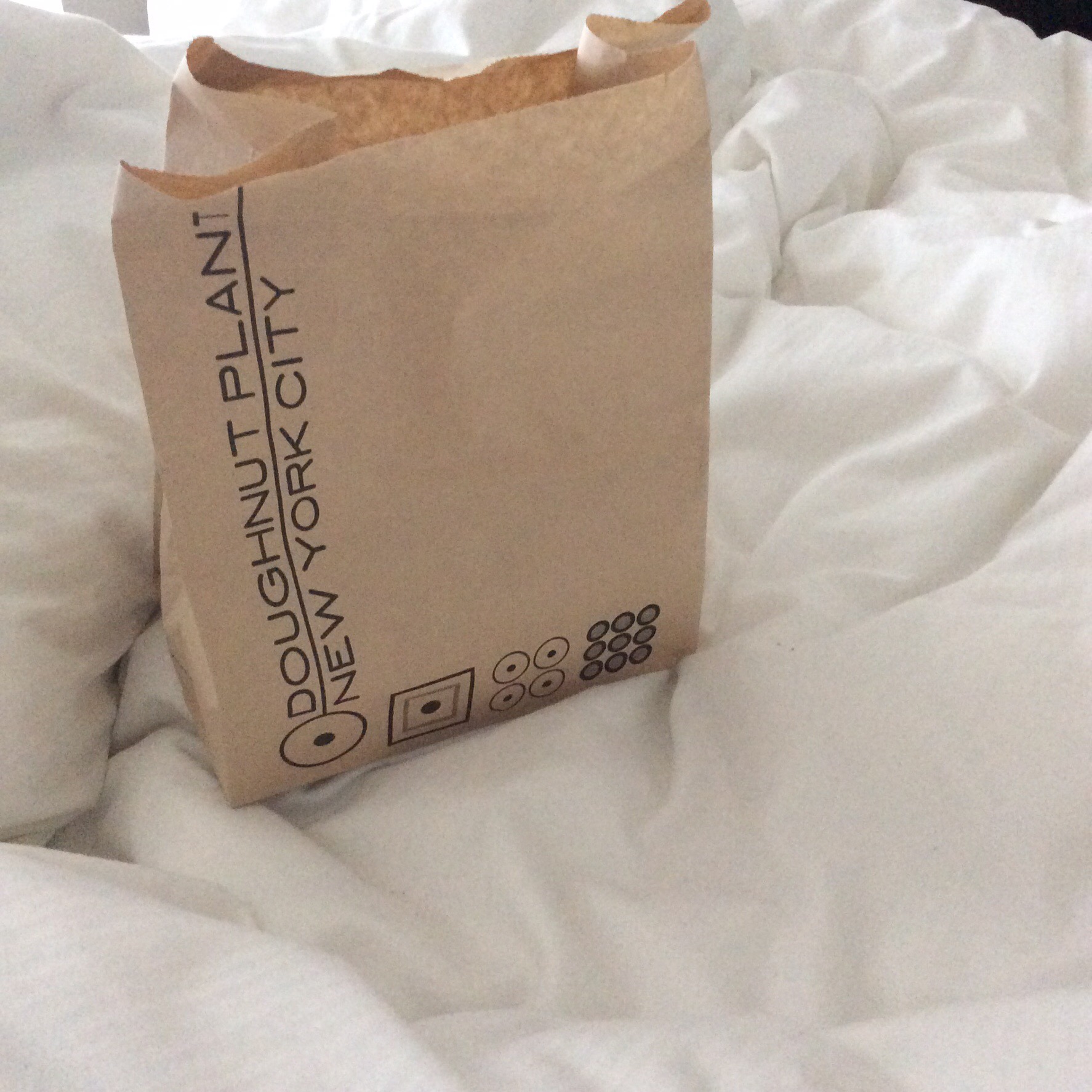
What is different when we travel is that the balanced, home-cooked meals that are the norm at home are replaced with a far more ad hoc, mixed up meal schedule. This doesn’t mean that nutritious food is ignored completely. It’s just that I’m more open to starting the day with doughnuts. In bed.

And that’s just the beginning….

We’ve recharged our batteries with a snack on the run, downing hot dogs from street vendors. (I do keep thinking that I should prepare myself for some sort of horrendous food poisoning, but it’s not happened. Yet.)

You'll have to take my word for it; it was delicious!

You’ll have to take my word for it; it was delicious!

We’ve whiled aways hours and hours on the rooftop of Eataly with friends sharing antipasto platters, the most amazing porcini fritters, and salumi plates while drinking beer brewed on that very rooftop.

Also at Eataly, we’ve munched pastries slathered with Nutella accompanied by steaming Italian espresso to kick off the day.

We’ve eaten pancakes in diners, hamburgers at burger joints, waffles for breakfast and bagels from…well…anywhere.

And soup – warming, sustaining and full of vegetables and restorative chicken broth – has satisfied my ‘mummy moments’ where I’ve thought we needed a hit of something a little healthy.

We’ve taken shelter from cold, wind, rain and snow in coffee shops, hugging bowls of coffee and hot chocolate to warm our frozen fingers.

We’ve eaten at all hours, walking to Shake Shack for dinner one night just before 11pm, or sneaking into a bar after seeing a Broadway show at nearly midnight for fries with our drinks.

Walking out of MoMA yesterday, we made a beeline to the bright red food truck across the road. Ordering lobster rolls for the three of us, I said to the vendor ‘I’m not even hungry – I just love lobster rolls!’

Anytime we’ve been near 23rd Street, we’ve detoured to Doughnut Plant.

Melbourne latte in Midtown.

Melbourne latte in Midtown.

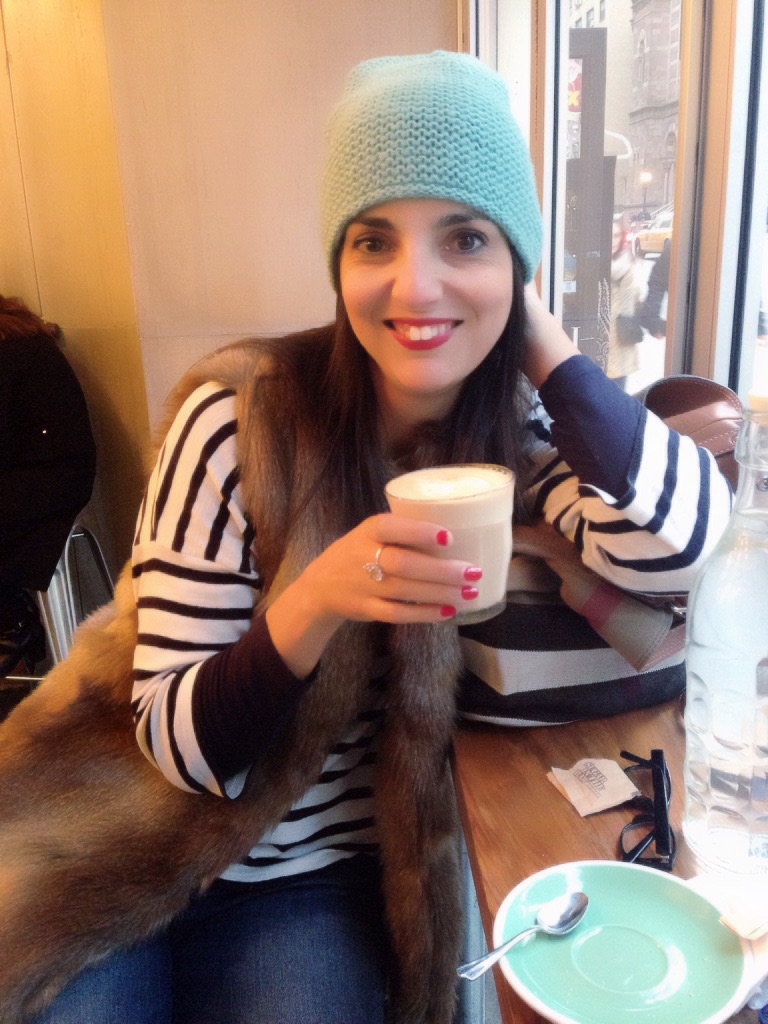
We located coffee shops run by Melbourne people and sat in the window drinking lattes tasting like they were made by the barista at our local in Brunswick and munching on perfect ANZAC cookies.

Mimosas are the drink of choice at brunch. So there have been mimosas. With brunch.

We ate zipolli at an Italian restaurant on Mulberry Street after being sent there by Rudy’s from Rudy’s Guitars in SoHo after I told him how sorry I was to have missed my mum’s zipolli this Christmas.

And I have poured Half and Half over and in everything and anything that I could!

Changes in diet always pose challenges when it comes to insulin dosing. Just being somewhere different often means that different ingredients are used for dishes that I am pretty good at guesstimating insulin doses for when home. And it also often plays out that the food we’re eating is more carb heavy than usual.

However, despite the oft-carb-laden food, I’ve managed to work out insulin doses. I’ve worked out when to reduce basal doses if it looks like we are going to spend the day on the run, or increase them if the day is looking to be particularly cruise-y and spent indoors doing not much at all.

Quite often the extra carb intake is offset by the extra exercise. We walk a lot when we’re holidaying. New York is a walking city – even in the cold. The other evening, as the temperature sat near freezing, I walked over 40 blocks from where I’d spent the afternoon catching up with my beautiful DOC friend, Alecia, back to our apartment in Hell’s Kitchen. I didn’t do it because I thought I should walk off the food. I just did it because I like walking around here. Plus I was looking for a new pair of boots.

I would be lying if I told you that there have not been some mishaps. Like the night I over-bolused for my burger and had a horrid hypo that saw me wandering into our daughter’s room before Aaron led me back to bed, pouring orange juice down my throat, following it up with toast and jam.

But for the most part, I’ve simply eaten whatever and dealt with it accordingly.

Have I eaten healthfully the whole time? Hell no!

Have I enjoyed food and eating and sharing meals with friends and family? Yes. Absolutely.

Have I felt guilty for any of my food choices? Not. One. Bit.

Before even opening my eyes, I could feel it. It started in the pit of my stomach – a kind of fluttering – and rose to my chest, where my heartbeat started to quicken.

I was low. Not horribly so – I could comprehend where I was and what was going on. But nonetheless, I knew that I would need to act soon. Well…soon-ish. I snuggled under the doona focusing on my heartbeat; willing it to slow down a little.

Even though our apartment is warm – beautifully so – I didn’t want to have to remove myself from the warm bedding, put my feet on the cool parquetry and pad to the kitchen.

My eyes were still shut and I wished that I had a jar by my bedside full of jelly snakes – like I do at home – so I could just reach my arm out.

But I’ve not found any sweets here that I like to use to treat lows. Jelly Belly jelly beans take too long to chew, and often I find myself gagging as I chew, chew, chew before swallowing. Gummy bears are pure evil and leave the most horrendous after taste. And I don’t like over-the-counter glucose tabs. (This is where I remind myself that I should organise a Gluco Lift order before heading home…..)

No. I would need to get up, go to the kitchen and find something there.

I opened my eyes and turned to the bedside table to check the time. And there, right in my line of vision was a tall glass of orange juice. I sat upright, very quickly.

‘How did that get there?‘ I asked

‘I put it there,’ said Aaron, who was awake and reading a magazine. ‘You’ve been low a couple of times in the mornings, so when I got up to get myself something, I brought it in for you.’

I looked at him gratefully.

It takes a village – I’ve said it before. Diabetes is constant, it doesn’t end, and each and every day there are dozens of things I do to stay healthy and try to be on top of things. Most of the time, I just do them – on my own, without fanfare or even comment.

So, it’s little actions like this make me truly appreciative. It’s not ‘just a glass of juice’; it’s someone noticing something about my diabetes and doing something to help. Not because they were asked to – I am pretty sure that I had not even mentioned that I’d woken low a couple of mornings – but just because they thought it would help.

I guzzled the juice – downing it in just a couple of gulps – and cuddled back down into the warm bed. Within a short time, I could feel my heart rate had returned to normal and the fluttering feeling in my stomach had disappeared.

‘Thank you, hon,’ I said. I knew that he wouldn’t want me making a big deal of it (he would be the one saying it’s ‘just a glass of juice‘). But it made one diabetes thing for the day less of a pain to deal with.

Four weeks into a family holiday, away from the mundanity of every day, away from schedules, away from stresses, and I can see just how much better I feel – emotionally as well as diabetes-wise.

After writing an extremely raw account of the diabetes burnout I have been experiencing for some time, I have spent time wondering just how I was going to get diabetes back to a place that would stop causing me so much concern and guilt and stress and anxiety. Because that’s the thing with the way I do diabetes burnout – I don’t just burnout, I then focus on the burnout. Which makes me more burnt out. And then I focus on how much bigger the burnout is getting. You get the picture.

But here, in New York, surrounded by my family and visits from friends, I am feeling that things are slowly, but surely, balancing out again.

Diabetes management has gently snaked it’s way back into my life – just as a regular part of my routine. I’ve found myself checking my BGLs with more frequency – and less frustration – than had been the norm at the end of recent times.

I don’t get to the end of the day and find a pressing feeling on my chest because I have been suppressing the guilt of not checking my BGLs. I don’t ignore high BGLs that I know to be the result of a pump line that really needs to be changed. Diabetes tasks like these just happen; far more effortlessly.

But I am taking things slowly and easily. Baby steps.

I decided not to reconnect my CGM after the sensor fell out during the first week here. I’m spending most of the time with my family, so not feeling I need it as my safety net as I do when either travelling alone or at home at night while Aaron is out doing gigs.

I know that this isn’t reality – as much as I wish it really were – but I am absolutely savouring this time. This somewhat alternate existence is such a privilege – I feel lucky. I feel happy, actually. For the first time in a very, very long time, I feel truly content.

And of course, that makes the overall shitty-ness of diabetes a little easier to manage. But (make no mistake) it doesn’t make it less shitty overall…

I came to this realisation the other day as I was pushing in a new infusion set. I packed away the waste and tucked the freshly-primed pump into my bra, thinking about how much I really dislike diabetes tasks. Because I do. I don’t want to check my BGL or shove a sharp introducer needle into my side to re-site my cannula. But I just do it.

When I am burnt out, one of the reasons I don’t want to do these things is because I hate them. But even when I am just getting on with things and all is ticking along okay, I still don’t enjoy these tasks.

And you know what – that’s perfectly okay!

Perhaps for me what comes after burnout isn’t just getting back on track. Perhaps every episode of burnout – however long or debilitating – ends with a realisation that diabetes is still a shit. There’s just a little more acceptance.

And a tangible sigh of relief to find myself seeing some light for the first time in a very, very long time.

The bathrooms at Madison Square Garden would have to be the cleanest public toilets I’ve ever seen. It was tough to get up and take a break from what was turning into one of the best gigs I’d ever been to, but when nature calls, you answer – even if Billy Joel is on stage!

I found an empty cubicle, quickly peed (TMI) and went to wash my hands. At the basin, out of the corner of my eye, I saw a women rummaging in her bag. I was about to look away, when, in the reflection of the mirror, I saw her pull out some thing familiar. It was an insulin pen. She bent over ever so slightly and jabbed the needle into her thigh, right through her jeans.

Our eyes met. ‘Oh, sorry,’ she said. I could tell it was a reflex – said in the same tone as if she had accidentally knocked elbows with me.

Don’t be,‘ I said. ‘I have diabetes too.’

She smiled at me and looked relieved. ‘My blood glucose is high. I needed some insulin…’Suddenly she looked a little sheepish. ‘I shouldn’t inject through my clothes though. Right?’

‘Ah – shoulda coulda woulda!‘ I said to her. ‘Whatever works for you! I was high at the beginning of the night. It’s coming back down though, but now I’m paying for the water I was guzzling earlier! If you don’t mind me asking, why are you injecting in the loo?’

She looked confused.

Ah…bathroom.’ I corrected myself. I keep forgetting that even though we allegedly speak the same language, I spend a lot of time rephrasing what I say here in the US to make myself understood.

‘I always do,‘ she said. ‘Some of my friends and family get uncomfortable around needles,‘ she said. ‘So I use the restrooms. I don’t want to upset them. Where do you inject?’

I finished washing my hands. ‘I use a pump,’ I said. ‘But I always would just inject wherever I was – I never used the bathroom. But that was my choice. My attitude has always been that if someone has a problem with seeing me do my diabetes stuff, look away. And grotty…um…dirty bathrooms are not the place to manage my diabetes. Not that these bathrooms are dirty – they’re spotless!’

‘Do you like the pump? I’ve read a lot about them. I’ve only had diabetes for a year.’

I could see in her face that she really wanted to talk. And I really wanted to talk to her.

But I was at Madison Square Garden, and Billy Joel was playing. And I wanted to get back out there and keep dancing and singing and enjoying the gig too.

‘I do,’ I said. ‘I’ve been using a pump for almost 14 years now and a CGM for about 5. For me, it’s the right choice for managing my diabetes as best I can. If you are interested in hearing what people think, maybe have a read of some diabetes blogs. I find that they give the best – and usually most unbiased – views of diabetes technology and treatments.

Yes, I have started to read some really great blogs that have helped me. It’s so great to find people who are going through the same things. It makes me feel like I am gong to be okay.’

You are,‘ I told her. ‘Really; you are.’ I looked at her square in the eye, hoping to help her understand.

Right. I’m going to head back out there. But it’s been lovely meeting you. Good luck with everything. And enjoy the rest of the gig. Hope your sugars come back down soon.’

As I walked out of the bathroom, the cleaners continued to wipe up the basins and clean out the cubicles.

I ran down the stairs and took my seat just as the piano intro to ‘And So It Goes‘ was being played, and squeezed my husband’s hand.

‘You good?’

I looked around the stadium, at the thousands of people in the room and wondered what the odds were of me and another PWD bumping into each other. I shook my head a little and smiled.

Yes, babe.’ I replied. ‘I’m so good.’

2015/01/img_3024.jpg

The New Year is but a week old, yet Twitter outrage is already in full force.

Jamie Oliver released a photo the other day. There was the cheeky lad standing in front of a giant Coke can, holding up sixteen sachets of sugar. It took me a moment to see why this photo was flooding my social media streams.

But there it was: in the familiar Coca Cola font, across the giant can, the word ‘diabetes’.

And my heart sank.

There it was: unsophisticated messaging at its worse, that we’ve all seen it before. It’s unimaginative and, quite frankly, boring.

No. The reason was because I could taste the stigma, and I could taste the outrage. I could see what was happening and I could see that the outcome would be. Without reading them, I knew the words. I could feel the anger.

I’d seen it all before. Countless, countless times.

Jamie’s response was swift. He apologised on Twitter and removed the photo. That was the right thing to do after doing something thoughtless.

I love Jamie Oliver – I always have. I think the work he does supporting better nutritional choices for kids at school and people everywhere is really important. His profile allows for great reach and he usually is spot on with what he says.

His messaging is generic – it needs to be to reach the masses – but one of the things that I admire is that he doesn’t overstep the mark like some other celebrities. I can’t recall him ever making health claims, other than urging people to eat as much fresh food as they can and encouraging people to cook at home. ‘Teach your kids to cook,’ he says. That’s good advice!

But here he missed the mark here – drinking too much Coke doesn’t cause diabetes. But comments like his do cause stigma to those living with diabetes. How many times have we seen that happen?

I wasn’t all that angry about it this time.

Maybe my response is clouded by the fact that I am currently in the middle of an enormously enjoyable holiday where the most stressful thing I’ve encountered each day is deciding which hat to wear to face the cold. Perhaps I am too relaxed and chilled out and basking in the glow of doing nothing but spending time with my husband, daughter and some wonderful friends. Perhaps it was his swift apology.

In my incredibly fortunate position of enjoying said holiday, maybe it’s easy for me to just dismiss this. It’s easy to not let it add to stresses and pressures of work and life. It’s actually quite liberating! Perhaps something to try more of when reality returns at the end of the month and I go back to work and back to ‘real life.’ Life can be stressful enough without adding social media outrage to the list!

Follow Diabetogenic on WordPress.com

Enter your email address to follow this blog and receive notifications of new posts by email.

Read about Renza

Archives