
You are currently browsing the category archive for the ‘technology’ category.
There are two boxes on my desk today because I am recording a little video for a new series at work. In my diabetes store cupboard, there are lots of boxes from currently using and past diabetes devices and products.
These boxes all contain promises and hope – promises to make diabetes easier and the hope that some of the significant time dedicated to something that no one really wants to dedicate time to is gained back.
Burden is very personal. One person’s significant diabetes burden is another’s mild inconvenience. Some look at a CGM and see life changing and lifesaving technology and others see a nagging device of torture. I vacillate between the two trains of thought.
No diabetes device is perfect and does all things. Most rarely even do what they promise on the box.
And yet when we look online often all we see is the perfect stuff. With diabetes tech companies getting smart and becoming all social media savvy, they have looked to the community to see how we communicate and share. It’s not a silly thing to do. Many of the decisions I’ve made about diabetes tech choices have been based on what my peers have to say. But I’m selective about who I search for when looking for those personal experiences and testimonials. I look either for people I kind of know, or people who have a history of being open and honest and real about their experience.
I’d make a lousy ambassador, even though I am asked almost daily to either become an ambassador for a company or promote their product, with lots of free stuff thrown in. Some offer payments. Sometimes I agree to try something, but there are never any strings attached, and while I will accept the product, I will never be paid for using it, or for writing about it. (You can see that in my disclaimers when talking about product. I always say that I’m sharing because I want, not because it’s part of the arrangement for me to use gifted or discounted product. I’ve never done that.) That’s not to say that I have not had arrangements with different companies and been paid an honorarium for my time and expertise, but that is always in the capacity of being an advisor, or consultant.
I’m too honest about the challenges of different diabetes technologies – you bet I love Dtech, but not everything about all of it! It’s why I am always wary of anyone spruiking any diabetes product who has only positive things to say. In the last 20 years, I’ve used or tried pumps from Medtronic, Cozmo, Animas, Roche and Ypsomed. I have loved them all. And hated them all. I’ve never had only good things to say about any of them – even the Cozmo which remains my favourite ever pump, and anytime I see one, I have strong happy feelings of nostalgia…but despite that, it still had its failings that I spoke about often when I used it.
I’ve used CGM products from Medtronic, Dexcom and Libre and had few good things to say about some generations, better things to say about others, but never loved every single aspect of any of them. Because there is always something that isn’t perfect, or even almost perfect.
And finally, I’ve used countless blood glucose monitors from every brand in Australia and some I’ve picked up on travels, and it’s the same deal: love some things, drop the f bomb about others.
The times I have been gifted products, I have always been honest when talking about them, highlighting the pros and cons. Even though I always write about the positives and negatives, I’ve always urged people to read or listen to whatever I have to say understanding that there is a lens of bias with which I see them through. Of course there is, and others should consider that. I also know I have never consented to having anything I’ve said or written reviewed or amended by the company who has kindly gifted product, or have I promised to do a certain number of posts or tweets or Insta pics about them. The sharing I do is always on my terms as are the words in those shares.
I have, however seen many contracts these days that are very prescriptive when it comes to the expectations and commitments of the people being given product. I don’t have an issue with that; I couldn’t care less really. But I don’t think that simply putting the words #Ad on a post gives people the true picture behind the arrangement in place, which is important for the reader if they are to consider just what bias could be at play when reading someone’s opinions.
I am always pleased when I see that industry is engaging with PWD. There should be clear lines of communication, and hearing what PWD say is critical – far more so, in my mind, than what the shiny brochures have to say. But just as I read what the company’s PR messaging has to say with some scepticism, I do the same when I am not clear of the pact between the company and the PWD.
Diabetes devices rarely, in fact, I’d go so far as to say NEVER, do all that they promise on the box. I think I’ve known that all along, but it wasn’t until I started using something that doesn’t come boxed up in sparkly, fancy packaging that I truly realised just how much that wasn’t true.
Those promises to do less diabetes – to reduce that burden – was only ever true to a small degree. And sometimes, there was added burden that you could only truly learn about if you knew where and how to access others with diabetes, in particular those that didn’t sound as though they were simply regurgitating what the brochures said.
Using an out of the box diabetes tech solution isn’t all perfect. There are somethings about DIYAPS that annoy me. A red loop on my Loop app can be frustrating – even if it’s a simple fix. Needing to carry around an OrangeLink and making sure it’s in range gets irritating. Not having a dedicated 1800 number that I can call 24/7 and handing over any concerns to someone else means that the troubleshooting burden falls squarely on my shoulders – even if there is a community out there to help me through.
And yet, even with all that, it is the first time ever that I have been able to say that I do less diabetes. How much less? Well, I think that Justin Walker’s assessment from a presentation at Diabetes Mine’s DData event back in 2018 is right. He said that using a DIYAPS has given him back an hour a day where he no longer needs to think about diabetes.
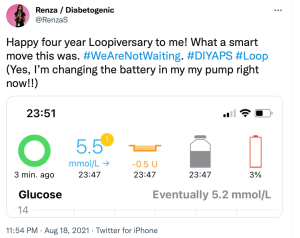
Last week, I hit four years of Looping. That’s 1,460 hours I’ve clawed back. Or over 60 days. If DIYAPS came in a box (and with a PR machine and marketing materials) and it promised me that, I wouldn’t believe it based on previous experience. But I guess that’s the thing. There is no box, there is no marketing juggernaut. It’s just the stories of people with diabetes who have worked through this and worked it out for themselves.
An out of the box marketing solution for an out of the box diabetes technology solution. I’ve never trusted anything more.
Often when we talk or read about technology it is very much about the latest, newest, shiniest devices. And yes, I wrote about those last week. There’s nothing wrong with learning about latest tech releases, or desperately wanting to get your hands on them.
But the devices are only ever half the story. And that’s why it was so great to see that in amongst all the data and the new things, was a presentation that reminded everyone watching the technology symposium at ADC that the data belongs to people and the devices are worn on the bodies of those people.
This is the whole warm hands, cool tech concept that is often missing when we hear about technology. The devices are not inanimate, they need human interaction to make them work for … well … for humans.
I despair at some of the stories we hear about technology and people with diabetes. Some talk experiences that have left them feeling like a failure when the tech has simply not been right for them. Because that is the way it is posed. If we decide the tech doesn’t suit us, hasn’t worked for us, hasn’t helped us achieve our goals, we’ve failed it.
The truth is, it’s more likely that the failure – if we need to frame it that way – is not the PWD at all. It’s more likely that the tech is not right for the person, and there wasn’t enough assistance to help navigate through to choose the right tech. Or the education was insufficient, or not tailored for the PWD, or not interesting, or not relevant (more on that soon, from Dr Bill Polonsky’s opening plenary from the conference). It is possible that the timing wasn’t right, the circumstances were not optimal, not enough conversations about cost or effort required … whatever it is, none of the blame for something not being right should be placed on the PWD.
When we look at diabetes education, or engagement with healthcare professionals, the stories that are celebrations or considered successes (from the perspective of the PWD and, hopefully, the HCP) show the right recipe. The ingredients will all be different, but the method seems to be the same: the person with diabetes is listened too, time is taken to understand what is important for them, the PWD’s priorities are clear, and goals are realistic and checked along the way. The end results are not necessarily based on numbers or data points, but rather, just how well the person with diabetes is feeling about their diabetes, and if anything new has added to their daily burden. Reviews are focused on successes more than anything else.
My favourite ever diabetes educator, Cheryl Steele, gave an outstanding presentation on how HCPs can best work with people with diabetes to ensure we get the most from our technology.
I spoke with Cheryl after her talk (you can watch the video of our chat for Diabetes Australia at the end of today’s post), and she laughingly said that she could have said the most important things she wanted to say in 2 minutes, and with one slide that basically just said that HCPs need to be truly person-centred and listen to PWD.
But thankfully, she spoke a lot more than that and covered a number of different topics. But the thing that got to me – and the thing that I hope the predominantly HCP audience would take home and remember – was Chery urging her colleagues to focus on the positives.
Cheryl said, ‘The emphasis has to be on what you’re doing well’ and I feel that is a wonderful place to start and end healthcare consultations. I think about experiences where that has happened to me. Such as the time I went to my ophthalmologist after a few years of missing appointments and his reaction to seeing me was not to tell me off for not showing up previously, but instead to welcome me and say it was great I was there. I’ve never missed an appointment since.

How many PWD reading this have stories to share of times when they went into an appointment with data and all that was focused on was the out-of-range numbers? There are countless stories in online diabetes groups where HCPs have concentrated on the 10% out of range numbers rather than the 90% in range. Actually, even if only 10% of numbers were in range, that is 10% that are bang where they need to be!
Perhaps that’s what’s missing from diabetes appointments. Gold stars and elephant stamps!
There is something devastating about walking into an appointment and the first, and sometimes only, thing that is on the HCPs radar is numbers that are below or above the PWD’s target glucose range. I’ve sat in those appointments. I know the feeling of walking in and feeling that I’m tracking okay, only to have none of the hard work I’ve managed acknowledged and instead, only the difficulties addressed.
But then, I think about one of the first experiences with the endocrinologist I have been seeing for twenty years. Without judgement, she acknowledged that I wasn’t checking my glucose much, and asked if I felt that I could start to do one check every Wednesday morning when I woke up. I said that it seemed like such a pathetic goal to set, but she gently said, ‘One is more than none’. The focus was not on what I wasn’t achieving. It was on what I could.
What a wonderful motivator that is.
Disclosures
Thanks to the Australian Diabetes Society and Australian Diabetes Educators Association, organisers of the Australasian Diabetes Congress for complimentary registration to attend the conference. This gave me access to all the sessions.
I work for Diabetes Australia and the video shared is part of the organisations Facebook Live series. I am sharing here because is relevant to this post, not because I have been asked to.
As usual, no one has reviewed this piece before I hit publish (which is unfortunate because I could really do with an editor).
This week, I’ve been at the Australasian Diabetes Congress. By ‘at’ I mean ‘sitting in my home office in lockdown, watching sessions on my MacBook’, because that is what ‘at a conference’ means in the time of COVID.
Today is the final day, and I spent a couple of hours in the technology session, listening to news about the latest and greatest in diabetes technologies, as well as the best way to work with people with diabetes who are using these technologies. I’ll be writing about the latter next week.
Today is all about shiny new stuff!
Big tech news from the Congress was the announcement from Insulet Australia that Omnipod DASH will be available this month, which is fabulous because it means that there is another choice added to the pump market for Aussies with diabetes – and a tubeless pump at that!
The not-so-great news is that Insulet has been unable to successfully negotiate a reimbursement model with the Department of Health. Pumps in Australia are generally covered through private health insurance, and pump consumables subsidised through the NDSS.
This has worked perfectly well to date because pump products have been easily divided into devices (the actual pump) and consumables (infusion sets and reservoirs/cartridges). The Omnipod system is different – it comprises a tubeless pod which is, essentially the pump and consumables. The pod is worn for three days before being discarded. There is a touchscreen ‘personal diabetes manager’ which is used to drive the device. This system simply doesn’t easily slide into the funding model that has worked for the last thirty odd years.
The latest notice from Insulet Australia is that they will now have to go through another submission process, and that will take a further 8 – 12 months. There is no guarantee of reimbursement at the end of this process, but Insulet – and Aussie PWD – are hopeful there will be good news.
Frustratingly, this means that anyone who decides that they really want an Omnipod and want it now needs to purchase it out of pocket, with no subsidy scheme on offer. The price that was announced at the Congress is AUD$400 for a one-month supply. There will be discounts for two- or three-month orders.
In other new tech news, Abbot’s new flash glucose monitor, Libre 2, is very much now available in Australia, and the positive here is that it is already listed on the NDSS for those eligible for the CGM Initiative. Those of us who need to pay out of pocket, the price is the same as for the first-generation Libre. It’s a small win.
Libre 2 has been out and about in Europe for some time now (and Libre 3 is out in limited release in some markets), and has recently received approval for use in the US.
The main difference with Libre 2 is that it alarms when glucose levels are out of range. The wearer will still need to scan over the sensor (either with a mobile phone or reader device0 to see the actual reading, but they will have been alerted to any numbers that are either too high or too low. The great thing is that the alarms are optional, which is great for PWD who prefer their diabetes to be silent.
It’s been described as an evolution rather than a revolution, which is not a negative. We don’t necessarily need every new generation to be a complete and utter overhaul with all new bells and whistles, but it’s always great to see improvements – especially when they are improvements PWD have recommended! I haven’t tried the Libre 2 yet, but will be doing so in the next week or so.
You can find more information about these two new technologies by clicking on the images below.
Omnipod (there is currently very limited information on the site, however that should change in coming weeks.)
Disclosures
Thanks to the Australian Diabetes Society and Australian Diabetes Educators Association, organisers of the Australasian Diabetes Congress for complimentary registration to attend the conference. This gave me access to all the sessions.
I hosted the Australian launch of the Omnipod DASH for diabetes advocates back in May this year, and was paid an honoraria for my time.
Abbott Diabetes Australia has provided me with a Libre 2 sensor to use.
All words here are mine and I have not been asked or paid to write anything you’ve just read.
What’s the holy grail when it comes to diabetes technology? I suspect the answer may change depending on who you ask. Different people with diabetes, different ideas of burden, different priorities. But one thing that seems to be quite universal is that people with diabetes want to do less when it comes to their diabetes, and they want tech to help with that.
Each and every week, I get asked to review or promote new apps, devices and other types of technology. Or I am asked if I can provide some feedback on an idea which has the aim of improving the life of people with diabetes.
When time permits, I’ll spend some time with developers, and I always start by asking ‘What’s your point of difference?’. I want to know that because there’s so much out there already, and if it’s just another app or program to add to the noise, why bother?
The point of difference I am always searching for is the bit that means doing less. Anything that requires more input or thought process than what is currently available, without offering benefit elsewhere seems to be a waste of time.
I want to do less for more. Surely that’s not asking too much…
For me these days, if I want to check my glucose level, I glance down at my watch. I don’t need to do anything more. Or I swipe right on my iPhone to see a little extra: the header of my Loop app (which shows current glucose level, predicted graph, IOB and battery volume).
To bolus, I either open the Loop app on my phone (two taps after waking my phone), or on my watch and go from there (one tap after waking my watch).
It takes very little effort. I don’t in any way have to stop what I am doing. And it is super inconspicuous. No one knows what I’m doing – not that I’d care. But it’s nice not to have to do something that often draws attention, or questions from others.
I have often wondered if I’ll try a Tandem t:slim pump once Control IQ is finally launched into Australia, and the one thing that is stopping me is knowing that I’d have to give up bolusing from my phone or watch.
New devices or technologies that demand more seem to be in direct contrast to PWD demanding to do less. I wrote this piece after a conference presentation about the (first gen) Medtronic hybrid-closed loop system that showed added burden from users because the system required so much extra input. The very idea that a device developed to increase automation needed users to think about it more was baffling.
DIY systems are developed by people with diabetes, or loved ones of people with diabetes. Having that skin in the game means that there is a determination to deliver not only a product that does more, better, but one that doesn’t add to diabetes burden. You will never hear the idea of ‘it’s good enough’ because to us, it never is!
But even with these goals, there still is a user burden. Cartridges don’t fill themselves; infusion sets don’t change themselves; sensors don’t insert themselves; batteries don’t replace or recharge themselves.
Which brings me to the latest toy I’ve started using, which has managed to cut a few tasks from my diabetes job list.
The diabetes DIY world continues to push the envelope with all components of systems. And the latest from a group that has been looking at the use and affordability of CGM has recently been launched (albeit in limited numbers).
Say hello to Anubis, named for the god of death and the afterlife. The group working on Anubis has worked out how to give used G6 transmitters a new life, and, quite frankly, they are far more impressive in their afterlife! Simon Lewinson from the stunning and aptly named Mt Beauty part of Victoria has led on this work. Simon is the bloke who developed a rechargeable G5 transmitter – the Fenix – which has been one of my all time favourite pieces of DTech ever. I used it continually for about three years, only stopping to trial an Anubis.
I realised just how impressive the other day when I checked the settings on my newly inserted sensor using an Anubis transmitter:

That number circled is when my sensor expires – 60 days after the sensor was inserted. What that means is that there is no need for me to do a restart after 10 days. I’m not sure how many of you reading this have tried to restart a G6 sensor, but my experience has required my husband and a butter knife, and ensuring that sensor restarts were only done when there was harmony in the home. As someone who fully self-funds CGM, I will get every single last minute of life out of a sensor, so restarts G6s up to three times.
The spouse-wielding-cutlery step has now been removed, as has the need for a two hour warm up every ten days. Now, a sensor goes in, and it keeps going until it finally just stops working. I’m not really sure how long that will be. It’s day 12 now and there’s not been a blip, and I’m super interested to know just how many days it will tick along, undisturbed and uninterrupted. I certainly don’t expect to get to 60 days, but I’ll give it a red hot go!
My Anubis is the latest device in my arsenal that is helping to chip away at all the things diabetes demands of me – things that, quite honestly, spark no joy at all. I’ve not yet found that holy grail, but compared with what else there is available to me, and what I have used before, this is better. Less work, less burden, better results. Why wouldn’t I want more of that?!
Want more information?
The Bionic Wookiee has written this terrific piece explaining the nitty gritty tech details of Anubis. My eyes usually glaze over when reading this sort of stuff, but David does a stellar job making it interesting. And understandable!
Want an Anubis? Of course you do. This is the FB page to head to. It’s a new page and there’s not much on there just yet, but it is where info will be shared.
I really wanted to call this piece ‘Hey, ableds, leave our kit alone’, but decided against it.
Over the weekend, two main things seemed to dominate diabetes twitter. The first was the suggestion from a nurse (in a now deleted tweet) that shoving cake frosting (more commonly called icing in my parts of the world) up the arse (more commonly called ass in other part of the world) of an unconscious person with diabetes was an excellent hypo treatment. The second was this picture:

Let’s just say that sexually assaulting a PWD to give them glucose is not a good idea, no matter how hypo you think they are. Call an ambulance, rub some frosting (or honey etc.) on their gums, or, if they have glucagon with them, and you what to do with it, use that. Once again, just to be completely and utterly clear, decorating the arse of people with diabetes as if it’s a plain tea cake in need of some ready some embellishing and sprinkles, is not appropriate without consent. If everyone is conscious and there is consent, do whatever you will.
With that out of the way let’s move to the second fun little incident and that photo. That’s right, it clearly refers to one of the diabetes devices that I and many others use to keep an eye on our glucose levels because the bit of our body that takes care of it broke.
Even before this photo appeared, there has been a lot of commentary from people with diabetes (PWD) about people without diabetes (non-PWD) using any sort of glucose sensing device. I think that in coming years we’re going to only see more of it as the makers of CGMs and Flash GM start to advertise the allure of glucose tracking to a broader audience, or, as is the case with the little photo above, third party app makers jump on board.
Because the diabetes community never has one united opinion on things, (although I’m yet to have heard from a PWD who has thought the icing-up-the-bum-for-hypo-treatment idea is a good one), some people are violently opposed to the idea of non-PWD using CGM. Others couldn’t be less fussed about it if they tried. And some actually think it’s great. There is no one way to respond, and everyone’s feelings are valid.
I have a lot of feelings wondering why non-PWD would want to do diabetes. From hypo simulators, to wearing a pump with saline in it, and lining up to get an A1c checked for fun – I’ve seen it, and I’ve written about it. Again, no one needs to agree with my feelings, although it seems from the feedback I get, a lot of people do.
But I have to say that the idea of CGMs as a weight loss tool was a new one for me. I understand that some people who are deep into the keto way of life use them, but my understanding of this is so they can repeatedly prove to themselves (and badger others) that eating meat causes minimal changes to glucose levels, but eating grains of rice make lines move.
I did a bit of a deep dive into the company behind this picture, (they are not the only one that is moving to capitalise on the excitement and interest around biohacking) and all I could find was a whole lot of pseudo-science speak that just screams scam to me! It preys on the insecurities of those who are trying to find happiness in the latest and greatest wellness fad. But this time, they claim to have science on their side.
This isn’t new. Weight loss cons from ‘teatoxes’ to fat-busting pills to miracle diets to superfood super-promises, have been around for years. There is a reason that new players come onto the market every week, and that reason is not because they work. It’s because we have diet industry worth billions, we have people – often young girls – being told their worth is tied up in the number on their scales, and we have people desperately looking for something that will work to get them to that number, and get them there quickly.
To explain their claims, they use science-speak to suggest that there is a medical side to what they are doing. It seems that the ‘trust me, I’m a doctor’ line works well for a lot of people. As do the words around graphs, data and glucose statistics. That might work for people who haven’t spent a shedload of time around doctors talking about graphs, data and glucose stats, but those of us who do, might see this as a load of bullshit.
This, directly from the company’s website claims that the app ‘…provides an immersive experience that shows you a continuous line graph of your glucose data; provides alerts when glucose spikes or dips out of your weight-loss range’.
Weight-loss range? I really don’t understand what that means because the only time my glucose levels have equalled weight loss is when they have been off-the-charts high. Such as before I was diagnosed with diabetes, and the time I was in DKA thanks to gastro. I doubt that the idea is to somehow send people without insulin-requiring diabetes in DKA, because that is going to take a lot more than just banging a sensor on your arm, and loading an app onto your iPhone.
Of course, that’s not what they mean. They are suggesting that by keeping glucose levels withing a tight range (the ‘weight-loss range’), there will be no excess glucose needing to be stored as fat.
There is limited evidence to support that measuring glucose levels on non-PWD is beneficial, so the science is shaky to say the least. But that doesn’t stop the program being presented as super science-y and evidence-based. And for a lot of people, that illusion of science means they think that the subscription cost (because there’s always a subscription cost!) is worth it.
But let’s move away from that for a moment, let’s ignore the lack of science, the cost and the hint that this could be nothing more than a money-making scam, targeting vulnerable people, because there is more that comes into play which explains why so many in the diabetes community push back at non-PWD wearing diabetes devices.
Continuous glucose monitors were created for people with diabetes to better manage our condition. They give us access data that helps managing our diabetes like never before. They are life changing. They are life saving. They are also only available to a small percentage of the global diabetes population. I haven’t even touched on the fact that generally, it’s only people with type 1 diabetes who have access. People with other types of diabetes are even less likely to be able to get subsidised or funded CGM, even though many of them might benefit from using them.
The idea that CGMS are toys of privileged biohackers, and being used exclusively as a weight-loss tool does not sit well with many. It does not sit well with me. If I look at Australia, only half of people with type 1 diabetes have subsidised access to CGM. The rest of us are left to having to find about $4K per year to fund the devices that really make a difference to our lives, that some of us say we couldn’t live without.
The weight-loss focus from this particular company is problematic when considering the higher rates of disordered eating, and insulin omission or restriction in people with diabetes for the purposes of weight loss. Some claimed that seeing CGMs heralded as being about weight loss, when they are using it as part of their eating disorder recovery was triggering. These factors all come into play within the diabetes community.
And finally, the idea that increasing use to a far broader community will bring down the cost…? Let’s just be reasonable about that (or sceptical…) and say that’s not going to happen. If that was the case, the fact that every keto-follower worth their ketosis now regularly checks their ketones, would mean that blood keto strips would be cheap as chips. That’s not the case at all.
The potential of medical devices being used outside of the reason they were created is likely to be explored a lot more in coming years. With (non-healthcare) tech companies moving into the space, it is not only possible, but highly likely, that glucose sensing (albeit non-invasive) will become standard on wearables, in the same way step counters have. But we’re not there yet. Right now, the best use of these devices is where the evidence points – on the arms (or bellies, or thighs, or wherever!) people with diabetes are wearing them, to assist with diabetes management, to help us with our decision-making process, and to improve our lives.
NOTE:
In this piece, I mean ALL people with ALL types of diabetes, including pre-diabetes. Basically, any condition that means an individual needs to consider glucose levels.
Today, there was an article in online publication, The Limbic, which reported on a recent study conducted out of Westmead Hospital Young Adult Diabetes Clinic
The top line news from this research was that there is a high discontinuation rate of CGM in young people (aged 15 to 21 years).
Let me start by saying I know that CGM is not for everyone. I don’t believe everyone should use it, have to use or even necessarily be encouraged to use it. As with everything, your diabetes technology wishes and dreams may vary (#YDTWADMV really isn’t a catchy hashtag, is it?), and there is a lot to consider, including accessibility and affordability. In Australia, affordability is not such an issue for the age group that was studied in this research. Our NDSS CGM initiative means that access to CGM and Flash is fully taxpayer funded (with no out-of-pocket expenses) for pretty much all kids, adolescents and young people up to the age of 21, provided a healthcare professional fills in the relevant form.
The top-level findings from this research are that within the first week of starting to use CGM, almost 60% of study participants stopped. The decision to start CGM was made after a one-hour education program that was offered to 151 young people with diabetes, and 44 of them decided to start CGM. Of those 44, 18 young people continued using it. They happened to be the 18 young people who were more connected with their HCP team (i.e., had more frequent clinic appointments) and had a lower A1c, which the researchers suggested meant that they were struggling less with their diabetes management. The 26 young people who chose not to continue cited reasons for stopping such as discomfort, and inconvenience.
I had a lot of questions after I read about this research. (These questions arose after reading the Limbic’s short article and the research abstract. I will follow up and read the whole article when I can get access.)
If the young people who chose to not continue were already struggling with their diabetes management, is adding a noisy, somewhat obvious (as in – it’s stuck to the body 24/7), data-heavy device necessarily a good idea? Was this discussed with them?
Was any psychological support offered to those young people having a tough time with their diabetes?
Was it explained to the young people how to customise alarms to work for them? If diabetes management was already struggling and resulting in out-of-range numbers, high glucose alarms could have been turned off to begin with. Was this explained?
What education and support had been offered in the immediate period after they commenced CGM therapy? Was there follow up? Was there assistance with doing their first sensor change (which can be daunting for some)?
In that one-hour education they were offered before deciding to start on a CGM, did they hear from others with diabetes – others their own age (i.e., their peers) – to have conversations about the pros and cons of this therapy, and learn tips and tricks for overcoming some typical concerns and frustrations?
What was in that one-hour education program? Apparently, 151 young people did the program. And only 44 people chose to start CGM. Now, as I’ve already said, I don’t think CGM is for everyone, but 29% seems like a pretty low uptake to me, especially considering there is no cost to use CGM. Did anyone ask if the education program was fit for purpose, or addressed all the issues that this cohort may have? Why did so few young people want to start CGM after doing the program?
Were they using the share function? Did they have the opportunity to turn that off if they felt insecure about others being able to see their glucose data every minute of every day?
What frustrates me so much about this sort of research and the way it is reported is that there is a narrative that the devices are problematic, and that the people who have stopped using them have somehow failed.
CGM may not be for everyone, but it’s not problematic or terrible technology. I remember how long it took me to learn how to live with CGM and understand the value of it. It took me time and a lot of trial and error. I didn’t want to wear CGM, not because it was lousy tech, or because I was ‘failing’, but because I hadn’t been shown how to get it to work with and for me. I had to work that out myself – with the guidance of others with diabetes who explained that I could change the parameters for the alarms, or turn them off completely.
And these young people are YOUNG PEOPLE – with so much more going on, already struggling with their diabetes management, and not connected with their diabetes healthcare team as much as the young people who continued using CGM. Do we have any information about why they don’t want to connect with healthcare professionals? Could that be part of the reason that they didn’t want to continue using CGM?
I don’t think we should attribute blame in diabetes, but it happens all the time. And when it does, blame is usually targeted at the person with diabetes, but rarely the healthcare professional working in diabetes. If a person with diabetes is not provided adequate, relevant education and support for using a new piece of tech, there should not be any surprise if they make the decision to not keep going with it.
The positives here is that there is data to show that young people who are already struggling with their diabetes management may need other things before slapping a CGM on them. Cool tech can only do so much; it’s the warm hands of understanding HCPs that might be needed first here. Someone to sit with them and understand what those struggles and challenges are, and find a way to work through them. And if CGM is decided as a way forward, work out a gently, gently approach rather than going from zero to every single bell and whistle switched on.
I am a huge supporter and believer in research and I am involved in a number of research projects as an associate investigator or advisor. I’m an even bigger supporter in involving people with diabetes as part of research teams to remind other researchers of the real-life implications that could be considered as part of the study, offering a far richer research results. Growing an evidence base about diabetes technologies is how we get to put forward a strong case for funding and reimbursement, increased education programs and more research. But sometimes there seems to be a lot of gaps that need filling before we get a decent idea of what is going on because the findings only tell one very small chapter in the diabetes story.

Chances are, Australians with diabetes will know who Stanley Clarke is, especially those who have many years of diabetes under their belt. Pretty much every person with diabetes who checks their glucose levels is benefiting from his legacy.
If you don’t know who he is, or his story, and don’t get Circle, let me give you a little taste of this remarkable man and his contribution to diabetes as we know it today.
I was thrilled to read a beautiful profile of Stanley in this month’s edition of Circle magazine, the quarterly magazine from Diabetes Australia. (And by way of disclosure I am employed for Diabetes Australia, and I write an article for each edition of the mag.)

Stanley and his wife Audrey’s daughter Lisa was diagnosed with diabetes in 1972, aged 5 years. As was the norm at the time, she relied upon the only option for checking glucose levels at the time: using Benedict’s solution, drops of urine and colour charts to provide highly inaccurate and misleading results. That was as good as it got!
Stanley was an electronics engineer, and he knew that there had to be a better way. In fact, he’d seen the better way – machines that were available in hospitals that checked glucose in the blood. But these machines were large, and very expensive and not considered part of routine, daily, at home care for people with diabetes. Stanley set about to change that.
He worked to develop a smaller, portable, battery-operated blood glucose machine and in two weeks had a prototype that he was ready to show his daughter’s paediatric endocrinologist. The endocrinologist, diabetes legend, Martin Silink, was impressed and ordered 30 and then an additional 200 machines to be given to children at the hospital. Apparently, within six months, every child with diabetes at the hospital had a home glucose meter, and monitoring blood glucose levels was part of their routine, changing their diabetes management forever.
Clarke machines were ordered and sent to all corners of the globe as people with diabetes everywhere were keen to be able to access this new technology which improved outcomes and reduced diabetes burden.
The machines were sold for what it cost Stanley to make them. He wasn’t interested in making a profit – only in that the machines were available and accessible to people with diabetes.
I read the beautifully written tribute to Stanley in Circle, getting a bit teary at some of the beautiful stories of people who had benefited from this new technology. And my reading was also tinged with a sense of familiarity. I didn’t have diabetes when his home blood glucose meters became common, but I certainly did benefit from it.
Even more so, I have benefitted from the ingenuity of people directly affected by diabetes. The #WeAreNotWaiting movement is built on the shoulders of people like Stanley and it continues to push boundaries and seek solutions for diabetes problems that we know matter. We know they are problems because we live with the consequences of them every minute of every day. We celebrate when the solutions are presented to us because we know what a difference they will make.
I remember hearing Dana Lewis speak about her work that meant she could actually hear her CGM alarm at a volume that woke her up at night, and understanding why that was something so critical.
I remember hearing about Nightscout for the first time, and how one of the benefits of remote monitoring meant that parents felt more confident allowing their kids to have sleepovers at friends’ houses, and understood just why that made all the difference to kids with diabetes.
I remember hearing someone tell me all about using DIYAPS, and I understood not only why it was a vast improvement on commercial diabetes therapies, but it made me determined to build a system for myself. And how glad I am that I did!
I find it unbelievable, and more than a little tragic, that at the same time that there is this incredible user-led innovation happening, there is also pushback. The opposition takes many forms, but it seems to come back to the same thing, and that is the discomfort of many working in healthcare and their reluctance to trust what people directly affected by diabetes are capable of.
I wrote in this piece a few years ago about the predictable way that many HCPs recoil from new therapies. There are reasons thrown around for that: no money to fund it; no evidence to support it; safety concerns.
But money doesn’t seem to be the driving factor propelling the innovators forward (a nod to Simon Lewinson who has been providing re-batteried CGM transmitters to people in Australia meaning that for them, that therapy is actually affordable). Safety is always the primary concern for those of us using these technologies, and to suggest otherwise is an insult. And the evidence is there, perhaps just not in expensive RCTs, which need to stop being considered as the be all, end all.
Stanley Clarke changed the way that day-to-day diabetes was managed and so have others since then. And all I can think of is that we are so, so fortunate to have innovators like that whose only motivation it seems is to improve a life lived with diabetes. What a truly remarkable goal to have.
Last week, I posted this on Twitter:

I take no credit for these numbers or that straight CGM line, or the first thing in the morning number that pretty much always begins with a 5. Those numbers happen because my pancreas of choice is way smarter than me. Actually, in a perfect world, my pancreas of choice would not be outsourced, but what are you going to do when the one you’re born with decides to stop performing one of its critical functions?
Anyway. I should know by now that any time diabetes thinks I’m getting a little cocky or too comfortable, something will happen to remind me not to get used to those lovely numbers.
And so, we have Tuesday this week. I woke up with a now very unfamiliar feeling. I reached over and looked at my CGM trace which immediately explained the woolly-mouth-extreme-thirst-desperate-to-pee-oh-my-god-I’m-about-to-throw-up thoughts running through my head. I found the culprit for that feeling very quickly – a pump with an infusion set that had somehow been ripped out overnight.
I didn’t get a screenshot of that number in the high 20s to share, because my head was down the loo. Ketone-induced vomiting is always special first thing in the morning, isn’t it?
I put in a new pump line, bolused and waited, all while resisting the urge to rage bolus the high away. Because that’s all there is to do, isn’t there? I hoped that just waiting and allowing Loop to do its thing would work, and that everything would settle neatly – especially my stomach which was still feeling revolting.
And as I lay there, I had another feeling that is somewhat unfamiliar these days: the feeling that I absolutely loathe diabetes. Beautifully mimicking the waves of nausea were the waves of my total hatred for this condition and how it was making me feel and the way it had completely derailed my morning’s plans.
I don’t feel like that most of the time anymore, because diabetes so rarely halts me from taking a moment out to deal with it. Hypos are so infrequent, and so easily managed; hypers that need real attention just don’t happen; sleep is so seldom interrupted because of diabetes anymore. Life just goes on and diabetes drones on in the background – annoyingly, but not too intrusively.
But this morning was completely handed over to diabetes to wait it out for my glucose levels returned to range – thankfully with a gentle landing and no crash – and for my stomach to stop lurching. Ketones were flushed and the feeling of molasses-y textured blood running through my veins subsided.
By the afternoon I was feeling mostly human, with nothing more than a slight hangover from the morning. But the feeling of diabetes hatred had been reignited and was flashing through my mind constantly.
A couple of days later, with a full day of decent numbers behind me, there is no physical aftermath of those few hours of diabetes trauma. But there is a whisper of the absolute contempt I feel towards diabetes. It’s always there, I guess. It just had reason to rear its ugly head.
My email autoreply is on and I have a glorious four weeks of holidays to look forward to. The last time I took any time off was back in January when my family travelled to NYC. There is no travelling this year. We have a new, beautifully landscaped back garden to camp out in over the next month instead. (By ‘camp out’ I mean sit comfortably on a sun lounger and drink Pimm’s.)
My plans are simple – do as little as possible. I’ve rallied against taking any time off this year because I’ve not seen the point. Why would I take time off to simply stay within the walls that I’ve stayed within for most of the year?
That was a mistake. I should have taken some time off. I should have stepped away from the computer and from work – even if it were just for a couple of days.
And so, I’m going to truly try to log off, to not stare at my computer, or open my laptop to just write a quick thing, revise something I’ve been working on, message a friend. I’m going to remove SoMe apps from my phone so that it’s not all that simple to quickly check for an update of what is going on in the Twitterverse or the world of Facebook and Instagram.
I wanted to finish the year on a positive by highlighting some of the people who have made the DOC truly remarkable. So, this is a little Interweb Jumble of the folks in the DOC who have made the place safe, happy and continue to truly be about community. Check them out if you already don’t. Expanding your view of the DOC is important if you want to learn about more than just your part of the world.
Cherise Shockley has a new podcast…
…and you should subscribe! It’s called ‘Don’t Keep it to Yourself’ and it’s my favourite new diabetes podcast which is completely not about diabetes! Instead, Cherise is pushing people outside their comfort zones and asking them to share things that others may not know about them. I’ve loved hearing the episodes she’s already shared and had an absolute ball chatting with her.
The thing about Cherise is that she IS community. Even though her podcast is not about diabetes, it is still about people supporting and looking out for each other. Because that is who this woman is! Subscribe and listen from wherever you subscribe and listen to podcasts.
DOC friends who have made me uncomfortable – but in a good way.
First up is wonderful Steffi from Pep Me Up whose Instagram stories challenged me to look at what was going on in the world in different ways. She has been absolutely relentless in her efforts to elevate the stories of people who are forgotten or left behind and highlight the bias we inherently have. You can find Steffi on Instagram here.
And secondly, the also wonderful Tine who you can find on Twitter at @SayTine. We’ve known each other for a number of years now and we bonded over a mutual love of food. We have been allies in the language matters movement. Tine’s feminism has always been aligned with my own, but she has introduced me to different people and ideas that have made me consider some of my own ideas.
Accessible Dtech information…
…from the always enthusiastic and excited Nerdabetic. I met Kamil for the first time a year or so ago and discovered that he is every bit as awesome and lovely in real life as he is online. I love the way he makes the latest in diabetes tech accessible and relevant to tech-imbeciles like me while also making it relevant to people whose interest in and understanding of technology generally makes my brain synapsis short circuit. It’s great to see Kamil appearing in the global DOC more with appearances on diaTribe. Kamil’s YouTube channel is here.
Brilliant photography…
…from a DOC stalwart. Mike Durbin was one of the first people I noticed in the DOC when I started participating in DSMA tweetchats over ten years ago. I’ve never met him, but am always interested in what he has to say, and his thoughtful takes on the diabetes world. Mike appears in every single presentation I give about diabetes peer support and the DOC because I always share this picture. It speaks community to me.

On top of being such an integral and wonderful part of the DOC, Mike is a truly outstanding photographer and this year, I have found myself absolutely obsessed with what he has shared. You can see his work on Twitter here.
More Clever creatives
I adore the gorgeous artwork Nicole Buchanan shares on her Instagram. She absolutely nails diabetes moments with stunning designs and clever captions. I’ve shared so many of her posts because it’s like she has climbed into my head and then perfectly explained the mess in there with a beautiful illustration. You can follow her on Instagram here.
Another favourite diabetes creative is Katie Lamb, another talented illustrator who manages to capture diabetes in her lush drawings. She’ll even draw you for a small fee! Find her here.
Aussie Jenna Cantamessa continues to share beautiful drawings on her Instagram here, and she has just opened an Etsy store so you can own one of her beautiful pictures.
Special mention to dedoc for keeping PWD at conferences…
…because it would have been all too easy for us to have been forgotten with conferences going online. Bastian has done a stellar job getting DEDOC Voices up and running, offering scholarships to PWD to be part of ATTD (the only IRL large-scale conference this year), EASD and ISPAD.
CWD keeping people connected
Children with Diabetes did a herculean job of not only running hugely successful Friends for Life conferences online, but also churned out relevant content all year, and seemed to run a bazillion meetups to keep people connected. In case you missed the fireside chat hosted by Kerri Sparling about #LanguageMatters, you can play catch up here.
Spare a Rose…
…will be back next year, but I just wanted to mention the amazing efforts of the community this year as we smashed all previous records and delivered a magnificent USD$73,748 straight to Life for a Child. How remarkable is it when the DOC stops looking inwards??
The offline DOC friends who kept me going…
…are the reason that I have reached this stage of this year with some sense of balance. A huge thank you to the squad of four friends from the US & UK who have shared their lives with me throughout this clusterfuck of a year in an endless message thread that has kept me going. And the IRL friends too – with special mentions to Georgie and Jo. I am so grateful we live close to each other.
And don’t forget…
…please do consider making a donation to Insulin for Life’s Secret Santa Campaign.
Finally…
…that’s all from me for 2020. I’ll be back in the new year, but for now I am switching off and doing everything in my power to be less busy, less online and less engaged. Probably the only downside I see with Loop is how reliant it is on being close to my iPhone at all times, because honestly, I would like to let my phone battery run flat and not charge it up again until the end of January! But I am making a concerted effort to turn off and ignore notifications and be more present with the people I am so, so lucky to spend my life with. To those celebrating, have a wonderful festive season. Thanks to everyone who has stopped by. See you in 2021.
The OPEN Diabetes Project is currently running a survey to look at the impact of do-it-yourself artificial pancreas systems (DIYAPS) on the health and wellbeing of users. There are stories all over the DOC about how people with diabetes (and parents of kids with diabetes) have taken the leap to Loop. These stories provide wonderful anecdotal tales of just why and how this tech has helped people.
The idea behind this new survey from the OPEN Diabetes team is to continue to build evidence about the effectiveness of this technology as well as take a look into the future to see just what this tech could have in store.
And important part of this new study is that it is not only OPEN (see what I did there?) to people who are using DIYAPS. That means anyone with diabetes can participate.
This project is important on a number of levels. It was conceived by people with diabetes and a significant number of the people involved in the project team (and I am one of them) are living with diabetes. We very much live the day-to-day life of diabetes and that certainly does make a difference when thinking about research. Also critically important is the fact that the ACBRD has recently joined the OPEN Project consortium. Having a team of researchers exclusively looking at the behavioural impact of diabetes technology will offer insights that have not necessarily been previously considered in such a robust way.
All the information you need can be found by clicking on the image below – including who to speak with if you are looking for more information. Please share the link to the survey with any of your diabetes networks, healthcare professionals who can help pass on details and anyone else who may be able to help spread the word.
A reminder – this is open to everyone with diabetes – not just people using DIYAPS. (I’m stating that again because it may not be all that clear as you are reading through the material once you click through to the survey.) You do not need to be Looping or ever tried the technology. Anyone with any type of diabetes, or parents/carers of kids with diabetes can be involved.

DISCLSOURE





