
You are currently browsing the category archive for the ‘Stigma’ category.
My first endocrinologist was a really nice man. He was very kind in the way that he acknowledged that I was dealing with something quite scary – a new diagnosis of type 1 diabetes.
I remember he was nice. In fact, when people asked me what my new doctor was like, it is highly likely that I actually used that word to describe him.
What I remember more was the way that he told me about diabetes-related complications, and the way that he told me that if I didn’t look after myself, and follow his instructions to the letter, that I would get those complications. If I was a good girl and did as I was told, I would be right. If I didn’t, every one of those terrifying, horrible, distressing complications would occur and it would be my fault.
Now, he didn’t say this in an ‘un-nice’ way; he wasn’t mean, he wasn’t cruel, he didn’t yell. He was saying it as if it was an absolute, and I quickly came to understand that being compliant was what was expected, and that there was a good and bad way to behave in diabetes, and that resulted in good and bad numbers. If I did what he said, I was good; if I didn’t, I was bad. And if I was bad, terrible things would happen and I would have no one to blame but myself.
That was twenty-one and a half years ago, and I can still hear those words in my head. The language he used set me on a course of not coping with my diagnosis and feeling intense fear about my future – a fear that sometimes paralysed me into inaction.
This week, there has been discussion on Twitter about what the #LanguageMatters movement is all about. It started with this tweet from a diabetes consultant in the UK, which suggests that it is ‘..mostly about being nice…’.
Eight years ago, when Diabetes Australia launched the first language position statement, the response from many was that this was not an important issue and that perhaps we should put our efforts into other things; things that matter. This was seen as a little bit of fluff that was a waste of time. It’s political correctness gone mad, was the reaction from many.
We’ve become smarter at showing the evidence to support just how destructive words and language can be. We hear stories from people who explain how damaging language resulted in them not seeking help when needed, and how the fear of being blamed kept them away from their healthcare team. We can show that diabetes gets fewer research dollars; that it’s harder to get people to put their hands in their pockets to donate to a diabetes charity, and that the general community does not understand just how serious diabetes is.
The timing of things is interesting, and it seems that last night someone on the TV show The Great British Bake Off referred to a dish as ‘diabetes on a plate’. The host’s reference to the sugary confection in that way wasn’t about him not being nice. It was about him using a phrase that has been thrown around by many for years, because it is accepted that diabetes is something to make fun of.
Now sure, the way people responded to this incident could be termed as nice and not nice. Nice would be ‘Please don’t refer to my health condition like that’; not nice would be ‘Don’t be an arse’. Obviously, I lean towards the latter. (Also, not especially nice is using an example like this to explain the different types of diabetes, because it is not relevant to the discussion and only adds stigma to type 2 diabetes. Don’t do that!)
As I read the tweets responding to this tired ‘joke’ from people in the diabetes community, what I saw was not people urging the TV host to be nice. It was for him to understand the seriousness of diabetes, to stop shaming people with diabetes, to not fuel the misconception that sugar causes diabetes, to not make diabetes a punchline.
People make diabetes ‘jokes’ because the words and language used around diabetes for years has given them permission to do so. And with that, attitudes were formed and the construct that diabetes is self-inflicted and free game for comedians and TV hosts became accepted.
And that’s where we are now and what we have to undo.
Perhaps part of the problem is that we don’t have an ‘ist’ or ‘ism’ word that we can attach to the language matters movement. We understand that when we challenge racist or sexist conduct, we are not asking people to simply ‘be nice’. We are trying to make a culture shift away from such damaging attitudes and to change behaviours. When I call out a bloke for making a sexist comment, I’m asking him to reconsider the way he thinks about women, change his behaviour and be respectful. I’m not asking him to ‘be nice’. I’m asking him to stop being sexist.
When someone makes a comment about someone based on the colour of their skin or the country they were born, we don’t dismiss it as them not being nice. We (rightly) expect them to stop that rhetoric because it is wrong and no acceptable.
So, I’m making up a word (and I hate made up words…). If you use words and language that judges, shames, blames, and stigmatises people with diabetes, you are being diabetesist. Diabetesism is not okay and should not be tolerated, and we need to challenge people behaving in that way. Perfectly nice people could still be diabetesist; their attitudes are long-held and seemingly socially acceptable. It’s what they have heard all their lives. We need them to stop doing that.
Here’s the thing: I don’t actually consider myself as being a particularly nice person a lot of the time. Nice people are agreeable, and don’t challenge others or their ideas; they accept them. They don’t call people out on Twitter. They’re not the person who rocks the boat. I am the boat rocker, and I do that because I believe that there are institutional, systematic problems that need to be changed in diabetes and diabetes care, and one of those is the way that the language used around diabetes.
So, back to where this all began and this tweet. I agree that berating HCPs is not the way to get the message through. #LanguageMatters is not only looking at HCPs attitudes and behaviours, anyway. My strongest criticism has been aimed squarely at the media and industry. I also believe that it works best when all stakeholders are involved.
But while I accept that there are different approaches, I don’t accept – and really don’t appreciate – that all the work, the research, the education and the efforts about this issue can be distilled into the concept of good manners and niceness.
I also believe in taking a harder line. That doesn’t mean haranguing or being aggressive. But it does mean understanding that there is a (real or perceived) power imbalance in healthcare, and those with influence should be held to account when it comes to the way they speak to and about people with diabetes. It means calling out HCPs and researchers when they stand up at conferences use language that hurts us by reinforcing wrong attitudes; correcting the media when they get it wrong, and calling out industry when their marketing teams misfire.
And I also believe that this is personal. Living with diabetes is not a bit of ‘fun stuff’ or something that we chose to do. It is incredibly personal for me and every single person with diabetes who has been made to feel not enough, or blamed or shamed, or judged or mocked due to beliefs about diabetes – beliefs that have been formed and accepted over time because of the language and attitudes about our health condition. The concepts of non-compliance, of good and bad numbers, of ‘bringing this on myself’, of ‘diabetes on a plate’, of grading A1cs have all been thrown at me, and affected me in ways, varying from feeling a little annoyed right through to deciding diabetes care was an exercise in futility so I was simply not going to bother anymore.
That is why #LanguageMatters and I would ask – and urge – everyone working in this space to listen to those of us living with diabetes, hear us. And sit down and learn. Sure, we can all be nice, because being nice is a good thing to aim for (and I promise that I will endeavour to do better there, too), but accept that language matters much, much, much more than that.

Firstly, let me start this piece by saying #NotAllHealthProfessionals. There: I got it out there upfront because I know that what follows is likely to garner response from a shedload of healthcare professionals that they would never do the sort of crap I am about to write about.
Sure – I know that there are lots of great ones out there. I get that there are champions for our cause; HCPs who genuinely walk alongside us and truly listen to what we say and what we need.
But here’s the thing. It takes more than that; more than just doing the right thing in your own little world. It takes guts and leadership to take a stand, and it takes standing up to colleagues who are not getting it right. And sadly, even the good ones don’t do that enough.
Last week, I shared a pathetic image from a Facebook page that is, allegedly, a satire site. It seems to be administered by HCPs and most of the comments appear to be from HCPs. (You can see it here if you are on FB. I don’t want to share the image on my blog.)
I shared the image with these words: ‘This isn’t funny. it’s not smart. It’s not clever. Even less funny is that it appears this is a page for and by healthcare professionals. The comments are disgraceful. HCPs are not our allies when they do this sort of shit. Instead, they’re contributing to the distress and shame that many PWD feel.’
The thing that upset me most wasn’t the pitiful attempt at humour. Let’s be honest – there was nothing in there we had not seen before. A million times over. This sort of ‘humour’ is in the DNA of every stigmatising diabetes ‘joke’.
What upset me were the comments that followed. At last count, there were about 1,000 of them, most of them applauding the image. Here’s just a selection from the first few:
‘Brilliant – but no one ever heeds this advice.’ (From a nurse who claims 30 years of nursing experience.)
‘This is how I label things.’ (Pharmacist.)
‘Should be on every diabetes med.’ (Exercise physiologist.)
‘The things you wish you could say to patients without losing your job.’ (Nurse.)
‘Love that!’ (Med student.)
‘Hahahah!’ (Podiatrist.)
‘Legit needs to be on boxes.’ (Nurse.)
‘Sorry…I can’t read that small print on account of my sugary eyes.’ (Doctor.)
‘Hahahah. Great quality labelling.’ (Pharmacy student.)
‘Accurate.’ (Physiotherapist.)
‘I love this so much.’ (Doctor.)
‘Damn, should’ve mentioned patient’s McDonalds intake as consideration for Contrave (a weight loss drug).’ (Doctor.)
‘If only we could write that!’ (Nurse.)
‘Control your diabetes or you’ll lose your feeties.’ (Doctor.)
There were more… a lot more. Predictably, the very few of us who questioned just how this was meant to be amusing were told that we needed to lighten up/see the funny side in it/understand it was satire. Or people doubled down to tell us that we were wrong and then went on to school us with further myths about diabetes. Seriously, these people need to get just a touch of originality and try to come up with a stigmatising meme we’ve not seen several million times already, and then come back at us with inventive comments.
I am willing to bet that pretty much every single one of those HCPs will claim to be all about ‘patient-centred care’. I am sure that they believe that they are truly there for what their ‘patients’ need. If pressed, they would probably say that they would never, ever say something like this in front of a patient – because they care about us so much.
That’s bullshit.
A healthcare professional who is truly there to champion PWD would have called that meme out for every shade of stigma that it is. They would not have shared it amongst their colleagues or wanted to print it out for the tea room (as a couple of people said they had done). They wouldn’t have found it funny; they would have found it offensive, stigmatising and downright wrong. And they would have said that, trying to put a stop to hundreds and hundreds of comments.
And those HCPs who realised that it was a load of bullshit and said nothing? They need to look at themselves too. The standard you walk past is the standard you accept. When you say nothing, you’re implicitly saying that it is okay.
It is not okay.
Who remembers the outrage from HCPs last year when #DoctorsAreDickheads was trending on Twitter? (Here you go: I wrote about it here.) Doctors were outraged, offended and irrate, and urged patients to counter the horror stories that people were sharing with positive stories of their own doctor experiences. And what happened? People – patients – did that. Even I defended my HCP team when I wrote my blog post. And I even prefaced this post with a disclaimer, because I know that some HCPs will read this and be all indignant. If that is your response to this… respectfully, get over yourself!
Because, where are those HCPs now? Where are the doctors getting angry and outraged every.single.time we have to endure another stigmatising, cruel, demoralising and downright wrong ‘joke’ or comment? Where are the HCPs standing up at conferences when a presenter makes some comment about how PWD ‘fake’ our BGL results or ‘forget our meters’ for download or whatever other behaviour gets us a non-compliant mark against our name?
So, here is what I want to say to HCPs – every single one of you.
Please, please be an ally. Stand up for us. Listen to us. Don’t talk over us. Don’t tell us that our experience is wrong or doesn’t matter. Don’t walk by when your colleagues do this sort of crap. Don’t minimise or delegitimise us by saying that it’s ‘just a joke’ or promising us that you wouldn’t do this. Because enough of your colleagues do. (Also, don’t @ me and tell me how much better you are because you are a leader and don’t do this kind of shit or do call it out. That’s great. And thank you. This isn’t about you. But you still can do something.)
We need you to do this for us. Or rather, along with us. Because when we do it alone (and most of the time, it is us doing it alone), we are dismissed as being too emotional or not being able to understand the humour. As much as I wish it was enough for our comments to resonate, it isn’t. So, we need allies. We need you.
It takes courage and leadership. But if you truly, truly want to be there for us for what we need, then you need to step up. Please be an ally. Please.

P.S. There were a couple of HCPs who commented on the FB page that obviously, this meme was about type 2 diabetes and not type 1 diabetes. If you are one of those HCPs who insists on doing things like that, ask yourself just how much you are contributing to the misinformation and stigma about type 2 diabetes. We know that T1D is autoimmune/not preventable, but when you use a broad brush to correct comments about diabetes with ‘You mean T2D‘ you are not really helping. In fact, you’re just adding to the misinformation by suggesting that all T2D is preventable and that is not true. You know that. Do better.
As part of my role at Diabetes Australia, I am often a media spokesperson for the organisation and will do radio or television interviews to talk about … well … diabetes. I usually step in when our CEO, Greg Johnson, is unable to do the spot, or if it is more in-line with the lived experience work that I do.
In the lead up to National Diabetes Week, I was interviewed on a program on commercial TV that airs in the middle of the day over the weekend. I spoke about NDW, gave a quick diabetes 101, answered a few questions. And responded to a segment they’d run the week earlier where they had interviewed Dr Michael Mosley, where he had spoken about intermittent fasting, the 5:2 diet, and low calorie eating for rapid weight loss as management tools for type 2 diabetes.
When asked about Mosley, I started by saying there is a growing body of evidence suggesting that rapid weight loss and/or intermittent fasting is a way that some people with type 2 diabetes have found is useful in managing their condition. (You can read my thoughts on using words such as reverse, remission or cure here.) Building on this evidence is important – and so is seeing how people are going 5, 10, 15 years down the track. Plus, it is fantastic that this is a treatment option that works for somepeople with type 2 diabetes.
I added that we need to caution suggestions this treatment is something that will work for everyonewith type 2 diabetes. Some people won’t respond to these methods, and will need other options for how to manage their own brand of diabetes. They should not be made to feel that they have failed if one treatment does not work for them.
I said all of this in about 45 seconds, and didn’t think any more of it. I walked out of the studio, climbed into the back of a cab and got on a plane to Brisbane, settling in for a week or NDW-prep and then NDW itself. I completely forgot about the segment airing until a few people had mentioned seeing it.
I still haven’t watched the whole interview, but I honestly can’t remember anything that I said that was especially offensive. The hosts and the segment producer said it had gone really well.
But clearly, there were some viewers who took objection to what I said. I know this, because my inbox and socials DMs were infiltrated with quite a few comments from people who were more than happy to tell me that I was wrong. They told me that following a similar program to Mosley had worked for them, (I am always, always happy when people find what helps), and that perhaps I should be more open minded, (I am – I just don’t believe that there is a one size fits all solution to diabetes). I was told that low carb is the only way to go and that my comments about there being no such thing as a ‘diabetic diet’ were wrong and that I was a shill for Big Food (yawn).
And then, a few people took the discussion in a direction I’d not had to deal with before, with these choice comments:
‘It’s obvious you could do with some intermittent fasting.’
‘Stop believing food companies and your own organisation and start eating low carb to manage your own diabetes because at your weight you are doing yourself harm.’
‘You are an example that dietary guidelines don’t work. If you ate low carb and fasted, you’d lose some of that excess weight.’
‘Stop listening to your dietitian and eat low carb, high fat. You’ll lose weight and won’t get all the complications that are in your future.’
‘Do you add sugar to your coffee? You mention baking cupcakes and brownies. Do you add sugar to them? Do you eat all normal foods which have sugar in them?’
There were others. They were equally tedious, misguided and, at times, laughable. (For example, ‘my dietitian’? As if!)
Now, I didn’t at any point during the interview say that I live with diabetes. I didn’t say anything about the type of food I eat or how I manage my condition. I didn’t mention baking or drinking coffee. If you know me, you would know that I do have diabetes, bake and drink coffee. And if you don’t know me, you can find that out quiet easily. If you went looking.
It seemed that some people went looking. I didn’t know any of the names that accompanied their useful and not-asked-for counsel. I assume they didn’t come from people I know, because I don’t know too many people who would send me this sort of advice.
But these folk (there weren’t many – maybe a dozen or so) took the time to find out who I was, how to message me and then tell me that I needed to lose weight and manage my health condition differently.
Please understand that I’m not asking for positive comments or reassurance about my body or my size. I don’t want anyone telling me I am a healthy weight, that I look fine and that I didn’t deserve what I got. NO ONE – whatever their size or shape – deserves this sort of unsolicited commentary from complete and utter strangers. Or people they know, for that matter.
This is about the idea that there are people out there who, if they disagree with something someone says, or if they hear someone suggesting that people manage their diabetes in a different way, get online and insult a person they have never met before by telling them to lose weight.
I know that this is a really tiny incident. And it’s the first time it has ever happened to me. I know that there are some people who face this sort of bullshit regularly.
It is not okay. Body shaming or commenting on someone’s weight or how they look is never, ever acceptable. And tying it up by telling them they are harming their health does not make it any better.

I totally had coffee and lemon cake I baked last night for breakfast. There was sugar in both.
We all do a good job at undermining ourselves at times. We use a four letter word that diminishes what we are doing, and limits the value of our experience and expertise. That four letter word is ‘just’.
In diabetes, we hear it all the time: ‘Oh, I just have type 2 diabetes’ as though it is insignificant and doesn’t have any challenges. ‘I’ve lived with diabetes for just a couple of years’ because we think there is only currency in decades of living with the condition, when really any length of time with diabetes is meaningful.
And we are all about minimising our experience when it comes to the treatment of our diabetes. ‘I just use diet and exercise to manage my type 2 diabetes’ or ‘I’m just on tablets’ or ‘I’m just on injections twice a day’ or ‘I’m just on MDI’. The list goes on and on. And on.
I realised just how ridiculous we have become with this when I heard myself, during a conversation with a fellow Looper, ‘Oh, I just use Loop’. (More on that later…)
At the Ascensia Social Media Summit at ATTD we spoke about this, specifically how there is almost a stigma within the diabetes for those seen to not be using the shiniest and brightest and newest of technologies. It seems that some people almost feel embarrassed if they are not constantly updating their technology toolkit with the most recently launched product.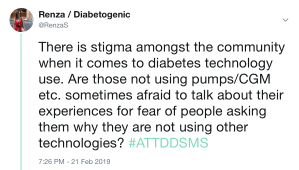
The idea that anything that we are using today is ‘yesterday’s technology’ is wrong. Blood glucose monitoring can’t be ‘yesterday’s tech’ if it is what most people are using to track their glucose. And syringes and pens can’t be considered the ‘old way to deliver insulin’ when that is how the vast, vast majority of inulin-requiring people with diabetes get insulin into their bodies. Plus, every single one of us using a pump must be able to deliver insulin this way because machines break.
Somewhere in discussions about our treatment technologies, we seem to have forgotten that, actually, not everyone wants to be using the latest kit. And that is okay. There is a spectrum of diabetes technology, and as long as we are on it somewhere and managing our diabetes the way that works best for us, then elephant stamps all around!
There is clearly an over-representation of people at one end of that spectrum dominating on and off line conversations. Spend a couple of hours in a diabetes Facebook group and it would be a reasonable assumption that most people are wearing pumps and CGM. But that’s not true.
And it could appear that DIYAPS is the way to go for most people with T1D, when the fact is that numbers are relatively low. It’s hard to estimate exactly, but there may be somewhere between 2,000 and 3,000 worldwide how have ‘built their own pancreas’. That is just a drop in the type 1 diabetes ocean.
It’s fantastic for those of us interested in this technology to be able to (virtually) congregate and talk amongst ourselves. I learn so much from my peers in these groups – just as I have with all aspects of life with diabetes. The lived experience continues to trump any other way of learning about diabetes.
Of course, that doesn’t mean that we shouldn’t be talking about technology used by limited numbers. Of course we should. We want others to know about it so they can make an informed choice about whether it may be right for them. We want our HCPs to know about it and to support those of us using all sorts of technologies and treatments.
Where it becomes problematic is when there is the misconception that this is the norm. Or when those not using the newest technology feel that they are wilfully doing diabetes the ‘old way’. It’s unfair to think for a moment that those who are not using the tech ‘don’t care’ enough about themselves – especially when decisions are made based on a very good understanding of what is available and what they have decided works best for them.
So, back to my ‘Oh, I just use Loop’ comment. It was directed to someone far more technologically advanced than me; someone who runs all sorts of other programs alongside their DIYAPS. They generate lots of reports and make lots of changes and seem to have far more bells and whistles than I even knew were available.
I nodded as they told me all they were doing and then, when they asked me how I manage my diabetes, I answered that I just use Loop. I heard myself saying it and stopped and corrected myself. ‘I mean…I use Loop. It works for me. Perfectly.’
We don’t need to make excuses for doing diabetes our own way. If we truly have choice (which I know is not always the case), and we have made the choice based on what we believe to be the best possible treatment and technology for us at that moment, then surely that’s a great thing. We shouldn’t ever be made to feel less committed to our own health and wellbeing. That’s not how it works.
DISLCOSURE
I was invited by Ascensia to co-chair the Diabetes Social Media Summit at ATTD (#ATTDDSMS). I did not receive any payment or in-kind support from them for accepting their invitation. I have co-written a piece for the blog, however this was not edited (apart from inevitable jet-lag-induced typos) and all words are those of mine and the piece’s co-author. You can read that piece here.
These days, it’s impossible to be at a diabetes conference and not have at least one conversation somewhere about language. Sometimes there are sessions dedicated to the topic on the program, but that wasn’t the case at ATTD a couple of weeks ago – a conference solely devoted to advancements in diabetes technology and treatments.
But despite there not being a session about language, it was still a hot topic. My eagle eye was trained when walking through the exhibition centre for examples where diabetes is misrepresented or the language used stigmatises people living with the condition. And in sessions, I immediately heard terms that suggested that we are misbehaving because the results of treatments aren’t living up to their promise. (A new one: I heard the statement ‘People with diabetes on <therapy> were not performing as expected’ which now makes me think that we are being trained, watched and judged by pageant mums/moms.)
At the Ascensia Diabetes Social Media Summit (more on that another day), there was a discussion about language and diabetes-related complications. This event was a follow on from the one we had at the Australia Diabetes Social Media Summit, and took the initial conversations and expanded it with a new group of PWDs.
Once again, as the discussion unfolded, it was clear to see that the PWD in the room all had experiences where the language they were faced with had impacted negatively and positively. One person commented that early on in their diagnosis, a health professional had addressed diabetes-related complications by saying ‘If you are diagnosed with a diabetes-related complication it will not have been your fault.’ What an empowering way to begin the discussion about complications, care and risk reduction!
I’ve been talking about language for a number of years. Some may call me a one trick pony and, honestly, that’s fine. My appetite for the subject matter has not diminished one bit despite more than a decade of speaking and writing about why language is so important and holds such power.
Language is not a one dimensional issue. Additionally it does not necessarily have a ‘right way’ to do it – especially when looking at it from the perspective of the person living with diabetes. The work I have been involved in has never been about policing the words used by people with diabetes, but rather how words used by others affect us.
It’s why the piece Grumps and I wrote for BMJ was important – it targeted healthcare professionals, explaining to them why the words and language used around diabetes-related complications needs to not make us feel hopeless. Because that is what can happen and when we feel that way, it is all too easy for diabetes to seem just too big and too hard and too much.
I have frequently written about how diabetes can become so overwhelming, that it can leave us unable to attend to even the most basic and mundane of diabetes management tasks. I myself have been paralysed by the detail and demands of this health condition. I understand that there are times when a conversation about language is not possible, because, quite frankly, there is a lot more to deal with. I know that there have been moments when even though I can hear judgement and blame in the words being directed at me, all I want to do is find a way out of what feels like a hole. I’ve heard others say that they have felt harshly treated by HCPs, but simply didn’t have the capacity to try to deal with that because there were other things higher up on the list.
And I am sure that there are people who simply wouldn’t even know where to begin if the words and language being directed at them were disempowering and negative.
But that is exactly why language matters. It is for the people in those situations – for me when I was in that situation – that we need to get the way we communicate about diabetes right.
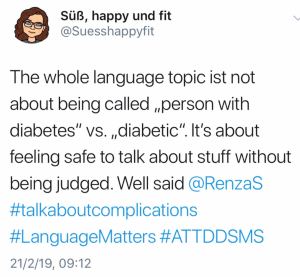
I am so sick of people trying to delegitimise the language discussion, or, even worse, reduce it to something that is insignificant. It frustrates me when the discussion returns again and again and again to the diabetic/PWD debate. As I said at the Ascenisa event at ATTD when we were discussing the annoying way some try to redirect meaningful discussion back to this single issue: ‘You can call me Blossom for all I care, language is about far more than this.’
And I think that while it is critical that we acknowledge that sometimes the language issue isn’t going to be a priority for some (by choice or otherwise), it seems unfair – and a little counter-intuitive – to diminish its importance, or criticise those of us trying to keep it on the agenda and actually do something about it.
(Click for original tweet)
DISLCOSURE
I attended the ATTD conference in Berlin. My (economy) airfare and part of my accommodation was covered by DOCLab (I attended an advisory group meeting for DOCLab), and other nights’ accommodation was covered by Roche Global (I attended the Roche Blogger MeetUp). While my travel and accommodation costs have been covered, my words remain all my own and I have not been asked by DOCLab or Roche Global to write about my attendance at their events or any other aspect of the conference.
Last week, the BMJ published a piece I wrote with the Grumpy Pumper. It was part of their ‘What Your Patient is Thinking’ series which includes stories from people sharing their experiences of living with a variety of health conditions, or using health services.
We wrote about the intersection between language and diabetes-related complications and why language matters so much any time this topic is raised. This is our latest piece on the issue (read the PLAID Journal article here, and something we wrote for diaTribe here). We may appear to be one trick ponies, but it seems the appetite for this issue has not in any way diminished – which is good, because there’s lots more to come! (We’re not one trick ponies – I for one can talk for hours about why the fax machine should be made extinct in healthcare.)
It’s been fascinating – and a little overwhelming – to read the responses to the article after it was shared on a variety of social media platforms at the end of last week, and then again over the weekend. It’s also been heartbreaking when people have told stories about how HCPs have spoken about diabetes-related complications in ways that have had negative effects.
It’s refreshing to see many HCPs (including those from outside the diabetes world) sharing and commenting on the article. Much of what we have written is applicable beyond diabetes. It doesn’t matter what health condition someone is diagnosed with; everyone wants to be treated with kindness and compassion and to not be blamed or shamed.
A couple of HCPs have said that after they read the article, they will now consider changing the way the speak. I love this piece from a CDE in the US who said that she honestly thought the words she was using when discussing diabetes-related complications were reassuring until she read our perspective, and now understands that there are better ways to frame the conversation. We only hope that this will lead to PWD feeling less judged and more supported, and not afraid to talk about what is still a taboo topic for so many.
The diabetes and language landscape is broad. I know that there are many who roll their eyes and say that actually, language doesn’t matter, and perhaps we should be focusing on more pressing issues, but I wonder if they are perhaps focussing on issues that they don’t think are really important.
But there is a lot more to this issue than, for example, the debate between being called ‘a person with diabetes’ or ‘diabetic’ – or if it even matters. Regardless of what the specific issue is, we are hoping is that people understand that words really do matter; they have far-reaching consequences; they determine how people feel about their diabetes; and that the right words have the potential to make people feel better equipped to manage their diabetes as best they possibly can.
Please read the BMJ article – it is freely accessibly – and share it with your networks. If you have diabetes, take a copy to your next HCP appointment and leave it for them to read. The way that we make real, sustainable change is to keep pressing a point, and explain why it is important. Hopefully this piece has gone some way to doing that.

The illustration that was commissioned for the print version of the article. Artist Rose Lloyd did such a great job of getting across the messages in the article!
I had a great conversation the other day with someone who was interested to talk about diabetes and language with me. ‘I’m trying to get a better grasp of why it’s something so important to you, because, quite frankly, I couldn’t care less what people say about diabetes.’
This isn’t the first time people have asked me this. And it’s certainly not the first time I’ve been asked why I spend so much time speaking about diabetes language matters.
I know the reasons, but to be perfectly honest, I’m not sure that I have them especially well mapped out when I need to explain them. So, let me try here.
There is a tangled and complicated link between the words used when talking about diabetes, and how we feel about it and how diabetes is perceived by others. That link then goes off on all sorts of LA-freeway-like tangents to include diabetes and stigma, and discrimination.
The effects of how we frame diabetes can be felt by us individually. But they can also be far reaching and affect how others feel about diabetes.
We know that language has the potential to make people with diabetes feel judged and stigmatised. In fact, most PWD I know have at some time or another faced someone speaking to them using Judgey McJudgeface words. Of course, we all respond differently to this. For some people, it’s water off a duck’s back. They couldn’t care less what people say and just ignore it. For others, it’s almost a challenge – they use it as motivation to prove that they ‘won’t be beaten’.
But that’s not the case for everyone. For some people, it can be absolutely paralysing.
Fear of being judged and shamed may lead to some PWD to not wanting to attend HCP appointments and, as a consequence, falling behind on complication screening. Some PWD may not even tell their loved ones they have diabetes for fear of being judged. I have met PWD who made the decision to keep their diabetes a secret and for years, not telling another person. This can add to feelings of terrible isolation.
When diabetes is spoken about in stigmatising and demeaning ways, this leads to the spreading of misinformation. And this can have far reaching consequences.
We know that kids with diabetes may be teased by their schoolmates. Their teachers may not respond appropriately to diabetes because of the way diabetes is framed in the media or by others. We can’t really blame teachers. If diabetes is punchline fodder for every B-grade comedian, or an excuse to point fingers at those living with it by every tabloid news outlet, how can we expect anyone to take it seriously?
(And if right now you are thinking ‘This is why we need to change the name of type 1 diabetes’, stop it! People with type 1 diabetes shouldn’t be teased or mocked or judged, but neither should people with type 2 diabetes. This isn’t about people understanding the differences between type 1 and type 2 – this about understanding diabetes.)
The language we use when talking about prevention in diabetes – whether it be preventing type 2 diabetes or preventing diabetes-related complications – means that there is an underlying idea that developing type 2, or complications must be the fault of the individual. ‘If you can prevent it and haven’t, it’s your fault. You obviously lived an unhealthy lifestyle/are lazy/didn’t listen to your doctor/failed to follow instructions/refused to do what you were told etc.’.Can you imagine hearing that, or feeling that is what people think about you – all the time? This is the language – these are the words – used to talk about diabetes.
A couple of weeks ago in the UK, it was Prevent Diabetes Week. I saw countless tweets from people urging, begging, pleading with others to remember that type 1 diabetes can’t be prevented and the week refers only to type 2 diabetes. I wonder if those tweeting realised that comments such as these actually contribute to the stigma associated with type 2 diabetes? Of course type 1 diabetes can’t be prevented. But in many cases, neither can type 2 diabetes. There are so many non-modifiable factors associated with a type 2 diagnosis – factors beyond the control of the individual.
But let’s look beyond individuals, the health system and the education system for a moment. What else happens in other settings when diabetes is spoken about in stigmatising ways?
Health organisations, including diabetes organisations, frequently seek donations from the public to continue the important work they do. There is only so much money in the donation pie, and yet there are more and more competing organisations representing people with different health conditions wanting a piece of that pie.
Donations are harder to come by from the general community when there is the idea – the wrong idea – that diabetes is a largely preventable lifestyle condition that is the fault of those diagnosed. There is not the idea that people who have developed cancer brought it on themselves, even though we know that some of the risk factors associated with a breast cancer diagnosis are the same as for type 2 diabetes.
Research dollars for diabetes are far less than for other health conditions. We see that every year when successful NHMRC grants are announced. Diabetes is the poor cousin to cancer research and CVD research.
Diabetes is just as serious as any other condition that is worthy of research dollars and fundraising dollars. Yet because of the way we speak about it and the way diabetes as a condition has been framed, there is a perception that perhaps it isn’t.
Words matter. Language matters.
So, what I want to say to people who think that talking about language and words is a first world problem that only occupies the minds of the privileged is this: I acknowledge my privilege. But this isn’t simply about words. It’s about perception.
Until diabetes is considered the same way as other conditions that are taken seriously and thought of as blameless, the trickle-down effect is people with diabetes will continue to feel stigma. Diabetes will continue to be the poor cousin of other health conditions and diseases because there is the misconception it is not as serious. People will not as readily make donations towards fundraising initiatives. Research dollars will continue to fall short, instead going towards ‘more worthy’ conditions.
That’s why I care so much about diabetes language. Because, language matters… so much.

There were some really important and impactful sessions in the Living with Diabetes stream at #IDF2017 in December last year, but perhaps one of the most significant was the final session. Chaired by Professor Jane Speight, the session was titled ‘Diabetes and mental health: distress, diabulimia and emotional wellbeing’.
Talk about finishing with something to get people thinking and talking!
Bill Polonsky kicked off the session with a talk about how emotional wellbeing is affected by diabetes, and offered some ideas for addressing these issues.
(Can I just say what a stroke of genius it was to have Jane Speight and Bill Polonsky on stage together?! To have two champions of diabetes behavioural psychology in one place was definitely a highpoint of the Congress, and anyone who chose to go to a different session missed out. Big time! … Credit where credit is due to us all, Manny, Mary, Hakeem and Kelly!)
The session ended with Erika Backhoff from Mexico who gave an outstanding presentation on diabetes distress and the importance of appropriate training and understanding of the difference between diabetes-related distress and depression.
But for me, the highlight of the session – and one of the highlights of the entire stream – was Georgie Peters speaking about diabetes-related eating disorders. (Georgie writes a great blog that you can read here.)
Georgie began by sharing her own story of insulin manipulation. I’m not going to write anything about this part of Georgie’s talk, because you can see and hear it all here. (You’ll need to have a Facebook account to view it.)
Often, when people speak about living with a health condition, they are called ‘brave’. I absolutely hate it when people refer to me as brave because I live with diabetes (and all that comes with it). I’m not brave, I’m just doing what I need to do to stay alive.
But Georgie WAS brave and I’ll explain why.
Often, when we hear from people living with diabetes, what we hear about is people conquering mountains (literally and figuratively). We hear tales of the super heroes running marathons and winning medals. These are the socially acceptable stories of living with a chronic health condition: the ‘I won’t be beaten’ anecdotes. They give hope, are meant to inspire and make those not living with diabetes feel better about things because suddenly, it seems that this health condition is manageable and everyone with it is a champion.
But the reality for most people with diabetes is the same as most people with diabetes – we don’t run marathons, we don’t climb mountains, we don’t win gold medals. We are just doing the best we can with the hand we’ve been dealt. And sometimes, we deal with difficult stuff.
Sharing stories of the tough times and the challenging things that often go hand in hand with diabetes is not always easy – for the person sharing the story or for those reading or listening to them
But perhaps that’s exactly why we do need to hear about these stories, and ensure stories like Georgie’s are heard and given a platform.
Just because something is difficult or uncomfortable to listen to doesn’t mean that it should be hidden. This is why people don’t seek the care and assistance they need. It’s why people think they are the only one’s struggling and why they don’t know where to turn.
I could see some people in the audience shifting uncomfortably in their seats as Georgie eloquently, determinedly – and completely unapologetically – shared her experience and, most usefully, offered suggestions for how to work with people with diabetes and eating disorders. I know that I left with a far better understanding of the topic. And an even more resolute desire to keep these types of issues in the public domain.
Disclosure
I was the Deputy Lead for the Living with Diabetes Stream, and an invited speaker at the 2017 IDF Congress. The International Diabetes Federation covered my travel and accommodation costs and provided me with registration to attend the Congress.

Georgie owning the stage at #IDF2017
Towards the end of last year, I wrote about some things happening online trying to encourage people to openly and freely speak about being diagnosed and living with diabetes-related complications.
When conversations about diabetes complications are brought into the public domain, often two things happen.
Firstly, people start to talk. That whole cornerstone of peer support – reducing isolation and sharing stories – flings doors and windows wide open, and people, often gingerly at first, start to offer their own experiences. Inevitably, someone will say that they don’t speak about their complications because they fear the judgement that will follow. Or that they believe they are the only one their age facing complications because they have never met another person, or read a blog post from another person sharing a similar experience.
Secondly – and most damagingly – there is judgement. And it comes in spades, often sending some of those who had started to open up retreating back into the depths of diabetes taboos. This is not helpful for anyone.
So I wasn’t surprised when, during a useful discussion starting online about living with diabetes related complications – which resulted in some people willingly talking about their own experiences – the horribly judgemental comments started infiltrating the conversation.
I shared this post that I wrote almost five years ago about why we need to reconsider the way we speak about diabetes complications as I thought it was relevant to the current online conversation. In fact, everything I wrote in that post was still true because diabetes continues to be a terribly stigmatised condition and, within that, those of us living with complications seem to face additional stigma and judgement.
If for one second anyone doesn’t believe that statement, here are just some of the comments that I received (on LinkedIn and Twitter) after sharing the post:
‘If considering that many people who are type 2 diabetic quite simply exercise too little and eat too much fat…… which has immense financial consequences for the provision of healthcare…….. how else do you propose to get these people to lose weight and stop emburdening (sic) themselves on our NHS? If you take away the need to shame them you take away the most powerful way of making them take responsibility for their health.’
‘Sorry Renza but if we get complications of diabetes then we have failed. We are each responsible for own health and must try to maintain it at all cost.’
‘Diabetic complications do not happen with ‘perfect’ blood sugars. I agree that we must be supportive and sympathetic and the insulins available don’t help but it’s still the patient’s responsibility and not the doctors. Sorry if this doesn’t bode well with you.’
Is it any wonder that people are reticent to speak about developing complications if people are thinking like this?
I have written before that I believe diabetes has an image problem, because I can’t think of any other health condition that, if a treatment does not get the desired outcome, the person living with that condition is blamed. I have never heard someone being blamed if the cancer for which they are being treated does not end up in remission. I don’t know of anyone with rheumatoid arthritis who is blamed if their pain increases or their mobility decreases. I’ve not heard of someone with psoriasis being accused of not caring for themselves if their skin flares up.
But all bets are off when it comes to diabetes and fingers are pointed fairly and squarely in the face of the person living with diabetes if they develop complications.
Diabetes complications happen. It is, unfortunately, a reality for many people living with diabetes. I’m not trying to be negative or scare people, but we know that the longer we live with diabetes, the more likely we are to develop complications.
In this post, The Grumpy Pumper says: ‘Complications are a hazard of what we have. Not a failing of what we do.’ Maybe if we take that as the starting point we can take away the blame. And maybe if we take away the blame, we break down the stigma. And maybe if we break down the stigma, we can start having a real discussion about how we treat complications if they develop, and get to treating them.
And maybe if we stop thinking that developing diabetes and anything that happens after living with it is a shortcoming we can stop feeling so judged and shamed, because others will stop judging and shaming us. More to read on this topic:
Riva Greenberg shared this one.
Sarah K from Sugarbetic wrote this.





 Diabetogenic