
You are currently browsing the category archive for the ‘Social media’ category.
Over the last two days (or last two middles of the night if you’re perpetually in the wrong part of the world as it seems I am), I participated in the excellent first World Health Organisation Global Diabetes Compact Forum. (You can read the Compact which was launched earlier this year here.)
Once again, the WHO team had brought together stakeholders, including diabetes advocates, from across the world to talk about some critically important challenges facing people living with diabetes. These included access to insulin, research and innovation and prevention, health promotion and health literacy. The Forum was definitely not a ‘sit and be lectured to’ event. It was interactive, with everyone having the opportunity to participate and share their experiences and perspectives. The chat function was open and there was a constant stream of engaging, energetic discussion and sharing.
The final session was about prevention and in his introduction, James Elliot, who expertly moderated the event, laid the foundation for the discussion. As with the previous sessions, there were no pre-conceived ideas or narrow focus about the topic.
Prevention isn’t just about prevention of type 2 diabetes. There is a lot of work also going on looking at prevention of type 1 diabetes. And also, once living with diabetes, looking to do what we can to prevent diabetes-related complications.
When I spoke, the first thing I wanted to highlight was the problem I feel with the word prevention, and I revisited previous discussions in which I’ve been involved which highlight the struggle I feel with the word prevention. For too many people it is a word that offers a promise – a promise which guarantees that we can prevent aspects of diabetes that are often well beyond our control. I presented my case for instead focusing on how reducing risk is a far more accurate description of what efforts are truly about, a perspective that I have noticed is being used more and more.
The discussion pivoted to being about complications and associated stigma. Thankfully, this is not the start of the conversation about diabetes-related complications and the way people see them. When I wrote this piece back in 2013, I wrote about the way complications were presented to people with diabetes and how non-modifiable factors such as genetics, are rarely part of the conversation. There seemed to be a very one-dimensional presentation of diabetes-related complications: ‘take care’ of yourself, and you won’t get them.
With communication around complications starting to be included in the language matters movement, I could see that too many people had been told that over-simplistic tale.
It all got taken up a very significant notch when there was a concerted effort in the DOC to encourage dialogue about diabetes-related complications in a non-judgemental and safe way. Suddenly, we were seeing the hashtag #TalkAboutComplications accompany people’s stories, or questions others might have. This led to a real shift, as more and more people shared their experiences, with many saying that it was the first time they had seen others being so open about what was often considered a taboo topic. Starting to peel away the shame and secrecy of what can be a scary part of life with diabetes allowed many people to seek support from peers and help from health professionals.
The legacy of the #TalkAboutComplications idea is that is that there are far more conversations today about diabetes-related complications. There is also a plethora of blog posts, podcasts, journal articles and conference presentations about the topic. I know that there is still significant stigma that we need to chip away at, but actually being able to easily find places online where conversations about complications are normalised and being part of those conversations is contributing to reducing that stigma.
The session at the Global Diabetes Compact Forum was terrific because it tied together diabetes-related complications and stigma. With the theme of access this World Diabetes Day, perhaps we need to think about what that means when it comes to diabetes-related complications. While we absolutely do need to think about all factors at play when it comes to the development of complications, we also need to acknowledge that access is a factor when it comes to outcomes. Access to the right information, including information about risk reduction, access to insulin, access to glucose monitoring devices, access to complications screening, access to early diagnosis and treatment, access to peer support, access to stigma-free treatment, access to mental health support…all these have the very real potential to influence outcomes.
Gosh, there’s lots in the #DOC-iverse (#DOC-osphere?) about seeing diabetes, isn’t there? Yes, yes there is. Not sure about you, but I seem to be seeing a lot of bright, shiny, happy people (and a pop star or model or two) talking about diabetes, when usually they are pretty quiet about the whole diabetes thing. Which is fine. No one needs to spend their time advocating all about diabetes every minute of the day.
But I wonder if any of the marketing boffins who threw together their messages of inspiration bothered to check to see what the International Diabetes Federation are up to for World Diabetes Day on 14 November. Afterall, that’s the showstopper event of the month, isn’t it? Celebrating the birthday of the bloke who I give thanks to every day for keeping me alive.
A bit of history about World Diabetes Day to help understand that it’s not just about privileged folks with diabetes showing off their high-tech gadgets strapped to their impossibly beautiful bodies. (And yes, I know I sound like the Grinch who stole World Diabetes Day, but I think that understanding the foundation of this day is kind of important because that all seems to get swallowed up in PR spin.)
World Diabetes Day means something. In 2006, it became an official United Nations Day thanks to United Nations Resolution 61/225. At the time it was one of only two official UN health days. But even before that, World Diabetes Day had been going on for some time. It was in 1991 that the IDF, together with the World Health Organisation, created World Diabetes Day in response to growing concerns about diabetes.
Over the last thirty years, World Diabetes Day themes have aimed to be inclusive of people from around the globe, but perhaps there has been a (necessary) focus on how to improve diabetes outcomes for people in under-resourced countries. Maybe that’s why I find it a little galling when it appears that the day is about showing off your latest diabetes kit or shouting to the globe about how diabetes doesn’t stop people reaching their dreams. I love positivity and I’m often accused of being far too Pollyanna for my own good, but having a good look beyond our own privilege is important if we’re trying to get across a global idea of what is going on in the world of diabetes.
This year the theme is ‘Access to care: if not now, when?’. The World Diabetes Day website is full of resources that explain the theme. There are materials you can share to help explain just what access means to different people.
It all seems to be a little bit of a throwback to community initiatives of the past. The diabetes community has been the creators of some absolutely stellar campaigns – ideas that seem to have been founded in similar frustrations about which I’m smashing on my keyboard today. In 2014 there was a campaign that asked us to ‘Put the World back in WDD’ which was in response to there being a very Western focus on World Diabetes Day. Sometimes it feels that some things never change. The #Insulin4All hashtag that was first used to highlight how people in under-resourced countries struggle to access insulin is now most often linked with insulin pricing in the US.
Access means different things to different people, and the materials the IDF has put together consider this. Even if you live in a well-resourced country, with decent subsidised, tax-payer funded (never free!) healthcare, it’s likely that some part of your diabetes care is still difficult to access. It may not be insulin or diabetes supplies that are your access issue – it could be mental health support or different tech solutions.
Here in Australia, thanks to Medicare, the PBS and the NDSS, we have well-subsidised diabetes care. It’s not perfect, but it is certainly better than I hear from friends in other places around the world. But there definitely are still deficiencies in our care. Mental health care is limited – and almost impossible, it seems, to access. Only 50% of people with type 1 diabetes can access subsidised CGM and Flash GM through the NDSS. People in rural and remote areas of the country have far more difficulty accessing quality, regular diabetes care. The outcomes for Indigenous Australians with diabetes fall far behind. As always, people who are disadvantaged in some way are disproportionately affected, and face more difficulties accessing the care they need.
How you choose to celebrate (or not) this month and World Diabetes Day is entirely up to you. You may choose to ignore the ‘official’ theme of the day and focus more on other initiatives and once again, all perfectly okay. Just as YDMV, so may your diabetes advocacy.
But if you are interested in focusing more on access, have a look at the World Diabetes Day website and pledge your support for greater access to diabetes care. Read about the Resolution that was adopted by United Nations Member States that calls for urgent, coordinated global action on diabetes.
Look, I know. UN Resolutions don’t sound nearly as sexy as a six pack with a CGM plastered to it, but it is pretty cool that the WHO and the UN are talking diabetes.
And while celebrating the centenary of insulin, learn where insulin is not easy to come by, and why that is. Through volunteer work supporting both Life for a Child and Insulin for Life, I have learnt a lot about the challenges faced by people with diabetes in under-resourced countries. If you can, please consider making a donation this month to either, or both, charities.
And if looking to the community, it’s wonderful to know that there will be a docday° event on World Diabetes Day that is dedicated to the theme of access. You can learn more about that event here. It’s free to join, and will be live streamed on Facebook – you don’t even need to sign up.
But perhaps a final thought. How great would it be if those with really, massively high followings, (and followings not-only-in-the-diabetes-community), used this time to talk about making a real difference – a difference to people with diabetes who are struggling to access the basic drugs and supplies to actually live with the condition.
Sure, ‘seeing diabetes’ helps raise awareness, but as ever, I ask how much of that actually cuts through and gets out of the community that is already seeing diabetes every single minute of every single day?

I facilitated an event for Ascensia (disclosures at the end of this piece) last night/early morning and the crappy time was partly (mostly) my fault, because although I sacrificed the Aussies and suggested we draw the short straw in the time zone lottery, I forgot that daily saving would have kicked in for us meaning kick off time was 11pm and not 10pm. That may not seem much – I mean, what’s an hour? – but there is definitely a psychological barrier about doing work after midnight. (Anyway, I digress, and that paragraph has just about put me to sleep).
The reason for last night’s adventures after dark was a facilitating gig for Ascensia’s latest Diabetes Social Media Summit (DSMS). The thing I love about (and why I am so keen to be involved) in these Summits is because they have tacked some difficult topics that are often hidden away.
This one was no different in that we looked to address something that needs more attention – diabetes and women’s health. In my introduction, I wanted to make the point that diversity and inclusion is important when speaking about any aspect of diabetes, and that for us to be truly inclusive in a discussion about women and diabetes, we needed to hear from women who represent all corners of the diabetes world. I particularly referred to needing better representation from women in the LGBTQIA+ community.
The other thing that we had wanted to make sure that we didn’t focus too much on diabetes and pregnancy, because so often that is the only easily information about women’s health and diabetes that can be easily found (and saying that, there does seem to be a bias towards women with type 1 diabetes). Of course, understanding and being aware of how diabetes can impact on pregnancy is important, but it is certainly not the only issue that women with diabetes want or need to know about.
In fact, one of the discussion points was that for some women, pregnancy is not a topic they want discussed. There is the assumption that all women of childbearing age need information about having a healthy baby when that is not the truth. Contraception discussions do not necessarily equal an invitation for pre-pregnancy counselling, and there needs to be some sensitivity in how healthcare professionals in particular raise the topic, and rid themselves of the belief that all women want to have kids.
There is so much more to talk about. So, so much more.
We touched on how much our cycles can impact and influence glucose levels (and a very amusing tangent where we joked about how when we see monthly perfect glucose patterns, they clearly don’t belong to people who menstruate – or people who understand the absolute havoc hormones can wreak on CGM traces).
We spoke about birth control and how the OCP can also make a significant difference to glucose levels, yet many of us were not told about that.
Of course, we spoke of menopause, but only briefly; briefly not because it’s not an important topic (or a super relevant topic), but because we just got caught up talking about other things (and perhaps my facilitating skills weren’t as tight as usual).
And we spoke about how cultural gender issues need to be shown and understood so that the experience of privileged white women with diabetes are not seen as the only experiences.
For me, the central message that I heard time and time and time again was that topics about the very things that occupy a lot of the headspace of women with diabetes are simply not discussed with us. And there is little research to inform our decision making, or even to help us form the right questions to ask. At best, we are given some piss-weak explanation that points a finger at diabetes being to blame. At worst, we are dismissed.
I do wonder when research and diabetes education will catch up. I know that there are some wonderful researchers doing some important work here, but we are so far from normalising discussions about women’s health and diabetes as part of our typical healthcare routines. We’re miles away from getting rid of the preconceived and outdated ideas about women’s sexual health.
Beyond discussing different women’s health matters, we also spoke about just how these discussions fit in the diabetes community. This was a completely unplanned turn for the summit (it was not a topic on the agenda), but I’m glad we had it and I’m glad that I am writing about it. Because of the nature of women’s health, sex and diabetes, there is a lot of taboo, shame, fear, and vulnerability. I know that some of the rawest and most open I’ve been in my writing has been when I have been dealing with moments in my life that were so, so hard and I was so, so vulnerable. When I look back, I sometimes wonder if I was right to hit publish after writing, and perhaps I should have tucked away the paragraphs until I was feeling stronger. Or not published at all. While I have been told that my words have provided some comfort to others facing similar challenges, it left my gaping, open wounds very public and visible.
After writing about miscarriages, I’ve been called selfish for wanting to have a child and potentially passing on diabetes to them. Writing about my fears of passing on diabetes to my child I’ve been told that perhaps I should have thought of that before I got pregnant. Speaking about body image concerns, I’ve been told to toughen up and stop being so shallow. I’ve seen and watched other women with diabetes experience the same thing, and I feel their pain as I watch them navigate the muddy, and sometimes distressing waters.
We spoke about how women are treated in the diabetes community, particularly when we write about struggles and difficulties, and the words and terms that are thrown our way when we dare to share how we are feeling. The ‘angry woman’ trope that I’ve written about before has been directed to many others too.
These discussions are real, and they are necessary. I am one of the loudest, most vocal supporters of peer support and have spoken about the value and importance of diabetes peer support and the online community on stages literally around the globe. Peer support saved me at times when I thought I was broken beyond repair. But it also can be a source of pain and bullying and nasty confrontations, and perhaps we need to have those discussions too so that when someone decides that they are ready to share and be especially vulnerable that they look out for themselves as much as looking out for the community. It’s all very well to want to share to connect and help with our own and others’ isolation but leaving ourselves exposed isn’t easy.
One of the attendees last night reminded us that we could share with selected friends in the community, still allowing for that peer support but under the protection of a safe space. It’s interesting, because until maybe two years ago, I had never experienced how unsafe the community can be to individuals. I’d not felt that before. While I still share a lot, these days I’m more inclined to turn to those trusted friends in the DOC who I know will be honest, open, but never nasty or judgemental.
Online spaces are different for women than they are for men. The misogyny that is inbuilt to even those that we think are allies comes out, often surprising us, as throwaway comments about a woman’s age or appearance. It is ever present in the diabetes community too. I’ve rolled my eyes as some of the most vocal advocates who have loudly aligned themselves as being supporters of women, revert to type, with snide sexist commentary. I’ve seen people in the DOC referred to as ‘angry old women’ for daring to be furious, older than 25 and a woman! I roll my eyes now when I know someone has called me angry. I also know that they’ve just announced to everyone how threatened they are of women who dare to not go quietly, and how they expect us to remain in our place!
There was so much more that we could have spoken about last night. We didn’t touch on body image and disordered eating (and yes, I know that this is not the domain of women only, but this is about us!), we didn’t talk about sex all that much either, even though it is often highlighted as an issue that needs more coverage and information. Again, it’s not because they are not important topics; it was because the fluid conversation took a feminist turn that highlighted a highly biased social and healthcare environment where it is seen as perfectly fine that the needs, and concerns of fifty percent of the diabetes community are barely considered.
Perhaps if we had a more feminist approach to, and model of, healthcare, the misogyny that has meant the topics important to us have not been researched, and are not discussed, could be eliminated. And women with diabetes would not be feeling ignored.
Disclosure
I was invited by Ascensia to help plan the agenda for #DSMSWomen and facilitate the discussion. I have been paid an honorarium for my time.
I generally don’t do my best work at 2am. I’m just not the spring chicken I used to be, and being awake, engaging and remotely coherent when I am usually in the middle of some decent REM sleep is a big ask these days.
But living in Australia, and wanting to remain as active as possible in global diabetes work and activities has meant that I have had to suck it up and learn to get on with it. I’ve become expert at stealthily getting up about so as not to wake my family, moving like a ninja about the house. I make a pot of tea, have hypo supplies handy, and layer on red lipstick to create the illusion of being alert and awake, completely together and impossibly glamourous (I fear I am only fooling myself) before settling into do whatever it is that I am needed to do in the wee hours.
Last night, it was a 1.30am call for a 2am event. I’d snuck in a couple of hours sleep ahead of the rude alarm that woke me. When I logged onto the event platform, I still had my ‘morning voice’ on, but the hot tea helped lubricate – and wake up – my vocal cords. Thankfully I was only required to speak and not sing an opera. (Silver linings!)
But despite grumbling about the hour, I’m glad I did it. Because the following couple of hours was a discussion about hypoglycaemia that combined lived experience stories from people with diabetes, peer support, all articulated with fabulous input from clinicians and researchers. It really was an exercise in how to put together an online diabetes event!
The event was the Lilly Hypo Summit, and I co-hosted with Bastian Hauck who is an absolute pro in any hosting seat. When I was asked to be involved, I had visions of a very staged and scripted event. I have worked with industry enough to understand that their compliance rules often means that events are required to be defined to the nth degree with all content being scrutinised by legal eyes, leaving little room for spontaneity or free discussion. How could we possibly get the true experience of hypos across if we were constrained by needing to stick within a pre-planned programme? I mean, hypos don’t do that, so discussions about them surely shouldn’t have to – and simply couldn’t if we were to do it justice.
Amazingly, we managed to put together an engaging and somewhat impulsive and free-formed event with full support from the global engagement team. They trusted the PWD who were shaping the event enough to understand that what we were trying to do was be respectful to the people telling their stories by not in any way censoring them. Plus we promised no one would throw caution to the wind, and talk about replacing their traditional diabetes management with bathing under a full moon and dancing to the beat of an inner drum (or something), which considering last night was a full moon, was a pretty important promise to make. We created a space for PWD to share their stories and highlight the incredibly complex challenge that is hypoglycaemia, and we punctuated those stories with research and clinical advice.
I knew that it was going to be a good event, because the speakers were remarkable. When it was over, I had dozens and dozens of messages from people congratulating me on my hosting, but there is a secret that I feel I should share. Hosting is impossibly easy when you are interviewing brilliant people. And it was programme overflowing with brilliant people. The PWD who spoke had fascinating tales to tell, and told them in wonderfully disarming ways. I’d not met them all and it was great to be just as surprised as the audience when hearing their stories. And then we had two remarkable researchers who I respect greatly, and I know to be incredible communicators.
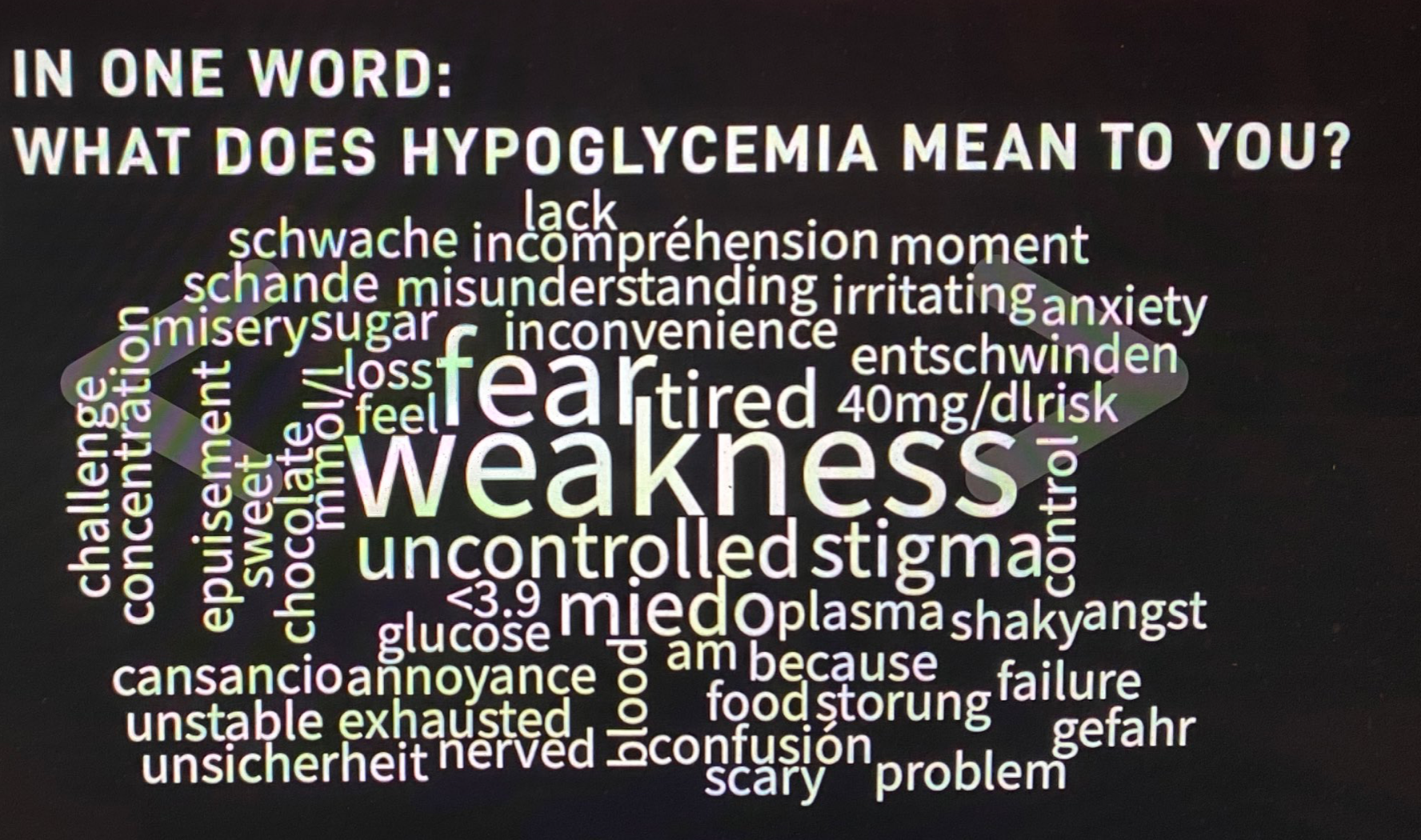
I really want to write more about what was discussed at the event, and will try to do that in upcoming posts, but for now, I just want to share this world cloud. We asked people to describe their hypos in one word. I’ve done exercises like this before and they never, ever reveal the same words. This is what the group came up with last night:
But to finish this post, I want to ask the question that one of last night’s HCPs, Pratik Choudhary, from the Leicester Diabetes Centre in the UK, asked us: ‘Do you see hypos as a slope or a cliff face?’ I can’t stop thinking about this, because I’ve never been asked about hypos this way, but it makes so much sense to consider them in this context. Of course, there are so many factors at play, but this either / or scenario does perfectly capture the in-the-moment way that I feel about hypos. I wonder what you might think about your hypos. Does it fit in here, or is it something completely different?
DISCLOSURE
I was an advisor to Lilly Diabetes for the Hypo Summit. I have been paid for my time. I have not been asked to write anything about the summit, but am sharing because there was so much amazing content at the event. No one has reviewed this post prior to publication.
As someone who spends far too much time sharing far too many things across far too many online platforms, this Hartley Lin cartoon for the New Yorker hits far too close to home. (But it made me laugh all the same.)

I really wanted to call this piece ‘Hey, ableds, leave our kit alone’, but decided against it.
Over the weekend, two main things seemed to dominate diabetes twitter. The first was the suggestion from a nurse (in a now deleted tweet) that shoving cake frosting (more commonly called icing in my parts of the world) up the arse (more commonly called ass in other part of the world) of an unconscious person with diabetes was an excellent hypo treatment. The second was this picture:

Let’s just say that sexually assaulting a PWD to give them glucose is not a good idea, no matter how hypo you think they are. Call an ambulance, rub some frosting (or honey etc.) on their gums, or, if they have glucagon with them, and you what to do with it, use that. Once again, just to be completely and utterly clear, decorating the arse of people with diabetes as if it’s a plain tea cake in need of some ready some embellishing and sprinkles, is not appropriate without consent. If everyone is conscious and there is consent, do whatever you will.
With that out of the way let’s move to the second fun little incident and that photo. That’s right, it clearly refers to one of the diabetes devices that I and many others use to keep an eye on our glucose levels because the bit of our body that takes care of it broke.
Even before this photo appeared, there has been a lot of commentary from people with diabetes (PWD) about people without diabetes (non-PWD) using any sort of glucose sensing device. I think that in coming years we’re going to only see more of it as the makers of CGMs and Flash GM start to advertise the allure of glucose tracking to a broader audience, or, as is the case with the little photo above, third party app makers jump on board.
Because the diabetes community never has one united opinion on things, (although I’m yet to have heard from a PWD who has thought the icing-up-the-bum-for-hypo-treatment idea is a good one), some people are violently opposed to the idea of non-PWD using CGM. Others couldn’t be less fussed about it if they tried. And some actually think it’s great. There is no one way to respond, and everyone’s feelings are valid.
I have a lot of feelings wondering why non-PWD would want to do diabetes. From hypo simulators, to wearing a pump with saline in it, and lining up to get an A1c checked for fun – I’ve seen it, and I’ve written about it. Again, no one needs to agree with my feelings, although it seems from the feedback I get, a lot of people do.
But I have to say that the idea of CGMs as a weight loss tool was a new one for me. I understand that some people who are deep into the keto way of life use them, but my understanding of this is so they can repeatedly prove to themselves (and badger others) that eating meat causes minimal changes to glucose levels, but eating grains of rice make lines move.
I did a bit of a deep dive into the company behind this picture, (they are not the only one that is moving to capitalise on the excitement and interest around biohacking) and all I could find was a whole lot of pseudo-science speak that just screams scam to me! It preys on the insecurities of those who are trying to find happiness in the latest and greatest wellness fad. But this time, they claim to have science on their side.
This isn’t new. Weight loss cons from ‘teatoxes’ to fat-busting pills to miracle diets to superfood super-promises, have been around for years. There is a reason that new players come onto the market every week, and that reason is not because they work. It’s because we have diet industry worth billions, we have people – often young girls – being told their worth is tied up in the number on their scales, and we have people desperately looking for something that will work to get them to that number, and get them there quickly.
To explain their claims, they use science-speak to suggest that there is a medical side to what they are doing. It seems that the ‘trust me, I’m a doctor’ line works well for a lot of people. As do the words around graphs, data and glucose statistics. That might work for people who haven’t spent a shedload of time around doctors talking about graphs, data and glucose stats, but those of us who do, might see this as a load of bullshit.
This, directly from the company’s website claims that the app ‘…provides an immersive experience that shows you a continuous line graph of your glucose data; provides alerts when glucose spikes or dips out of your weight-loss range’.
Weight-loss range? I really don’t understand what that means because the only time my glucose levels have equalled weight loss is when they have been off-the-charts high. Such as before I was diagnosed with diabetes, and the time I was in DKA thanks to gastro. I doubt that the idea is to somehow send people without insulin-requiring diabetes in DKA, because that is going to take a lot more than just banging a sensor on your arm, and loading an app onto your iPhone.
Of course, that’s not what they mean. They are suggesting that by keeping glucose levels withing a tight range (the ‘weight-loss range’), there will be no excess glucose needing to be stored as fat.
There is limited evidence to support that measuring glucose levels on non-PWD is beneficial, so the science is shaky to say the least. But that doesn’t stop the program being presented as super science-y and evidence-based. And for a lot of people, that illusion of science means they think that the subscription cost (because there’s always a subscription cost!) is worth it.
But let’s move away from that for a moment, let’s ignore the lack of science, the cost and the hint that this could be nothing more than a money-making scam, targeting vulnerable people, because there is more that comes into play which explains why so many in the diabetes community push back at non-PWD wearing diabetes devices.
Continuous glucose monitors were created for people with diabetes to better manage our condition. They give us access data that helps managing our diabetes like never before. They are life changing. They are life saving. They are also only available to a small percentage of the global diabetes population. I haven’t even touched on the fact that generally, it’s only people with type 1 diabetes who have access. People with other types of diabetes are even less likely to be able to get subsidised or funded CGM, even though many of them might benefit from using them.
The idea that CGMS are toys of privileged biohackers, and being used exclusively as a weight-loss tool does not sit well with many. It does not sit well with me. If I look at Australia, only half of people with type 1 diabetes have subsidised access to CGM. The rest of us are left to having to find about $4K per year to fund the devices that really make a difference to our lives, that some of us say we couldn’t live without.
The weight-loss focus from this particular company is problematic when considering the higher rates of disordered eating, and insulin omission or restriction in people with diabetes for the purposes of weight loss. Some claimed that seeing CGMs heralded as being about weight loss, when they are using it as part of their eating disorder recovery was triggering. These factors all come into play within the diabetes community.
And finally, the idea that increasing use to a far broader community will bring down the cost…? Let’s just be reasonable about that (or sceptical…) and say that’s not going to happen. If that was the case, the fact that every keto-follower worth their ketosis now regularly checks their ketones, would mean that blood keto strips would be cheap as chips. That’s not the case at all.
The potential of medical devices being used outside of the reason they were created is likely to be explored a lot more in coming years. With (non-healthcare) tech companies moving into the space, it is not only possible, but highly likely, that glucose sensing (albeit non-invasive) will become standard on wearables, in the same way step counters have. But we’re not there yet. Right now, the best use of these devices is where the evidence points – on the arms (or bellies, or thighs, or wherever!) people with diabetes are wearing them, to assist with diabetes management, to help us with our decision-making process, and to improve our lives.
NOTE:
In this piece, I mean ALL people with ALL types of diabetes, including pre-diabetes. Basically, any condition that means an individual needs to consider glucose levels.




 Diabetogenic