
You are currently browsing the category archive for the ‘Social media’ category.
Sunday is Feminist Christmas*. It’s the day that social media feeds turn pink and women get celebrated with morning teas (organised by women) and the lady folk are handed a cupcake (made by women) to shut us up and make us forget that women continue to live in a world designed and defined by patriarchy.
Isn’t that a joyful start to this article? I’ll wait while people shift uncomfortably and refer to me as an angry/difficult woman.
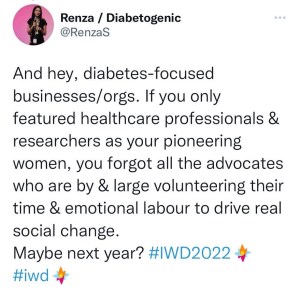
In the coming days in the diabetes world, you’ll see posts pointing to women in the diabetes landscape. These women are generally remarkable and doing great things. But oddly, rarely are the women whose faces appear on a social media carousel actually living with diabetes. A few years ago, I pointed out that while we should be recognising the clinicians and researchers improving our lives, women with diabetes are completely ignored.
So, a little hint to anyone who is putting together content for next week: don’t forget to also highlight the women with lived experience of diabetes who are actually doing so much of the work in our community. Those grassroots initiatives that continue to be life saving and life changing are very often powered by women with diabetes. And, as is often the case, these women do this work on a volunteer basis. All while managing a very demanding chronic health condition on top of all the other work women do.
In the meantime, you should all register for this year’s DiaLeb Annual Diabetes and Women Panel. This is the 7th year and I’m very excited to be on the panel with two remarkable women living with diabetes, and another two women with loved experience of diabetes. Be quick! It’s tomorrow!

Seriously, women with diabetes are brilliant. we deserve way more than a cupcake. But I’ll take one all the same if some bloke would like to organise it.
More on International Women’s Day at Diabetogenic
2023 – Deserving more than a cupcake
2019 – Interweb Jumble #34 – The IWD edit
*The brilliant Wilhelmina Stracke coined this term. You should follow her on Instagram.
My dad has always taken his parenting duties very seriously, and as such, he made sure that by the time I was ten years old, I had watched and rewatched all Marx Brothers movies to the point that I was able to recite the scripts word for word. I can’t tell you how many times I’ve watched ‘A Night at the Opera’, but it’s probably that movie and not twenty years of classical music training that means I can sing along to most of Il Trovatore.
My mum has never been a fan of the Marx Brothers. She’d roll her eyes while we were rolling around on the floor in fits of laughter, shaking her head and muttering that she simply didn’t understand what we found so amusing.
Does this mean she doesn’t have a sense of humour? Of course not, contrary to dad’s constant suggestion of as much. Mum regularly shares killer memes and jokes that are laugh out loud hilarious. It’s just that the Marx Brothers have never made her laugh (weirdo).
This showed me that people laugh at different things. One person’s funny bone tickler is another’s shrug of utter indifference.
One thing I learnt pretty early on when I started hanging out in the global online diabetes community is that humour is a really important coping mechanism for living with the condition. It makes sense, right? I mean, there are some pretty grim aspects of life with T1D, and having a laugh can lighten especially dark days, and help us keep perspective when things feel overwhelming.
Back in the OG DOC days, there were awards given to writers and people on social media, and one of the award categories was humour. I’ve tried to inject some humour into this blog over the years – you can be the judge how successful I’ve been. Read to the end and you’ll see I’ve linked to some posts where I tried to use jokes and humour to keep things a little lighter.
Sometimes, however, attempts at humour don’t land all that well. Or they land at the expense of others. And when that’s the case, I think we need to stop for a minute and check ourselves. Is it worth getting a laugh when you are punching down?
I don’t think so – especially because the result of punching down is often stigma. And we all know how I feel about that. Right? RIGHT?
None of this is new from me. I’ve been talking about how when people stigmatise any type of diabetes, we all suffer. I’ve been pretty blunt when calling out the T1D community for being outright nasty about people with other types of diabetes, especially people with T2D. The stigma we experience is a direct result of misinformation and ignorance about all types of diabetes. Contributing to it is not only nasty, but it is also voting against our own interests.
This post today has come about because over the last 24-hours a T1D Facebook group that I’m a member of has been embroiled in a fiery debate because one of the group’s moderators posted a meme that stigmatises type 2 diabetes. I’m not sharing the meme here, (because why would I add to diabetes stigma?) but I can describe it by saying that it highlighted a risk factor of T2D in a very stigmatising way. It was unoriginal, unamusing and unkind.
And it got messy. A number of people asked for the meme to be removed. Many were upset and found it offensive.
The moderators of the group doubled down. There were demands to scroll by and reminders that we were not there to ‘defend’ other types of diabetes. Comments pleading for the post to be removed were deleted and people were told they ‘Can’t take a joke’. I asked a few times for someone to please explain the ‘joke’, because I didn’t understand it. No one was able to do that. My comments were deleted anyway.
It astonishes me that the moderators of this group have chosen the hill they want to die on to be that it’s okay to stigmatise T2D and people should get over it if they don’t like it. They must have spent hours deleting comments and telling people to ‘get over themselves’. They repeatedly pointed out that the group is a T1D meme group with what seems an assumption that all people with T1D are happy for there to be nasty memes about T2D. Reassuringly, that’s not the case. A lot of people with T1D in the group are not impressed about the stigmatising posts and pop their heads above the parapet to let that be known.
A T1D meme page could be a source of joy, amusement, unity and some pretty clever humour, but instead, this group seems to regularly descend into bickering about what’s a joke and what’s just plain cruel, because many people with T1D don’t want to see T2D stigmatised or for misconceptions to be perpetuated. I’m one of those people.
And yes, I know that I can just leave the group. But one of the other things my dad, (and mum) taught me is that the standard you walk by is the standard you accept, and posting crappy, stigmatising, false and outright mean things about people with any type of diabetes is not a standard I accept. I call it out – regardless of who it is posting it.
I also want people to understand that these sorts of posts contribute to not just stigma about T2D, but to stigma about T1D as well. It constantly befuddles me that people who defend the right to be nasty and stigmatising about T2D are the same people who are up in arms when someone says something incorrect or stigmatising about T1D. The intellectual disconnect that can’t join the dots between the two issues is really something!
We can do better as a community. There are brilliant stories, jokes, and moments of wit that are truly hilarious, and we should be able to laugh about the shared absurdities and frustrations of life with T1D. But we can do it without throwing another group of people under the bus.

Want to see some truly funny things?
Watch Melissa Lee’s D-Parodies. Truly brilliant and hilarious.
Spoonful of Laughter from the team at dStigmatise brings comedians together to show how we can laugh about diabetes, and check stigma at the door.
Sam Morrison is one of the featured comedians on A Spoonful of Laughter and you can follow him, here.
Follow Brad Slaight! He’s hilarious.
Miss Diabetes manages to address some pretty serious issues around diabetes using her fabulous comics and artwork.
His Instagram handle is @type1comedian, and he’s damn funny! I’m not sure if any of Chelcie Rice’s stand up is online, but search for it and see if you get lucky.
And some questionable attempts of humour from me
Pancreas performance review (it’s really all about Effin’ Birds!)
My Lie on a Plate (rubbish influencers influencing rubbish)
Are you a diabetes expert? (This quiz has the answer!)
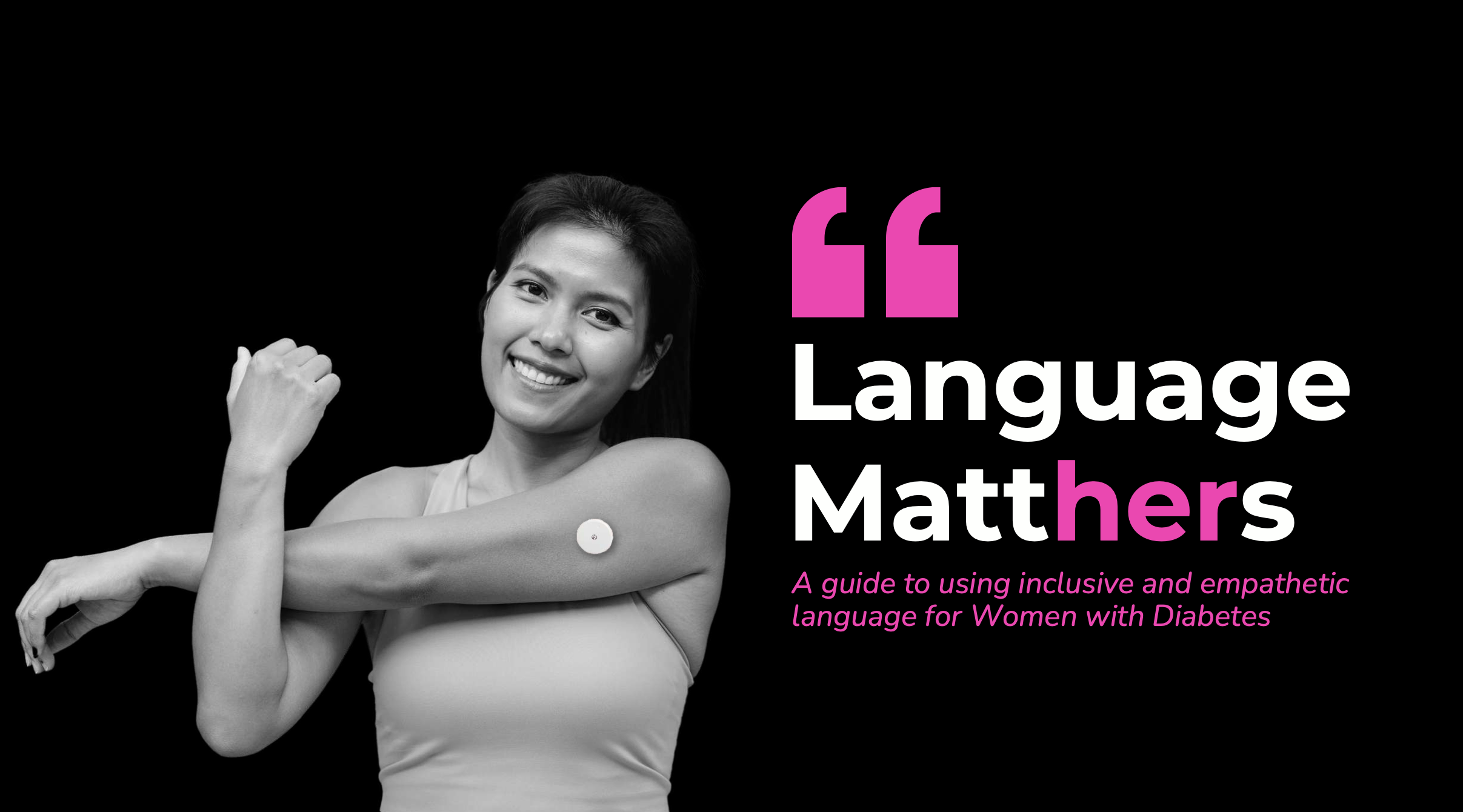
Last week, at the ISPAD Meeting in Lisbon, I was lucky enough to catch up with remarkable diabetes advocate Jazz Sethi and together, we launched a new resource about #LanguageMatters and women with diabetes. Jazz and her team from Diabesties conceived this idea and worked with a number of women in the diabetes community to bring this resource to life and add it to the ever-growing stable of #LangaugeMatters resources. I was one of those women.
So, why do we need a specific document highlighting the challenges faced by women with diabetes, and how language can be used to help overcome these challenges?
Let’s talk about gender bias in healthcare.
Anyone who has even a mild interest in healthcare knows that gender bias is very real, and women do indeed face specific challenges. The situation is worse for women from different backgrounds, sexual orientations and gender identities.
This was the reason behind the International Diabetes Federation focusing World Diabetes Day activities on women and children back in 2017.
Here is just some of the information from that campaign, explaining issues faced by women:
- As a result of socioeconomic conditions, girls & women with diabetes experience barriers in accessing cost-effective diabetes prevention, early detection, diagnosis, treatment & care, particularly in developing countries.
- Socioeconomic inequalities expose women to the main risk factors of diabetes, including poor diet & nutrition, physical inactivity, tobacco consumption and harmful use of alcohol.
- Stigmatisation & discrimination faced by PWD are particularly pronounced for girls & women, who carry a double burden of discrimination because of their health status & the inequalities perpetrated in male dominated societies.
- These inequalities can discourage girls & women from seeking diagnosis and treatment, preventing them from achieving positive health outcomes.
Beyond diabetes, and more generally in the healthcare world, women’s health concerns are frequently denied, minimised, ignored or not believed. Women are gaslit into believing that symptoms are not real, pain is imagined and that we are overreacting. These attitudes can have serious consequences. Here’s just a sprinkling:
- This year, findings of the Australian-first #EndGenderBias survey found 2 out of 3 women experience discrimination in healthcare.
- A Danish study of 6.9 million people showed that diagnoses for diabetes came four-and-a-half years later for women than men; cancer is diagnosed in women 2.5 years after it is diagnosed in men.
- This World Economic Forum article about the women’s health gap highlights how far more women than men are not diagnosed for common health conditions.
- This McKinsey Report showed that when it comes to gender-specific health conditions, diagnosis rates differ. Eight out of ten women are undiagnosed with menopause, and six out of ten are undiagnosed with PCOS. Meanwhile, only three out of ten men with erectile dysfunction remain undiagnosed.
- Want more? Okay, here’s something from the UK showing that women are underdiagnosed, undertreated and under-represented in clinical trials directed at management strategies for cardiovascular disease, making their results less applicable to this subset.
Pivoting back to diabetes, this from a Lancet editorial:
- Compared with men, women with diabetes are disproportionately affected by depression and anxiety & have a lower quality of life, which can negatively affect attitudes towards self-management &, in turn, disease outcomes
- Women with type 1 diabetes have a 40% higher excess risk of premature death than men with the disease, and those individuals with type 2 diabetes have up to 27% higher excess risk of stroke and 44% higher excess risk of coronary heart disease.
- Women from high income countries are less likely than men to receive the care recommended by guidelines
And a recent study published out of Canada reported:
- Women with diabetes may face additional challenges related to gender-based discrimination and its impact on depression symptoms
- Stigma was more significantly perceived by women compared to men
None of this will be a surprise to anyone who is familiar with gender bias in medicine. Actually, none of this will be remotely surprising to anyone who has listened women share their experiences in healthcare.
And so, anything that can be done to address this is surely a good idea, right?
Well, IDF Europe thinks so! In this article, one of their recommendations for addressing gender equality in diabetes is: The development of specific approaches to diabetes prevention, education and care for women and girls. In other words, targeted, specific, tailored information is frequently needed to ensure that messages get through and issues are addressed.
Which brings us full circle to the #LanguageMatters and women with diabetes resource launched last week. A resource specifically for women with diabetes, by women diabetes. It identifies the issues and provides practical solutions to address them and shines a light on gender bias in diabetes care, asking that women are treated with respect and all our concerns are believed.
You’ll see that nowhere in this article have I denied that men with diabetes face challenges, or that men with diabetes could benefit from focused information and resources. And the new language resource for women doesn’t say that either. And yet, that was an accusation on the cesspit that is Twitter after a video was tweeted, where Jazz and I excitedly launched this new resource. Because ‘whataboutism’ is never far away.
Diabetes MattHERs has been widely shared on social media, with overwhelmingly positive responses. But here’s the kicker: the only backlash? Aimed at a woman. Men who shared it? Nothing but praise. Funny how that works. It’s almost as though there’s a different standard for women. Perhaps… I don’t know… could it be bias?

The trend of people without diabetes obsessing over their glucose levels has become increasingly common (and increasingly annoying). Remember when some journo hack likened wearing a CGM to a polygraph test? And that time CGMs were hailed as a weight-loss tool? These days, spotting a Libre sensor on an upper arm no longer guarantees a diabetes in the wild encounter at the local farmers’ market. It could just be a bloke tracking his perfectly in range glucose levels after devouring a steak. With butter. For breakfast.
But just when we thought we’d reached peak glucose obsession, in steps Jessie Inchauspé, who smugly calls herself ‘the Glucose Goddess’, peddling her ‘Anti-Glucose Spike’ capsules with the zeal of a medieval alchemist. Her evangelical followers are behaving as if she’s just unearthed the holy grail of endocrinology, but in reality, it’s a flask of nostrum, a concoction containing a mishmash of herbs. And cinnamon. Because of course it does.
It’s not hard to realise that this is less miracle cure, and more nonsense without any semblance of scientific backing. Looking for peer-reviewed studies or clinical trials to understand the influencer-led hype? Sorry, there are none. What you will find is a masterclass in marketing to those in pursuit of eternal ‘wellness’.
But dig deeper and Inchauspé’s potion becomes more than just an ineffective supplement; it’s a symbol of the insidious ways in which diet culture infiltrates our perceptions of health and wellbeing. By suggesting that normal glucose fluctuations are something to fear and fix, Inchauspé is not just selling a product; she’s selling a problem. She is capitalising on the anxiety many feel about their eating habits, offering a solution to a non-existent issue for those without diabetes. And she is exploiting a fundamental misunderstanding about how the body works, turning the natural process of glucose regulation into something to be feared and needing a cure. Oh, and look! She has the cure! It’s a classic case of creating a problem to sell the solution – a solution that, in reality, does nothing but lighten wallets and propagate myths.
There’s a reason I get so furious when I see these sorts of scams. Inchauspé isn’t just misleading the wellness crowd. The ripple effect is that the misconceptions she’s peddling are harmful to people with diabetes.
People without diabetes, I urge you: Please stop misusing the term ‘spike’ in reference to your glucose levels when what you mean is a perfectly normal, healthy bodily responses to food. Your bodies handle these variations seamlessly. Seriously, it’s magic. Instead of throwing a pointless pill at it, marvel at the brilliance. I only wish that my body did that all on its own.
The word ‘spike’ has a very different, often challenging, reality for people like me. It represents the balancing act of wearing devices that talk to each other and respond based on an algorithm (still don’t know what that word means) while my brain goes into overdrive as I attempt fail to correctly count carbs, wonder if the walk to the café needs to be factored into how much insulin I need for my latte, consider my stress levels, contemplate if it’s likely that I could possibly be getting my period (unlikely, hello peri!), check the humidity level, and do the hokey pokey. That’s what it’s all about (to us)!
The problematic narrative that ‘spikes’ need to be ‘cured’ or ‘controlled’ with a monthly subscription of a herb cocktail trivialises the complexities of necessary glucose management. And it suggests that managing glucose levels is as simple as popping a pill, ignoring the intricate and often unpredictable nature of diabetes.
Even with the most advanced AID and exceptional tech brain, those of us with diabetes still experience fluctuations in our glucose graphs. When scammers like the Glucose Grinch sensationalise these fluctuations, it adds unnecessary alarm and misunderstanding about how diabetes works.
And it gives people buying into the hype a false sense of their own expertise in glucose management. Everyone becomes an authority on glucose. Everyone must fixate on their glucose levels. And so, everyone becomes an expert in the issue. Respectfully, that expertise is completely unfounded! You know who are experts in glucose management? Those of us who have to actually manage our own glucose every single day. You know, the people actually living with diabetes!
P.S. I seriously love the take that diabetes advocate from Netherlands, Eline, took when Anti-Glucose Spike was launched. She immediately took back the name ‘Glucose Goddess’, giving it to people who deserve it: people with diabetes! Find Eline on Instagram (@typisch_ein) and add your Glucose Goddess image using the template she’s provided in her GG highlight reel.

Just what is the emotional labour associated with living with a life-long health condition like diabetes? I’ve been thinking about it a lot this week, firstly because I was asked to give a talk about it to a group of researchers to help them understand barriers they may experience with getting participants into their research. It was a great discussion, with plenty of questions and hopefully a new understanding of the burden diabetes unleashes on us. And then, I thought about it when I was feeling the weight of that burden – more so than usual.
The emotional labour of living with diabetes is a complex, often invisible force, shaping our lived experience in profound ways. It’s the mental and emotional effort we put into the never-ending demands of the condition. It’s accompanied by an inner dialogue that asks if we’re doing enough, trying enough, feeling enough, being enough. It comes on top of the physical labour of doing diabetes, which in itself, is significant. It’s an ever-accruing emotional toll of being perpetually alert, constant decision making and wondering how those decisions might impact our immediate and long-term health and wellbeing. The emotional resilience required to do diabetes each day is an additional burden of itself, the sum of all these parts equalling an unforgiving weight that, at times, just feels too damn heavy to carry anymore.
But it doesn’t end there. Living with diabetes is an act of advocacy in itself, even if that advocacy is for ourselves alone and whether we use the word or not. Some people who take on advocacy issues and causes, leading efforts, participating in them, speaking about them. Whether involved in advocacy as a paid day job, consulting-type role, voluntarily, or a hybrid version (me), all of it adds to the emotional labour of diabetes.
Of course advocacy can be energising – striving for better healthcare, pushing for more understanding, and campaigning for supportive policies are endeavours close to our hearts and seeing efforts result in stunning outcomes bolster our energy levels. Working together with others with diabetes to change our communities is motivating. But it can also be exhausting. Each act of advocacy draws from our already limited reserves. The constant need to explain, to justify, to fight for our rights and needs can lead to burnout, leaving us feeling drained and disheartened in a fight that seems unending.
That’s where I spent a lot of this week: drained, disheartened, devastated and frequently teary with the weight of advocacy casting a long, dark shadow.
I know that this is something people with diabetes speak about, and the mental health of diabetes is finally on agendas, but it still needs to be said that being adjacent to diabetes, or being a champion for mental healthcare doesn’t offer a true understanding of just what it feels like. The best allies I know are the ones who recognise this gap in understanding and do all they can to ensure they don’t add to it and try to learn by stepping back and not overshadowing our voices or efforts.
One of the ways people with diabetes have attempted to deal with this labour and resulting burnout is to build peer communities and networks. Solace from the weight of diabetes can be found in others with shared experiences in sanctuaries where our struggles don’t need to be explained but they are deeply understood. These are safe spaces where we exchange stories, share tips, and buoy each other’s spirits. These communities become a wellspring of support and encouragement, where our emotional labour is shared, and our advocacy efforts are collectively bolstered. Safeguarding those spaces is essential if we’re to draw strength from them rather than find ourselves being overwhelmed by them.
In recent years, I’ve found myself becoming more and more selective about where I find that support. Twitter was probably the first to be left behind as I no longer found it a safe space. I’m reminded of that any time I venture back an innocent tweet about my own diabetes choices is attacked from some low carb bro. I replaced the openness of social platforms with closed group chats of others with diabetes, knowing that the support was there without the risk of trolling. Those chats provide the light to guide my way through the shadows.
This week, with the heaviness of all that is diabetes weighing me down, it has been difficult to find that light. The networks I have are always there, but even that is sometimes not enough when everything is overwhelming. Hosting this week’s #docday°, and hearing from advocates from around the world doing incredible things wasn’t enough to help me see clear. I thought of how to push through this, and I don’t have an answer. Except this: One of the things we do so well in our community is lift each other up because our community and other people with diabetes are everything. And so, even while I am feeling weighted down, I can focus on that. And hope that in amplifying and cheerleading my peers with diabetes and their efforts, I’ll rise too.
Two community things you should know about…
Spare A Rose, Save a Life is continuing to accept donations here. Thanks to amazing advocate Tinotenda for driving this year’s campaign.
Sign and share this petition and read the consensus statement initiated by a group of #dedoc° voices which is calling for uninterrupted insulin access in humanitarian crises. Congrats to Lucia for coordinating this work.

Diabetes stigma is a hot button topic in the diabetes world. It has been for some time. I wrote just last month how stigma was one of the most talked about issues at ADA. That week, we also launched an Open Letter from the Diabetes Community, asking health professionals to join us in our call to stop diabetes stigma.
And behind the scenes, for all of this year, another exciting, BIG, project has been hatching and I’m so excited to share it today.
Earlier this year, in an unprecedented show of unity and determination, a group of 51 experts from 18 countries joined forces to pool our lived, research and clinical experience to address diabetes stigma and discrimination. Together, we’ve reviewed the scientific evidence and established an international consensus on 49 Statements of Evidence and Recommendations. The full report on this review has been submitted and is currently under review.
Excitingly, the group also reached a consensus on a Pledge dedicated to bringing an end to diabetes stigma and discrimination. And that’s where you come in! Everyone can sign to show your commitment stop the ingrained negative judgments, stereotypes, and prejudices that influence attitudes about diabetes, and contribute to the stigma so many of us face. This isn’t just for the community. We know there is sometimes an echo chamber as we say the same things to each other, over and over. We also know that while diabetes stigma is indeed prevalent within our community, we also need to tell the story of its harm outside the diabetes world.
Well, here’s an easy way to do both. Please sign the pledge and share details across your social platforms. You can sign as an individual, and we’d also love for you to see if your place of work, school, community group, hospital, church, sporting team, favourite cafe…basically anywhere that is likely to come into contact with people with diabetes (i.e. literally everyone!) would be interested in signing too.
This is a true community effort, with involvement from stakeholders from across the diabetes landscape, across the world. You won’t see logos anywhere, because this for and about all people with diabetes. The names of the people involved in the work so far is on the website.
Are you with us?

A few weeks ago, I saw a post on LinkedIn from Nick Dawson. Nick was around Twitter health communities a lot when I first joined and it was great to read his post and take a wander down Twitter’s memory lane.
The feeling of nostalgia was strong. I don’t remember joining Twitter, but I do remember when I started actually using it to connect with others with diabetes from around the globe and how my diabetes world suddenly seemed infinitely bigger. No longer was I constrained to only people in my own networks, or even my own country. I was a global citizen in the diabetes online world. And it felt great.
Twitter became the cornerstone of a lot of my own advocacy and connections online. I never missed a weekly #DSMA tweet chat, expertly moderated by Cherise Shockley. The rapid fire hour of diabetes power often included hundreds of people. Dana Lewis’ #HCSM weekly chats brought together from different health communities, opening my eyes not only to different healthcare struggles, but also to solutions that helped me with my own diabetes. I used Twitter to find people who were doing incredible things that elevated the voice of people with diabetes. It was on Twitter that I followed along with the first Roche blogger summit that brought together US social media pioneers. I used those sorts of events to shape the Australian Social Media Summit that was held at the end of 2012, coordinated by Diabetes Victoria, bringing together Australian diabetes social media folk and Kerri Sparling from the US.
I was part of the team that started the weekly #OzDOC tweet chats in July 2012, working with Cherise to help get things started close to home. Around the same time, the first #GBGoc tweet chat happened and the first #dedoc° chat, #FRDoc and #ItDOC followed soon after. Back then, those chats were brilliant at highlighting local issues, but by and large, they were indeed global.
Twitter was the tool I used to take notes at conferences, live tweeting sessions to share with those not in the room, and then pulling the information together in briefing documents at works, and writing articles here and on other platforms. And Twitter was the channel where remarkable whole community events happened. Remember Kelly Kunik’s #IWishPeopleKnewThatDiabetes and those #DayOfDiabetes discussions? Or the groundbreaking and overwhelming community event that was #Simonpalooza? It was peer support on demand. There was no need to feel alone with your diabetes if you were on Twitter!
And then, I don’t know when, Twitter changed. Or I changed. Or the community changed. It became harder to find the people who had shone so brightly and made Twitter a place of support and community. I stuck close to old friends who never advertised the Twitter following count, because who cared? I learnt the difference between an advocate and an influencer. And I started to steer completely clear of parts of the community which was so alien to what it had been like when I first joined. #DSMA chats became less frequent because Twitter chats became kind of old hat. #OzDOC chats completely stopped because there hadn’t been a sustainability plan in place and there really wasn’t anyone to take over. Perhaps this was a reflection of how the community wanted to engage and what they…what we…wanted.
For me, most of the day-to-day reaching out I used Twitter for moved to being via private channels. And that worked fine and became the same lifeline that the public space Twitter had once been.
There have absolutely been some bangers recently that have made me remember how great Twitter can be. The weekly #DiabetesChat, using Spaces, launched a new community that, although based in the UK, was very much global. Tom and the organisers went out of their way to include people from other places around the world to be interviewed and lead discussions. I loved it straight away for the beautiful open and welcome feeling that was there and embraced it. #dedoc° isn’t really a Twitter based organisation, but the #dedoc° voices use it brilliantly, and diabetes conference are so visible because of their prolific sharing.
In the last few days, a new Twitter-like app called Threads has been launched and I tentatively signed up and had a nosy look around. It felt like Twitter in 2012. Friendly. Fun. Open. I’ve found Threads friends (thriends?) who I’ve not seen around the Twitter traps for years and have re-engaged. I’ve managed to steer clear from the parts of diabetes Twitter that I’ve actively avoided over recent years.
It’s not perfect. There needs to be an option for people to add ALT text to photos, because that’s not there yet. Apparently it is coming. (But, you know, accessibility should have been a first level consideration, not an after thought…) A desktop version would be useful – it’s annoying only having the option to type on a phone keypad. The lack of hashtags is annoying. (Just today, I went back and read the tweets from that first Australian social media summit by searching the hashtag. What a treasure trove!) Again, this is said to be on the cards. As is the capability to see only threads from people you’re following rather than the mishmash right now. Having said that, sprinkled in amongst the predominantly diabetes focused threads I’ve been seeing, I’m not too disappointed with the cat pics, recipes and book recommendations that I’m seeing a lot of. Also pleasing is that I’ve managed to avoid so much as a hint of the crappy, manipulative, misogynist side of the diabetes world that clouded my Twitter experience for a while before I worked out how to block it out completely.
Is this the future of Twitter? Over here on this new app? Threads feels like the nostalgia Nick wrote about. It really does feel like the ghost of Twitter past and I like it a whole lot more than the ghouls of Twitter present. Come and visit if you’re not there already. I’m @RenzaS and you’ll see me sharing diabetes stuff, pet photos, books. And asking people about their diabetes experiences to help me make sense of my own. I hope to see you there!

On day 2 of the American Diabetes Association Scientific Sessions, rushing between meetings, I overhead another attendee say this: ‘I’ve never heard so many people talking about diabetes stigma’. I turned to them, a bright smile on my face and said, ‘I know, right?’, (a phrase I only ever utter when I’m in the US).
Just a few hours earlier, Jazz Sethi and I had tweeted simultaneously, setting free an open letter from the diabetes community about diabetes-related stigma. You may have seen it; thousands of people have. And others have shared, commented and even translated it into different languages (I think we’re at 6 translations and counting). Here it is!


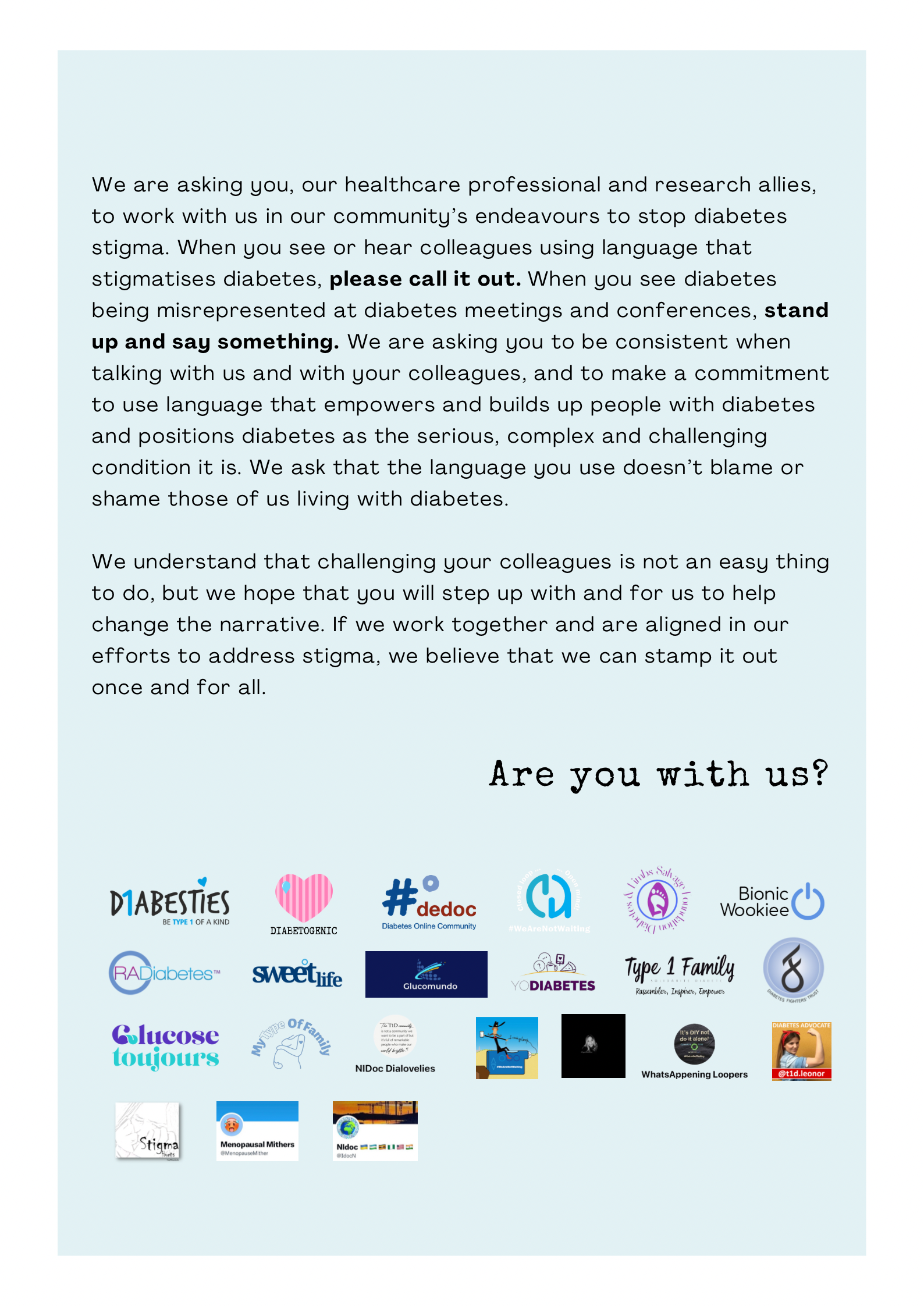
When we first asked advocates from the community if they would like to add their logo to the letter we were surprised by the quick response. Almost everyone we went to said yes. We hadn’t gone out too widely – we wanted to test the waters first. The first version of the open letter includes advocates and peer support groups from across the world. Amazing!
And after our very low-key, (i.e. a couple of tweets from unverified Twitter accounts, so who knows what the algorithm did with them!), we were once again inundated by people asking for us to add their logos. (We haven’t managed to add them yet, but absolutely will in coming weeks. Please give us time if you’ve shared your logo. We’ll get there. And I’ll update this post with the new final page when that happens.)
There is something magic about these sorts of very grassroots, very community, very inclusive initiatives. Not only are they great because they collaboratively offer a narrative from people with diabetes, highlighting an issue that is of great importance to many. They also show you just how powerful and united our community is while also pointing to individuals and groups who are keen to work together, support each other and power the importance of lived experience. And that’s pretty special!
Hey, do you remember a couple of weeks ago when it was International Women’s Day and women got a cupcake (probably baked by a woman) and a breakfast (probably organised by a woman) and then we all agreed that gender equality didn’t need to be spoken about for another year?
Look, I know I sound cynical. But that’s only because I am. Every year at Diabetogenic, I write a post celebrating the incredible women working in diabetes. Mostly I centre diabetes advocates who are generally donating their time – and emotional labour – to power advocacy efforts and make change. And if you look back at the history of the DOC, you will see that the majority of the work has been by women in the community. (Don’t @ me with your ‘But I’m a bloke and I’ve done this’ commentary. It’s not the time for #NotAllMen.)
This year, I started to write something, and then stopped, and started again. And then stopped. Anyone who is a frequent visitor to this site or follows any aspects of my personal advocacy knows that I celebrate the incredible work done by grassroots and community advocates (many/most of whom are women) throughout the year and I didn’t want to buy into the ‘It’s-IWD-here-are-the-womens-now-it’s-back-to-the-misogyny-we-usually-deal-with’ crap that seems to be the aftermath of each and every IWD.
So, I’m using today – this random day – to give a shout out to some of the great things going on that you may have seen, or you may have missed. These things are powered by women who, in most cases, are doing this as extra work on the side of their day jobs, and everything going on in their personal lives. But it’s undeniable that it’s this sort of stuff that is going on all the time, usually flying under the radar, but it’s making a difference to so many folks in the diabetes world.
And so…
There is some remarkable work out of India where the Blue Circle Foundation continues to make a mark in diabetes advocacy. On IWD, a team of women from the Foundation conducted an awareness program for 200 women inmates in Yerwada Jail in Pune, India. This is part of their ongoing Project Gaia which creates safe spaces for women with diabetes. Snehal Nandagawli is just one of the women involved in this work. You can hear more from her at this week’s #dedoc° #docday°.

From the UK, Mel Stephenson-Gray has been a brilliant force in the diabetes community for a number of years. She recently launched a fabulous new Insta page celebrating and empowering women with diabetes. It’s called Diabetes Women’s Health Club and the information she’s been sharing (accompanied by gorgeous graphics) is brilliant. I loved the profiles of some of women who were groundbreaking pioneers in diabetes research. Go give the page a follow now!
Dawn Adams hasn’t managed to convince me that she is only one person because the sheer volume of the work she is doing is immense and she’s bloody everywhere. Dawn continues to blaze trails in her research and writings about diabetes and menopause (follow @MenopauseMither on Twitter for great information and support), has been featured in a number of Diabetes UK publications, spoke at the recent #dedoc° symposium at ATTD, and continues to be a daily support and mentor to people across the global diabetes community. I’ve barely scratched the surface with this list. Someone please send Dawn a coffee and cinnamon bun so she can sit down for 30 seconds and recharge her batteries!
Another woman who is a human powerhouse and obviously works 23 hours a day (lazily, she sleeps for an hour) is Jazz Sethi whose work with the Diabesties Foundation continues to multiply exponentially. She’s also a brilliant speaker and gave an emotional talk at ATTD last month. Check out just some of what she is doing here (and stay tuned for something super exciting that we’ve been working on together!)
Also at the recent ATTD #dedoc° symposium, Hamidah Nabakka from the Sonia Nabeta Foundation captivated the packed-to-capacity room, sharing stories of children and young people living with diabetes in Africa. This was held on the first day of ATTD and for the rest of the week, I had people coming up to me and saying that it was their highlight of the whole conference.
I’m getting to this a little late because it was started last year, but Niki Breslin started a brilliant Insta page to build community called ‘My Type of Family’ for anyone with diabetes who is planning and trying to conceive, pregnant, recently had a baby and parenting. There’s lots of great information and encouragement for the community with this page and definitely worth a follow!

I was so excited to see some artwork by Miss Diabetes from New Zealand make it across the ditch Melbourne in an IWD street art exhibition. Her comic ‘Women and Diabetes’ was on show in our city’s iconic Hosier Lane! Miss Diabetes’ diabetes advocacy is super well-known in the community thanks to her tireless efforts supporting Insulin4All efforts and with work she’s done with the WHO diabetes team. You can see the artwork here.
Anita Sabidi in Indonesia continues to drive and build community with her advocacy work that shine very bright lights on issues such as emotional wellbeing and mental health, and women’s health. Anita is a regular speaker about these important topics, and also leads a number of community initiatives supporting women with diabetes in Indonesia. She’s also speaking at #docday° this week.
Dana Lewis never ceases to amaze. Last week she ran 100kms in a day, but unbelievably, it’s not her physical feats that make her name so well known in the diabetes world. It is, of course, her work in open source AID. Last month she gave two presentations at the Open Diabetes Closing Conference, and she has an upcoming session at the ADA Scientific Sessions in San Diego. On top of that, she continues to publish regularly and is a force for nothing but good!
Ashley Ng from Australia has been documenting life with two gorgeous little girls on her blog, opening up about some of the more difficult aspects of parenting while living with diabetes. I love Ash’s candidness and honesty and am always grateful for her ability to be so raw, but also hopeful. Read and subscribe to her blog here.
These women are just a few of the many who continue to make our community tick and flourish. There work is not only meaningful on 8 March: it’s making a difference every, single day. The very idea that women and their achievements get just one day of real celebration (albeit while battling the calls of ‘where’s International Men’s Day?’) is in equal parts frustrating and insulting. I celebrate the incredible work that women spearhead all the time because I know that alongside that work, they are dealing with patriarchal attitudes that make their successes all the more remarkable. That deserves far more than a cupcake!
Postscript
The UN theme for the day was DigitALL: Innovation and technology for gender equality, not the saccharine sweet ‘EmbraceEquity which means absolutely nothing and was created by some corporate machine that does nothing to advance equality in any way. So, if you spent IWD posting selfies of you hugging yourself, that’s great, but what did that really mean when it comes to advancing gender equality?
If you haven’t had a look at the website from the UN, it’s definitely worth it, even if it’s just to see the high-level details, one of which explains that online gender-based violence silences women and discourages their public participation. It may be odd to think this is a thing in the diabetes community when so much of what you see comes from women, but actually, it’s real. Harassment is a concern for many women, and I know of many women who have stopped sharing or locked down their accounts (permanently or temporarily), or deleted them completely, due to this harassment. I’m one of those women. This is something to be mindful of every day – not just a single day in March.
Four weeks. That’s about how long ago it was that the first murmurings of Fiasp being withdrawn from the PBS were heard in the Australian diabetes community.
It’s been a pretty wild ride in those four weeks, hasn’t it? I never should be surprised at the dedication and never-say-die attitude of diabetes communities, but what we saw from the Australian community was next level! And it went beyond that, with Aussie advocates rallying our friends from overseas (hello #dedoc° Voices!) to amplify our efforts here.
And today, news of a reprieve. Fiasp would be available on the PBS for another 6 months for anyone with a script dated prior to 1 April 2023. (That’s the catch – you need a script before that date, or you will have to pay the private prescription cost.)
This is a great result. It gives everyone with diabetes using Fiasp some breathing space to make plans for what happens if we need to change insulins.
There are a lot of beautiful things about grassroots advocacy. Firstly, it can be incredibly responsive. It takes just one person to share, and the community response is often instantaneous.
We saw that here, didn’t we. As soon as it was just a hint about what was going on with Fiasp, people with diabetes in Australia took to it. This was even before the Minister’s office was aware of what was happening! From a petition (amazing, Belinda!), blog posts and discussions in social media groups, to standing around conference exhibition halls (this is exactly what was going on at ATTD with Aussie advocates!) the momentum started and picked up speed.
It is undeniable that the best results happen when everyone works together, and as I said in my post about this issue a couple of weeks ago, …Community advocacy is often the starting point of rumblings that, combined with strong advocacy from diabetes organisations, leads to policy change.
This is a dazzling example of exactly that! A community of all stakeholders coming together, led by community. Doesn’t THAT make you feel all warm and fuzzy? And today, people with diabetes have celebrated in great ways – the people who should be centred in this win for their efforts. This was my tweet about that earlier today:

Some final thoughts
Celebrate the win and cheer with other community advocates. I’ve loved seeing the commentary in online community groups today! Our celebrations are so meaningful because it is our fridges that were going to be bare of Fiasp if this didn’t come through!!
I know it’s tempting to stockpile, but please don’t! There are 14,000 Australians using Fiasp and hopefully everyone who needs to get a script filled over the next six months will be able to do so effortlessly. Of course there is the human urge to make sure we don’t run out but remember that if you have a year’s supply in the fridge, that might mean someone can’t get their next week’s supply.
This isn’t done yet! Six months is AWESOME but keep the pressure up with the grassroots efforts that worked this time.





 Diabetogenic