
You are currently browsing the category archive for the ‘Real life’ category.
Last Wednesday, I walked into a local pathology office, rolled up my sleeves, held out my arm and watched as the pathology nurse filled three vials of my blood to be sent away. I then peed into a little yellow-lidded plastic jar, placed the jar in a plastic bag and handed that to the nurse waiting outside the bathroom.
And then I walked out of the office, headed to one of my favourite cafés, sat down and worked for a few hours.
I’d like to say that’s end of a very boring story. But it’s not. It’s Monday today and for the last six days, I’ve not stopped thinking about those drops of blood and pee. (I know; slightly gross.)
This week on Wednesday, I have an appointment with my endo. It’s a follow up from my visit last month. I walked out of that consultation with the path slip in my hands and a promise in my head and heart that I would go and have the blood draw done and face the results.
It’s been a very long time since I last had my A1c checked. Very.Long.Time. As in – no freaking idea the last time. It’s also been a while (the same length of time, I guess) since I had any other diabetes complications screening. I’ve not had my kidney function measured or my coeliac screening done. With only half of my thyroid still in my body, (the right half was removed along with a benign tumour back in 1998), I should be having that checked regularly. But I’ve not.
I don’t know why I am so committed and diligent about getting my eye screening done, but that is truly the only diabetes screening that is always – ALWAYS – up-to-date.
So for the last six days, I’ve had many hours, often in the dark of the night when the rest of the household is sleeping, lying wide awake wondering what those drops of bodily fluids have to say. (Again, yuck.) That’s when the nasty self-talking me comes out.
The nasty self-talking me is destructive. She’s relentless and actually quite nasty. ‘I bet your A1c is high, Renza. Really high. And I bet that your urine test is going to show some problems with your kidneys. And you know what? If there is, it’s all your own fault for not being on top of it.
My nasty self-talking me hasn’t read the Diabetes Australia Language Position Statement and says things like ‘You’re totally non-compliant. You know that, right?’ and ‘You’re a bad diabetic. The results are going to not be good at all.’
Last night I dreamt that it was Thursday and I’d missed my appointment, and try as I might, no one would give me my results. I called my endo’s office and the receptionist told me that as I’d forgotten to show up for my appointment the results had expired and disappeared. And then she called me non-compliant and unreliable. (This is so totally not what would happen because she is delightful and lovely and no one in my endo’s office is nasty and judge-y.)
When it’s not the middle of the night and I am thinking logically, the usual self-talking me – the rational one – says sensible things. ‘Yep, you’re right. It has been a while since you had all your screening things done. But you’ve done it now and that’s awesome. Just sit tight until Wednesday and then you’ll see where things are. And if there are problems, we can address it then. Do you need a new pair of boots?’
And when nasty self-talking me says things like ‘Bad, bad diabetic whose A1c is going to be terrible’, the rational self-talking me says ‘It’s just a number. You know that. And if it is higher than you would like, you can put some strategies in place to bring it back to where you are comfortable.’
I like the rational self-talking me. She’s sensible and uses words I like to hear. But it does seem that when there is even a shadow of doubt, she is very much overwhelmed by the nasty self-talking me. And, boy, does she has some attitude! She makes me feel that I should measure myself by numbers. She makes me feel like a failure for not always staying on top of all my diabetes screening. She makes me feel that if anything goes wrong I am to blame. She’s nasty. Really, really nasty!
So right now, with rational self-talking me typing away, I’m putting this here for the next couple of days (and for future reference) when nasty self-talking me is the louder voice:
- You are not defined by your A1c or any other number.
- You are not a bad person because you have let some of your diabetes management slip.
- If it turns out that the results are not what you hoped for – in any way – you can and will deal with that.
- And it’s not your fault if that is the case.
- Diabetes complications do not mean that you have failed.
- You work bloody hard to manage your diabetes as best as you can at any moment and you should go and eat a cupcake right now to congratulate yourself for that.
- If you feel that you could be doing better, work out how to make that happen. Your endo appointment on Wednesday might be a good place to start.
- Tell that nasty self-talking part of you to piss right off.
- And yes. You do need a new pair of boots.

After my pathology visit, I went to one of my favourite local cafes which sometimes has puppies to cuddle. How cute is Juno?!
I have a diabetes cupboard. It is in the corner of our bedroom and is actually an antique music cupboard. At least, that is what it was used for when it belonged to Aaron’s great Aunt. When we were gifted the beautiful piece from Aaron’s mother, we were living in a warehouse apartment with soaring ceilings and exposed beams, and we used it for crockery.
When we bought and moved into our first home, the cupboard sat at the end of the very long corridor in our Victorian cottage. There was always a vase of flowers and a small plate which held our house keys on top and it continued to house bits and pieces of crockery, vases and other bowls and plates.
In our new house (is it still new? We’ve been there over three years now…), it started in the corridor until we had floor to ceiling shelves built in along one wall of the wide hallway. Then we moved it into the corner of our bedroom. Now on top of the cupboard is a pile of books about New York, topped with a Yankees cap I bought when we went to ball game back in July 2013.
It was when it moved into the bedroom that it became my diabetes supplies cupboard. Inside it is stacked with boxes of insulin pump supplies, BGL strips, CGM sensors, chargers and cables for my meter, the empty box from the CGM transmitter I am currently using, Rockadex tape, alcohol wipes, back up BGL meters, spare little purses to house my diabetes kit, syringes (in case of pump fail) and anything else that is filed under ‘crap things I need to manage my crap health condition’.
Every now and then – usually after an avalanche of diabetes supplies has fallen to the floor as I’ve frantically searched for a line or new packet of strips – I do a big clean up and tidy. I throw out empty packages and the annoying instructions for use that are in EVERY box of every supply and take stock of what is in there.
I did this just the other day and now the inside of the cupboard is all neat and tidy, and appealing to my neatness obsession. I can see what supplies I have, what’s running low and what needs reordering now. The size of the cupboard is perfect for diabetes supplies because it’s not too big and doesn’t allow me to over order and overstock – something that is especially important if there are any products on backorder in the NDSS, which can happen occasionally – although, I’m not sure I’d do that anyway because I’ve never been the type to stockpile anything.
My mother stockpiles food and household groceries for Armageddon. I know that at any time I go to her house I can open the pantry doors and find pretty much anything I need to whip up a three course meal. For about sixty people. I rarely leave my parents’ place without a bagful of groceries after mum says, ‘Do you need anything? There is chicken stock in the freezer in the laundry. Take some with you. Oh and some pastina for the kid’s dinner. Do you need some? Plus, coffee. Do you need coffee? Take some coffee. And in the pantry, find some juice boxes and jelly beans’. Their house is better hypo-equipped than our own. You know – the house where the person with diabetes actually lives.
But while I don’t overstock, I am a little paranoid about running out of any of my diabetes supplies. Being prepared when it comes to living with diabetes is essential because it’s not like you can walk into a 24-hour store at 2am if you are out of pump cartridges and expect to find in stock what you need!
When pump supplies went from being available from the Diabetes Victoria store downstairs from where I work, I was more than a little annoyed. I found the convenience of simply walking down a flight of stairs to stock up very useful – especially as I would often be running very low and leave restocking to later than I probably should have.
The change in ordering process has actually meant I actually become better at reordering when NDSS supplies were moved to community pharmacies. I now align my pump consumable order with needing to fill an insulin prescription. I pick up my insulin and another couple of months of pump lines and cartridges at the same time.
At the same time, I usually order a box or two of blood glucose strips. A box of 100 now lasts me almost two months as I rarely do more than a couple of checks a day – simply for calibration purposes of my Dex G5.
The only time that I order above my usual number of boxes of anything is if I am about to travel overseas. I kinda turn into my mum when packing to go away and prepare for the apocalypse, imagining every possible disaster scenario that would involve me needing three times the number of lines or cartridges of strips than I would usually require. I then pack accordingly, only to spend the whole time away cursing the excess baggage. And I end up returning home with almost all I’ve packed!
At home, having a dedicated space for my diabetes supplies is one of those things that I do to try to be as organised as possible. Plus, it keeps all of the diabetes paraphernalia in one place rather than stowed throughout the house. Which I realised is actually why I like this method of organisation better than anything I’ve had before. It means that I can try to ‘contain’ diabetes. And for a condition that likes to stamp its DNA all over the place (she says as she sweeps a handful of BGL strips FROM THE FREEZER!!!) trying to squash it all in one small space is incredibly satisfying!

Containing diabetes.
It’s the final day of the eighth annual #DBlogWeek, created by Karen from Bittersweet Diabetes. This is the sixth year I’ve taken part and it’s a great opportunity to not only write about some truly interesting topics, but also a chance to read some blogs you may not otherwise. Here are the links to today’s posts.
Today’s prompt: Let’s wrap up the week by sharing a little more about ourselves, beyond the chronic illness we or our loved ones live with. Share an interest, hobby, passion, something that is YOU. If you want to explore how it relates to or helps with diabetes you can. Or let it be a part of you that is completely separate from diabetes, because there is more to life than just diabetes!
I have lived with type 1 diabetes for 19 years. I work for a diabetes organisation and have done so for over 15 years. I write a diabetes blog. I am an ambassador for a couple of diabetes-related charities. Occasionally, I can be found speaking about diabetes on radio and television, or writing about it for online and print publications. There is a lot of diabetes in my life.
And yet diabetes is actually such a small part of my life. It may be hard to believe, but it is the truth.
When I have a few idle hours, you won’t find me thinking about diabetes. If I catch up with friends, we rarely, if ever, speak of diabetes.
In fact, the thing that takes up a lot of my spare time, and spare mental space, is food and cooking – especially baking. I thought today I’d share some of my recent baking activities and recipes, just in time for weekend bake-ups!
One day, about two weeks ago, I had an urge to get out the piping bag and make macaroons. As you do. Not to be confused with the ubiquitous macaron, macaroons are little mounds of coconut, egg white, sugar, vanilla and (in my world) edible glitter. This was the outcome.
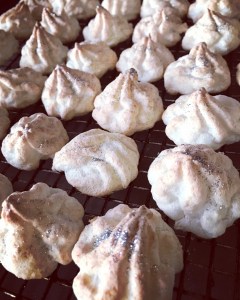
(For the record, two days later, I decided to up the ante, looking for fancier macaroons. I tried another recipe that called for shredded rather than desiccated coconut, and they were an unmitigated fail! Also, I broke my piping bag in the process of trying to push the too-large coconut strands through the nozzle. Moral of the story: sometimes the more elaborate the recipe, the poorer the outcome!)
The kidlet decided that we’d not made gingerbread folks for a while. So we did. And they were so much fun, dressed in bright colourful candied-sugar buttons!
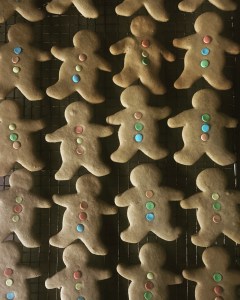
These came on the heels of a shortbread bake-up a few weeks earlier. Again, it was the kidlet saying that we’d not made them for ages, and this was the result of a Sunday afternoon in the kitchen. We used a Stephanie Alexander xmas shortbread recipe, but simply shaped the dough into weird square/rectangular shapes. The Smarties on top are a nod to a local café we used to drop into when she was just a little kidlet. She’d slurp on a babycino, getting the sprinkled chocolate from the top all over her face and we’d share one of their colourful, spotty shortbread cookies. She promised that these tasted just like she remembered!

And while we’re talking fun biscuits (or cookies for my US friends), check out these doughnut-inspired masterpieces created by the kidlet using Nigella’s basic butter biscuit recipe. They tasted as amazing as they look! (This recipe is THE best never-fail biscuit recipe and a brilliant opportunity to show off any cookie-cutter shape you have!)

For Mother’s day afternoon tea last weekend – with Autumn in full swing – I made this delicious and rather impressive-looking caramel apple upside-down cake to serve up, with ice-cream generous dollops of double cream to my mum and mother-in-law.

But one of the most wonderful things I’ve made of late are these Nutella biscuits. The recipe was sent to me by none other than #DBlogWeek creator, Karen Graffeo, who knew I’d not be able to resist the Nutella-y gooeyness of these cookies. They were an absolute hit with everyone who tried them and will definitely be making a regular appearance in the kid’s lunchbox!

And finally – this recipe appeared in my inbox yesterday morning, and yesterday afternoon, with 10 minutes before a teleconference was due to start I whipped it up and threw it in the oven. It was delicious! I love an easy recipe that turns out exactly as it promises.

It’s not hard to know why baking is such a wonderful outlet for me. I love the methodical process of following a recipe combined with the freedom to tweak and adjust as I want. I often bake with the kidlet by my side, and as we throw together ingredients, or decorate cakes and biscuits, we chat and catch up – often about not much at all, but sometimes about pretty serious things too. Creating those opportunities to just hang out and talk with her is important, but mostly, I really like baking with her!
And the end result is always worth it! A house that smells divine, and homemade, delicious treats pulled from the oven to share with family, friends and the neighbours. A pretty damn perfect hobby!
It’s day four of the eighth annual #DBlogWeek, created by Karen from Bittersweet Diabetes. This is the sixth year I’ve taken part and it’s a great opportunity to not only write about some truly interesting topics, but also a chance to read some blogs you may not otherwise. Here are the links to today’s posts.

Today’s prompt: May is Mental Health Month (in the US) so now seems like a great time to explore the emotional side of living with, or caring for someone with, diabetes. What things can make dealing with diabetes an emotional issue for you and / or your loved one, and how do you cope?
One of the things I’ve found about living with diabetes is that the way I respond to certain situations is inconsistent. Some days, I’ll look at a rollercoaster CGM trace, shrug my shoulders and think ‘That’s diabetes!’ and move on. Other times, I’ll look at a similar rollercoaster CGM trace and burst into tears, wanting to curl up in the corner under a quilt, asking ‘Why? Why? WHY?’ while someone brings me a cup of tea and Lindt orange chocolate.
There are periods when my resilience stores are high and I can manage anything thrown at me, and other days where the smallest diabetes issue sends me into a spiral of despair. The unpredictability of diabetes is matched only by my own haphazard responses.
There do seem to be some things that do get me down pretty much any time they happen. When diabetes starts to affect my family, making my health issue theirs, I get very emotional and upset. I think it is probably a combination of sadness, guilt, anger and frustration that guarantees an emotional response.
The unknown of diabetes worries and scares me. I don’t think about it most of the time – I guess that is how I cope. The fears and anxiety are neatly packaged up and hidden away, brought out only in moments of weakness – or perhaps when my resilience is low.
Earlier this month, when I was an invited speaker at the Primary Care Diabetes Society of Australia (#PCDSAus) conference, and in the same session as me was Dr Christel Hendrieckx from the Australian Centre for Behavioural Research in Diabetes. Christel was very clear that clinicians need to consider diabetes and emotional health side by side as the two are undeniably connected.

I truly think that when we break it down, we can’t separate the two. When we live with a condition that is so ever-present; that we invest so much of our time and energy into managing; that we can’t put in a box when we are feeling over it and come back to it when we feel more equipped, it’s impossible for it to not impact emotionally.
We, all too often, draw a line with the physical on one side and the emotional on the other side. That line is terribly blurred – if it’s even there at all – when it comes to diabetes.
It’s day two of the eighth annual #DBlogWeek, created by Karen from Bittersweet Diabetes. This is the sixth year I’ve taken part and it’s a great opportunity to not only write about some truly interesting topics, but also a chance to read some blogs you may not otherwise. Make sure you check out the list for today’s posts here.
Today’s prompt: Insulin and other diabetes medications and supplies can be costly. In the US, insurance status and age (as in Medicare eligibility) can impact both the cost and coverage. So today, let’s discuss how cost impacts our diabetes care. Do you have advice to share? For those outside the US, is cost a concern? Are there other factors such as accessibility or education that cause barriers to your diabetes care?
Diabetes is an expensive condition with which to coexist. Every now and then, I tally my annual diabetes expenses, at which point, the reason for my frequent flyer status at the pharmacy becomes more than apparent. Between insulin, insulin pump consumables and blood glucose strips, it doesn’t take long for the costs to add up.
Then I add the fees to see diabetes-related HCPs. I choose to see all my HCPs privately, so there is a gap (out of pocket) cost for all these appointments. Fortunately, pathology is bulk-billed, so I don’t pay to have my A1c checked or for any other blood work.
Private health insurance (PHI) is a significant cost each year. We pay about $450 per month to cover the whole family for top hospital and extras cover. PHI means that every four years, the full cost of my insulin pump replacement is covered, and it also means a choice of doctors if we’re in hospital, subsidised stays at a private hospital, and we claim optical, dental and orthodontic each year, plus other things as well.
I wear CGM every day of the year, which adds about $4,000 per year to the tally.
It’s a lot of money. Without factoring in incidentals such as hypo treatments and other things that just seem to come up, my out-of-pocket expenses for diabetes (excluding health insurance) would be about $6,500 per year.
And yet, I feel oddly fortunate, because there are few surprises – or changes – each year when it comes to my medical expenses. I know how it will all play out in the family budget each year.
I know the prices that I pay for all my diabetes expenses are pretty much set, and that means I can plan for them.
I know that every time I walk into the pharmacy to fill an insulin prescription, I will hand over $38.80 for five 10ml vials of insulin. We are never at the mercy of Big Pharma’s arbitrary price hikes. (Last week’s announcement from Lilly of a 7.8 per cent increase on the cost of Humalog – after years of substantial increases – has left me reeling and astonished at how my American friends can afford to just survive with diabetes, let alone live or thrive…)
I know that my diabetes consumables will be the same price every time I order them thanks to the NDSS. The National Diabetes Services Scheme (NDSS) is celebrating 30 years this year – that’s 30 years of subsidised diabetes supplies for all people living with diabetes.
I know how much my doctor will charge me and I know the Medicare rebate. And I know that if I was unable to afford to see my doctors at their private offices, I’d have access to the free diabetes clinic at the tertiary hospital less than 10 minutes from my home, and a bulk billing GP of my choice.
I know that if I couldn’t afford private health insurance, my ability to buy insulin, diabetes supplies or see healthcare professionals would not be affected.
I know that there is no time that I will need to ration insulin doses. I know there will be no time that I cannot afford to see a doctor. I know my pharmacy will always be able to provide me with the supplies I need to live with diabetes and drive the devices I use to manage as best I can. I know I am not really limited by maximum rebate amounts or that if I need more BGL strips, I can get them.
And I also know – and acknowledge – the privilege that allows me to afford health insurance that pays for my insulin pump, and to self-fund CGM, and to see the endocrinologist of my choice privately.
I know there are many other Australians with diabetes who are not as fortunate.
The outcomes for Indigenous Australians are worse – far worse. Poorer Australians have poorer health outcomes. People living in remote areas often struggle to access decent, timely and appropriate healthcare. Australians from CALD backgrounds may not understand a new diagnosis or the treatment being prescribed which affects how they manage their health.
Our system here in Australia is not perfect and we should be continually striving to do better. But it is certainly better than in a lot of other places. The thing about diabetes is that, as many of us wrote yesterday, we are wrangling a health condition that likes surprising us. We often feel we are fighting our own bodies. We shouldn’t need to fight to afford our care – and our health – as well.

The cards that cover my diabetes – and other health – needs. (Oh – and a credit card for all the out-of-pocket expenses…)
It’s day one of the eighth annual #DBlogWeek, created by Karen from Bittersweet Diabetes. This is the sixth year I’ve taken part and it’s a great opportunity to not only write about some truly interesting topics, but also a chance to read some blogs you may not otherwise. Make sure you check out the list for today’s posts here.
Today’s prompt: Diabetes can sometimes seem to play by a rulebook that makes no sense, tossing out unexpected challenges at random. What are your best tips for being prepared when the unexpected happens? Or, take this topic another way and tell us about some good things diabetes has brought into your, or your loved one’s, life that you never could have expected?
There are things in this world that are predictable. The early evening darkness that descends as soon as daylight saving ends each April; the desserts of warm crumble in front of the fire as soon as the weather cools down; the taste and jolt of the first coffee of the morning; or the way the puppy runs around in circles for a good five minutes once she’s let into the house when her people arrive home after a day at work.
The predictability is comforting. I like comforting. I like predictable!
Because then…then there is diabetes. Diabetes doesn’t do predictable. In fact, my diabetes laughs in the face of predictable. It seems to take great delight in waiting until the exact moment that I start to feel comfortable and confident that something is sorted and working in a certain way, and then throws me a curve ball, messing up any notion of security.
Being prepared can help though, although if I were to truly be prepared for any and all possibilities diabetes has in store, I’d never leave the house – or only ever leave carrying a suitcase and medical team. However, there are some little things that I do routinely that do make those unexpected situations a little easier to manage.
My ‘diabetes spares bag’ is always in my handbag and is probably the thing that saves me most. I wrote about how it came to the rescue a few months ago when I got to work and realized I’d forgotten to attach my insulin pump (it turns out that sixteen years of pumping is no guarantee that I’d remember to actually connect the bloody thing in the morning). Again, this is what my spares bag looks like:
 And that pretty much takes care of most contingencies for a device malfunction. Empty cartridge alarm? No problem – swearing and spare insulin vial and spare cartridge can take care of that. Pump line snagged on door handle and ripped from body? Swearing and spare infusion set can take care of that. Dead battery alarm? Swearing and spare battery has that sorted (and the five cent piece in there will open the battery cap without much effort). Insulin pump left on the bathroom vanity? So much swearing and spare insulin vial and syringe will take care of that.
This little bag has helped me out of diabetes messes more times that I care to remember.
I consider having a well-connected and easy-to-reach endo an absolute essential for the unexpected. I’d never call her out of hours for something trivial, but I have reluctantly used her mobile number in case of emergencies. For example – the time I was in hospital and the A &E staff wanted to take away my pump, blood glucose meter, insulin and dignity. Or the time I passed out from a hypo and I needed her to convince the paramedics that I didn’t need to be taken to A&E – and could manage at home myself. She’s an insurance policy like to other in those moments of desperation.
To be honest, the times that I am most surprised by diabetes isn’t when it does something unexpected. The unexpected is actually normal. The times diabetes surprises me is when it is just ticking along quietly doing its thing and letting me tick along quietly and get on with things. I become most suspicious and wary, waiting for it to get back to doing its thing: being an impulsive, random, fickle pain in the pancreas.
It’s Mother’s Day on Sunday. In recent years, as I have found aspects of the day challenging, I’ve really channelled my energy on Mother’s Day into what my own mother has given me.
I am willing to admit my bias, but I think my mother is the best Mum in the world. She’s very cool, and when I was growing up all my friends thought she was awesome. She was in her early 20s when she had me, and has always been a young Mum. That’s not to say that she always knows what the cool kids are talking about. We have many stories of absolutely hysterical things she has said and done in the belief that she was being oh-so-hip. My sister and I never stop making fun of her, which she mostly takes with good grace. Mostly…
When I was growing up, there was nothing that I felt I couldn’t talk to Mum about. She was very open and no subject was taboo. I felt comfortable speaking with her about pretty much everything, and when I had my own daughter, I knew that I wanted to have the same sort of relationship with her.
Mum instilled in me a love of food and cooking – something for which I am so grateful. Yet as great as the cakes are that I pull out of the oven, or the plates I serve up for dinner, nothing is as good as her food.
She showed me that chicken soup is truly all it takes some days to lift my spirits and fortify me for what comes next. I’ve not managed to always have a stash in the freezer for quick thawing, but I am always welcome to let myself into my parents’ house and help myself to whatever is in my freezer. And when I am under the weather – physically or emotionally – a text message of ‘I’m sending dad over with some chicken soup for you’ is an inevitability.
When I was diagnosed with diabetes, she was there, alongside me: a pillar of strength on the outside when, I knew, she would have been falling apart inside.
She taught me how to live with a chronic health condition. I have watched Mum deal with her own health conditions for over thirty years. She has done so with incredible grace, determination and resolve. Every time something new has been thrown at her, she’s rolled up her sleeves and taken it on. A couple of years ago she had a double knee replacement and the speed and intensity of her recovery was a marvel. She pushed and pushed through rehab, recovering far sooner than expected.
There may not be an instruction book for diabetes, but thanks to watching Mum live with lupus, rheumatoid arthritis and Sjögren’s syndrome meant I did sort of have a real-life manual for how to get on with life even with my new health challenge. I looked at her attitude and took it on as my own.
She’s shown me that even through the pain and fatigue and frustrations that seem to go hand-in-hand with life-long health conditions, laughing and carrying on in a silly way is absolutely okay.
But equally, she also taught me that it’s okay to cry and feel overwhelmed.
She helped me understand that even though there are times that the thought of another appointment with another doctor for another thing was just too much to deal with, it is okay to complain about it, but I just had to do it.
She taught me that self-care days that involved sitting on the couch under a quilt watching reruns of British cop shows is absolutely okay. But the next day, you get up and get back into it.
She taught me that even though there were times I didn’t want to, I had to show up – show up to my own care, to doctors’ appointments, to blood draws, to work. She might say ‘Diabetes is shit today,’ (she’s a trade unionist; my potty mouth came from her!), ‘But you have to keep going.’ She tells me all the time that life with chronic health issues is boring. And it is. It really is!
Every day, she’s made me see that even though something may look easy, living with a chronic health condition is simply not. She wears the invisibility of her health condition the way I do mine. We smile through the sadness of what could have been had we not had so many health challenges to manage.
She made me understand that not everyone is as fortunate as we are when it comes to health care accessibility and affordability. And that helping those less fortunate is a responsibility I must never shirk.
The unconditional love, support and pride she has demonstrated in spades is, of course, much appreciated. Having a prototype right there for the type of mother I want to be has been a blessing. But I appreciate so much more than that. Our health issues may be different, but it is my Mum who taught me how to thrive with diabetes. I would not be living the way I am now without her having gone ahead of me. Or without having her stand beside me, and hold me up when I’ve needed.
Happy Mother’s Day, Mum. Thanks for the chicken soup. And everything else.
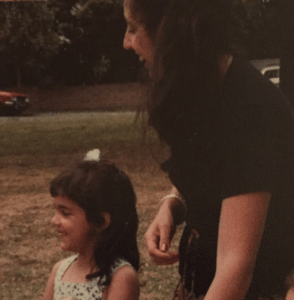
Now we are six! Mum and me at my sixth birthday party.
The term ‘mansplaining’ has made its way into modern language – and with good reason.
But I’d like to get ‘diabetesplaining’ in there, too. Recently, I’ve had a few diabplaining episodes that have left me shaking my head (and making up words…).
In all of these cases, the person doing the diabetesplaining didn’t have diabetes. And yet, they felt that I needed their advice on how to live with, and how to feel about, the health condition that I’ve been managing for the last nineteen years.
I am always happy to speak about diabetes and answer any questions people have. (Provided, of course that people are polite and respectful.) But I don’t appreciate unsolicited advice and explanations, or someone thinking they know more about my diabetes than I know. (Spoiler alert: no one does.)
These are just some of the gems that have been fired in my direction recently:
‘You know, someone at my work has diabetes and they don’t seem to have all the things you have to manage it. Maybe you should try to simplify what you are doing. You don’t need all of those things.’
‘Diabetes is a really easy to manage condition if you just eat the right foods. Do you eat the right foods? Let me tell you the foods that are good for diabetes.’
‘You shouldn’t worry about diabetes. You look really healthy. There is no need for you to worry.’
‘Your preoccupation with how people speak about diabetes is ridiculous. There is no need to stress out about that. Do you think you really need to be so concerned about it? Instead, you should channel that energy into something else…’ (There was no suggestions as to what else I could channel all that wasted energy into…)
With diabetes being a health issue with considerable attention, it makes sense that people want to have a say. I am actually all for that! I think that we need to have people speaking about diabetes and hearing about it too.
But the best people to drive the conversation has to be people actually affected by diabetes – not those who only think they know about it, or have become armchair experts because they saw a Michael Mosley doco on the issue!
Plus, those of us who are living with diabetes who have concerns or fears or a focus on any particular issue, or are managing our diabetes in a certain way don’t need to be told that we are unnecessarily ‘overdoing it’ or could be doing it better.
So, how did I respond to these comments? Not as ferociously as I would like, to be honest. But equally, not in the manner in which I really would like. It’s bloody hard to keep myself nice when I feel that someone is trying to enlighten to me when I really just want them to shush. Because as arrogant as this makes me sound, the chance that someone has something new to tell me about how I could better think or deal with my diabetes is slim to none.
It’s actually very tiring being on the receiving end of these sorts of comments. I don’t always want to be in ‘diabetes education mode’. I don’t feel equipped sometime to have to defend the way I feel, or explain why I do something to keep myself as healthy as I can. Diabetes is hard enough without having to justify myself. And I don’t need anyone to explain the finer details of diabetes, especially when there are far more interesting things we could be talking about. Such as these awesome ninjabread cookie cutters.
The other day, I walked into my local NDSS pharmacy and collected four boxes pump consumables and a couple of boxes of blood glucose strips.
I have a lovely pharmacist. She’s friendly and chatty and every time I visit, we catch up about how our kids are going and she comments on how I seem to spend a lot of time on aeroplanes and that I need to look after myself better. (She’s also my parents’ pharmacist, so I suspect that my dad asks her to say that to me.)
While we were talking, she was packaging up my supplies and came out from behind the counter to hand me a black bag. As I was paying for them, I had a really strong flashback to the days that I worked in a local pharmacy.
I was a pharmacy shop girl from when I was 15 until I was about 20. It was a convenient part-time job – a few hours on Saturdays and Sundays, and extra hours in the lead up to Xmas – and a great way to earn a little spending money.
I remembered that there was a customer who came in about once a month and that when he walked in, the pharmacist would step down from his little ‘stage’ with all the medications and bring out the customer’s order, wrapped up in a couple of paper bags. I had no idea what was inside them, and it took me a couple of years of wondering before I finally asked the pharmacist.
‘He has diabetes. It’s insulin and other things he needs for his diabetes,’ was the answer. ‘He doesn’t like to see the different products, so I wrap them up when I order them in for him and just pass them to him. That way, no one knows what’s in the bag.’
I knew nothing about diabetes back then. I just acknowledged what the pharmacist said with a nod of my head, and the next time I saw that customer, I handed him his package without a word.
I wasn’t working at the pharmacy anymore when I was diagnosed with diabetes, but it is where I picked up my first insulin prescription. I have never, ever thought to ask for my insulin to be hidden away, in fact, the only discussion I have is lying about promising that I am going straight home and don’t need a cool bag for the drugs. Pharmacists seem to worry that the hour or so the insulin is out of the fridge while I pop into a café to grab a coffee is going to send it sour.
But apparently the attitude of the customer at the pharmacy I worked at isn’t all that uncommon. Until the change in ordering from the NDSS, I used to collect my supplies from the NDSS shop downstairs at Diabetes Victoria. This was always fabulously convenient for me, considering I worked just upstairs. The products were always loaded into an opaque, black plastic bag. I remember someone saying those bags were used because a lot of people didn’t want others to know what was inside.
All mail being sent out by the diabetes organisation I worked at was sent in unbranded, plain envelopes. Apparently some people didn’t want their neighbours – or postie – knowing they were receiving mail about diabetes-related matters.
I’ve heard countless stories of people going to great lengths to hide their diabetes. I remember a case where a house was over-crowded with sharps and diabetes waste because the people in the house refused to throw out any packaging that might suggest someone living there had diabetes. They didn’t use sharps containers because they didn’t want to go to their local council for a free one because it might mean having to identify themselves as having diabetes. And they didn’t pay for a sharps container, because depositing it at a sharps collection point would also mean saying they had diabetes.
Another time, someone called me to complain because a letter sent out by the team I managed had slipped inside the plane envelope and the logo identifying the diabetes organisation was visible through the window. ‘I don’t want people knowing I have diabetes,’ I was told angrily.
This reluctance to let others know could be a matter of people simply not wanting to share their personal health with others, which is, of course, fine. But I suspect that it is more than just that. I think that in a lot of cases there is shame involved too. For every one of us who claims to be out, loud and proud about our diabetes, there are others who still want it hidden away – people who feel ashamed, and shamed, by their condition so much so that they don’t want others to know they are affected by diabetes.
I wear my diabetes very visibly and have never thought not to. I don’t feel shame about it at all. Diabetes is tough enough as it is without trying to conceal it from everyone as well. I just don’t have the headspace to think about how to hide it away.
There’s a war going on and it’s getting very, very messy.
Fat or carbs? These are the two big hitters in our diets, and when it comes to diabetes, are demonised by some, celebrated by others. And it’s confusing to say the least.
It’s also incredibly polarising and some of the most brutal arguments I’ve seen online within the diabetes community are about the foods we choose to eat or the eating plans we choose to follow.
My own personal decision to eat a lower carb diet was met with almost comical responses. Both sides of the fence told me I was being an idiot, all of which I happily ignored and continued doing what I was doing. Because it was working for me and is none of anyone else’s business.
When we look at the science of food, it’s confusing. I don’t for a minute pretend to understand how things work, I really don’t. I know how different foods impact my glucose levels, I know foods that make me feel better and I know that I like to eat.
But having made all of those disclaimers, I am health (and food) literate and I do understand some aspects of the science. I understand the basics of the carbs versus fat argument. But mostly, I understand that choice needs to be the driving force, along with acknowledging no one way of eating will ever work for every person. (Because if that were true, we’d all just eat Nutella ALL the time, because it tastes so bloody good and if you believe their spin, it’s a health food! Don’t believe their spin.)
What I really don’t like about the debate though is the acrimony. It makes me uncomfortable when either side take to cheap shots or aggression. Exhibit A is in the form of a tweet which I’m not sharing, because its writer is selling diet books and I’ve no intention of giving her any publicity here. But the gist of her tweet was condemning dietary guidelines and slamming carbs because she doesn’t (and this is a direct quote) ‘want to be fat and diabetic’.
The tweeter managed to food shame, fat shame, stigmatise and judge – all in 140 characters. As well as get things wrong. There are plenty of people who do follow dietary guidelines and eat carbs, yet do not have diabetes and nor are they overweight.
I get that there is some real anger, particularly within the LCHF community because there is so little recognition of how eating in this way can, for some people, help manage weight, diabetes and overall health. And some feel cheated that LCHF is frequently not even presented or recommended as an option, instead ignored or claimed to be dangerous. I get that this is frustrating for people who have seen great results after adopting this sort of diet.
I’m actually one of those people. But I refuse to think for one minute that just because this is working for me that everyone else should do it, too. I’ve never subscribed to thinking that any aspect of diabetes management is one size fits all.
So, what’s the answer? Well, I’ve no idea really. Ever since taking an interest in different eating habits, I’ve been astounded at just how many new diets are released. Obviously some of them are more sound than others, but regardless, there are always new ideas out there.
Perhaps the answer is to be patient. The ‘in’ and guideline-approved way of eating changes every decade or so. Perhaps those who are cross that their chosen eating plan isn’t the plan de jour just need to wait a few years before it is. And then they can say ‘told you so’. At least, until it’s old hat and replaced by some other new trend.
This is the first of a couple of food/diet-related posts I have ready to go over the next few days. I’m really interested to hear what others have to say about what works/doesn’t and why. And also how people deal with the judgement and commentary that inevitable comes when we are talking about what we eat.





 Diabetogenic