You are currently browsing the category archive for the ‘Real life’ category.
It’s day two of the eighth annual #DBlogWeek, created by Karen from Bittersweet Diabetes. This is the sixth year I’ve taken part and it’s a great opportunity to not only write about some truly interesting topics, but also a chance to read some blogs you may not otherwise. Make sure you check out the list for today’s posts here.

Today’s prompt: Insulin and other diabetes medications and supplies can be costly. In the US, insurance status and age (as in Medicare eligibility) can impact both the cost and coverage. So today, let’s discuss how cost impacts our diabetes care. Do you have advice to share? For those outside the US, is cost a concern? Are there other factors such as accessibility or education that cause barriers to your diabetes care?
Diabetes is an expensive condition with which to coexist. Every now and then, I tally my annual diabetes expenses, at which point, the reason for my frequent flyer status at the pharmacy becomes more than apparent. Between insulin, insulin pump consumables and blood glucose strips, it doesn’t take long for the costs to add up.
Then I add the fees to see diabetes-related HCPs. I choose to see all my HCPs privately, so there is a gap (out of pocket) cost for all these appointments. Fortunately, pathology is bulk-billed, so I don’t pay to have my A1c checked or for any other blood work.
Private health insurance (PHI) is a significant cost each year. We pay about $450 per month to cover the whole family for top hospital and extras cover. PHI means that every four years, the full cost of my insulin pump replacement is covered, and it also means a choice of doctors if we’re in hospital, subsidised stays at a private hospital, and we claim optical, dental and orthodontic each year, plus other things as well.
I wear CGM every day of the year, which adds about $4,000 per year to the tally.
It’s a lot of money. Without factoring in incidentals such as hypo treatments and other things that just seem to come up, my out-of-pocket expenses for diabetes (excluding health insurance) would be about $6,500 per year.
And yet, I feel oddly fortunate, because there are few surprises – or changes – each year when it comes to my medical expenses. I know how it will all play out in the family budget each year.
I know the prices that I pay for all my diabetes expenses are pretty much set, and that means I can plan for them.
I know that every time I walk into the pharmacy to fill an insulin prescription, I will hand over $38.80 for five 10ml vials of insulin. We are never at the mercy of Big Pharma’s arbitrary price hikes. (Last week’s announcement from Lilly of a 7.8 per cent increase on the cost of Humalog – after years of substantial increases – has left me reeling and astonished at how my American friends can afford to just survive with diabetes, let alone live or thrive…)
I know that my diabetes consumables will be the same price every time I order them thanks to the NDSS. The National Diabetes Services Scheme (NDSS) is celebrating 30 years this year – that’s 30 years of subsidised diabetes supplies for all people living with diabetes.
I know how much my doctor will charge me and I know the Medicare rebate. And I know that if I was unable to afford to see my doctors at their private offices, I’d have access to the free diabetes clinic at the tertiary hospital less than 10 minutes from my home, and a bulk billing GP of my choice.
I know that if I couldn’t afford private health insurance, my ability to buy insulin, diabetes supplies or see healthcare professionals would not be affected.
I know that there is no time that I will need to ration insulin doses. I know there will be no time that I cannot afford to see a doctor. I know my pharmacy will always be able to provide me with the supplies I need to live with diabetes and drive the devices I use to manage as best I can. I know I am not really limited by maximum rebate amounts or that if I need more BGL strips, I can get them.
And I also know – and acknowledge – the privilege that allows me to afford health insurance that pays for my insulin pump, and to self-fund CGM, and to see the endocrinologist of my choice privately.
I know there are many other Australians with diabetes who are not as fortunate.
The outcomes for Indigenous Australians are worse – far worse. Poorer Australians have poorer health outcomes. People living in remote areas often struggle to access decent, timely and appropriate healthcare. Australians from CALD backgrounds may not understand a new diagnosis or the treatment being prescribed which affects how they manage their health.
Our system here in Australia is not perfect and we should be continually striving to do better. But it is certainly better than in a lot of other places. The thing about diabetes is that, as many of us wrote yesterday, we are wrangling a health condition that likes surprising us. We often feel we are fighting our own bodies. We shouldn’t need to fight to afford our care – and our health – as well.

The cards that cover my diabetes – and other health – needs. (Oh – and a credit card for all the out-of-pocket expenses…)
It’s day one of the eighth annual #DBlogWeek, created by Karen from Bittersweet Diabetes. This is the sixth year I’ve taken part and it’s a great opportunity to not only write about some truly interesting topics, but also a chance to read some blogs you may not otherwise. Make sure you check out the list for today’s posts here.
Today’s prompt: Diabetes can sometimes seem to play by a rulebook that makes no sense, tossing out unexpected challenges at random. What are your best tips for being prepared when the unexpected happens? Or, take this topic another way and tell us about some good things diabetes has brought into your, or your loved one’s, life that you never could have expected?
There are things in this world that are predictable. The early evening darkness that descends as soon as daylight saving ends each April; the desserts of warm crumble in front of the fire as soon as the weather cools down; the taste and jolt of the first coffee of the morning; or the way the puppy runs around in circles for a good five minutes once she’s let into the house when her people arrive home after a day at work.
The predictability is comforting. I like comforting. I like predictable!
Because then…then there is diabetes. Diabetes doesn’t do predictable. In fact, my diabetes laughs in the face of predictable. It seems to take great delight in waiting until the exact moment that I start to feel comfortable and confident that something is sorted and working in a certain way, and then throws me a curve ball, messing up any notion of security.
Being prepared can help though, although if I were to truly be prepared for any and all possibilities diabetes has in store, I’d never leave the house – or only ever leave carrying a suitcase and medical team. However, there are some little things that I do routinely that do make those unexpected situations a little easier to manage.
My ‘diabetes spares bag’ is always in my handbag and is probably the thing that saves me most. I wrote about how it came to the rescue a few months ago when I got to work and realized I’d forgotten to attach my insulin pump (it turns out that sixteen years of pumping is no guarantee that I’d remember to actually connect the bloody thing in the morning). Again, this is what my spares bag looks like:
 And that pretty much takes care of most contingencies for a device malfunction. Empty cartridge alarm? No problem – swearing and spare insulin vial and spare cartridge can take care of that. Pump line snagged on door handle and ripped from body? Swearing and spare infusion set can take care of that. Dead battery alarm? Swearing and spare battery has that sorted (and the five cent piece in there will open the battery cap without much effort). Insulin pump left on the bathroom vanity? So much swearing and spare insulin vial and syringe will take care of that.
This little bag has helped me out of diabetes messes more times that I care to remember.
I consider having a well-connected and easy-to-reach endo an absolute essential for the unexpected. I’d never call her out of hours for something trivial, but I have reluctantly used her mobile number in case of emergencies. For example – the time I was in hospital and the A &E staff wanted to take away my pump, blood glucose meter, insulin and dignity. Or the time I passed out from a hypo and I needed her to convince the paramedics that I didn’t need to be taken to A&E – and could manage at home myself. She’s an insurance policy like to other in those moments of desperation.
To be honest, the times that I am most surprised by diabetes isn’t when it does something unexpected. The unexpected is actually normal. The times diabetes surprises me is when it is just ticking along quietly doing its thing and letting me tick along quietly and get on with things. I become most suspicious and wary, waiting for it to get back to doing its thing: being an impulsive, random, fickle pain in the pancreas.
It’s Mother’s Day on Sunday. In recent years, as I have found aspects of the day challenging, I’ve really channelled my energy on Mother’s Day into what my own mother has given me.
I am willing to admit my bias, but I think my mother is the best Mum in the world. She’s very cool, and when I was growing up all my friends thought she was awesome. She was in her early 20s when she had me, and has always been a young Mum. That’s not to say that she always knows what the cool kids are talking about. We have many stories of absolutely hysterical things she has said and done in the belief that she was being oh-so-hip. My sister and I never stop making fun of her, which she mostly takes with good grace. Mostly…
When I was growing up, there was nothing that I felt I couldn’t talk to Mum about. She was very open and no subject was taboo. I felt comfortable speaking with her about pretty much everything, and when I had my own daughter, I knew that I wanted to have the same sort of relationship with her.
Mum instilled in me a love of food and cooking – something for which I am so grateful. Yet as great as the cakes are that I pull out of the oven, or the plates I serve up for dinner, nothing is as good as her food.
She showed me that chicken soup is truly all it takes some days to lift my spirits and fortify me for what comes next. I’ve not managed to always have a stash in the freezer for quick thawing, but I am always welcome to let myself into my parents’ house and help myself to whatever is in my freezer. And when I am under the weather – physically or emotionally – a text message of ‘I’m sending dad over with some chicken soup for you’ is an inevitability.
When I was diagnosed with diabetes, she was there, alongside me: a pillar of strength on the outside when, I knew, she would have been falling apart inside.
She taught me how to live with a chronic health condition. I have watched Mum deal with her own health conditions for over thirty years. She has done so with incredible grace, determination and resolve. Every time something new has been thrown at her, she’s rolled up her sleeves and taken it on. A couple of years ago she had a double knee replacement and the speed and intensity of her recovery was a marvel. She pushed and pushed through rehab, recovering far sooner than expected.
There may not be an instruction book for diabetes, but thanks to watching Mum live with lupus, rheumatoid arthritis and Sjögren’s syndrome meant I did sort of have a real-life manual for how to get on with life even with my new health challenge. I looked at her attitude and took it on as my own.
She’s shown me that even through the pain and fatigue and frustrations that seem to go hand-in-hand with life-long health conditions, laughing and carrying on in a silly way is absolutely okay.
But equally, she also taught me that it’s okay to cry and feel overwhelmed.
She helped me understand that even though there are times that the thought of another appointment with another doctor for another thing was just too much to deal with, it is okay to complain about it, but I just had to do it.
She taught me that self-care days that involved sitting on the couch under a quilt watching reruns of British cop shows is absolutely okay. But the next day, you get up and get back into it.
She taught me that even though there were times I didn’t want to, I had to show up – show up to my own care, to doctors’ appointments, to blood draws, to work. She might say ‘Diabetes is shit today,’ (she’s a trade unionist; my potty mouth came from her!), ‘But you have to keep going.’ She tells me all the time that life with chronic health issues is boring. And it is. It really is!
Every day, she’s made me see that even though something may look easy, living with a chronic health condition is simply not. She wears the invisibility of her health condition the way I do mine. We smile through the sadness of what could have been had we not had so many health challenges to manage.
She made me understand that not everyone is as fortunate as we are when it comes to health care accessibility and affordability. And that helping those less fortunate is a responsibility I must never shirk.
The unconditional love, support and pride she has demonstrated in spades is, of course, much appreciated. Having a prototype right there for the type of mother I want to be has been a blessing. But I appreciate so much more than that. Our health issues may be different, but it is my Mum who taught me how to thrive with diabetes. I would not be living the way I am now without her having gone ahead of me. Or without having her stand beside me, and hold me up when I’ve needed.
Happy Mother’s Day, Mum. Thanks for the chicken soup. And everything else.
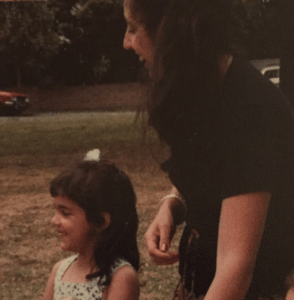
Now we are six! Mum and me at my sixth birthday party.
The term ‘mansplaining’ has made its way into modern language – and with good reason.
But I’d like to get ‘diabetesplaining’ in there, too. Recently, I’ve had a few diabplaining episodes that have left me shaking my head (and making up words…).
In all of these cases, the person doing the diabetesplaining didn’t have diabetes. And yet, they felt that I needed their advice on how to live with, and how to feel about, the health condition that I’ve been managing for the last nineteen years.
I am always happy to speak about diabetes and answer any questions people have. (Provided, of course that people are polite and respectful.) But I don’t appreciate unsolicited advice and explanations, or someone thinking they know more about my diabetes than I know. (Spoiler alert: no one does.)
These are just some of the gems that have been fired in my direction recently:
‘You know, someone at my work has diabetes and they don’t seem to have all the things you have to manage it. Maybe you should try to simplify what you are doing. You don’t need all of those things.’
‘Diabetes is a really easy to manage condition if you just eat the right foods. Do you eat the right foods? Let me tell you the foods that are good for diabetes.’
‘You shouldn’t worry about diabetes. You look really healthy. There is no need for you to worry.’
‘Your preoccupation with how people speak about diabetes is ridiculous. There is no need to stress out about that. Do you think you really need to be so concerned about it? Instead, you should channel that energy into something else…’ (There was no suggestions as to what else I could channel all that wasted energy into…)
With diabetes being a health issue with considerable attention, it makes sense that people want to have a say. I am actually all for that! I think that we need to have people speaking about diabetes and hearing about it too.
But the best people to drive the conversation has to be people actually affected by diabetes – not those who only think they know about it, or have become armchair experts because they saw a Michael Mosley doco on the issue!
Plus, those of us who are living with diabetes who have concerns or fears or a focus on any particular issue, or are managing our diabetes in a certain way don’t need to be told that we are unnecessarily ‘overdoing it’ or could be doing it better.
So, how did I respond to these comments? Not as ferociously as I would like, to be honest. But equally, not in the manner in which I really would like. It’s bloody hard to keep myself nice when I feel that someone is trying to enlighten to me when I really just want them to shush. Because as arrogant as this makes me sound, the chance that someone has something new to tell me about how I could better think or deal with my diabetes is slim to none.
It’s actually very tiring being on the receiving end of these sorts of comments. I don’t always want to be in ‘diabetes education mode’. I don’t feel equipped sometime to have to defend the way I feel, or explain why I do something to keep myself as healthy as I can. Diabetes is hard enough without having to justify myself. And I don’t need anyone to explain the finer details of diabetes, especially when there are far more interesting things we could be talking about. Such as these awesome ninjabread cookie cutters.
The other day, I walked into my local NDSS pharmacy and collected four boxes pump consumables and a couple of boxes of blood glucose strips.
I have a lovely pharmacist. She’s friendly and chatty and every time I visit, we catch up about how our kids are going and she comments on how I seem to spend a lot of time on aeroplanes and that I need to look after myself better. (She’s also my parents’ pharmacist, so I suspect that my dad asks her to say that to me.)
While we were talking, she was packaging up my supplies and came out from behind the counter to hand me a black bag. As I was paying for them, I had a really strong flashback to the days that I worked in a local pharmacy.
I was a pharmacy shop girl from when I was 15 until I was about 20. It was a convenient part-time job – a few hours on Saturdays and Sundays, and extra hours in the lead up to Xmas – and a great way to earn a little spending money.
I remembered that there was a customer who came in about once a month and that when he walked in, the pharmacist would step down from his little ‘stage’ with all the medications and bring out the customer’s order, wrapped up in a couple of paper bags. I had no idea what was inside them, and it took me a couple of years of wondering before I finally asked the pharmacist.
‘He has diabetes. It’s insulin and other things he needs for his diabetes,’ was the answer. ‘He doesn’t like to see the different products, so I wrap them up when I order them in for him and just pass them to him. That way, no one knows what’s in the bag.’
I knew nothing about diabetes back then. I just acknowledged what the pharmacist said with a nod of my head, and the next time I saw that customer, I handed him his package without a word.
I wasn’t working at the pharmacy anymore when I was diagnosed with diabetes, but it is where I picked up my first insulin prescription. I have never, ever thought to ask for my insulin to be hidden away, in fact, the only discussion I have is lying about promising that I am going straight home and don’t need a cool bag for the drugs. Pharmacists seem to worry that the hour or so the insulin is out of the fridge while I pop into a café to grab a coffee is going to send it sour.
But apparently the attitude of the customer at the pharmacy I worked at isn’t all that uncommon. Until the change in ordering from the NDSS, I used to collect my supplies from the NDSS shop downstairs at Diabetes Victoria. This was always fabulously convenient for me, considering I worked just upstairs. The products were always loaded into an opaque, black plastic bag. I remember someone saying those bags were used because a lot of people didn’t want others to know what was inside.
All mail being sent out by the diabetes organisation I worked at was sent in unbranded, plain envelopes. Apparently some people didn’t want their neighbours – or postie – knowing they were receiving mail about diabetes-related matters.
I’ve heard countless stories of people going to great lengths to hide their diabetes. I remember a case where a house was over-crowded with sharps and diabetes waste because the people in the house refused to throw out any packaging that might suggest someone living there had diabetes. They didn’t use sharps containers because they didn’t want to go to their local council for a free one because it might mean having to identify themselves as having diabetes. And they didn’t pay for a sharps container, because depositing it at a sharps collection point would also mean saying they had diabetes.
Another time, someone called me to complain because a letter sent out by the team I managed had slipped inside the plane envelope and the logo identifying the diabetes organisation was visible through the window. ‘I don’t want people knowing I have diabetes,’ I was told angrily.
This reluctance to let others know could be a matter of people simply not wanting to share their personal health with others, which is, of course, fine. But I suspect that it is more than just that. I think that in a lot of cases there is shame involved too. For every one of us who claims to be out, loud and proud about our diabetes, there are others who still want it hidden away – people who feel ashamed, and shamed, by their condition so much so that they don’t want others to know they are affected by diabetes.
I wear my diabetes very visibly and have never thought not to. I don’t feel shame about it at all. Diabetes is tough enough as it is without trying to conceal it from everyone as well. I just don’t have the headspace to think about how to hide it away.
There’s a war going on and it’s getting very, very messy.
Fat or carbs? These are the two big hitters in our diets, and when it comes to diabetes, are demonised by some, celebrated by others. And it’s confusing to say the least.
It’s also incredibly polarising and some of the most brutal arguments I’ve seen online within the diabetes community are about the foods we choose to eat or the eating plans we choose to follow.
My own personal decision to eat a lower carb diet was met with almost comical responses. Both sides of the fence told me I was being an idiot, all of which I happily ignored and continued doing what I was doing. Because it was working for me and is none of anyone else’s business.
When we look at the science of food, it’s confusing. I don’t for a minute pretend to understand how things work, I really don’t. I know how different foods impact my glucose levels, I know foods that make me feel better and I know that I like to eat.
But having made all of those disclaimers, I am health (and food) literate and I do understand some aspects of the science. I understand the basics of the carbs versus fat argument. But mostly, I understand that choice needs to be the driving force, along with acknowledging no one way of eating will ever work for every person. (Because if that were true, we’d all just eat Nutella ALL the time, because it tastes so bloody good and if you believe their spin, it’s a health food! Don’t believe their spin.)
What I really don’t like about the debate though is the acrimony. It makes me uncomfortable when either side take to cheap shots or aggression. Exhibit A is in the form of a tweet which I’m not sharing, because its writer is selling diet books and I’ve no intention of giving her any publicity here. But the gist of her tweet was condemning dietary guidelines and slamming carbs because she doesn’t (and this is a direct quote) ‘want to be fat and diabetic’.
The tweeter managed to food shame, fat shame, stigmatise and judge – all in 140 characters. As well as get things wrong. There are plenty of people who do follow dietary guidelines and eat carbs, yet do not have diabetes and nor are they overweight.
I get that there is some real anger, particularly within the LCHF community because there is so little recognition of how eating in this way can, for some people, help manage weight, diabetes and overall health. And some feel cheated that LCHF is frequently not even presented or recommended as an option, instead ignored or claimed to be dangerous. I get that this is frustrating for people who have seen great results after adopting this sort of diet.
I’m actually one of those people. But I refuse to think for one minute that just because this is working for me that everyone else should do it, too. I’ve never subscribed to thinking that any aspect of diabetes management is one size fits all.
So, what’s the answer? Well, I’ve no idea really. Ever since taking an interest in different eating habits, I’ve been astounded at just how many new diets are released. Obviously some of them are more sound than others, but regardless, there are always new ideas out there.
Perhaps the answer is to be patient. The ‘in’ and guideline-approved way of eating changes every decade or so. Perhaps those who are cross that their chosen eating plan isn’t the plan de jour just need to wait a few years before it is. And then they can say ‘told you so’. At least, until it’s old hat and replaced by some other new trend.
This is the first of a couple of food/diet-related posts I have ready to go over the next few days. I’m really interested to hear what others have to say about what works/doesn’t and why. And also how people deal with the judgement and commentary that inevitable comes when we are talking about what we eat.
On Saturday, Medtronic Australia hosted their first Diabetes Advocates Day. Ten or so advocates from across Australia came together to hear about new technologies and talk about real-life application of technology in our diabetes lives.
There were some familiar faces and some newbies too which is always great to see. I, most opportunistically, used my role as facilitator for the day to get book recommendations from as part of the ice–breaker session. (Truthfully, this is always one of my favourite parts of these events, but it can also be a challenge when the people in the room are all over-sharing bloggers!)
There were a couple of standout moments throughout the day worth sharing.
Melbourne endocrinologist, Professor David O’Neal, gave a great talk on the future of diabetes technology.
David is one of those endos who after you meet and hear speak, you want to make him your endo for life. He is ridiculously tech savvy and his knowledge of diabetes technology is hard to beat. If you Google him, you’ll see that he is a regular contributor to diabetes journals and is involved in a lot of diabetes tech research.
Which is all good and well, but the real reason David is so wonderful is because he completely ‘gets’ diabetes and what technology can actually offer us. As a tech geek, it’s easy to be completely and utterly captivated by the technology, but David readily admits it has limitations.
This is really important to remember. Too often we forget that the tools we have today are not perfect, and cannot seamlessly mimic a fully functioning pancreas. Most importantly, this is not the fault of the person using the tech. David acknowledged both of these points in the opening to his talk.
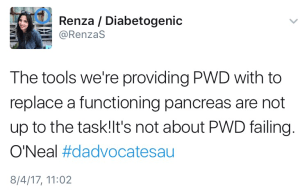
I really love that David mentioned this because so often when technology doesn’t work the way it is meant to, there is an assumption that it is the fault of the user. We mustn’t have pressed the right button, at the right time, in the right order, with the right calculation.
But actually, the tools are just not smart enough to account for the daily changes and variabilities and inconsistencies that play a pivotal role in life and impact our diabetes. As David said, insulin requirements overnight can fluctuate by up to 200%. There is nothing available at the moment that is equipped to deal with that sort of variation.
Add to that, the effect of exercise, food, stress, hormones, illness or pretty much anything else, and there is no way the tech can keep up – or those of us using it can work out how to factor it all in.
This constant need to makes changes is what sets diabetes technology apart from other medical technologies which are often ‘set and forget’ for the wearer. With diabetes devices, there is no such luxury, which is why we need to remember that often, technology actually adds work to our already significant list of diabetes tasks.
Another absolute gem from the day came from blogger and advocate Melinda Seed. During a discussion about HCPs reticence to deal with PWD’s research online, was her comment (as tweeted by Georgie Peters):
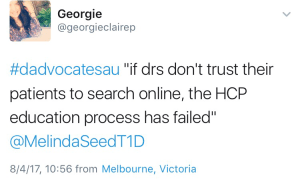
This really is turning the whole ‘Dr Google’ thing on its head. Instead of fearing the internet – and PWD who use it to research and better understand our health condition, surely HCPs could engage to discuss safe ways to do that research. Being part of the solution rather than just fearing it makes a lot of sense.
And perhaps, look at it the way David O’Neal chooses to:
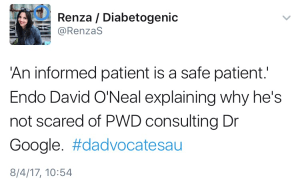
In a roomful of tech-heads, there was also a moment where we considered those who have no interest in using any sort of newer tech available. With the dawn of new hybrid closed-loop systems that take even more control away from the user, how do we make that leap to completely trusting the device? And is this particularly difficult for those of us who identify as control freaks when it comes to our diabetes management?
Affordability and access also came up, reminding me – and hopefully those from the company producing the devices – that this needs to be a consideration at all steps of the conversation. There is no point in developing and releasing onto market whiz-bang tech if people can’t afford to use it. (And we also must remember that as every new piece of tech is released, the divide between the haves and have-nots becomes more and more cavernous – especially when you remember ‘have-nots’ refers to not only the unaffordable tech, but also to basic needs such as insulin…)
DISCLOSURE
The Diabetes Advocates Day event was hosted by Medtronic Australia and was supported by Diabetes Australia. I am employed by Diabetes Australia as Manager of Type 1 Diabetes and Consumer Voice, and attending and facilitating the event was part of this role.
There was no expectation by Diabetes Australia or Medtronic Australia that I would write about the event, and my words here and in other online spaces are mine and mine alone. For more, check out the #DAdvocatesAU hashtag on Twitter and keep an eye out for blogs by other attendees.
Hi Lady
I was a little snappy to you the other day. But then you were rude, so how about we call it even? I wrote this just after our little encounter and I hope you take it in the spirit in which it was written. That spirit being ‘pissed off’.
I didn’t say anything when you first started making comments directed at me. We were sitting in a busy café. A small, busy café with lots of people and some kids, and a woman trying to juggle a screaming baby and drink her coffee, and quite frankly, I was paying more attention to her to see if she needed any help trying to locate whatever it was she was desperately searching for amongst her gear.
So when you made your ‘Ugh – does she have to do that?’ comment while staring at me – and then pointing, I ignored you. I didn’t say ‘Yeah, I do. I’m checking my BGL to calibrate my CGM. The buzzing on my phone (because I should have already done it) is pissing me off and probably everyone around me. So, yes, I do have to do that.’
And then when you announced to your friend – and everyone else I the café (did I mention it was a small café) that I ‘must have diabetes,’ I ignored that too, even though I didn’t really see how my medical condition was any of your business, or of any interest to the rest of the people trying to have a morning coffee and prepare for the day.
I did throw a death stare at you when you moaned about the crying baby. I know that the kid had a set of lungs on him, and I know that he was loud, but I promise you that he wasn’t doing it on purpose. And no matter how uncomfortable it was making you feel, that’s nothing to how it was making his mum feel. I didn’t say that because that was the moment that I did lean over and offer to pass the mum the dummy she was reaching for in her baby’s pram, and then we had a bit of a chat after her little one settled down.
I looked away, but was listening intently, as you complained about how you’d seen people with diabetes inject in public and that you hate the thought of me leaving blood around the café after I’d finished calibrating my CGM. In no uncertain terms you announced with misplaced authority that ‘diabetics’ (your word; not mine) should use the bathrooms provided to do whatever it is we need to do.
I tried not to listen when you shared the story of someone you knew who had all sorts of nasty diabetes complications, because you were starting to sound like a cliché and I really don’t like to hear about end-stage renal failure before I’ve had at least two cups of coffee. I wasn’t there yet. Not nearly there yet.
But then, when you started your ill-informed rant about diabetes, I couldn’t stay quiet any longer. When you started saying that I probably shouldn’t have just added sugar to my morning coffee because I am ‘diabetic’ and that if only I ate better and did some exercise I’d be cured, I decided that it was time for us to have a little chat.
Could I have been more polite? Yeah, absolutely. But then, so could you. So I’m not actually going to apologise for my manner.
You probably didn’t listen to what I said, so I’ll lay it out for you again:
Yes, I have diabetes. No amount of exercise or different eating is going to change that fact. But that’s not really the point. The point is that it’s not your concern that I have diabetes, and certainly none of your business to suggest how I could better manage my condition – especially when not asked. Diabetes cannot be cured, so you should probably strike that piece of advice off your playlist for good.
It’s not appropriate to chastise someone for doing a task that needs to be done to manage that condition. I’m pretty sure I’m right when I say that no one voluntarily jabs their finger to check their BGL because it’s fun and they’ve nothing better to do. I can also promise you that your claim that I’ve left ‘blood all over the café’ is completely groundless. I generally don’t splatter blood from my tiny finger prick test on every surface nearby.
But this is the message that I really hope got through: It’s not your place to comment, criticise, or appraise someone’s health condition. Nor is it okay to judge someone. We get enough of that – often from ourselves. Really, you should have said nothing. Nothing at all.
After I finished what I was saying, I stood up and went to the counter to pay because I wasn’t interested in hearing your reply. You’d already said more than enough. But I did leave you my card with the address this blog. I’m hoping that you typed in the URL and started to read. (Actually, I hope you’re doing it after I post this, so you can read this letter because you did, after all, inspire the content here today. Thanks for the content.)
And I hope that you click on a couple of other posts and have a read about what it’s like for me to live with diabetes to give you an idea of just how wrong you seem to have the whole diabetes thing.
If you see me again in the café, feel free to come up and say hi and we can have a chat. As long as you have remembered your manners and can be respectful, I promise to be polite in return. I’ll even buy you a coffee and answer any questions you might have.
Best

I’m still getting my head around the #HealtheVoicesAU conference – there was so much that happened over the event that it’s taking time to write about it all and really nut out what I took away from each session. (Previous posts here and here.)
When I looked at the program, I was probably most excited to hear from Nick Bowditch. I knew nothing about Nick other than what the program told us: He is the only person in Asia Pacific to have worked at Facebook and Twitter; he’s an entrepreneur who helps small businesses here and across the globe shape their online presence. And his personal health story is that Nick is a mental health advocate as someone who has lived with depression for many years.
I knew Nick’s talk would have lots to offer, and title of his talk that had me excited: ‘The Art of Storytelling’.
I’ve written before about why I love story tellers and story-telling. And telling my own story. It’s reading and hearing the stories of others with diabetes that helps put in context my own experiences. Others’ perspectives shape my own and I learn so much from how others deal with the clusterfuck that diabetes can be.
The first slide Nick showed us was of the wonderful Jamaa el-Fna in Marrakech. He told us how he spent an evening captivated in the square. There amongst the snake charmers and the men walking around with monkeys on leads and the little girls selling tissues and the vendors hawking fresh orange juice, were story tellers. And although he couldn’t understand a word they were saying, he was enthralled as they animatedly told their stories.
That’s the beauty and magic of a good story teller – you don’t necessarily need to understand the detail; just getting the gist of the tale is enough.
And then, Nick gave us the snapshot of his story. In a nutshell, he told us this:

Slide from @NickBowditch
It’s easy to make assumptions and think that you know what Nick might be living with if you see that list. But you’d probably be wrong. I know I certainly was. My initial ideas of what life must be like for Nick were turned on their heads as he put into context what each of the above aspects of his life actually means to him:
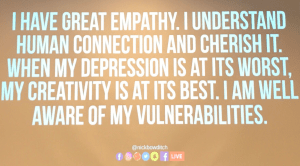
Slide from @NickBowditch
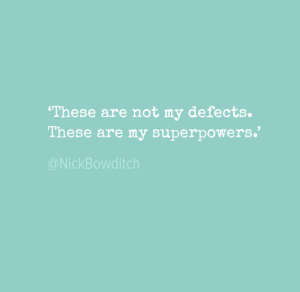
By turning our assumptions on their head and reframing how he lives with mental health conditions shows us that Nick is not ‘just coping’, he’s living. His words were: ‘These are not my defects. These are my superpowers.’ And it challenges us to reconsider our preconceived ideas. I know that those of us who speak about diabetes often challenge what others think.
The image of T1D being all about kids and needles and blood is not really what it’s about for me. And the far-too-easy idea that T2D is all about older, overweight, inactive people is wrong too.
When we tell our stories – and reframe the narrative – the truth comes out.
Possibly the most powerful thing Nick said was this: ‘Telling the truth is not brave. It’s easy. The hard thing is not being authentic.’ We’d come full circle back to the first speaker of the day who implored us to find authenticity in what we were saying. And it reminded me of why I have always been an advocate of having people with diabetes sharing their stories in any forum where people are talking diabetes: the legitimacy of lived experience cannot be found in any other way than actually having someone tell their story.
I see first-hand the power that having a person with a health condition stand alongside a healthcare professional and put into context the theory and research that they have just presented.
There is an art to storytelling. We do it every day that we tell our story. We do it every time we put words on a page for a blog post, or in a diary or in a letter, ot when we stand up and tell it like it is. Some do it far more elegantly and eloquently, but the things is; it doesn’t matter. As long as we’re authentic.
DISCLOSURE
Thanks to Janssen (the pharma arm of Johnson and Johnson) for covering my travel and accommodation costs to attend the #HealtheVoicesAU conference. There was no expectation by Janssen that I would write about the event and everything expressed here (and on Twitter Facebook and other social feeds) is mine and mine-alone! To read more, check out the conference hashtag, #HealtheVoicesAU, on the socials.
A few people read this blog. I actually checked the stats just before, and was surprised to see that each day a significant number of people check in and read what I have to say.
So, given that people seem interested in what I have to write, I’ve decided I should take advantage of this. With this profile, I am going to do good for the world.
Just so you know – because I’m all about disclosure – I’m a classically trained flute player. Also, I like to cook. And I’m quite good at air hockey. Also, I write some mindless crap a few days each week and publish it here, so that OBVIOUSLY qualifies me as MORE than suitable to give advice – any sort of advice I’d like, but specifically medical and nutrition advice. In fact, I’d argue that I am probably more qualified than most people who have gone to medical school, because they have been brainwashed by all the evidence and peer-reviewed journals they’ve been forced to study. I haven’t.
I think that it’s fair for me to advise that insulin is actually really poisonous. It’s dangerous and it’s dodgy. Doctors, of course, won’t tell you this. They want to keep you on insulin because they are in the pocket of Big Pharma, and like their holiday houses on the Peninsula, so they won’t tell you what they know.
Really, you should all be off insulin and use air and water, and maybe some cinnamon, which is NATURAL and can be found in NATURE and is ORGANIC. Because NATURE’S NATURAL ORGANICS are health care. Medicine (such as insulin) is sick care.
Also – if you are ingesting grains, dairy, fruit, vegetables, sugar, protein, carbs, caffeine, flowers, condiments, oils, sauces and/or food (except organic kale) and drink (except organic kale juice), you should stop. Dietitians know this, but they won’t tell you that because they are in the pocket of Big Food and they want you to be sick so you’ll go to doctors who are in the pocket of Big Pharma.
It’s the circle of life and everyone everywhere is trying to keep you sick. Okay? OKAY?????
And, finally, I’ve seen the way and realise now that vaccines are really dangerous and I wish that I’d never vaccinated my kid and will be cancelling my flu vax appointment for early next month. I’m trying to work out if I can actually somehow withdraw the vaccines I had injected into my kid last week so she doesn’t have those evil pollutants floating around her otherwise perfect self. Vaccines are full of toxins and heavy metals and evil pixies. Plus, vaccines cause frizzy hair, skin tags and bugs to fly into your mouth making you cough. Doctors know this, but won’t tell you because … well, you know why…
Also: kale. Because KALE, KALE, KALE, KALE, KALE!! (Must be organic.)
I know. I sound like a lunatic, right?
Actually, I sound kinda like Pete Evans. To be honest, I didn’t watch Pete Evans’ interview last night. I’m not interested in seeing him being allowed to spruik his dangerous crap on a television station that employs him (poor form, Channel 7), plus he’s full of shit. Most importantly, we were watching ‘Shut Up and Sing’ in preparation for seeing the Dixie Chicks next Saturday night and needed to bring the kidlet up to speed with her political education. #TeachingMoment
But I did catch up online with some of his rubbish claims and am once again flabbergasted that people actually believe what he has to say and defend his right to say it.
If Pete Evans said ‘You know, it’s always best to eat fresh, healthy, in-season foods and as a chef, I’m going to share some recipes that will show you how to make an easy and healthy dinner’, I’d be ALL over it. I’d love that! I’d make his recipes and then Instagram the shit out of them. Because I care and share.
But that’s not what Pete Evans does. Pete Evans tells you that fluoride is bad and that babies should be fed bone broth and drink camel’s milk and that sunscreen is pointless. He blunders about in a way that is oddly (and frighteningly) similar to fools including Donald Trump and Pauline Hanson who seem to think that just because they have a public profile, they are qualified to give health advice.
And people believe their claims and then blindly follow them.
I (somewhat stupidly) had a look at Pete Evans’ Facebook page today and found this:

I’m not here to debate whether any people are taking medicines they maybe don’t need to take. I’ve no qualifications in health (real or imagined) and it’s not my place.
But this sort of meme is really damaging because it lacks any sophistication at all. It suggests that if a doctor puts you on any drug, they do not have your best interests at heart.
Could our HCPs be more holistic about the way they treat us? Maybe. Do some doctors over- and unnecessarily – prescribe drugs? Possibly. Do ALL doctors do this? Absolutely not. Most doctors – the vast majority, in fact – do not prescribe drugs that people don’t need. (I’ll just let the conspiracy theorists make their ‘ALL DOCTORS ARE IN THE POCKETS OF BIG PHARMA claims for a bit…Done? Okay, let’s move on.)
And, of course, I’m not stupid, and I know that when Evans puts up a meme like this on his Facebook page, he’s not really about people like me who need insulin to stay alive.
But the problem is that not everyone realises that.
Just last week, we heard another case of a child dying after his parents took him off insulin to treat his diabetes using ‘natural methods’. I still have people telling me to try <insert ridiculous and pointless herb> to treat my diabetes. There will always be people who just need a tiny push to stop the drugs they’ve been prescribed, because meds are bad, right? And natural is good, right? No. Not right.
Evans (and his ilk) speak in generalisations and sound bites that make sense to some people. But he fails to in any way address the intricacies of health. And he certainly has no concept of the complexities of living with a chronic health condition and how the drugs we take HELP keep us well (and alive).
This could be because he is a chef and doesn’t need to. And if he stayed being a chef and shut the fuck up about health, I wouldn’t be writing this blog post. Or getting into online arguments with members of his ‘tribe’ who keep offering me unsolicited and wrong medical advice*.
*Also – note to self: You are a fool for voluntarily falling down the rabbit hole and engaging with conspiracy theorists!




 Diabetogenic