You are currently browsing the category archive for the ‘Real life’ category.
Last night, I attended an event at Parliament House in Canberra, acknowledging and celebrating two milestones: 60 years of Diabetes Australia and 30 years of the National Diabetes Services Scheme (NDSS).
I spent the night chasing down people who were instrumental in the establishment of the NDSS to thank them for their efforts and try to explain just how significant the Scheme has been in my diabetes life for the last (almost) 20 years.
I never knew diabetes before the NDSS. On the day following my diagnosis, after spending the morning seeing my new best friends (endo, CDE, dietitian…actually, the dietitian and I never hit it off), I took a couple of freshly-filled-in forms to 100 Collins Street in the city and took a creaky elevator to the third floor. It was there I was introduced to the NDSS. I handed over the registration form and then the order form. Box after box was piled onto the counter in front of me and I looked at the unfamiliar words on unfamiliar boxes wondering where I was going to put it all and how much it was going to cost.
A few boxes of needle tips for insulin pens and a few boxes of glucose strips and a box or two of urine strips. It was tallied up and I was surprised that it wasn’t a lot more expensive. I was given a card and told to bring it in any time I needed further supplies.
As I came to learn about diabetes in other countries, I realised just how unique the NDSS is and how fortunate we are in Australia to have it.
I proudly speak about the NDSS to diabetes friends from all over the world. Often, these friends are astounded that the NDSS is free to join and available to everyone with diabetes. They are astonished that the price of diabetes supplies is the same for everyone and not reliant on insurance. Often they can’t get their head around the idea that we can choose which strips to use for which meter we prefer, with no interference from an insurance provider. And they simply cannot believe that while there are some limitations to the quantities that we can purchase, the amount we can access is actually quite significant, and there are allowances and exemptions for people who need more than the limits determined by the government.
The NDSS is more than a diabetes supplies program. It is intrinsically linked with Diabetes Australia who was instrumental in the establishment and implementation of the NDSS back in 1987. Diabetes Australia continues to administer the NDSS and runs all the services associated with the Scheme – from diabetes camps, information events, information resources and support services.
But more than that, Diabetes Australia continues to lobby the government to extend the NDSS. More than five years of consistent lobbying resulted in the CGM initiative being announced and launched, and Diabetes Australia is actively urging the broadening of initiative to include other groups of people with diabetes who benefit from CGM (as outlined in the original joint submission from Diabetes Australia, JDRF, ADS, ADEA and APEG). Back in 2004, following a similarly consistent campaign, pump consumables were added to the Scheme. Recently, Diabetes Australia’s responded to the stakeholder engagement regarding the listing of Freestyle Libre on the NDSS with this submission. From the initial lobbying for the introduction of the NDSS to today, the link between Diabetes Australia and the NDSS has resulted in supporting people living with diabetes and making our lives easier.
The NDSS remains the only scheme of its kind in the world. It has enjoyed bipartisan support from consecutive governments.
Of course, our health system is not perfect here in Australia. I believe that there should be more funding and more subsidies on the NDSS. I don’t believe in restricting access to glucose strips for people with type 2 diabetes not using insulin. I know that a lot of people still find the cost of diabetes prohibitive and there is still a divide between those who can afford the latest technologies and those who cannot.
But the NDSS does go a long way towards lessening the burden in some ways and I certainly am glad – and proud – that we have it.

Disclosure
I have been an employee of Diabetes Australia (and Diabetes Victoria) since 2001. I cover all costs for all NDSS products I use.
Last week, a recipe was posted on the Medtronic Australia Facebook page. The recipe was for a Chocolate Tim Tam Cake, which looked rather gooey and very chocolate-y.
I was looking for something to bake over the weekend, but decided that this cake wasn’t really the sort of baking I was up to, so I scrolled on, searching for the right recipe for my baking adventures.
But for some reason, I kept seeing the recipe appear in my FB feed, a couple of times because it had been posted in some of the LCHF groups I follow.
And then I did what I know I shouldn’t do. I looked at the comments, and down the rabbit whole of the very angry LCHF brigade I tumbled.
I am always very wary when it comes to dietary advice. I don’t follow the Australian Dietary Guidelines because I find the quantity of carbs recommended is just simply too difficult for my non-functioning pancreas. Or rather, for my (frequently barely-functioning) brain which has to act like my non-functioning pancreas. Also, I just don’t really want to have to bolus large quantities of insulin in one go. But that’s just me.
Equally, I don’t follow a paleo diet or I Quit Sugar or Dr Bernstein because anything that is so prescriptive is never going to work for me. Instead, I pick and choose what I know will work for me and, more importantly, what I can manage sustainably. I couldn’t really care less what other people with diabetes (or people without diabetes) eat, because I’m far too concerned with my own diabetes existence. And being obsessed with the @TrumpGoogles Insta account…
In exactly the same way I would never accept a HCP who judged what people eat or the tools people choose to manage their diabetes, I don’t take too kindly to other PWD (or anyone, really) suggesting that people who prefer to eat in a certain way are ‘killing themselves’. This is what was happening in the case of the recipe posted by Medtronic.
You can read the comments yourself (the post is here), or you can just assume that they all had to do with the criminality of a company daring to post the recipe while suggesting that people with diabetes might want a piece of cake. And varying versions of ‘you might as well just kill yourself’.
I’m not bagging the LCHF movement and anyone who fully subscribes to it. But I am calling out the frequent aggressive and belligerent rhetoric of some LCHF folk. I’ve had more than enough disrespectful and rude comments sent my way anytime I write about food or share recipes. Despite that, I’m not for a minute suggesting that the way you are choosing to eat is harmful, in fact, I completely agree that eating LCHF is one way for some people to best manage their diabetes. I know a significant number of people of have changed to this way of eating and they have found the results to be incredibly positive.
I also know a significant number of people who simply haven’t found it to be the right thing for them. Some say they have found it unsustainable, others say they found it boring. Others say they are simply not interested because they found it too restrictive, or too expensive. And some say the results they saw simply didn’t warrant the effort they needed to put in.
I know that for me, exclusively following a LCHF diet doesn’t work because I just don’t do food restriction. I’ve never dieted in my life and I don’t do well with being told what I can and can’t eat. I also know that I can quite easily manage to limit my carbs to around 50 grams per day and that the results I have seen since doing that have been worth the effort for me. I also know that all carbs are not created equal and I try to be smart about what I choose to make up those 50g (or so).
Oh – and mostly I know that sometimes…sometimes, those 50 grams of carbs are going to be a doughnut. I’m okay with that. Doughnuts are delicious and bolus-worthy.
As I firmly and resolutely believe, everyone has the right to manage their diabetes in a way that works for them. And they have a right to do that without being bothered by others. Being told that what you are eating is ‘poisoning your body’, or being told that the devices you are using are toxic helps no one.
Oh, and the personal attacks are also totally unnecessary. The person who sent me an aggressive FB message after seeing this profile photo can just pull their head in. I ate a few bites of chocolate cake (the best chocolate cake ever), not ‘poison’. And yes – even after eating those few bites, I still have both my legs, and my kidneys continue to work just fine. But thanks for asking.
Eat how you want. Let others eat how they want. It’s really not that hard.
For the record – this is what I made on Saturday evening. (This one went to the neighbours, but I also made a smaller one for home.) It’s a blueberry crostata. I added a little ricotta underneath the fruit and made a ridiculously buttery pastry to hold it all together. Super easy. Super delicious. (And my CGM trace peaked at 7.3mmol/l for anyone wondering…)

I’ve now been looping now for a couple of months. During that time, I’ve come to understand that I know far less about diabetes – my diabetes – than I actually realised. I’ve come to realise that diabetes is far more complex and difficult than I ever thought. I’ve come to see that the tools we have been using are so incapable of managing with the constant changes of diabetes. And I’ve come to realise that using tech off label is the only way to go anyway towards overcoming these challenges.
After my first couple of weeks of looping, I honestly thought that the whole thing was somehow tricking me. What was this ridiculousness of waking every single morning with numbers firmly between 5mmol/l and 5.5mmol/l? I’d look at my Loop app suspiciously, switching to my Dex app only to have the number confirmed, and a straight and steady glucose trace showing that I’d been there all night. How did THAT happen? I’d ask myself every. The Loop app had all the answers.
The automation is where the magic is. Prior to looping, I had about fourteen different basal rates sets for a 24-hour period. I had gone through times of extreme basal checking to try to tighten up those rates as much as possible, tweaking them here and there, and I thought that I had it pretty right. And insofar as basal rate settings on a pump, I suppose I did have it right.
But loop has taught me that while the overall shape of my basal rates was pretty spot on, there is only so much a pump can do with set, static rates programmed into a pump. There is nothing my pump could do to respond in real time if I needed more basal insulin unless I manually inserted a temporary basal rate.
On an average night for me now, my basal rates are automatically being adjusted dozens and dozens of times. Remember, this is during the night, when there is no need to contend with food or most other factors that affect glucose levels.
You know those mornings where you wake up, see a number in the double figures and wonder if it is at all possible that you sleep walked to the kitchen, sleep baked a pavlova and then sleep-ate the whole thing? Loop’s automation addresses that.
One morning I woke up to see that my basal rates over night had been more than double the set rate for three hours. I’d gone to sleep with a glucose level of 5mmol/l, but for some reason at about 1am, I had started climbing. Instead of waking high, the significant increase in basal insulin took care of it and I woke up in range.
Is looping the solution to all diabetes problems? Of course not and I’d be naïve to think that there was a silver bullet. But it is certainly a useful tool in my diabetes treatment arsenal, especially when combined with eating mostly lower carb. And thanks to the automation, it certainly does lift some of the burden. It also helps beautifully when I am ovulating or my period is about to start, when all bets are off and I just resigned myself to a couple of days of mayhem.
Undoubtedly it is not THE solution – in fact, if anything, it has made me despair more about what we are lacking in diabetes technology, because the increased understanding of diabetes that has come with using Loop makes me more desperate and impatient for tools that actually can manage more and more of the complexity of diabetes. I have a new found respect for that complexity.
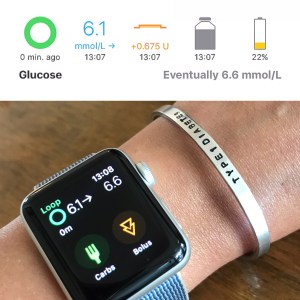
Real time; Loop and iPhone app.
I really tried to switch off from the external diabetes world during my recent holiday. (I would have liked to have switched off from my own diabetes too, but apparently this diabetes gig doesn’t work that way.)
But now, I’m back and playing catch up on all the things I book-marked and planned to read later. Join me!
PLAID
Do you read PLAID Journal? It’s a truly terrific open access peer-reviewed research journal full of interesting articles and research news.
The latest edition is out now, and it includes a little piece I wrote about day to day diabetes.
PROPORTIONAL
My friend Hope Warsaw alerted me to this graph which was tweeted during the recent MedX conference. I like-y very much!

WORDS AND MUSIC
Gee I have some talented friends! Melissa Lee, (there are truly not enough adjectives to describe her aweseomess), has been recording D-Parodies for a number of years now. In recent efforts to raise money for Bigfoot Biomedical’s recent JDRF walk team, she enticed people to donate with promises of new tunes. And boy did she deliver. You can see all of her parodies via her YouTube channel.
But start here for a gorgeous diabetes-themed rendition of Fleetwood Mac’s Landslide – obviously renamed ‘Lancet…’
COVERAGE ON ANIMAS
There has been A LOT written about the recent Animas announcement that they will be ceasing business in the USA and Canada.
If you’re looking to catch up, here are some things I’ve found to be particularly useful:
This comprehensive update from Diabetes Mine.
This great piece from Georgie Peters reminding us how personal these devices are to those of us wearing them.
This piece from Diabetes Wookiee, David Burren, urging Roche to step up with their pump which is still available in Australia despite no longer being in the US market.)
And just a reminder of the situation in Australia: Animas is not going anywhere yet, with disruptor AMSL’s update that it’s ‘business as usual’. Unlike our US and Canadian friends who need to make a decision quickly about changing pumps, there is no suggestions that we need to do the same. Animas is still in the Australian pump market – along with Medtronic’s offerings, the Roche Accucheck Spirit Combo pump and (from 1 November) Cellnovo.
HAVE ANOTHER COFFEE
Presented at EASD – the results of a ten-year study that showed people who drink coffee regularly are less likely to die of diabetes. Another latte, please.
How’s this? A free 5-day diabetes summit that anyone can attend. The online Diabetes Empowerment Summit is the brainchild of Danielle Hargenrader.
Read all about it and get your ticket here.
YOGA FOR DIABETES
More from talented friends! Rachel Zinman is currently on a book tour in the US promoting her new book – Yoga for Diabetes: How to manage your health with Yoga and Ayurveda.
THROW OUT THE FAX!
I was delighted when Scott Johnson included this slide in his presentation about MySugr at the recent Roche Blogger MeetUp at EASD:
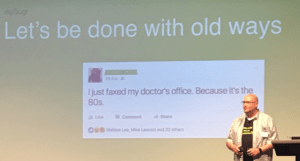
Clearly I’m not alone in my frustration at the insistence of some HCPs to continue to champion (and only use) fax machines!
PEER SUPPORT SESSION WRAP UP
I wrote about the peer support session at ADS-ADEA, and my talk in the symposium. Here’s the wrap up from the ACBRD – the organisers of the symposium.
ALSO FROM THE ACBRD…
If you live in Australia or the UK, please take part in the yourSAY quality of life study. Have your say about the impact living with diabetes has on your life.
Click here to take the survey.
BINGO!
I couldn’t help but laugh when Melinda Seed developed this neat little bingo chart to be used at diabetes conferences. She tweeted it out at the beginning of EASD, just as I was lamenting that questionable language being used by presenters at the conference.
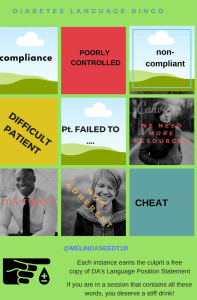
Unfortunately, I couldn’t play during talks. I would have spent far too much time shouting Bingo at inappropriate moments. Come on, people; do better!
My blog break was completely unplanned, but once EASD was over and my family joined me in Lisbon, I knew that our next three weeks together would be completely dedicated to chasing the sun, relaxing, eating, wandering through art galleries, napping in the afternoons. And not writing.
I thought the best way to get my writing chops back would be to share some pictures. Because pictures tell a thousand words, which means I won’t have to write many!
So, here are some photos. With tenuous links to diabetes…
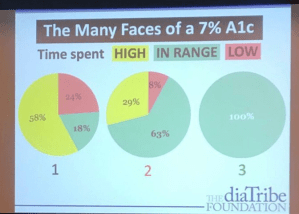
Fab event (as usual) by diaTribe at EASD. And this slide is just so damn on point and why I keep harping on about time in range rather than A1c:
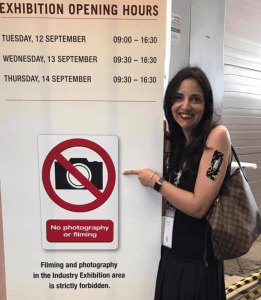
We’ll title this photo ‘As if’. Or ‘Pffft”:
Wandering the streets of Lisbon, I found a shop that I wish was a real pharmacy:
Smart advice found in Lisbon. In my hands is the best chocolate cake I have ever eaten:

Also in Lisbon, this #LanguageMatters gem printed on the window of a water-side restaurant:
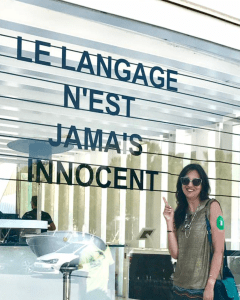
All day, every day. With thanks to Finn:

This is what happens when the sun is bright, all day is spent wandering around. And a Dexcom is firmly affixed to my upper arm….
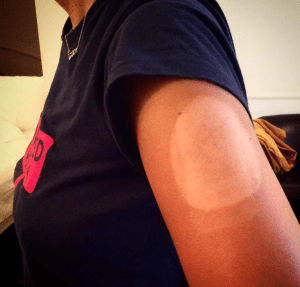
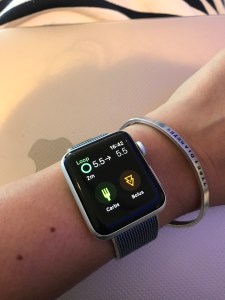
It appears that Loop has broken my diabetes:
It’s important to visit family when visiting other countries. Thanks to CEO Chris Askew for the great catch up:
We visited Cheddar, went to an ice-creamery and discovered their ice cream has diabetes:

And finally: tribe.
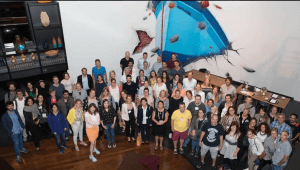
DISCLOSURES
My flights and accommodation costs to attend EASD2017 have been covered by Roche Diabetes Care (Global). Yesterday I attended the Roche #DiabetesMeetup (more on that to come). Roche also provided me with press registration to attend ATTD. My agreement to attend their blogger day did not include any commitment from me, or expectation from them, to write about the day or their products.
Our holiday following EASD was funded by my family’s dwindling bank balance.
I flew into Lisbon, arriving at my hotel just after midnight on Monday. I get that Australia is a long way from everywhere, but the 38 hours’ transit was a record for me and as I tumbled into bed, I dreaded the alarm that would sound a mere 6 hours away.
However, I’ve done this enough times now to know a sure-fire way to overcome jet lag is to organise a relatively early morning meeting that involves coffee and local pastries. (Hello, Pastelaria Versailles and thank you for your beautiful baked goods.)
The main reason for this trip was to attend the Roche #DiabetesMeetup. (Disclosures? Yep-all at the end of this post….) This is the third one of these meetings I’ve attended (read about the first one at EASD2016 here and the next at ATTD2017 here) and, as always, it was great to see the familiar faces of dynamic diabetes advocates doing dynamic diabetes advocacy.
This year, there were a whole lot of new faces, with over 60 diabetes bloggers from across Europe having been invited to become part of the conversation. As well as attended the dedicated satellite ‘consumer’ events, the bloggers are all given press passes to attend all of EASD.
This is astounding. It means that it is impossible to walk around the conference centre without seeing other people with diabetes. Arms adorned with CGM or Libre are not startling – they’re everywhere. The beeps and vibrations of pumps can be heard in sessions, causing heads to bob up, and knowing glances to be shared. Our presence here is undeniable.
On the first official day of the EASD meeting, the third annual #DOCDAY event was held. While Bastian Hauck (the event organiser) starts by inviting bloggers to the event, he warmly and enthusiastically extends the invitation to HCPs and industry too.
On Tuesday, the room was full of people, discussion and enthusiasm
#DOCDAY has become a platform for anyone who attends to take the stage, and five minutes, to share what they’ve been up to in the diabetes advocacy and support space. I stepped down from my usual language soap box, proving that this pony does indeed have more than one trick.
Instead, I spoke about the role of people with diabetes at diabetes conferences. I couldn’t think of a more appropriate time, or a more suitable room to plead my case, even though I knew that I was preaching to a very converted choir!
Two weeks ago, in Perth, there were a few of us wandering the #ADSADEA conference as part of the Diabetes Australia People’s Voice team. And at one point, on Twitter, where our presence is felt more than anywhere else, an interesting, frustrating and downright offensive (if I’m being honest) discussion started.
It was said that diabetes conferences are the safe place of diabetes healthcare professionals and that perhaps a day at the start of the conference could be dedicated to people with diabetes, but the delegate program (delegates being only HCPs) start the next day.
As you can imagine, that didn’t go down too well with some of the diabetes advocates in attendance.
I am actually unable to provide you with the arguments offered as to why people with diabetes should be excluded, but I think it included reasons such as HCPs need a space to be among peers, these are scientific conferences, HCPs need lectures without people with diabetes (not sure why – are we really that terrifying?).
I’m not into preventing people with diabetes attending diabetes conferences. Melinda Seed’s vision of 1000 people with diabetes at the conference is far more aligned with mine. We are not asking that the conference we ‘dumbed down’. I don’t want the sessions to be any different than they are now (with the exception of having PWD as part of the speaker list – but that is regardless of who is in the audience).
Here’s the thing. Organising a team of three consumers to attend (as happened in Australia) required someone to provide funding and coordination. That was Diabetes Australia and I’m really proud that the organisation I work for created this initiative.
To have over sixty advocates supported takes a commitment. I won’t for one moment suggest that I am naïve enough to believe that we are part of industry’s marketing strategy. But we absolutely should be part of that strategy. I am more than happy to give Roche the shout out and kudos they absolutely deserve for bringing us all together. I don’t use any of their products at the moment (although, in the past have used their meters), so I’m not in any way spruiking their devices or suggesting you go and update your meter with one of theirs.
But I am grateful that as part of their engagement with people with diabetes involves bringing us together at a diabetes conference.
What’s the role of people with diabetes at diabetes conferences? Our role is to share from inside with those not here. We’re here to remind attendees that using language that diminishes us and our experiences and efforts in living with diabetes is not okay. We’re here to tell industry they’ve messed up when they design is not spot on, or their marketing misses the mark. We’re here to challenge the idea that we should be quiet, ‘compliant’ and do what we are told.
As I said at #DOCDAY, we have a responsibility to share what we learn. I acknowledge – every single minute of every single conference day – that I am privileged to be here. And that comes with responsibility to share what I see, hear and learn.

DISCLOSURES
My flights and accommodation costs to attend EASD2017 have been covered by Roche Diabetes Care (Global). Yesterday I attended the Roche #DiabetesMeetup (more on that to come). Roche also provided me with press registration to attend ATTD. My agreement to attend their blogger day did not include any commitment from me, or expectation from them, to write about the day or their products.
Last week, I was invited to speak as the consumer in a peer support symposium at ADS ADEA. My talk was called ‘People like me’ because more and more, I’ve come to understand that the real value for me in peer support is the combination of the masses with diabetes – as accessed through the DOC – as well as those who form a part of my ‘inner circle’, or tribe.
So, obviously, my first slide was this one:

And then, I introduced the audience to my tribe from last week:
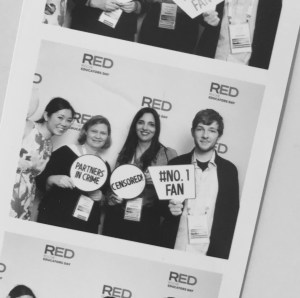
People like me! The #DAPeoplesVoice Team (L-R) Ashley, Melinda, Renza, Frank
The peer support symposium was coordinated by the ACBRD. Last year, they produced this report for the NDSS. They brought together four speakers, each speaking about different considerations of peer support.
After I gave my personal perspective on the peer support that works best for me, Professor David Simmons from Western Sydney University spoke about the evidence. The idea (as outlined in the symposium abstract) was to ‘…identify ways in which they are in synergy and/or tension with one another’.
David began by speaking about the Peers for Progress model, highlighting its four core functions of peer support:
- Assistance in daily management
- Social and emotional support
- Linkages to clinical care and community resources
- Ongoing support, extended over time.
I can only speak for myself and my own experiences, but the peer support I have carved out for myself meets all these points. While points 2 and 4 are probably the most relevant to me, I certainly have used my peers to assist with the day-to-day grind of living with diabetes and have also found connections with clinical support through my peers.
My experience is certainly not structured or formal in any way, however, for me, it works and it works superbly. Which was another point that I made – we need to find the right sort of peer support and that may be different for different people.
Some PWD may prefer to have something that is very organised. I prefer a more ad hoc, dip-in-and-out-as-I-need-it approach, and focus my energies on what I require at specific times. I also love the online community and the support it offers because it meets many of the things I’m looking for: flexibility (there’s not a meeting on the first Monday of each month to attend and if I can’t make that, I miss out); broad reach and a variety of people (which means that I will always find someone to provide support, no matter what the issue; diversity of experiences so my own understanding of what is going on with others is constantly growing, evolving and, often, challenged; all over the world allowing me to connect with people whatever the day of day – or wherever I happen to be (speaking of which…anyone in Lisbon next week?).
Another discussion point during the symposium was to do with the need for evidence to strengthen the case for peer support, which will ensure adequate funding to run programs. I find this a slightly double edged debate, really. I understand that with limited funding, those holding the purse need to know that money is going to go to programs that are known to work. But equally, I know peer support works. People with diabetes know peer support works. Melinda Seed, clearly frustrated (as am I) at the constant need to defend the value and importance of peer support, posed an interesting question, here:
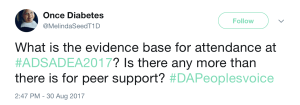
Now, I don’t doubt for one moment that HCPs get a lot of benefit from attending diabetes conferences. Of course they do – they hear from leading experts, learn about the latest research finding, network with colleagues, speak with industry about new diabetes technologies and treatments. The leave feeling inspired, have improved knowledge, feel supported by others doing what they are doing, and have new tips and tricks up their sleeves top improve their practice. They know that. We all do. And yet where is the evidence to support it?
(For the record, someone did point out on Twitter to Melinda that the difference is that conferences are privately funded and therefore do not stand up to the same scrutiny that programs seeking public funding do. Melinda responded (quite correctly) that this argument doesn’t really hold water as many attendees there attend on the ‘government dime’. It is an interesting discussion….)
I think one of the problems we might have is that we narrow the definition of peer support sometimes, and perhaps some people think that it’s too fluffy and feel-good, and just about sitting around someone’s kitchen table and chatting. But as I said in my talk, there is much more than mere ‘tea and sympathy’, (although, I’m reticent to dismiss the power of such interactions because I know that sometimes those moments do produce a lot of support from people who are otherwise feeling very isolated and alone.)
I am speaking at the World Diabetes Congress at the end of this year and will be challenging the notion that peer support is all about group meetings. It is more than the traditional ‘support group’ model. One example I gave was the Pumpless in Vienna story (yeah – I’ll tell that whenever I can!). It was through peer connections that my friend Jo found a pump. It can also be seen and found in other ways – camps, information sessions, structured education programs. Peer support can be found in a lot of places, even if that’s not the term we give to it.
CEO of Diabetes Australia, Greg Johnson, and me talking peer support after last week’s symposium.
Disclosures
Roche Diabetes Australia has covered my travel and two night’s accommodation for my stay in Perth as I am a presenter at the Roche Educators Day (RED). There is no expectation from Roche that I will write anything about the RED, but I expect I will because it’s always such an interesting and enjoyable day!
The remainder of my time in Perth is part of my role at Diabetes Australia.
A recurring theme throughout last week’s ADS ADEA meeting in Perth was the need to manage expectations. I think, in general, we do a really lousy job of this in diabetes.
We’re told that can expect to live a ‘normal life’ after a diabetes diagnosis, when that’s not necessarily the truth.
We’re told we can expect to eat whatever they want, when really, the effort that goes into calculating medication doses depending on the nutrient value of our foods is hard and it may be easier for some to actually limit food choices to make things a little easier.
We’re told to expect a cure in five years’ time, when the truth is that a cure is not even on the distant horizon.
We’re told that we can expect new technology to significantly reduce the burden of living with diabetes, when the reality is that sometimes, it’s more – not less – work.
We’re told to expect person-centred care, when, really, our health system, is not designed to cater for the individual needs of people living with diabetes.
We’re told that emerging technology will be fully automated, smart and cure-like, but we are not told that there will still be human-input necessary and that the devices are not as smart as a functioning pancreas.
We’re told that if we keep our A1c below 7% we can avoid complications, and yet, there is no guarantee, and some of us do develop complications despite an A1c regularly hitting that magic number.
We are told that if we count carbs and dose the right amount of insulin at the right time, we can keep our glucose levels in range, often neglecting to be told that there are a lot of other factors at play.
We are told all this, and then, when these expectations are not met, we are told we’ve failed. Or we are disappointed.
Here’s the thing. The tools are actually really great. Our health system here in Australia is mostly terrific. The majority of our HCPs genuinely do want to give us the best care they can. We don’t need to oversell things as much as we do.
Our expectations are being set so realistically high, that it’s impossible to meet them.
So, THIS is what I would like to say about all the things I’ve covered above to help manage expectations:
Your life will be different after a diabetes diagnosis. But that’s okay. Your new normal is going to be different to your old normal, but hopefully, there will be very things that diabetes will prevent you from doing. Acting like a pancreas is not really normal, but you can do it!
Yeah, you can eat whatever you want. But it’s undeniable that certain foods are harder to manage after your pancreas decides to go on strike. Find what works for you – and that can change. But do be prepared for food to become something that can be a little fraught because you may find that some of your most favourite foods are a little difficult to deal with.
Researchers are brilliant and amazing and the advances in diabetes management are actually quite mind blowing, but a cure? We’re nowhere near that yet. Keep up to date with everything and try to mine through it to work out what is relevant for you. Keep getting excited about management and tech advances – but do keep it in perspective. (Also – consider the source. I promise you that the Channel 10 news or Buzzfeed is NOT going to be where you learn that diabetes has been cured forever.)
You are going to have a lot that you will want to know and work through, and possible a variety of healthcare professionals to see. As wonderful as it would be to have someone to coordinate it all for you, you’ll have to put in the leg work to find the right team, the right service and the right people. And then, once you’ve found them, it’s still up to you to direct what you need. Otherwise you might find yourself at the mercy of a system that is not really going deliver exactly what you need to get the most from it.
You may have heard that in the US there is a (hybrid-closed loop) pump/CGM combo. Some are calling it an artificial pancreas. It’s not. The tech is incredible, but it’s not fully automated. It still requires calibration and it still requires operator input. This is not me being negative, because the tech is exciting. It’s me being realistic about the level of automation
No new devices are going to completely remove the load diabetes adds to your life, or your involvement in their operation. Insulin pumps need buttons pushed; CGMs need calibration, food needs to be considered. Full automation may be the goal, but it’s a while off.
An A1c of 7% or below will indeed reduce your risk of developing diabetes-related complications and there is a lot of evidence to support that. But it doesn’t eliminate the risk. That’s the annoying and somewhat unfair reality of diabetes. Unfortunately, it’s the reality. Obviously, do what you can to manage your diabetes as well as you can. But don’t expect that a number is a guarantee of anything.
Carbs and insulin are only part of the equation. How you’re feeling emotionally, illness such as colds and flus, hormones, nutrients other than just carbs, the phase of the moon (well, maybe not) … all these impact on your numbers. And they change. Don’t expect that there is an equation that will work all the time.
In life, we’re often told to expect the unexpected. But in diabetes, the unexpected is often only that way because what we have been told to expect is unrealistic. If we were told the truth, and provided with realistic expectations from diagnosis – and throughout our diabetes lives, perhaps we wouldn’t feel that we’re constantly falling behind and failing.
Here’s me and my boss talking about expectations in technology.
Disclosures
Roche Diabetes Australia has covered my travel and two night’s accommodation for my stay in Perth as I am a presenter at the Roche Educators Day (RED). There is no expectation from Roche that I will write anything about the RED, but I expect I will because it’s always such an interesting and enjoyable day!
The remainder of my time in Perth is part of my role at Diabetes Australia.
There’s lots happening, but I can’t look away from my Loop app at the moment because I’m so damn excited and obsessed! (I’ll be writing something about it sometime this week.)
But if I wasn’t doing that, I’d be (re)reading these things…
Why it costs so much to see a specialist
I’ve always paid to see my endos privately. In fact, I generally ‘go private’ for all my healthcare needs – I can’t remember the last time I was bulk-billed for a medical consultation.
It does cost a lot, and I am grateful I can afford it, but the excessive costs often discourage people from seeking the right care they need. Of course, we do have excellent public health in Australia. My choice for seeing HCPs privately include wanting continuity of care, and not being subject to frequently very long waiting periods.
This piece in The Conversation looks at why specialist care is so expensive. And what can be done to reduce costs.
Lookiee! A diabetes Wookiee!
For those who participate in OzDOC (and other DOC activities) you may have come across David Burren. I met David last week to talk all things tech (actually, I just fired questions at him about Loop and he patiently answered them without rolling his eyes even once). He’s started a diabetes blog all about diabetes and technology and, thankfully, it is in language that even I can understand.
Check out David’s Bionic Wookiee blog here.
Statues are like tumo(u)rs.
With all the nonsense going on in America at the moment, this piece from McSweeney’s most adequately explains why the ridiculous idea that statues commemorating less than favourable moments in history need to remain. Here’s my favourite part:
I view this tumor as an important symbol of your body’s history and heritage. Removing the tumor would be yet another example of misguided medical correctness in today’s liberal America. I protest this surgery and refuse to whitewash your rich medical history. The tumor must be kept prominently displayed inside your body.
Do better, America. We all know you can.
More on what’s on the inside
Mel Seed’s blog about normalising mental healthcare in diabetes follows on from DX2Melbourne and is well worth a read. Read it here.
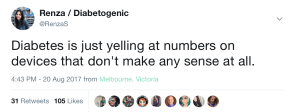
Diabetes is just…
This…
Faster insulin coming to Aus
A couple of weeks ago, I shared on my socials the exciting news that ultra-fast insulin, FIASP, had received TGA registration. No actual ‘launch’ date info as yet, although next week is the ADS ADEA Annual Scientific Meeting, so we may hear more then.
And in news that we already know…
Apparently, CGM is not just for abdomens anymore… File under ‘No Shit Sherlock’.
Swear-y
My blog emails keep getting blocked by the profanity filter at my husband’s work. Every now and then, he forwards me the message he’s received which states that the email was not delivered due to ‘offensive language’. #SwearyWife
This Twitter account definitely wouldn’t make it through, but it’s one of the best things I’ve seen on the interwebs for a while. I’d like to print THIS up poster size and put it on the wall of my office/wear it on a t-shirt, but perhaps that’s not appropriate.
D-parents and sharing the scary parts of their child’s diabetes online
I’ve linked to Moira McCarthy’s writing before because I think that she gets it right every single time she writes about the role of parents in their child’s diabetes.
This piece asks parents to consider if sharing their child’s scary and dramatic diabetes stories online is doing more harm than good. (I rather clumsily explored a similar issue last year in this post.)
Read her piece at ASweetLife here.
4Ts on Diabetes Mine…
Last month, during National Diabetes Week, in an endeavour to get our 4Ts message out as widely as possible, the good folks at Diabetes Mine allowed me to write a little about our campaign. You can read that here.
Living and loving someone with diabetes
As much as I think I am the most delightful and easy-to-live-with person in all the world, I have to admit that diabetes can and does impact on all relationships… and makes me perhaps not the most delightful and easy-to-live-with person. Aaron and I chalked up 23 years together yesterday. Diabetes has been part of the equation for over 19 of those years.
Diabetes advocates Nicole Johnson and Lorraine Stiehl have written a new book which has been called a practical guide to loving a person with diabetes. I’ve ordered a copy and will be leaving relevant pages open for my loved ones to read.
You can get a copy of What To Do When Your Partner Has Diabetes: A Survival Guide from Amazon.
Meme-y and true
There are a lot of diabetes memes out there, but sometimes I see one that just hits the mark so perfectly. Such as this from a TuDiabetes community member:





 Diabetogenic