
You are currently browsing the category archive for the ‘Real life’ category.
So, something happened to me in Berlin that hasn’t happened for a while. I had a hypo. Actually, I had more than one.
In one of those perfect storm situations where everything that could go wrong did, I found myself with a red Loop, no CGM, and in a pissed off mood. My Dex sensor had died in the morning and I couldn’t restart it because my transmitter died at the same time. I knew this was coming – I’d had the warnings. And I had a plan. I would use the reset app and get the transmitter going again.
Except it didn’t reset. I checked and double checked that I was doing all that I needed to do, but the bloody thing wouldn’t work. I still wasn’t too stressed – I had a back up transmitter with me, plus I was at a tech conference surrounded by DIY tech nerds (I say this with great fondness).
I put it all out of my mind, and focused on DOCDAY, launching our #SpareAFrown stunt and then getting on with the rest of the day.
Three hypos later (thanks conference hypo syndrome, running around Berlin like a headless chook and more activity than normal), I was exhausted at the end of the day.
But, as I gorged myself on fruit pastilles I realised a few things. I realised that fruit pastilles really aren’t all the tasty and actually a little gag-y when needing to get them down quickly.

Bleurgh
And I realised that the return of hypos made me very annoyed. ‘Three hypos today,’ I announced. ‘This is lousy.’ I complained to anyone who would listen, and probably stamped my foot a little too.
But there is a silver lining. Kind of. As I whinged and moaned about my day of lows, a friend asked if I had symptoms for my hypos. I stopped and thought about it for a moment. ‘Yes…I felt them all,’ I said. ‘You’ve got your hypo symptoms back,’ he said.
I hadn’t thought about that, but it was true. I had felt the undeniable heightened anxiety that indicated that I was low for each of the three hypos I’d had that day. My heart rate had increased a little – not too much, but enough for me to notice. And that feeling was confirmed with a finger prick check.
These hypos were relatively easy to manage – a few of the bleurgh fruit pastilles and all was good. If I had to explain them in one word it would be ‘annoying’. But I did feel exhausted and drained. I was more than just jet lag and conference-tired; I was jet lag, conference and hypo-tired.
By the end of the day, I had my back-up transmitter paired and the two hour warm-up passed. I calibrated and my Loop turned green, and said a little prayer of gratitude to the Loop gods. The hypos stopped, and the next day I went back to ticking along as I have become accustomed after eighteen months of Looping.
And that’s where I’ve been since then. Absolutely one of the best things about Loop is the way that it helps me manage lows. I’m not for a moment saying that the system is so perfect that there is no risk of lows. Of course there is. But these days, I get enough warning and the system does its bit so that a mouthful of juice or a couple of jelly beans is all I need to manage any incoming lows.
That day was the most I’ve thought about my own hypos in a long time. Of course, I think about hypos in general a lot. Being on the PAC for HypoResolve means that I talk and think about it a lot. And other initiatives, or talking with friends with diabetes means that it’s never a topic of conversation all that far from mind.
Which brings me to this…
There is a new website being launched by Diabetes Australia about hypoglycaemia. The idea behind it all is to reduce the stigma associated with hypos and also to encourage people with diabetes to share their own experiences of living with lows. Diabetes can be such an isolating condition – we know that. Hypos are part of the deal for so many of us. And yet, many of us are afraid to talk about it too much for fear we’ll be told that we’re not managing our condition properly.
This new project hopes to bring the conversation out into the open a little more and you can get involved.
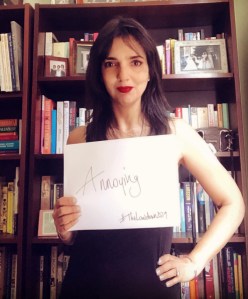
If you are an adult with type 1 diabetes or type 2 diabetes on insulin, share what hypoglycaemia means to you, or even just share the word you would use to describe hypos. Email a photo and your words to thelowdown@diabetesaustralia.com.auand you could feature on the new website. Or, share a photo holding the word you would use to describe hypos using the hashtag #TheLowdown2019.
We all do a good job at undermining ourselves at times. We use a four letter word that diminishes what we are doing, and limits the value of our experience and expertise. That four letter word is ‘just’.
In diabetes, we hear it all the time: ‘Oh, I just have type 2 diabetes’ as though it is insignificant and doesn’t have any challenges. ‘I’ve lived with diabetes for just a couple of years’ because we think there is only currency in decades of living with the condition, when really any length of time with diabetes is meaningful.
And we are all about minimising our experience when it comes to the treatment of our diabetes. ‘I just use diet and exercise to manage my type 2 diabetes’ or ‘I’m just on tablets’ or ‘I’m just on injections twice a day’ or ‘I’m just on MDI’. The list goes on and on. And on.
I realised just how ridiculous we have become with this when I heard myself, during a conversation with a fellow Looper, ‘Oh, I just use Loop’. (More on that later…)
At the Ascensia Social Media Summit at ATTD we spoke about this, specifically how there is almost a stigma within the diabetes for those seen to not be using the shiniest and brightest and newest of technologies. It seems that some people almost feel embarrassed if they are not constantly updating their technology toolkit with the most recently launched product.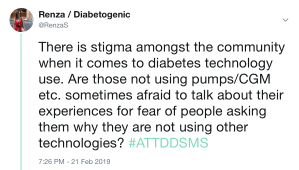
The idea that anything that we are using today is ‘yesterday’s technology’ is wrong. Blood glucose monitoring can’t be ‘yesterday’s tech’ if it is what most people are using to track their glucose. And syringes and pens can’t be considered the ‘old way to deliver insulin’ when that is how the vast, vast majority of inulin-requiring people with diabetes get insulin into their bodies. Plus, every single one of us using a pump must be able to deliver insulin this way because machines break.
Somewhere in discussions about our treatment technologies, we seem to have forgotten that, actually, not everyone wants to be using the latest kit. And that is okay. There is a spectrum of diabetes technology, and as long as we are on it somewhere and managing our diabetes the way that works best for us, then elephant stamps all around!
There is clearly an over-representation of people at one end of that spectrum dominating on and off line conversations. Spend a couple of hours in a diabetes Facebook group and it would be a reasonable assumption that most people are wearing pumps and CGM. But that’s not true.
And it could appear that DIYAPS is the way to go for most people with T1D, when the fact is that numbers are relatively low. It’s hard to estimate exactly, but there may be somewhere between 2,000 and 3,000 worldwide how have ‘built their own pancreas’. That is just a drop in the type 1 diabetes ocean.
It’s fantastic for those of us interested in this technology to be able to (virtually) congregate and talk amongst ourselves. I learn so much from my peers in these groups – just as I have with all aspects of life with diabetes. The lived experience continues to trump any other way of learning about diabetes.
Of course, that doesn’t mean that we shouldn’t be talking about technology used by limited numbers. Of course we should. We want others to know about it so they can make an informed choice about whether it may be right for them. We want our HCPs to know about it and to support those of us using all sorts of technologies and treatments.
Where it becomes problematic is when there is the misconception that this is the norm. Or when those not using the newest technology feel that they are wilfully doing diabetes the ‘old way’. It’s unfair to think for a moment that those who are not using the tech ‘don’t care’ enough about themselves – especially when decisions are made based on a very good understanding of what is available and what they have decided works best for them.
So, back to my ‘Oh, I just use Loop’ comment. It was directed to someone far more technologically advanced than me; someone who runs all sorts of other programs alongside their DIYAPS. They generate lots of reports and make lots of changes and seem to have far more bells and whistles than I even knew were available.
I nodded as they told me all they were doing and then, when they asked me how I manage my diabetes, I answered that I just use Loop. I heard myself saying it and stopped and corrected myself. ‘I mean…I use Loop. It works for me. Perfectly.’
We don’t need to make excuses for doing diabetes our own way. If we truly have choice (which I know is not always the case), and we have made the choice based on what we believe to be the best possible treatment and technology for us at that moment, then surely that’s a great thing. We shouldn’t ever be made to feel less committed to our own health and wellbeing. That’s not how it works.
DISLCOSURE
I was invited by Ascensia to co-chair the Diabetes Social Media Summit at ATTD (#ATTDDSMS). I did not receive any payment or in-kind support from them for accepting their invitation. I have co-written a piece for the blog, however this was not edited (apart from inevitable jet-lag-induced typos) and all words are those of mine and the piece’s co-author. You can read that piece here.
I never thought I’d be one to think about back-up plans the way I do now. A few years ago, I remember being extraordinarily proud of myself as I wrote this post about my diabetes spares bag. And then a couple of years ago, I thought I was remarkable and quite brilliant at being able to easily manage when I got to work and realised my insulin pump hadn’t made it with me. I thought I had every contingency sorted and was fabulously good at diabetes. Give me a medal, please.
But in the last six months or so, I’ve come to see I’m not quite as prepared as I thought. I probably should point the finger right now at David ‘Bionic Wookiee’ Burren for this. He has highlighted holes in what I thought was a well-planned strategy a number of times (‘What’s your RileyLink Bluetooth address, Renza? You don’t know? You should.’), shaming me into wanting to do better, and really making me question all my life choices at the same time.
Back-up planning has been covered in both the Australian and European Social Media Summits hosted by Ascensia (disclosure at the end of this post) and it is interesting to see that the level of organisation and preparation varies so much in those of us living with diabetes.
Some people have thought out every possible contingency and have a plan for each one. Others have a fixed idea about what might go wrong and have made accommodations for those (that’s me). And others figure that it will all work out and the diabetes gods will sort it out.
I guess that personality type comes into how well-equipped we all may be. Some of us have a far more lackadaisical approach to planning for the apocalypse than others. But I do agree that it never hurts to be prepared or to consider things that may never have entered your mind before.
So here are some things that I have learnt in recent times that have completely changed the way that I think about my back-up planning.
It’s not just about kit (1). It’s all very well to have back up for what happens if (for example) your pump dies, but if that means returning to MDI until a replacement can be delivered, actually knowing how to do MDI is important. (Bless my endo who always asks if I need any long acting insulin ‘just in case’. She gave me some in-date long acting insulin and we had a discussion about what doses would look like after I proclaimed ‘It’s been 18 years since I gave myself a dose of long acting insulin. And it was Protophane. I have no idea what I am doing.’Lovely endo didn’t even roll her eyes at me when she walked me through exactly what I’d need to do to ensure my basal dose was right and the timing of the injections.)
It’s not just about kit (2). Look – my back up plan to my pump dying is another pump. I have a couple in the diabetes spares cupboard and always travel with one. But I don’t carry one around with me on a day-to-day basis. If I was a couple of hours from home and my pump died, I’d need to know what to do in the meantime. Again – it’s been 18 years since I was on MDI, but I always have a spare syringe and insulin with me so I can bolus until I get hooked up again to a working pump. My injection technique is scratchy – very scratchy, but in a pinch, I can manage it. There’s nothing wrong with asking for some re-education on something for which you may be a little out of practise.
Apparently my long-held belief that the DOC is my back-up plan is not actually adequate, because who is going to be able to provide me with insulin/pump consumables/spare pump/battery/RileyLink at 3am when things like to go wrong. (This is despite the success of the whole Pumpless in Vienna story.)
Equally, having a neighbour with type 1 diabetes two doors down is great when I need a Dexcom sensor at breakfast time. But it would probably stretch and test the neighbourly spirit if I woke her and her family in the middle of the night because I desperately wanted my loop to turn back to green and needed a sensor to do that.
I need a back-up of EVERYTHING I use if I want to be able to seamlessly manage any issue that comes up. With Loop that means a spare Loopable pump, a spare Riley Link, a spare G5 transmitter as well as all the necessary consumables. That takes expense as well as organisation.
CABLES!! They need to be part of my back up plan. I was at a conference last year somewhere (can’t remember where) and remembered as I was about to sleep that I’d forgotten the charger to my RileyLink. And just last month didn’t charge it overnight, meaning that my Loop turned red while I was at work and I was unable to do anything until I got home. Carrying the right charging equipment for all devices is important.
But! If I don’t have all these things, I need to ensure that I have a suitable, easy and fully ready-to-go option that will get me through until I can assemble all required to return to normal service.
When your back up plan becomes someone else’s back up plan, you need to do something about it. Case in point: at the DOCDAY event at ATTD, a friend leaned across the table and asked me if I had a spare battery for her Loopable pump. Of course I did, because there is always at least one in my spares bag. I handed it to her and made a mental note to pick up some more AAA batteries next time I passed a convenience store. Of course, I forgot all about it until Loop started complaining and that the battery was running low. Down to 4% battery and starting to feel a little nervous, I found a tiny little store in a backstreet in Brussels, crossing my fingers as I walked in that there would be a stash somewhere of what I needed. There was and I changed the battery just as my Loop app was showing 0% battery.
Beating ourselves up about our perceived or real lack of planning is unnecessary. As Sophie, one of the participants at #ATTDDSMS, said: ‘Life gets in the way.’ And it does. I challenge anyone not living with diabetes to do their normal life, live with diabetes and not only think about all the ‘just-in-case’ scenarios, but also prepare for each and every one of them.
But mostly, what I have come to see is that the point of a back-up plan is for it to be smooth and simple, with as little disruption to our day as possible. A plan that requires a cast of thousands, hours of travel, is insanely complex and relies on a number of external factors that are potentially beyond our control is not really going to make executing our plan all that easy, or give us peace of mind. And that’s a big part of what this is all about – feeling confident that we can manage whatever gets thrown at us.
That is, after all, the nature of this condition we live with.
DISLCOSURE
I attended the ATTD conference in Berlin. My (economy) airfare and part of my accommodation was covered by DOCLab (I attended an advisory group meeting for DOCLab), and other nights’ accommodation was covered by Roche Global (I attended the Roche Blogger MeetUp). While my travel and accommodation costs have been covered, my words remain all my own and I have not been asked by DOCLab or Roche Global to write about my attendance at their events or any other aspect of the conference.
I was invited by Ascensia to co-chair the Diabetes Social Media Summit at ATTD (#ATTDDSMS). I did not receive any payment or in-kind support from them for accepting their invitation. I have co-written a piece for the blog, however this was not edited (apart from inevitable jet-lag-induced typos) and all words are those of mine and the piece’s co-author. You can read that piece here.
These days, it’s impossible to be at a diabetes conference and not have at least one conversation somewhere about language. Sometimes there are sessions dedicated to the topic on the program, but that wasn’t the case at ATTD a couple of weeks ago – a conference solely devoted to advancements in diabetes technology and treatments.
But despite there not being a session about language, it was still a hot topic. My eagle eye was trained when walking through the exhibition centre for examples where diabetes is misrepresented or the language used stigmatises people living with the condition. And in sessions, I immediately heard terms that suggested that we are misbehaving because the results of treatments aren’t living up to their promise. (A new one: I heard the statement ‘People with diabetes on <therapy> were not performing as expected’ which now makes me think that we are being trained, watched and judged by pageant mums/moms.)
At the Ascensia Diabetes Social Media Summit (more on that another day), there was a discussion about language and diabetes-related complications. This event was a follow on from the one we had at the Australia Diabetes Social Media Summit, and took the initial conversations and expanded it with a new group of PWDs.
Once again, as the discussion unfolded, it was clear to see that the PWD in the room all had experiences where the language they were faced with had impacted negatively and positively. One person commented that early on in their diagnosis, a health professional had addressed diabetes-related complications by saying ‘If you are diagnosed with a diabetes-related complication it will not have been your fault.’ What an empowering way to begin the discussion about complications, care and risk reduction!
I’ve been talking about language for a number of years. Some may call me a one trick pony and, honestly, that’s fine. My appetite for the subject matter has not diminished one bit despite more than a decade of speaking and writing about why language is so important and holds such power.
Language is not a one dimensional issue. Additionally it does not necessarily have a ‘right way’ to do it – especially when looking at it from the perspective of the person living with diabetes. The work I have been involved in has never been about policing the words used by people with diabetes, but rather how words used by others affect us.
It’s why the piece Grumps and I wrote for BMJ was important – it targeted healthcare professionals, explaining to them why the words and language used around diabetes-related complications needs to not make us feel hopeless. Because that is what can happen and when we feel that way, it is all too easy for diabetes to seem just too big and too hard and too much.
I have frequently written about how diabetes can become so overwhelming, that it can leave us unable to attend to even the most basic and mundane of diabetes management tasks. I myself have been paralysed by the detail and demands of this health condition. I understand that there are times when a conversation about language is not possible, because, quite frankly, there is a lot more to deal with. I know that there have been moments when even though I can hear judgement and blame in the words being directed at me, all I want to do is find a way out of what feels like a hole. I’ve heard others say that they have felt harshly treated by HCPs, but simply didn’t have the capacity to try to deal with that because there were other things higher up on the list.
And I am sure that there are people who simply wouldn’t even know where to begin if the words and language being directed at them were disempowering and negative.
But that is exactly why language matters. It is for the people in those situations – for me when I was in that situation – that we need to get the way we communicate about diabetes right.
I am so sick of people trying to delegitimise the language discussion, or, even worse, reduce it to something that is insignificant. It frustrates me when the discussion returns again and again and again to the diabetic/PWD debate. As I said at the Ascenisa event at ATTD when we were discussing the annoying way some try to redirect meaningful discussion back to this single issue: ‘You can call me Blossom for all I care, language is about far more than this.’
And I think that while it is critical that we acknowledge that sometimes the language issue isn’t going to be a priority for some (by choice or otherwise), it seems unfair – and a little counter-intuitive – to diminish its importance, or criticise those of us trying to keep it on the agenda and actually do something about it.
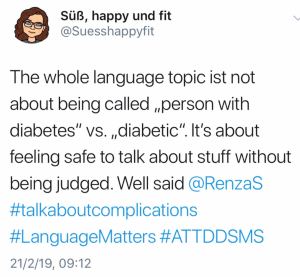
(Click for original tweet)
DISLCOSURE
I attended the ATTD conference in Berlin. My (economy) airfare and part of my accommodation was covered by DOCLab (I attended an advisory group meeting for DOCLab), and other nights’ accommodation was covered by Roche Global (I attended the Roche Blogger MeetUp). While my travel and accommodation costs have been covered, my words remain all my own and I have not been asked by DOCLab or Roche Global to write about my attendance at their events or any other aspect of the conference.
When we find something in diabetes that works for us, we can become a little evangelical. In the past, I’ve been guilty of this.
I have really tried to tone it down; I know that just because something works for me doesn’t mean it will work for others. But even more than that, it’s none of my business how someone chooses to manage their diabetes. And none of anyone else’s how I choose to manage mine.
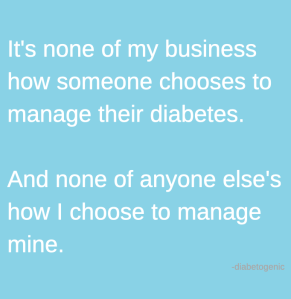
So, I’m revisiting this little post from last year as a reminder that we are lucky to have choices. And to not shove ours down others’ throats.
____________________________________
Pumps. Pens. Syringes.
Patch pump. Pod.
Share your data. Don’t share your data.
Blood glucose monitors. Continuous glucose monitors. Flash glucose monitors.
Low carb. High carb. Low(er) carb. No carb. ALL the carbs.
Private diabetes team. Public clinic.
#WeAreNotWaiting. #WeAreWaiting.
Apps for recording data. Scribbling down numbers on the back of an envelope. Making up numbers as you go along.
Online peer support. Face to face peer support. No peer support.
How fortunate we are to have choices – to have choices we can make for ourselves for our own brand of diabetes.
I’m feeling a little burnt out at the moment by the zealots online who think it’s their way or the highway. Do what works for you and share it, by all means. But attacking someone else for doing something different is just being a dick. Don’t be a dick. There’s really no need.

I went to the endo the other day armed with questions and issues I wanted to discuss. I’d found all random notes I’d typed on my phone and sticky notes I’d stuck around my office and cobbled together a list of things to work through.
And at the end of the appointment, there was a tick against every single one of them. (Except for the one about a new travel letter. I haven’t bothered travelling with a letter for some time now because I never needed it, but the last couple of times I’ve gone through security in the international terminal in Melbourne, I’ve been given some grief about refusing to walk through the full body scanner.)
I asked about other drugs that I could take to augment my current diabetes treatment. I know that others with type 1 have added Metformin or SGLT2s to their drug cocktail and wondered if I should be considering something else.
I asked about new drugs coming, how I will use faster insulins once they finally bloody hit our PBS shores and talked about protective measures I could take to reduce the risks of every single thing that diabetes likes to throw in our direction.
I realised half way through the appointment what I was doing and it struck me all at once why I was doing it. It was about feeling in that diabetes rut – not in terms of general ‘over it burnout’, but a treatment rut. It was about me wanting more. What else can I do? What else can I take? What else should I think about? What else? What else? What else?
Loop is continuing to do doing its thing. It keeps me and my diabetes ticking along with minimal effort and generally decent lines on my CGM.
But because I am an idiot and obviously have D-FOMO, apparently, it’s not enough. I turn into Chester, that annoying little puppy in the Warner Bros ‘Chester and Spike’ cartoons, bouncing around ideas and thoughts and different drugs and treatments.
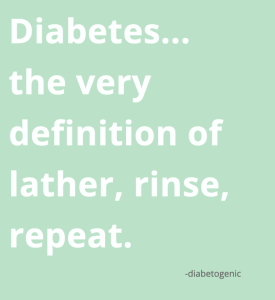
When you co-exist with diabetes, the very definition of ‘lather, rinse, repeat’, it’s easy to get complacent. And from there, it’s just a hop, skip and a jump to being in a rut. Is it any wonder that we get bored, disinterested and downright over the whole bloody thing? Or that to try to counter that boredom, we want to try anything and everything; whatever we can to keep a little bit of interest in what we are doing. We see things new and shiny and flashy and want it – not always because we feel we need it. But just because it’s something novel.
I walked out of my endo appointment without a prescription for any new drugs. We chatted about my options and when we weighed it all up, there didn’t seem to be any real benefit. But the door is open for further discussions when I see her next.
I don’t need anything new. There is nothing I can do really to be doing better. It’s just more of the same. Every day. Lather. Rinse. Repeat. (And repeat…repeat…repeat.)
I’ve been Looping for about 17 months now. I’m a fan (perhaps you may have picked that up).
The reason I am a fan has nothing to do with my A1c. In fact, right now, I couldn’t tell you what my A1c is (more about that later). I love Looping because it works for me. It takes away a shedload of my diabetes tasks. It helps me sleep better. It gives me more energy. It means I think about diabetes less. It significantly, significantly, significantly reduces the number of hypos I have, and the impact of the almost-hypos that have replaced the doozeys used to have. It means I get to wear cool t-shirts.
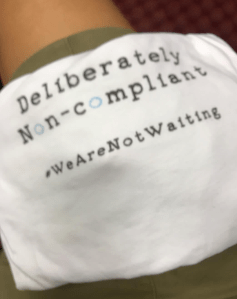
Badge of honour…
Because in exactly the same way as if I have tried a different eating plan it’s never been about numbers on the scale, Loop has never been about A1c.
It’s especially never about a measurement that is so flawed that it really is time to wonder why, for me and those of us who are able to access far more informative and useful data, even bother to have this checked. (Read this piece by Dr Steven Edelman from TCOYD for more on that.)
I have to say that I feel a lot of discomfort when I see A1c as such a focus. Some if it is for the reasons I’ve already stated, but also, it reinforces that we measure our success as PWD and how we are managing with this number. If my A1c went up this time, I really couldn’t care less. I’ve not long come off three weeks of holidays where diabetes barely interrupted the flow of sunshine, sea and sleep. And family, friends and food. I have not had a hypo in months. I have not had days of wanting ‘I hate diabetes’ tattooed across my forehead.
I went to my endo appointment last week still in slight January holiday mode. I completely forgot to call ahead for a pathology request – in fact, I’d forgotten all about the appointment until I was sent the text reminder a few days earlier. I used to think it was a waste of time not showing up without results waiting for me. But I wasn’t really all that concerned this time. I had some other information at hand including how much time I am spending in range. That gave me enough to focus on before I moved onto other things I wanted to talk about: the things that are really important to me with my diabetes.
Living well with diabetes is about so many factors. Those factors will be different for different people (and yes – A1c may be how some people consider living well).
As someone who has had really dark times with diabetes, it’s the light times that demonstrate how well I am doing. Those times may not be the times that I am ticking boxes that we are told gauge our success. They have certainly not been times necessarily marked with a low or in-range A1c. They are the times when the impact of diabetes is lightest. When it dances across my conscious rather than lives there. When it casts a gentle shadow rather than a thunderous cloud. A1c has never had anything to do with that.
I walk into a room of people. It’s a work meeting, and I am with a couple of colleagues. We’re greeted by about 8 others who all work for a large diabetes-related organisation. Two or three are from their Australian office, the rest have travelled from Europe. They’re here to meet with people working in the diabetes space to get an idea of the landscape in Australia.
We take our seats at a U-shaped table; we’re brought coffees. Introductions start. One of the overseas visitors tells us a bit about who he is, and rounds out his introduction by saying ‘I have type 1 diabetes. And I use Dexcom,’ he says, looking straight at me.
It’s summer in Melbourne and I am wearing a short-sleeved top. The Dex adorning the top of my left arm is clearly visible. I smile at him. ‘Snap!’ I say.
The meeting continues, with a lot of discussions and chatter. My new friend asks a lot of questions, some directed at me. I know what he is doing – it’s that thing people with diabetes who are ‘working in’ diabetes do. We try to learn how others manage living with a condition and working it too.
The meetings winds up; people start to chat with each other, continuing on from some of the discussions we’ve just had.
And the two PWD immediately turn to walk to each other. We shake hands and fall into an easy conversation. We speak about the challenge and responsibility of having diabetes while working in the space. We ask each other more questions and we listen carefully. And then we talk about our own diabetes, starting with ‘When were you diagnosed?’. I want to know how he found being diagnosed with diabetes after having already worked for a number of years for a diabetes-related organisation. We work out if we will be at any of the same meetings or conferences throughout the year.
The meeting is over. We shake hands again, and say good bye.
I walk to the elevator with my colleagues, thinking about the different ways people with diabetes connect. It happens like this. We find each other in a room. We see each other in a café. We opportunistically meet in a gelati shop. We bump into each other on the street. And we talk. We learn from each other. We gather information. We feel connected.
We get it.

I walked into my endo’s office yesterday, and was greeted by the receptionist with a smile (and by name). ‘You’re next; shouldn’t be too long,’ she said to me.
I was especially grateful for the welcome I received yesterday. Because earlier in the day I’d started the search for a new GP. It hadn’t gone well.
My quite awesome GP who I’d been seeing for almost twenty years decided to move interstate which is incredibly inconvenient. For me. But apparently it was a good opportunity for his family, so off they went and now I am left GP-less. Because, yes, it’s all about me.
So, I’ve been looking and asking friends in the area who they see and if they would recommend them. There is a woman at the same practice as my previous GP who I quite like, and a few people had suggested. I’d seen her a few times when my GP had been on leave, and she knows my convoluted medical history. But when I rang for an appointment the other day, I was told she was booked up until March. M-A-R-C-H. Over a month away. I was told that I could call at 8.20 the next morning as they keep a few on-the-day appointments, but there was no guarantee I could see the GP I wanted.
I sighed and said that I’d call back the following day. And when I did, there were no appointment times with the doctor I wanted. Continuity of care is important to me – I don’t want to have to explain the CGM on my arm, the pump down my bra, the way I manage my diabetes each time I need a quick visit to the GP for a UTI, or sore throat that won’t go away.
I decided that I probably needed to find another doctor, so I called another clinic that had been recommended to me. I didn’t speak to the receptionist. But I did hear the hold message.
Firstly, the calm voice on the recording told me that the doctors at the clinic all had lots of experience and were there to serve the local community, and that the whole clinic operated under a philosophy of patient-centred care. ‘Excellent,’ I thought. ‘That’s a buzz phrase I like. Good start’.
But then came a shopping list of things that callers should know before pressing hash to speak with someone.
- Appointments can only be made before midday. If you call outside those hours, you will be asked to call back the following day
- Same day appointments can only be made between 8.30am and 9.30am, although most will be taken by 8.45am
- Doctors generally will not take or return calls from patients unless this has been agreed upon during an appointment
- No results given over the phone by doctors (or anyone else); you need to a follow up appointment
- No bulk billing is offered (even for people on a HCC)
- If you are late, you will miss your appointment
- You will not be contacted if the GP is running late
- But you should call to see if the GP is on time
- Missed appointments (by the patient) incur a no-show fee
- If you want a referral (even to an existing specialist) you must make an appointment to see the doctor
- Ongoing referrals will not be provided
- If you want a prescription (even for an existing medication) you must make an appointment to see the doctor.
After listening to the message three times – just to make sure that I had everything correct – I hung up. There was literally not a single thing on that list that could be considered to be patient-centred.
Before I go on, I want to say that I know that GPs are overworked. I know that they are underpaid. I know that there are too many people trying to get into see them, and their time is precious. I can’t even imagine what it takes to run a GP clinic – or a clinic for any discipline really. I assume that there will be some using the service who have unreasonable expectations and demand that a doctor be available to them at all times of the day and night. So, rules are needed to deal with those sorts of people.
I am not one of those people. I am, however, a person who lives with type 1 diabetes and sometimes, I need a prescription for insulin because I thought I had another repeat left, or my current prescription has expired, or I lost the last one, or the littlest dog ate it (hasn’t happened, but wouldn’t put it past her). Or I need a referral to one of the other specialists I get to see semi-regularly (such as my dermatologist for psoriasis, rheumatologist for psoriatic arthritis, OB/GYN for gynae stuff etc.). And I definitely appreciate an ongoing referral, because, you know, diabetes doesn’t go away and I will need to see my endo forever (or until she retires, at which point I’ve decided I’ll give up this diabetes palaver too).
I don’t think these are unreasonable requests to have of a GP clinic. I don’t expect to be bulk billed. I am not asking for a diagnosis over the phone; or a phone consultation. But surely, it’s a waste of time (mine and the doctor’s) for me to need an appointment for a prescription for a drug that I will need to take FOREVER, and dose myself. Or for an annual referral to a doctor I’ve been seeing for over seventeen years for a health condition that I’ve had for almost twenty-one years. Or to be told that my A1c (or whatever else is being checked) is in range.
I wrote last week about how we get burnt out with needing to be advocates for ourselves. I felt a wave of that hit me as I listened to the list of rules from the GP clinic I will not be going to. I don’t want to start by giving a medical history … and then needing to beg for a little flexibility in their rules.
Does this make me sound like a princess? Maybe. Does it make me sound unreasonable? Perhaps it does.
But healthcare settings cannot have it both ways. They cannot promise that they are patient-centred if they are actively setting rules that make it more difficult – and exhausting – for us to live with a chronic health condition.
One day, I won’t be anxious when waiting to see my lovely endocrinologist. Today’s not that day.





 Diabetogenic