
You are currently browsing the category archive for the ‘Real life’ category.
Two years ago, I walked off the stage at the inaugural ADATS event feeling very shaken. I’m an experienced speaker, and regularly have presented topics that make the audience feel a little uncomfortable. I challenge the status quo and ask people to not accept the idea that something must be right just because ‘that’s how it’s always been done’. Pushing the envelope is something that I am more than happy to do.
But after that very brief talk I gave back in 2017, a mere three months after I started Looping, I swore I would never speak in front of a healthcare professional audience again.
That lasted all of about two months.
In hindsight, I was more than a little naïve at how my enthusiasm about user-led technologies would be received. I can still remember the look of outright horror on the face of one endo when I cheerfully confirmed:‘Yes! Any PWD can access the open source information about how to build their very own system. And isn’t that brilliant?!
Fast forward to last Friday, and what a different two years makes! The level of discomfort was far less, partly because more than just a couple of people in the room knew about DIYAPS. In the intervening years, there have been more talks, interviews and articles about this tech, and I suspect that a number of HCPs now have actually met real-life-walking-talking loopers. Plus, Diabetes Australia launched a position statement over a year ago, which I know has helped shape discussions between HCPs and PWDs.
I’ve gotten smarter too. I have rejigged the words I use, because apparently, #LanguageMatters (who knew?!), and the word ‘hack’ scares the shit out of people, so I don’t use it anymore. (Plus, it’s not really accurate.) And, to protect myself, I’ve added a disclaimer at the beginning of my talk – a slide to reinforce the sentiment that I always express when giving a talk about my own life with diabetes, accentuating that I am speaking about my own personal experiences only and that I don’t in any way, shape or form recommend this for anyone else. (And neither does my employer!)
I framed my talk this time – which had the fabulously alliterative title ‘Benefits, Barriers and Burdens of Diabetes Tech’ by explaining how I had wanted to provide more than just my own perspective of the ‘three B’s’. I am but one voice, so I’d crowd sourced on SoMe for some ideas to accompany my own. Here’s just some of the responses.
 (Click to enlarge)
And this:

One of the recurring themes was people’s frustrations at having to wade through the options, keep up with the tech and customise (as much as possible) systems to work. And that is different for all of us. One person’s burden is another person’s benefit. For every person who reported information overload, another celebrated the data.
What’s just right for me is not going to be just right for the next person with diabetes. So, I used this slide:
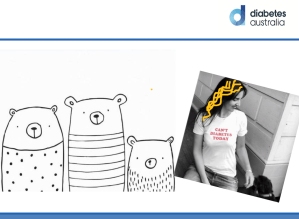
I felt that the story of Goldilocks and the Three Bears was actually a really great analogy for diabetes tech. Unfortunately, my locks are anything but golden, so I needed a little (basic and pathetic) Photoshop help with that.
In this fairy tale, Goldilocks is presented with things that are meant to help her: porridge for her hunger, a seat to relieve her aching legs and then a bed to rest her head after her busy day. But she has to work through options, dealing with things that are not what she wants, until she finds the one that is just right.
Welcome to diabetes technology.
On top of working out what is just right for us, we have to contend with promises on the box that are rarely what is delivered to us. Hence, this slide:

Apart from the Dex add circled in red, all the other offerings are ‘perfect’ numbers, smack bang in the middle of that 4-8 target that we are urged to stay between. These perfect numbers, obviously belonging to perfect PWD with their perfect BGLs, were always completely alien to me.
A selection of my own glucose levels showed my reality.
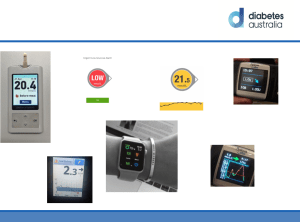
I explained that in my search for finding what was ‘just right’, I had to actually look outside the box. In fact, for me to get those numbers promised on the box, I had to build something that didn’t come in one. (Hashtag: irony)
Welcome to Loop! And my next slide.

And that brings us back to two years ago and the first time I spoke about my Looping experience in front of healthcare professionals. It was after that talk, during a debrief with some of my favourite people, that this term was coined:

Funny thing is, that I am now actually the very definition of a ‘compliant’ PWD. I attend all my medical visits; I have an in-range A1c with hardly any hypos; I am not burnt out. And I have adopted a Goldilocks approach in the way I do diabetes: not too much (lest I be called obsessive) and not too little (lest I be called disengaged), but just right.
It turns out that for me to meet all those expectations placed on us by guidelines and our HCPs, I had to do it by moving right away from the things there meant to help us. The best thing I ever did was start Loop. And I will continue to wear my deliberate non-compliance as a badge of honour and explain how it is absolutely just right for me!
My first endocrinologist was a really nice man. He was very kind in the way that he acknowledged that I was dealing with something quite scary – a new diagnosis of type 1 diabetes.
I remember he was nice. In fact, when people asked me what my new doctor was like, it is highly likely that I actually used that word to describe him.
What I remember more was the way that he told me about diabetes-related complications, and the way that he told me that if I didn’t look after myself, and follow his instructions to the letter, that I would get those complications. If I was a good girl and did as I was told, I would be right. If I didn’t, every one of those terrifying, horrible, distressing complications would occur and it would be my fault.
Now, he didn’t say this in an ‘un-nice’ way; he wasn’t mean, he wasn’t cruel, he didn’t yell. He was saying it as if it was an absolute, and I quickly came to understand that being compliant was what was expected, and that there was a good and bad way to behave in diabetes, and that resulted in good and bad numbers. If I did what he said, I was good; if I didn’t, I was bad. And if I was bad, terrible things would happen and I would have no one to blame but myself.
That was twenty-one and a half years ago, and I can still hear those words in my head. The language he used set me on a course of not coping with my diagnosis and feeling intense fear about my future – a fear that sometimes paralysed me into inaction.
This week, there has been discussion on Twitter about what the #LanguageMatters movement is all about. It started with this tweet from a diabetes consultant in the UK, which suggests that it is ‘..mostly about being nice…’.
Eight years ago, when Diabetes Australia launched the first language position statement, the response from many was that this was not an important issue and that perhaps we should put our efforts into other things; things that matter. This was seen as a little bit of fluff that was a waste of time. It’s political correctness gone mad, was the reaction from many.
We’ve become smarter at showing the evidence to support just how destructive words and language can be. We hear stories from people who explain how damaging language resulted in them not seeking help when needed, and how the fear of being blamed kept them away from their healthcare team. We can show that diabetes gets fewer research dollars; that it’s harder to get people to put their hands in their pockets to donate to a diabetes charity, and that the general community does not understand just how serious diabetes is.
The timing of things is interesting, and it seems that last night someone on the TV show The Great British Bake Off referred to a dish as ‘diabetes on a plate’. The host’s reference to the sugary confection in that way wasn’t about him not being nice. It was about him using a phrase that has been thrown around by many for years, because it is accepted that diabetes is something to make fun of.
Now sure, the way people responded to this incident could be termed as nice and not nice. Nice would be ‘Please don’t refer to my health condition like that’; not nice would be ‘Don’t be an arse’. Obviously, I lean towards the latter. (Also, not especially nice is using an example like this to explain the different types of diabetes, because it is not relevant to the discussion and only adds stigma to type 2 diabetes. Don’t do that!)
As I read the tweets responding to this tired ‘joke’ from people in the diabetes community, what I saw was not people urging the TV host to be nice. It was for him to understand the seriousness of diabetes, to stop shaming people with diabetes, to not fuel the misconception that sugar causes diabetes, to not make diabetes a punchline.
People make diabetes ‘jokes’ because the words and language used around diabetes for years has given them permission to do so. And with that, attitudes were formed and the construct that diabetes is self-inflicted and free game for comedians and TV hosts became accepted.
And that’s where we are now and what we have to undo.
Perhaps part of the problem is that we don’t have an ‘ist’ or ‘ism’ word that we can attach to the language matters movement. We understand that when we challenge racist or sexist conduct, we are not asking people to simply ‘be nice’. We are trying to make a culture shift away from such damaging attitudes and to change behaviours. When I call out a bloke for making a sexist comment, I’m asking him to reconsider the way he thinks about women, change his behaviour and be respectful. I’m not asking him to ‘be nice’. I’m asking him to stop being sexist.
When someone makes a comment about someone based on the colour of their skin or the country they were born, we don’t dismiss it as them not being nice. We (rightly) expect them to stop that rhetoric because it is wrong and no acceptable.
So, I’m making up a word (and I hate made up words…). If you use words and language that judges, shames, blames, and stigmatises people with diabetes, you are being diabetesist. Diabetesism is not okay and should not be tolerated, and we need to challenge people behaving in that way. Perfectly nice people could still be diabetesist; their attitudes are long-held and seemingly socially acceptable. It’s what they have heard all their lives. We need them to stop doing that.
Here’s the thing: I don’t actually consider myself as being a particularly nice person a lot of the time. Nice people are agreeable, and don’t challenge others or their ideas; they accept them. They don’t call people out on Twitter. They’re not the person who rocks the boat. I am the boat rocker, and I do that because I believe that there are institutional, systematic problems that need to be changed in diabetes and diabetes care, and one of those is the way that the language used around diabetes.
So, back to where this all began and this tweet. I agree that berating HCPs is not the way to get the message through. #LanguageMatters is not only looking at HCPs attitudes and behaviours, anyway. My strongest criticism has been aimed squarely at the media and industry. I also believe that it works best when all stakeholders are involved.
But while I accept that there are different approaches, I don’t accept – and really don’t appreciate – that all the work, the research, the education and the efforts about this issue can be distilled into the concept of good manners and niceness.
I also believe in taking a harder line. That doesn’t mean haranguing or being aggressive. But it does mean understanding that there is a (real or perceived) power imbalance in healthcare, and those with influence should be held to account when it comes to the way they speak to and about people with diabetes. It means calling out HCPs and researchers when they stand up at conferences use language that hurts us by reinforcing wrong attitudes; correcting the media when they get it wrong, and calling out industry when their marketing teams misfire.
And I also believe that this is personal. Living with diabetes is not a bit of ‘fun stuff’ or something that we chose to do. It is incredibly personal for me and every single person with diabetes who has been made to feel not enough, or blamed or shamed, or judged or mocked due to beliefs about diabetes – beliefs that have been formed and accepted over time because of the language and attitudes about our health condition. The concepts of non-compliance, of good and bad numbers, of ‘bringing this on myself’, of ‘diabetes on a plate’, of grading A1cs have all been thrown at me, and affected me in ways, varying from feeling a little annoyed right through to deciding diabetes care was an exercise in futility so I was simply not going to bother anymore.
That is why #LanguageMatters and I would ask – and urge – everyone working in this space to listen to those of us living with diabetes, hear us. And sit down and learn. Sure, we can all be nice, because being nice is a good thing to aim for (and I promise that I will endeavour to do better there, too), but accept that language matters much, much, much more than that.

 Today is Pregnancy and Infant Loss Remembrance Day. For many, it’s an occasion to mark the babies that we never got to know and watch grow up. It’s the hugs we never gave, the stories we never got to share, the first days we never got to celebrate. Those of us living with chronic health conditions have an extra level of complexity to deal with, as we wonder if our own bodies were partially (or completely) responsible for those losses. Sometimes, we never know.
But we hold close those losses and all that comes with them, carrying them quietly. Until the roar back into our consciousness.
Just a couple of weeks ago, I went to the GP because I had a UTI. (One day, the oversharing will stop. Today is not that day.) As the gift that keeps on giving, diabetes means that UTIs are more common in women with diabetes than those without. This is another reason that diabetes is so, so much fun.
My new GP asked if I’d noticed an increase in insulin needs because of higher glucose levels due to the infection. She then asked some general questions.
‘Is your period regular?’ she asked.
I nodded. ‘Like bloody clockwork. 28 days to the minute! Where was that when I was trying to have a baby?’ I remembered the desperation of wanting a reliable period to signal some sort of regular ovulation and the relief when I started on fertility treatment to make that happen.
‘Could you be pregnant?’ she then asked.
Could I be pregnant? Well, technically, I guess I could. ‘Jesus! I hope not!’ I exclaimed, wondering how my almost 46-year-old body would cope with such an assault! And then, because I catastrophise everything, I started to imagine first trimester blood sugars and hypos and climbing insulin requirements and all the other things that mammas with diabetes have to think about every second of a pregnancy.
I nearly threw up. Which I attributed to morning sickness. Obviously.
She handed me a jar and sent me to the bathroom for a sample.‘We’ll do a pregnancy test here now and also send the sample away to make sure the infection you have is going to respond to the antibiotics I’m prescribing,’ she explained to me.
I’m not pregnant. I breathed a sigh of relief when she told me that, flashing back to the complete opposite feeling I used to have each month when I realised that was the case. And to the literal and figurative emptiness I would feel when I realised another month had passed and I was not pregnant. And how that emptiness would increase exponentially after each miscarriage.
At the time, I didn’t have anyone to really talk to about how I felt. I had the support of my family, but there was no one who could understand the shame I felt, or the blame I was attributing to my diabetes – and therefore to myself. It’s only since speaking about it that I realised that so many other women feel the same way. And friends with diabetes have similar stories to share. We just needed an opportunity and a space to talk. And listen.
Today is a chance to do that. My love goes out to all of you who have lived through pregnancy loss, or who have lost a baby. I hope that you have a safe place to tell your story. And to my friends with diabetes who have experienced pregnancy loss: be kind to yourself. Sometimes the path we walk is lonely, and littered with too many times when we blame ourselves, when instead we should be kind and gentle. Today is a really, really good day to remember to do that.
Some more stories to read…
I wrote this for Mamamia just after my last miscarriage.
Kerri Sparling wrote this about her own experiences of infertility, and shared this guest post about pregnancy loss.
Anna Floreen’s story of pregnancy loss is heartbreaking, but I am so grateful to her for sharing it.
Look, I know there are times that engaging with people online who are sprouting a load of bullshit is a bad, bad idea, and really, I should just walk on by. But here’s why I don’t always do that…
I was speaking with someone who is thinking about starting to Loop the other day. I explained my own experiences – how simple the set-up had been (even after I’d delayed it for six months because I thought I wouldn’t be able to do it), how it is completely changed the way I think about diabetes, how much less time I have to dedicate to dealing with the daily frustrations of diabetes, how the highs and lows have been evened out and how glucose rollercoasters are a thing of the past.
‘So, you never have highs and lows? Ever?’ he asked me.
‘No; that’s not completely true,’ I said. I am frequently guilty of being evangelical about diabetes technology, and wanted to be sure that I wasn’t overselling DIYAPS. ‘After all, I still have diabetes!’
I have my range set to 4mmol/l – 8.0mml/l. It’s the mythical range that was presented to me as the ultimate goal the day I was diagnosed. It’s quite a tight range – I know that – and I probably could afford to ease up on that upper range. My target is 5.0mmol/l (it used to be 5.5mmol/l – another mythical number).
The reality is that for the very vast majority of the time, I am within that range, and hovering around that target number. If I was to check my Dex as soon as I woke up each morning, it would be boringly somewhere between about 4.8mmol/l and 5.3mmol/l.
But I still do spent time outside of the target range. The thing about Loop is that in most cases, I can explain the reasons when that happens.
I had a hypo the other night. A pretty terrible one, actually. I can’t remember the last time my Dex read LOW, but that was what I was staring at when I checked the app after my phone started screaming at me. I double checked with a finger prick and sure enough I was low. Really low. I treated (over treated) and was fine a short time later, albeit with a rebound leading to numbers I’ve not seen in a very long time.
How did that happen? Well, let’s start with the double bolus I gave myself. For some reason, I decided that the chicken soup with noodles I was eating for dinner needed not one, but two boluses. That was mistake number one. Mistake number two was not eating as much as I thought I was going to because I had a teleconference starting, so I left about half of my dinner in the bowl. Mistake number three was not realising mistake number one. And mistake number four was not doing anything to address mistake number two.
Following? Diabetes is fun!
The low resulted in an ‘eat-the-kitchen’ hypo that saw me eat six jelly beans, wait fifteen minutes and then recheck my glucose levels. Just kidding. I drank half a litre of juice, ate three bowls of breakfast cereal, chomped on a tube of fruit pastilles and then started attacking a homemade fruit bun my mum had delivered earlier in the day.
Because I was dying and all the carbs in the kitchen were the only way to prevent that happening.
The high that followed could be easily explained (see: juice, cereal, pastilles, fruit bun).
Other highs on Loop can usually also be explained quite simply. If I under bolus, I know pretty quickly, and Loop has already started doing its thing anyway to remedy that.
Stubborn highs generally mean one thing and one thing only: Renza, change your cannula. And as soon as I do, numbers come back into range fairly quickly.
Out of range numbers these days aren’t due to the unpredictability of diabetes. These days, they come down to one thing and one thing only: human error. My human error.
I trust Loop more than I trust myself. It is way smarter, completely and utterly unemotional, and an absolute workhorse, making adjustments every five minutes as required. It doesn’t get tired or busy or distracted. It understands numbers better than I ever will.
This is the cool tech I need to help me keep my diabetes moving. Of course, I still need the warm touch – the human connection – to help me make sense of my life with diabetes. But not having to think or do the diabetes numbers nearly as much gives me time and headspace I didn’t know I had. It keeps my numbers in range for the vast, vast majority of each day. And it means far fewer errors. Errors that I used to make all the time.
I am, after all, only human. Loop, on the other hand, is not.
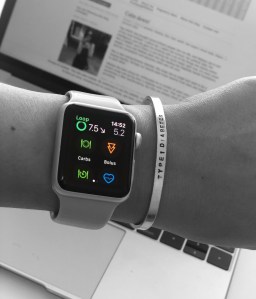
One of the many highlights for me at last week’s EASD meeting was the satellite event about DIYAPS. It was a Hacking Health event, co-organised by the OPEN Project consortium and promised to highlight the perspective of the #WeAreNotWaiting movement through the eyes of people with diabetes, researchers and clinicians.
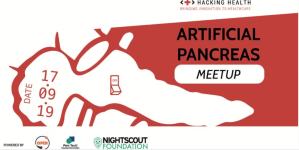
It was standing room only, with the event having sold out a few days earlier. I was a little late (I had to present at an event involving early researchers and PWD) so unfortunately missed the always brilliant Dana Lewis kick off the event.
If you ever need someone to warm up an audience and set the scene about the DIYAPS movement, Dana is your person! I have seen her present a number of times now, and always pity anyone who shares the stage with her. Her presentations are always enthusiastic, articulate and engaging, and leave the audience wanting more.
I followed her talk on Twitter as I was in the cab from the EASD conference centre to the Centre Cívic Sagrada Família (bonus of offsite events is actually seeing some of the tourist attractions the city has to offer!) and could see that the audience was enchanted and galvanised with her talk.
The program was packed – and provided a balanced view of not only people using the tech (because honestly, sometimes it can sound like we have all drunk the Kool-Aid!), but also about DIYAPS in clinical practice, and research settings, as well as a session on medical ethics.
There were many stand out moments for me, but perhaps the one that stands out the most was from paediatric endo, and fellow Looper, Katarina Braune where she was able to distil DIYAPS into this single sentence (as tweeted by another Looper, Andrea Limbourg):
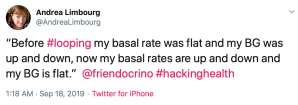
Perfect, perfect summary of looping!
We also heard from Roman Hovorka who presented on the experience of developing the Cambridge closed loop system (CamAPS). Anyone who has been following artificial pancreas technologies and research would know of Roman. I’ve heard him speak a number of times at conferences around the world and have always been grateful for his passion and dedication to advancing technologies to benefit people living with diabetes. So, it was a little surprising that I found his talk a little challenging.
One of the things that I have always admired about the DIYAPS movement is that there is a strong sense that our chosen DIY path sits neatly alongside commercial systems and regulatory bodies. While we may not choose or want to use a commercial system (and, of course, are not waiting for them), that doesn’t mean that there is disdain or derision of other options. In fact, there is admiration and gratitude for industry working to provide this technology to a broader audience. We know that not everyone wants to build their own system, and many ARE happy to wait for a system that will be in warranty, and comes straight out of a box, rather than cobbled together.
I say this knowing that same courtesy is not always afforded to the DIY world from industry, and I can point to every single time someone from a company developing a commercial automated system claims their systems are safe – implying that those of us in the #WeAreNotWaiting world are all cowboys not concerned with safety.
I would so have loved to have heard Roman really highlight all that his system has to offer, and what sets it apart from DIY systems, and how it is one more choice that will be available to PWD, rather than put down the DIY movement. I am all – ALL – about choice and love the idea that with this choice comes a better chance for us to find the tech that works best for our personal circumstances.
We don’t need to be defensive about ‘the other’ in diabetes technology. We need to acknowledge that there is no one right, perfect choice. DIY is certainly one of those choices, and as we heard sprinkled throughout the day, has been life changing for many people. But it is not the only option out there, and few people in the DIYAPS world would even suggest that it is. I guess perhaps that is what challenged me about Roman’s talk – he did seem to throw DIYAPS under the bus a little when it would have been far better to suggest it was just another bus route people may like to take.
So how could this event have been better? Well, I wish it had been part of the official EASD program. There is a lot of opportunity for HCPs to learn from the user-led tech community, and this extends to technologies and treatment options beyond DIYAPS. Reinforcing what is an overarching fact of life with diabetes – that all diabetes is DIY – is important for all working in diabetes to remember.
While DIYAPS technology may be at a far spectrum of the whole DIY diabetes idea, having HCPs and researchers listen to just how diabetes impacts on daily life, and the decisions we need to make is critical in their approach working with us.

Panel session to finish the day.
DISCLOSURES
My airfare and part of my accommodation to attend EASD was covered by Lilly Diabetes so that I could participate in the DOCLab advisory group meeting which took place all of Monday. Another night’s accommodation was covered by Novo Nordisk as I attended their advocate meeting on Digital Health Technologies.
I am part of the OPEN Project Consortium. I did not receive payment for my involvement in the Hacking Health event.
While my travel and some of my accommodation costs have been covered, my words remain all my own and I have not been asked to write or speak about any of the activities I attended, or anything I have seen at the conference. As ever, profanities are also all mine.
Two things happened that got me excited on the 6 train when I was in New York back in June.
Firstly:

Obviously, every green circle in the world ever is a tribute to Loop. That’s my story and I’m sticking to it, and I refuse to be told otherwise.
And secondly:

Click on pic to be taken to the campaign where you can clearly see this and other images.
I absolutely love this from NYC Department of Health and Mental Hygiene. The campaign is called ‘Choose the Best Words’ and encourages people to speak with their friends and family, and learn how to support those who need it. Ads like this one also highlight a recent city-funded mental health first aid training course that is offered in all five NYC boroughs. The ads, which were all over the subway and other places in the city, point out that using the right words and phrases to support those living with mental illness is really important and can help reduce associated stigma.
I guess this kind of follows on from yesterday’s post. I know that often people say things just because they feel the need to fill a silence…or just to say something, not realising the impact of the specific words they say. But it does matter. The choice of words you make really, really matters. And this beautifully simple campaign shows that.
This is an edited version of a blog post I wrote over three years ago, but refer to frequently. Because it seems that there is a human need to force people to feel that their lives could be worse – so much worse – so they should be grateful that it’s only diabetes they have to contend with. Or that they only have a certain type of diabetes, because the other one is worse. Or that they were diagnosed at a certain age or in a particular decade, which is (somehow) better/easier/less crap than a different age/different decade. Oh, and of course…at least it’s not <fill in the blank>… because that would be worse.
I say, fuck that.
I get that people genuinely are just trying to make others feel better about a situation. Here’s the deal though – no one really expects that. At least, I don’t. I don’t need anyone to try to buoy me up or make me feel better. I don’t need anyone to point out others have it harder (yeah – I know that…). I just need people to nod. Aaron really has it nailed, and I tell everyone that he knows just what to do in those moments when diabetes is pissing me off: offer a cup of tea, some chocolate, and loudly pronounce ‘Diabetes sucks‘. I don’t think he realises just how validating that is and how much more meaningful it is to me rather than insisting I look on the bright side and be all Pollyanna-ish about my screwed beta cells.
Next time you are tempted to say ‘…at least…’ to someone with diabetes (or, for that matter, someone who is having a rough time about anything at all), stop for a minute and think about what you are really saying. Because honestly, you’re not helping at all.
For the sake of my own mental health, I have learnt to not compare myself with others.
I was thinking of this the other day when I was involved in a conversation with a woman newly diagnosed with diabetes. She told me that she was really upset at the response from a close family member who, when told about the diagnosis and how distressed she was, responded with ‘It could be worse. At least it’s not cancer.’
I’ve had that said to me. Several times. And it is one of the most offensive things I have heard. I don’t really know how to respond to it, because it’s true, I don’t have cancer. But I do have diabetes and that is pretty bloody horrible sometimes. (For the record, I equally dislike the idea of responding with ‘At least it’s not cancer? There is a chance of remission with cancer; type 1 is for life…’)
I get just as annoyed when it happens in our community. ‘At least it’s not type 1,’ is something I have heard said to people with type 2, diminishing the challenges they may face. A woman who had just been diagnosed with gestational diabetes told me that people kept telling her that at least her diabetes would go away when her baby is born. Sure, that may be the case, but right here and right now, this woman is pregnant, thinking about her baby and wondering just what diabetes is doing to her growing bub.
When I was anxious about my impending cataract surgery a few years ago, I was told ‘It’s nothing. At least you don’t have to have laser or have your eyeball injected.’ Again, that’s true. But I was still terrified and had every right to be.
When discussing a nasty hypo ‘At least you didn’t lose consciousness and wake up to a roomful of paramedics.’ Sure, I remained conscious throughout that unpleasant and seemingly endless low. But I needed help to treat it and it happened in front of my kid. She was scared, which really upsets me and makes me feel guilty.
When our experiences are belittled or minimised, it means we may stop sharing them. No one wants to be told they are being a drama queen and that it could always be worse. Of course it could be worse, but that doesn’t mean what we are dealing with doesn’t suck.
I have had diabetes for 21 years now. I have not had to deal with debilitating complications. I have not had to spend weeks in hospital because of my diabetes. But does that mean that my fears and concerns and anxieties are any less relevant than someone whose experiences are different?
And that’s why you will never hear me say to someone newly diagnosed ‘At least you have just been diagnosed. Just wait until you have had diabetes as long as me and <this or that> happens,’ because everyone’s experience is different and that newly diagnosed person may have their own concerns at that particular time. Or not. Which is also fine.
I had a healthcare professional once tell me that at least I didn’t have diabetes ‘too terribly’, because I worked, had a child and travelled. It was one of those (incredibly rare) moments where I was stunned into silence. I was torn between wanting to say ‘Well, surely that makes what I’ve achieved all the more incredible‘ and stabbing her with a fork. I said (and did) nothing.
There is no ‘at least...’ when it comes to diabetes. There is no discussion about how it ‘could be worse’. Because the truth is, it could be a whole lot better. I could NOT have diabetes.

The perfect Effin’ Birds response (because there always is one!) if someone says ‘At least….’ about your diabetes. (For more of these wonderful sweary birds, click on the image. And buy the book!)
Catching the end of Women’s Health Week, revisiting this post from last year about all things girls, women and diabetes. Today, on the final day of the campaign, Jean Hailes for Women’s Health is suggesting that we take some time to think about our mental health. That sounds like a good idea anytime, but I’m really pleased to see that the organisation is highlighting this important, under-researched and misunderstood health issue. Check it out at their Women’s Health Week website.
I’ve really appreciate today’s messages – they couldn’t have come at a more opportune moment! But that’s not to say that the rest of the week wasn’t just as terrific. Have a look at each day’s theme – there is lots of important information to read through.
And have a read (or re-read) through this post which was all about a lot of the things we don’t talk about enough. When I published it last year, a number of women reached out and said they used this as a conversation starter with loved ones and HCPs. That might just work for you too…
It’s Women’s Health Week here in Australia and once again, Jean Hailes for Women’s Health has been doing a stellar job of talking about women’s health issues that are rarely (if ever) spoken about in the public sphere. As usual, this year’s campaign is presented in a clear, no-nonsense way. Just as it should be.
Shining a light on women’s health issues is critical for a number of reasons. There is still too much stigma associated with women’s sexual and reproductive health, so finding a way to easily speak about the realities of women’s health just makes sense.
Not all women’s health issues necessarily seem relevant to diabetes. But, as ever, diabetes has a way of complicating things, so it makes sense that they are on the list of things covered when speaking with our HCPs.
I honestly can’t remember the last time my GP spoke with me about any sexual or reproductive health issues. Some women see gynaecologists regularly (I see mine every couple of years for a pap smear), but that may not be the case for most women. Surely conversations about contraception, periods and other things should be part of a regular check-up alongside other ‘tick the box’ issues such as blood pressure, cholesterol and weight.
I wish that I had seen an endo from the beginning who had spoken to me about women’s health stuff. I know that it wasn’t until I found the endo I see now – one who I sought out specifically for her expertise in women’s health and pregnancy – that issues such as contraception were even mentioned.
So, here is a (non-exhaustive) list of things that women with diabetes may want to consider chatting to their HCP about – and that HCPs may want to consider speaking with PWD about. (There are links at the end of the post for where to go for further information.)
Periods. To be honest until I was trying to get pregnant, I really didn’t think much about my period. I thought of my lack of regular periods (as in, I would get my period sporadically maybe four or five times a year) as a blessing, rather than something to be concerned about. Of course, once I was trying to get pregnant, I was desperate for a monthly period that I could set a clock to.
No HCP had ever spoken to me about how diabetes would impact on my period – or, probably more importantly, vice versa. I had no idea about how different times in my cycle might affect my glucose levels. In fact, I think it wasn’t until I started wearing CGM and could really see what was going on that I learnt how to manage my insulin doses at different times throughout the month. (And it also explained the two days each cycle I was so freaking low I pretty much took no insulin. Apparently that’s how MY body deals with ovulation..)
If I was diagnosed today, I would be asking a lot of questions about diabetes and menstrual cycles and the best way to adjust my management methods depending where I am in my cycle.
Sex. When I’ve written about diabetes, women and sex before, I’ve noted how at diagnosis no one spoke with me about how diabetes could impact on my sex life. It wasn’t until I started speaking to other women about it that I realised that this is an issue for a number of us.
We need to start talking about women with diabetes and sex in a non-threatening way that normalises the discussion.
UPDATE for this revisited post: Check out this brilliant resource that came out of the research led by UK health psychologist, Professor Kath Barnard. This is one of those projects that I was just so damn pleased to be involved in!
Contraception. No one mentioned contraception to me when I was diagnosed. I was twenty four, engaged to be married. Surely both the endo and CDE I saw the day I was diagnosed realised that I was having sex, or considering it after I was married. (I really, really hope that they didn’t think that they didn’t need to speak about it with me because we weren’t married yet…because it was only 20 years ago and there’s no place for puritan attitudes in healthcare. Plus, that ship had sailed. A long time before.)
At the time, I was on the pill, but there was no discussion about the best form of contraception for me relating to diabetes, (was there a better pill to be on?), and I didn’t know to ask. Surely, all women of child-bearing age should be asked regularly about contraception, especially as women with diabetes are so often told about the importance of avoiding unplanned pregnancies.
Pregnancy. Thankfully, these days finding information about diabetes and pregnancy is relatively simple. If you know where to look.
But twenty years ago, when I was diagnosed, the only thing I was told about diabetes and pregnancy (and I think it was only because I asked) was ‘You need to have all your kids by the time you’re thirty’. (Not sure if just scraping in three days before I turned 31 counts there. Probably not. Looks like this deliberately non-compliant palaver has been happening for a while….)
Talking pregnancy and diabetes needs to be done delicately, but it needs to happen. And, ideally, it needs to happen long before pregnancy is even being considered.
Back in 2003 when I was at Diabetes Vic, I coordinated the first diabetes and pregnancy info evening. Over 100 people were squashed into an overheated room in the basement of the old Royal Women’s Hospital. At the end of the night, I was walking around speaking with as many of the people who had come along as possible to see if they had found the evening useful. I walked up to one woman and thanked her for coming. ‘I hope that you found tonight helpful,’ I said to her. She nodded at me, and I noticed she was holding onto a copy of the ‘Can I Have a Healthy Baby?’ booklet that Diabetes Victoria had published with Realty Check and ADIPS the previous year. ‘My daughter has T1D,’ she said to me. ‘She’s only 8, so obviously this isn’t something that is relevant now. But I wanted to know so that when she asks questions I can answer them. I feel really reassured that she can have a baby if she wants one if it’s planned.’ I remember reaching out to her and hugging her (I have no boundaries). ‘Your daughter is so lucky to have you in her corner,’ I said to her. ‘Thank you for coming!’
Fertility. This isn’t the same as pregnancy. It’s not an easy subject – ever – but it is one that needs to be discussed openly and safely. I can honestly say that no healthcare professional has ever discussed fertility with me unless I have raised the issue.
My experiences around fertility have been complex, emotional and quite painful. It took me a while to get pregnant the first time. My irregular periods needed to be addressed (fortunately, that was easy enough with only Chlomid needed), but even once I was having monthly cycles, and apparently ovulating regularly, I could not get pregnant.
When finally did, I miscarried. Miscarriages are common. I know that. But it still sent my spiralling into a really difficult period which took a lot of time and effort to emerge from. I got pregnant and had a baby, and thought that from there, fertility issues would be a thing of the past.
But I think that because miscarriages are so common that sometimes it can be forgotten just how traumatic they can be. My first miscarriage ended my first pregnancy, and the two other miscarriages I had ended those ones. It’s clear that while I seem to be able to get pregnant, keeping those babies growing, safe and alive is not something my body does well. I wanted that explained to me – or at least for someone to speak with me about it.
Diabetes and fertility was never, ever discussed with me, except that I was reassured after each of my miscarriages that I could not blame diabetes for losing the baby. That was a double edged sword because I wanted to know what it was that was stopping me from being able to continue my pregnancies. I would have liked to be able to point at something. Because the alternative is that it’s just another thing my body can’t do properly.
PCOS. I was diagnosed with polycystic ovarian syndrome when I was about 26. I’d been referred to an OB/GYN by my endo because she wanted me to have a gynaecological check-up because we’d started seriously talking babies. My lack of regular periods was flagged as something that needed investigating and an internal ultrasound showed a number of small of cysts all over my ovaries. I had no other symptoms of PCOS, but that was enough for my OB/GYN to speak with me about potential fertility issues once we were ready to start trying for a baby. I had a laparoscopy and they were removed.
Both type 1 and type 2 diabetes can increase the risk of PCOS (more so type 2 diabetes) so this is definitely something to discuss with your healthcare team if you are in any way concerned.
Body image. I don’t even know where to begin with this because body image is such a huge, huge concern for so many women, and I really do believe that diabetes amplifies those concerns. Whether it is the physical signs of diabetes (tech that we wear on our bodies), the psychological side of being diagnosed with a life-long health condition or the emotional toil of having an allegedly invisible condition that we can’t help but see every day, living with diabetes significantly affects how we feel about our bodies.
This is one of the reasons that having a psychologist as part of our HCP team is important, because we need people who are able to ask the right questions and offer support and solutions for dealing with how we see our bodies.
Eating disorders. Diabetes and food; food and diabetes. It’s impossible to separate the two, and for some people, the relationship is complex and very, very difficult. Women with diabetes do have an increased risk of developing an eating disorder, and of course, there are diabetes-specific eating disorders. And, unfortunately, this is another issue that is not spoken about openly.
Menopause. At my last appointment with my endocrinologist, I raised something that I’d not raised yet. ‘What can you tell me about diabetes and menopause?’I asked her.
I’m not going through menopause – I’m not even peri-menopausal yet. But I don’t need a magic mirror into the future to see what lies ahead. And I like to be prepared.
So, there’s something you should know about how I came to see the endo I have been seeing for the last almost-17 years. I was searching for someone who could help with what I really needed, one of them being an expertise in T1D and pregnancy. She was absolutely the right endo for me then. And continues to be now, because recently, she has become an expert in menopause. (I know! It’s like she is a few years ahead of me in her areas of interest and expertise!)
If I’m honest, I’m a little stressed and worried about what menopause has in store for me when it comes to my diabetes, mostly because I know nothing about it. We’ll see how that plays out…
Self-care. Why do women find it so hard to prioritise our own care and take care of our own wellbeing? We do need to get better at fastening our own oxygen masks before making sure that everyone else on the plane has theirs in place.
This might be another reason to consider seeing a psychologist to ask for some tips for how to make sure that we remember to look after ourselves in a way that is healthy, consistent and achievable.
Pelvic floor. Diabetes, as the gift that keeps on giving, can mean our pelvic floor isn’t as strong as it could be. Just as nerves in other parts of our bodies can be affected by our diabetes, so can the ones in our pelvic floor.
(You’re doing your pelvic floor exercises right now, right? Yep. Me too.)

Looking for more info? Have some links…
Here’s the Jean Hailes for Women website for Women’s Health Week.
The rather awesome Mindy from There’s More to the Story has been writing about diabetes and sex over the last couple of months and her posts are a must read. I wish I’d had something like this to read when I was first diagnosed.
Some information about diabetes and PCOS. This article is about type 1 diabetes and PCOS. And this one is about PCOS and types 1 and 2 diabetes.
The NDSS Diabetes and Pregnancy website is an absolute goldmine of information about pregnancy and planning for pregnancy. There are different sections for women with type 1 and type 2 diabetes, HCPs and loved ones of women with diabetes.
The NDSS Type 1 Diabetes and Eating Disorders booklet can be found here.
Lots of valuable information for PWD and HCPs at the Diabetes and Eating Disorders Awareness website.
Window seat on a Qantas flight back to Melbourne after a busy few days at #ADC19 and to say that I am exhausted doesn’t touch the sides of how I am really feeling. It’s been a busy conference, but then, when are conferences not busy? I’ve spoken to a lot of people, sat in a lot of meetings, heard a lot of sessions. But that’s just the usual way conferences go.
My exhaustion started before I even got in a cab to the airport on Monday. And really, that exhaustion isn’t just about the sore legs, the lack of sleep or the mental overload of trying to digest stats and presentations, or wandering around a huge conference centre.
I’m so burnt out right now. Not diabetes-wise; advocacy wise. I’m weary. And I feel so, so beaten that I almost ache. I feel like I am at the edge of tears a lot of the time because everything feels like such an effort.
This is a challenge when working in, while living with, diabetes. Even when my diabetes is impacting as minimally as I could ever hope it to (thanks to the Loop god/esses again), the big world of diabetes is there in a way that, at times, crushes me. I used to feel like this a lot more when I had to spend so much time justifying to co-workers the value and importance of the work I and my team were doing. That’s not the case now, but there are still times that it all does feel like it is too much.
And when I feel like this, things that usually would barely be a blip on the radar are weighing me down. I usually am ready to take on whatever is thrown at me, or whatever I see that needs the PWD voice to interject, but right now that actually feels like a burden. A relentless burden where my efforts are misfiring or yielding hardly any benefit. The fire that is usually ignited in my belly feels like instead of fuelling my enthusiasm and passion is instead giving me heartburn.
Right now, being in this advocacy space is making me feel hopeless. I know that there are always allies that truly do believe in what I believe in – the value of the PWD, the need for us to be heard, the value and vastness of our experience and expertise.
But the voices of those who don’t necessarily feel that way are especially loud at the moment. It’s the HCPs who still (STILL?) question the right for PWD to be wandering around and on the stage at diabetes conferences, the comments about how the value our lived experience doesn’t equal the weight of scientific evidence, the messaging that I keep seeing everywhere I turn that misrepresents diabetes and actually does PWD a disservice. It’s the idea that others think they can dictate to PWD how we need to see the safe places we have created, or tell us that because they can’t back up with data when we say a technology, or a service or a program helps us, it is not valid or deserves funding. It is being confronted constantly online and offline and at every opportunity, when really, if we say we feel a certain way about living with diabetes, we actually do have the right to have that unchallenged.
And right now, I don’t seem to have the energy to try to counter that.
I tried to explain to someone the other day why I rarely let something that I see as being negative towards PWD go by. I know that it would be easier to ignore a lot of the crap and let it just slip by. I know that being angry is tiring. But that isn’t enough for me to not respond.
Usually, I have the resilience and robustness to address whatever the issue, and then whatever gets thrown back at me. I don’t think that I am the only one who can do this, but I do know that often I am one of the few people who actually is at the table while it is happening. Once, where I was the only PWD in a meeting of HCPs someone told me that I didn’t need to have an opinion on everything and I pointed out that actually, as the only PWD in the room when others were making negative comments, I actually do. And that it was in my position description, so I was simply doing my job.
I am tired. I really am.
Having my tribe around me this week has helped – it always does. But even with this support, and the laughs and the knowing looks and the understanding, I’m feeling beaten. (I am so grateful to have had them around this week…I’m not sure how I would have otherwise coped…)
I know it’s a phase but this time I don’t know how to locate the strength I need to get back to where I like to be. Or to push down the doubt and imposter syndrome that shoots up alongside this sort of advocacy burnout. That’s what happens – just as with diabetes burnout – we start to second guess out efforts and wonder if what we are doing is enough or really has any point. There is a point – I know that. There has to be. Because the personal investment is vast and really, there is no other choice but to keep on keeping on.

Grateful for my tribe.





 Diabetogenic