
You are currently browsing the category archive for the ‘Pumps’ category.
Knowing what to expect when it comes to diabetes is tricky. Our day-to-day lives with diabetes can be so varied and unpredictable. The same can be said when it comes to understanding the role our healthcare team play on an ongoing basis in our diabetes management. Given that there is not a one-size-fits-all approach to any area of diabetes, it can be very difficult to quantify just what we can and should expect.
So it’s great when something comes out that can actually provide some guidance as to what to anticipate when navigating the diabetes system.
 The Australian National Adult Insulin Pump Working Group is made up of leading diabetes clinicians from all across Australia. In response to much confusion from people living with diabetes about the initial and ongoing support HCPs provide, the group decided to try to explain what appropriate levels of care may look like, and the role played by different HCPs.
Working with Diabetes Australia, a new information resource has been developed and launched which clearly outlines the care and contact people with diabetes ought to be getting from their HCP team.
Guidelines are always a tricky little monkey. I think that problems can arise when individuals refuse to waver at all from the guidelines, using them as strict ‘rules’ from which to develop management plans. Following guidelines and getting perfect results is just never going to happen – firstly because everyone is different. And secondly because diabetes is different all the time. What works today may not work tomorrow.
Flexibility is necessary, as is the understanding that individualising guidelines is required – and will hopefully then result in people getting what they need.
This resource provides a general idea of what people with diabetes can expect their healthcare team to do for and with them. It provides PWD the understanding that at different points along their pump ‘journey’ they can ask for and expect certain levels of assistance. The resource offers key ‘talking points’ which can assist with the development of a plan that works.
Currently, this information resource can be downloaded here. Have a read and take a copy of it to your next HCP appointment. It may provide an opportunity for new areas of discussions, and open pathways for new treatment choices.
DISCLAIMER
This resource was developed by The Australian National Adult Insulin Pump Working Group in collaboration with Diabetes Australia. I oversaw the contribution from Diabetes Australia. No funding arrangement is in place between the two organisations. Diabetes Australia has funded the printing of limited copies of this resource.
I run on a double A battery. Yep, that’s what keeps me alive. My pump uses one single AA battery to deliver insulin throughout the day, receive information from my CGM and then report it back to me. The battery lights my pump, makes it vibrate and alarms when it needs me to look at it.
It doesn’t matter that AA batteries are easy to find, without the right tools, it’s not gonna work.
I learnt this last week when my pump battery was completely dead and I couldn’t for the life of me find a five cent (or ten) cent coin to open the battery cap of my pump, extract the spent battery and insert a new, fully charged battery to start giving me juice again.
I rummaged and searched for the right coin and then tried other things, getting more and more frustrated. (FYI – twenty cent coins don’t work, neither does a knife, my finger nail, a piece of cardboard or a pair of scissors). Nope. No luck. Eventually, at the bottom of my handbag, I found a lonely five cent piece and changed the battery, adding the coin to my ‘diabetes contingency bag’ for next time.

Not the right tool.
I needed the right tool.
I was reminded of this yesterday afternoon when I tried to hammer a fallen picture hook back into the wall with a tiny hammer. Didn’t work. No matter how hard I bashed, there wasn’t enough weight in the hammer head to push the picture hook back in the wall.
Anyone else would have probably worked that out just by looking at it. But not me. Possible because I was being…. a right tool.
Am I the only one singing ‘If I Had a Hammer’ right now?
I woke up this morning with that unpleasant and disagreeably familiar feeling. Ever-so-slight nausea, furry mouth and a desperate need to go to the loo. Why was I high? I grabbed my meter and a lovely number in the low 20s appeared for me. ‘Eff you, diabetes’ I thought.
I rushed to the loo, brushed my teeth, drank two glasses of icy-cold water. And grabbed my pump to see a completely dead, black screen. ‘What the eff?’ (Second f-bomb for the morning and I’d been awake for a total of five minutes. It was shaping up to be a good day.) I pressed buttons, trying to wake my pump up. Maybe it was having trouble getting the week started too. Nothing. Completely and utterly blank and unresponsive.
I rummaged around for a spare battery and located one in my diabetes supplies bag (seriously, every contingency is catered for in that bag!) and changed batteries. It responded with a lovely sounding ‘Boo-beep!’ and fired into action.
I primed, bolused, checked for ketones (too little to be too concerned about), drank more water and started my getting-ready-for-work routine.
Crisis averted, but how long had my pump been dead? And did it alarm? And if it did, how did the whole household not get woken by it? (And the neighbours for that matter. Living in inner-city Melbourne means we almost live on top of each other!) The alarm on the pump is loud, constant and downright annoying until it is silenced with a button push (or new battery). It wakes everyone – people and pets alike.
There was no low battery alarm before bedtime last night, so I had no warning this was going to happen and I slept like a log, not waking for anything until the alarm went off this morning. Is it possible that my pump had died just after I went to bed and I was insulin-free for 8 hours? Surely not, given the negligible ketones in my blood this morning.
I’m putting in a call to the pump company today because I don’t think that this is okay. There needs to be a much longer warning period for a dying battery.
Now I’m at work and I have that slightly fuzzy-head feeling that comes from high sugars. I’m guzzling water and checking my sugars (and ketones) regularly, trying not to over-bolus in a desperate attempt to get by BGLs back into single figures.
A dead pump. In 13 years of pumping that’s never happened. Diabetes – and diabetes therapies – have a way of making sure you never get complacent. Effing diabetes. (That’s number three…..)

It’s the fifth annual Diabetes Blog Week, with thanks to the lovely Karen Graffeo from Bitter~Sweet Diabetes. Today it’s diabetes in pictures. Come back tomorrow for the last instalment, and in the meantime, check out #DBlogWeek and follow along!
It’s Saturday and this morning, I had to work for a short while at a diabetes event. And when I was done, there was only one way to celebrate the real start of the weekend. With these:
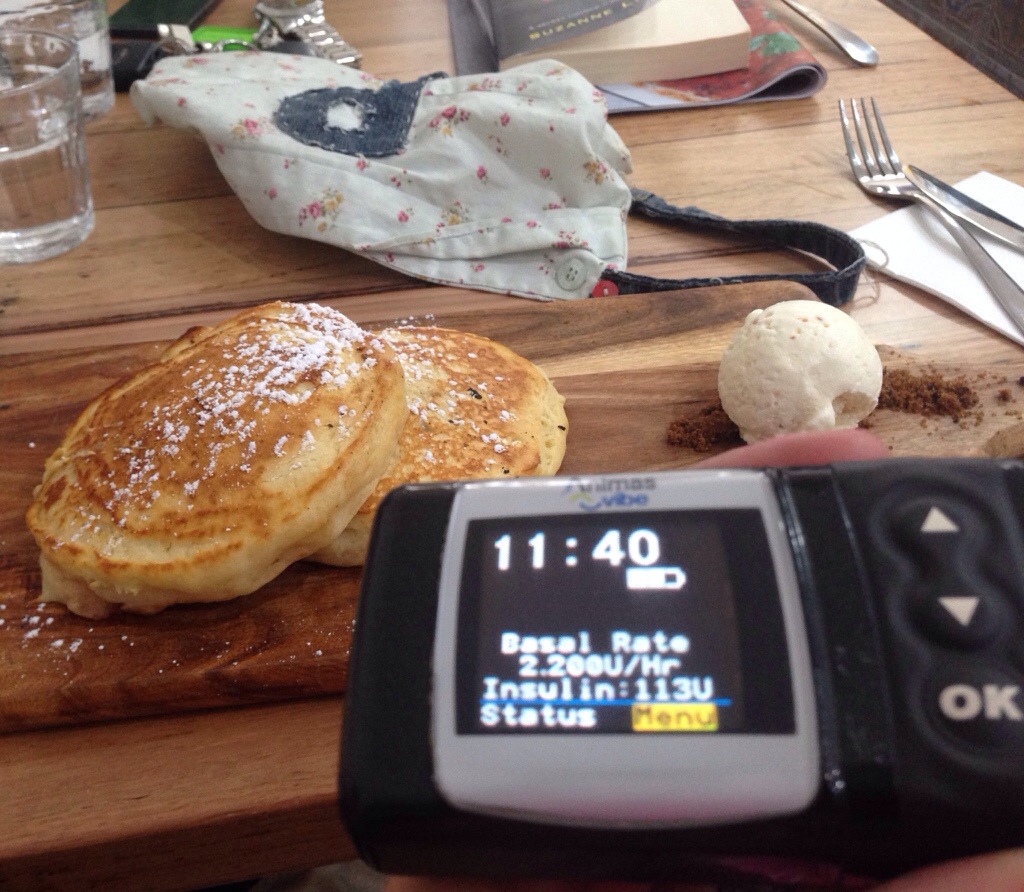
A new cafe has opened up in my ‘hood serving amazingly good coffee and this fabulous dish. Yes – the doughcakes are delicious. They’re fluffy and light and filled with strawberry jam, which oozes out onto the serving board in a most pleasing way. But the most exciting thing? The bacon ice cream. Yes. Bacon. Ice. Cream.
Has there ever been a better nod to the DOC than this very dish? The only way it could be better if it was served up by unicorns.
So yes. I can eat that, and thanks to that nifty little pump thing, insulin takes care of all the carbs.
There seems to be a little bit of a theme to my Saturday Snaps for Diabetes Blog Week. Last time this was the prompt, I wrote (and snapped) about cupcakes. Apparently, when it comes to pictures of diabetes, it’s all about the food for me!
 THE GRUMPY PUMPER
No. It’s not the “Bad” Type
No. I don’t have it “Really” bad and that’s why I’m on a pump.
No. If you press that button I won’t die. YOU WILL!!

You can read more from Grumpy at his blog, The Grumpy Pumper and follow him on Twitter here. (He’s actually quite delightful!)
Diabetes Tales is a new thing I’m trying out at Diabetogenic. If you’re interested in taking part, let me know!
Technology in diabetes has come a long way in recent times. In the almost-sixteen years I’ve had diabetes, we’ve seen the advent of ‘smart’ pumps, CGMS and even trials of closed-loop systems that make the artificial pancreas seem a real possibility in the not-too-distant future.
BGL meters are smarter too, with new ones having built-in wizards to help keep track of insulin on board to avoid stacking-induced hypos. Carb to insulin ratios and insulin sensitivity factors can also be programmed to help calculate the amount of insulin required, taking into account how much insulin is still active, the carbs in what you are about to eat as well as your current BGL. These calculations, once the domain of pumps only, can now be used by all people with diabetes with minimal training.
There are aggregate apps that pull together data, make them into pretty graphs and assist with finding patterns, highlighting problems and allowing the user to send the information to their HCPs for online discussions (or follow up at your next face-to-face appointment).
There is data everywhere and we can track, estimate and predict our BGLs, insulin doses, carb intake. It’s all there for the taking.
And it can be overwhelming.
If information is power, then with this much information at our fingertips, we should all be incredibly powerful! But sometimes rather than power, instead I find it’s information overload. I stop responding to the data because there is just too much of it. In the same way that we are bombarded with social media updates so we stop listening, the never-ending data stream become white noise, too hard to distinguish anything of any real meaning.
I mentioned that in an endeavour to keep things simple, I stopped wearing my CGMS. There was no point in attaching an $80 sensor if I wasn’t going to be doing anything with the numbers it was constantly giving me. Instead, it made sense to do whatever BGL checking I felt I could manage and actually respond to the information in a meaningful way.
I’m still enjoying this lower level of data collection and am finding that it has contributed to be staying on track, rather than contributing to a season of burnout. Tailoring the information I can deal with is a smart way for me to ‘cope’ without being the data nerd I am at other times.
You will never hear from me that the technology available in helping manage our diabetes is a bad thing. You will never hear me say that it is a waste of time or pointless or an unnecessary expense. But I will say that I think there needs to be an acknowledgement and understanding that sometimes it’s just too much and can result in feelings of desperation, exhaustion and a sense of it all being just too much!
If you are finding that all the data is excessive and paralysing you into inactivity, think about cutting back the information you are collecting to the basic minimum. This, of course, will be different for everyone and there is no right amount of data for everyone. Being safe, feeling satisfied and being able to cope with what you are getting is key.
It’s Friday! So here are the Pogues.
Also – would you vote for me in the Australian Best Blogs 2014 Competition? Click here to be taken to a short survey and select Diabetogenic (half way down the first page) as your blog of choice. Thank you!!





 Diabetogenic