You are currently browsing the category archive for the ‘Peer support’ category.
The very first time I ever saw or heard anyone speaking of an insulin pump was about 14 months after I was diagnosed. It was National Diabetes Week in July 1999, and I attended an event organised by Reality Check, and supported by Diabetes Vic. Reality Check was a support group of young adults with type 1 diabetes. I don’t remember much from the program at the event, but I do remember a woman called Cheryl Steele. Cheryl was living with type 1 diabetes, and she was sharing her story of using an insulin pump and how it had completely revolutionised her type 1 diabetes management. Three moments from Cheryl’s talk stood out for me: the first was that she was able to be more flexible with what she was eating, the second was that a pump gave her more flexibility with being able to sleep in. And the third was that she loved her pump so much that she threatened to cut the arms off anyone who tried to take it away from her.
The first time I heard about CGM was years before we had the devices here in Australia. I read about them in online blogs and in support groups led by PWD in the US. I read stories about how this technology was changing the way the managed their diabetes in ways I could only imagine. I heard about Libre for the first time a number of years later when I met Claudio Pelizzeni at EASD, and he shared his experience of using the device as he travelled the world (without taking planes).
The first time I heard about DIYAPS was at an informal lunch thrown by Medtronic (I think) in 2015 (I think) in Boston (I think). I’m sketchy about the details, but I do remember with great clarity that at the other end of the table was a woman called Dana Lewis who I had seen online and read about, and knew to be amazing, but not yet met in person. She was talking about…well, to be honest, at the time I had no idea what she was talking about. All I could see and understand was that she was doing something that sounded like science fiction. She had a number of devices linked together and there was something totally magical happening.
The first time I heard about Loop (the DIYAPS I went on to use) was on a rainy New York night in January 2017 at a pub in the financial district. I was having a drink with a friend and just as he was taking the first mouthful of his stout he said, ‘Hang on, I need to bolus’, and he pulled his phone from his pocket and pressed some buttons. ‘What the what?’ I asked and he proceeded to explain Loop, how it worked, how he’d woken at between 80 and 100 (4 & 5) every single morning for the three months he’d been using it, and how he was sleeping better than he ever had.
When it comes to technology, it has always been up to me to first raise discussions about different devices or options. After seeing Cheryl talking about her pump, I asked my endocrinologist about getting one and his opening line (and closing line, as it turned out) was ‘They kill people; I’ll never allow one of my patients to use one’. That was the last time I saw him, and I went on the hunt to find an endocrinologist who would support my choice. I started on CGM because I enrolled myself in a trial. I was given my first Libre at a blogger event. I cobbled together my DIYAPS after sourcing what I needed. As brilliant as my HCP team is, they have not been especially proactive about suggesting, or even introducing the idea of, different diabetes technologies. It’s been learning through others with diabetes that has set me on that road.
When I talk about what peer support means to me, it goes beyond moral support and shared experience. It has been the driving force behind much of the way I choose to manage my diabetes. It has been the impetus for investigating if something new might be right for me. It has paved the way for me to start conversations with healthcare professionals to make access happen.
Peer support is absolutely essential for the mutual understanding and the tips and tricks for making day-to-day diabetes easier. And I’ve always said that hearing others’ stories help make sense of my own. But it is about much, much more. I’ve detailed the ‘first times’ when it comes to tech, but there have been so many more moments – moments that have helped make that tech work for me in ways I’d not thought, and certainly not had discussed with me by HCPs.
When I speak with newly diagnosed PWD I ask if they know others. I gently suggest that it may be a good thing to think about – not necessarily straight away, but certainly at some point. I can never repay the debt of gratitude I have for people who steered me in the direction to the tools that make my diabetes life that little bit easier, but I can do all I can to give back and try to do that every day.
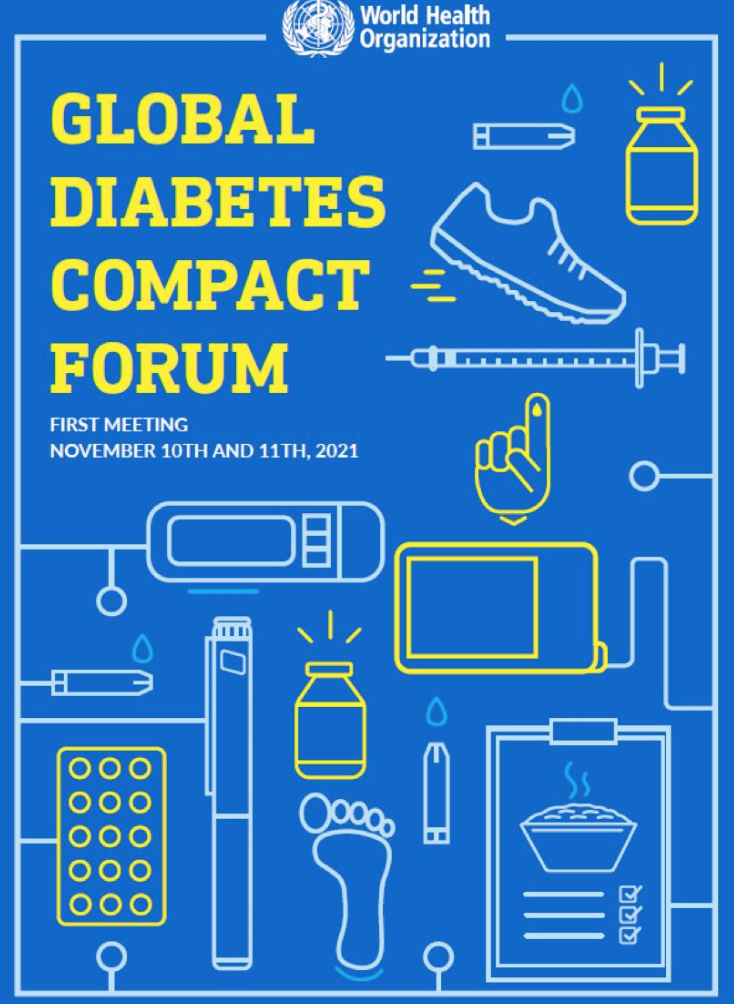
Over the last two days (or last two middles of the night if you’re perpetually in the wrong part of the world as it seems I am), I participated in the excellent first World Health Organisation Global Diabetes Compact Forum. (You can read the Compact which was launched earlier this year here.)
Once again, the WHO team had brought together stakeholders, including diabetes advocates, from across the world to talk about some critically important challenges facing people living with diabetes. These included access to insulin, research and innovation and prevention, health promotion and health literacy. The Forum was definitely not a ‘sit and be lectured to’ event. It was interactive, with everyone having the opportunity to participate and share their experiences and perspectives. The chat function was open and there was a constant stream of engaging, energetic discussion and sharing.
The final session was about prevention and in his introduction, James Elliot, who expertly moderated the event, laid the foundation for the discussion. As with the previous sessions, there were no pre-conceived ideas or narrow focus about the topic.
Prevention isn’t just about prevention of type 2 diabetes. There is a lot of work also going on looking at prevention of type 1 diabetes. And also, once living with diabetes, looking to do what we can to prevent diabetes-related complications.
When I spoke, the first thing I wanted to highlight was the problem I feel with the word prevention, and I revisited previous discussions in which I’ve been involved which highlight the struggle I feel with the word prevention. For too many people it is a word that offers a promise – a promise which guarantees that we can prevent aspects of diabetes that are often well beyond our control. I presented my case for instead focusing on how reducing risk is a far more accurate description of what efforts are truly about, a perspective that I have noticed is being used more and more.
The discussion pivoted to being about complications and associated stigma. Thankfully, this is not the start of the conversation about diabetes-related complications and the way people see them. When I wrote this piece back in 2013, I wrote about the way complications were presented to people with diabetes and how non-modifiable factors such as genetics, are rarely part of the conversation. There seemed to be a very one-dimensional presentation of diabetes-related complications: ‘take care’ of yourself, and you won’t get them.
With communication around complications starting to be included in the language matters movement, I could see that too many people had been told that over-simplistic tale.
It all got taken up a very significant notch when there was a concerted effort in the DOC to encourage dialogue about diabetes-related complications in a non-judgemental and safe way. Suddenly, we were seeing the hashtag #TalkAboutComplications accompany people’s stories, or questions others might have. This led to a real shift, as more and more people shared their experiences, with many saying that it was the first time they had seen others being so open about what was often considered a taboo topic. Starting to peel away the shame and secrecy of what can be a scary part of life with diabetes allowed many people to seek support from peers and help from health professionals.
The legacy of the #TalkAboutComplications idea is that is that there are far more conversations today about diabetes-related complications. There is also a plethora of blog posts, podcasts, journal articles and conference presentations about the topic. I know that there is still significant stigma that we need to chip away at, but actually being able to easily find places online where conversations about complications are normalised and being part of those conversations is contributing to reducing that stigma.
The session at the Global Diabetes Compact Forum was terrific because it tied together diabetes-related complications and stigma. With the theme of access this World Diabetes Day, perhaps we need to think about what that means when it comes to diabetes-related complications. While we absolutely do need to think about all factors at play when it comes to the development of complications, we also need to acknowledge that access is a factor when it comes to outcomes. Access to the right information, including information about risk reduction, access to insulin, access to glucose monitoring devices, access to complications screening, access to early diagnosis and treatment, access to peer support, access to stigma-free treatment, access to mental health support…all these have the very real potential to influence outcomes.
It’s been a while since my last diabetes in the wild encounter. It makes sense. I’ve barely left my house for the last 20 months and I’ve not really been frequenting the places where I would usually have those happenstance meetings – cafés and airports. Gosh, remember airports? Remember the queuing and the waiting and the frustrations and the delays and the cancellations? Anyway, I digress…
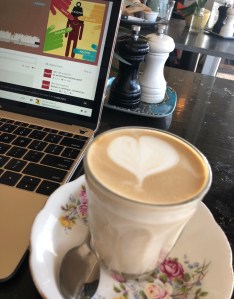
It shouldn’t surprise me that it was a café that provided the setting for my accidental encounter with another person with diabetes. I was working away, happy to not be in my house, even happier that someone kept bringing me outstanding caffeine. Happiest because I knew that every single other person sitting there was fully vaccinated.
I was doing the sort of work I do best in a café – editing. I get into a zone, concentrate on the task, and just read and edit in a super-efficient and fixated way. I don’t get distracted by anyone around me, and the noise becomes a reassuring beat that I work to. I completely block out anything on around me.
Including the fall rate alert on my Dexcom app. Anyone who uses Dexcom knows that this is a particularly urgent, loud and unforgiving wail. It cuts through absolutely everything. I absentmindedly nodded in the general direction of my phone when I heard it, but didn’t make a move as I was totally focused on rewriting a particularly sticky sentence. (Probably like every bloody sentence in this post…)
And so, I didn’t notice a woman sitting nearby get up from her chair and walk in my direction. I didn’t notice her stop right at my table. In fact, it wasn’t until she cleared her throat and said ‘Excuse me’ that I looked up, realising there was someone right there. She was fixing her mask behind their ears at the moment I looked up at her, my eyes focusing away from my MacBook. I blinked a few times and smiled, and then reached for my own mask before realising it was already on my face. I exaggerated my smile, so I was smiling with my eyes.
There was a slightly awkward moment as I waited, because, look, I’ve forgotten how to engage with people. I probably should have said ‘hi’, but I’ve really lost the art of chatting with people. How do conversations start? So, I was thankful when she introduced herself. And then she asked, ‘Are you okay? I heard your Dexcom a couple of times. I just wanted to check you are okay.’
And that was how I broke my streak of having conversations about diabetes with other people with diabetes I’ve never met before.
Turns out, I’ve missed it. Really, missed it.
We spoke for a while, sharing the usual things, comparing notes about which HCPs we see, and talking about which tech we are using. She is about to start looping, so I answered a heap of questions, remembering that I need to not be too evangelical and gushy about it. I toned down my ‘It’s the best thing I’ve ever done for my diabetes’ (because it is) by adding ‘But, of course it’s a learning curve and can be tricky.’
We told self-deprecating stories about how crappy our attitudes to diabetes have been at different periods. We shared our Covid-19 vaccination stories and compared when we’d be getting boosters. And we spoke about how we felt every time diabetes was mentioned in connection to Covid-19.
Through it all my Dexcom kept squealing and I ignored it because I just wanted to slurp up a diabetes conversation with someone in real life, where all we really had in common was diabetes. It felt like a therapy session, a confession, and catching up with a long-lost friend all in one fifteen-minute encounter.
When our conversation ended, she turned to return to her seat, and I settled back, searching for the sentence I’d been working on. But before I could do that, she turned back towards me and said, ‘I read your blog. I’ve seen you here before…well, used to see you here before Covid…and I wanted to say something. It’s really lovely knowing that there is someone like me who comes here.’
And then I cried. Because I remembered just what it is to connect. How real it feels. It’s why I started this blog in the first place – because I wanted to meet others just like me. Well over ten years of writing about diabetes, twenty years of diabetes advocacy, and that feeling of connecting never gets old.
Lots more diabetes in the wild stories on this blog post from earlier this year.
I facilitated an event for Ascensia (disclosures at the end of this piece) last night/early morning and the crappy time was partly (mostly) my fault, because although I sacrificed the Aussies and suggested we draw the short straw in the time zone lottery, I forgot that daily saving would have kicked in for us meaning kick off time was 11pm and not 10pm. That may not seem much – I mean, what’s an hour? – but there is definitely a psychological barrier about doing work after midnight. (Anyway, I digress, and that paragraph has just about put me to sleep).
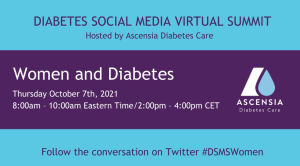
The reason for last night’s adventures after dark was a facilitating gig for Ascensia’s latest Diabetes Social Media Summit (DSMS). The thing I love about (and why I am so keen to be involved) in these Summits is because they have tacked some difficult topics that are often hidden away.
This one was no different in that we looked to address something that needs more attention – diabetes and women’s health. In my introduction, I wanted to make the point that diversity and inclusion is important when speaking about any aspect of diabetes, and that for us to be truly inclusive in a discussion about women and diabetes, we needed to hear from women who represent all corners of the diabetes world. I particularly referred to needing better representation from women in the LGBTQIA+ community.
The other thing that we had wanted to make sure that we didn’t focus too much on diabetes and pregnancy, because so often that is the only easily information about women’s health and diabetes that can be easily found (and saying that, there does seem to be a bias towards women with type 1 diabetes). Of course, understanding and being aware of how diabetes can impact on pregnancy is important, but it is certainly not the only issue that women with diabetes want or need to know about.
In fact, one of the discussion points was that for some women, pregnancy is not a topic they want discussed. There is the assumption that all women of childbearing age need information about having a healthy baby when that is not the truth. Contraception discussions do not necessarily equal an invitation for pre-pregnancy counselling, and there needs to be some sensitivity in how healthcare professionals in particular raise the topic, and rid themselves of the belief that all women want to have kids.
There is so much more to talk about. So, so much more.
We touched on how much our cycles can impact and influence glucose levels (and a very amusing tangent where we joked about how when we see monthly perfect glucose patterns, they clearly don’t belong to people who menstruate – or people who understand the absolute havoc hormones can wreak on CGM traces).
We spoke about birth control and how the OCP can also make a significant difference to glucose levels, yet many of us were not told about that.
Of course, we spoke of menopause, but only briefly; briefly not because it’s not an important topic (or a super relevant topic), but because we just got caught up talking about other things (and perhaps my facilitating skills weren’t as tight as usual).
And we spoke about how cultural gender issues need to be shown and understood so that the experience of privileged white women with diabetes are not seen as the only experiences.
For me, the central message that I heard time and time and time again was that topics about the very things that occupy a lot of the headspace of women with diabetes are simply not discussed with us. And there is little research to inform our decision making, or even to help us form the right questions to ask. At best, we are given some piss-weak explanation that points a finger at diabetes being to blame. At worst, we are dismissed.
I do wonder when research and diabetes education will catch up. I know that there are some wonderful researchers doing some important work here, but we are so far from normalising discussions about women’s health and diabetes as part of our typical healthcare routines. We’re miles away from getting rid of the preconceived and outdated ideas about women’s sexual health.
Beyond discussing different women’s health matters, we also spoke about just how these discussions fit in the diabetes community. This was a completely unplanned turn for the summit (it was not a topic on the agenda), but I’m glad we had it and I’m glad that I am writing about it. Because of the nature of women’s health, sex and diabetes, there is a lot of taboo, shame, fear, and vulnerability. I know that some of the rawest and most open I’ve been in my writing has been when I have been dealing with moments in my life that were so, so hard and I was so, so vulnerable. When I look back, I sometimes wonder if I was right to hit publish after writing, and perhaps I should have tucked away the paragraphs until I was feeling stronger. Or not published at all. While I have been told that my words have provided some comfort to others facing similar challenges, it left my gaping, open wounds very public and visible.
After writing about miscarriages, I’ve been called selfish for wanting to have a child and potentially passing on diabetes to them. Writing about my fears of passing on diabetes to my child I’ve been told that perhaps I should have thought of that before I got pregnant. Speaking about body image concerns, I’ve been told to toughen up and stop being so shallow. I’ve seen and watched other women with diabetes experience the same thing, and I feel their pain as I watch them navigate the muddy, and sometimes distressing waters.
We spoke about how women are treated in the diabetes community, particularly when we write about struggles and difficulties, and the words and terms that are thrown our way when we dare to share how we are feeling. The ‘angry woman’ trope that I’ve written about before has been directed to many others too.
These discussions are real, and they are necessary. I am one of the loudest, most vocal supporters of peer support and have spoken about the value and importance of diabetes peer support and the online community on stages literally around the globe. Peer support saved me at times when I thought I was broken beyond repair. But it also can be a source of pain and bullying and nasty confrontations, and perhaps we need to have those discussions too so that when someone decides that they are ready to share and be especially vulnerable that they look out for themselves as much as looking out for the community. It’s all very well to want to share to connect and help with our own and others’ isolation but leaving ourselves exposed isn’t easy.
One of the attendees last night reminded us that we could share with selected friends in the community, still allowing for that peer support but under the protection of a safe space. It’s interesting, because until maybe two years ago, I had never experienced how unsafe the community can be to individuals. I’d not felt that before. While I still share a lot, these days I’m more inclined to turn to those trusted friends in the DOC who I know will be honest, open, but never nasty or judgemental.
Online spaces are different for women than they are for men. The misogyny that is inbuilt to even those that we think are allies comes out, often surprising us, as throwaway comments about a woman’s age or appearance. It is ever present in the diabetes community too. I’ve rolled my eyes as some of the most vocal advocates who have loudly aligned themselves as being supporters of women, revert to type, with snide sexist commentary. I’ve seen people in the DOC referred to as ‘angry old women’ for daring to be furious, older than 25 and a woman! I roll my eyes now when I know someone has called me angry. I also know that they’ve just announced to everyone how threatened they are of women who dare to not go quietly, and how they expect us to remain in our place!
There was so much more that we could have spoken about last night. We didn’t touch on body image and disordered eating (and yes, I know that this is not the domain of women only, but this is about us!), we didn’t talk about sex all that much either, even though it is often highlighted as an issue that needs more coverage and information. Again, it’s not because they are not important topics; it was because the fluid conversation took a feminist turn that highlighted a highly biased social and healthcare environment where it is seen as perfectly fine that the needs, and concerns of fifty percent of the diabetes community are barely considered.
Perhaps if we had a more feminist approach to, and model of, healthcare, the misogyny that has meant the topics important to us have not been researched, and are not discussed, could be eliminated. And women with diabetes would not be feeling ignored.
Disclosure
I was invited by Ascensia to help plan the agenda for #DSMSWomen and facilitate the discussion. I have been paid an honorarium for my time.
I probably should stop thinking of my job as ‘my new job’. I’ve been at Diabetes Australia now for well over five years. But for some reason, I still think of it that way. And so do a lot of other people who often will ask ‘How’s the new job?’
Well, the new job is great, and I’ve enjoyed the last five years immensely. It’s a very different role to the one I had previously, even though both have been in diabetes organisations.
One thing that is very different is that in my (not) new job I don’t have the day-to-day contact with people with diabetes that I used to have. That’s not to say that I am removed from the lived experience – in fact, in a lot of ways I’m probably more connected now simply because I speak to a far more diverse group of people affected by diabetes. But in my last job, I would often really get to know people because I’d see them at the events my team was running, year in, year out.
Today, I got a call from one of those people. (I have their permission to tell this story now.) They found my contact details through the organisation and gave me a call because they needed a chat. After a long time with diabetes (longer than the 23 years I’ve had diabetes as an annoying companion), they have recently been diagnosed with a diabetes-related complication. The specific complication is irrelevant to this post.
They’ve been struggling with this diagnosis because along with it came a whole lot more. They told me about the stigma they were feeling, to begin with primarily from themselves. ‘Renza,’ they said to me. ‘I feel like a failure. I’ve always been led to believe that diabetes complications happen when we fail our diabetes management. I know it’s not true, but it’s how I feel, and I’ve given myself a hard time because of it.’
That internalised stigma is B.I.G. I hear about it a lot. I’ve spent a long time learning to unpack it and try to not impact how I feel about myself and my diabetes.
The next bit was also all too common. ‘And my diabetes health professionals are disappointed in me. I know they are by the way they are now speaking to me.’
We chatted for a long time, and I suggested some things they might like to look at. I asked if they were still connected to the peer support group they’d once been an integral part of, but after moving suburbs, they’d lost contact with diabetes mates. I pointed out some online resources, and, knowing that they often are involved in online discussions, asked if they’d checked out the #TalkAboutComplications hashtag. They were not familiar with it, and I pointed out just how much information there was on there – especially from others living with diabetes and diabetes-related complications. ‘It’s not completely stigma free,’ I said. ‘But I think you’ll find that it is a really good way to connect with others who might just be able to offer some support.’
They said they’d have a look.
We chatted a bit more and I told them they could call me any time for a chat. I hope they do.
A couple of hours later, my phone beeped with a new text message. It was from this person. They’d read through dozens and dozens of tweets and clicked on links and had even sent a few messages to some people. ‘Why didn’t I know about this before?’, they asked me.
Our community is a treasure trove of support and information, and sometimes I think we forget just how valuable different things are. The #TalkAboutComplications ‘campaign’ was everywhere a couple of years ago, and I heard from so many people that it helped them greatly. I spoke about it – particularly the language aspect of it – in different settings around the world and wrote about it a lot.
While the hashtag may not get used all that much these days, everything is still there. I sent out a tweet today with it, just as a little reminder. All the support, the connections, the advice from people with diabetes is still available. I hope that people who need it today can find it and learn from it. And share it. That’s one of the things this community does well – shares the good stuff, and this is definitely some of the good stuff!
Want more?
Check out the hashtag on Twitter here.
You can watch a presentation from ATTD 2019 here.
Read this article from BMJ.

I generally don’t do my best work at 2am. I’m just not the spring chicken I used to be, and being awake, engaging and remotely coherent when I am usually in the middle of some decent REM sleep is a big ask these days.
But living in Australia, and wanting to remain as active as possible in global diabetes work and activities has meant that I have had to suck it up and learn to get on with it. I’ve become expert at stealthily getting up about so as not to wake my family, moving like a ninja about the house. I make a pot of tea, have hypo supplies handy, and layer on red lipstick to create the illusion of being alert and awake, completely together and impossibly glamourous (I fear I am only fooling myself) before settling into do whatever it is that I am needed to do in the wee hours.
Last night, it was a 1.30am call for a 2am event. I’d snuck in a couple of hours sleep ahead of the rude alarm that woke me. When I logged onto the event platform, I still had my ‘morning voice’ on, but the hot tea helped lubricate – and wake up – my vocal cords. Thankfully I was only required to speak and not sing an opera. (Silver linings!)
But despite grumbling about the hour, I’m glad I did it. Because the following couple of hours was a discussion about hypoglycaemia that combined lived experience stories from people with diabetes, peer support, all articulated with fabulous input from clinicians and researchers. It really was an exercise in how to put together an online diabetes event!
The event was the Lilly Hypo Summit, and I co-hosted with Bastian Hauck who is an absolute pro in any hosting seat. When I was asked to be involved, I had visions of a very staged and scripted event. I have worked with industry enough to understand that their compliance rules often means that events are required to be defined to the nth degree with all content being scrutinised by legal eyes, leaving little room for spontaneity or free discussion. How could we possibly get the true experience of hypos across if we were constrained by needing to stick within a pre-planned programme? I mean, hypos don’t do that, so discussions about them surely shouldn’t have to – and simply couldn’t if we were to do it justice.
Amazingly, we managed to put together an engaging and somewhat impulsive and free-formed event with full support from the global engagement team. They trusted the PWD who were shaping the event enough to understand that what we were trying to do was be respectful to the people telling their stories by not in any way censoring them. Plus we promised no one would throw caution to the wind, and talk about replacing their traditional diabetes management with bathing under a full moon and dancing to the beat of an inner drum (or something), which considering last night was a full moon, was a pretty important promise to make. We created a space for PWD to share their stories and highlight the incredibly complex challenge that is hypoglycaemia, and we punctuated those stories with research and clinical advice.
I knew that it was going to be a good event, because the speakers were remarkable. When it was over, I had dozens and dozens of messages from people congratulating me on my hosting, but there is a secret that I feel I should share. Hosting is impossibly easy when you are interviewing brilliant people. And it was programme overflowing with brilliant people. The PWD who spoke had fascinating tales to tell, and told them in wonderfully disarming ways. I’d not met them all and it was great to be just as surprised as the audience when hearing their stories. And then we had two remarkable researchers who I respect greatly, and I know to be incredible communicators.
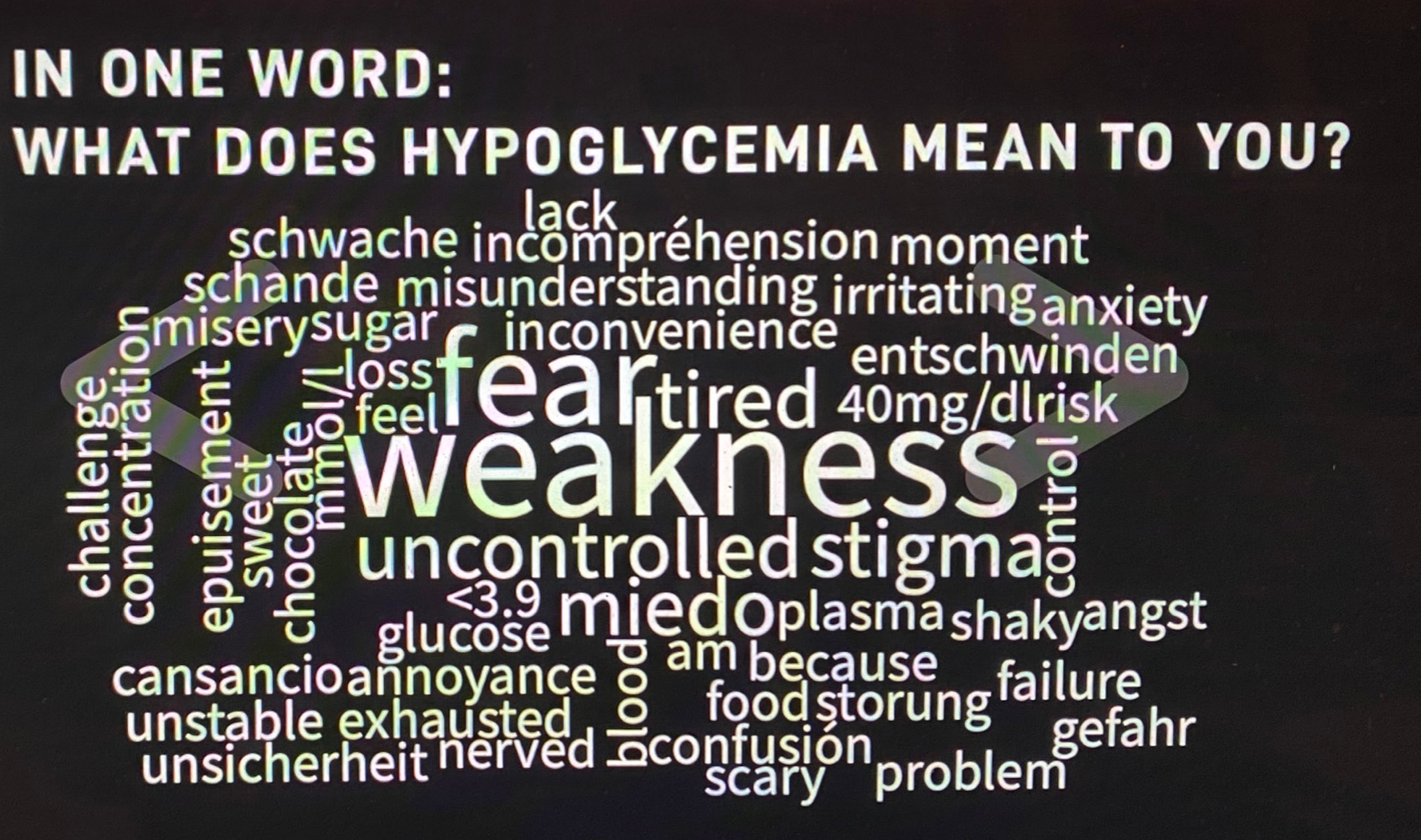
I really want to write more about what was discussed at the event, and will try to do that in upcoming posts, but for now, I just want to share this world cloud. We asked people to describe their hypos in one word. I’ve done exercises like this before and they never, ever reveal the same words. This is what the group came up with last night:
But to finish this post, I want to ask the question that one of last night’s HCPs, Pratik Choudhary, from the Leicester Diabetes Centre in the UK, asked us: ‘Do you see hypos as a slope or a cliff face?’ I can’t stop thinking about this, because I’ve never been asked about hypos this way, but it makes so much sense to consider them in this context. Of course, there are so many factors at play, but this either / or scenario does perfectly capture the in-the-moment way that I feel about hypos. I wonder what you might think about your hypos. Does it fit in here, or is it something completely different?
DISCLOSURE
I was an advisor to Lilly Diabetes for the Hypo Summit. I have been paid for my time. I have not been asked to write anything about the summit, but am sharing because there was so much amazing content at the event. No one has reviewed this post prior to publication.
Last night, my gorgeous friend Andrea tweeted how she had seen someone wearing a CGM on the streets of Paris. When she rolled up her sleeve to show him her matching device, he turned and walked away. ‘Guess you can’t be best friends with every T1D’, she wrote. ‘Diabetes in the Wild’ stories have been DOC discussion fodder for decades – including wonderful stories of friendships being started by a chance encounter, and less wonderful stories such as Andrea’s most recent encounter. I was reminded of the many, many times pure happenstance of random diabetes connection has happened to me.
There was the time I was waiting for coffee and another person in line noticed my Dexcom alarm wailing, and the banter we fell into was so comfortable – as if we’d known each other forever!
And that time that someone working the till at a burger flashed her CGM at me after seeing mine on my arm and we chatted about being diagnosed as young adults and the challenges that poses.
Standing in line, queuing for gelato, is as good as any place to meet a fellow traveller and talk about diabetes, right? That’s what happened here.
And this time where I spotted a pump on the waistband of a young woman with diabetes, and started chatting with her and her mother. The mum did that thing that parents of kids with diabetes sometimes do – looking for a glimpse into her child’s future. She saw that in my child, who was eagerly listening to the exchange. But I walked away from that discussion with more than I could have given – I remember feeling so connected to the diabetes world in that moment, which I needed so much at the time.
I bet that the woman in the loos at Madison Square Garden wasn’t expecting the person who walked in at the exact moment she was giving herself an insulin injection to be another woman with diabetes. But yeah, that happened…
I’ll never forget this time that I was milliseconds from abusing a man catcalling me out his car window, until I realised he was yelling out at to show me not only our matching CGMs, but also the matching Rockadex tape around it. My reaction then was ridiculous squealing and jumping up and down!
Airports have been a fruitful place to ‘spot diabetes’, such as the time my phone case started a discussion with a woman whose daughter has diabetes, except we didn’t really talk about diabetes. And the time another mum of a kid with diabetes was the security officer I was directed to at Amsterdam’s Schiphol Airport. She was super relaxed about all my diabetes kit, casting her eyes over it casually while telling me about her teenage son with diabetes.
The follow up to this time – where I introduced myself to the young mum at the next time who I overheard speaking about Libre, and saying how she was confused about how it worked and how to access it – but not really being all that sure about it, is that she contacted me to let me know that she’d spoken with their HCP about it, had trialled it and was now using it full time. She told me that managing diabetes with toddler twins was a nightmare, and this made things just a little easier.
Sometimes, seeing a stranger with diabetes doesn’t start a conversation. It can just an acknowledgment, like this time at a jazz club in Melbourne. And this time on a flight where we talked about the Rolling Stones, but didn’t ‘out ourselves’ as pancreatically challenged, even though we knew …
But perhaps my favourite ‘Diabetes in the Wild’ story is one that, although I was involved, I didn’t write about. Kerri Sparling wrote about it on her blog, Six Until Me. Kerri was in Melbourne to speak at an event I was organising, and one morning, we met at a café near my work. We sat outside drinking our coffees, chatting away at a million miles an hour, as we do, when we noticed a woman at the next table watching us carefully. We said hi, and she said that she couldn’t help listening to us after she heard us mention diabetes. She told is her little girl – who was sitting beside her, and was covered in babycino – had recently been diagnosed. I will never forget the look on the mother’s face as two complete strangers chatted with her about our lives with diabetes, desperately wanting her to know that there were people out there she could connect with. I also remember walking away, hoping that she would be okay.
Five years later, I found out she was okay – after another chance encounter. I was contacting people to do a story for Diabetes Australia and messaged a woman I didn’t know to see if she, along with her primary aged school daughter would be open to answering some questions. Turns out, this was the woman from Kerri’s and my café encounter. She told me how that random, in the wild conversation made her feel so encouraged. She said that chance meeting was the first time she’d met anyone else with diabetes. And that hearing us talk, and learning about our lives had given her hope at a time when she was feeling just so overwhelmed.
I know that not everyone wants to be accosted by strangers to talk about their health, and of course, I fully respect that. I also know there are times that I find it a little confronting to be asked about the devices attached to my body. But I also know that not once when I’ve approached someone, or once when someone has approached me has there been anything other than a warm exchange. I so often hear from others that those moments of accidental peer support have only been positive, and perhaps had they not, we’d all stop doing it. It’s a calculated risk trying to start a conversation with a stranger, and I do tread very lightly. But I think back to so many people in the wild stories – the ones I’ve been involved in, and ones shared by others – and I think about what people say they got out of them and how, in some cases they were life changing. A feeling of being connected. The delight in seeing someone wearing matching kit. The relief of seeing that we are so alone. The sharing of silly stories, and funny anecdotes. And in the case of that mum with a newly diagnosed little kid, hope.
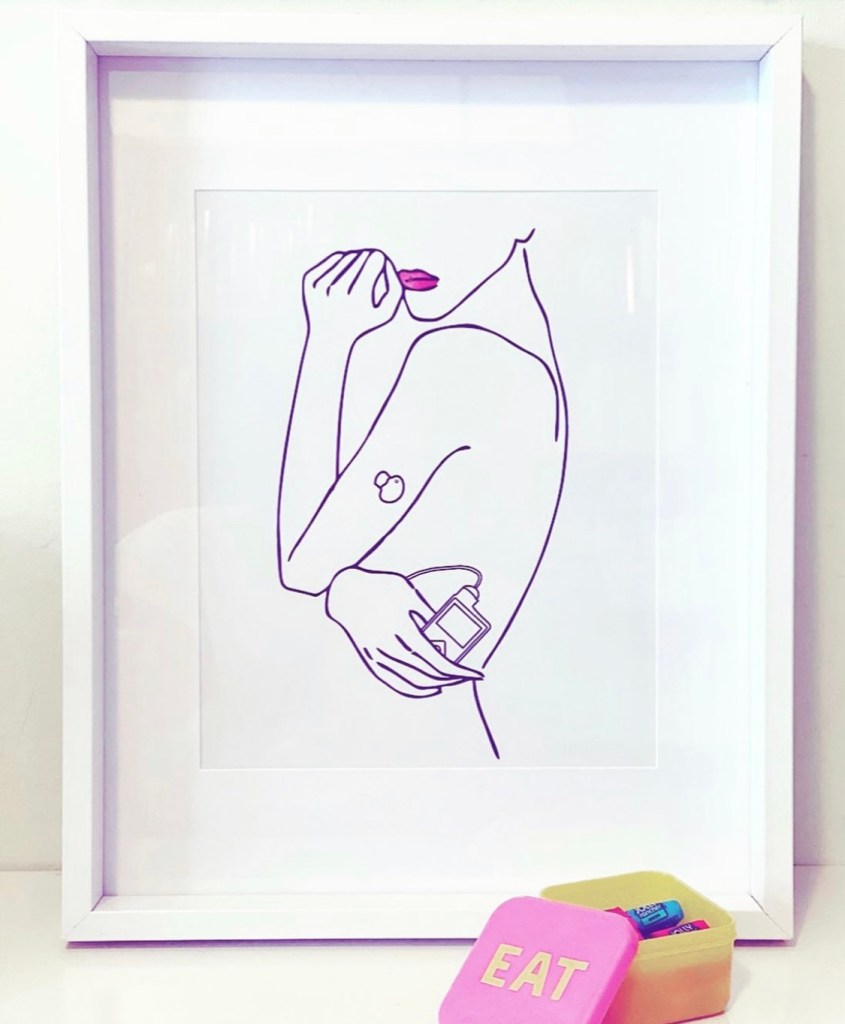
Today’s post is dedicated to Andrea whose tweet kicked off this conversation in the DOC last yesterday. Thanks for reminding me about all these wonderful chance meetings, my friend.
There have been a number of times here on this blog and in other online platforms that I have been critical about the low carb community. Actually, let me be more specific. I have been critical of the response from certain corners of that community, particularly the corners that are free with their fat shaming, and accusing people with diabetes who choose not to eat low carb as not caring about their health, and attacking others for daring to suggest that there could possibly be more than one way to eat. This has come from a long list of incidents I’ve either seen or have been involved in, such as the time I was fat shamed for saying that intermittent fasting is great for some, but not for everyone, and the time that people in the LC community got angry at the idea of saving the lives of children with diabetes from developing countries.
I guess I shouldn’t have been surprised really at what happened earlier this week just before I published a post on diabetes and menopause. As I often do, I look to the community for others’ experiences. And so, I tweeted (and shared on Facebook) this:

The responses were many and great. One aspect of the generosity of the DOC is the willingness and openness to share not only experiences, but to offer tips and tricks for what has worked for them. I’ve always found that so amazing, especially when addressing issues that are considered a little taboo. Menopause is one of those issues. But even so, there were so many replies from people who have either gone through menopause, or started to think about it.
And then, out of the blue, came a reply from a nutritionist. A nutritionist I have never encountered before. I don’t follow him on Twitter, I have no idea who he is. Which is all fine. My Twitter is public and if I ask a question everyone is free to offer their input. Here is his reply:
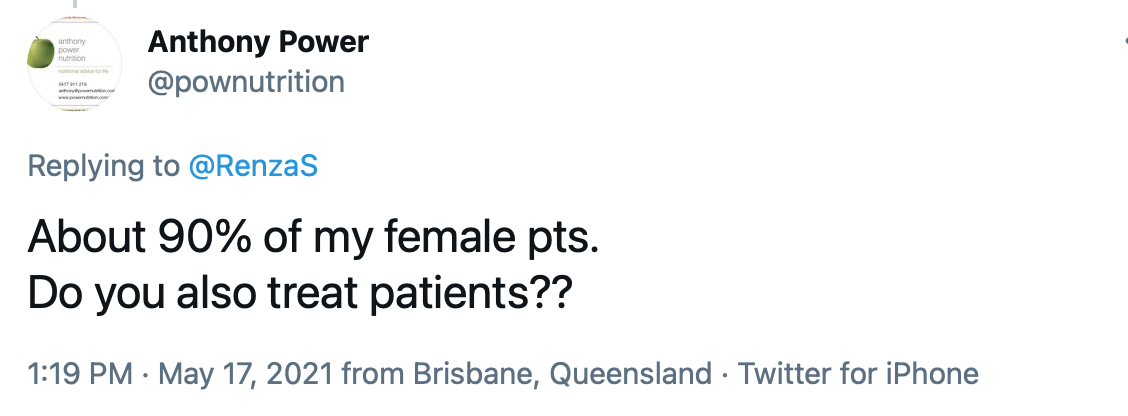
I replied that I am not a healthcare professional. And then came this:
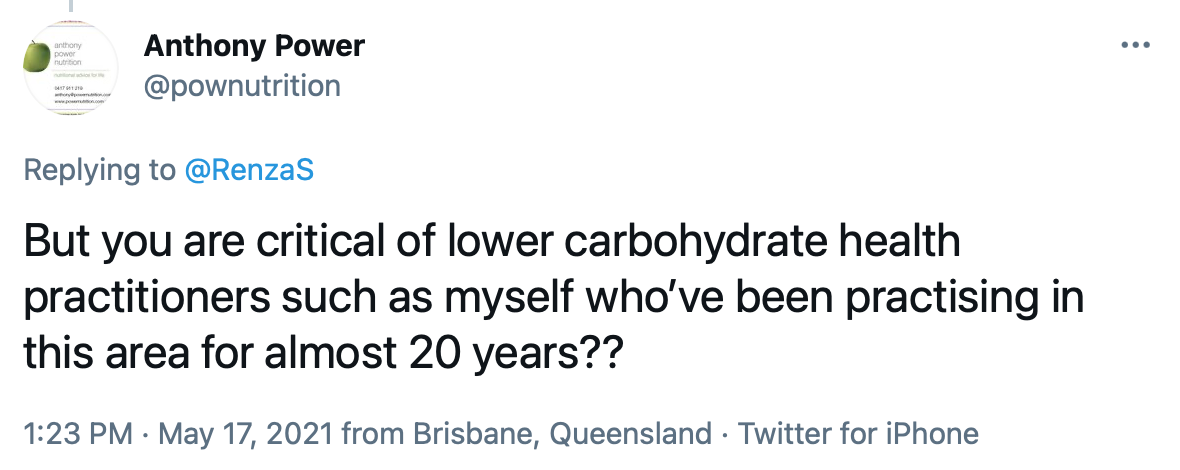
Followed by this from me:

(I’m not going to share anymore of the tweets in what turned out to be a rather long back and forward thread, but if you click on any of the tweets above you will be able to find the whole mess.)
He kept going, demanding to know why I am critical of low carb diets and health professionals who promote them (which he apparently had deduced from reading through my Twitter feed). I’m not. Which is what I repeatedly tweeted to him in responses to his continued demands that I explain my stance on diets and diabetes, and, as a healthcare professional, I must stop giving ‘personality-driven healthcare advice’. I reminded him that, a) I am not a HCP (which I had already stated), and, b) I share my experiences, not give advice. He helpfully suggested that my blog posts read that way.
I had asked about menopause. I asked people with diabetes who had either been through menopause, were going through it now, or thinking about going through it. I asked whether it had been a topic of conversation with their HCPs.
This bloke – who doesn’t have diabetes and has never experienced menopause – had nothing to offer, other than attacking me for my choices. And my choice is that I believe in choice.
It’s not okay for a healthcare professional to enter into a discussion with a person with diabetes seeking peer support, and telling them what it is that they do and don’t do in that community. I am so over this sort of paternalism in healthcare. I’m over HCPs bullying their way into our community and trying to shape it into what they want.
I’d also add that a man hijacking a conversation started by a woman about menopause is pretty shitty behaviour. I’m also over misogyny and the way male healthcare professionals centre themselves in discussions that are not about them. It happens all the time. It happened on Monday.
A tweet about menopause. And not even about food and menopause! It sounds somewhat ridiculous really. I don’t look for this sort of reaction, and I certainly have never baited anyone from the LC community. I don’t post photos of high carb meals accompanied by a ‘dare you to say something’ comment. (But I should say, that even if people are doing that, there is still no valid reason to criticise what another person is eating** or criticise the way they choose to eat.)
I understand that there will always be difficult people in any community. Unfortunately, it is people like this who are often the most seen from the LC community. And it’s why I am critical. But be clear – I am not critical for the advice they are giving, or the eating plan they are following. I am critical of, and will continue to call out, this sort of behaviour.
**Okay, I know that I said that there is no valid reason to criticise what another person is eating. But I am adding a caveat to that because I do (and probably will continue to) criticise anyone who wants to drink flavoured coffee. Or instant coffee. Or coffee from a bag. I fully acknowledge and accept my status as a Melbourne coffee snob and will not be entering into any discussions that caramel, pumpkin spice or unicorn flavourings are okay. They are not. Don’t @ me.