
You are currently browsing the category archive for the ‘Language’ category.
I’m heading to Sydney this morning (it’s early…too early) for the Australasian Diabetes Advancements and Technologies Summit – ADATS, (follow along at #ADATS2018), which had me thinking about the conference last year where I spoke about Loop, scared a shitload of HCPs, was almost traumatised into never speaking again in public (almost – didn’t happen) and was happy to be branded non-compliant.
Today will be a far gentler experience – my role is as a member of the organising committee, and as a session chair. Surely no one will want to sue me for that. Right?
As I ponder that, and reminisce about last year’s talk, here are some links. So many links that I have been wanting to share. So, have a cuppa, have a read, and share stuff.
Also, being deliberately non-compliant is kind of fun…

(Disclosure first: My flights from Melbourne to Sydney are being covered by the National Association of Diabetes Centres (NADC), the organisers of ADATS. I am on the organising committee for the conference.)
_________________________________________
Finally DIYAPS makes it to the mainstream media in Aus
I’d heard of The Saturday Paper, (which was a surprise to the journalist who interviewed me), but apparently not all that many people have. It’s a weekly newspaper (somewhat unimaginatively named – it’s a paper and comes out each Saturday) with long-form articles. One of those articles was about DIYAPS and came about after journalist Michele Tyde heard about the Diabetes Australia DIYAPS Position Statement.
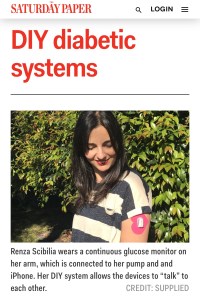
Read the DIYAPS Position Statement here.
The body part is connected to the PWD
‘Talking about the “diabetic foot,” the “diabetic kidney,” or the “diabetic eye” suggests they are somehow separate from the person whose body actually hosts the diabetes. This language suggests the diabetes-complicated body part is more like a malfunctioning car part that needs service – if only we could be provided with a courtesy foot, eye, or kidney to use until our own is better!’
The language at ADA this year (all the way back in June…all the way over in Orlando) didn’t really set off too many alarm bells. Until we had a good look at the program. I wrote this piece with The Grumpy Pumper for diaTribe about how it seems that #LanguageMatters a whole load less when talking about diabetes-related complications…and that needs to change.
Conference blogs
It’s great to see the Ascensia Diabetes Care team continue to support diabetes bloggers by inviting them to write up their thoughts on diabetes conferences. The latest contribution is from Sascha Stiefeling (who blogs at Sugar Tweaks) where he gives some insights into the start of EASD. (It was written in German and translated into English.)
Oh – and here’s the post I wrote for them about the Australasian Diabetes Congress a couple of months ago. (I was not paid to write this, or supported by Ascensia to attend, but I did work with them on their Social Media Summit.)

No weakness at all
On Mental Health Awareness Day this year, UK writer and poet David Gilbert wrote this beautiful post about the strength – not weakness – of living with mental illness.
How we are wrong about obesity
This piece about obesity is a must read. It talks about how weight bias from healthcare professionals and stigma often results in higher weight people avoiding going to the doctor because they fear discrimination, not being believed and being shamed.
More on weight stigma
And read this piece (also on diaTribe) about how weight stigma hurts people and affects health outcomes.
Keep Sight
This week, Diabetes Australia officially launched the first ever national eye screening program, Keep Sight. The program will make it easier for Aussies with diabetes to get their eyes checked. You can read about the program here (from when it was announced back in July).
Disclosure: I work at Diabetes Australia, but was not asked to write about this program. I’m doing so because it is important.

Your story is important
True champion of listening to ‘the patient’, Marie Ennis-O’Connor wrote this wonderful piece about the power of storytelling in healthcare.
Always be kind
I’m always fascinated to read stories from HCPs who write about their experiences on the other side of healthcare. Moving from care-giver to the one needing care can be life-changing. In this BMJ Opinion piece, health researcher Maria Kristiansen writes about how important compassion and kindness from healthcare professionals were for her and her family during her young son’s illness and death.
More on kindness (because we can never have enough)
The first sentence of this article in BMJ by Dr John Launer had me hooked: ‘I’m not a clever doctor, but I’m a kind one’. Have a read.
Diabetes in hospital
I know I’m not the only one to be terrified of needing to go into hospital, worrying about a lack of knowledge about type 1 diabetes treatment and my technology, and having to fight to maintain ownership of my own diabetes care. Adam Brown at diaTribe has written about his recent trip to A&E, surgery and subsequent recovery after his appendix ruptured. Lots of great tips for anyone who may wind up in hospital.
Digital diabetes
How can digital medicine and research, and artificial intelligence transform diabetes? That’s the question research scientist in diabetes, Dr Guy Fagherazzi, asks in his (open source) review in Science Direct that you can read here.
Bake these!
And finally…It’s nearly the weekend and if you have a spare 20 minutes, you really, really should think about baking these! They are crackled parcels of molasses, spice and all things nice and are, quite possibly, one of the best things I’ve ever baked.

The European Association for the Study of Diabetes (EASD) Annual Meeting has been its usual busy self and I have lots to write. But today, let’s look at some pictures…
Actually, let’s just look at one.
So, allow me to share a little secret. I have found that coffee at conferences is hit and miss. But Lilly usually has the best coffee. This assertion is made after attending many conferences for a number of years…and drinking a lot of coffee. A. Lot. So on Tuesday morning, I made a bee line to the Lilly stand to grab what I assumed would be the first of many coffees for the day.
I marched with purpose to the stand. And suddenly stopped short. Because there in huge, huge writing, hanging high above where the coffee queue would be, was this:

I usually have a lot to say. But as I stared at this sign, I had no words. There was a lot of ‘Wait. What? Huh? Hang on…What does that say?’ And then ‘What the fuck were they thinking?’ But I had no thoughts that made any real sense. (And I couldn’t even blame jet lag for the inability to form a cohesive sentence – I’d been in Europe for two weeks already.)
Of course, I ignored the not-in-any-way-policed policy forbidding the taking of photos in the expo area and snapped a picture, posting it straight to Twitter. Because of course I did. (And to Facebook and Insta later on!) The response was swift, and as horrified as my own.
I have not been able to stop thinking about this sign. For the whole of the conference, every time I have wandered through the Exhibition Hall, I have tried to avoid the Lilly area (I found other places to get coffee), and yet I have not been able to escape it because it is so huge. No matter how much I try to avert my eyes, I keep catching it.
I did speak with someone about it eventually. I found someone at the stand and I asked them about their messaging. ‘There aren’t people with diabetes here,’ was the first (predictable) comment. I pointed out that wasn’t true. That just casting my eyes around the room at that particular moment in the vicinity of where we were standing, I could see half a dozen PWD that I knew, and I would assume there were others I did not.
But, I explained, that’s not the point. I know that this is a health professional conference. It is not aimed at PWD. But actually, that is irrelevant. Because the messaging and language that is used when speaking about people with diabetes should be the same as the messaging and language used when speaking to people with diabetes.
I don’t know why this is such a confusing concept to grasp. It is the same as when I hear HCPs say ‘Oh, we wouldn’t use that language/those words in front of PWD.’ Here’s an idea: Don’t use that language/those words at all!
There is a lot to be said about raising awareness of the links between diabetes and cardiovascular disease. Diabetes Australia recently had a campaign called ‘Take Diabetes 2 Heart’ doing just that by highlighting the how people with diabetes can take care of their heart health. (And I’ll remind everyone that I work for Diabetes Australia, however have not had any involvement in this project, nor have been asked to promote it.)
But the messaging in this Lilly campaign is horrific.
I would love to know the process that occurred before this was approved. I am sure that a marketing company was contracted to do this work. Several different story board ideas would have been presented. How is it possible that as soon as this one was shown, it was not immediately shut down…with an explanation of why it is not appropriate?
I sighed as I walked away from the stand. I know that language is an issue at EASD – probably more so than at any other diabetes conference. I have come to expect that. In fact, I sent out a pre-emptive tweet the morning the conference starting, urging those speaking and writing about diabetes to be considerate in their choice of language, and linking to the Diabetes Australia Language Position Statement.
Before I sent the tweet, I hesitated, wondering if it was really necessary for me to tweet that. Clearly, it was.
This time, it was Lilly. Next time it will probably be someone else. My message to these companies is to please, please do better. Think about how this messaging would impact a person living with diabetes. Because behind those stats; behind the risk factors; behind the numbers…we are people. And we want to know how to be well; how to be healthy. Not terrified into inaction.
___________________________________
DISCLOSURE
Roche Diabetes Care (Global) covered my (economy) travel and accommodation costs to attend their #DiabetesMeetup Blogger event at #EASD2018 and present at their media event the day before EASD. Roche Diabetes Care also assisted with providing me press registration to attend all areas of the EASD meeting. As always, my agreement to attend their blogger day does not include any commitment from me, or expectation from them, to write about the company, the events or their products.

Click to be taken to Daisy Natives store.
I bought a new t-shirt the other day. I saw it on Instagram and decided that I just had to have it. I’m not sure if it was growing up in a mostly female household; or the six years I spent in an all-girls school; or perhaps it’s the friends I am fortunate enough to be around a lot; or maybe the fact that most of the people I work with are dynamic women; or raising a daughter in 2018. Whatever it is, girls supporting girls, and women supporting women is the approach I have always tried to take in both my personal and work lives.
I guess my thinking is that we need to look out for and support each other because we know that outcomes for girls and women around the world are not always that great. And also, when women build each other up, and support and encourage each other, we are unstoppable!
I was thinking about this last night as I followed a Twitter conversation that all started after a somewhat sensationalist article in a newspaper about a bloke (sportsperson?) who, as it turns out, seems to have some diabetes-related neuropathy. As people shared the article and spoke about it, there were a couple of comments from people with diabetes about this person – another person with diabetes – ‘not looking after himself properly’.
When I started reading, I almost pinched myself to make sure that I hadn’t been sucked into some sort of void, and been dragged back to another time. Because this conversation has happened before – countless times. (A search through Twitter and this post pointed me to just a couple of those times.)
Diabetes-related complications and stigma. Diabetes-related complications and language. They go hand in hand. And along for the ride is judgement.
The complexity between diabetes, and developing diabetes-related complications is far too much for my little brain to comprehend. But I do know that there are no guarantees in diabetes. And I know that blaming people for whatever path their diabetes travels is not helpful in any way.
When someone suggests that another person with diabetes is ‘not looking after themselves properly’ there is a lot packed into that. It may not be intended, but that comment is so loaded with blame and shame and judgement that it becomes agonisingly heavy and, quite frankly, terrible.
To suggest that someone’s diabetes-related complications are the result of them ‘not looking after themselves properly’ means that essentially what is being said is that the person intended for this to happen. That they ‘brought it on themselves’. That they deserve to now have to face a future of diabetes-related complications.
To that, I say bullshit!
And, somehow, it is even worse when a comment like that comes from another person with diabetes, because if anyone should understand how harmful judgement can be, surely it is others with diabetes.

Supporting each other doesn’t mean just patting each other on the back and saying ‘good job.’ It is far more than that. It is acknowledging that we are doing the best we can at that moment time with what we have. It’s accepting that there are myriad ways of managing diabetes, and that people should have the right and the ability to choose the way that is right for them – even if we don’t think it is right for us. It is encouraging others’ efforts, cheering their successes and standing alongside them when things are tough. It is being happy for other PWD when they are doing, or being invited to do, great things.
It is not saying ‘You are not doing enough’.
We would be quick to say that it’s not okay for a healthcare professional to suggest that we are not trying hard enough. We don’t accept it when the media make claims that people aren’t looking after ourselves properly. We push back and say it is not okay when those without diabetes suggest that we are not doing our very best.
And in exactly the same way, it is not okay for other PWD to criticise one of our own because, honestly, we should know better. We should be on the same side. We should be building each other up.
It is completely unreasonable to expect that people with diabetes are going to agree on everything, and actually, who would want that anyway? Diversity of opinions is as important as diversity of experience. We all have our own ideas and ways to live with diabetes and there will be times that we completely disagree. That is all fine, as long as it is done with respect.
But even with those differences – differences that we can celebrate – the commonality of messed up beta cells should be what brings us together to be on the same side.
I could be Pollyanna-ish about it all and say that we should just be kind to each other, and that may be a good place to start.
Living with diabetes is fucking hard. We never, ever get a break from it. No matter how manageable our diabetes seems or how cruisy things may be at a particular moment, it is still always there. It doesn’t matter if we are scaling mountains or running marathons. Or living our dreams or travelling the world. Or getting up in the morning and going to work or school. Diabetes does not take a break.
Diabetes doesn’t take a break. But we can give each other one. No blame. No shame. Just an acknowledgement that we are doing the best we can. PWD support PWD. That’s what makes us stronger. That what makes US unstoppable!

P.S. If you really don’t agree with what someone is doing with their diabetes, you can say nothing at all. You don’t have to be critical.
I’m popping back in from my blog break to share this wonderful video which premiered at the AADE conference in Baltimore over the weekend.
It’s a brilliant example of co-design, with the coordinator of the project, Deb Greenwood, working with people with diabetes, healthcare professionals, researchers and other key stakeholders to talk about the importance of language matters in diabetes.
The result is this three minute video which highlights how simple it can be to reframe the words we use, and to focus on empowering and supporting people with diabetes rather than judging and stigmatising us.
Please share this video. If you have diabetes, share it with your friends and family; if you are in a diabetes support group, share it with other group members and have a chat about it at your next meeting; I would urge (and hope that) diabetes organisations share the link on their socials and in newsletters and on websites; HCPs could watch and discuss during staff meetings; industry reps could also share through all their networks, and align their messaging with what they see and hear in this video. This is relevant to anyone and everyone affected by diabetes and/or working with people with diabetes.
We’ve been saying it for years: language matters. Let’s continue to improve the way we speak about and to people living with diabetes.
DISCLOSURE
Well done to the wonderful Deb Greenwood for coordinating this video and to Mytonomy for funding its development. I was invited by Deb to provide input in the script used in the video and then, while at ADA in Orlando, was filmed for it. I was kindly provided with a gift voucher for my efforts – and a makeup and hair stylist to make me look like a cable news anchor.
I have a very scientific way of collecting info to share in these Internet Jumbles. I make weird notes on my phone that absolutely make sense when I note them down, and then make absolutely no sense when I revisit them to put together the latest edition. (Case in point: ‘DMK mine’ had me stumped for a few hours until I realised that was shorthand for the HypoRESOLVE piece on Diabetes Mine. The DMK is because the meeting was in Copenhagen. Of course it makes sense. Perfect sense.)
Half the time, even after trying to work it out, I still can’t understand my notes, so there is a shedload of stuff I wanted to share that is still a mystery trapped in my iPhone.
But! Here are the ones I was able to decipher. Buckle up…it’s a long one.
Ask patients? That’s novel
Results of a review of international literature examining patient involvement in the design of healthcare services showed that patient engagement can inform education (peer and HCP) and policies and improve delivery and governance.
I am always interested to read these sorts of articles, but must say, my response is often an eye roll and the words ‘No shit, Sherlock’ muttered under my breath.
Research and people with health conditions
What is the role of people with health conditions when it comes to research? This editorial from BMJ suggests that full partnership is the best way.
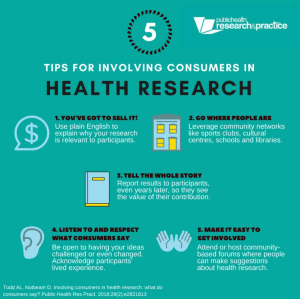
And this infographic from Public Health Research and Practice about how to involve consumers in health research is also useful.
Thanks for listening
It’s so nice when people actually take home some tips and tricks from presentations I’ve been involved in. This tweet over the weekend from diabetes educator Belinda Moore (referring to a symposium at last year’s ADS ADEA meeting in Perth in which I was fortunate enough to be involved) was gratifying.

Peer support remains an absolute cornerstone of how I manage my diabetes as effectively as I possibly can. It is those others walking the same road who help me make sense of a health condition which takes delight in confusing the hell out of me!
The driver’s seat
This post from Melinda Seed underlines why she believes that the idea of diabetes being a ‘team sport’ is not especially accurate.
Complications and language
The awesome PLAID Journal (which you really should bookmark and read) published a piece just as ADA kicked off about why we need to change the way we speak about diabetes complications.
The piece was written by me and Chris Aldred (AKA The Grumpy Pumper), bringing together Grumps’ #TalkAboutComplications initiative and my constant banging on about language. (I first wrote about needing to reframe the way we talk about complications five years ago in this piece. Every word still holds true.)
You can reads the PLAID Journal piece here. And please share. This is a message that we need to get out.

Wellness is not the same as medicine
My huge crush on OB/GYN Dr Jen Gunter only increased after she published this piece in the NY Times last week.
I have written before about how damaging the ‘wellness industry’ can be in diabetes, including this piece on the language of wellness.
Diabetes Voice reboot
The IDF’s magazine has had a reboot and is not delivered in a digital format. Check it out here.
Well, that’s candid…
This photo of Cherise and me snapped at Diabetes Mine’s DData Exchange is hilarious in itself, but Amy Tenderich’s caption is gold!

(Click for source)
Right device, right person, right time
Dr Kath Barnard’s piece in Diabetes Medicine Matters reiterates her message from the 2017 ATTD meeting (I wrote about it here) about the importance of matching the right device at the right time for the right person.
What are the barriers to preconception care ?
This piece was just published in Diabetes Research and Clinical Practice looking at the reason women with diabetes may or may not attend pre-pregnancy care. (I was a co-author on this piece.)
‘If only there was a….online community for people with diabetes’
That comment came from a HCP at a diabetes conference a few years ago – just after someone (maybe me? I can’t remember…?) had literally just given a talk about the diabetes online community.
The DOC is not new – it’s been around for some time – and this great piece from Kerri Sparling gives a history of the DOC.
HypoRESOLVE on Diabetes mine
I was interviewed by Dan Fleshler from Diabetes Mine about HypoRESOLVE. You can read his piece here – it gives a great overview of the project.
On a break
I’m going to be taking a little Diabetogenic break for the next couple of weeks. The rest of the year is shaping up to be super busy, so I thought I’d use the next fortnight to get myself organised.
I’ll be sharing some old posts from the Diabetogenic archives and expect to be back just in time for the Australasian Diabetes Congress which kicks off in Adelaide on 22 August.
In the meantime, be well and be kind to yourself.
Diabetes Week kicked off in the UK yesterday with the launch of their very own Language Guidance statement. Well done to all involved. It’s great to see another language document joining the movement started by Diabetes Australia back in 2011, and added to in recent years by the ADA and AADE (who presented their Guidance Statement last year), diaTribe Foundation (who has written extensively on the issue) and the Team Novo Nordisk (who developed a great guide for media reporting on the team.) And now, it’s great to see the UK on board, too.
Click to read the new UK Diabetes Language Matters guide.
In Australia, it’s been wonderful to see just how widely our statement has been used. Conference organisers have embraced the Diabetes Australia statement, including it in speaker packs, encouraging presenters to align their talks with the document. (The table which offers suggestions for words and phrases that can be problematic is a very useful reference tool.)
I can still remember the launch of the Diabetes Australia statement. It was at the State Library of Victoria which played to my word and book nerdiness almost perfectly. There could not have been a better setting for a media launch about words, language and diabetes.
Little did we know back then just how significant or far-reaching this document would be. At first, we were met with a lot of resistance, and people thinking that it was political correctness gone slightly mad. But we persevered and made sure that we were clear why this work was necessary.
I remember sitting in talks given by HCPs and flinching constantly as judgemental and stigmatising language was considered appropriate. Now, in Australia at least, it is startling when someone uses words such as non-compliant, because the ongoing, constant and committed efforts by many have completely changed the way that the words are used when speaking about and to people with diabetes.
While the official statement was launched seven years ago, the impact language and words have on diabetes was not a new area of discussion. People with diabetes have been talking and writing about how significant the (positive and negative) impact of words can be. I remember seeing discussions about it on the Reality Check forum not long after I was diagnosed, and speaking about it at events we ran back when the consumer program started at Diabetes Victoria in the early 2000s. We knew that words had power. We just needed to bring everyone on the ride with us to get them to understand it too.
And that’s why the Diabetes Australia statement – and all those that have come since – are so important. They provide a framework to refer to; something to hold up as an example of how things could be better.
Even though there has been a lot written and spoken a great deal about language and diabetes over the last seven years, we’re not finished. This is not a static movement. No one can for a moment think that we have ‘done’ language; there will always be new and different things to consider. Some particular areas of interest to me in recent times include the language we use when talking about hypos. And how we reframe the way we talk about diabetes complications.
I wrote this piece after the ADA Annual Scientific Meeting last year when I realised that we need to keep moving forward because there is still much to be done.
But while we do that, I believe it is important that we never deviate from the intention of the language matters movement. It is not about dictating to people with diabetes the words we can and cannot use when talking about our own diabetes, or criticising the words we choose to use. It is about framing the way people speak to and about those of us living with diabetes, and encouraging the use of language that is inclusive, engaging, non-judgemental, destigmatising and respectful. It is about using words that make us feel empowered, positive, hopeful.
Fundamentally, it is about making things better for us.
I’m back from a very busy week in London and Copenhagen. I arrived back in the door at home exactly two minutes after Harry and Meghan got hitched, so I missed the whole happy occasion. If only we had some sort of magical way to see photos and videos and relive beautiful experiences like that. Oh well, never mind.
The main reason for my trip was for the kick-off meeting for Hypo-RESOLVE, a new four-year project focusing on better understanding hypoglycaemia. I’m there as part of the Patient Advisory Committee (PAC), which is made up of advocates from across Europe. Obviously, it is now legislated that an Australian also be included in any European diabetes advocate activities. I believe it’s called the Eurovision Law.
The project is made up of eight work packages, each led and staffed by leading European diabetes researchers and clinicians, and after seeing just who was going to be in the room, I suddenly was struck down by the worst case of Imposter Syndrome I have ever experienced. This didn’t get any better when I was told that the presentation I had been asked to give was not only for the PAC. No – it would be in front of all eighty project participants. I looked at the list of who I would be standing up and speaking to, and cursed the meme- and photo-filled presentation I had prepared, wondering if I could pretend to understand statistics and graphs, and add some to my slide deck to at least try to sound smart.
I decided to stick with what I knew (memes, cartoons, photos of weird hypo tales), and left the slide deck as it was, hoping against all hope that I would manage to keep myself nice, and sound as though I understood what I was speaking about.
I was asked to give a talk about the real life experiences of hypoglycaemia. Fortunately I have kept a pretty good record of the literal lows of my diabetes (which, incidentally, was the title of my talk). Thanks to the search function on Diabetogenic, I was able to easily pull together a number of stories about the lows I’ve had. This proved to be more useful than I realised because these days, lows are few and far between. Since I started Looping, I’ve not had the sort of low that has made me want to write about it and try to analyse what it all means in my diabetes life. In fact, I’ve not had any lows that have required anything more than a mouthful of juice or a couple of fruit pastilles to treat.
Reading back through my blog posts was actually really quite confronting, and I found myself getting emotional as I read details of terribly scary lows and how they had impacted on me – in the moment, and in the days following. As I read, I remembered the anxieties I felt about something happening while low that would seriously affect my family.
I’ve not asked them, but I wonder if the fact that I have so few hypos these days makes Aaron and the kidlet feel calmer about my diabetes. They still see me sucking on a juice box every now and then, but it is done without urgency, and without the look in my eyes that betrays the calm I used to try (and fail) to convey.
In my talk, I really tried to express just how significant hypos have been in my life with diabetes. I tried to explain that even once a low is ‘fixed’ there are often residual effects – effects far beyond just trying to work out what my glucose levels would do after playing the how-low-can-you-go-hypo-limbo.
I spoke about how the emotional fallout after a nasty hypo can be crippling, leading me to second guess every diabetes decision I made, wondering what I had done to cause the low in the first place – because that is the ongoing narrative of diabetes….we did something wrong to cause the hypo (or the complication, or the high, or the technology failure). And I really tried to explain how sometimes there are no answers, no matter how hard we look, or how desperate we are to find something to blame.
Of course I spoke about the language of lows and how the words we use impact on the way that hypos are considered. There is no doubt that ‘severe’ hypos are serious and need urgent attention and investigation, but so-called ‘mild’ hypos can be just as burdensome.
Obviously, everyone’s hypo stories will be different and I took great pains to clarify that I was speaking of my own experiences only. In the past, hypos have terrified, paralysed and alarmed me. I was afraid to sleep, I was afraid of lows when awake. I was scared I would have a particularly nasty low around my daughter and scare her. I am fortunate that my deliberate non-compliance has resulted in almost no lows, and feeling safer that I have ever felt before. My fear of hypoglycaemia is manageable these days, yet I don’t take for granted that it will always be like this. I still carry hypo food around with me – there is no point tempting the hypo gods by not being prepared!
I’ll be writing more about Hypo-RESOLVE in coming days. I’m so pleased to be involved in such an exciting and interesting project; I’m honoured to have been selected for the PAC. I’m beyond thrilled that PWD are included in the DNA of the project – right from the kick-off, not brought in at the last minute for comment when all the decisions have been made. And mostly, I am grateful that hypoglycaemia is being given the attention it deserves. I honesty hope that one day no one ever needs to feel the panic and fear that so many of us have come to know.
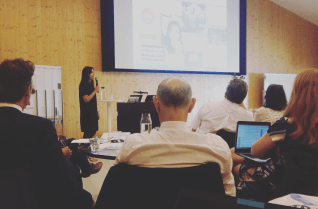
Kicking off the kick-off meeting (Click for source)
You can read all about Hypo-RESOLVE in the Innovative Medicines Initiative media release from last week announcing the launch of the project. My flights and accommodation to attend the Hypo-RESOLVE kick off meetings were funded from within the project. PAC members are volunteers on this project.
I had a great conversation the other day with someone who was interested to talk about diabetes and language with me. ‘I’m trying to get a better grasp of why it’s something so important to you, because, quite frankly, I couldn’t care less what people say about diabetes.’
This isn’t the first time people have asked me this. And it’s certainly not the first time I’ve been asked why I spend so much time speaking about diabetes language matters.
I know the reasons, but to be perfectly honest, I’m not sure that I have them especially well mapped out when I need to explain them. So, let me try here.
There is a tangled and complicated link between the words used when talking about diabetes, and how we feel about it and how diabetes is perceived by others. That link then goes off on all sorts of LA-freeway-like tangents to include diabetes and stigma, and discrimination.
The effects of how we frame diabetes can be felt by us individually. But they can also be far reaching and affect how others feel about diabetes.
We know that language has the potential to make people with diabetes feel judged and stigmatised. In fact, most PWD I know have at some time or another faced someone speaking to them using Judgey McJudgeface words. Of course, we all respond differently to this. For some people, it’s water off a duck’s back. They couldn’t care less what people say and just ignore it. For others, it’s almost a challenge – they use it as motivation to prove that they ‘won’t be beaten’.
But that’s not the case for everyone. For some people, it can be absolutely paralysing.
Fear of being judged and shamed may lead to some PWD to not wanting to attend HCP appointments and, as a consequence, falling behind on complication screening. Some PWD may not even tell their loved ones they have diabetes for fear of being judged. I have met PWD who made the decision to keep their diabetes a secret and for years, not telling another person. This can add to feelings of terrible isolation.
When diabetes is spoken about in stigmatising and demeaning ways, this leads to the spreading of misinformation. And this can have far reaching consequences.
We know that kids with diabetes may be teased by their schoolmates. Their teachers may not respond appropriately to diabetes because of the way diabetes is framed in the media or by others. We can’t really blame teachers. If diabetes is punchline fodder for every B-grade comedian, or an excuse to point fingers at those living with it by every tabloid news outlet, how can we expect anyone to take it seriously?
(And if right now you are thinking ‘This is why we need to change the name of type 1 diabetes’, stop it! People with type 1 diabetes shouldn’t be teased or mocked or judged, but neither should people with type 2 diabetes. This isn’t about people understanding the differences between type 1 and type 2 – this about understanding diabetes.)
The language we use when talking about prevention in diabetes – whether it be preventing type 2 diabetes or preventing diabetes-related complications – means that there is an underlying idea that developing type 2, or complications must be the fault of the individual. ‘If you can prevent it and haven’t, it’s your fault. You obviously lived an unhealthy lifestyle/are lazy/didn’t listen to your doctor/failed to follow instructions/refused to do what you were told etc.’.Can you imagine hearing that, or feeling that is what people think about you – all the time? This is the language – these are the words – used to talk about diabetes.
A couple of weeks ago in the UK, it was Prevent Diabetes Week. I saw countless tweets from people urging, begging, pleading with others to remember that type 1 diabetes can’t be prevented and the week refers only to type 2 diabetes. I wonder if those tweeting realised that comments such as these actually contribute to the stigma associated with type 2 diabetes? Of course type 1 diabetes can’t be prevented. But in many cases, neither can type 2 diabetes. There are so many non-modifiable factors associated with a type 2 diagnosis – factors beyond the control of the individual.
But let’s look beyond individuals, the health system and the education system for a moment. What else happens in other settings when diabetes is spoken about in stigmatising ways?
Health organisations, including diabetes organisations, frequently seek donations from the public to continue the important work they do. There is only so much money in the donation pie, and yet there are more and more competing organisations representing people with different health conditions wanting a piece of that pie.
Donations are harder to come by from the general community when there is the idea – the wrong idea – that diabetes is a largely preventable lifestyle condition that is the fault of those diagnosed. There is not the idea that people who have developed cancer brought it on themselves, even though we know that some of the risk factors associated with a breast cancer diagnosis are the same as for type 2 diabetes.
Research dollars for diabetes are far less than for other health conditions. We see that every year when successful NHMRC grants are announced. Diabetes is the poor cousin to cancer research and CVD research.
Diabetes is just as serious as any other condition that is worthy of research dollars and fundraising dollars. Yet because of the way we speak about it and the way diabetes as a condition has been framed, there is a perception that perhaps it isn’t.
Words matter. Language matters.
So, what I want to say to people who think that talking about language and words is a first world problem that only occupies the minds of the privileged is this: I acknowledge my privilege. But this isn’t simply about words. It’s about perception.
Until diabetes is considered the same way as other conditions that are taken seriously and thought of as blameless, the trickle-down effect is people with diabetes will continue to feel stigma. Diabetes will continue to be the poor cousin of other health conditions and diseases because there is the misconception it is not as serious. People will not as readily make donations towards fundraising initiatives. Research dollars will continue to fall short, instead going towards ‘more worthy’ conditions.
That’s why I care so much about diabetes language. Because, language matters… so much.

It’s easy to remember the difficult moments we’ve experienced at the hands of healthcare professionals who have been less than kind.
And, equally, we remember those moments where kindness was shown in spades.
I know I certainly remember moments of kindness in healthcare. And those moments transformed me. I so appreciated the kindness that came from HCPs at moments when a tsunami of grief or despair or pain or a diagnosis washed over me, knocked me to the ground and left me doubtful that I would ever be able to get back up again.
I remember kind words, the silences afforded to me giving me a moment or two (or dozens) to think, the time I was given to understand what was happening and formulate a plan to manage… I remember them all because they left me stronger, more determined, better supported and far more empowered to cope.
Kindness is a highly underrated quality in healthcare. I’m not sure how it should be included in a curriculum full of critically essential information, but it needs to be taught from the very beginning of any healthcare courses, and it’s importance highlighted and stated over and over and over again.
In the last year or so, I’ve read a few books written by (as the publicity often claims) ‘healthcare professionals turned patients’. (I’ve found this to be quite an odd term, because surely everyone at one point or another has been a patient.)
A recurring theme throughout the books is how difficult the HCPs have found it being on the other side of the HCP / patient divide. They often appear astounded at the red tape and bureaucracy they came up against, the hoops they need to jump through to receive the appropriate care, and the sheer unfriendliness of the system. And they write about the extraordinary moments of kindness that often feel far too infrequent.
Sometimes, they have written about how they didn’t realise that the way they themselves behaved could be interpreted as having a lack of consideration and kindness – explaining it was simply their manner and how they made sure they got through the day as efficiently as possible in a system often built on the foundation of complete and utter inefficiency. And yet now…now they understood.
While the books I read have been beautifully written, heart breaking at times, and often end terribly, the stories in them were not surprising. They tell truths about the system – and the lack of kindness – that people with diabetes face every day in every encounter.
When Kate Grainger launched #HelloMyNameIs, she was echoing the calls of countless people before her: please treat us like people. Please tell us what you are doing here. Please know we are scared. Please tell us who you are and what your role in my care will be.
She did it beautifully, simply, eloquently and changed the landscape of healthcare communication. I am so sad that she had to be so ill for this to happen. But her legacy is one for which I am so grateful.
Kindness in healthcare makes all the difference. Some may think it is completely unnecessary and that as long as we are receiving the right diagnosis, good care and excellent treatment, there is nothing more we need. But that is not true. Kindness adds a human element. We need warm hands, warm hearts and warm words alongside the cool tech, sterile environments and scary diagnoses.
Kindness takes no more time; it takes no more effort. But it’s effects can indeed be monumental.




 Diabetogenic