
You are currently browsing the category archive for the ‘Language’ category.
Last month was the tenth anniversary of Diabetes Australia first launching a position statement about diabetes and language, encouraging everyone – health professionals, researchers, the media and the general public – to be conscious of just how powerful the words used about diabetes can be.
People with diabetes already knew this – we’d been speaking about it for decades. But to have a document supported by research certainly did add some weight to the discussion. It started a global movement and other diabetes organisations and groups have since launched their own guidance statements and documents motivating the use of language that doesn’t shame, blame and stigmatise diabetes.
Today, I’m so delighted to be hosting a panel with some of the people who have been instrumental in elevating and advancing the #LanguageMatters movement all around the world. You can watch from the Diabetes Australia Facebook page – there’s no need to register. And, I’ll share the full video of the Summit on here some time in the next couple of days.

Disclosure
I work at Diabetes Australia. I have been involved in organising this event and will be speaking at it. I’m sharing simply because I’m beyond exited that it’s happening and am hoping to see lots and lots of you there!
I’m a huge fan of New Yorker cartoons, (clearly – they’re littered throughout this blog!), and the artists that make real life situations come to life using humour, satire and more than a little cynicism.
Sometimes I hoot out loud at the sheer brilliance of what I am seeing. Other times I smile wryly. This time I gasped in absolute shock and horror. And familiarity.
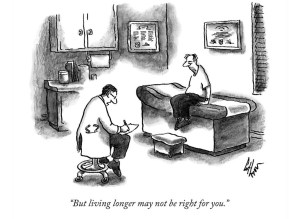
It’s from February 2016, and seems to have been frightfully prophetic for our COVID times. As ‘underlying conditions’ has become barely-concealed code for ‘half dead anyway’, artist, Frank Cotham seems to have had a futuristic glimpse into the 2021 minds of conservative politicians and commentators.
Stay strong, my friends with diabetes and other underlying conditions. You matter. We all do. And living longer absolutely is right for us.
I probably should stop thinking of my job as ‘my new job’. I’ve been at Diabetes Australia now for well over five years. But for some reason, I still think of it that way. And so do a lot of other people who often will ask ‘How’s the new job?’
Well, the new job is great, and I’ve enjoyed the last five years immensely. It’s a very different role to the one I had previously, even though both have been in diabetes organisations.
One thing that is very different is that in my (not) new job I don’t have the day-to-day contact with people with diabetes that I used to have. That’s not to say that I am removed from the lived experience – in fact, in a lot of ways I’m probably more connected now simply because I speak to a far more diverse group of people affected by diabetes. But in my last job, I would often really get to know people because I’d see them at the events my team was running, year in, year out.
Today, I got a call from one of those people. (I have their permission to tell this story now.) They found my contact details through the organisation and gave me a call because they needed a chat. After a long time with diabetes (longer than the 23 years I’ve had diabetes as an annoying companion), they have recently been diagnosed with a diabetes-related complication. The specific complication is irrelevant to this post.
They’ve been struggling with this diagnosis because along with it came a whole lot more. They told me about the stigma they were feeling, to begin with primarily from themselves. ‘Renza,’ they said to me. ‘I feel like a failure. I’ve always been led to believe that diabetes complications happen when we fail our diabetes management. I know it’s not true, but it’s how I feel, and I’ve given myself a hard time because of it.’
That internalised stigma is B.I.G. I hear about it a lot. I’ve spent a long time learning to unpack it and try to not impact how I feel about myself and my diabetes.
The next bit was also all too common. ‘And my diabetes health professionals are disappointed in me. I know they are by the way they are now speaking to me.’
We chatted for a long time, and I suggested some things they might like to look at. I asked if they were still connected to the peer support group they’d once been an integral part of, but after moving suburbs, they’d lost contact with diabetes mates. I pointed out some online resources, and, knowing that they often are involved in online discussions, asked if they’d checked out the #TalkAboutComplications hashtag. They were not familiar with it, and I pointed out just how much information there was on there – especially from others living with diabetes and diabetes-related complications. ‘It’s not completely stigma free,’ I said. ‘But I think you’ll find that it is a really good way to connect with others who might just be able to offer some support.’
They said they’d have a look.
We chatted a bit more and I told them they could call me any time for a chat. I hope they do.
A couple of hours later, my phone beeped with a new text message. It was from this person. They’d read through dozens and dozens of tweets and clicked on links and had even sent a few messages to some people. ‘Why didn’t I know about this before?’, they asked me.
Our community is a treasure trove of support and information, and sometimes I think we forget just how valuable different things are. The #TalkAboutComplications ‘campaign’ was everywhere a couple of years ago, and I heard from so many people that it helped them greatly. I spoke about it – particularly the language aspect of it – in different settings around the world and wrote about it a lot.
While the hashtag may not get used all that much these days, everything is still there. I sent out a tweet today with it, just as a little reminder. All the support, the connections, the advice from people with diabetes is still available. I hope that people who need it today can find it and learn from it. And share it. That’s one of the things this community does well – shares the good stuff, and this is definitely some of the good stuff!
Want more?
Check out the hashtag on Twitter here.
You can watch a presentation from ATTD 2019 here.
Read this article from BMJ.

Over the weekend, I could not stop thinking about the words ‘from’ and ‘with’, specifically when used before the word COVID. The reason for this is that there seems to have been a subtle shift in the language used by NSW government and health officials when speaking about people dying during this wave. You see, rather than saying people are dying FROM COVID, they’ve started to say dying WITH COVID.
It means something different. It suggests that the person didn’t die from the virus, but from other factors. This is on top of the over-emphasis made at pressers about how people who have died have underlying conditions (I wrote about that last week). The implication is that the person was already unwell; that they were dying anyway.
I know I’m a little fragile at the moment, but not fragile enough to not get fired up when I see language being used in a harmful way, and negatively framing people with chronic health conditions. And so, today, I wrote to the Premier of NSW about this issue.
Here’s what I wrote:
______________________________________
Dear Premier Berejiklian
My name is Renza Scibilia, and I am not one of your constituents. I don’t live in NSW, so you may be inclined to simply disregard this message. I hope you (or rather, someone from your team) will read it, because I know that what I have to say is relevant to many people in your state. In fact, I am sure that you have heard similar sentiments from people in NSW and I am adding my voice to that choir.
I don’t envy the position you are in right now and I’m not here to complain or credit the work you are doing regarding the current serious wave of COVID-19 in your state.
But I would like to make comment on something that is very close to my heart and an area in which I have some experience – health communications.
Communication matters. The words that people use are sometimes employed flippantly and sometimes they are employed deliberately. Either way, they are important. I fear that a change in the words you and your team have recently started is a deliberate move and I believe it is harmful to people like me. When speaking about the tragic deaths of people during this COVID-19 wave, you are now saying they die WITH COVID-19 rather than FROM it.
It may seem ridiculous to draw attention to words that appear so immaterial. Except, of course, they are not immaterial at all. And I believe that the shift is deliberate. And it does a great disservice to the people to whom you are referring.
I live with type 1 diabetes. It’s undoubtedly a serious condition, and one that I have had to manage for the last 23 years. On a day-to-day basis, I do quite impressive mathematical calculations as I measure glucose levels, dose insulin, consider my activity, and monitor my stress levels. This takes time – a lot of time. Outside of diabetes-specific care, I eat well, walk 10K steps a day, and manage my wellbeing as best I can.
Beyond what I do each day, I remain on top of my longer-term diabetes and overall health. I never miss screening checks – diabetes or otherwise; I have annual health checks and I can tell you my BP, resting heart rate, HbA1c, lipids and cholesterol. Most people my age are not this switched on with their health and wellbeing, and because I am, I can confidently say that I am healthier than a lot of people my age.
And so, when you use sweeping statements suggesting that if someone like me was to be diagnosed with, and die from COVID-19, that the reason for my death is my health condition you are not correct. I am not already dying from diabetes.
There is a difference between dying FROM COVID-19 and dying WITH covid. Your change in language is an insult and is upsetting to people like me and it is also misleading. I am healthy, I am fit and if I got covid and died, it would be because of the virus not because of my type 1 diabetes.
I urge you to reconsider how you are speaking about people like me. It is heartbreaking for us to know that in the minds of some, our lives, and our deaths, are so easily explained away. While I am sure your intention is not to make us feel as though we are nothing more than collateral, that is how it sounds. The language you are using frames us and our health conditions as being to blame. It makes us sounds and feel as though we already have one foot in the grave and I can assure you that is not the case.
Language matters, words matter. Please, please be careful when selecting yours.
Sincerely,
Renza Scibilia
Melbourne
Back when I first started writing and talking about diabetes language matters, it didn’t seem to be all that contentious an issue. I had been following with great interest how this discussion played out among people with diabetes, and it was super clear to me back then that there wasn’t a one size fits all approach or way of thinking. Some people were interested, some couldn’t have cared less. It was accepted that there would be different opinions and attitudes with different people. I know, how completely unexpected, because in every other way, people with diabetes are a tidy, identical, homogenous group who agree on EVERYTHING! #SarcasticFont
Many, many, many years down the track, more and more people are buying into this topic of conversation, which leads me to think that language does, in many ways, matter. To lots of folks.
Which is why it’s frustrating – and problematic – how fixated this discussion can become on specific words. That, I believe, is the problem with #LanguageMatters.
When I think about why I became so interested in this issue, I’m really clear why it mattered to me. It wasn’t about manners. It certainly wasn’t about suggesting that people with diabetes (that’s my preferred terminology, but you do you!) be told how to speak about the health condition we own.
To me, it never was about individual words. It was about words, broadly. It was about images used to accompany diabetes discussions. It was about attitudes. It was about behaviour. It was about addressing the image problem that diabetes (still) has. It was about changing the mindset that it’s okay to use diabetes and those of us living with it as a punchline. It was about shifting the public perception about diabetes. It was about people with diabetes not feeling ashamed to do their diabetes tasks in public. It was about elevating our health condition to the same level as other health conditions. It was about people with diabetes being respected. It was about stopping blame and shame and stigma. It was about people with diabetes deciding and directing how their own brand of diabetes would be discussed by those around them.
It was always about communication as a whole – communicating to and about people with diabetes.
And yet, with all that in mind, so many online discussions that I see still want to reduce this big body of work to: ‘But I want to call myself a diabetic.’ If someone said that to me, which some people certainly have, my response has been, ‘Okay, cool. You should definitely do that then!’
So why does THIS seem to be the particular tiny, infinitesimal, microscopic, miniscule part of the whole language discussion that some people keep coming back to?
I’ve started to wonder what are their motives behind focusing on this issue? When I see someone, especially someone who’s been around for a couple of years and who everyone knows has been part of these discussions before, start with the PWD vs diabetic debate, I wonder if they’re trolling. They know it will get a response. They know it’s likely there will be disagreements. There are some super savvy people on social media out there who know that asking this question, or even just mentioning it will get a reaction – every single time – and it might even add to their follower count. I guess that some people think that’s currency.
But really, all it seems to do is narrow and diminish the broader discussion. These days, when I am asked to give a talk on language and diabetes, I dedicate one slide and about 45 seconds at the beginning of my talk to get the diabetic / PWD issue over and done with, and then focusing on what I want people listening to the presentation to take away with them.
I don’t know how or when the diabetes #LanguageMatters hashtag started. It wasn’t the name of the first language position statement, but it certainly has been used for a very long time, and been associated with the global movement that has its foundations very firmly rooted in the diabetes community – even before the advent of the DOC, because this discussion has been happening for long before our community moved into online spaces.
The problem with using #LanguageMatters is that it is too often drawn into being about one tiny part of the whole big issue. But it seems that #LanguageMatters is here to stay with a whole lot of material and dialogue and debate behind it – a lot of which is making a huge difference to the way people feel about their own diabetes. So, what a shame that it so often gets minimised to something that is only one little part of it. What a shame that some people knowingly fuel the fire and the arguments that ensue by bringing up diabetic/PWD again. What a shame that this really important, really BIG issue is reduced to something quite tedious.
Perhaps we should have gone with #CommunicationMatters to signpost that it wasn’t about specific words. Perhaps we should have gone with #AttitudesMatter to bring in how language adds to attitudes of stigma and blame Perhaps #BehavioursMatters would have addressed how body language and other behaviours can be just as important as verbal language.
Or perhaps we should have used all of them because, really, #ItAllMatters.

You can read read more on my frustration about this issue in this post (and frequently on my Twitter feed).
There are a lot of words that get thrown around the diabetes space to describe people involved in advocacy and support. These include (patient) leader, influencer, advocate, supporter… the list goes on. Some people prefer certain terms; others don’t. Some people don’t want to be labelled.
I had no idea the word ‘advocate’ was a loaded word in some places. I sprinkle it around like glitter – because I see it as a term that typically describes people doing really great things – and not just in diabetes.
It’s a word I’m comfortable with for myself.
It’s a word that I connected with others when I first started volunteering in diabetes – before I was working in it – because I could see that there were people with diabetes making a real difference to the lives of others with the condition.
It’s a word that I attach to people standing up, showing up and being counted. I asked on my FB page about the word, and someone said they like it because it not only refers to the person, but also the actions they are taking (thanks for that gem, Cathy).
But while it’s a word that I feel relaxed with, it doesn’t seem to be sit all that comfortably with other diabetes folks around the globe. (Which is, of course, fine. We can use whatever words we want to describe ourselves and what we do.)
I’m not sure if it is a cultural thing, or if it is just a preference. I’ve learnt that some languages don’t have a word that literally translates to advocate, but someone from Sweden told me she uses the English word, because it most adequately describes what she does. And in some places, people are very reluctant to use the word to describe themselves. After I asked about it, a number of people contacted me privately to say that they would like to use it for themselves, but they are worried about what others may think. Interestingly, they were all from the same part of the world.
Last month, I was an invited speaker at an event for people with diabetes in South Africa, and I was asked to speak about how the DOC has been a source of support for me in my years with diabetes. The event was titled Diabetes Influencers Summit. Now THAT’S a word I’m NOT comfortable with! I spent the first few minutes of my talk explaining why I’m prickly about the word and how I see what I do as advocacy, not influencing, and that I consider myself an advocate, not an influencer.
In my mind – and of course this is just my own assessment – influencers are building a brand for themselves, while advocates are more focussed on community. There is NOTHING wrong with building a brand – we all do it to a degree. But the advocates that I met and followed when I first started hanging out in the DOC were the ones that were truly all about community. They’re the ones I engage with now.
I don’t know any advocates who have made a squillion from their advocacy work. I don’t do sponsored posts here (or on any other of my socials). If I have been given product and then choose to write about it, I mention that in my wordy disclosure statements at the end of posts (and frequently throughout them as well), but I have never received money for what I have written, even though I am contacted almost daily with offers. I am a freelance writer, so I get paid to write elsewhere, but that’s my side hustle, writing is my job, and I should be paid for that.
No one has to call themselves an advocate – because of course that’s fine! – but I am saddened when those of us who do use the word are criticised, or considered to be ‘above our station’. (Ugh – just writing that makes me feel sick. Aussies baulk at class systems.)
Being an advocate doesn’t mean that I think I speak for others. I have never heard another diabetes advocate share their story with the message that they are representative of everyone. It also doesn’t mean that the issues that are important to me MUST be important to others – or that they’re the most important issues. I like to think that many of those issues that I’ve spent 20 years advocating for – access to healthcare, drugs and technology; PWD being recognised as experts in our care; respect from HCPs; the importance of using language that builds us up, rather than tears us down; working to diminish diabetes stigma; the philosophy of ‘Nothing About Us Without Us’; highlighting the need for more research about women’s health and diabetes – are universally acknowledged as issues that, if addressed and improved, can mean better outcomes for others with diabetes. But, these are my things and #YDA(dvocacy)MV.
Last week, I attended the Shifting Gears Summit which was coordinated and hosted by the Consumers Health Forum of Australia*, and the word ‘patient leader’ was used a lot. I realised that I was bristling with the term leader, not necessarily because I object to it, but more because I know how others would react if we started using it widely. I wonder why I feel that way. I happily and easily acknowledge many diabetes (and other health condition) advocates as leaders in what they do, knowing that they too may cringe with the label.
And yet, others working in the healthcare space are considered leaders – and usually, quite rightly so. We recognise HCPs, policy makers, hospital administrators, researchers and industry representatives as leaders in what they do, however the term seems to not be quite so comfortably applied to those of us with lived experience. But surely our experience and our role should be equal when all stakeholders are engaged. Otherwise, are we just there as window dressing? When an HCP offers their opinion on a diabetes issue, it does not necessarily mirror that of all HCPs, and yet no one questions their right to share that opinion. But despite this, they will be identified as leaders in their field. Why is that not also afforded to diabetes advocates?
It is definitely worth noting that I have rarely, if ever, seen, heard or had pushback from the HCPs I’ve worked with at the term advocate, or even leader. In fact, on a number of occasions I have been horribly embarrassed with the words – the very kind words – that have been used to introduce me. I’m always very touched that they see me in that light, but I am horrified at how other people with diabetes might react to their words. Why do some people with diabetes (myself included) want to distance ourselves from these descriptors?
Is it because in most cases people who are doing the sort of work we do are unpaid volunteers? Or is it because the status of the ‘patient’ is considered below that of others working in the healthcare space? Is it because there is no formal qualification needed to become an advocate?
Whatever it is, I don’t think we do ourselves any favours, or any favours in the endeavour to ensure the lived experience voice is considered as important – if not THE most important – in discussions about diabetes. In fact, that sort of rhetoric does nothing more than keep us in our place – that of a measly patient who can do no more than share their own tales of woe. When we say, or are told, ‘You’re only telling your story’, that devalues the contribution of advocates. It’s already hard enough to be heard, but then to be told that our story doesn’t mean much is offensive and harms us. I would never think to tell another PWD that, and it saddens me that others do.
We don’t have to label ourselves in any way we don’t feel comfortable, and we can describe ourselves and what we do in diabetes how we would like. I’ll keep throwing around the word advocate, and use it to describe myself. And continue to elevate the people with diabetes in the community who I see as being advocates, too.
*DISCLOSURE
I received a scholarship to attend the CHF Shifting Gears Summit after applying through an open submission process. Registration was paid for by CHF. I was not paid to attend.

Every year on International Women’s Day, I write a post about the incredible women in the diabetes world doing remarkable things for the community. I’m going to link to some of them at the end of today’s post because they highlight some truly brilliant women making a difference in the lives of so many, and their stories should be told, and contributions shared.
But today’s post isn’t about that. Today’s post is more about the way that women in diabetes often get treated. I should point out that a lot of what I’m writing about isn’t unique to diabetes. It’s seen time and time again in healthcare, and in health communities. But my space is the diabetes world, and that’s what I write about, so here goes.
So-called ‘women’s issues’ continue to be under-represented in research. Those issues and concerns are dismissed and ignored, and women are simply told to ‘deal with it’. Sexual function can be as relevant for women as it is for men with diabetes, and yet, do a search using the words ‘sexual dysfunction and diabetes’ and you’ll need to scroll a long way into the 32,000,000 results before women are mentioned.
I have sat on panels and been spoken over, and sat in audiences as I’ve watched women be spoken about and over. Last year, I spoke in a session at an international conference and then was the only PWD in the panel discussion at the end of the presentations and the chair (a male HCP) answered all questions directed at me.
Conference organising committees continue to be majority male, and award lectures seem to be more frequently given by men – and white men at that.
I sat in an online conference last year and was astonished to see that the woman whose contribution to one of the most significant advancements in diabetes tech in recent years was minimised. Thankfully a number of women in the audience corrected the misconception, and then had to deal with having mansplainers tell us all the ways in which we were wrong. (Spoiler: we were not wrong.)
I have heard so many mothers (and sometimes fathers too, but usually mothers) of kids with diabetes tell stories of being dismissed when they took their kid to the GP with symptoms of diabetes. They were told that they were imagining things, and there was no need to investigate further.
Remember the furore we saw when the IDF dared to focus women for WDD a few years ago? So many fragile egos were hurt because the challenges unique to women were centred in this ONE campaign.
I’ve been called a girl in meetings (still, at 47 years old), and seen the same happen to other women – women who are professional, qualified, experienced and absolute leaders in their fields.
And then there are the words used to speak to and about when, because of course, I’m going to talk about language.
I asked about this on my Facebook page the other day and these were some of the words and phrases that women who had called out shitty behaviour from men were called:
Angry. Aggressive. Hysterical. Dramatic. Attention-seeking. Pushy. Loud. Hormonal. Over-sensitive. Too much. Shrill. Strident. Opinionated
We’re told to calm down, moderate our words, and when we dare call out crap, we are gaslit and belittled, and told that we need to chill out.
How often do you see the same language used to describe men when they are calling out crap? It’s more likely they will be identified as brave, assertive, progressive …
In our own diabetes online community, it is fascinating to see how often this happens when women share experiences or lousy experiences, or simply have an opposing view. I have never believed that everyone needs to get along, but look at how comments, subtweets, even direct messages work and you will see the gendered language that is used to scorn and dismiss women. The label of the ‘angry woman’ is alive and well when a woman stands up. For extra credit, the ‘angry old woman’ tag adds some ageism to the sexism.
These words are used to minimise, dismiss and silence our voices. And it works. The number of women I know who have stepped away from support communities because of the way they have been spoken to or about is significant.
I usually like to use this day as a chance to celebrate women, because we deserve to be celebrated. Our contributions to the diabetes world are significant. The diabetes community has been fashioned by amazing women doing amazing things.
But it has also been shaped by women being silenced, reduced and curtailed. And that also needs to be recognised.

Previous International Women’s Day posts:
2020 – Strident women
2019 – Interweb jumble – the IWD edit
2018 – The women
2017 – Hear me roar
2016 – The F word




 Diabetogenic