
You are currently browsing the category archive for the ‘Healthcare team’ category.
Can you think of any other medical condition where removal of a treatment is threatened?
I was thinking about that question a couple of nights ago, in my hotel room in Sydney, at 2.30am, getting over a hypo, after chugging OJ, messaging people, tweeting and reading pages of my book. I couldn’t fall back to sleep.
In diabetes, we (still; STILL?) hear of HCPs threatening to remove pump therapy from people who are considered to not be meeting expected results.
Let’s not even open the can of worms asking who actually has set those results, or if the PWD had any input into the decision making process around targets, or if too much focus is being given to a number.
No. Let’s instead just focus on the fact that some PWD are (still; STILL?) being told that their chosen treatment option for their life long health condition will be removed from them as punishment because they are being ‘bad’.
Now, I love my insulin pump, but let’s remember what it is. It’s a little box that delivers insulin. Okay – a little, highly-sophisticated magical box that delivers insulin, but nonetheless, it’s an insulin delivery device.
It would be the same as saying to someone who is using insulin pens that because their A1c has increased, (often the reason behind the threat of pump removal), their pens were being confiscated and they would have to use disposable syringes. Or, people using disposable syringes would have to use glass syringes with needles needing to be sharpened.
Crazy, right? There is no way that we would consider that okay. It’s actually laughable.
Of course, people with type 2 diabetes are not immune to the threats of diabetes management, however in this case, it is threatening to add treatment rather than take it away. People with type 2 are often told that if they require insulin injections to treat their diabetes it is because they have failed with other treatments.
Making threats about diabetes management options is bullying. Holding the tools we need to live well with the condition over our heads as rewards or punishment is not okay. It is scary and unfair and sends the wrong message.
Earlier this week, Aaron and I saw the Melbourne Theatre Company’s production of the play ‘Death and the Maiden’. It was fabulous – amazing performances – and if you are in Melbourne and looking for a night at the theatre, get tickets! Here is the Schubert string quartet by the same name, which is providing my background music in the office today. Have a lovely weekend.
A couple of years ago, when CGM was first launched into Australia, the typical thing happened. The device company took their shiny new product to health professionals around the country, showing off their wares. There were dinners and events and showcases, all highlighting the new technology.
Now, obviously with a product like CGM which requires HCP initiation, it is important to promote the product to the people who will be getting consumers hooked up. I understand that.
Nonetheless, it was with much envy that I saw HCPs being given a trial of the product. They were connected to a CGM and given an empty pump for four days – the number of days a sensor was meant to be worn.
I was desperate to get my grubby hands on one of these. I had read all about CGM and how much people with diabetes living overseas loved it. I read about how it made people feel safer and less frightened about hypos. I learnt that it helped to level out …well…levels. It sounded exciting. I wanted to try it myself.
The HCPs on the trial I spoke to were incredibly dismissive about this technology. Over the few days they were wearing it, I heard comments such as ‘It’s making me obsessive’ or ‘I can’t stop looking at the pump and watching what’s going on’ or ‘When I calibrate it, the numbers don’t match exactly’ or ‘The infusion set insertion process is terrible. I bled everywhere!’
I heard them say repeatedly that the technology was rubbish, that it wasn’t worth the cost, and that all it would do for people with diabetes is make them more distressed and anxious about their diabetes. Plus, it hurt.
Not one of them had diabetes themselves.
I started to get annoyed. I recall sitting with one of them after hearing this pronouncement yet again, feeling quite angry. ‘You know,’ I said. ‘You don’t get to say these things. You don’t get to write off this technology after a few days of wearing it, making claims that it is pointless. This is the latest technology that we have to manage our diabetes. It’s first generation so of course it’s not perfect. The second, third and probably even fourth gen products probably won’t be perfect either. But it is a new and worthwhile tool to help us manage our condition. It is exciting. We are hopeful. You don’t get to trash it.’
I remembered this whilst siting in a session on the first day here at the American Diabetes Association Scientific Meeting. It was a ‘Meet the Expert’ session and the topic was about personal experiences of the artificial pancreas.
Kelly Close (she’s amazing – read all about her here) was talking about her experiences of being involved in trials for a couple of different artificial pancreas projects. It was fascinating hearing about the AP and her excitement about the current technology being trialled – and about what is still coming.
Her enthusiasm was obvious. In fact she actually commented on why enthusiasm and excitement need to be employed when talking about advances in technology. We need to create a buzz and have people talking and asking questions and going on trials and writing (and blogging) about our experiences.
On the panel with Kelly was Chris Aldred (better known as The Grumpy Pumper) whose role in the session was to be the one challenging all the hype. He immediately explained that he had not used the AP, and had some questions. He was skeptical about a few things.
Being skeptical is absolutely okay. We shouldn’t ever blindly accept any new treatment without asking questions, but that actually adds to the buzz. It forces people who have experience with the device to talk about the good things and its limitations. It also helps alleviate a lot of the concerns people may have.
I thought back to my experience with the launch of CGM back home. When the HCPs who were privileged to try the then-new tech were trashing the product, I wish that there had been a voice to be able to respond to those concerns. I wish that the trial of the product had been extended to people with diabetes who could see it for what it was and how its application worked in the real world. And who could share their experiences – absolutely the good and the bad – with other PWD.
That’s exactly what I did when I finally got to try CGM. You bet the first gen was clunky. It did have accuracy problems and I did bleed a little most times the sensor was inserted. But whoa! It was amazing technology for the time and made a huge difference to me. When I understood how the trends worked, I knew how to respond to them. I could address things before they became problems.
I left the AP session on the first day pretty excited and inspired. And wanting to be part of the buzz – either as a trial participant or as someone on the periphery talking about it, reading about it, hearing people speak about it.
Read more at diaTribe where Kelly shares her AP trial experiences.
Today, I travelled to Geelong to hang out with Kim and have lunch speak at the Barwon Region Diabetes Health Professionals Group about diabetes and language.
I have given lots of talks about the importance of language when speaking to and about people with diabetes. It is such an important issue and I am always pleased when I am asked to present on this topic.
When I was preparing for today’s talk, I looked over all the blog posts I’ve written here (and on other blogs too) about this issue and I realised that there were many. So very many.
There was this one – the post I wrote following the launch of the Diabetes Australia Language Position Statement.
There was this post where I asked if people consider diabetes a disability and if the word offends them in any way when referring to diabetes.
And this one where I took a couple of ward nurses to task for daring to use the words non-compliant and diabetic in the same sentence.
Also here is a post about someone calling me a diabetic. They really shouldn’t have.
There was this whole post that focused on the word ‘sufferer’ – still a word that I despise!
I discussed a lot about the importance of language specifically relating to diabetes, but I wanted to explore further today. I talked about the language of health, pointing to how I thought Healthy Weight Week missed the boat with the name of the initiative and also the language of food and of the ‘wellness industry‘.
The group was really engaged – lots of terrific discussions and questions and ideas being thrown around, which I love when I am presenting not only because it means less for me to do, but because I love to hear ideas from others and learn about what works for them. This was a really sensitive group. They were very switched on and understood that not only is language important, but the way they use it needs to be tailored to the person they are working with.
We also talked about language extending to more than just what they say. Their waiting rooms need to reflect the same sensitivity being demonstrated in the consultation room. I recalled the incident of the launch of the Diabetes MILES study where in the waiting room of a diabetes clinic was a horrid poster about foot care showing foot ulcers and amputations.
It was a terrific discussion and I am so grateful whenever I spend time with health professionals who are just so damn considerate and respectful when speaking about diabetes. And I am also grateful that they are seeking the consumer/patient/client/PWD (yes, we discussed that too!) perspective.
Earlier this week, The Conversation ran a great article about the value of GPs providing nutrition education and information.
It’s a discussion worth having. For many people, their main HCP contact is a GP, so in the broader scheme of things, having GPs able to provide general health and wellbeing information (which includes nutrition information) is a sound idea.
Whilst most people I know with type 1 diabetes have a network of diabetes healthcare professionals – often including a dietitian – this isn’t the case for everyone. And for many people with type 2 diabetes their GP is the only HCP they see about their diabetes.
This discussion, however, is far broader than people with diabetes. Information about how to eat well and make food choices to enhance our health is a great idea and would be great if it were available to all.
But for this to work, we need to have confidence that our HCPs are equipped with up-to-date and sound information. As well as being across evidence-based nutrition guidelines, they need to be able to respond to queries about fad diets and ‘teatoxes’. (It’s a thing. Really.)
I can still remember the first dietitian I saw. It was within days of my diabetes diagnosis and it wasn’t a good experience at all. In fact, I walked out and vowed never to see another dietitian because, in the hour-long consultation, all I could envision was angst and stress about food thanks to diabetes. I didn’t want that at all. I certainly didn’t want the healthy way I looked at food to be compromised by someone who was extolling the idea of ‘bad foods’ and ‘good foods’, and expecting me to live with a diet that included the same things every single day.
So I never went back and spent the first three years with diabetes muddling along as best I could, adapting what I needed to and trying to keep enjoying food the way I always had.
When I started to consider using a pump, I decided to find another dietitian – one more in line with my attitudes to food. I didn’t have an understanding of carb counting (that wasn’t explained to me because it wasn’t the nutrition ‘in-thing’ in April 1998). Once again, I was disappointed to discover that the restrictive and dictatorial advice she was delivering wasn’t in line with my food philosophy which, I thought then (and still do now) to be quite sensible.
These two experiences have somewhat clouded my opinion of dietitians, despite having met with some amazingly balanced and well-informed dietitians since – including one I saw a few times who was just brilliant and never made me feel guilty because I like Nutella, but really am not a fan of lentils.
Nutrition advice needs to be about a lot more than what the best choices look like for breakfast foods.
There needs to be some acknowledgement of people’s relationship to food – how we view food in our overall life; where it fits in our family; if we enjoy preparing and knowing about food or if we just care about food as fuel; if we have any issues with certain foods. Plus there needs to be the ability to address the different levels of knowledge people have (and want to have) when it comes to food. Not everyone wants to prepare food from scratch, make fresh pasta each week or mill their own flour. And that’s perfectly okay.
And there needs to be openness about the choices – a willingness to understand that some people may want to try something slightly (or very!) outside the guidelines. For example, the low carb movement at the moment is of great interest to a lot of people with insulin-requiring diabetes. I have heard some people say that when they have raised this as a discussion point with their HCP, the topic has been dismissed as irresponsible, not in line with the recommended guidelines and not something people with diabetes should be considering.
And yet, many people with diabetes do manage to eat a lower-than-recommended carb diet and are far happier with the results they see – whether those results be numbers on a meter or how they feel.
With the huge array of food and nutrition and health advice available to people now – frequently by people less than qualified to be providing it – having a respected healthcare professional help cut through definitely, in theory, sounds like a valuable plan.
But because of the very nature of discussions about food, whoever is charged with providing information and assistance – whether that be a GP or a dietitian, or any other HCP – needs to check their judgement at the door, be well informed, sensitive, and open to ensuring that the person they are working with is comfortable with the discussion and feels open to choice.
I remember the first time I ever heard Cassandra Wilson. I was blown away by her beautiful voice and have loved her ever since. She has a gorgeous new album – a tribute to Billie Holiday – which we’ve been listening to this week. But today’s Friday song is from the first album of hers that I listened to, New Moon Daughter. This is Solomon Sang.
One night, when the kidlet was three years old, we heard her cry out. She had been in bed for an hour or so and we thought it was simply one of her usual I’m-not-tired-so-I-will-try-every-trick-in-the-book-to-not-have-to-go-to-sleep tactics. She is extraordinarily good at these!
We went into her room to find her crying – whimpering, really.
Parents: ‘What’s wrong, darling?’
Kidlet: ‘I stuck a pebble up my nose.’ (It actually sounded like ‘I stuck a pebble up my dose’ because her nose was, of course, blocked. She helpfully illustrated her story by pointing to her left nostril.)
Parents: ‘What?’
Kidlet: ‘I stuck a pebble up my dose.’
Parents: ‘Darling, what? Why did you do that?’
Kidlet: ‘To keep it safe.’
I had a look and sure enough, a pebble was firmly wedged up her tiny left nostril. I knew that the worst thing would be to try to get it out with a pair of tweezers – I would only push it further up, making it even harder to remove.
‘I guess we’re going to the hospital.’ I said to Aaron. Now, we’re like pretty much any other parents. We would avoid a trip to A & E at all costs. But we knew that there was no escaping this one!
So, we bundled the kidlet into the car and headed to the hospital, fortunately less than a ten minute drive from home.
As we walked up to the triage desk, I could see that it was definitely a REALLY busy night. There were parents and kids everywhere; kids that looked really, really sick. We walked in with our skipping, bright, happy three year old. Who had a pebble stuck up her nose.
‘Hi,’ I said to the triage nurse. ‘Our three year old stuck a pebble up her nose. It’s stuck there now.’
The triage nurse didn’t even look up. Clearly this was not a rare occurrence.
We gave all our details and were told to head to the waiting room.
‘How long’s the wait?’ I asked, knowing full well that this is the question that triage nurse’s despise because the answer they want to give is ‘How long is a piece of string’ but they have to be polite.
‘A while. About four hours. Maybe a little more.’ She said. Again, she barely looked up. I guess that it must be soul destroying to repeatedly see that look on the faces of parents who have just been told that they will not be sleeping, possibly ever again.
By this stage, the kidlet had turned into the happiest and most social kid in the world. Sure she had a pebble stuck up her nose, but it was night-time and dark and she was out and there were people around. ‘I have a pebble stuck up my dose,’ she told anyone who would listen, pointing to her nostril.
We asked her to sit with us. ‘Sweetie,’ I said. ‘Everyone else in here has come to the hospital because they are really, really sick. That is usually why kids have to get out of bed and come to the hospital. They have things that it would be better if you don’t catch. So please sit here with us. And absolutely do not speak to anyone holding a bucket. We do not want you to get gastro. Daddy and I do not want to get gastro. Got it? Don’t. Talk. To. Anyone. With. A. Bucket.’
We settled in for what we were expecting to be a long wait, so were very surprised when after about 10 minutes, a nurse called out to us.
‘Now,’ she said to the kidlet. ‘What do we have here?’
‘I have a pebble stuck up my dose/nose.’
‘Hmmm, let me see.’
She had a look and then turned to us. ‘Okay. That’s really stuck in there! I think she’s going to need to see the doctor, so I’m afraid you are in for a long wait. But let’s just try something; it may work. It may not.’
We were prepared to try anything to avoid a four hour wait with all the bucket children back in the waiting room!
She turned to the kidlet. ‘I want you to lie down on the bed, and open your mouth, okay?’
And then she turned to me. ‘And I want you to block her right nostril – the one without the pebble. Then, I want you to blow into her mouth, really hard. It may dislodge the pebble making it possible for me to remove it.’
‘Really?’ I said.
‘It may work, it may not,’ said the nurse. ‘Let’s try it.’
She explained what we were about to do to the kidlet who immediately asked, ‘Is it going to hurt?’
‘Not at all,’ promised the nurse.
I pressed the kidlet’s right nostril, blocking it tightly and leant down over her. ‘A really deep breath – hard!’ the nurse instructed.
I did as I was told and blew into the kidlet’s mouth.
And sure enough, the pebble not only became dislodged, but shot out of her nose. And across the room.
Apparently, the look of shock and surprise on both my and the kidlet’s face was hysterical because the nurse and Aaron burst out laughing.
I recovered from my surprise, stood up and threw my arms around the nurse. And then the kidlet. We couldn’t get out of the hospital fast enough!
I was reminded of this story the other day when I was speaking to a parent who had spent the evening before in A & E with her daughter, who has type 1 diabetes. Thanks to a tummy bug, her daughter was seriously dehydrated and dealing with very high BGLs.
The conversation shifted to the amount of time she has spent in doctors’ offices, hospitals and at the GP in the 12 months since her daughter’s diagnosis. It amounted to hours and hours and hours and hours. Her daughter had missed days of school because it had taken so long for a correct diagnosis (their GP kept telling them it was just a virus and her daughter needed rest). After a couple of weeks of this, she was rushed to hospital in an ambulance, drifting in and out of consciousness, before they were told she had type 1 diabetes.
‘I’m so sorry,‘ she said to me after we’d been speaking for about an hour. ‘I sound like I’m whinging.’
‘You absolutely don’t!’ I said. ‘And even if you did, I think you have something to whinge about.’
The truth is that she really wasn’t whinging. She was being very matter of fact about her daughter’s diabetes journey so far. She didn’t complain about any of the HCPs she had seen – although it would have been completely warranted if directed towards the bloody GP and his misdiagnosis.
She asked me about our kid and if she had ever been taken to A & E. ‘Only once,‘ I told her. (Actually, there was a second time when she was about 4 and had a really high fever, but we ended up at the GP clinic at the Children’s instead of having to deal with the three hour wait of the emergency department.)
‘Really? Wow! Lucky you!‘ she said. ‘Was it for something serious.’
‘Um, no. Not so much.’ I said and I told her the pebble up the nose story. She loved it – she thought it was hilarious.
But that was it; one visit to the hospital with a perfectly healthy kid who wanted to keep a pebble safe so she hid it. Up her nose. And we were out in less than an hour thanks to a superhero nurse called Nicole!
Kids with diabetes learn early on that they will be spending more than their fair share of time visiting HCPs. Their visits to A & E are often for much nastier things than a stuck pebble. Their visits last much longer than an hour.
I thought about this after I had said goodbye to the mum I’d been chatting with. In fact I thought about if for a long time. One A & E visit, appointments for her immunisations and maybe one, two at the most GP visits per year. That’s our kid’s encounters with doctors.
The mum called me the next day and asked if it would be okay to tell people the ‘pebble up the nose’ story.
‘Absolutely!’ I said. I asked her if I could write a little about our chat.
‘That’s fine,’ she said. ‘We all learn from each other. I really learnt a lot from you yesterday. Talking to adults with diabetes is really helpful for me.’ Then she paused. ‘Although, really, that trick about how to dislodge a stuck pebble from a kid’s nose is probably the most useful thing I’ve ever heard.’
Two and a half minutes. I reckon that’s how long it took before the tears started.
I walked into my endo’s office and we exchanged pleasantries. I’ve been seeing her for over thirteen years now and there is an easy banter that we fall into.
I sat down and said, ‘I’m going to need tissues. Where are the tissues?’ And that was all it took. No one had even said the word ‘diabetes’ yet.
‘I’ve got no idea where to start. Things have been terrible. I’m all over the place. I feel like I have dropped the ball – really dropped the ball and I don’t know what to do to get back on top of things.’ I briefly explained the burnout, the rough couple of years, the grief I still feel shrouded in at times following the miscarriage. ‘Even when I feel like I am seeing some light, I fall too easily back. My self-care gets forgotten very easily. Very quickly. I can’t seem to get over my miscarriage and there are days that I feel so weighed down by the loss.’
She listened without interrupting, letting me blurt out what I needed to, sniffling my way through grottily. And then she waited. So I filled the silence.
‘I know that I am being too tough on myself,’ (there was a tiny, barely noticeable nod from her at this point). ‘And I know I would be quick to point out to anyone else saying these things that they need to be a little kinder to themselves. But I don’t give myself the same breaks. I feel like I’m letting myself down.
‘I don’t know where to begin. I didn’t get my blood work done before coming here. I just didn’t have it in me. I don’t want to see any results. But I am so angry at myself for not having it done and for not keeping on top of my complications screenings – I have never, ever been behind on this before. I’m even scared to have my BP taken because I am terrified that it is going to be high. And then I’m catastrophising that into equalling kidney problems, and eye problems. Even though I know my eyes are fine. That is one thing that I am up to date with. But I am anxious about my kidneys. I don’t know why.
‘I wrote about this yesterday on my blog. I don’t want to be here. I don’t want to see you. And I really like you! But I don’t want to be here and having to think about my diabetes – and how little I’ve been thinking about my diabetes.’
The words dribbled out of me, sentences running into each other. Until I stopped. I wiped my eyes with a tissue and took a deep breath. We spent a while not talking about diabetes – instead discussing other things. We chatted about our trip to New York, the kidlet, my work. My tears had dried, the scrunched up, soggy tissue deposited into my bag.
‘Okay. Jump up on the bench and I’ll just check your BP,’ she then said. And I did. And it was fine. In fact it was better than fine. I asked her to repeat the numbers to me and a lump formed again at the back of my throat, and tears pricked my eyes, but I wiped them away. They’re just numbers. I know they’re just numbers. But they were not scary numbers. They were numbers that gave me a little confidence to find out more.
‘I suppose I should get weighed,’ I said. ‘Actually, do I need to?’
‘No. Not unless you want to.’ This led to a discussion about being weighed and how fraught that is. I decided that I wasn’t really ready to get on the scales. There was nothing I needed to know or do about my weight and it would make no difference to anything.
‘I need an A1c. And a coeliac screening too,’ I said.
‘We’ll run all the usual things and take it from there,’ she said.
When I walked out of her consultation room, I felt relieved. The insurmountable ‘I need to get back on track properly’ that had been my mantra in the lead up to the appointment had subsided and was replaced with a gentle list of a few things that I could do in the short term. I had some goals, I have some plans. I have another appointment in four weeks.
I drove home and walked into the house. ‘How was your appointment?’ asked Aaron. He knew how anxious I had been feeling about it. ‘It was good. My BP is awesome. I’m going back in four weeks.’ I changed the subject. That was all I needed for today. I didn’t want to speak about it anymore.
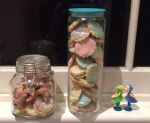
Cookies!
I’ve just had a wonderful long weekend where pretty much every moment we were home, the oven was on with cakes, biscuits and pies filling the house with beautiful smells.
I spent the time out of the house doing the things that build me up – playing in the park and soaking up the sun, visiting bookshops, going to galleries, drinking coffee. We added artwork to our SHAG collection and I added a couple of new bracelets to my Kate Spade arsenal. I danced to Taylor Swift in the kitchen with my girl and watched Better Call Saul with my boy. Family dropped in, cups of tea were drunk, neighbours were visited. I took a Twitter break. We chased the moon. International Women’s Day was marked.
It was a good weekend – a great weekend.

Now showing on the wall in our living room.
And yet.
I start the week with a ball in the pit of my stomach and am incredibly distracted. I have an appointment tomorrow with my endo. And I am terrified.
It’s been too long since I last saw her. And if truth be told, I really don’t want to see her. I don’t want to sit there and discuss diabetes – my diabetes – and talk about how I have really dropped the ball. (Understatement.)
I don’t want to talk about the burnout that has overwhelmed me for so long and even though I feel myself emerging – there are glimpses of brightness – I don’t want to admit just how much it has affected my diabetes self-care.
I don’t want to discuss complications screenings. I don’t want to talk about them. I don’t want to know. I don’t want to face things.
I don’t want to sit in her office and cry, which I know is exactly what I will do the moment I sit down and she asks me how I have been in her incredibly non-judgemental, beautiful, concerned and caring way.

New jangly bracelets.
Throughout the last few days, in the middle of all the lovely stuff, I have paused and taken stock and thought of my upcoming appointment. I have thought about how it will play out. I have considered how, after the tears and admissions of feelings of guilt, I will leave feeling stronger and more determined – I always do after seeing my endo. But I am still scared and anxious about it all. I know that the truth of what has been going on scares me and the possibility of what has been going wrong. All of this terrifies me beyond belief.
I needed the long weekend to build me up and help with my resilience stores and I feel that it certainly did that. My support network is strong and I have people around me who are so gentle in the way the support and encourage me to live well with diabetes.
So with this in mind, I am focusing on getting through the next couple of days. And what happens after my appointment.

An expensive trip to Readings
A full biscuit tin, an armful of noisy bangles, a library of new books and a gorgeous new Josh Agle artwork on the wall are all helping and keeping me grounded. All things I need as I face a tough week.
It’s #DBlogCheck day. Read about it here and go and give some love to – and leave a comment on – some of the diabetes blogs out there that help make up this wonderful community.
‘Okay, so I’ll deal with the diabetic who’s just been brought in. She’s been in here four times in the last couple of months. Completely non-compliant.’
Whoa!
I was walking through the rabbit-warren-like corridors of the Epworth Hospital and passed a nurses’ station at the exact moment those words were spoken, stopping me dead in my tracks. If I was in a Warner Bros cartoon, there would have been a dust and smoke cloud around me as I screeched to a halt.
‘Move on, Renz,’ said the first voice in my head.
‘Not freaking likely,’ said the louder voice.
I turned to the nurses who hadn’t noticed me yet.
‘Hi,’ I said. I was trying for sweet and polite, but could already hear the patronising tone in my voice.
They turned and looked at me.
‘Um. I just wanted to say a couple of things. Calling someone a ‘diabetic’ isn’t helpful for anyone. It labels them as their condition and I’m pretty sure that the person you are referring to is a lot more than her insulin problems. Secondly, non-compliant is a really nasty term. I’m guessing that you’ve no idea what else is going on in her life – I have no idea either – but I am pretty sure that there is a reason that she is not managing her diabetes as well as she’d probably be hoping to. Non-compliant suggests that it is a deliberate ploy to make herself unwell – which it may be and if that is the case, then that is something that needs to be addressed.’
At this point, the nurses were just looking at me with a mix of surprise, suspicion, annoyance and interest.
‘Also, to be compliant means following a defined set of rules or guidelines. Diabetes has a funny way of mocking such an idea. The rules keep changing – without notice.
‘Now, I am hoping that you wouldn’t use this language around the person you’ve been referring to when you are actually in the same room as them, but here’s the thing. You’re saying those words now, and that means that somewhere deep inside (or, probably just on the surface) that’s how you really feel.
‘No one wants to have diabetes. No one wants to be in hospital. No one wants to be so overwhelmed by diabetes that they don’t – for whatever reason – manage their condition the best way possible. But sometimes, it gets like that. The never-ending relentlessness of diabetes can be so debilitating that all self-care stops. And then, sometimes, you wind up in hospital. Four times in a month, sometimes.
‘I have diabetes. I’ve been that person you are speaking about. But I wasn’t being non-compliant. I just couldn’t cope. And I felt really bad and guilty that I couldn’t cope. So on top of feeling crap about my diabetes, I also felt crap about not looking after my diabetes.
‘So. Maybe think about what else is going on in her life. She is more than diabetes (that’s why calling her a ‘diabetic’ isn’t a great idea) and I bet she is going to respond a lot better to some kindness and concern and perhaps a suggestion she see a psychologist if she’s not already doing so. Because the judgement and judgemental language is not helping at all.’
I looked at both nurses. I was still using a really calm, level voice, but I could tell that they were a little annoyed. And more than a little stunned. I smiled at them.
‘Okay then. Bye.’ I started to walk off, but stopped and turned back around. ‘Oh – can you tell me how to get to room 18A please?’
Right-oh. Next up on the holiday playlist is James Taylor. Have Yourself a Merry Little Christmas.
‘You have brittle diabetes,’ the diabetes educator told me, regret in her voice.
Brittle. It’s such a sharp sounding word – all edges to cut yourself upon.
I first heard the term ‘brittle diabetes’ about three years after I was diagnosed. It was handed to me as a grave diagnosis within a diagnosis. Not just diabetes for me. I had brittle diabetes. I heard it, thought about it, said the words a few time together, jarring at the sound.
I was given this ‘diagnosis’ during a really rough period. My diabetes was all over the place thanks to a totally unrelated stomach issue. There were thoughts it may have been gastroparesis or, for a moment there, thanks to the significant weight loss I was experiencing, an eating disorder.
I became terrified to eat because every time I did, I was in extreme pain. At times I threw up everything I ate, other times I didn’t. My blood sugars were all over the place and the delightful insulin regimen which at the time involved Protophane was incredibly hopeless at doing anything other than send me plummeting low, or sky-rocketing high. It was a very tough few months.
I was seeing doctor after doctor after doctor. And all anyone could think about was my diabetes. My brittle diabetes. I was told: ‘This is what your diabetes is like. Sometimes there are no answers and we can do nothing to better manage things. This is it for you.’ There was an undertone of ‘get used to it, love’.
I wasn’t prepared to just accept it though. I wanted to have a baby and I knew that there was no way that I could even consider going down that path while my health was all over the place.
I finally sacked all the health professionals I was working with and sought out someone – something – else. I refused to believe that this was how I was going to be forever. I knew there were answers; I just didn’t know how to find them.
I found a new endo and when I walked in I told her that I had brittle diabetes. ‘I can’t be fixed, apparently. Give me everything you’ve got!’ I thought silently.
‘I don’t like that term,’ she told me gently. She wasn’t rude about it; she just explained that she thought we could work out why things weren’t going so well. And then, she went about finding answers. And we found them.
It took time and it took a lot of thinking outside of the square. It took putting diabetes to the side and not thinking that it was the only reason for all my health problems. Once I got sorted and my stomach was sorted and I spent some time talking things through, my diabetes was much easier to manage. I know that a big part of getting through was not only addressing the physical side of things. There were mental health issues I needed to address, mostly dealing with the grief I was experiencing about having to let go of my life before diabetes.
I too came to not like the term ‘brittle diabetes’. When I hear it now, I want to ask what else is going on. And I can’t help wonder where I would be now if I had just accepted that as my lot in diabetes.
Want more? Mike Hoskins wrote this interesting post on Diabetes Mine last year.





 Diabetogenic