
You are currently browsing the category archive for the ‘Diabetes’ category.
‘What’s the hardest thing about living with diabetes?’
I was asked this question the other day by someone who is not in any way connected to diabetes. He does not have it himself, does not have a family member with diabetes and doesn’t work in the area.
‘The fear’. I blurted out. I didn’t think my response through; it just came out.
I backtracked and gave my usual answer, where I become a little glib because I’ve said it and written it down so many times. ‘Oh – and you know – it never ends. It’s there all the time. There is no rule book. It changes for no reason.’
I smiled at him. I was back on message.
But later on that day, I realised my initial reply was true. I am scared. We constantly hear that we shouldn’t take our health for granted. I always did. But diabetes has robbed me of that.
What I am scared about isn’t the day-to-day living with diabetes. As much as I complain about it and feel it is a pain in the arse, the truth is that I actually can deal with it. The infusion set changes and sensor insertions and BGL checks are annoying disturbances. Counting carbs makes my head hurt and scheduling in doctors’ appointments far more than I’d like are all really annoying. But I just do them. Begrudgingly.
But I don’t find these things hard.
I am scared about the stuff I don’t know about. I’m scared about complications developing. I’m scared about what might happen and I am scared that these things are going to happen soon.
I’ve come to realise in recent times that the things I fear are becoming more and more a part of my emotional self. Where they used to be a passing thought that I could dismiss with a flick of mental power, now they appear and are harder to deal with.
I find myself having these thoughts more and more – often completely out of the blue. And I can’t just acknowledge them, tell myself it will be okay and move on. They settle in, get comfortable and are there a lot now.
Overwhelming. Paralysing. Frightening. Today these are words I use when thinking about diabetes.
And I fear that the fear is going to actually become unmanageable. I fear that the fear is going to make me stop doing things and stop wanting to do things. And I fear that the fear is going to change who I am and make diabetes a thing that suddenly has moved from being an inconvenience to something more. To something bigger. To something ugly and shameful and devastating. I. Am. Afraid.
It’s time for me to do something about my internal dialogue about diabetes. I don’t want to be afraid of diabetes because then it wins. And while this is not a competition (because believe me, there really is no winner) I have to find the way back to feeling better about diabetes. And I will. I have to.
When you read about travelling and diabetes, you are told about the practicalities:
Pack twice as many diabetes supplies as you think you’ll need.
Carry a letter from your healthcare professional explaining you have diabetes to give to security personnel.
Don’t forget hypo food.
All of this is great advice and definitely things to consider when packing and planning a trip.
The theory of travelling and diabetes is different for every person and every trip. And every trip I learn something new – and not everything I learn is about diabetes!
Hotel cocktail hours are a great way to wind down from a busy day at a conference, read and respond to work emails and write a blog post of the day’s activities. Hotel cocktails are the work of the devil and their contents cannot be measured ensuring effed up BGLs for the remainder of the evening.
Don’t ever assume that people will know what an insulin pump is. We went through seven security checkpoints (Melbourne, Dubai (x2), Vienna, London (x2), and Amsterdam) and at all bar one I set off alarms and was given a pat down. Each time I asked the security attendant if they had seen an insulin pump before and apart from in Melbourne, the answer was no. (For the record, it was Amsterdam airport that didn’t cause any problems. Perhaps not surprisingly….?)
Don’t try to explain an insulin pump to said security guards who have never before seen such a device. Case in point:
DUBAI
Me: I am wearing a medical device here. It is shaped like a box. I can show it to you.
Security attendant (SA): Yes please.
Me: Here it is. It’s an insulin pump.
SA: Is it a pace-maker?
Me: No. An insulin pump. For diabetes.
SA: Oh – a pace maker. For your heart?
Me: No. It gives me insulin…medicine. For diabetes. Diabetes?
SA: Ah – you have a heart problem.
Me: …..Um. Okay. Yes. Yes.
SA: Thank you. All good. You can go.
The Natural Confectionary Company jelly snakes taste different in London to in Australia. No idea why; they just do.
Jet lag is cruel, evil and soul destroying. I say that as I write this not knowing what day it is; what country I am in, or how to spell my name.
Riding a bike around Amsterdam will cause hypos. Most people who have half a brain and have lived with diabetes for 16 years would know this and therefore make appropriate considerations to the quantity of insulin they give themselves. I am not one of those people.
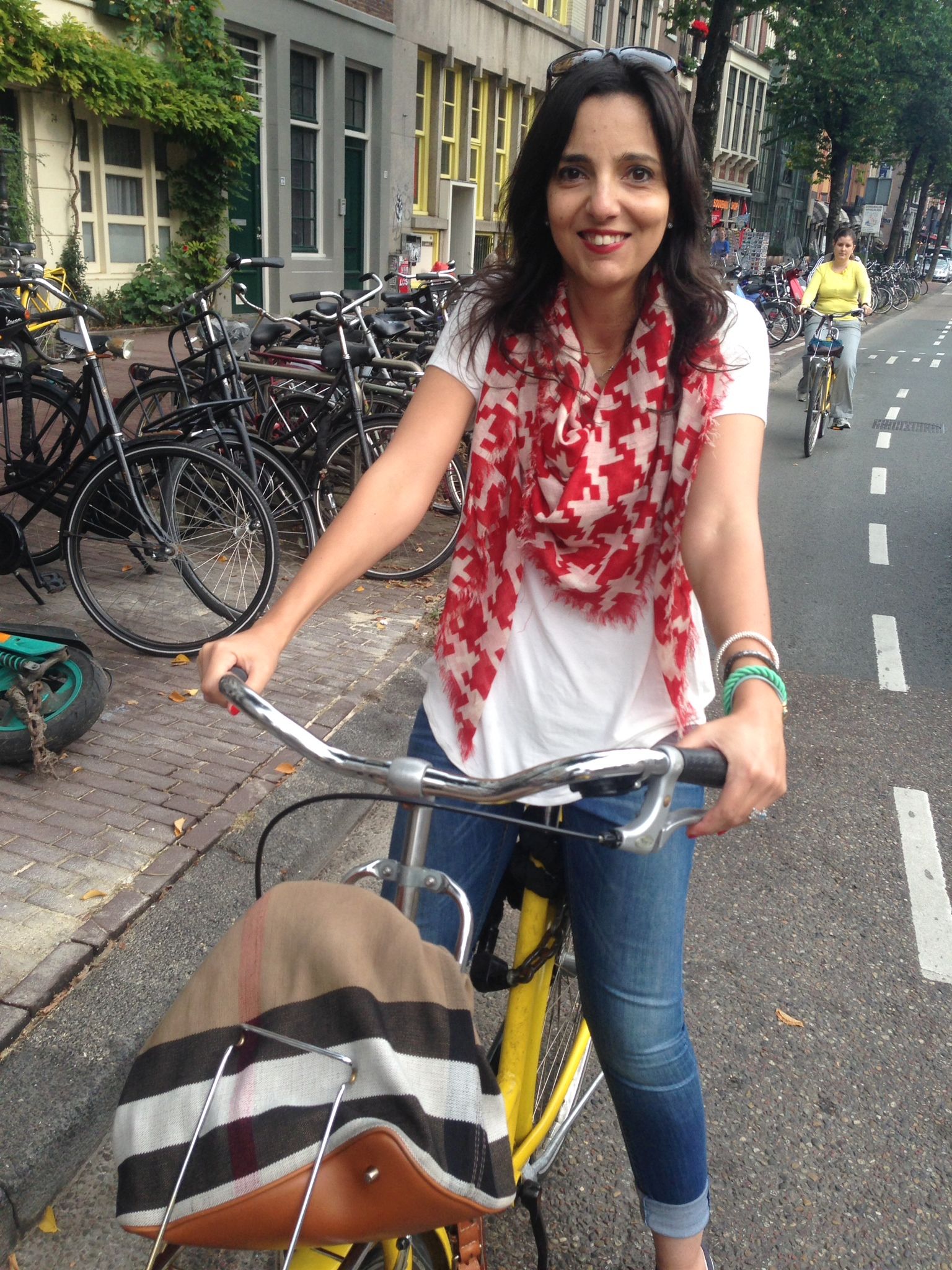
On yer bike.
Walking around cities will cause hypos. See above.
Eating Sacher torte for breakfast may not be nutritionally ideal, but it’s fun and delicious and a lovely way to start the day. And if you have it with whipped cream, you’re getting a serve of dairy. #PracticallyHealthFood #OkayThatWasALie
Being prepared for any contingency is a really good and smart and important idea. But it is a bloody pain to have to carry a whole suitcase (of carry-on luggage) with all the spares only to bring most of them home.
It’s possible that while I will tell everyone that seeing Klimt’s ‘The Kiss’, going to the Rijksmuseum, visiting The Anne Frank House and going to see ‘L’elisir D’amore’ at the Vienna Opera House were all amazing and incredibly culturally enriching, the thing that got me most excited was going on the Harry Potter Tour at Warner Bros. Studio and riding a broomstick.
Travelling is fun; attending conferences about diabetes is eye opening; visiting new places is a privilege; catching up with DOC friends in real life is magical. But. Missing our little girl hurts like nothing else, and being greeted by said little girl late at night as the cab pulled up in front of our house is the sweetest thing ever. Coming home? Nothing ever beats that. Not even riding a broomstick.
Community Service Announcement for those in Australia affected by daylight saving which kicked in yesterday making it even harder for me to have any clue what freaking day it is.
You are welcome!
Stop for a moment and imagine that the cost of buying insulin for a month was financially crippling to you and your family.
 Think about having to make the choice between buying insulin or buying food.
Think about rationing insulin and taking the smallest quantity possible – just so you are taking something, but not what you need.
Think about how terrible you would feel. Think about the thirst and the exhaustion and the fuzziness.
Think.
I don’t do emotive and I don’t do scare campaigns, but this is the reality for many children – and adults – living with insulin-requiring diabetes.
It’s unfair and it’s terrible.
And now think about doing something about it that is actually quite simple.
Many of you will be aware of the ‘Spare a Rose, Save a Child’ campaign that has been run over the last two years around St Valentine’s Day. The basics are – instead of sending a dozen roses to your loved one, send eleven. And with the five bucks you’ve saved, make a donation to the International Diabetes Federation’s Life for a Child Program. That fiver has just provided insulin for a month to a child whose family could otherwise not afford it.
There are many, many reasons to love this campaign; but for me, I adore it because it is simple and tangible. One rose = one month of insulin. Two roses = two months of insulin. I’m a simpleton – this sort of maths works for me!
I know that it’s not Valentine’s Day right now, but it will be in a mere 137 days. Which means that you have 137 days to plan to see how you could possibly contribute to this great initiative.
Contributing doesn’t necessarily mean making a donation – although it is wonderful if you can. You can blog about it, spread the word on Facebook and Twitter, ask your workplace or school to get behind it. You can just TALK to people about it.
Oh – by the way, this was set up by a few do-gooders in the DOC. Yep, that’s right, with nothing but the internet, their contacts and 140 characters or less (and some blogs, Facebook pages and other social media things) they managed to get this up and running. The first year, they raised about $3,000. The second year, they made close to $30,000. (You can use this the next time someone tells you that social media is the work of the devil and nothing good will ever come of it!)
The ‘Spare a Rose, Save a Child’ campaign was discussed at the 2014 Euro Bloggers Summit (disclaimer-y bits on this page). Kerri Sparling spoke about how the campaign came about and how people could get involved. One of the aims of the Summit is to share great work being done by people in the diabetes community. If you have something you would like others to know about, pease feel free to comment below.
There are times – frequently – that I really don’t want to have to speak or think about diabetes. But it comes up. Often in the most unlikely places.
Other times, I hope it won’t, but it does.
Such as going through security at airports. As we left Vienna to travel to London, I was stopped after I set off alarms (again). I had already taken off my boots, my necklaces and my bangles, but I was still making the alarm sound.
I was taken to a curtained-off room for a search and when I produced my pump was shocked to hear the lovely woman from security tell me she’d never seen one before. ‘Never?’ I asked. ‘Never,’ she confirmed.
Same thing happened as we headed Amsterdam. More alarms, more searches, more pat downs and a special little swab for my pump.
So far, it was three for three – Dubai, Vienna and now London.
When we landed in the UK and got to the end of the customs queue, we had a most friendly customs agent chat to us about the reason for our stay. ‘Well, I’m doing some work. And I’ve come from a conference in Vienna.’ ‘What do you do?’ He asked. ‘I work for a diabetes organisation in Australia and I’ll be spending some time with diabetes people here. The conference was a diabetes conference.’ And he was off, sharing the he used to work for a health insurance fund and diabetes is a really, really big problem and why don’t people look after themselves and even when you tell people what could happen to them if they don’t start looking after themselves they ignore you and then they get complications and then……’
And then I decided to not listen anymore, smiled blankly and waited for a new stamp to appear in my passport. Because UK Passport Control is not where I look to have a discussion about diabetes.
A visit to the chemist to buy cough mixture came with the question, ‘Do you have diabetes.’ I wish I could lie and just say no, because when I said yes, there was then a big discussion about the sugar free mixture and having to ask the pharmacist ‘can diabetics take this?’
And then there are the times when it is just a pain in the bum and whilst trying to enjoy a stroll, we have to stop so I can replenish my glucose stores.
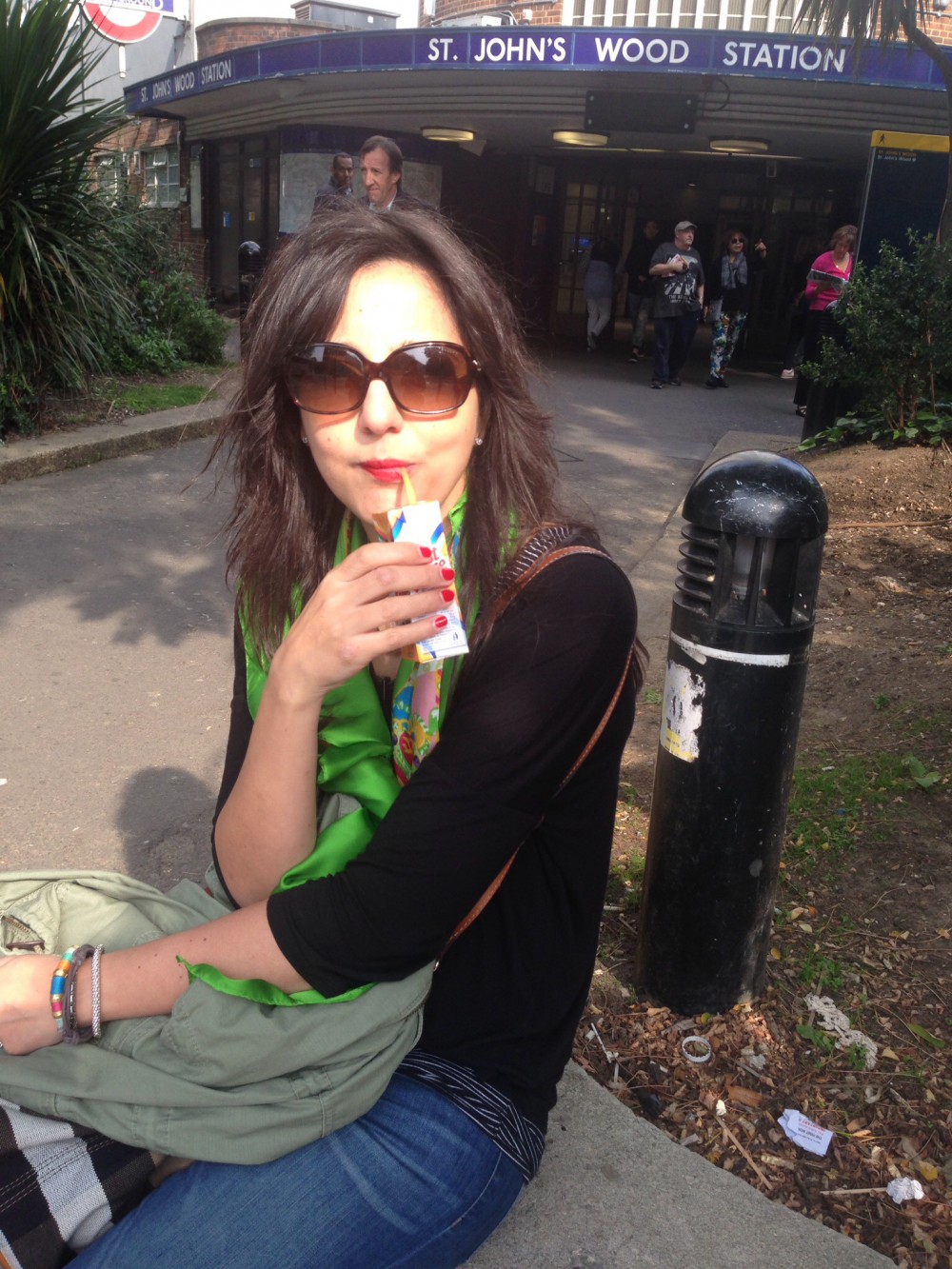
Hypo-treating on the streets of London.
A couple of weeks ago in Vienna, I was surrounded by members of the diabetes community – many of whom I am lucky to call my friends. We may live with this condition, but it really isn’t what we talk about when we sit together after the official stuff is over. No, we talk about anything but diabetes for most of the time. It’s actually refreshing!
Because so often, it seems that even when I don’t want to have to think about diabetes, I do.
This morning when I checked Facebook I saw this:
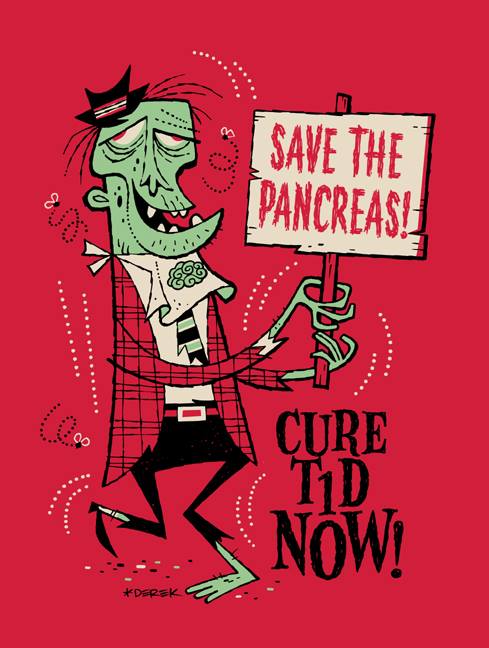
Derek Yaniger is one of my favourite artists. The walls in our living room are covered in his quirky work. I’ve no idea what his connection to diabetes is or why he painted this. I am going to write to him and hope to find out. And I am going to try to get myself a copy of this and hang it somewhere
In related news, I walked into my office today and found this:
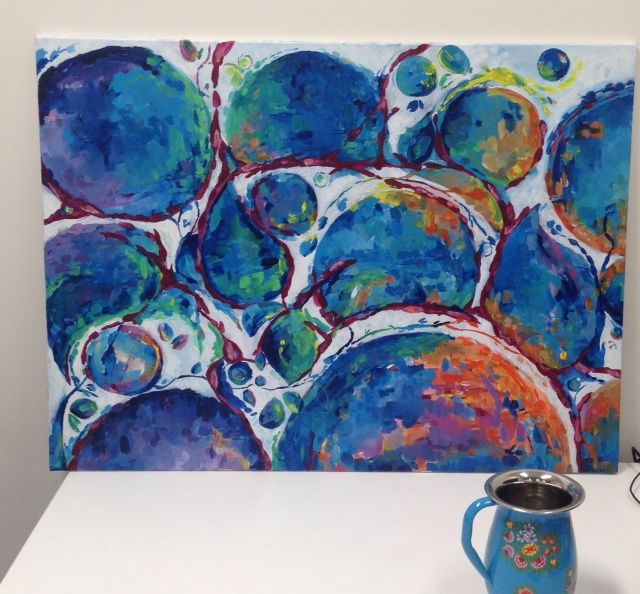
My very talented team-mate Julia painted this beautiful and calming piece for me to hang on the far-too white wall in my office. I am so lucky I’ll be looking at this every day I am at work.
Also in my office is this gorgeous work that won a competition we held a few years ago. It was done by a young girl with diabetes and I love how clever she has been incorporating ‘diabetes waste’ into the piece.
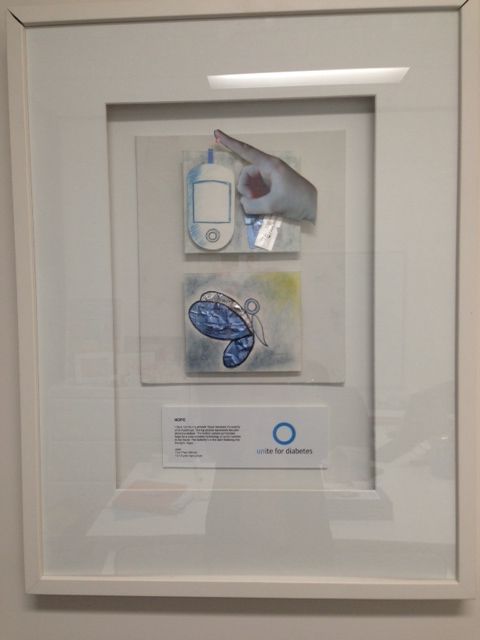
And finally, next week, I’m in Vienna and at some point, in between the conferencing and meetings and strudel-eating and schnitzel-eating, I will find my way to the Belveder museum to see Klimt’s The Kiss.

Diabetes Art Day may not be until February, but between now and then there are lots of opportunities to look at beautiful works of art – diabetes-related and not.
It’s Friday. Of course, Billy Joel’s Vienna was the only choice for today.
Last week, there was a very interesting infographic doing the rounds on social media sites about where people donate as compared with the diseases that kill us.
It looks like this:
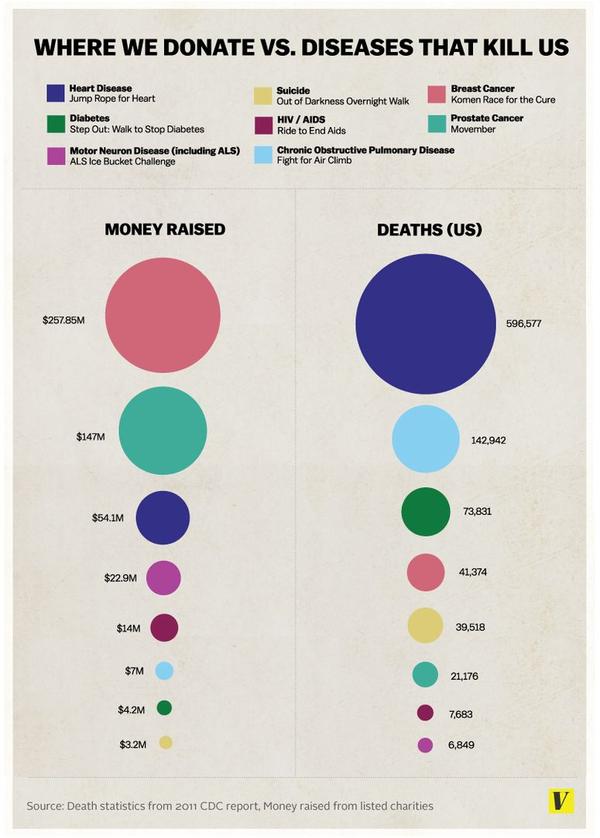
As you can see, diabetes is credited with causing the third most deaths, yet it accounts for relatively little money raised.
Firstly, this isn’t a game of ‘my health condition is worse than yours’. As someone most eloquently wrote on a Facebook status the other day: ‘all diseases suck’. Equally, every single condition is worthy of people’s donations. There simply isn’t enough money to go around to do the research, run the programs and assist people dealing with whatever health condition they have.
But I think unpacking why some conditions attract more donations than others is worthwhile.
Despite being responsible for many, many deaths and affecting millions of people both here in Australia and around the world, diabetes just doesn’t seem to be the ‘disease of choice’ when people reach into their wallets to make a donation.
Why is this? Why is diabetes not at the top of people’s minds when they want to do some good?
I’m just going to say this.
Diabetes isn’t sexy. It’s really not. It’s chronic; there’s no cure; and while there is the cute factor when we’re talking about little kids with type 1 diabetes, they grow up. And then it’s just boring adults with boring diabetes.
But there’s more than that.
The media does a great job of stigmatising this condition. Plus, there’s the ‘you did this to yourself’ misconception that means it’s okay to blame people for developing (type 2) diabetes in the first place and ‘…why the hell should I donate to you. Get off the couch and go for a walk’. Helpful. Really, really helpful.
Diabetes needs a makeover. Plain and simple. We need people in the general community to change the way that they currently think about diabetes so when it’s time for a little generosity, they consider making a donation to diabetes research or consumer organisations.
The neat little packages we seem to have about diabetes are misleading. Tying up type 1 with kids means that adults with type 1 have no voice at all. Blaming all people with type 2 diabetes for ‘doing this to themselves’ completely forgets the facts that genes play a significant role in developing type 2 diabetes. Calling diabetes ‘a touch of sugar’ ignores the seriousness of everyday life with diabetes. In fact, the very idea that this is all about eating sugar results in such misunderstanding about diabetes that people think the solution is as simple as not eating cake. The misconception that insulin is a cure ignores the multitude of factors that are involved with the daily management of this condition. And by thinking it is just about sticking needles into our bodies negates the distress and anxiety life with diabetes can bring.
I don’t know what the answer is. But I do know that what we’re doing at the moment isn’t working. Our messaging is wrong. How do we get it right?
As always, the internet is a trove of …well, cat pictures, naked photos of celebrities and silly cures for diabetes. But there is also some other stuff. You’ve just gotta look.
A Case for Action
As mentioned, I was in Canberra on Wednesday for the launch of a new Diabetes Australia report on insulin pump therapy. You can read Insulin Pump Therapy; A Case for Action here.
ADEA Video wrap-up
The people from online magazine Diabetes Educators Update have put together a short video wrap up of last week’s ADS-ADEA conference. It was nice to be asked about whether HCPs need to consider the consumer perspective.
Try to overlook the questionable language – (diabetes sufferers’???) – I’ll be sending them a copy of the DA Language Position Statement soon.
Use words wisely
While we’re talking language, this tweet from Kim at www.txtingmypancreas.com really resonated:

It’s why I don’t say I’m ‘battling’ diabetes. I’m living with it. We co-exist (not always happily). There is no fighting; there is just learning to get along.
On yer bike!
Have you been following Team BG doing the mHealth Grand Tour? They have been making their way from Barcelona to Vienna. On bikes. Because they’re slightly crazy. The photos are gorgeous and I have to admit I’m a little in awe of their sportiness. Go team! I’ll see you in Vienna.
Let it go ON!
We need to talk about Frozen because pretty much everyone else on the DOC has been. This week in the US, a documentary about the making of Frozen was screened. As it turns out executive producer John Lasseter based much of the character of Queen Elsa on his kid with type 1 diabetes. I love this character for so many reasons and now, I have another one. I’m not sure that we’ve had many ‘Let it Go’ free days in our house since we first saw the film, and now I don’t care if it’s played every single day for the rest of my life! Here’s what John Lassiter had to say:
Not our turn
‘We need an ice bucket challenge for diabetes’. I’ve heard this said so many times over the last few weeks from people affected by diabetes. It’s not a sentiment I share, because this particular social media-driven stunt doesn’t belong to us. Moira McCarthy has a daughter with type 1 diabetes and wrote this incredibly eloquent piece about how the diabetes community should be able to celebrate this for the ALS/MND community.
Moira wrote in the piece that her daughter with type 1 asked this question: “Why can’t our community be thankful another community is having success? Why isn’t that enough?”
Our turn will come. But for now, I think we should step back, support this community and this campaign however we see fit and be pleased for their success. (For the record, you can just donate – you don’t need to pour ice over your head; it’s bloody freezing still in Melbourne!).
MedX
The Medicine X (MedX) Conference for 2014 has kicked off at Stanford University. This conference is all about the future of medicine and healthcare and there is considerable consumer (patient) involvement. There are some familiar faces in the speakers’ gallery. Follow along on Twitter here.
Noodle
We have a new puppy. And she is the cutest thing ever!

Happy Friday! It’s Fathers’ Day on Sunday. This is for the three men for whom I get to celebrate this day.
Diabetes MILES Youth
Are you the parent of a child (aged 10 – 19 years) with diabetes? Then we need YOU! And your child with diabetes too.
You may remember that a few years ago now, the Diabetes MILES survey was conducted. Diabetes MILES looked at the psychological health of people living with diabetes, and the survey results continue to be collated and presented.
Now, a new study – Diabetes MILES Youth – is being conducted asking young people about what it’s like to live with diabetes, and how diabetes affects their wellbeing.
And because we all know that diabetes is a ‘family sport’, parents of kids with diabetes are also being asked to complete the survey.
The survey is only open until the end of September, so please take the time (about thirty minutes) to respond. (I know that you would get involved anyway, but as an added incentive, there’s an iPad to be won!)
Diabetes MILES and now Diabetes MILES Youth will actually show just how diabetes affects our lives on a day-to-day basis. The more we can talk about the psychosocial side of diabetes – the more evidence there is to show that diabetes affects our wellbeing – the more that diabetes stops being just a numbers game. (Although, in this case the number of people completing the survey is important, so get clicking!)
DISCLAIMER
Diabetes MILES Youth is part of the NDSS-funded Young People with Diabetes National Development Project of which I am the Project Manager. I’m writing about it here because I think it’s really important for as many people as possible to take part in this survey and have their voice heard.
The survey is being conducted by the Australian Centre for Behavioural Research in Diabetes.
I’ve been at the Australian Diabetes Society-Australian Diabetes Educators Association Annual Scientific Meeting this week. It’s been a big few days with some really interesting sessions, terrific opportunities to catch up with people, trying to avoid (unsuccessfully) Conference Hypo Syndrome, and a gorgeous poodle called Gaby.
Today is the final day of the conference and it’s the first ever Consumer Outreach day. I’m really pleased to be spending the day with some inspiring diabetes consumer advocates who are all about promoting the ‘patient voice’.
I’ll be writing about it next week. But in the meantime, it’s Friday and for some reason I’ve had this Tom Lehrer song going through my head. Enjoy!
One evening last week, I was in bayside St Kilda and I looked up, expecting to hear screams. But Luna Park was dark and closed for the night. The rollercoaster was still.
How I wish I could close down the rollercoaster of diabetes – even for just one night.
After the deliciously weird hypo I had early Sunday morning, I thought that I’d bought a bit of time off the rollercoaster. It wasn’t to be.
I woke early Monday morning, this time feeling revoltingly high. I jumped up and made it to the bathroom in time to throw up. My BGLs were in the mid-20s and I had mild ketones. Where the hell had that come from? I was perfectly fine when I went to sleep around 11pm.
I had done a set change yesterday afternoon and wondered if that could be the culprit. Not wanting to wait around to see if the correction dose I was about to bolus would work, I ripped out the site and sure enough, a nasty kink in the end of the cannula. That thing wasn’t delivering anything.
I inserted a new line, bolused, set a temporary basal rate and drank a litre of water.
By the morning when my alarm went off, my BGL was a far more respectable 8mmol/l and the ketones had all but disappeared.
I got ready for work and felt like my whole body was wrapped in cottonwool. I felt fuzzy and everything sounded a little muffled. It took until midday (and three cups of coffee) to stop feeling that I was listening to everything in a tunnel.
Two consecutive nights on the diabetes rollercoaster equals exhaustion. And frustration. And feeling overwhelmed.
Last night, I climbed into bed quite early and fell asleep pretty much straight away. And slept through. The rollercoaster was indeed closed last night.





 Diabetogenic