
You are currently browsing the category archive for the ‘Diabetes’ category.
‘What was your favourite thing about ADA?’
I’ve been asked this question a few times now since returning from San Diego. And even though the meeting was so busy, with a lot of super interesting information being shared, it was actually an easy question for me to answer.
‘Language’, I answer without hesitating. ‘Specifically, that language was on the agenda at the meeting for the first time.’
On Sunday, there was a whole session dedicated to language in diabetes: ADA – AADE Joint Consensus Statement on the Use of Language in Diabetes. I attended eagerly because, of course, #LanguageMatters is my thing. It’s also the ‘thing’ of others far smarter than me, including these two women who let me sit with them and jump up and down like an excited puppy:
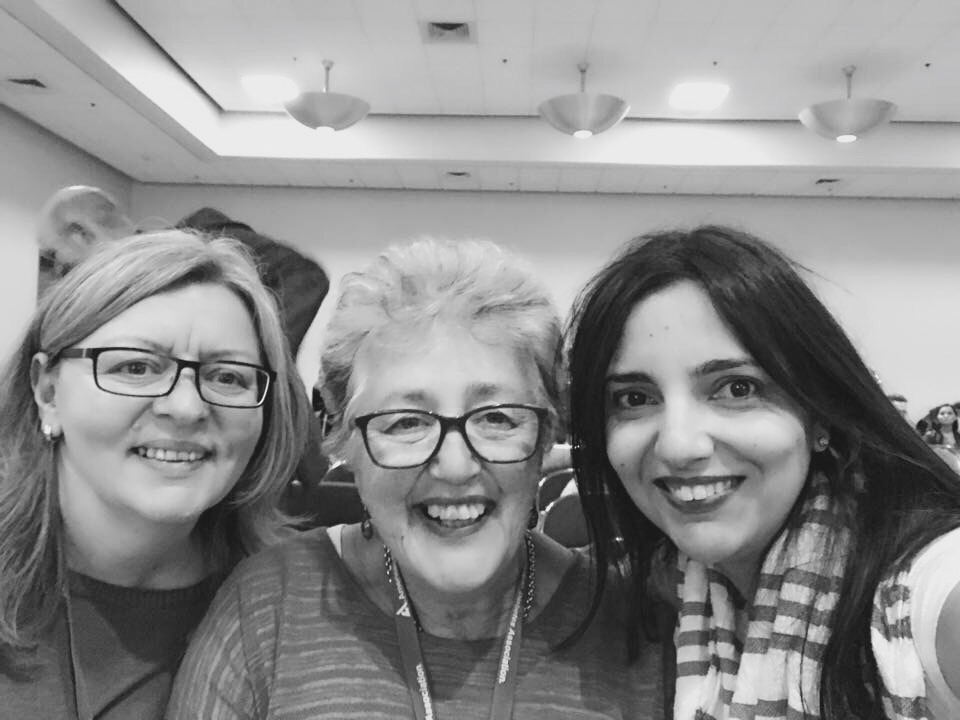
Professor Jane Speight led the development of the Diabetes Australia Language Position Statement, and Ann Morris, last year’s Australia Diabetes Educator of the Year, has been a champion of people with diabetes for a very long time.
There were some highlights in the language session for me, particularly from the first speaker, Dr Jane Dickinson. Jane recently wrote about a piece for Diabetes Spectrum about the effect of language on diabetes. She has type 1 diabetes herself and is a CDE, and her presentation was peppered with personal experiences of the role of language in diabetes care. (You can read more from Jane via her blog here.)
One particular comment Jane made really highlighted the rock and hard place between which PWD often find ourselves:

Susan Guzman was the second speaker and she pointed out that words not only affect the person with diabetes, but also create a bias for people working with us. The second that a PWD is described as ‘non-compliant’, ‘uncontrolled’ or that they ‘don’t care’, HCPs feel differently about the person. Appropriate language use isn’t important only for the person living with diabetes. It also matters if we want those working with us to treat us respectfully.

The final speaker was Melinda Maryniuk, CDE, from the Joslin Center and she spoke about the ADA-AADE Language Consensus Statement, and the five guiding principles that form the basis of the document as captured in this tweet from @MarkHarmel:

It’s not surprising that I was excited that this session was on the program. It was the first event I added to my calendar and I rearranged meetings to ensure that I didn’t miss it.
But I left wanting more. A lot more. And tomorrow, I’ll write about why.
Back from the ADA conference after whirlwind few days in San Diego which basically involved 19-hour days sandwiched between the first day (and 8-hour meeting) and the final day (a couple of short meetings before heading to the airport to fly home). Unsurprisingly, I slept most of the way home.
There were some absolute standouts of the meeting and here they are in super quick dot points. Some I’ll write about in more detail when I’ve finished hugging my family and infusing Melbourne coffee back into my exhausted body.
PR Fail
The ADA’s PR machine needs attention after the completely misjudged way they dealt with objections to their misplaced and archaic ‘photo ban’. It became the story of the first few days of the meeting and they really will need to reconsider what they do next year. (More on this another time, but here is a good summary from Medscape.)
Innovation away from the conference
While the conference is always full of late-breaking research and an exhibition hall of diabetes technology, the satellite events are often where the real innovation is at! On Friday afternoon, I went to the Diabetes Mine DData-Exchange event and was lucky to see and hear some of the latest and most innovative tech advances happening in diabetes, including lots in the DIY/#WeAreNotWaiting world.
Mostly, the room was full of those who knew what was going on in this space, so there really were only a few people who were surprised that there are many walking around with their own DIY kits, (which always makes me chuckle, especially if it’s a HCP having their mind blown by something PWD have known about and been doing for a while…)
(A bit of a watch this space from me as I am about to embark on my own build, which is slightly terrifying. The only thing giving me any confidence is that I have these two Wonder Women to call on if (when) I am completely lost!)
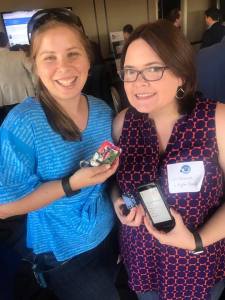
Wonder Women! Dana Lewis and Melissa Lee and their magical machines.
Life for a Child
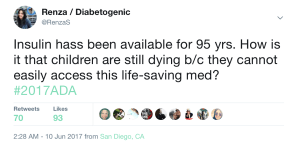
The IDF Life for a Child update, annually held at the start of the meeting, was, in equal measure, enlightening and despairing.
In this video, hear from Life for a Child Education Director, Angie Middlehurst, who recently visited the Diabetes Association of Sri Lanka and met some young people benefitting from the Program.
If you would like to consider helping Life for a Child, it costs only $1 per day to provide full diabetes care for a child. That’s right, one dollar a day. If you can, please do donate.
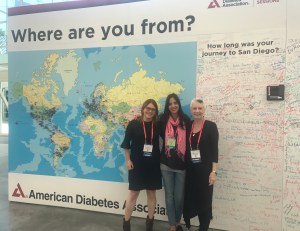
With Life for a Child’s Education Director, Angie and Health Systems Reform Specialist, Emma.
Who has a meeting at 5.30am?
Anyone who believes these meetings are junkets would reconsider the first time they need to be dressed, coherent, communicative and respectable for a 5.30 session. That’s 5.30am. And on the Saturday morning of the conference, I found myself in a room with a lot of other people (also foolishly awake at that time), to listen to the latest in CGM studies.
Thankfully, the session was super interesting with a lot of very valuable information being shared. (I really would have been pissed if I got up and it was a waste of time…)
Dr Steven Edelman from TCOYD was, as always, enlightening and added a most important ‘personal touch’ as he shared some of his own experiences of CGM. And some brilliantly relevant sound bites to remind the audience that while they may be focused on the machines and the algorithms and the clinical outcomes, this is about people living with diabetes.
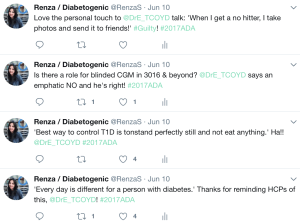
Trying to tweet everything Dr Steven Edelman was saying…
Diabetes Hands Foundation wake
The news about the closure of the Diabetes Hands Foundation, and the move of its forums to Beyond Type 1 was met with sadness, but also a lot of optimism. Innovators in the online community, DHF was the first online diabetes network I ever felt a part of. It spoke to me, but mostly, it was inclusive. That’s what happens when you have people like Manny Hernandez, and later Melissa Lee, at the helm, and a team around you of people like Mila, Corrina, Emily and Mike.
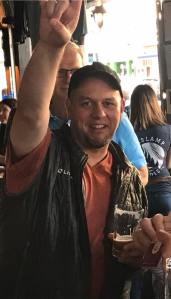
DHF founder, Manny Hernandez.
We farewelled the DHF at a wake in a bar on 5th Ave in San Diego on Saturday evening and the love and gratitude for DHF was overwhelming. Melissa asked us to recall DHF’s Word in Your Hand campaign as a tribute to Manny and DHF.
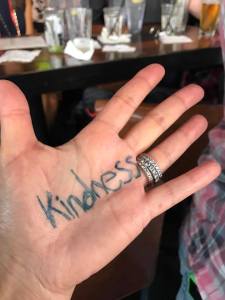
My word on my hand… We can always use more of this.
I’m honoured to have been a part of it.
Language
Oh yeah, there was a language session at #2017ADA and I have PLENTY to say about it. Maybe next week….
Sex, Insulin and Rock ‘n’ Roll
The team from Insulet threw an event on Sunday night way up in the sky, overlooking Petco Ballpark, home to the San Diego Padres, and we were presented with a panel of diabetes advocates prepared to talk about anything and everything. Brilliant in the way it was candid, unashamedly open and, possibly for some, confronting. Well done to the panel members who really were prepared to answer every question with personal insight and experience. This format really should be rolled-out as widely as possible to as many people as possible to help breakdown any embarrassment, or idea that there are taboo topics in diabetes.

Children with Diabetes
I was lucky enough to be invited to attend the annual CWD-ISPAD dinner on Monday night and speak with a number of healthcare professionals working to improve the lives of children living with diabetes.
Jeff Hitchcock, founder of CWD, is a personal friend now. I guess that’s what happens after you attend a Friends for Life conference and are welcomed into the family. FFL Orlando is taking palce in three weeks and my family’s time at FFL remains one of the most overwhelming and positive experiences of my life with diabetes.
I caught up with Jeff a few times throughout the conference to speak about the organisation’s work. He gave me a CWD medallion, which is now firmly wedged in my wallet as a reminder of not only my FFL experience, but also value of Children with Diabetes.
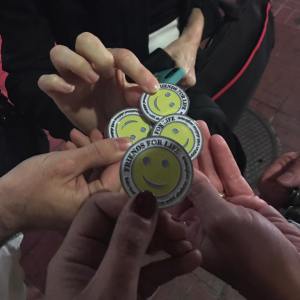
diaTribe
I could complain about my 19-hour days, but then I think about Kelly Close from diaTribe and then feel sheepish for even suggesting that I’m working hard! On the final night of the conference, diaTribe hosted three events and I attended the later two: Musings Under the Moon and Musings After Hours.
These events bring together leaders in diabetes technology and innovation and digital health and offer an opportunity to ask questions and challenge (and be challenged!) in a far less formal situation that the official ADA conference. For me, this is where I learn the most as the speakers are prompted by hosts Kelly and Adam Browne to really reflect on where we are going in diabetes innovation. My only misgiving about these events is that there are not enough people attending. That’s not to say that the spaces were not packed to the brim – they absolutely were. But I do wonder if perhaps it’s the people who really need to hear the realities of diabetes technology are not in the room…

MedAngel
I meet Amin from MedAngel as part of my time with the European Roche Blogger Group. Amin has created an easy-to-use sensor and app to help people with diabetes ensure insulin is kept at the right temperature. More about this another day, but in the meantime (after I’ve been using my sensor for a while), you can read about it here.
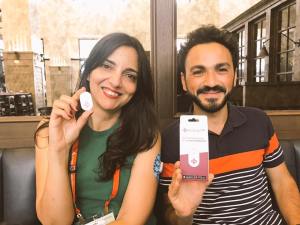
Learning all about MedAngel, with Amin.
Take aways
ADA is a very large conference. There is a lot going on, there are a lot of people around and I always leave with a lot to think about. Over the next few days…weeks…I’ll start to gain some clarity about a lot of what I saw, heard and learnt. It’s always the way after a big meeting like this one.
Someone asked me if I enjoyed the meeting and I suggested that was probably the wrong word to use. It was very worthwhile. I learnt plenty. I was able to catch up with advocates in the space who continue to push boundaries and lead the way in insisting that all work in the diabetes space is ‘person-centred’. People with diabetes are expected at this conference and seeing us as just being there – rather than having to fight for our place – inspires me to keep working better and harder.
Disclosures
I attended the ADA Scientific Sessions as part of my role at Diabetes Australia who covered my expenses, except for my first two nights’ accommodation which were covered by the International Diabetes Foundation so I could participate in meetings for the World Diabetes Congress where I am Deputy Lead for the Living with Diabetes Stream.
I got on a plane in Melbourne on Wednesday at 9am, travelled for 20 hours , touching down in San Diego on the very same Wednesday at 10am. This sorcery explains the jet lagged mess below.
For the next few days, you can mostly find me at #2017ADA where I’ll be sharing the latest from the 77th American Diabetes Association Scientific Sessions.
In my endo appointment the other day, after we’d finishing working through my pathology results, I wanted to speak about the mythical pre-bolus.
I say mythical because, seriously, the day I work out how to get the whole pre-bolus thing right is the day I see a unicorn walking up a rainbow while talking to a phoenix. I have hope this will happen one day.
My endo is one of those rare beings who understands the absolute intricacies of pumps. She knows a lot – from simple button pushing to complex things that make my brain hurt. When I started talking pre-bolusing, she brought out graphs and charts to help us work through my questions.
I mentioned that eating lower carb certainly helps avoiding post-meal spikes, but I was having trouble getting my morning coffee dose right. I know exactly the number of carbs in the milky-latte-with-one I order, but the timing of the bolus is critical to avoid a post-caffeine spike and ensuing plunge.
‘Plus,’ I added. ‘It depends what is going on with my glucose level as I start to drink. If I’m already dropping, which may be happening at that time of morning, and I bolus too early, I’ll end up hypoing, so I usually wait until about five minutes before I order my coffee. But if I’m above target, I need to bolus at least 15, but more like 20 minutes before ordering. If I’m steady and in range, somewhere closer to 10 is more like it. Maybe 12…’

Just drink the damn coffee!
I heard myself going into such detail and suddenly, I realised how bloody boring I sounded. My poor endo had just endured a 10-minute monologue from me on bolus dose timing to cope with my over-priced morning coffee from the hipster coffee shop next to work. I couldn’t help wondering if this really is the best use of the time and expertise of a most excellent endocrinologist? Also, I was embarrassed at presenting this first world problem as such a pressing issue.
She showed me some graphs, and drew a few others for me to think about. We spoke about timing and strategies and things to consider before pressing the bolus button.
But then she stopped and said, ‘You know, you can think about all these things, but you can also not worry too much. Obviously it’s up to what you want to do here, but thinking about things in ‘minutes’ before your dose…you need to decide if that really necessary.’
And then it hit me. The over-analysing and over-stressing and excessive scrutiny. What for? I’d just seen an in-range A1c that suggested I’m managing just fine with what I’m doing. Was the angst of blousing twelve minutes versus 16 minutes prior to my morning caffeine jolt really worth the calculations and the strain?
We are often critical that our HCPs put unreasonable expectations on us with what they demand we do to manage our diabetes. How refreshing to have a diabetes HCP who actually suggests that we breathe and take a step back for a moment to decide if a particular undertaking is absolutely necessary, or if it is just adding unnecessary pressure to our already highly-pressured diabetes selves.
As someone who is rather passionate about the words we use when we are talking about diabetes, I was framing how I would respond in my endo appointment when I finally received my pathology results yesterday. ‘Path results are not a moral compass, Renza. They give you a snapshot of data and that is information to help you inform treatment decisions moving forward. Nothing more. Nothing less. Your value as a person is not based on the numbers on the paper.’ I repeated the words rhythmically over and over and over again.
And maybe, I almost started to believe them.
I walked into the office and sat down anxiously. With a smile, she handed me sheets of paper. ‘You’ll be happy,’ she said to me. She told me my A1c as she knew that was what I would want to know first.
I flipped through the papers, the numbers starting to blur. I heard the A1c number but the rest stopped making any sense. ‘I don’t know what I’m looking at all of a sudden!’ I said to her.
‘Ah,’ she said. ‘Let’s start with your kidney check because I know that always worries you.’
We went through all the other results too. I was smiling and almost bursting into tears. ‘I’m so pleased,’ I said. ‘I’m so pleased with myself.’ And it’s true. I was feeling good about myself. And then I stopped taking.
Of course I was pleased; the results were all good. The numbers were in my target range. All of the worries I’d had for the last week melted away. But along with the celebration, I was starting to feel uncomfortable.
If the numbers were not where I wanted, my response would have been disappointment and, perhaps a little shame. I would not have been pleased with myself, instead chastising my lack of effort and feeling I was not enough. Yet, the effort would have been the same regardless of the numbers on the page.
Try as I might, I cannot divorce the idea that an in-target number is somehow connected to my value as a ‘good person’, which translates to an out-of-target number means I’m not. I fight this idea all the time. I write about it, I talk about it, I genuinely thought I believed it. Does the entrenched messaging we are told over and over again by some HCPs mean we actually should assess our own value as people based on numbers (a pathology check, BGL check, CGM trace, weight, blood pressure….)? Can we simply not move beyond the judgement?
I pushed away the thoughts and tried to just breathe with the relief I was feeling.
I walked out, paid the bill and walked to my car. I decided that I wanted to share the good news with Aaron, and I sent him a text with my A1c result. He responded perfectly with a gorgeous message…and then brought me Tim Tams for dessert.
And while we were munching on those Tim Tams, I said to Aaron, ‘You know, I’m really pleased with everything here. I’m pleased with my A1c, but the thing that relieved me more than anything are these five words…’ I leaned over and pointed to the paper at the five words I was referring to:

And I breathed out. Possibly for the first time in a very, very long while.
Last Wednesday, I walked into a local pathology office, rolled up my sleeves, held out my arm and watched as the pathology nurse filled three vials of my blood to be sent away. I then peed into a little yellow-lidded plastic jar, placed the jar in a plastic bag and handed that to the nurse waiting outside the bathroom.
And then I walked out of the office, headed to one of my favourite cafés, sat down and worked for a few hours.
I’d like to say that’s end of a very boring story. But it’s not. It’s Monday today and for the last six days, I’ve not stopped thinking about those drops of blood and pee. (I know; slightly gross.)
This week on Wednesday, I have an appointment with my endo. It’s a follow up from my visit last month. I walked out of that consultation with the path slip in my hands and a promise in my head and heart that I would go and have the blood draw done and face the results.
It’s been a very long time since I last had my A1c checked. Very.Long.Time. As in – no freaking idea the last time. It’s also been a while (the same length of time, I guess) since I had any other diabetes complications screening. I’ve not had my kidney function measured or my coeliac screening done. With only half of my thyroid still in my body, (the right half was removed along with a benign tumour back in 1998), I should be having that checked regularly. But I’ve not.
I don’t know why I am so committed and diligent about getting my eye screening done, but that is truly the only diabetes screening that is always – ALWAYS – up-to-date.
So for the last six days, I’ve had many hours, often in the dark of the night when the rest of the household is sleeping, lying wide awake wondering what those drops of bodily fluids have to say. (Again, yuck.) That’s when the nasty self-talking me comes out.
The nasty self-talking me is destructive. She’s relentless and actually quite nasty. ‘I bet your A1c is high, Renza. Really high. And I bet that your urine test is going to show some problems with your kidneys. And you know what? If there is, it’s all your own fault for not being on top of it.
My nasty self-talking me hasn’t read the Diabetes Australia Language Position Statement and says things like ‘You’re totally non-compliant. You know that, right?’ and ‘You’re a bad diabetic. The results are going to not be good at all.’
Last night I dreamt that it was Thursday and I’d missed my appointment, and try as I might, no one would give me my results. I called my endo’s office and the receptionist told me that as I’d forgotten to show up for my appointment the results had expired and disappeared. And then she called me non-compliant and unreliable. (This is so totally not what would happen because she is delightful and lovely and no one in my endo’s office is nasty and judge-y.)
When it’s not the middle of the night and I am thinking logically, the usual self-talking me – the rational one – says sensible things. ‘Yep, you’re right. It has been a while since you had all your screening things done. But you’ve done it now and that’s awesome. Just sit tight until Wednesday and then you’ll see where things are. And if there are problems, we can address it then. Do you need a new pair of boots?’
And when nasty self-talking me says things like ‘Bad, bad diabetic whose A1c is going to be terrible’, the rational self-talking me says ‘It’s just a number. You know that. And if it is higher than you would like, you can put some strategies in place to bring it back to where you are comfortable.’
I like the rational self-talking me. She’s sensible and uses words I like to hear. But it does seem that when there is even a shadow of doubt, she is very much overwhelmed by the nasty self-talking me. And, boy, does she has some attitude! She makes me feel that I should measure myself by numbers. She makes me feel like a failure for not always staying on top of all my diabetes screening. She makes me feel that if anything goes wrong I am to blame. She’s nasty. Really, really nasty!
So right now, with rational self-talking me typing away, I’m putting this here for the next couple of days (and for future reference) when nasty self-talking me is the louder voice:
- You are not defined by your A1c or any other number.
- You are not a bad person because you have let some of your diabetes management slip.
- If it turns out that the results are not what you hoped for – in any way – you can and will deal with that.
- And it’s not your fault if that is the case.
- Diabetes complications do not mean that you have failed.
- You work bloody hard to manage your diabetes as best as you can at any moment and you should go and eat a cupcake right now to congratulate yourself for that.
- If you feel that you could be doing better, work out how to make that happen. Your endo appointment on Wednesday might be a good place to start.
- Tell that nasty self-talking part of you to piss right off.
- And yes. You do need a new pair of boots.
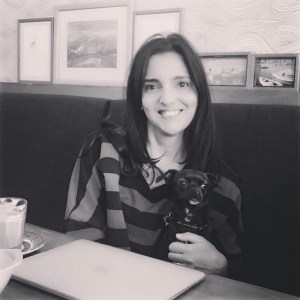
After my pathology visit, I went to one of my favourite local cafes which sometimes has puppies to cuddle. How cute is Juno?!
I travel a lot for work. Day trips interstate for meetings or giving talks are a regular feature in my working week. This week, I’ve had two early morning starts with two separate trips.
I have the airport routine down to a fine art. I arrive at the airport, make my way to the express lane through security, whipping my laptop from my bag, any bangles from my arm and emptying my pocket as I walk. I know which shoes trigger the metal detector and which don’t. I get through and then there is exactly enough time to get to the lounge, grab a coffee and make my way straight to the gate just as the plane is boarding. I sit down, grab what I need from my bag before tucking it under the seat in front of me and usually fall asleep within a few minutes, or read whatever book I’m carrying around with me. From arriving at the airport to being settled in my seat is usually about 20 minutes.
On a recent flight, nothing was out of the ordinary. It was early – I was half asleep as I sat down on the plane. It was still dark outside and I didn’t fall straight asleep as I needed to keep an eye on my CGM trace for a little. I’ve been hypoing out many mornings and I wanted to make sure that I was okay before settling in for the flight.
The temp basal rate I’d set in the cab to the airport had more than done its job and I was not too worried about going low – especially with the milky coffee I’d just finished.
I pulled my pump from my bra and, with the press of a few buttons, turned off the temp basal rate and gave myself a small bolus for the milk. I tucked the pump away again and then checked the Dex widget from the home screen of my phone, confirming the number on my Apple Watch.
I was on autopilot as I usually am when doing these sorts of diabetes chores. Buttons pressed, I pulled my book from my bag and started to read, completely oblivious of my surroundings. The plane took off and I was starting to get sleepy, so I put down the book on the seat next to me.
As soon as the seatbelt sign was turned off, a flight attendant leaned over to me. I was the only person in the row. I looked up and noticed that there were two other flight attendants standing there.
‘Excuse me, Ms Scibilia,’ she said.
‘Yes. Hi,’ I said, smiling, wondering what was going on.
‘Are you able to please tell me what you were just doing.’
I was confused. I had been reading. I showed the flight attendant my book.
‘No,’ she said. ‘Before that. You seemed to have some…machines?…or a box?…Down your shirt…? And checking your phone.’ She was searching for the right words to use and it took me a moment to realise what she was asking.
‘Oh,’ I said. ‘Um…I was just pressing some buttons on my insulin pump.’
It was the flight attendants turn to look confused.
‘I have diabetes. It’s how I deliver insulin. I needed to adjust some of the settings and give myself some insulin.’ I explained. I pulled the pump from my top and showed her.
‘I also wear a device that measures my glucose levels and it transmits to my phone….and watch. I was checking the numbers.’
I showed her. And then added quickly. ‘It’s Bluetooth. The phone and watch are both on Airplane Mode.’
‘Oh,’ she said, turning to the two other attendants behind her and quietly repeated what I had just said.
‘Do you have some sort of documentation about having diabetes?’ she asked.
Now I was really confused. This was a quick flight interstate. I never carry my doctor’s letter when travelling domestically and have never, ever needed it before – not at security and certainly not on board a flight.
‘Um…no,’ I said. ‘Oh, wait! Yes! I have a card for the NDSS. Hang on…’ I rummaged around in my bag searching for my purse.
‘Here. This is the card that gets me subsidised diabetes products,’ I said, pointing out the word diabetes on the card and then turning it over to show the information on the back.
She took the card and showed it to her colleagues.
‘Okay,’ she said. ‘I’m sorry. A passenger mentioned they had seen you pulling something from your shirt and they were a little concerned about what you were doing. I’m sorry for troubling you.’
I half smiled and said that it was all fine, but I realised I was fighting back tears as I did. Had someone thought that I…? I couldn’t even form the words in my head. What did they think when they looked at me?
I felt really self-conscious for the rest of the flight. I’ve no idea who spoke to the flight attendant. I looked around and noticed that most of the people nearby were on laptops or tablets or checking their phones. Everyone has a device …. What was it about mine that had set someone’s mind to thinking that I was going to do something nefarious?
Are people on heightened alert in the wake of the recent terrible events around the world? Is it general anxiety about devices and suspicious little black boxes? Are people noticing more, watching more, reporting things that ordinarily would be completely overlooked?
Would I notice if someone around me on a plane – or a café or in a park or on the street – was fiddling with a medical device? Maybe, but then I have a sixth sense about it, always looking for a new diabetes best friend in the wild!
I sat quietly for the remainder of the flight, my book open, but unable to concentrate. I read the same paragraph over and over. Diabetes is meant to be an invisible condition, but at that moment, there was a neon flashing sign above my head – an arrow pointing at me announcing that there was something not quite right – and I felt very, very conspicuous and very, very vulnerable. And I didn’t like it one bit.
It’s day three of the eighth annual #DBlogWeek, created by Karen from Bittersweet Diabetes. This is the sixth year I’ve taken part and it’s a great opportunity to not only write about some truly interesting topics, but also a chance to read some blogs you may not otherwise. Here are the links to today’s posts.

Today’s prompt: Having diabetes often makes a visit to the doctor a dreaded experience, as there is invariably bad news of one kind or another. And sometimes the way the doctor talks to you can leave you feeling like you’re at fault. Or maybe you have a fantastic healthcare team, but have experienced blame and judgement from someone else in your life – friend, loved one, complete stranger. Think about a particularly bad instance, how that person talked to you, the words they used and the conversation you had. Now, the game part. Let’s turn this around. If you could turn that person into a puppet, what would you have them say that would leave you feeling empowered and good about yourself? Let’s help teach people how to support us, rather than blame us!
I’ve written before about difficult encounters with HCPs. There was this time and this time. And this time where it wasn’t even me who the HCPs were speaking poorly about!
So, instead of doing that today, I’m going to talk (as in actually speak) about the the overall issue of blame and diabetes, and what can be said to address the blame game. (Apologies for the speed talking and hand waving.)
It’s day two of the eighth annual #DBlogWeek, created by Karen from Bittersweet Diabetes. This is the sixth year I’ve taken part and it’s a great opportunity to not only write about some truly interesting topics, but also a chance to read some blogs you may not otherwise. Make sure you check out the list for today’s posts here.
Today’s prompt: Insulin and other diabetes medications and supplies can be costly. In the US, insurance status and age (as in Medicare eligibility) can impact both the cost and coverage. So today, let’s discuss how cost impacts our diabetes care. Do you have advice to share? For those outside the US, is cost a concern? Are there other factors such as accessibility or education that cause barriers to your diabetes care?
Diabetes is an expensive condition with which to coexist. Every now and then, I tally my annual diabetes expenses, at which point, the reason for my frequent flyer status at the pharmacy becomes more than apparent. Between insulin, insulin pump consumables and blood glucose strips, it doesn’t take long for the costs to add up.
Then I add the fees to see diabetes-related HCPs. I choose to see all my HCPs privately, so there is a gap (out of pocket) cost for all these appointments. Fortunately, pathology is bulk-billed, so I don’t pay to have my A1c checked or for any other blood work.
Private health insurance (PHI) is a significant cost each year. We pay about $450 per month to cover the whole family for top hospital and extras cover. PHI means that every four years, the full cost of my insulin pump replacement is covered, and it also means a choice of doctors if we’re in hospital, subsidised stays at a private hospital, and we claim optical, dental and orthodontic each year, plus other things as well.
I wear CGM every day of the year, which adds about $4,000 per year to the tally.
It’s a lot of money. Without factoring in incidentals such as hypo treatments and other things that just seem to come up, my out-of-pocket expenses for diabetes (excluding health insurance) would be about $6,500 per year.
And yet, I feel oddly fortunate, because there are few surprises – or changes – each year when it comes to my medical expenses. I know how it will all play out in the family budget each year.
I know the prices that I pay for all my diabetes expenses are pretty much set, and that means I can plan for them.
I know that every time I walk into the pharmacy to fill an insulin prescription, I will hand over $38.80 for five 10ml vials of insulin. We are never at the mercy of Big Pharma’s arbitrary price hikes. (Last week’s announcement from Lilly of a 7.8 per cent increase on the cost of Humalog – after years of substantial increases – has left me reeling and astonished at how my American friends can afford to just survive with diabetes, let alone live or thrive…)
I know that my diabetes consumables will be the same price every time I order them thanks to the NDSS. The National Diabetes Services Scheme (NDSS) is celebrating 30 years this year – that’s 30 years of subsidised diabetes supplies for all people living with diabetes.
I know how much my doctor will charge me and I know the Medicare rebate. And I know that if I was unable to afford to see my doctors at their private offices, I’d have access to the free diabetes clinic at the tertiary hospital less than 10 minutes from my home, and a bulk billing GP of my choice.
I know that if I couldn’t afford private health insurance, my ability to buy insulin, diabetes supplies or see healthcare professionals would not be affected.
I know that there is no time that I will need to ration insulin doses. I know there will be no time that I cannot afford to see a doctor. I know my pharmacy will always be able to provide me with the supplies I need to live with diabetes and drive the devices I use to manage as best I can. I know I am not really limited by maximum rebate amounts or that if I need more BGL strips, I can get them.
And I also know – and acknowledge – the privilege that allows me to afford health insurance that pays for my insulin pump, and to self-fund CGM, and to see the endocrinologist of my choice privately.
I know there are many other Australians with diabetes who are not as fortunate.
The outcomes for Indigenous Australians are worse – far worse. Poorer Australians have poorer health outcomes. People living in remote areas often struggle to access decent, timely and appropriate healthcare. Australians from CALD backgrounds may not understand a new diagnosis or the treatment being prescribed which affects how they manage their health.
Our system here in Australia is not perfect and we should be continually striving to do better. But it is certainly better than in a lot of other places. The thing about diabetes is that, as many of us wrote yesterday, we are wrangling a health condition that likes surprising us. We often feel we are fighting our own bodies. We shouldn’t need to fight to afford our care – and our health – as well.

The cards that cover my diabetes – and other health – needs. (Oh – and a credit card for all the out-of-pocket expenses…)
It’s day one of the eighth annual #DBlogWeek, created by Karen from Bittersweet Diabetes. This is the sixth year I’ve taken part and it’s a great opportunity to not only write about some truly interesting topics, but also a chance to read some blogs you may not otherwise. Make sure you check out the list for today’s posts here.
Today’s prompt: Diabetes can sometimes seem to play by a rulebook that makes no sense, tossing out unexpected challenges at random. What are your best tips for being prepared when the unexpected happens? Or, take this topic another way and tell us about some good things diabetes has brought into your, or your loved one’s, life that you never could have expected?
There are things in this world that are predictable. The early evening darkness that descends as soon as daylight saving ends each April; the desserts of warm crumble in front of the fire as soon as the weather cools down; the taste and jolt of the first coffee of the morning; or the way the puppy runs around in circles for a good five minutes once she’s let into the house when her people arrive home after a day at work.
The predictability is comforting. I like comforting. I like predictable!
Because then…then there is diabetes. Diabetes doesn’t do predictable. In fact, my diabetes laughs in the face of predictable. It seems to take great delight in waiting until the exact moment that I start to feel comfortable and confident that something is sorted and working in a certain way, and then throws me a curve ball, messing up any notion of security.
Being prepared can help though, although if I were to truly be prepared for any and all possibilities diabetes has in store, I’d never leave the house – or only ever leave carrying a suitcase and medical team. However, there are some little things that I do routinely that do make those unexpected situations a little easier to manage.
My ‘diabetes spares bag’ is always in my handbag and is probably the thing that saves me most. I wrote about how it came to the rescue a few months ago when I got to work and realized I’d forgotten to attach my insulin pump (it turns out that sixteen years of pumping is no guarantee that I’d remember to actually connect the bloody thing in the morning). Again, this is what my spares bag looks like:
 And that pretty much takes care of most contingencies for a device malfunction. Empty cartridge alarm? No problem – swearing and spare insulin vial and spare cartridge can take care of that. Pump line snagged on door handle and ripped from body? Swearing and spare infusion set can take care of that. Dead battery alarm? Swearing and spare battery has that sorted (and the five cent piece in there will open the battery cap without much effort). Insulin pump left on the bathroom vanity? So much swearing and spare insulin vial and syringe will take care of that.
This little bag has helped me out of diabetes messes more times that I care to remember.
I consider having a well-connected and easy-to-reach endo an absolute essential for the unexpected. I’d never call her out of hours for something trivial, but I have reluctantly used her mobile number in case of emergencies. For example – the time I was in hospital and the A &E staff wanted to take away my pump, blood glucose meter, insulin and dignity. Or the time I passed out from a hypo and I needed her to convince the paramedics that I didn’t need to be taken to A&E – and could manage at home myself. She’s an insurance policy like to other in those moments of desperation.
To be honest, the times that I am most surprised by diabetes isn’t when it does something unexpected. The unexpected is actually normal. The times diabetes surprises me is when it is just ticking along quietly doing its thing and letting me tick along quietly and get on with things. I become most suspicious and wary, waiting for it to get back to doing its thing: being an impulsive, random, fickle pain in the pancreas.




 Diabetogenic