You are currently browsing the category archive for the ‘Diabetes’ category.
My head is firmly in the language space at the moment, thanks to a big piece of work I’m involved in. So, I’m sharing this post from last year. I remember being frustrated during a session at ATTD last year where a roomful of diabetes advocates were acknowledging how stigmatising and damaging language could be – and equally, how positive and positively powerful it could be, too. My frustration was because despite some pretty insightful tweets going out from people at the event I was in, the online discussion pivoted it all to being about the diabetic/people with diabetes debate (despite this NOT even being discussed in the session), and then how some people with diabetes don’t even care about the words used.
So, twelve months on from first publishing this post, some people do occasionally call me Blossom. I’m okay with that. It’s my decision. And as a person with diabetes I get to decide how I talk about diabetes, just as every other person with diabetes can. I’m pretty sure that’s been my personal opinion about diabetes language matters for more than decade now: it’s our diabetes. We get to talk about it however we want.
These days, it’s impossible to be at a diabetes conference and not have at least one conversation somewhere about language. Sometimes there are sessions dedicated to the topic on the program, but that wasn’t the case at ATTD a couple of weeks ago – a conference solely devoted to advancements in diabetes technology and treatments.
But despite there not being a session about language, it was still a hot topic. My eagle eye was trained when walking through the exhibition centre for examples where diabetes is misrepresented or the language used stigmatises people living with the condition. And in sessions, I immediately heard terms that suggested that we are misbehaving because the results of treatments aren’t living up to their promise. (A new one: I heard the statement ‘People with diabetes on <therapy> were not performing as expected’ which now makes me think that we are being trained, watched and judged by pageant mums/moms.)
At the Ascensia Diabetes Social Media Summit (more on that another day), there was a discussion about language and diabetes-related complications. This event was a follow on from the one we had at the Australia Diabetes Social Media Summit, and took the initial conversations and expanded it with a new group of PWDs.
Once again, as the discussion unfolded, it was clear to see that the PWD in the room all had experiences where the language they were faced with had impacted negatively and positively. One person commented that early on in their diagnosis, a health professional had addressed diabetes-related complications by saying ‘If you are diagnosed with a diabetes-related complication it will not have been your fault.’ What an empowering way to begin the discussion about complications, care and risk reduction!
I’ve been talking about language for a number of years. Some may call me a one trick pony and, honestly, that’s fine. My appetite for the subject matter has not diminished one bit despite more than a decade of speaking and writing about why language is so important and holds such power.
Language is not a one dimensional issue. Additionally it does not necessarily have a ‘right way’ to do it – especially when looking at it from the perspective of the person living with diabetes. The work I have been involved in has never been about policing the words used by people with diabetes, but rather how words used by others affect us.
It’s why the piece Grumps and I wrote for BMJ was important – it targeted healthcare professionals, explaining to them why the words and language used around diabetes-related complications needs to not make us feel hopeless. Because that is what can happen and when we feel that way, it is all too easy for diabetes to seem just too big and too hard and too much.
I have frequently written about how diabetes can become so overwhelming, that it can leave us unable to attend to even the most basic and mundane of diabetes management tasks. I myself have been paralysed by the detail and demands of this health condition. I understand that there are times when a conversation about language is not possible, because, quite frankly, there is a lot more to deal with. I know that there have been moments when even though I can hear judgement and blame in the words being directed at me, all I want to do is find a way out of what feels like a hole. I’ve heard others say that they have felt harshly treated by HCPs, but simply didn’t have the capacity to try to deal with that because there were other things higher up on the list.
And I am sure that there are people who simply wouldn’t even know where to begin if the words and language being directed at them were disempowering and negative.
But that is exactly why language matters. It is for the people in those situations – for me when I was in that situation – that we need to get the way we communicate about diabetes right.
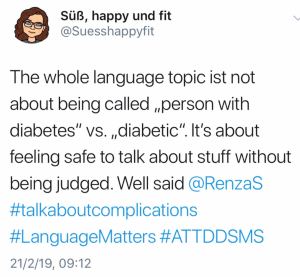
I am so sick of people trying to delegitimise the language discussion, or, even worse, reduce it to something that is insignificant. It frustrates me when the discussion returns again and again and again to the diabetic/PWD debate. As I said at the Ascenisa event at ATTD when we were discussing the annoying way some try to redirect meaningful discussion back to this single issue: ‘You can call me Blossom for all I care, language is about far more than this.’
And I think that while it is critical that we acknowledge that sometimes the language issue isn’t going to be a priority for some (by choice or otherwise), it seems unfair – and a little counter-intuitive – to diminish its importance, or criticise those of us trying to keep it on the agenda and actually do something about it.
(Click for original tweet)
DISLCOSURE
I attended the 2019 ATTD conference in Berlin. My airfare and part of my accommodation was covered by DOCLab (I attended an advisory group meeting for DOCLab), and other nights’ accommodation was covered by Roche Global (I attended the Roche Blogger MeetUp). While my travel and accommodation costs have been covered, my words remain all my own and I have not been asked by DOCLab or Roche Global to write about my attendance at their events or any other aspect of the conference.
‘Art is not a mirror held up to society but a hammer with which to shape it’. (A quote usually attributed to German playwright and poet, Bertolt Brecht, but actually first said by Trotsky.)
Using different artforms as advocacy platforms is not new. In my time working in diabetes (18 years), I’ve been lucky to be involved in a number of different initiatives with foundations very much in creativity and the arts. Perhaps my previous life as a musician – and being married to one for over 21 years – means that artistic approaches are always on my mind when looking at how to tell the story of diabetes.
When planning for the IDF Congress last year, a gap came up in our session on advocacy and diabetes awareness initiatives. Our Living with Diabetes stream committee wanted to look outside the box and move away from traditional awareness campaigns. ‘How about we get Appleton in?’ And that’s how we had a street artist from New York appear on the program in Busan last year in a session with the same title as this blog post!
At that time, I’d not met Appleton in person before, but I had come face-to-face with his artwork. (He’s on Insta here.) There is something quite magical when wandering the streets of NY to look up and see a bottle of insulin stuck to the wall of an old building in SoHo, or in Chelsea. I’d snapped photos and shared them to Facebook, wanting to learn more about the artist: Who is he? What is his story? What is the response to his artwork? After meeting him in Busan, and then again at a mutual friend’s place for dinner in NY, Appleton hosted me and my family in his New York studio one rainy afternoon in January and I learnt a lot about his work.
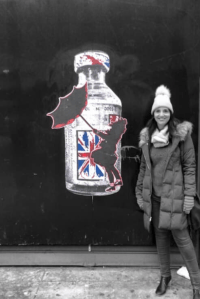
Appleton on W 23rd street.
But even before meeting Appleton, I’d seen the power of how different artforms have the potential to talk diabetes in different ways.
Australian actor and playwright, Alan Hopgood’s play ‘A Pill, a Pump and a Needle’ from a few years ago, told the story of three women living with diabetes. Chatting after a chance encounter in a café over coffee and cake, this was a quintessential Melbourne story! But it was also a great way to start a conversation with those who were lucky enough to see the play. I sat in the audience a number of times, then took to the stage to be part of the panel discussion. Mine was one of the stories that had been brought to life on stage and it was incredible to hear the number of people who watched the play and said that they could see themselves in the women’s stories. ‘Their stories are my stories are their stories,’ I would think to myself.
One year, my team at Diabetes Vic held an art competition for World Diabetes Day, asking children living with diabetes to submit an artwork depicting diabetes. The only requirement for submission was that the artwork needed to somehow incorporate the Blue Circle. I remember the way these pictures offered a most meaningful and impactful representation of life with diabetes – in ways that we’d not seen before. I still have one of those artworks hanging in my office. Its 14-year-old artist managed to perfectly capture the pain of diabetes balanced perfectly with the hope she felt. I’ve been looking at it a lot in the last week, breathing in deeply and letting her feelings of hope wash over me.
A number of years ago, The Diabetes Hands Foundation asked for submissions for an anthology of poems by people with diabetes. Selected poems were compiled in the book ‘No-Sugar Added Poetry’ – a copy of which sits on my bookshelf and is frequently pulled down and perused. In her introduction, Lee Ann Thill says ‘From words, carefully chosen, purposely arranged, emerges a shared experience and mutual understanding’. In other words, peer support through poetry.

And while mentioning Lee Ann… Diabetes Art Day was created by this dynamic advocate and art therapist to encourage people affected by diabetes to use whichever artform they wanted to express diabetes. I remember sitting around the kitchen table with my family, trying to show how we feel about diabetes with coloured paper, glue sticks and rubber letter stamps and ink.

Illustrator, Janina over at Miss Diabetes is absolutely brilliant in her depictions of diabetes. And, of course, comics by Claire Murray are still my favourite diabetes superhero tales. And my friend Weronika at Blue Sugar Cube, creates stunning pieces – her Spare a Rose designs were so gorgeous.

Click to be taken to Weronika’s Insta page.
Australian advocate Jenna’s artwork is nothing short of stunning. I bought one of her beautiful images earlier this year and need to get it framed so I can stare at it endlessly when I should be writing!

Click to be taken to Jenna’s Insta page.
Melissa Lee has combined her beautiful voice, brilliant sense of humour and story-telling powers to sing diabetes in ways that get us thinking, smiling, laughing…and crying.
As for me? Well, I create through baking and have managed to create some pretty damn fun and delicious cookies to mark important days and initiatives in the diabetes calendar.

And of course, storytelling is an artform, and I know that for me personally, that is how I have connected and felt supported by people affected by diabetes from every corner of the globe. Words have a power that can convey the very helplessness, hurt, hope and heartbreak that is real in diabetes, and as I frequently say, the stories people tell have always helped me make sense of my own diabetes.
Art has the power to reach people in ways that other, more traditional methods don’t. Health campaigns are important, but sometimes they seem just one step removed from the reality of real life. Art has the power to bridge that step and bring people together, and provide a fundamental understanding of the story being told, and the people behind those stories.
So back to the quote that opened this post: art can – and does – shape how diabetes is seen within and outside our community; it can influence how people outside the diabetes community understand diabetes, and within the community, offer different ways to think of things. It can start conversations that encourage us to consider others’ ideas; it pushes boundaries and forces us outside our comfort zones; it gives voice to people in the community who don’t necessarily want to use words to express how they feel. Advocacy using art can also cut through the white noise of health campaigns – often they all look and sound so similar that they are easy to ignore. But for me, I think the most powerful thing they give is humanity and hope to a condition that is often so misunderstood.
Diabetes burnout is real, and it takes many different forms. In the past, I have been burnt out to the point of a complete inability to do any sort of diabetes task. Other times, I have just muddled along with low-level haziness and apathy with and at my diabetes. Sometime burnout has been caused by such a deep hatred of diabetes that the very idea of actually managing it is impossible. Focusing on diabetes after a miscarriage ridiculously felt like a betrayal to the baby I’d been unable to keep. My broken body had not been able to carry a baby, and there I was still tending to it – to the very part of it that I held responsible for the loss.
Today, I am burnt out but in ways that are different and if there was such a thing as a burnout spectrum, I wouldn’t think that I am at the really serious pointy end. I suspect part of that is that those diabetes tasks that once seemed impossible during periods of debilitating burnout are far fewer these days. Having to refill a cartridge and change a canula every three days, calibrate a CGM occasionally, and change a sensor even less occasionally is manageable for me even while I am feeling the way I am right now.
The bottom line is that at the moment, I don’t want to do diabetes and that is a big shift from where I have been since using Loop. It is also a big shift from where I usually am after attending a diabetes conferences and being surrounded by friends. This usually gives me a kick of motivation and focus, allowing me to put in a little more effort which generally yields pleasing results.
Instead, I am a mere 48 hours back from one of those occasions of peer support and I am staring at diabetes with that deep-seated hatred that feels unfamiliar these days. This has not sprung on me all of a sudden. It’s been brewing and fermenting over the last few months. It’s a combination of diabetes being diabetes and some advocacy burnout that has hurt me in ways I never imagined possible. I’ve not felt comfortable mentioning it because what the hell do I have to be burnt out from? My automated insulin delivery device that does most of the heavy lifting for me? The CGM on my arm that barely beeps at me? The support of friends and family? The ease of access to any sort of health professional I need? My diabetes isn’t first world diabetes, it’s first class diabetes so why would I possible be feeling crap about it all? (Oh good, let’s add some guilt to the way I’m feeling too then, shall we?)
And I’ve not felt comfortable mentioning it because, apparently, I am so self-confident and resilient that these things aren’t meant to happen to me. Or rather, that is the perception that a number of people have felt the need to share they have of me. (If anyone can locate that resilience, I’d really like some of it back. It is AWOL in the same way my beta cells are, and I am finding this all rather inconvenient.)
This brand of burnout has been joined by something new. I have had a couple of panic attacks over the last few weeks and the repercussion of those has been to suddenly feel very wary about my ability to make decisions about diabetes – my own and how I read things in the wider diabetes world. I am back to second guessing myself – a behaviour that I really had managed to positively change thanks to devices that I trust implicitly. As it turns out, those devices are smarter than me and as much as I was a maths whizz at school, I am no match for an algorithm that knows my diabetes better than I do.
But the bits I need to do? I’m misfiring left, right and centre.
I stared at a low glucose level on my Loop for two hours yesterday, unable to process exactly what I needed to do to deal with it. The low was entirely my fault. I’d forgotten to change the time on my pump when I arrived back into Melbourne because I was dealing with a more pressing matter – namely, staying out of quarantine. (Airport panic attack led to me trying to remember how to breathe properly rather than making that time zone change. I felt it better I focus my efforts on minimising the effects of said panic attack in an endeavour to keep away staff on heightened alert because of a global respiratory virus epidemic.)
I did a sensor change yesterday morning and it bled all over the place and felt terribly painful, and instead of just ripping it out and starting again, I wept – at the blood, the waste of a thrown-out sensor. And having read not long ago someone refer to CGMs as non-invasive.
So here I am. Burnt out, overwhelmed and feeling broken into little pieces. Oh, and terrified to write about it because I am finding corners of the world that I usually turn to when I am feeling like this not especially kind at the moment. (Unlike other times when my tribe has been amazing as I’ve navigated the tricky waters of the burnout continuum.) But I’m sharing anyway, because it’s what I do, and my mess is my mess and this blog is my blog and so somehow this feels the right place to dump the chaos and clutter I am trying to tidy up and make sense of.
Burnout is real. This feels hard and sad and more than a little scary. And it’s a reminder that no matter how well we think we are doing with diabetes – and no matter how we seem to be on top of things to others – there is always the chance that it overcomes us. That seems just so terribly, terribly unfair.

What would you change about your diabetes diagnosis?
Mine was almost 22 years ago, but much is still fresh in my mind. While there is a lot I am eternally grateful for, such as the speed and accuracy of diagnosis, and the way I was easily able to access specialist care, there are things that I wish were different.
One of those things is the line-up of HCPs that was offered to me. Making sure I knew the basics of daily diabetes management, the importance of knowing how many carbs I was eating, and the impact of activity, were, of course, critically important to learn before I was sent on my way. But diabetes was presented to me with this very one-dimensional approach. It was all about the magic carb/insulin/activity equation. Get that right and all would be relatively simple.
I had the relevant HCPs that could help me get that equation right – the endocrinologist, the diabetes educator and the dietitian. This was the holy trinity of diabetes care, I was told. This was the team that had diabetes knowledge to share.
And perhaps, if I’d been able to keep diabetes all about numbers, that trio would have been enough. Alas, it didn’t take long for this new-to-me medical condition to move to my head. No one mentioned the anxiety and fear that started to accompany the distress that was due to not being able to meet any of the targets I’d been set, and feeling overwhelmed by just how much diabetes there was to do. Or the disordered eating that may creep into my thinking because of this sudden focus on food in a different way. Or the crippling fear of complications that was keeping me awake at night.
I wish a version of these words had been said to me: ‘Diabetes is not easy. You can do this, but it is not easy. But we are here to help you. And endocrinologist and educator can help you with the practical side of diabetes. Food questions can go through your dietitian. We have an arsenal of allied health professionals to think about when it comes to doing all we can to reduce the risk of diabetes-related complications. And if you ever feel that you are becoming overwhelmed or anxious or distressed, if you ever want someone to talk with someone about how you are feeling to work through what’s going on outside the clinical aspects of diabetes, we have someone here for that too. It is perfectly, perfectly normal for you to feel all of those things. It is also perfectly normal for you to not feel them! We can help with whatever you need.’
Planting that seed would have made those first few years – those years before I found an endocrinologist who did say those words to me – so very, very different. I may not have understood why I might need, or rather want, to see a psychologist straight away – I didn’t understand what diabetes was, let alone how it was going to impact on my emotional wellbeing – but I wish that I had known from the very beginning that I had easy access to a one if and when I needed it. And that it was perfectly understandable if I did.
While I believe that GPs, endocrinologists and educators all have a role to play in talking about emotional wellbeing, they are not experts in this area. Having our diabetes HCPs acknowledge the high mental burden diabetes places on us is reassuring, but they may not be equipped with the strategies to help us lighten that load. But a psychologist can – especially one that works with people living with diabetes or other chronic health conditions. Plus, I repeatedly see HCPs say that they don’t have time as it is to ask about mental wellbeing, because there is already so much to do in the allotted appointment time.
Here’s the thing: so, so many people with diabetes are not reaching targets. Now, while I don’t agree with measuring diabetes success on numbers, that is still the way that it is done in many settings. And with that in mind, so many of us are above recommended glucose levels and our A1cs don’t even closely resemble what guidelines tell us to aim for. Clearly what we are doing now isn’t working, in fact, I’ll be so bold as to suggest that the current standard HCP line up is not necessarily best for PWD. Would adding a psychologist to the mix help? Would the expertise a psychologist can offer to help us learn how to address behaviour change, distress, anxiety result in not only feeling better about diabetes overall, but also improve those other measures?
I am not for a second suggesting that everyone with diabetes should have to see a psychologist. I don’t think that PWD should have to see any HCP they don’t believe is helping. But I do believe that we should be able to access a psychologist as easily and readily as we can any other diabetes HCP. Psychologists should be integral in multidisciplinary teams in diabetes clinics in the same way that educators, dietitians and endocrinologists are.
In my experience, it wasn’t until I started working with a psychologist that I got any benefit from seeing the rest of the diabetes team. Go check out the hashtag #DiabetesPsychologyMatters for some more commentary on this from PWD, psychologists and clinicians. It’s already gaining momentum, but I think it’s time that it really took off…

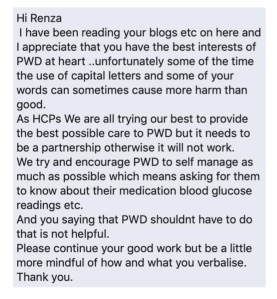
Tuesday last week, I woke up to find this message in my Twitter DMs. I read it and read it again. It accompanied a tweet or two to me about my blog post from the previous day.
I debated about whether or not I should share this publicly. I wrote some words, walked away, came back to them, walked away, asked a few friends their thoughts, walked away, wrote a bit more and walked away again. I posted it to my closed Facebook page to get some feedback from others and wondered if that was enough.
But then remembered this blog post. #StandUP.
So, here I am, standing up. Because I am upset and angry.
I am not upset and angry that someone didn’t like or disagreed with what I wrote. It would be frightfully boring if we always all agreed with each other and loved the same things.
I am not upset and angry that this message was unsolicited. I believe that people don’t need an invitation to comment when I write and publish things on a public forum. I invite all feedback – good and not so good.
I’m not even upset or angry that I don’t understand what was being referred to in the message. I re-read and re-read and re-read my post, and I can’t see where I ever, ever said that people with diabetes shouldn’t self-manage, or know what meds they’re taking or what their glucose readings are. I couldn’t find it in there. But, people interpret things differently and perhaps my writing wasn’t as clear to them as I thought it was.
I’m not here today to defend the content in that blog post, because that’s not what this is about.
I am upset and angry that I was being told to ‘be mindful of what and how I verbalise’. This is called tone policing. It is telling me that I should moderate the way that I talk and think about my own diabetes. This was an opinion piece. My opinion. People don’t need to agree with it – and they can tell me they don’t. But telling me to moderate the way that I communicate is a very different thing.
I will forever call out and stand up to anyone who tells me, or others with diabetes, to restrain our feelings or opinions, and that is why I am writing this post. Because more than anything, I believe that we have a right to express how we feel about diabetes, in the way we want to, especially when we are sharing our own opinions or experiences. When we are told to be mindful of what and how we are writing/speaking it is a step on the way to censoring and silencing us. We already do that enough.
Often, in clinical settings, we moderate the way we speak. We might minimise how tough things are, or don’t speak out about the way we are treated or the judgement we face. When we are told that we’re not doing enough and are failing, we look down, afraid to stand up for ourselves.
And so, we created spaces where we could be free to share and rant and cry in a way that gave us some comfort. We turned to others who are likely to have had similar – if not identical – experiences. We share our opinions, some of them unpopular, thought-provoking and challenging of the status quo because we feel we have the liberty to do just that.
We have had to be quiet for too long. But that should never be the case in our own space.
The diabetes online community is that space. Twitter, when we use our #xxDOC (or #DSMA) hashtags is that space. Other online and offline support opportunities and groups we have created is that space.
And this blog (and others written by PWD) is that space.
So, back to the message I received last week. I did ask for clarification, and for examples of where I’d used capital letters or words that could be considered harmful, but I didn’t get a response.
Just this message:

No answers, just a threat to mute me. To silence my voice. Sure, it is only being silenced on this one person’s twitter stream, but that was the response to me refusing to be ‘compliant’ and agree with a healthcare professional’s demands that I tone down the way I write about my own opinion. I had not been aggressive, abusive or rude. I had just shared my own opinion and thoughts in my own voice. In my own space.
These days, I usually don’t show my glucose data online. When I first started Looping (about two and a half years ago), I regularly posted the flat CGM lines that amazed and surprised me. I also shared the not-flat lines that showed how hard my Loop app was working as temp basal rates changed almost every five minutes. The technology worked hard so I didn’t need to, and the results were astonishing to me. I shared them with disbelief. (And gratitude.)
I stopped doing that for a number of reasons. It did get boring, and I definitely recognise my privilege when I say that. I also acknowledge my privilege at being able to access the devices required for the technology to work. And there was the consideration that sharing these sorts of stats and data online inevitably lead to comparisons and competition. That was never my intention, but I certainly didn’t want to add to someone having a crappy diabetes day while I blabbed about how easy my day had been.
But today, I’m sharing this:

This was my previous 30-day time in range data from the Dexcom Clarity app on the day I arrived back home in Australia after returning from New York. (My range is set to 3.9mmol/l – 8.1mmol/l.) I’m not sharing it to show off or to boast. I don’t want congratulations or high fives. In fact, if anyone was to see this and pat me on the back, I would respond with the words: ‘I had very little do with it’.
I can’t really take credit for these numbers and would feel a fraud if anyone thought I worked hard to make this happen. Using an automated insulin delivery system full time means that I do so much less diabetes than ever before while yielding time-in-range data that I could once only dream of.
I want to share it, not to focus on the numbers (because it’s NEVER about the numbers!), but to explain what happens when diabetes tools get better and better, and what that means in reality to me.
Those thirty days included the following: End of year break up parties for work and other projects (four of those); ‘We-must-catch-up-before-the-end-of-the-year’ drinks with friends (dozens of those!); actual Xmas family celebrations (three of those over a day and a half– and I’m from an Italian family, so just think of the quantities of food consumed there). Oh, and then there were the three weeks away in NY with my family. Our holiday consisted of long-haul flights from Australia, frightful jet lag (there and back), a lot of food and drink indulgences, out-of-whack schedules, late nights, gallons of coffee, no routine, and more doughnuts than I should admit to consuming.
Add to that some diabetes bloopers of epic proportion that had the potential to completely and utterly railroad any best laid plans: insulin going bad, blocked infusion sets, sensors not lasting the distance, a Dex transmitter disaster.
And yet, despite all of that, my diabetes remained firmly in the background, chugging away, bothering me very little, with the end result being time in range of over eighty per cent.
This graph is only part of the story of why I so appreciate the technology that allowed me to have a carefree and relaxed month. Diabetes intruded so little into our holiday. I bolused from my iPhone or Apple watch, so diabetes devices were rarely even seen. Alarms were few and far between and easily silenced. I was rugged up in the NY cold, so no one even commented on the Dex on my upper arm. The few times I went low, a slug of juice or a few fruit pastilles were all it took, rather than needing to sit out for minutes or hours. Diabetes didn’t make me feel tired or overwhelmed, and my family didn’t need to adapt and adjust to accommodate it.
That time-in-range graph may be the physical evidence that can point to just how my diabetes behaved, but there is a lot more to it, namely, the lack of diabetes I needed to do!
As I spoke about this with Aaron, he reminded me of my well-worn comments about not waiting around for a diabetes cure. ‘You’ve always said that although you would love a cure, it’s the idea that diabetes is easier to manage that excites you. Ten years ago, when you spoke about what that looked like, you used to talk about diabetes intruding less and being less of a burden to your day. That is what you have now. And it is incredible.’
A very smart friend I met through Twitter, and has become a treasured IRL friend, says that when publicly telling our diabetes stories we may have opened a window into our lives, but that doesn’t mean we need to open a door. We get to choose how we protect ourselves and who we let in.
I choose to leave the window open and have come to learn over the years that as more and more people walk by, more people see what is going on inside. I know I can shut the window and draw the blinds any time I choose, and I did that for a short time at the end of last year. But mostly it is very, very wide open.
But having an open window to glance into doesn’t give anyone the right to yell that they don’t like what you see through the window, especially if I don’t ask. And certainly make sure that you have a good look and understand what you are seeing before you start to tell me that I am wrong about my decorating choices.
My window is on one side of the street. You can cross the road to avoid looking in. Or you can walk by, but not stop for a chat.
I choose what it looks like inside my window. I choose where the furniture goes, how it looks and feels. I live in it the way that works for me. I’m not a professional window dresser or decorator, just someone who knows what looks and feels good to me. I have never given decorating advice because I am not a professional decorator. Just a person living in this room that can be seen through that open window.
This blog is my open window. I welcome anyone who wants to peek inside. No one has to be here, but they’re welcome if they want to be. Some people might have a quick look and decide that it is all a little too frivolous or boring. They may think the things I get worked up about are a waste of time and that there are far better things to spend energy on. They may think it’s all naval grazing. They may think there are far too many pink stripes. That’s okay. It probably is a bit of each of those things, but it works for me. I sometimes write my thoughts on things in the broader diabetes world – and that may not be your take. That’s okay, too. We don’t need to agree on everything. I’m here, narrating my diabetes and how that intersects with the rest of my life, the world around me, the people I love.
Sometimes, I do that with great vulnerability. I share stories that are painfully personal and sometimes very raw. I try to infuse humour in there because sometimes, living with diabetes hurts so, so much that I need to break that up with something amusing.
I write about those sensitive topics, as well as more general day-to-day subjects, and that is not a decision I make lightly. I do it for selfish reasons – I hope that by telling my story I might just find someone who has a similar experience who can share their wisdom with, and help, me. Another reason is that I don’t want anyone to feel the loneliness and isolation I have felt at times. Diabetes can be lonely. Diabetes on top of other really tough things, such as infertility and pregnancy loss, parenting, mental illness, distress, diabetes-related complications can feel isolating.
If you don’t like what you see in here, that’s perfectly okay. If I have said something factually incorrect, I would really like to know about it so I can correct it. You can tell me about typos (I know there are many) and eventually, I may get around to fixing them. If I have upset you, I would love to understand why and welcome that discussion if you’re comfortable doing that. You can leave a comment – anonymously if you would like – sharing your thoughts.
But don’t ever tell me that I need to change what you read here because you don’t like what you see. Don’t tell me that I need to moderate what I say, or the tone in which I choose to say it. I have chosen to open the window into my diabetes life. But I have not ever chosen to be told how to live that life.

Outside looking in.
Recently, the Australian of the Year was announced. This year, the gong was awarded to Dr James Muecke, an eye surgeon from South Australia, who was acknowledged for his work raising awareness of type 2 diabetes and its links to preventable blindness.
I didn’t really know of Muecke before the announcement, but clearly, he is very accomplished, and his work reaches beyond Australia’s borders. He co-founded social impact organisation, Sight for All, which raises funds to deliver vision-saving programs and eye health projects to people in under-resourced countries.
However, it is Muecke’s work in linking type 2 diabetes and blindness that received the majority of the media coverage, with (as can always be relied upon) some pretty average reporting. Interviews with and soundbites from the newly crowned Australian of the Year did focus on a simple and incorrect equation of sugar equalling diabetes, and this certainly did seem to concern a lot of people responding to what they were seeing online.
I sighed as I read through a lot of that commentary, dismayed as the calls to differentiate between the types of diabetes drowned out Dr Muecke’s award, with repeated bleats that ‘Sugar didn’t cause my/my child’s type 1 diabetes’.
Sugar didn’t cause anyone’s diabetes – it’s just not that simple. I appreciate wanting people to understand that drinking too much Coke isn’t why type 1 diabetes develops. But equally, I want people to understand that it isn’t why type 2 diabetes develops either.
Asking for clarification of the different types of diabetes isn’t always necessary because it doesn’t always matter. You bet that it does matter at times, but other times, it really doesn’t.
We see this time and time again. Think about the time that café in Sydney thought they were being cute by calling a dessert ‘Diabetes’, or the time that guy on that UK cooking show referred to something as ‘Diabetes on a plate’. Was this really the time to get all uptight because the difference between type 1 and type 2 diabetes were not specified? Were the calls to stop stigmatising type 1 diabetes by not clarifying that ‘our’ diabetes isn’t because we ate that dessert? Does it matter in these moments if the person stigmatising and misrepresents diabetes doesn’t point out which sort of diabetes?
It really doesn’t. If the dessert was called ‘type 2 diabetes’ or the recipe was ‘type 2 diabetes on a plate’, it still would have been wrong. It still would have been stigmatising.
And yet, every time another lousy comedian, or celebrity or chef makes a diabetes joke, or the media gets diabetes wrong, or the Australian of the Year explains diabetes in the wrong way, the predictable cries, and rapid soundbite responses only feed into the stigma, prejudices and misconceptions of type 2 diabetes.
We can do better – we need to do better. And we can, by being more thoughtful in our response to correct people getting diabetes wrong.
I should point out that this goes beyond people with (or parents of children with) type 1 diabetes. Lots of other diabetes stakeholders get into it too. Some health professionals trip over themselves in their endeavour to speedily demand clarification of type, (even when it is not necessary). This has always left me somewhat befuddled and wonder if they think this will win them brownie points with the cool kids on Twitter. Surely HCPs working in diabetes understand that sometimes putting ‘type 2’ before diabetes is not actually rectifying what is factually incorrect in the original statement. And that should matter, a lot more than the ‘likes’ from the type 1 diabetes Twitterati they seem so eager to impress!
We can get it right, and get it right quite easily. When the Australian of the Year announcement was made, the comms team at Diabetes Australia absolutely nailed the messaging, striking a balance between commending Dr Meucke for his award, acknowledging how wonderful it was to see the Australian of the Year platform being used to highlight the link between diabetes and diabetes-related eye disease (with a plug for KeepSight!), and adding a note to clearly and eloquently explain the complexities of type 2 diabetes, the role that genetics and other non-modifiable risk factors play in its diagnosis, and reminding people that type 2 diabetes is not caused by eating sugar.
I think the team got it right – the information was correct and accurate and did not in any way add to the stigma of diabetes. (Disclaimer: I work for Diabetes Australia and I’m talking about my colleagues. Whilst I sometimes work with the comms team, they are all far smarter and better at communicating than I could ever hope to be. Which is possibly why they won’t let me near any of our socials. That, and they worry I’ll swear, or share an Effin’ Birds cartoon…)
Each type of diabetes – and there are many! – has its own complexities and some of the time we need to make sure that it is clear which diabetes we are talking about. But next time you find yourself about to take to the keyboard to correct some misinformation, ask if you are actually adding to that misinformation. And if you see someone demanding such clarification, ask them if they are aware they are contributing to type 2 diabetes stigma. Because I think a lot of the time that is exactly what is happening.

Complete digression, but the title of this post reminded me of these books, which anyone who has been around kids in the last 15 or so years would know about!
My packing-for-travel routine is pretty relaxed. We left for New York at 8am on Boxing Day and I started packing when we got home from our five millionth family gathering at about 10pm on Xmas night.
Admittedly, my laid back attitude to diabetes-supplies packing could be because I usually spend my time travelling surrounded by other PWD who are far better organised than I could ever hope to be. I know that if I run out of insulin, pack the wrong glucose strips for the meter I’m carrying or forget a charging cable, someone will be able to help me out. (I know this because these things have all happened. More than once. Way more than once.)
Anyway, I thought that I had done a pretty damn good job of throwing everything I needed together for New York, with back up supplies and contingencies. As we headed to the airport bright and early, still full of my mother’s Xmas zippoli, I felt comfortable that diabetes was going to be a relatively easy companion on this trip.
Turned out that I got it mostly right. Just not completely!
Issue one happened when I got a transmitter low battery warning the first week we were in NY. ‘Bugger,’ I thought, remembering back to the last time I recharged my Fenix G5 transmitter*. It was while I was sitting at breakfast one morning in Boston at ISPAD. I recalled that I definitely hadn’t had the transmitter plugged in long enough for a full charge. At the time, I thought I’d charge it fully the next time I did a sensor change…and then promptly forgot.
Of course, I had forgotten to pack the very specific charger required to recharge my Fenix. And I couldn’t for the life of me remember what it was called. ‘It has two little magnetic-y things on the side. And it’s kind of shaped like this,’ I said sketching a rough picture to the people behind the counter in about fifteen electrical stores around the city.
After getting nothing more than blank stares, I went directly to the source – Facebook – and sent a message to a couple of tech friends back home (including the bloke responsible for building the device). I had a response minutes later, placed an Amazon Prime order straight away and two days later my Fenix was charging on the kitchen counter in our apartment.
I had a re-batteried travel transmitter with me that I used in the interim (with layer upon layer upon layer of waterproof tape over the top of it because I had also forgotten to pack the resin needed to finish off that little device…), but as soon as the Fenix was fully charged, I reset it and shoved it back into the still in situ sensor. Crisis mostly averted.
And then there was the run in with Dex sensors. I’d sited a new sensor a day or two before we left and took two spares with me. I usually get three weeks out of a sensor, so thought that if lucky I wouldn’t even need to change one at all during our time away. But if I did, I would be right and have another there … and a spare just in case.
Well, best laid plans and all… the original sensor failed after less than a week. The second sensor did too, and the third sensor was actually faulty – the needle scarily poking out the end as I released it all from the packaging.
I believe the word I used at that point was ‘Fuck’. Loudly. And then turned straight back to Facebook with this:

A few NY friends reached out and shared the post, and within an hour, I had organised to meet up with someone who could help me out. Thanks a million to Stacey for connecting us, and thanks two million to Caroline who rode into Manhattan with her ridiculously beautiful baby to drop off sensors to me and have a coffee. (Off topic, but Caroline and I thought this was our first-time meeting, but we realised later that we had met for dinner one night in New York back in 2011!)
I am forever grateful for the support I receive from my peers online – and being my back up plan because I am so crap at diabetes. I do promise to try to do better when getting myself organised for travel, but I know that I am still likely to get things wrong. Diabetes is a hard task master and demands a lot. Slip ups happen.
But there is always help at hand. I was off Twitter at the time, feeling particularly vulnerable after the brutal time on there at the end of the year. Thankfully I had Facebook to turn to and a huge group of diabetes friends there to help me out. But what if that wasn’t the case? This is why our online spaces must be safe at all times, and why that power imbalance between HCPs and PWD, and how potentially harmful that can be, needs to be recognised. We need to feel safe reaching out wherever our peers are for whatever support we need. I did that and that’s why this blogpost is called ‘Peer support on the road’ rather than ‘Loopless in New York’!

Back to the important things.
* I use a rechargeable G5 transmitter with my Dexcom, built by a very clever bloke in Australia.
I wrote a post a while ago called ‘You Do You’, (and revisited and expanded on it here). It’s where I wrote about how everyone should have the freedom to do diabetes whichever way they see fit. I’m pro-choice in all aspects of life*, especially when it comes to PWD choosing their own management tools.
And I think that people with diabetes should have the choice to BE the people we need to be. And the people we are. I touched on this on my post on Monday when I spoke about how I felt intimidated online because my opinions and thoughts, and the way I addressed issues, were not everyone’s cup of tea. I felt that I was being called out for being myself. And that wasn’t okay.
No two people with diabetes are the same; no two people with diabetes will have precisely the same management ideas and preferences, and no two people with diabetes will react and respond to situations in exactly the same way.
THAT IS OKAY.
Diabetes is messy, frustrating, weird, annoying, amusing (rarely, but sometimes), scary, boring and a whole lot of other adjectives. And how we react and respond to it is our own business and no one else’s. You BE you, because you have the right to do that.
You have the right to be as loud or as quiet as you want.
You have the right to be as bitter and angry as you need to be in the moment.
You have the right to celebrate and be joyful about your diabetes.
You have the right to call out things that upset you just as much as you have the right to commend the things that make you satisfied.
You have the right to step away from groups, situations, people who upset you.
You have the right to disagree with others. Having an opposing view does not mean that you are attacking another person.
You have the right to have an opinion on what you see in the world of diabetes – even if it is happening on the other side of the world. I was incredulous when it was suggested that I shouldn’t question something happening in a healthcare system of which we are not a part. (I may not use the healthcare system in the US or the UK or Italy or anywhere other than Australia, but I am allowed to comment on what I see being done in those places.)
You have the right to be passionate and not be told that is a character flaw.
You have the right to be emotional because diabetes is real in a way that only makes sense to those of us who are living with it or have a loved one living with it. I don’t know how to take the emotion out of this, so you bet I will be emotional at times. I don’t get to clock off at the end of the work day and not think about it.
You have the right to use the words and language that works for you when talking about your own diabetes and if anyone tells you that #LanguageMatters is actually preventing PWD from doing that, tell them to fuck right off. It’s not. It never was. It never will be, and anyone who says it is has missed the point of the whole movement.
You have the right to use the word ‘fuck’ or whatever else you want to use. Profanity helps some people and we shouldn’t be told to wash out our mouths if others don’t like us using those words. (Sorry, dad.)
You have the right to be the sort of advocate you want to be. Or to not be an advocate.
You have the right to share your experiences – even the ones that don’t shine a particularly positive light on health systems or HCPs. No one – NO ONE – should silence us when we turn to our peers to seek support, or talk about what is going on in our diabetes lives.
You have the freedom to talk about your own diabetes, especially in the diabetes online community which we created for this very reason – to be able to share our experiences, learn from each other, support our peers and build each other up.
So, this? This is me being me. This is me standing up and not going quietly. This is me saying that I will be the person with diabetes I need to be, because it’s the only way I can be true to myself and true to my community.
*Except vaccinations. I don’t believe in choice there.





 Diabetogenic