
You are currently browsing the category archive for the ‘Diabetes’ category.
Today is the day. The centenary of what remains one of the greatest medical discoveries ever. Here is a reworked post (first published here). There is not a day that I am not grateful for this discovery. And not a day goes by when I am not aware that the diabetes life I live and the access I have is not the same for everyone around the world.
And so today seems a really good day to make a donation to a charity that supports people with diabetes who need it. For me, when deciding which diabetes charities I’ve decided to donate to, it’s been important that the support is tangible. And that’s why I have repeatedly written about Life for a Child, and Insulin for Life on this blog, and supported them with regular donations for a number of years. Their works provides on the ground support, medications, diabetes supplies, education, as well as doing research. They also have an advocacy function, raising awareness of not only the work they do, but the people they support.
If you are able to make a donation it’s a great day to do it. In amongst the celebrations it’s important to remember not everyone will be able to do that today. Remembering them on this important day in diabetes history is very fitting.
Donate to Insulin for Life
Donate to Life for a Child
______________________________________________________________
There has been lots of discussion about what happened 100 years ago today – on 27 July 1921. University of Toronto scientists Fredrick Banting and Charles Best successfully isolated the hormone insulin. Today, that means that I am alive and kicking, 20 years after my islets stopped making any.
It means that type 1 diabetes treatment moved from being a starvation diet and not much else, to injecting a drug that was life giving and life saving.
It means that I take a drug that while giving me life, is also lethal and if not dosed carefully and with great consideration can cause terrible side effects.
It means that people with diabetes don’t die terrible, agonising deaths simply because they were diagnosed with diabetes.
It means that I need to be able to do crazy calculations to ensure what I put into my body completely and utterly imperfectly mimics what those with functioning islet cells do completely and utterly perfectly.
It means that there is a treatment therapy that gives us hope and life and allows us to live – sometimes very long, long lives.
It means that each and every day I feel fortunate to have been born when I was and not 100 years earlier.
It means I take for granted that I have access to a drug that keeps me going.
It means that there are far too many people around the world who still do not have access to the drug I take for granted. And 97 years later, that is not good enough.
It means that it was 97 years ago – 97 years ago – since the discover of insulin to treat diabetes and we are still without a cure.
And it means that I wonder when there will be the next breakthrough that is as significant and meaningful and life changing and life saving as what those two Canadian scientists discovered 97 years ago.
But mostly. It means that I live with hope. Hope that those scientists are somewhere working away, and perhaps – just perhaps – are about to find that next big breakthrough.

I’ve just placed an order so I can have this print in my office at home.
Alex is donating 20% of all sales of this print to Type 1 International, another charity I have written about a number of times, and supported financially.
You can see more artworks by Alex at her website, Diabetes by Design.
A week out from National Diabetes Week, and this piece has been sitting in my ‘to be published’ folder, just waiting. But the post-NDW exhaustion coupled with lockdown exhaustion, plus wanting to make sure that all my thoughts are lined up have meant that I haven’t hit the go button.
In the lead up to NDW I wrote this piece for the Diabetes Australia website. That piece was a mea culpa, acknowledging my own contribution to diabetes-related stigma and owning it. I also stand by my thoughts that the stigma from within the community is very real and does happen.
But what I didn’t address is just where that stigma comes from. Those biases that many people with type 1 diabetes (and those directly affected by it) have towards type 2 diabetes come from somewhere, and in a lot of cases that is the same place where the general community’s bias about diabetes comes from. It is all very well for us to expect people with type 1 diabetes to do better, but I’m not sure that is necessarily fair. I think that we should have the same expectations of everyone when it comes to stamping out stigma.
And so, to the source of stigma and, as I’ve said before, it comes from lots of places. As someone who has spent the last twenty years working in diabetes organisations, I know that the messaging my orgs like (and including) those that have paid my weekly salary has been problematic. I still am haunted by the ‘scary’ campaign from a few years ago that involved spiders, clowns, and sharks. (If you don’t remember that campaign, good. If you do, therapy works.)
For me personally, I don’t think much stigma I have faced has come at the hands of other PWD. Sure, there’s the low carb nutters who seem to have featured far too frequently on my stigma radar, however, the most common source of stigma has undoubtedly been HCPs.
It’s not just me who has had this experience. The majority of what I have seen online as a response to experiences about stigma involves heartbreaking tales of PWDs’ encounters with their HCPs.
While I will call out nastiness at every corner, and no stigma is good stigma, it must be said that there is a particular harm that comes when the origin of the stigma is the very people charged to help us. Walking into a health professional appointment feeling overwhelmed, scared, and frustrated only to leave still feeling those things, but with added judgement, shame and guilt is detrimental to any endeavours to live well with diabetes. In fact, the most likely outcome of repeated, or even singular, experiences like that is to simply not go back. And who could criticise that reaction, really? Why would anyone continually put themselves in a situation where they feel that way? I wouldn’t. I know that because I didn’t.
It’s one thing to see a crappy joke from a comedian who thinks they’re being brilliantly original (they never are) or the mundane, and almost expected, ‘diabetes on a plate’ throwaway line in a cooking show, but while these incidents can be damaging, they are very different to having stigmatising comments and behaviours directed at an individual as is often the case when it is from a HCP.
Of course, HCPs aren’t immune to the bias that forms negative ideas and opinions about diabetes. In the same way that people with type 1 diabetes form these biases because those misconceptions are prevalent in the community, HCPs see them too. Remember this slide that I shared from a conference presentation?
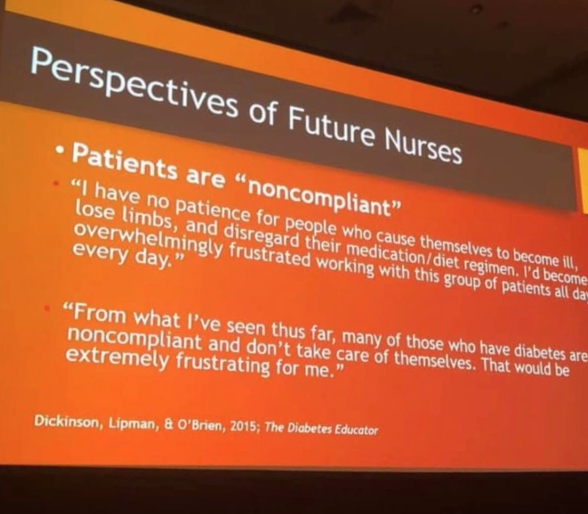
This came from student nurses. Just think about that. Students who were training to be HCPs who would inevitably be working with people with diabetes. A I wrote at the time:
‘They hadn’t even set foot on the wards yet as qualified HCPs. But somehow, their perceptions of people with diabetes were already negative, and so full of bias. Already, they have a seed planted that is going to grow into a huge tree of blaming and shaming. And the people they are trusted to help will be made to feel at fault and as though they deserve whatever comes their way.’
Is it any wonder that, with these attitudes seemingly welded on, that people with diabetes are experience stigma at the hands of their HCPs?
The impetus can’t only be on PWD to call this out. And the calls to fix stigma can’t exclusively rest on the shoulders of PWD – we already have a lot of weight there! It must come from HCPs as well – especially as there is such a problem with this group. Perhaps the first step is to see real acknowledgement from this group of their role here – a mea culpa from professional bodies and individuals alike. Recognising that no one is immune to the bias is a good step. Owning that bias is another. And then doing something about it – something meaningful – is how we make things better for people with diabetes. I really hope we see that happening.
More about this:
Becoming an ally – how HCPs can show they’re really on our side.
Ask a group of people with diabetes about their experiences of stigma, and for examples of the sorts of things they’ve heard and before long you’ll be able to compile a top ten list of the most commonly heard misconceptions that have contributed to diabetes having an image problem. When I’ve asked about this recently, the main perpetrators of these seemed to be healthcare professionals. More on that later this week.
This year, in the Diabetes Australia National Diabetes Week campaign about diabetes-related stigma, two videos have been produced and they’re almost like a highlight reel of some of the stigmatising things people with diabetes hear.
Let me tell you something I found really interesting. As part of the testing of these, I showed them to a heap of people with diabetes and a heap of people without diabetes. The reaction from people with diabetes varied from sadness (including tears), to anger and frustration, and mostly, recognition in everything they saw.
The reaction from a number of people without diabetes was disbelief that this really happens. They simply couldn’t believe that people would be so insensitive; so cruel, so shaming.
However, for so many people with diabetes, this is our reality.
Here’s one of the two videos we produced. (You can watch the second one here.) Already, this is being shared widely in our own diabetes community. I’ve lost count of the places online I’ve seen this shared. Keep doing so, if you can. Because clearly, we need to get the message out to those without diabetes so they understand that not only is this sort of stigmatising behaviour harmful, but it is also horribly common. And it needs to stop.
DISCLOSURE
I work for Diabetes Australia, and I have been involved in the development of the Heads Up on Diabetes campaign. I’ve not been asked to share this – doing so of my volition, because I think the messaging is spot on. The words here are my own, and have not been reviewed prior to publication.
I don’t know too many people living with diabetes who haven’t experienced stigma. I know I certainly have. In twenty-three years of living with diabetes, it’s come from all directions: the media, healthcare professionals, work colleagues and even family and friends. That’s because people outside the diabetes community often have pre-conceived ideas about what diabetes is all about, and a lot of those ideas are plain wrong.
But stigma doesn’t only come from outside the community. In fact, for some people with diabetes, some of the most harmful and hurtful experiences of stigma has actually come from other people with, or affected by, diabetes. [Click here to read more…]

DISCLOSURE
This piece was published today on the Diabetes Australia website, and I wrote it as part of the organisation’s National Diabetes Week campaign on diabetes stigma. I work for Diabetes Australia, and am sharing this because I’ve chosen to – not because I’ve been asked to. The words here are my own, and perhaps the only thing missing from the published text is some of the decorative language I often use when speaking about diabetes-related stigma. Bottom line – all stigma sucks. Let’s #EndDiabetesStigma now.
Gosh, I love baking a cake! It’s excellent therapy, super relaxing and is one of my favourite stress busters. I can pretty much guarantee to turn out something that not only looks Instagram-pretty but will also taste divine. I’ve written before that one of the reasons I love baking so much is because it is the exact opposite of diabetes: I know precisely what I’m going to get when I follow the steps of the recipe, and know enough that when I’m making things up as I go along what works, what doesn’t and what will yield the best results. Which is the polar opposite of diabetes, where following a ‘recipe’ guarantees nothing but confusion, frustration, and a completely different result to yesterday, and making it up can mean winding up with a rollercoaster or a straight line on the CGM. No one knows. It’s a mystery. It makes no sense to anyone.

Next week is National Diabetes Week here in Australia, and focus is going to be on diabetes-related stigma. I’ve spent a lot of time in recent weeks involved in the preparation of our campaign, listening to people with diabetes share their stories. You can check out this post on the Diabetes Australia Facebook page to see people sharing some examples of stigma they’ve experienced. It’s heartbreaking. It shouldn’t be happening.
I am very conscious that in the past I’ve probably contributed to stigma associated with type 2 diabetes. I’m horrified by it, and ashamed. I should have known better, and maybe if I’d bothered to learn from people with type 2 diabetes, I would have been more sensitive. When we blame and shame diabetes, we are blaming and shaming real people living with diabetes. I seemed to have forgotten that when I thought it was okay to demand that my diabetes was seen as the more serious diabetes, and that people make sure that they get my type of diabetes right.
And that brings me back to my cakes. And cakes in general. And comments about cakes. Especially comments about cakes being ‘diabetes on a plate’. They’re not. We all know that, right? And we all know that they are not any type of diabetes on a plate. Right?

And we know that when some idiot on a cooking show refers to a delectable, rich dessert as ‘diabetes on a plate’ that demanding clarification about ‘WhAt TyPe Of dIaBeTeS yOu MeAn’ is only contributing to the stigma. Right?
Right?
Stigma sucks. It really does. It makes people just want to curl up and hide from others, and hide their diabetes. It makes people feel ashamed and guilty and, really, that’s just not fun at all.
We don’t all need to love each other in the diabetes world – god knows that there are people who steer clear of me, and I am more than happy to return that favour – and we don’t need to align our advocacy efforts. But maybe we can all agree that all stigma associated with any type of diabetes is pretty nasty. That actually seems like a pretty simple thing upon which to agree.

That time I wrote about this (and then a HCP misread it as me saying PWD don’t need to know what type of diabetes they have. It doesn’t say that…)
That time I owned my own shitty behaviour.
That time I wrote about how heavy diabetes stigma is.

What’s the holy grail when it comes to diabetes technology? I suspect the answer may change depending on who you ask. Different people with diabetes, different ideas of burden, different priorities. But one thing that seems to be quite universal is that people with diabetes want to do less when it comes to their diabetes, and they want tech to help with that.
Each and every week, I get asked to review or promote new apps, devices and other types of technology. Or I am asked if I can provide some feedback on an idea which has the aim of improving the life of people with diabetes.
When time permits, I’ll spend some time with developers, and I always start by asking ‘What’s your point of difference?’. I want to know that because there’s so much out there already, and if it’s just another app or program to add to the noise, why bother?
The point of difference I am always searching for is the bit that means doing less. Anything that requires more input or thought process than what is currently available, without offering benefit elsewhere seems to be a waste of time.
I want to do less for more. Surely that’s not asking too much…
For me these days, if I want to check my glucose level, I glance down at my watch. I don’t need to do anything more. Or I swipe right on my iPhone to see a little extra: the header of my Loop app (which shows current glucose level, predicted graph, IOB and battery volume).
To bolus, I either open the Loop app on my phone (two taps after waking my phone), or on my watch and go from there (one tap after waking my watch).
It takes very little effort. I don’t in any way have to stop what I am doing. And it is super inconspicuous. No one knows what I’m doing – not that I’d care. But it’s nice not to have to do something that often draws attention, or questions from others.
I have often wondered if I’ll try a Tandem t:slim pump once Control IQ is finally launched into Australia, and the one thing that is stopping me is knowing that I’d have to give up bolusing from my phone or watch.
New devices or technologies that demand more seem to be in direct contrast to PWD demanding to do less. I wrote this piece after a conference presentation about the (first gen) Medtronic hybrid-closed loop system that showed added burden from users because the system required so much extra input. The very idea that a device developed to increase automation needed users to think about it more was baffling.
DIY systems are developed by people with diabetes, or loved ones of people with diabetes. Having that skin in the game means that there is a determination to deliver not only a product that does more, better, but one that doesn’t add to diabetes burden. You will never hear the idea of ‘it’s good enough’ because to us, it never is!
But even with these goals, there still is a user burden. Cartridges don’t fill themselves; infusion sets don’t change themselves; sensors don’t insert themselves; batteries don’t replace or recharge themselves.
Which brings me to the latest toy I’ve started using, which has managed to cut a few tasks from my diabetes job list.
The diabetes DIY world continues to push the envelope with all components of systems. And the latest from a group that has been looking at the use and affordability of CGM has recently been launched (albeit in limited numbers).
Say hello to Anubis, named for the god of death and the afterlife. The group working on Anubis has worked out how to give used G6 transmitters a new life, and, quite frankly, they are far more impressive in their afterlife! Simon Lewinson from the stunning and aptly named Mt Beauty part of Victoria has led on this work. Simon is the bloke who developed a rechargeable G5 transmitter – the Fenix – which has been one of my all time favourite pieces of DTech ever. I used it continually for about three years, only stopping to trial an Anubis.
I realised just how impressive the other day when I checked the settings on my newly inserted sensor using an Anubis transmitter:

That number circled is when my sensor expires – 60 days after the sensor was inserted. What that means is that there is no need for me to do a restart after 10 days. I’m not sure how many of you reading this have tried to restart a G6 sensor, but my experience has required my husband and a butter knife, and ensuring that sensor restarts were only done when there was harmony in the home. As someone who fully self-funds CGM, I will get every single last minute of life out of a sensor, so restarts G6s up to three times.
The spouse-wielding-cutlery step has now been removed, as has the need for a two hour warm up every ten days. Now, a sensor goes in, and it keeps going until it finally just stops working. I’m not really sure how long that will be. It’s day 12 now and there’s not been a blip, and I’m super interested to know just how many days it will tick along, undisturbed and uninterrupted. I certainly don’t expect to get to 60 days, but I’ll give it a red hot go!
My Anubis is the latest device in my arsenal that is helping to chip away at all the things diabetes demands of me – things that, quite honestly, spark no joy at all. I’ve not yet found that holy grail, but compared with what else there is available to me, and what I have used before, this is better. Less work, less burden, better results. Why wouldn’t I want more of that?!
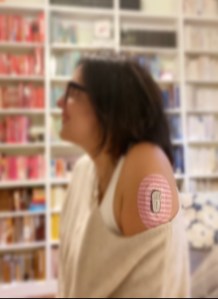
Want more information?
The Bionic Wookiee has written this terrific piece explaining the nitty gritty tech details of Anubis. My eyes usually glaze over when reading this sort of stuff, but David does a stellar job making it interesting. And understandable!
Want an Anubis? Of course you do. This is the FB page to head to. It’s a new page and there’s not much on there just yet, but it is where info will be shared.
As someone who spends far too much time sharing far too many things across far too many online platforms, this Hartley Lin cartoon for the New Yorker hits far too close to home. (But it made me laugh all the same.)

I really wanted to call this piece ‘Hey, ableds, leave our kit alone’, but decided against it.
Over the weekend, two main things seemed to dominate diabetes twitter. The first was the suggestion from a nurse (in a now deleted tweet) that shoving cake frosting (more commonly called icing in my parts of the world) up the arse (more commonly called ass in other part of the world) of an unconscious person with diabetes was an excellent hypo treatment. The second was this picture:

Let’s just say that sexually assaulting a PWD to give them glucose is not a good idea, no matter how hypo you think they are. Call an ambulance, rub some frosting (or honey etc.) on their gums, or, if they have glucagon with them, and you what to do with it, use that. Once again, just to be completely and utterly clear, decorating the arse of people with diabetes as if it’s a plain tea cake in need of some ready some embellishing and sprinkles, is not appropriate without consent. If everyone is conscious and there is consent, do whatever you will.
With that out of the way let’s move to the second fun little incident and that photo. That’s right, it clearly refers to one of the diabetes devices that I and many others use to keep an eye on our glucose levels because the bit of our body that takes care of it broke.
Even before this photo appeared, there has been a lot of commentary from people with diabetes (PWD) about people without diabetes (non-PWD) using any sort of glucose sensing device. I think that in coming years we’re going to only see more of it as the makers of CGMs and Flash GM start to advertise the allure of glucose tracking to a broader audience, or, as is the case with the little photo above, third party app makers jump on board.
Because the diabetes community never has one united opinion on things, (although I’m yet to have heard from a PWD who has thought the icing-up-the-bum-for-hypo-treatment idea is a good one), some people are violently opposed to the idea of non-PWD using CGM. Others couldn’t be less fussed about it if they tried. And some actually think it’s great. There is no one way to respond, and everyone’s feelings are valid.
I have a lot of feelings wondering why non-PWD would want to do diabetes. From hypo simulators, to wearing a pump with saline in it, and lining up to get an A1c checked for fun – I’ve seen it, and I’ve written about it. Again, no one needs to agree with my feelings, although it seems from the feedback I get, a lot of people do.
But I have to say that the idea of CGMs as a weight loss tool was a new one for me. I understand that some people who are deep into the keto way of life use them, but my understanding of this is so they can repeatedly prove to themselves (and badger others) that eating meat causes minimal changes to glucose levels, but eating grains of rice make lines move.
I did a bit of a deep dive into the company behind this picture, (they are not the only one that is moving to capitalise on the excitement and interest around biohacking) and all I could find was a whole lot of pseudo-science speak that just screams scam to me! It preys on the insecurities of those who are trying to find happiness in the latest and greatest wellness fad. But this time, they claim to have science on their side.
This isn’t new. Weight loss cons from ‘teatoxes’ to fat-busting pills to miracle diets to superfood super-promises, have been around for years. There is a reason that new players come onto the market every week, and that reason is not because they work. It’s because we have diet industry worth billions, we have people – often young girls – being told their worth is tied up in the number on their scales, and we have people desperately looking for something that will work to get them to that number, and get them there quickly.
To explain their claims, they use science-speak to suggest that there is a medical side to what they are doing. It seems that the ‘trust me, I’m a doctor’ line works well for a lot of people. As do the words around graphs, data and glucose statistics. That might work for people who haven’t spent a shedload of time around doctors talking about graphs, data and glucose stats, but those of us who do, might see this as a load of bullshit.
This, directly from the company’s website claims that the app ‘…provides an immersive experience that shows you a continuous line graph of your glucose data; provides alerts when glucose spikes or dips out of your weight-loss range’.
Weight-loss range? I really don’t understand what that means because the only time my glucose levels have equalled weight loss is when they have been off-the-charts high. Such as before I was diagnosed with diabetes, and the time I was in DKA thanks to gastro. I doubt that the idea is to somehow send people without insulin-requiring diabetes in DKA, because that is going to take a lot more than just banging a sensor on your arm, and loading an app onto your iPhone.
Of course, that’s not what they mean. They are suggesting that by keeping glucose levels withing a tight range (the ‘weight-loss range’), there will be no excess glucose needing to be stored as fat.
There is limited evidence to support that measuring glucose levels on non-PWD is beneficial, so the science is shaky to say the least. But that doesn’t stop the program being presented as super science-y and evidence-based. And for a lot of people, that illusion of science means they think that the subscription cost (because there’s always a subscription cost!) is worth it.
But let’s move away from that for a moment, let’s ignore the lack of science, the cost and the hint that this could be nothing more than a money-making scam, targeting vulnerable people, because there is more that comes into play which explains why so many in the diabetes community push back at non-PWD wearing diabetes devices.
Continuous glucose monitors were created for people with diabetes to better manage our condition. They give us access data that helps managing our diabetes like never before. They are life changing. They are life saving. They are also only available to a small percentage of the global diabetes population. I haven’t even touched on the fact that generally, it’s only people with type 1 diabetes who have access. People with other types of diabetes are even less likely to be able to get subsidised or funded CGM, even though many of them might benefit from using them.
The idea that CGMS are toys of privileged biohackers, and being used exclusively as a weight-loss tool does not sit well with many. It does not sit well with me. If I look at Australia, only half of people with type 1 diabetes have subsidised access to CGM. The rest of us are left to having to find about $4K per year to fund the devices that really make a difference to our lives, that some of us say we couldn’t live without.
The weight-loss focus from this particular company is problematic when considering the higher rates of disordered eating, and insulin omission or restriction in people with diabetes for the purposes of weight loss. Some claimed that seeing CGMs heralded as being about weight loss, when they are using it as part of their eating disorder recovery was triggering. These factors all come into play within the diabetes community.
And finally, the idea that increasing use to a far broader community will bring down the cost…? Let’s just be reasonable about that (or sceptical…) and say that’s not going to happen. If that was the case, the fact that every keto-follower worth their ketosis now regularly checks their ketones, would mean that blood keto strips would be cheap as chips. That’s not the case at all.
The potential of medical devices being used outside of the reason they were created is likely to be explored a lot more in coming years. With (non-healthcare) tech companies moving into the space, it is not only possible, but highly likely, that glucose sensing (albeit non-invasive) will become standard on wearables, in the same way step counters have. But we’re not there yet. Right now, the best use of these devices is where the evidence points – on the arms (or bellies, or thighs, or wherever!) people with diabetes are wearing them, to assist with diabetes management, to help us with our decision-making process, and to improve our lives.
NOTE:
In this piece, I mean ALL people with ALL types of diabetes, including pre-diabetes. Basically, any condition that means an individual needs to consider glucose levels.
Today, I had my second COVID jab. I feel grateful, happy, relieved. I recognise how privileged I am to be living somewhere where I was able to access the vaccine. And I feel lucky. My tee wasn’t a deliberate choice when I threw it on this morning, but jeez, it sure does feel appropriate right about now.*

I also feel…
One step closer to not being so anxious.
One step closer to not worrying all the time.
One step closer to not calculating how close someone is standing.
One step closer to avoiding lockdowns.
One step closer to not having to check in everywhere we go.
One step closer to not thinking every sniffle, every cough is a sign of something more sinister than just a sniffle, just a cough.
One step closer to stressing less about my parents getting the virus.
One step closer to walking into places without first counting how many others are there.
One step closer to being free to meet up with friends in crowded bars.
One step closer to not assessing risk at every step, every move, every breath.
One step closer to not scrutinising testing numbers, vaccination numbers, virus numbers.
One step closer to borders opening.
One step closer to crossing borders.
One step closer to the Qantas Business lounge.
One step closer to getting on an aeroplane.
One step closer to walking the streets of New York.
One step closer to hearing Mike Stern at the 55 Bar on a Monday night.
One step closer to cinnamon buns in Copenhagen.
One step closer to more in-person diabetes peer support.
One step closer to presenting on a stage instead of a zoom room.
One step closer to IRL #docday°.
One step closer to hugging friends from far flung places.
One step closer to thanking my squad in person for keeping me going.
One step closer to kisses on the cheeks say hello.
One step closer to not having to get up at least once a week for 3am meetings for projects run outside of Australia.
One step closer to walking the halls of diabetes conferences again.
One step closer to this being over.
One step closer to life as we knew it, even if it will never be the same again.
*My tee wasn’t a deliberate choice when I threw it on this morning, and it wasn’t until I was on my way to getting my jab that I really though about it. There’s a story to that tee, and today, it feels pretty special.
In January 2020, I was in my favourite store in Melbourne (shout out to Sian at RMP Melbourne), and there, on the racks, was a white t-shirt, from Rabens Saloner, with ‘Lucky one’ printed across the front. Startled, I took in a sharp breath and lifted the shirt from it’s hanger, holding it up to me. And I flashed back the last day of EASD in Barcelona just a few months earlier, remembering…
I remembered how on that last day of the conference, walking between the hotel and the conference centre, I saw a stencil of the words ‘Lucky One’, the paint dripping from the words. It was on a concrete wall with nothing else around it. It summed up perfectly how I was feeling, so I snapped a pic to remind me.
Here is that photo…





 Diabetogenic