
You are currently browsing the category archive for the ‘Conferences’ category.
A recurring theme throughout last week’s ADS ADEA meeting in Perth was the need to manage expectations. I think, in general, we do a really lousy job of this in diabetes.
We’re told that can expect to live a ‘normal life’ after a diabetes diagnosis, when that’s not necessarily the truth.
We’re told we can expect to eat whatever they want, when really, the effort that goes into calculating medication doses depending on the nutrient value of our foods is hard and it may be easier for some to actually limit food choices to make things a little easier.
We’re told to expect a cure in five years’ time, when the truth is that a cure is not even on the distant horizon.
We’re told that we can expect new technology to significantly reduce the burden of living with diabetes, when the reality is that sometimes, it’s more – not less – work.
We’re told to expect person-centred care, when, really, our health system, is not designed to cater for the individual needs of people living with diabetes.
We’re told that emerging technology will be fully automated, smart and cure-like, but we are not told that there will still be human-input necessary and that the devices are not as smart as a functioning pancreas.
We’re told that if we keep our A1c below 7% we can avoid complications, and yet, there is no guarantee, and some of us do develop complications despite an A1c regularly hitting that magic number.
We are told that if we count carbs and dose the right amount of insulin at the right time, we can keep our glucose levels in range, often neglecting to be told that there are a lot of other factors at play.
We are told all this, and then, when these expectations are not met, we are told we’ve failed. Or we are disappointed.
Here’s the thing. The tools are actually really great. Our health system here in Australia is mostly terrific. The majority of our HCPs genuinely do want to give us the best care they can. We don’t need to oversell things as much as we do.
Our expectations are being set so realistically high, that it’s impossible to meet them.
So, THIS is what I would like to say about all the things I’ve covered above to help manage expectations:
Your life will be different after a diabetes diagnosis. But that’s okay. Your new normal is going to be different to your old normal, but hopefully, there will be very things that diabetes will prevent you from doing. Acting like a pancreas is not really normal, but you can do it!
Yeah, you can eat whatever you want. But it’s undeniable that certain foods are harder to manage after your pancreas decides to go on strike. Find what works for you – and that can change. But do be prepared for food to become something that can be a little fraught because you may find that some of your most favourite foods are a little difficult to deal with.
Researchers are brilliant and amazing and the advances in diabetes management are actually quite mind blowing, but a cure? We’re nowhere near that yet. Keep up to date with everything and try to mine through it to work out what is relevant for you. Keep getting excited about management and tech advances – but do keep it in perspective. (Also – consider the source. I promise you that the Channel 10 news or Buzzfeed is NOT going to be where you learn that diabetes has been cured forever.)
You are going to have a lot that you will want to know and work through, and possible a variety of healthcare professionals to see. As wonderful as it would be to have someone to coordinate it all for you, you’ll have to put in the leg work to find the right team, the right service and the right people. And then, once you’ve found them, it’s still up to you to direct what you need. Otherwise you might find yourself at the mercy of a system that is not really going deliver exactly what you need to get the most from it.
You may have heard that in the US there is a (hybrid-closed loop) pump/CGM combo. Some are calling it an artificial pancreas. It’s not. The tech is incredible, but it’s not fully automated. It still requires calibration and it still requires operator input. This is not me being negative, because the tech is exciting. It’s me being realistic about the level of automation
No new devices are going to completely remove the load diabetes adds to your life, or your involvement in their operation. Insulin pumps need buttons pushed; CGMs need calibration, food needs to be considered. Full automation may be the goal, but it’s a while off.
An A1c of 7% or below will indeed reduce your risk of developing diabetes-related complications and there is a lot of evidence to support that. But it doesn’t eliminate the risk. That’s the annoying and somewhat unfair reality of diabetes. Unfortunately, it’s the reality. Obviously, do what you can to manage your diabetes as well as you can. But don’t expect that a number is a guarantee of anything.
Carbs and insulin are only part of the equation. How you’re feeling emotionally, illness such as colds and flus, hormones, nutrients other than just carbs, the phase of the moon (well, maybe not) … all these impact on your numbers. And they change. Don’t expect that there is an equation that will work all the time.
In life, we’re often told to expect the unexpected. But in diabetes, the unexpected is often only that way because what we have been told to expect is unrealistic. If we were told the truth, and provided with realistic expectations from diagnosis – and throughout our diabetes lives, perhaps we wouldn’t feel that we’re constantly falling behind and failing.
Here’s me and my boss talking about expectations in technology.
Disclosures
Roche Diabetes Australia has covered my travel and two night’s accommodation for my stay in Perth as I am a presenter at the Roche Educators Day (RED). There is no expectation from Roche that I will write anything about the RED, but I expect I will because it’s always such an interesting and enjoyable day!
The remainder of my time in Perth is part of my role at Diabetes Australia.
On Monday and Tuesday of this week, I attended and facilitated Abbott Diabetes Care’s #Dx2Melbourne event which brought together eleven Australian diabetes bloggers. (All my disclosures can be found at the end of this post.)
(Just a recap – the DX (or Diabetes Exchange) series of events have now been run about half a dozen times. Other than #DX2Sydney and this year’s Melbourne events, the others have been held in hard-to-take cities including Stockholm, Berlin and Lisbon and have been attended by bloggers from the UK and Europe.)
#Dx2Melbourne reunited most of the bloggers who attended last year’s event, with some new faces thrown in for good measure. I was introduced to Alana Hearn for the first time, finally got to meet diabetes yoga guru Rachel Zinman, and caught up with Helen Edwards. (All the links to the blogs of the ‘repeat offenders’ who attended #D2Sydney can be found on this post.)
Some may believe that I am naïve in saying this, but the event is not about product. In fact, apart from a 45-minute presentation – the session that kicked off the two days – there was no other discussion about Libre or any other diabetes product unless it was specifically raised by one of the bloggers. Abbott did not have a new product to push; Libre has been out for over 12 months now in Australia.
(I am not, however, naïve enough to think that events like this are not part of the health industry’s 21st century marketing strategy. But, as I said last year when responding to a comment on my blog about this, this is the 21st century marketing. And I’m glad that consumers have a place in this strategy, because it would be far worse if industry was continuing with 20th century marketing strategies which completely excluded people with diabetes, and did not offer us any opportunity to directly engage and work with industry. Any device company NOT doing this is falling way behind and needs to catch up.)
As the Abbott team stated in their welcome, the idea of the DX events is to continue their commitment to bring together people living with diabetes to share ideas. And for Abbott to get an idea of what it is that is important to people with diabetes and what makes us tick – albeit a very select and privileged sample of advocates.
With this in mind, for me, the most valuable part of the event was the discussions that were completely driven by the bloggers. In an open session where we were exploring ‘why we blog’, I listened carefully as everyone articulated their reasons for going online and sharing their stories with strangers.
Reasons varied – some do it because they simply want to tell their story, some because they love to write, some have specific issues within diabetes they want to open up for discussion, some see it as an advocacy platform. What we don’t hear – ever – is anyone saying ‘Because I want to make money doing it’. I can be all evangelical about it and say it’s because we’re a choir of angels, but mostly I think it’s because we’re smart enough to know the limitations of what it is that we do, as well as understanding the strength is in connecting, not money-making.
We also considered the shortfalls of having an online presence.
I’m an over-sharer and I know that there is a lot I write that many others wouldn’t feel comfortable sharing – and some people have told me that it is sometimes difficult to read. I also write about issues that are of no real concern to others, and they are more than happy to let me know that I’m wasting my time and energy on such irrelevant (language) matters. I also know that as soon as I put something out there, I am opening myself up for comment – both positive and not-so-positive. We had a discussion about how we manage unwanted attention and, in the most extreme cases, trolling.
I have never regretted anything I have written or shared, and have never taken anything down because I’ve felt it was too personal. But I have had some very unwelcome and sometimes nasty comments sent my way.
I found this a really useful, but somewhat challenging, discussion. I have written about some very personal experiences, probably most notably, pregnancy loss. I’ve also written a lot about how diabetes impacts my mental health. These are two topics that are frequently hidden away, surrounded by shame and secrecy – precisely the reason that I am committed to writing about them.
However, the times I’ve been trolled – and fortunately, that hasn’t been often – it has been when I’ve shared very personal stories. They’ve been the times where I have found myself at my most vulnerable, and being so exposed makes any sort of negativity harrowing.
It was reassuring to discuss – and remind each other – that even though we are voluntarily putting ourselves online, we are not inviting people to be nasty and disrespectful. Online is real life, despite what some people may think. This is the space where many of us convene to work together, support each other and share information; it’s not a place for personal attacks.
I left the event on Tuesday feeling utterly exhausted, but also filled to the brim – a feeling that only comes after spending a solid period of time with others treading the blogging and advocacy boards. I was reminded of the similarities as well as the differences we experience living with diabetes. I felt buoyed by the various issues that draw our attention. I felt desperate at the access issues I still hear about – both here in Australia and overseas. But most of all I felt part of something that is much bigger than me, much bigger than my blog and much more powerful that anything I can do on my own.

Abbott Diabetes Care covered all my costs to attend #Dx2Melbourne, and provided all attendees with two FreeStyle Libre sensors and, if requested, a scanner. There was no expectation from Abbott that I would write about the event or any of their products, and everything I do write about it is my opinion, in my own words, and in no way reflects those of Abbott – or anyone else, for that matter.
 A lot has already been written about the photo ban at ADA last week. For the first couple of days of the meeting, the first topic of conversation I had with everyone I met was not about what I’d seen or learnt. It was about the photo ban and the ADA’s failure to appropriate deal with the complaints. It was a debacle, an absolute shit storm that could have been addressed in many ways to make it better.
Firstly, it’s worth noting this is not new. Two years ago, I was swiftly reprimanded for tweeting a photo during one of Bill Polonsky’s talks. The ADA bot who was monitoring any flouting of the no photo rules quickly responded to anyone sharing photos on twitter or other social media platforms. The message was strong: stop doing this or your credentials will be revoked. For the record, this was the photo that got me in trouble:
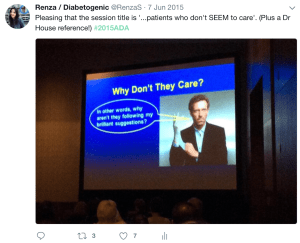
Yes – that photo of Dr House straight from the Internet was the reason that removal of my press credentials was threatened.
This year, execution of the archaic policy was increased to expert level. And people were not happy.
Many were asking why the ADA was being so strident in their enforcement of the policy or, more importantly, why the policy was there in the first place. But it’s not just the ADA. Taking photos or videos during sessions or of posters is banned at the IDF’s WDC, EASD meeting and here in Australia at the ADS-ADEA meeting. (How’s that for a sentence of alphabet soup?)
However, I have never known it to be enforced the way it was last week with a multifaceted approach of vigilant soldiers in red approaching anyone daring to photograph a slide during talks or in the Poster Hall, as well as social media (mostly Twitter) responses being fired left right and centre to anyone who then tweeted a photo.
The ridiculous thing is that anyone at the conference could tweet WORD FOR WORD what the speaker was saying (provided they are a speed Tweeter), but just couldn’t take a photo of the slides. And to be honest, a lot of the speakers were pretty much reciting WORD FOR WORD what was on the slide, so it was possible to pretty much tweet out every single thing being presented. (Also, that makes for a really boring presentation. Don’t do that!)
Suddenly, the story of #2017ADA was not new diabetes research or technology or treatment. In fact, the story wasn’t diabetes at all; it was how pissed off people were at the ridiculous ban.
People trying to follow along from home felt excluded and annoyed. Attendees of the conference felt frustrated that we couldn’t share what we were seeing with those not in the room. As is often the case at these meetings, there were two or three or more concurrent sessions I wanted to attend, but as I’m yet to learn how to be in more than one place at the one time, rely on people in the sessions I’m not at to share what they are seeing and hearing.
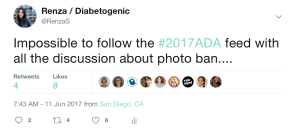
And me? I was irritated and exasperated at how difficult it was to follow the #2017ADA Twitter feed because of all the bloody criticism of the photo ban. (And just delicately, those people who commented on EVERY SINGLE TWEET about the ban, you were not helping. You were making it harder.)
I understand that I am very fortunate to attend diabetes conferences both here and overseas and I am conscious that not many people with diabetes are sitting in the audience. I also know – from personal experience as well as anecdotally – the people in the audience are not always the best sharers. When they return from conferences, they don’t sit with people with diabetes to share what they have learnt.
So, as a person with diabetes who likes to share and communicate, I think it’s my responsibility to share as much as I possibly can about what those of us with a registration or press badge are seeing and hearing.
Trying to stop the flow of communication in digital times is ridiculous and it demonstrates an appalling lack of understanding about harnessing digital platforms’ reach to educate, inform and support not only people with diabetes, but also healthcare professionals. It was also ludicrously naïve of the organisation to think that there would not be backlash and that they would get off without condemnation.
The control of information is really not possible in this day and age. A conference about diabetes should not be shut off from people with diabetes, and if the only way ‘in’ for most people is online, then that avenue should be thrown open as broadly as possible.
In two months’ time, the ADS ADEA conference will be in Perth, bringing together diabetes healthcare professionals from across Australia. It is our largest meeting. Currently, on the meeting website, there is this warning in their social media guidelines:
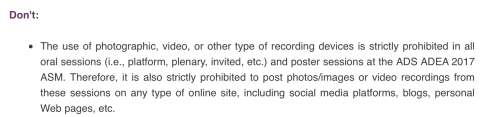
I am calling on the organisers of the ADS-ADEA conference to change this policy immediately, instead, encouraging the sharing of information far and wide. Consider those who cannot afford the time or fee to be at the conference, yet would benefit significantly from learning what is going on. Embrace social media as a way to extend reach from the few thousand attendees (or few hundred in any one session) to a far larger audience. And welcome all diabetes stakeholders to be part of the discussion online.
Just think how much better #2017ADA could have been if that had been the story.
Some excellent commentary on the photo ban at ADA.
Medscape’s piece written while the meeting was happening.
The always thoughtful Marie Ennis O’Connor’s piece for Medium.
Yesterday, I wrote a quick review of the language session at #2017ADA and my excitement as I anticipated the session.
I don’t want to sound Grinch-like, but I walked out of the session feeling less enthused than I had when I walked in. That’s not because the speakers weren’t good. They hit the mark and said all the right things.
And it’s not because I am not excited to see the ADA and AADE developing and getting ready to launch their Language Consensus Statement (it’s due out in August). I am; I am so excited!
It’s because I didn’t hear anything new, and the time has come for us to do something more with language matters. Because, #LanguageMatters.
It was six years ago that Diabetes Australia launched ‘A New Language for Diabetes’ position statement. In collaboration with the Australian Centre for Behavioural Research in Diabetes, Diabetes Australia wanted a concise, easily shareable document that could straightforwardly and succinctly explain how to communicate with and about people with diabetes. Unapologetically, it called out the words that harmed and offered replacements that were more inclusive, less judgemental, all in an attempt to use language that didn’t make us feel like we were constantly failing at life with diabetes.
Six years is a long time in diabetes. Disappointingly, there’s still a lot that’s not great about the way diabetes is discussed in the media, in healthcare settings and, unfortunately, by healthcare professionals. We haven’t reached a position of respect; we have not managed to leave all judgement at the door when speaking about diabetes; we have not even started to eliminate stigma.
When the Language Position Statement was initially launched in Australia, I saw it very much as as first and most welcome step. Was it perfect? No. It was a starting point, not the end of it all.
It was never considered as definitive document, but it certainly a great place to begin; a living resource that could evolve. As the ACBRD did more and more work in the stigma space, it became very clear that words do indeed matter, and Diabetes Australia took the evidence and continued to push the envelope and innovate in this previously unexplored space.
Perhaps that’s not actually a correct statement. Language and words had long been on the radar of people living with diabetes. Diabetes camps had stopped using words such as ‘good’ and ‘bad’ to describe glucose numbers; the debate on the word ‘diabetic’ had been going for years, and many rallied against the words used that blamed, judged and slurred people with diabetes – whether it be for developing diabetes in the first place, or how well we are managing it.
But the Language Position Statement was the first time that it was all there in one neat document, backed by evidence to support the thoughts of PWD. (Jane Speight and I gave a number of talks which started with me ranting and waving my hands around about how language and words affects those of us living with diabetes, and concluded with Jane stepping up to present the evidence. Those talks packed a punch and made it very difficult for people to ignore the issue or to keep referring to it as political correctness gone mad.)
But now, six years on, I want more. I don’t want it to just be a debate about whether or not we use the word ‘diabetic’ (although this is still an important issue). We get waylaid when that is our whole focus, and I feel that anywhere that is just now coming to the language party needs to be a step ahead of the development of a language position statement. That’s been done and has been in circulation for over half a decade. Use it, adapt it, rebrand it and make it your own, but I’m not sure there is a need to recreate the wheel and start from scratch?
Not when there is still a lot more to do.
What’s the next frontier in language and diabetes? Maybe it’s diabetes conferences.
Because, they are a mess, with many presentations still peppered with words such as ‘non-compliant, non-adherent, poor control’, or referring to participants in research as ‘subjects’, and often (and sadly) a not a great understanding of the difficulties of living with diabetes.
With a Language Positions Statement already in existence, a great (and simple!) start to remedy these shortcomings could be for conference organisers to send a copy of it to all speakers, explaining there is an expectation that slide decks and talks will be in line with the document and its recommendations. And while they’re at it, the same expectations should be in place for anyone showing in the exhibition hall at the conference, or writing about the event. Along with embargo regulations, press corps could also be sent the position statement.
We know that organisations have the capacity to be vigilant – perhaps had the ADA put effort into urging appropriate use of language at the conference instead of enforcing their archaic photo ban, they wouldn’t have been hit so hard on the socials.
It’s time for us all to expect more and to demand better. How are YOU going to do that?

‘What was your favourite thing about ADA?’
I’ve been asked this question a few times now since returning from San Diego. And even though the meeting was so busy, with a lot of super interesting information being shared, it was actually an easy question for me to answer.
‘Language’, I answer without hesitating. ‘Specifically, that language was on the agenda at the meeting for the first time.’
On Sunday, there was a whole session dedicated to language in diabetes: ADA – AADE Joint Consensus Statement on the Use of Language in Diabetes. I attended eagerly because, of course, #LanguageMatters is my thing. It’s also the ‘thing’ of others far smarter than me, including these two women who let me sit with them and jump up and down like an excited puppy:
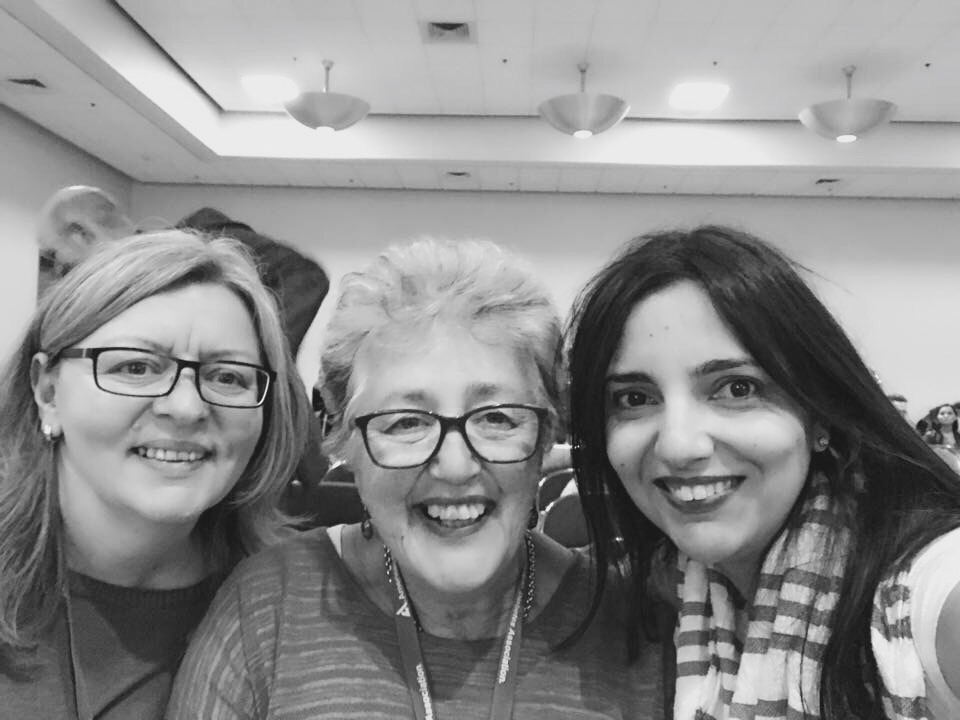
Professor Jane Speight led the development of the Diabetes Australia Language Position Statement, and Ann Morris, last year’s Australia Diabetes Educator of the Year, has been a champion of people with diabetes for a very long time.
There were some highlights in the language session for me, particularly from the first speaker, Dr Jane Dickinson. Jane recently wrote about a piece for Diabetes Spectrum about the effect of language on diabetes. She has type 1 diabetes herself and is a CDE, and her presentation was peppered with personal experiences of the role of language in diabetes care. (You can read more from Jane via her blog here.)
One particular comment Jane made really highlighted the rock and hard place between which PWD often find ourselves:

Susan Guzman was the second speaker and she pointed out that words not only affect the person with diabetes, but also create a bias for people working with us. The second that a PWD is described as ‘non-compliant’, ‘uncontrolled’ or that they ‘don’t care’, HCPs feel differently about the person. Appropriate language use isn’t important only for the person living with diabetes. It also matters if we want those working with us to treat us respectfully.

The final speaker was Melinda Maryniuk, CDE, from the Joslin Center and she spoke about the ADA-AADE Language Consensus Statement, and the five guiding principles that form the basis of the document as captured in this tweet from @MarkHarmel:

It’s not surprising that I was excited that this session was on the program. It was the first event I added to my calendar and I rearranged meetings to ensure that I didn’t miss it.
But I left wanting more. A lot more. And tomorrow, I’ll write about why.
Back from the ADA conference after whirlwind few days in San Diego which basically involved 19-hour days sandwiched between the first day (and 8-hour meeting) and the final day (a couple of short meetings before heading to the airport to fly home). Unsurprisingly, I slept most of the way home.
There were some absolute standouts of the meeting and here they are in super quick dot points. Some I’ll write about in more detail when I’ve finished hugging my family and infusing Melbourne coffee back into my exhausted body.
PR Fail
The ADA’s PR machine needs attention after the completely misjudged way they dealt with objections to their misplaced and archaic ‘photo ban’. It became the story of the first few days of the meeting and they really will need to reconsider what they do next year. (More on this another time, but here is a good summary from Medscape.)
Innovation away from the conference
While the conference is always full of late-breaking research and an exhibition hall of diabetes technology, the satellite events are often where the real innovation is at! On Friday afternoon, I went to the Diabetes Mine DData-Exchange event and was lucky to see and hear some of the latest and most innovative tech advances happening in diabetes, including lots in the DIY/#WeAreNotWaiting world.
Mostly, the room was full of those who knew what was going on in this space, so there really were only a few people who were surprised that there are many walking around with their own DIY kits, (which always makes me chuckle, especially if it’s a HCP having their mind blown by something PWD have known about and been doing for a while…)
(A bit of a watch this space from me as I am about to embark on my own build, which is slightly terrifying. The only thing giving me any confidence is that I have these two Wonder Women to call on if (when) I am completely lost!)
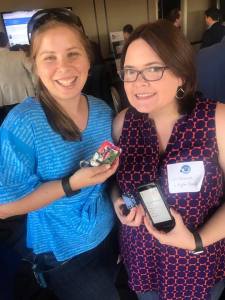
Wonder Women! Dana Lewis and Melissa Lee and their magical machines.
Life for a Child
The IDF Life for a Child update, annually held at the start of the meeting, was, in equal measure, enlightening and despairing.
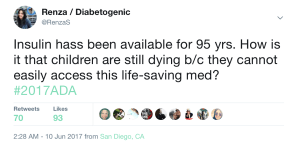
In this video, hear from Life for a Child Education Director, Angie Middlehurst, who recently visited the Diabetes Association of Sri Lanka and met some young people benefitting from the Program.
If you would like to consider helping Life for a Child, it costs only $1 per day to provide full diabetes care for a child. That’s right, one dollar a day. If you can, please do donate.
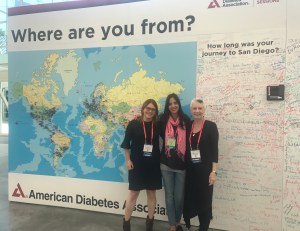
With Life for a Child’s Education Director, Angie and Health Systems Reform Specialist, Emma.
Who has a meeting at 5.30am?
Anyone who believes these meetings are junkets would reconsider the first time they need to be dressed, coherent, communicative and respectable for a 5.30 session. That’s 5.30am. And on the Saturday morning of the conference, I found myself in a room with a lot of other people (also foolishly awake at that time), to listen to the latest in CGM studies.
Thankfully, the session was super interesting with a lot of very valuable information being shared. (I really would have been pissed if I got up and it was a waste of time…)
Dr Steven Edelman from TCOYD was, as always, enlightening and added a most important ‘personal touch’ as he shared some of his own experiences of CGM. And some brilliantly relevant sound bites to remind the audience that while they may be focused on the machines and the algorithms and the clinical outcomes, this is about people living with diabetes.
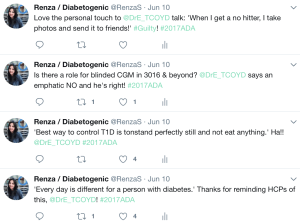
Trying to tweet everything Dr Steven Edelman was saying…
Diabetes Hands Foundation wake
The news about the closure of the Diabetes Hands Foundation, and the move of its forums to Beyond Type 1 was met with sadness, but also a lot of optimism. Innovators in the online community, DHF was the first online diabetes network I ever felt a part of. It spoke to me, but mostly, it was inclusive. That’s what happens when you have people like Manny Hernandez, and later Melissa Lee, at the helm, and a team around you of people like Mila, Corrina, Emily and Mike.
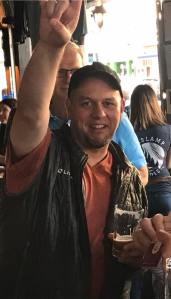
DHF founder, Manny Hernandez.
We farewelled the DHF at a wake in a bar on 5th Ave in San Diego on Saturday evening and the love and gratitude for DHF was overwhelming. Melissa asked us to recall DHF’s Word in Your Hand campaign as a tribute to Manny and DHF.
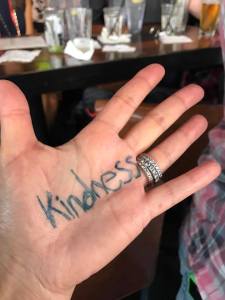
My word on my hand… We can always use more of this.
I’m honoured to have been a part of it.
Language
Oh yeah, there was a language session at #2017ADA and I have PLENTY to say about it. Maybe next week….
Sex, Insulin and Rock ‘n’ Roll
The team from Insulet threw an event on Sunday night way up in the sky, overlooking Petco Ballpark, home to the San Diego Padres, and we were presented with a panel of diabetes advocates prepared to talk about anything and everything. Brilliant in the way it was candid, unashamedly open and, possibly for some, confronting. Well done to the panel members who really were prepared to answer every question with personal insight and experience. This format really should be rolled-out as widely as possible to as many people as possible to help breakdown any embarrassment, or idea that there are taboo topics in diabetes.

Children with Diabetes
I was lucky enough to be invited to attend the annual CWD-ISPAD dinner on Monday night and speak with a number of healthcare professionals working to improve the lives of children living with diabetes.
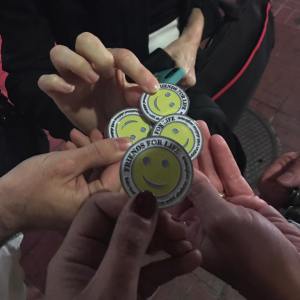
Jeff Hitchcock, founder of CWD, is a personal friend now. I guess that’s what happens after you attend a Friends for Life conference and are welcomed into the family. FFL Orlando is taking palce in three weeks and my family’s time at FFL remains one of the most overwhelming and positive experiences of my life with diabetes.
I caught up with Jeff a few times throughout the conference to speak about the organisation’s work. He gave me a CWD medallion, which is now firmly wedged in my wallet as a reminder of not only my FFL experience, but also value of Children with Diabetes.
diaTribe
I could complain about my 19-hour days, but then I think about Kelly Close from diaTribe and then feel sheepish for even suggesting that I’m working hard! On the final night of the conference, diaTribe hosted three events and I attended the later two: Musings Under the Moon and Musings After Hours.
These events bring together leaders in diabetes technology and innovation and digital health and offer an opportunity to ask questions and challenge (and be challenged!) in a far less formal situation that the official ADA conference. For me, this is where I learn the most as the speakers are prompted by hosts Kelly and Adam Browne to really reflect on where we are going in diabetes innovation. My only misgiving about these events is that there are not enough people attending. That’s not to say that the spaces were not packed to the brim – they absolutely were. But I do wonder if perhaps it’s the people who really need to hear the realities of diabetes technology are not in the room…

MedAngel
I meet Amin from MedAngel as part of my time with the European Roche Blogger Group. Amin has created an easy-to-use sensor and app to help people with diabetes ensure insulin is kept at the right temperature. More about this another day, but in the meantime (after I’ve been using my sensor for a while), you can read about it here.
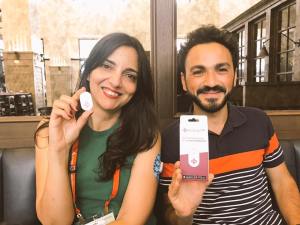
Learning all about MedAngel, with Amin.
Take aways
ADA is a very large conference. There is a lot going on, there are a lot of people around and I always leave with a lot to think about. Over the next few days…weeks…I’ll start to gain some clarity about a lot of what I saw, heard and learnt. It’s always the way after a big meeting like this one.
Someone asked me if I enjoyed the meeting and I suggested that was probably the wrong word to use. It was very worthwhile. I learnt plenty. I was able to catch up with advocates in the space who continue to push boundaries and lead the way in insisting that all work in the diabetes space is ‘person-centred’. People with diabetes are expected at this conference and seeing us as just being there – rather than having to fight for our place – inspires me to keep working better and harder.
Disclosures
I attended the ADA Scientific Sessions as part of my role at Diabetes Australia who covered my expenses, except for my first two nights’ accommodation which were covered by the International Diabetes Foundation so I could participate in meetings for the World Diabetes Congress where I am Deputy Lead for the Living with Diabetes Stream.
I got on a plane in Melbourne on Wednesday at 9am, travelled for 20 hours , touching down in San Diego on the very same Wednesday at 10am. This sorcery explains the jet lagged mess below.
For the next few days, you can mostly find me at #2017ADA where I’ll be sharing the latest from the 77th American Diabetes Association Scientific Sessions.
I’m still getting my head around the #HealtheVoicesAU conference – there was so much that happened over the event that it’s taking time to write about it all and really nut out what I took away from each session. (Previous posts here and here.)
When I looked at the program, I was probably most excited to hear from Nick Bowditch. I knew nothing about Nick other than what the program told us: He is the only person in Asia Pacific to have worked at Facebook and Twitter; he’s an entrepreneur who helps small businesses here and across the globe shape their online presence. And his personal health story is that Nick is a mental health advocate as someone who has lived with depression for many years.
I knew Nick’s talk would have lots to offer, and title of his talk that had me excited: ‘The Art of Storytelling’.
I’ve written before about why I love story tellers and story-telling. And telling my own story. It’s reading and hearing the stories of others with diabetes that helps put in context my own experiences. Others’ perspectives shape my own and I learn so much from how others deal with the clusterfuck that diabetes can be.
The first slide Nick showed us was of the wonderful Jamaa el-Fna in Marrakech. He told us how he spent an evening captivated in the square. There amongst the snake charmers and the men walking around with monkeys on leads and the little girls selling tissues and the vendors hawking fresh orange juice, were story tellers. And although he couldn’t understand a word they were saying, he was enthralled as they animatedly told their stories.
That’s the beauty and magic of a good story teller – you don’t necessarily need to understand the detail; just getting the gist of the tale is enough.
And then, Nick gave us the snapshot of his story. In a nutshell, he told us this:

Slide from @NickBowditch
It’s easy to make assumptions and think that you know what Nick might be living with if you see that list. But you’d probably be wrong. I know I certainly was. My initial ideas of what life must be like for Nick were turned on their heads as he put into context what each of the above aspects of his life actually means to him:
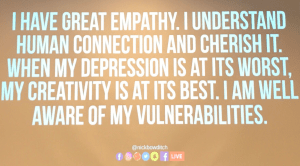
Slide from @NickBowditch
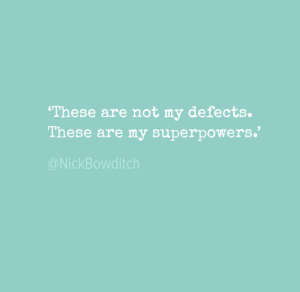
By turning our assumptions on their head and reframing how he lives with mental health conditions shows us that Nick is not ‘just coping’, he’s living. His words were: ‘These are not my defects. These are my superpowers.’ And it challenges us to reconsider our preconceived ideas. I know that those of us who speak about diabetes often challenge what others think.
The image of T1D being all about kids and needles and blood is not really what it’s about for me. And the far-too-easy idea that T2D is all about older, overweight, inactive people is wrong too.
When we tell our stories – and reframe the narrative – the truth comes out.
Possibly the most powerful thing Nick said was this: ‘Telling the truth is not brave. It’s easy. The hard thing is not being authentic.’ We’d come full circle back to the first speaker of the day who implored us to find authenticity in what we were saying. And it reminded me of why I have always been an advocate of having people with diabetes sharing their stories in any forum where people are talking diabetes: the legitimacy of lived experience cannot be found in any other way than actually having someone tell their story.
I see first-hand the power that having a person with a health condition stand alongside a healthcare professional and put into context the theory and research that they have just presented.
There is an art to storytelling. We do it every day that we tell our story. We do it every time we put words on a page for a blog post, or in a diary or in a letter, ot when we stand up and tell it like it is. Some do it far more elegantly and eloquently, but the things is; it doesn’t matter. As long as we’re authentic.
DISCLOSURE
Thanks to Janssen (the pharma arm of Johnson and Johnson) for covering my travel and accommodation costs to attend the #HealtheVoicesAU conference. There was no expectation by Janssen that I would write about the event and everything expressed here (and on Twitter Facebook and other social feeds) is mine and mine-alone! To read more, check out the conference hashtag, #HealtheVoicesAU, on the socials.
I’m a sucker for a man with a beard. So when Jimmy Niggles was introduced as the second speaker at last weekend’s HealtheVoicesAU conference, I snapped to attention to hear what he had to say.
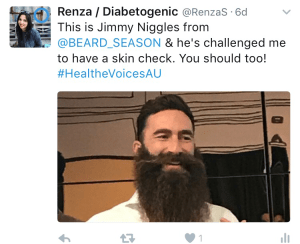
Jimmy Niggles (not his real name) started Beard Season at the wake of his 26-year-old mate, Wes, who died of melanoma. Each year, 46,000 people lose their life to melanoma making it one of the most lethal cancers globally.
Jimmy wanted to do something to encourage people to have regular skin checks, because (as is often the case) early detection of melanoma is critical to survival. The idea was for blokes to grow a beard in Winter (apparently the season for beards!) and then use their hirsuteness to start a conversation and challenge their friends and family to have a skin check.
One of the great things about this charity is that any bloke can become an ambassador. Grow a beard. Start a conversation. Encourage people to have a skin check. It’s simple, scalable and easily translatable. (And there is something on their website here about how women can get involved too.)
Jimmy is a reluctant advocate in some ways. He says he made himself an expert speaker by starting with one on one conversations, with the belief that every conversation can make a difference. That grass roots approach has grown to him (and his beard) being the face and voice of Beard Season and he has really kicked some major goals!
It was easy to draw parallels between what Jimmy is doing with Beard Season and how it could be adopted for diabetes awareness – both in terms of screening for type 2 diabetes and also complications screening. Those conversations at an individual level have so much potential, and tied together with public health campaigns and media promotions, there is an opportunity to reach lots of people.
Jimmy’s beard is there permanently for now and will be until someone offers him a cool million bucks to shave it off. He’s open to offers, so if you have a spare million under the mattress or in the freezer, he’ll put it to good use.
Want to do something to support Beard Season RIGHT NOW? Check out these beyond fabulous playing cards with some incredibly impressive beards. Be still my beating heart! Each deck of cards contains a lucky card. The idea is that you read the card, do as it says and spread the word. It’s another simple and effective way of getting the word out.
DISCLOSURE
Thanks to Janssen (the pharma arm of Johnson and Johnson) for covering my travel and accommodation costs to attend the #HealtheVoicesAU conference. There was no expectation by Janssen that I would write about the event and everything expressed here (and on Twitter Facebook and other social feeds) is mine and mine-alone! To read more, check out the conference hashtag, #HealtheVoicesAU, on the socials.





 Diabetogenic
