
You are currently browsing the category archive for the ‘Conferences’ category.
‘Oh, it’s beautiful.’ These were the words the followed the sharp intake of breath as I saw the Kaleido pump stand at EASD last week. I didn’t say it to anyone in particular – I was wandering the expansive expo hall alone at the time. It was completely involuntary. The stand was a rainbow – I may have said to someone that it looked like a unicorn had thrown up in there.

You can read all about the Kaleido here. This is where you get to read about the specs and the details all tied up in the usual marketing spin that is inevitable when it comes to diabetes devices.
 My take on it – after a long chat with one of the developers – is that this is a nifty little pump. It is simple – really simple – with far fewer bells and whistles than available on other pumps. There is no CGM compatibility. At this point there is no bolus wizard calculator, however, following feedback from customers, the company is developing one.
The simplicity is actually part of the beauty in a lot of ways. Those of us experiencing data burnout might find some relief in a pump that is loud and proud in its claims to be a delivery device. Full stop.
 Enough about all that. What I want to talk about is how it looks. This could be because I am shallow – let’s start with that – but I think there is more to explore in here.
There was a lot of excitement from diabetes people at the event. There were a number of times that in conversations with fellow PWDs the Kaleido came up. Photos were instagrammed and tweeted, with a lot of attention being given to the gorgeous design and kaleidoscope of colours available. (Get it? Kaleidoscope…)
And inevitably, there were comments from people asking if colour is really something to be getting so excited about.
My answer to that is: actually yes.
At the moment, there are people around the world deciding what colour their next iPhone will be. Apple recently announced a rose gold case to accompany the grey and gold already available. People make decisions based on how it looks, the emotional pull, how it will look with what they are wearing.
 So why is it perfectly acceptable for decisions about other tech to be about how it looks and how it makes us feel, but it’s not okay for us to take this into consideration when thinking about which insulin pump we want to use?
Obviously, we need to feel confident that it will deliver insulin accurately, that it won’t malfunction if you look at it the wrong way, or that, if something does go wrong, there is good customer service. Of course all of these things are important.
But if we can assume that it will pass the accuracy test (approval processes are tough!) and that, being a new company, they will be doing their utmost to get their customer service game right, then how it looks and makes us feel is an absolutely reasonable and rational thing for us to consider when making a decision.
The first time I went to EASD (back in 2012), I met Fredrik Debong from MySugr and he said we need to make diabetes sexy. I agree. This is a condition with a serious image problem. MySugr is all about injecting some appeal and fun into diabetes, while producing a product (a kickass app) that people love and use because the functionality is brilliant.
Funking it up a little is a good thing. And this little pump is a step in the right direction!
No – I am not funded by Kaleido. No I did not receive any product. Yes, I did ask when it is coming to the Australian market. There is no official word on that yet, but we are certainly in their plan. The launch markets will be in Europe.

It’s day two of the 2015 EASD conference in Stockholm. Sunday and Monday showcased some impressive symposia – including industry announcements – and yesterday the official opening ceremony started the conference proper.
 We arrived in Stockholm around midday on Sunday after 26 hours in transit, so the afternoon was spent settling into our hotel which, bizarrely, has only round windows giving the odd sense that we are in a boat. Seventeen floors above ground level. In the sky. Weird, but gives an incredible view of each morning’s sunrise!
In keeping with EASD tradition, the conference is very science-y. There is little about the psychosocial aspects of diabetes and minimal input from people with diabetes. I have developed a twitch in my right eye because I keep hearing the word ‘diabetic’ and as much as I try to tell myself to get over it, it just doesn’t sit right with me coming out of the mouths of clinicians.
There is much mention of the ‘patient perspective’ and on Monday there was an entire symposium dedicated to it. Unfortunately, there wasn’t an actual ‘patient’ on the panel, which surely is weird. It is, right?
But despite the limited presence of PWD in the official programme, there are a lot of satellite events and activities taking place.
 Yesterday was #DOCDAY, an event organised by Bastian Haulk from he German online community. He had hired a space in downtown Stockholm and invited bloggers, advocates and others with diabetes to come along, network, chat, and talk about what we are all doing in our different communities and the larger DOC. Bastian asked me to say a few words at the introduction and I highlighted for me what is the most important thing when we are talking about the DOC: No one owns this community. No one is more important or more relevant or more powerful.
Sure, some of us are very fortunate that we get to actually meet IRL and attend conferences, but we do it as part of our jobs – whether it be like me (through my work at a diabetes organisation mixed with my online work) or through independent consulting or other work.
But regardless if you are in the room or following along on Twitter, everyone has the same right to be here and to be part of it.
Two separate blogger summits have been organised by industry – I will be attending the Johnson and Johnson DOC Exchange event tomorrow and Friday. These activities showcase just how smooth PWD and industry can work together – disclaimers and all that sort of stuff out in full view!
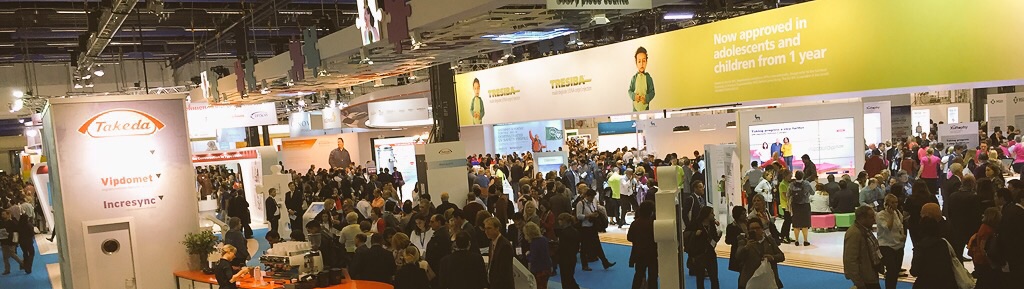
The Exhibition Hall here is, as expected, huge. Whilst the usual suspects are all here in force, there are also a few new faces on the scene. The Keleido pump is something to watch – if, for no other reason, than the gorgeous colour spectrum! More in coming days!
 While we’re talking new stuff, check out this gorgeous range of clothing from Anna PS (Scandinavia). Anna is delightful and started this company to address a gap in the market, producing high quality t-shirts, bathers, underwear and more to accommodate diabetes devices such as pumps, CGM receivers, pens etc. The clothing is of the most beautiful designs – the fabrics are divine. (And yes, she ships to Australia!)
There is a lot on show and a lot being presented and as in previous years, I have found this conference a lot more daunting than other meetings like ADA or our own ADS-ADEA. but there is plenty to write about and share. More in coming days.
This Saturday, I will be heading to the European Association for the Study of Diabetes (EASD) annual meeting – and the Euro Bloggers Summit.
Somewhat serendipitously, Saturday is also Diabetes Victoria’s first ever Travel Well with Diabetes event. Hop over to the Diabetes Victoria blog to read all about it.
In the meantime, I’ll be spending the rest of my week ignoring the fact that I’ve left everything to the last minute (as usual) and haven’t even thought about getting my diabetes stuff organised. I’ll also be ignoring the kidlet’s repeated protestations that her parents are abandoning her and swanning around Europe without her for the fourth time. Diabetes guilt and mother guilt – I need a holiday!
After pounding the corridors of the Adelaide Convention Centre, it was nice to have a quiet weekend of recovery, coffee and sleep.
And I caught up on lots of World Wide Web happenings. Here are some highlights.
LET’S TALK ABOUT COMPLICATIONS.
I am always saying how lucky I feel to have friends with diabetes both online and IRL. I always get a kick out of meeting people in person who I have connected with on social media. Kim Hislop is one of those people. I met Kim for the first time at the ADA conference in Boston this year and then again at Friends for Life in Orlando.
Last week, Kim guest-blogged for Kerri at Six Until Me about living with complications and her post is required reading for anyone affected by diabetes.
Complications are spoken about as an ‘end point’: if you do this/don’t do this, you will get this. Full stop. Threat, threat; blame, blame; guilt, guilt.
Where is the discussion about what happens next? Actually, what DOES happen next?
Kim’s piece starts to answer those questions and open the dialogue. Thank you for writing it, Kim!
NERD ALERT
THERE IS A PERIOD TABLE OF DIABETES!!!! I am too excited to write anything more. (And busy memorising it….)

(Click on pic for source.)
STICK TO THE FACTS TO COUNTER THE ANTI-VAXX
My heart broke a little last week when one of my favourite artists, cartoonist and poet Michael Leunig, had a cartoon published in The Age newspaper that could only be considered as anti-vaccination propaganda.
I adore Leunig and pretty much all he does – we have a Leunig drawing on our wall and I have barely been able to look at it since I saw the cartoon in the paper.
An article I read today in MJA says that perhaps we need to reframe the way we try to deal with those sprouting anti-vaxx rubbish. The message from this study proposes that instead of shouting about the irrefutable scientific evidence which demonstrates that vaccines are safe we should show parents what vaccine-preventable diseases actually do.
This makes sense. Most people have not seen what diseases such polio or measles actually look like. Thanks to the success of vaccines, most of these infectious diseases are uncommon. Instead of sprouting stats, show pictures
ARTY
I’ve written before about how we love the artwork of Josh ‘SHAG’ Agle and Derek Yaniger. Last week, I was introduced to Cliff Roberts an artist who illustrated the gorgeous (and unfortunately out of print) The First Book of Jazz.
My new project is to find a copy of the book and also some of his prints to adorn our walls.

Artwork by the wonderful Cliff Roberts
ICYMI
Last week was the ADS-ADEA annual scientific meeting. Click back through last week’s posts to see what went on. And read Ashley’s take aways from the conference over at Bittersweet Diagnosis.
COUNTDOWN TO WDD
Somehow, tomorrow is September. Which means that we are a mere two and a half months away from World Diabetes Day 2015. The IDF has launched its campaign for WDD this year and you can read all about it here.
The theme this year is all about healthy eating and its importance in diabetes management. Which it is. Even type 1 diabetes. I can already hear the ‘food has nothing to do with type 1 diabetes’ protests, but how about instead we consider how healthy eating is important to healthy living. And that includes those of us with an under-performing pancreas.
Healthy eating is a right – one that is not afforded to everyone. And this is a campaign that is worth supporting.
PRETTY THINGS
Prikkedief is an originations from The Netherlands making some pretty gorgeous diabetes fashion. You’ll find beautiful buttery leather awareness bracelets, pouches to hold diabetes supplies, cheeky t-shirts and fun wall art. Find them on Facebook here. (Their website seemed to be down at the time of writing this.)

Pretty pastels from Prikkedief.
ONE FOR THE WOMEN AND ONE FOR THE MEN
Diabetes Victoria is holding its annual Women’s Weekend in October. Details are here.
If you are thinking about possibly attending, but are just not sure, I would absolutely urge you to book. The previous two events have been hugely successful with attendees being overwhelmingly going home inspired and armed with new strategies to live well with diabetes.
And men are not forgotten. There is also an event exclusively for men living with type 1 diabetes coming up in information session coming up in October. Details here.
FUN FACT
The plural of pancreas is pancreata. You are welcome.
It’s nice to be back in Melbourne after three days of running around the Adelaide Convention Centre, unsuccessfully avoiding CHS and giving myself RSI from the constant tweeting and blogging.
There were some terrific things happening at the conference, it was a chance for me to catch up with some people I only see once a year and to hear and see some interesting new things. So here is a quick final wrap up of my ADS ADEA annual meeting.
Highlights
Overwhelmingly, without a doubt, unquestionably the highlight for me was how the consumer voice was heard at the conference. I wrote about it on Wednesday, so ICYMI, here it is. (But I would like to add that yesterday, at the Diabetes in Schools ADEA Symposium, this was taken to expert level with the inclusion of a STUDENT in the session.)
At morning tea on Thursday, the National Diabetes Services Scheme held a launch of some wonderful new resources for people living with diabetes. Details here. The diabetes and pregnancy resources have a special place in my heart, firstly because I am on the Expert Reference Group working on the program, but more so because the Having a Healthy Baby booklet is a revision (of a revision of a revision) of the Can I Have a Healthy Baby booklet? I was involved in developing well over 10 years ago. It’s great to see that there is still so much value in this resource. There’s a new diabetes and pregnancy website. Check it out!
The ‘little purple room’ on the Abbott stand had me giggling each time I saw it. This was where you were taken to hear about the Freestyle Libre. Because the device is yet to receive TGA approval, regulations state that it cannot be spoken about in the public space.
There were definitely more people tweeting! And I was so thrilled to have people who sat in my two social media sessions on Tuesday reaching out once they had joined Twitter.
Helen Edwards’ (Diabetes Counselling Online) presentation at the social media session on Thursday. I have to say, that overall, I felt the session missed the mark, so it was terrific to have Helen as the final presenter providing actual real and practical advice for those in the room wondering how to incorporate SoMe into their practise.
The number of sessions addressing the psychosocial aspects of living with diabetes was significant this year – I thought more than ever more. This is such a huge step forward – in previous years there has been a little focus on it, but not much. I do believe that the increase is largely due to the considerable contribution being made by the Australian Centre for Behavioural Research in Diabetes. Well done to the team there. And it is a pleasure and a privilege to work with you all!
Hanging out with the few consumer advocates who attended the conference. Thanks to Kim, Kelly, Elise, Jane C and Ashley for being so much fun, providing such useful insight, and talking me down from the ledge the couple of times it was looking like I was getting ready to head off on a rant.
Speaking of which…..
Lowlights
Pesky little things seem to get to me at conferences.
It is really disappointing that the ADS ADEA do not have a stronger SoMe presence at the conference. There was not a single tweet sent from their Twitter account for the whole of the week and their Facebook page has been completely inactive since 1 June.
Nowhere at the conference was there a Twitter wall, which can serve many functions. In addition to keeping those wandering around up to date with what people are saying about the conference, it also has the potential to encourage others to get on board and start sharing their thoughts of what is going on and engaging with other attendees and those not in the room too.
And the App for the conference was possibly the biggest waste of time I have ever seen. It was completely unintuitive, difficult to navigate and confusing. The schedule didn’t sync with my diary, so I couldn’t click on a session I wanted to see and have it added to my calendar for the day.
Social media has a place at this, and all conferences. Despite presenting (twice!) on SoMe on Tuesday at the Roche Educator Day, and there being another session which aimed to encourage HCPs to use SoMe, it was really a second-rate and most unsatisfactory attempt by the ADS and ADEA to utilise digital platforms to engage, connect and share.
I watched the launch of the (recently approved for use in Australia) A1c Now product, which is an A1c check that can be done on the spot. The device looks like a BGL meter and it operates in much the same way (strip in, blood on strip, wait, result!) Great idea – and one that has been around for some time in the US. I actually bought one when I was in New York on one of our visits and had a go.
After the launch, I spoke to the rep. ‘Great to see these are finally here now. I’m not a healthcare professional – I have diabetes myself. How do I get one?’ I asked.
‘They are for use by professionals, so through your HCP.’
At that point, I had to check myself, because I know I had that look on my face. I know I had that look on my face because the bloke I was speaking to looked a little scared all of a sudden.
I took a deep breath. ‘I think you are doing that around the wrong way. Why wouldn’t you make these available direct to people with diabetes?’ I waited for the response. I thought I knew what he was going to say. I thought he was going to tell me that it was important people with diabetes had someone speak to them about what the results meant (at which point I would have said that people with diabetes most often KNOW how to interpret the results) or that it was important for people with diabetes have someone tell them what to do with the result (at which point I would have said that a lot of people with diabetes would KNOW what to do with the result.)
But even I was surprised when he said ‘We don’t want to step on HCPs toes.’ I looked at him incredulously. ‘So what you are saying is that even though this technology has the potential to be used incredibly positively by PWD, you are not willing to make that happen because you are afraid of pissing off HCPs? Really?’
Poor guy. I then told him that one of the reasons people with diabetes might not be getting their A1c checked is because they are afraid of being judged or ‘told off’ by their HCP. And that if they were able to get an idea of what the result might be, it would give them some knowledge and perhaps give them a chance to do something about it.
He thought about it for a while and then said, ‘I see what you are saying. Maybe we’re going about this the wrong way.’ Yes. Yes you are.
Overall, for me – both personally and professionally – it was a valuable three days. So, that’s another conference ticked off for the year. Only another three more to go…
In the program for the ADS-ADEA conference, there was an unfortunate typo in the title for one of yesterday afternoon’s symposia. It took me a moment to realise that ‘Better Understanding the Needs of YOUR People with Diabetes: A Behavioural Perspective’ was meant to be ‘Better Understanding the Needs of YOUNG People with Diabetes: A Behavioural Perspective’.
It was in this symposium that there was a talk that certainly challenged some long-held ideas.
Dr Jessica Browne from the ACBRD gave a talk with the heading ‘Young adults with type 1 and 2 diabetes: more similar than you may think’. When I saw this in the program, I immediately winced. Not because I disagreed with it. But because I knew that there would possibly be some very unhappy people – predominantly people with type 1 diabetes or parents of kids with type 1 diabetes – who would not like what they were reading.
Controversial? Well, actually, I’m not so sure.
I know Jessica’s work, and I have a very clear understanding about what she is saying. And Jess herself took great pains to makes sure that everyone else in the room understood that she is not saying that type 1 and type 2 diabetes are the same conditions. (Bold, underlines, italics for emphasis all mine.)
Jess’ talk was about how emotional and behavioural attitudes to diabetes are very similar in young people – regardless of the type of diabetes.
This makes perfect sense when you think about it. Young adulthood is an often-challenging period of great change. For some, it involves studying or work or a combination of both. Some are planning families and moving out and buying houses and travelling the globe. Some are in relationships, others are not. It’s a time of a lot of self-discovery and finding one’s identity.
And diabetes adds an extra degree of difficulty – whatever type it might be.
Young people with type 2 diabetes face some considerable barriers to good emotional health. Unfortunately, they are often beginning far behind the start line, having to overcome a lot of social stigma and misconceptions about their health condition.
Yet when they search for information to help them out, much of what they find has been developed with an older adult audience in mind. Little of it is relevant to what a 25 year old is going through or addresses the issues they are facing.
In recent times when I have met young adults with type 2 diabetes, the things they say they need to better manage their condition and the how they say they are feeling about diabetes pretty much equal what young people with type 1 diabetes say they need.
Jessica called for tailored healthcare that is intensive, responsive, non-judgemental and targeted for young people with type 2 diabetes, which, when you think about it, is really not that different to what those of us with type 1 diabetes are asking for when it comes to treating ‘our’ diabetes.
One of my (very frequent) criticisms of diabetes conferences – especially here in Australia – is that there is not enough input from people with diabetes. The very people who are the reason that these conferences exist are largely silent and very, very invisible.
This year, however, I am so pleased to say that even though there may not be many of us storming the halls of the Adelaide Convention Centre, the voices of people with diabetes are being heard very, very loudly.
The day kicked off with a breakfast celebrating the 10th anniversary of the OzDAFNE program. There, in between discussions about the program was a video showing people who had completed DAFNE sharing their thoughts about the course.
I then headed to an often-challenging session on hypoglycaemia, where Dr Christel Hendrieckx from the ACBRD, in her session about the emotional and behavioural consequences of hypoglycaemia, dedicated a slide to quotes from this Diabetogenic post about the language we use when referring to mild and severe hypos. I am not sure that I have ever been prouder. (I also completely broke the no photos rule with this, but they are my words, so I thought I would be safe!)

In the next session , diabetes educator, Virginia Hagger (also from the ACBRD), spoke about the TEAM T1 Program. Once again, interspersed between stats and explanations of the program, quotes from teens who had attended TEAM T1 were read out, highlighting how the course helped them.
Virginia spoke again later in the day, this time about the Diabetes MILES Youth report and played the video used at the launch of the report (and shared on this post) for the audience. The words used to explain how young people feel about living with diabetes are powerful and their impact is significant.
Amelia Lake from the ACBRD (you’ve noticed the common theme here, right?) spoke about the development of a resource about young people with type 2 diabetes and retinal screening. She too provided great insight into how young adults with type 2 diabetes feel about eye checks by sharing quotes of their experiences.
While it would indeed be wonderful to have people with diabetes sitting in sessions, and standing on the podium lending their voice to provide the practical side of the theory often being discussed, incorporating the words of many into talks is a powerful and effective way to hear from us. Plus it means that there is never only one voice – which can at times seem tokenistic – being heard. Instead there are many – every single one important as the next.
Adelaide is sunny and fine and lovely. I am here for the ADS-ADEA conference which officially kicks off tomorrow.
Today, the Roche Educators Day – is a program of practical sessions which, according to the program notes, ‘aims to determine and understand unmet needs in diabetes from the clinician’s perspective.’ The program also promises ‘Experts in the field of diabetes will share to you their clinical experience and knowledge on various topics in relation to diabetes management.’
It is a great program with some incredible experts. And me pretending to know what I am talking about and trying to not be a trouble maker.
The day kicked off with Professor Jane Speight’s plenary session – ‘Adherence and Motivation: Dealing with the elephants in the diabetes consultation’. Jane’s talk was, as expected, full of practical tips. She challenged the people in the room to think about what their expectations are and if they meet the expectations of people with diabetes.
I presented next, delivering an hour long session on ‘Diabetes in a digital world’, where I put a spotlight on how social media can be – and is being – used by people with diabetes and healthcare professionals to connect, support and enhance care. Plus, I used cartoons and cat pictures. Because I was talking about the internet. I will be doing the same talk later this afternoon and I hope the audience is as receptive as this morning’s audience.
I’ve also had a look around the Exhibition Hall and while I will tell anyone who asks that it is because I am interested in the latest and greatest in diabetes management, the real aim for today was to find where the best coffee can be found. Head to the Novo stand, people. The English barista from Sydney has shattered all of my Melbourne-coffee-snob-bias and bangs out a bloody good latte!
Other important priorities for the day included avoiding conference hypo syndrome (failed miserably AFTER mentioning it in my talk), tweeting the bejeezus out of all the sessions (except my own, because although I can multi task like a boss, I’ve not yet learnt how to tweet while giving a talk), and trying to remember that I can’t take photos of…well…pretty much anything.
Looks like it is shaping up to be a great conference. Follow along at home on Twitter: #ADSADEA2015 (and for today’s Roche Educators Day: #RED2015)
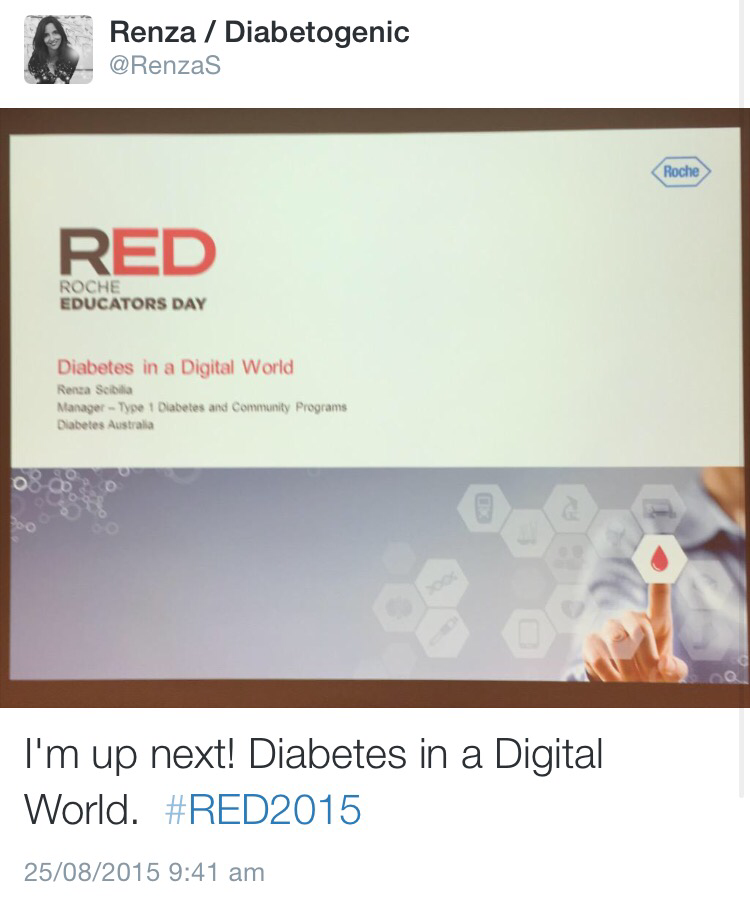
Oops. Broke the ‘no photographing in sessions’ rule.
DISCLAIMER
I am here as an invited speaker. Roche has covered my travel, accommodation and conference fee costs. There was no arrangement for me to write about the day – I’m just doing it because it’s been very interesting! I am very grateful to Roche for putting a consumer on their speaker panel today. It is terrific to see industry engaging in such a meaningful way.
I’m a bit of a goody-two-shoes most of the time. I like rules; I like to play by them. If someone hands me a policies and procedures handbook, I read it and then tick boxes as I make sure I do what is expected of me. Playing by the book is my MO! (You can see why being diagnosed with diabetes is not really in sync with this philosophy…)
So, it pains me greatly when I see a rule that I don’t like – especially one that I can see no reason to be there!
I am in Adelaide from tomorrow for the Australian Diabetes Society – Australian Diabetes Educators Association annual conference. Actually, tomorrow, I am presenting at the Roche Educators Day which is very exciting and also making me a little nervous. Speaking to healthcare professionals about the benefit of using social media is sometimes a terrifying thought. In fact, the people listening are the definition of a tough audience. (So, if anyone who is attending tomorrow is reading this, please be kind and nice and gentle and open to discussing this topic. Please!)
It has been great that the planners of the conference for the last couple of years have actually bothered to consider how social media can be used to talk about what is going on in the presentations. There was some great tweeting last year – admittedly, mainly people from Diabetes Victoria and the Australian Centre for Behavioural Research, but nonetheless, definitely an improvement on previous years. (So maybe, all the talking to healthcare professionals about social media is starting to pay off??)
This is all great. All heading in the right direction! Social media at our premier diabetes healthcare professional conference is here to stay. So I was really disappointed to see this year that the social media guidelines on the conference website state the following:
The use of photographic, video, or other type of recording devices is strictly prohibited in all oral sessions (i.e., platform, plenary, invited, etc.) and poster sessions at the ADS ADEA 2015 ASM. Therefore, it is also strictly prohibited to post photos/images or video recordings from these sessions on any type of online site, including social media platforms, blogs, personal Web pages, etc.
Now, I recently got into trouble for breaking a similar rule. When I attended the ADA meeting in Boston, I was live tweeting Bill Polonsky’s sessions, and tweeted a couple of his slides*. Within minutes, the SoMe boffins from the ADA sprang into action:

I was firmly rapped over the knuckles. There were a few follow up tweets from DOC peeps obviously as pissed off as me about the policy. We all thought it was pretty crazy.
So let me explain why I don’t like this policy.
I completely understand if there is a restriction around photographing unpublished data. That makes sense. But I believe that the people in the room are smart enough to not take photos of anything if they are told that it is unpublished. They would understand why there was such a restriction and, I believe, not publish the data.
But if the data is in the public domain and available for everyone, then what is the harm?
I live tweet conference sessions because it is a great way to capture what is going on in the moment at the meeting. I am also very aware of what a privilege it is to be in the room! Most people with diabetes don’t get the chance, so this is an opportunity to share what is being discussed.
Of course, I quote what the speaker is saying, or highlight key points, but with a 140 character limit, the value of a picture and its thousand words is never truer!
It also means that there is less chance of me misinterpreting what is being said.
Live tweeting from conferences is a fabulous way to reach a far broader audience – frequently an audience that may never actually be in the room – yet is directly affected by what is being discussed! And I have said it before, but one of the reasons that it is so great to have consumer reps in the room is because we share the information. How many of us actually have HCPs who do that when we see them?
I tweet and blog and talk about them – as do my peers – and that is how we find out what is hot, what is new, what is coming up.
This policy is ridiculous. And it needs to be changed.
*For the record, one of the tweets I sent at ADA was a photo of Dr Gregory House. Dr Polonsky was using a photo of him to illustrate a point. It was a good point. It was a good photo. Plus, I love Hugh Laurie and any chance to look at him. It was worth getting told off for!
This time last week, I was sitting on a plane, flying back from Friends for Life. As we’d booked this trip at the last possible moment, I was not travelling the long LA – Melbourne leg with Aaron and the kidlet. We hadn’t managed to all get on the same flight and my trip (booked though work) and theirs didn’t coincide.
So I had a lot of thinking time and kept trying to put into words what the Friends for Life (FFL) experience was for me. I found myself tearing up quite a bit, and kept touching the green bracelet that was wound around my right wrist. It’s still there, and I find myself glancing at it when I am sitting in meetings, or as my fingers fly across the keyboard typing these words.
I had an idea of what I was going to experience at FFL. I have spent enough time with FFL alumni and read a lot about it to have formed an impression about what the week would hold.
I knew what to expect.
Excect I absolutely didn’t. I had no idea.
I expected it to be all touchy-feely. I expected lots of hugs. I expected a quiet understanding – of all and from all who were there. I expected to feel included and part of something and welcomed.
And those expectations were all met. Ten fold.
But what I didn’t expect was the sheer, overwhelming emotion of the conference.
And I didn’t expect the science.
Make no mistake. Friends for Life is a diabetes conference in the truest sense of the word. It is not a support group meeting – of course there is support, but it is much more than that – it is a scientific meeting with the focus very clearly on providing up-to-date, evidence-based, important information to people living with diabetes. It’s not dumbed-down – absolutely not! The information presented at FFL would not be out of place at the ADA scientific meeting I’d attended the month prior, or ADS-ADEA conference I am attending next month.
I didn’t expect an exhibition hall that was bigger than what I know I’ll see at the annual ADS-ADEA conference.
I didn’t expect that there would be announcements like the one Ed Damiano made about his work on the (brilliantly named, iLET) bionic pancreas. And when it was made, I didn’t expect the outpouring of emotion, of gratitude, of understanding, of hope.
And running alongside it – as part of it – are the sessions where you sit, and breathe and cry and nod and share your story. Or say nothing and just fill up.
This is not a cult-like gathering of the pancreatically-challenged and our support people. There is no sitting around feeling sorry for ourselves. Equally, it’s not a pep rally where we marched to the beat of the same drum, patting ourselves in the back. Every person at that conference has their own story and while there certainly are similarities, there are also differences.
Friends for Life challenged me. It made me feel uncomfortable at times. The discussions were not all easy and self-affirming. There were topics that I don’t regularly talk about, instead hiding them away in a chamber of my mind that I manage to keep locked away most of the time. I sat quietly in talks about how diabetes affects those around me. I struggled to share my story at times. But I did, often with hesitation, because talking about how diabetes impacts on Aaron and our beautiful girl hurts me in ways that make me feel like I am falling to pieces inside.
I didn’t walk out of all of those challenging sessions feeling great. But I felt validated and I felt less alone. And I understood better that it was okay to speak about those confronting issues, even if what I am feeling isn’t wonderful. I took away from those sessions the ideas and strategies other use and I feel better equipped to manage some of the more difficult aspects of living with diabetes in the family.
I attended FFL as a guest of Children with Diabetes (CWD). For years, I have been begging CWD President, Jeff Hitchcock to bring this event to Australia and while I did that with the idea that it would be great for people affected by diabetes to have the experience, I had no idea just what that experience would mean. I still am not fully cognisant of what the experience has given me.
My expectations weren’t met at Friends for Life. They were exceeded. And I hope that we can find a way to bring it to Australia so that as many people as possible can become part of the FFL family.
A huge thank you to Jeff Hitchcock and the CWD Board for covering my costs to attend Friends for Life 2015.





 Diabetogenic