
You are currently browsing the category archive for the ‘Community’ category.
Sunday is Feminist Christmas*. It’s the day that social media feeds turn pink and women get celebrated with morning teas (organised by women) and the lady folk are handed a cupcake (made by women) to shut us up and make us forget that women continue to live in a world designed and defined by patriarchy.
Isn’t that a joyful start to this article? I’ll wait while people shift uncomfortably and refer to me as an angry/difficult woman.
In the coming days in the diabetes world, you’ll see posts pointing to women in the diabetes landscape. These women are generally remarkable and doing great things. But oddly, rarely are the women whose faces appear on a social media carousel actually living with diabetes. A few years ago, I pointed out that while we should be recognising the clinicians and researchers improving our lives, women with diabetes are completely ignored.
So, a little hint to anyone who is putting together content for next week: don’t forget to also highlight the women with lived experience of diabetes who are actually doing so much of the work in our community. Those grassroots initiatives that continue to be life saving and life changing are very often powered by women with diabetes. And, as is often the case, these women do this work on a volunteer basis. All while managing a very demanding chronic health condition on top of all the other work women do.
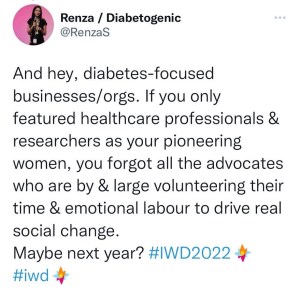
In the meantime, you should all register for this year’s DiaLeb Annual Diabetes and Women Panel. This is the 7th year and I’m very excited to be on the panel with two remarkable women living with diabetes, and another two women with loved experience of diabetes. Be quick! It’s tomorrow!
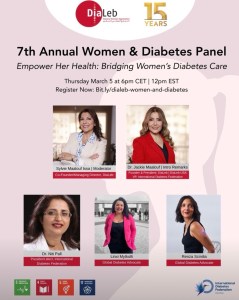
Seriously, women with diabetes are brilliant. we deserve way more than a cupcake. But I’ll take one all the same if some bloke would like to organise it.
More on International Women’s Day at Diabetogenic
2023 – Deserving more than a cupcake
2019 – Interweb Jumble #34 – The IWD edit
*The brilliant Wilhelmina Stracke coined this term. You should follow her on Instagram.
So what has been occupying your minds over the first few weeks of the year? Well, for a while there (and still), mine was trying to understand the veritable PR disaster of the Adelaide Writers Week (AWW). Niche? Yes. Relevant to diabetes? Also yes. In a roundabout way.
Let me set the scene. A writers festival in Australia was cancelled after one of the speakers had her invitation rescinded. The simple explanation of this is that the speaker, academic and author Dr Randa Abdel-Fattah had made some comments on social media that were deemed controversial by the AWW Board. More concerning, they connected these comments with the shootings in Bondi in December last year, effectively associating Dr Abdel-Fattah with the shooters. I’m actually not here to comment on Dr Abdel-Fattah, other than to say her treatment was appalling. There has been a lot of commentary, and if you’re not from Australia (or are from Australia but somehow managed to miss it) simply google AWW for details of what happens when decisions are made without consultation or understanding of the affected community.
I specifically want to focus on one part of the whole saga and that is the decision makers responsible for the PR nightmare. The Board of the Adelaide Festival (who is also responsible for the AWW) made the decision without the support of AWW director, Dr Louise Adler AM or her team. Dr Adler, in a letter published in the Guardian after she resigned from her role highlighted that the board was ‘composed of individuals with little experience in the arts ‘, which lead to decisions being made without cultural context and an absence of understanding consequence.
Even before I’d read Dr Alder’s compelling and commentary, the conversations I was having with friends and family were homed in on the same themes. We knew that the other writers at the festival would withdraw from the festival, one by one. We knew that Dr Adler had been treated terribly. And we were waiting for the gaslighting that would come from the Board, and anyone else involved in the decision making.
We knew, because we are a family of artists. My husband is a professional musician. My daughter is studying writing and journalism and has a part time job writing for a local newspaper. I studied music at university. Our friends are musicians, composers, writers, film makers, makers and journalists. We’d had discussions with many of them about how the Board’s lack of understanding of the arts sector, the way the community would respond, and how the community would be impacted. The words I used were ‘They have no skin in the game’, and by that I meant that not only couldn’t they see what was coming, they could also walk away relatively unscathed. Their careers were unlikely limited by their involvement in the decision and even though the entire board resigned, I would bet that it hasn’t made a dent professional standing or income.
Yet it wasn’t the arts scene that was the focus of my thoughts when I considered the AWW board, the decisions they made, the lack of insight into community response or the inevitable and highly predictable fallout.
It was, of course, diabetes.
I found myself wandering around the house and on daily walks muttering ‘Nothing about us without us’ with a growing frustration that this lesson keeps having to be learnt the hard way.
It may be different communities and different contexts, but we’ve seen similar incidents play out just like this in the diabetes world for years. People with diabetes are not included in decision making processes. But then sit there, watching the fall out.
The process is the same. The positioning from the people making decisions is the same. Think about some pretty ridiculous diabetes decisions in recent years and think about who made them, and who wasn’t consulted. Think about the fallout from a particularly nasty diabetes campaign that adds to diabetes-related stigma. It’s with disbelief that I think back to campaign discussions when I was told outright that offending and upsetting people with diabetes when a campaign launched was the price to pay because we weren’t the intended audience, as if we would be magically shielded from the stigmatising messaging. And that it was an unintended consequence in efforts to inform the general public.
Those gaslighting me weren’t going to be in the firing line next time someone made some horrid comment about diabetes. It wasn’t their weekend that was going to be ruined when some smartarse in a supermarket queue or café said something about sugar causing diabetes or personal responsibility or how diabetes is a ticking time bomb.
When a decision is made that directly impacts people’s lives, surely those people should be in the room, at the table and have their voices heard the loudest. Surely. It’s so frequently not the case when diabetes decisions are made. It wasn’t the case when the AWW Board decided to cancel Dr Abdel-Fattah’s speaking engagement.
And so, the AWW was cancelled after almost all the writers on the program withdrew and the Board resigned. Interestingly, most of the Board members sit on other boards, so their status as ‘leaders’ and ‘decision makers’ doesn’t seem to be too impacted. Meanwhile, those writers have lost one of the few (and seemingly shrinking) opportunities to meet to share ideas and celebrate their community. Their incomes have been impacted. The chance to get their work in front of an audience has disappeared.
Nothing about us without us. It seems that this little catch phrase has been ignored too often, unless being used in convenient and cute attempts to demonstrate (usually lacking) community engagement. Instead, maybe it’s time to put us on boards and in leadership and decision-making positions. Maybe it’s time to actually listen to the people who know. Because our skin? It’s the one in the game more than anyone else’s. Raw, exposed and in the firing line.

It’s been a hot minute, hasn’t it. And by ‘hot’ I mean sweltering here in Melbourne. While my friends in the northern hemisphere are sharing snow photos, we’ve been dealing with days in the high 30s and 40s. (For my US friends – we hit almost 120°F this month. It was not nice.)
Anyway, now that the weather discussions are over, let me wish you all a belated happy new year. I’d like to say that I hope that your start to 2026 has been gentle and kind, but instead, picture me gesturing wildly at the world and shaking my head in despair.
I finished up 2025 feeling pretty damn exhausted and burnt out. But, really, who wasn’t feeling that way? There was a lot of good stuff that I could look back on, but the never-ending travel wore me out. I feel compelled to say that I know I am fortunate to do the work I do, and I love my job. Being able to work with people in the diabetes community who are making real change is a gift every single day. I would just be so happy if someone could find out a way for Australia to not be a 30-hour trip away from most of the places I need to visit.
I was lucky to have a three-week break over the Christmas/New Year period where I travelled no further than 5kms from my house, and I’ll have had a 10-week hiatus before I next find myself in an airport. Both of these breaks feel like a luxury!
But as we gear up for 2026, it’s undeniable that the global health world is in a mess and diabetes is not immune to that. I’m really pleased that some of my work will involve addressing issues that are important to people with diabetes. I’m beyond honoured to have been invited to give the Anita Carlson lecture at this month’s Psychosocial Aspects of Diabetes (PSAD) Conference (even happier that it’s being held in a regional city in my state and I only have to drive for an hour to get there!). I’ve called my lecture ‘Building Diabetes Healthcare from the Ground Up’ and it’s given me an opportunity to imagine just what diabetes healthcare could be if people with diabetes were actually centred and involved in its creation.
Next month the first Global Summit to End Diabetes Stigma is being held in Jaipur, India. Can you imagine hundreds of people with or working in diabetes coming together in one place to come up with meaningful and real strategies to end stigma? For disclosure purposes, this event is being funded via a grant from Breakthrough T1D (I work there), and I am involved in the planning of the event. It feels like a culmination of a lot of efforts highlighting the impact of stigma to get to a place where the diabetes world is ready to collaborate to end it. I’m so thrilled to be working for the organisation that has recognised that.
For me right now though, there is an overarching feeling that the world really is burning. While the US gets a lot of our attention, diabetes healthcare and access to insulin and care remains incredibly lacking in other parts of the world. As always, the most vulnerable in our world are impacted the most negatively. I don’t know about you, but a lot of the time I feel helpless.
Now it’s February, you may have once again seen that the annual Spare a Rose campaign has started. I think this is the fourteenth year of the campaign. I think back to what the diabetes community was like when Spare a Rose first started, and honestly, it feels very different to what we have today. I don’t know if a campaign like this would be started in today’s community. In fact, sometimes I find it harder and harder to find community and advocacy these days, as “influencer culture” takes hold.
And so, it’s worth remembering where Spare a Rose came from and the intentions behind it. It was a group of advocates in the US who wanted to give back somehow. I should point out that the advocates who started Spare a Rose had already given so much to the community. Many of them have taken a back seat to front-facing advocacy efforts but their legacies live on, even if fewer and fewer people see how they shaped the DOC. It’s diabetes advocates who have driven this campaign over the years and made sure that it has remained in the view of people with diabetes.
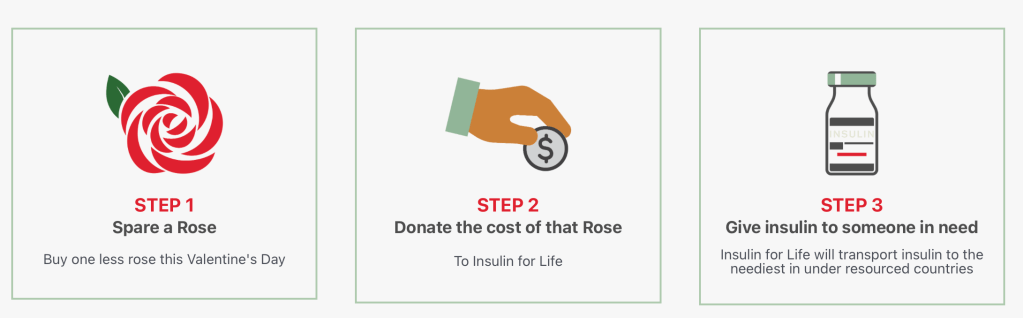
I have always loved the simplicity of Spare a Rose. The donation being asked for is small – US$5. For those needing a refresher, the idea is to give your loved one eleven rather than twelve roses and donate the saving to the campaign. In our house, we forgo flowers completely and recognise that empty vases are a small price to pay for making a donation to the value of a year’s worth of insulin.
I know that many are doing it tough these days. I also know that a lot of people who would have donated without a second thought in the past are unable to do so now due to changes of circumstances in so-called high-income countries.
But if you can support Spare a Rose by making a donation, please do. All funds go directly to the brilliant charity Insulin for Life, and each contribution makes a difference to a person with diabetes in a low-income country. If you can’t make a financial contribution, please share the website across your networks. Someone else in there might be able to donate. Every single dollar counts.
Click to donate!
ISPAD has led the way when it comes to including people with lived experience of diabetes at their annual meeting. It was the first conference to work with #dedoc° to have a voices scholarship program. The society has included people with diabetes on the organising committee for some time. ISPAD has awarded the ‘Hero Award’ which recognises the work done by people in the community. And the conference scientific program involves people with diabetes speaking and chairing sessions.
And so, it was interesting to hear someone ask at last week’s meeting in Montreal whether there should be a limit to the involvement and number of people with diabetes.
I wasn’t actually in that session, but I certainly heard about it from many others. People seem to expect me to have words to say about these sorts of questions. Turns out I do – and so do other people. And there was quite a bit of discussion – both at the conference, and in an online group after I shared the question with members.
While the question may have been well intended, (I certainly don’t believe there was any malice in asking), it did make me bristle. The idea of limiting access to a diabetes conference to people with diabetes has never sat well with me. It reeks of gatekeeping. And it also sends the message that people with diabetes are ‘allowed’ at the discretion of others rather than having a right to attend.
I think that quantifying the number of any sort of participant is problematic, but I have always liked this pie chart drawn and tweeted by James Turner (@jamesturnereux, although he appears to no longer be on the cesspit site) from a Medicine X conference in 2017. I am pretty sure that I have already shared this somewhere in the #diabetogenic archives, because I think it’s great! What I like about this is that it recognises that everyone has an equal place to be there. That equilibrium does sit well with me!

I also like the comment from my friend, and researcher and fabulous diabetes advocate, Ashley Ng. We caught up today to discuss this issue, and she said ‘I don’t agree with a maximum, but I do think we need minimum representation by people with lived experience’.
But this isn’t just a matter of representation, and it’s not simple either. There is the broader issue of people with diabetes wearing more than one hat. Some may also be researchers, clinicians, involved in technology development, industry representatives and more. This certainly does point to the complexity of the ecosystem. When looking at the number of people with lived experience of diabetes, we draw the cohort from many different spaces.
But this in itself adds to the intricacies of the situation. In fact, it is something that I have spoken and written about for decades (most recently here) and my position is very clear, albeit not especially popular with everyone. I believe that people with lived experience who wear no other hat in the healthcare space must be prioritised for positions centring lived experience at conferences, in panels, on advisory groups and anywhere people with diabetes are intended to be represented. Why? Because these are usually the ONLY way for us to get a seat at the table. Those wearing other hats may find themselves able to access other pathways via their employment or professional settings.
This is why #dedoc° generally doesn’t offer scholarships to healthcare professionals and researchers. The voices program is for people with diabetes who otherwise would not be able to find a way to attend conferences and who don’t have other prospective funding opportunities. I am aware that HCPs and researchers have limited opportunities available to them, but there are funding streams and grants, and institutional supports that are simply not open to people with lived experience who do not have any professional affiliation. Of course, (and it shouldn’t need to be said, but I’ll say it anyway), I’m not minimising the experiences of those who bring both professional and personal perspectives. But there are so very few opportunities for people with diabetes who represent as community members only to find a seat at the table. Those seats should not only be reserved for us, but we should all work to protect them.
It would be remiss of me to not point out that there are indeed unique challenges for people who straddle the professional and lived-experience divide. This article (I am a co-author) was written by people with lived experience of diabetes and wearers of other hats and addresses some of the issues faced by people in this situation.
These discussions are always interesting, but they can be uncomfortable. And also frustrating. I would hope that we are far along the lived experience inclusion road to not have to justify the rights of people with diabetes to be part of conferences and other efforts. And rather than even suggesting gatekeeping, we should be looking at more ways to make access to these spaces easier, and focused on diversity of voices. Chelcie Rice says we should bring our own chair if there isn’t one already for us. I say, bring two or three and the people to fill them too. But honestly, we should be beyond that now, right? We should simply be able to walk into any space and take a seat.
Disclosure
ISPAD invited me to speak at this year’s meeting and covered by accommodation costs. Travel was part of my role at Breakthrough T1D.
My dad has always taken his parenting duties very seriously, and as such, he made sure that by the time I was ten years old, I had watched and rewatched all Marx Brothers movies to the point that I was able to recite the scripts word for word. I can’t tell you how many times I’ve watched ‘A Night at the Opera’, but it’s probably that movie and not twenty years of classical music training that means I can sing along to most of Il Trovatore.
My mum has never been a fan of the Marx Brothers. She’d roll her eyes while we were rolling around on the floor in fits of laughter, shaking her head and muttering that she simply didn’t understand what we found so amusing.
Does this mean she doesn’t have a sense of humour? Of course not, contrary to dad’s constant suggestion of as much. Mum regularly shares killer memes and jokes that are laugh out loud hilarious. It’s just that the Marx Brothers have never made her laugh (weirdo).
This showed me that people laugh at different things. One person’s funny bone tickler is another’s shrug of utter indifference.
One thing I learnt pretty early on when I started hanging out in the global online diabetes community is that humour is a really important coping mechanism for living with the condition. It makes sense, right? I mean, there are some pretty grim aspects of life with T1D, and having a laugh can lighten especially dark days, and help us keep perspective when things feel overwhelming.
Back in the OG DOC days, there were awards given to writers and people on social media, and one of the award categories was humour. I’ve tried to inject some humour into this blog over the years – you can be the judge how successful I’ve been. Read to the end and you’ll see I’ve linked to some posts where I tried to use jokes and humour to keep things a little lighter.
Sometimes, however, attempts at humour don’t land all that well. Or they land at the expense of others. And when that’s the case, I think we need to stop for a minute and check ourselves. Is it worth getting a laugh when you are punching down?
I don’t think so – especially because the result of punching down is often stigma. And we all know how I feel about that. Right? RIGHT?
None of this is new from me. I’ve been talking about how when people stigmatise any type of diabetes, we all suffer. I’ve been pretty blunt when calling out the T1D community for being outright nasty about people with other types of diabetes, especially people with T2D. The stigma we experience is a direct result of misinformation and ignorance about all types of diabetes. Contributing to it is not only nasty, but it is also voting against our own interests.
This post today has come about because over the last 24-hours a T1D Facebook group that I’m a member of has been embroiled in a fiery debate because one of the group’s moderators posted a meme that stigmatises type 2 diabetes. I’m not sharing the meme here, (because why would I add to diabetes stigma?) but I can describe it by saying that it highlighted a risk factor of T2D in a very stigmatising way. It was unoriginal, unamusing and unkind.
And it got messy. A number of people asked for the meme to be removed. Many were upset and found it offensive.
The moderators of the group doubled down. There were demands to scroll by and reminders that we were not there to ‘defend’ other types of diabetes. Comments pleading for the post to be removed were deleted and people were told they ‘Can’t take a joke’. I asked a few times for someone to please explain the ‘joke’, because I didn’t understand it. No one was able to do that. My comments were deleted anyway.
It astonishes me that the moderators of this group have chosen the hill they want to die on to be that it’s okay to stigmatise T2D and people should get over it if they don’t like it. They must have spent hours deleting comments and telling people to ‘get over themselves’. They repeatedly pointed out that the group is a T1D meme group with what seems an assumption that all people with T1D are happy for there to be nasty memes about T2D. Reassuringly, that’s not the case. A lot of people with T1D in the group are not impressed about the stigmatising posts and pop their heads above the parapet to let that be known.
A T1D meme page could be a source of joy, amusement, unity and some pretty clever humour, but instead, this group seems to regularly descend into bickering about what’s a joke and what’s just plain cruel, because many people with T1D don’t want to see T2D stigmatised or for misconceptions to be perpetuated. I’m one of those people.
And yes, I know that I can just leave the group. But one of the other things my dad, (and mum) taught me is that the standard you walk by is the standard you accept, and posting crappy, stigmatising, false and outright mean things about people with any type of diabetes is not a standard I accept. I call it out – regardless of who it is posting it.
I also want people to understand that these sorts of posts contribute to not just stigma about T2D, but to stigma about T1D as well. It constantly befuddles me that people who defend the right to be nasty and stigmatising about T2D are the same people who are up in arms when someone says something incorrect or stigmatising about T1D. The intellectual disconnect that can’t join the dots between the two issues is really something!
We can do better as a community. There are brilliant stories, jokes, and moments of wit that are truly hilarious, and we should be able to laugh about the shared absurdities and frustrations of life with T1D. But we can do it without throwing another group of people under the bus.

Want to see some truly funny things?
Watch Melissa Lee’s D-Parodies. Truly brilliant and hilarious.
Spoonful of Laughter from the team at dStigmatise brings comedians together to show how we can laugh about diabetes, and check stigma at the door.
Sam Morrison is one of the featured comedians on A Spoonful of Laughter and you can follow him, here.
Follow Brad Slaight! He’s hilarious.
Miss Diabetes manages to address some pretty serious issues around diabetes using her fabulous comics and artwork.
His Instagram handle is @type1comedian, and he’s damn funny! I’m not sure if any of Chelcie Rice’s stand up is online, but search for it and see if you get lucky.
And some questionable attempts of humour from me
Pancreas performance review (it’s really all about Effin’ Birds!)
My Lie on a Plate (rubbish influencers influencing rubbish)
Are you a diabetes expert? (This quiz has the answer!)
Do you remember life before diabetes? It’s getting harder and harder for me to. I had 24 years without diabetes, and occasionally, I’ll look at a photo from the BD years and think about how much simpler my days were.
Today, I’m wondering how much I remember diabetes before I started using automated insulin delivery (AID). It’s been eight years. Eight years of Loop. Happy loopiversary to me! Diabetes BL (before Loop) felt heavier. And scarier. I remember those months just after I started looping and how different things felt. I remember the better sleep and the increased energy. I remember a lightness that I hadn’t experienced since I was diagnosed.
That’s now my “diabetes normal”. Life with Loop is simply easier than life BL. On the very rare occasions I’ve had to DIY diabetes, it’s been a jolt as I’ve realised just how truly bad I am at diabetes. Embarrassingly bad.
While there was a stark difference back then between people who were using DIYAPS and those who were using interoperable devices on the market, today that difference is less. AID systems are not just for people who choose to build one for themselves. These days, it’s so great to know that there are commercial systems available which means more people have access to AID. We can debate which algorithm is better or whether a commercial or an open-source system is better, but I think that’s a little pointless. If people are doing less diabetes and feeling happier, better and less burdened, it doesn’t matter what they’re using. Your diabetes; your rules!
Eight years on, and despite there being commercial systems I could access, I’ve decided to keep using Loop – the same system I started on 8 years ago. The changes I’ve made are the devices with which I am using Loop. My pink Medtronic pump has been retired, along with the Orange Link (which was obviously in a pink case). Instead, I now use Omnipod, a single device instead of two which has further simplified my diabetes. It’s also meant not worrying about a working back up Medtronic pump, and it means carrying less bulky supplies when travelling.
These may all seem like little things, but they add up.
My decision to not move to a commercial system has been based on a couple of different reasons. I always said that I wouldn’t move to something that required a trade-off whereby any of the convenience of Loop was compromised. I’ve been blousing from my iPhone or Apple watch since 2017, and I refused to let that go. In my mind, having to wrangle my pump from my bra or carry an additional PDM to bolus was a step backwards. Of course, this is now available on some commercial systems, and it’s been super cool to see diabetes friends have access to something that does make diabetes a little less intrusive.
The customisability of Loop has meant that my target levels are set by me and me alone. The lower limit on commercial systems is not what I like mine set at. I wasn’t prepared to sacrifice the flexibility of personalised settings fora one-size-fits-all approach.
I do understand that there are pros to having a commercial system. Having helplines to trouble shoot and customer support on call is certainly a positive. Knowing that an annual Loop rebuild (always anxiety inducing because …well, technology?) is upcoming is stressful. And the worry that the update will break something that’s been working perfectly.
And yet, measure for measure, the decision to continue to use Loop has been very easy.
I still thank the magicians behind open-source technologies for their brilliance and generosity every single day. I’m grateful for the algorithm developers, the people who have written step by step instructions that even I can follow, and I am so thankful for the people who have tried to make devices more affordable. I believe that device makers do genuinely want to make diabetes simpler and help ease the load of diabetes. But in my mind, it’s undeniable that user-led developments have been more successful in actually making diabetes easier. These magicians know firsthand just what it means to claw back from diabetes.
In the end, the goal for me has always been clear: I want diabetes to intrude in my life as little as possible, and I will avail myself of anything that helps. It’s why I continue to use an Anubis even though there is no out of pocket cost for G6 transmitters. Using an Anubis means I change my sensor when it’s getting spotty, not when the factory setting insists, and the transmitter last six instead of three months. See? Fewer diabetes tasks. Less diabetes. That’s the whole point. (And it’s also why I’m hesitant about moving to G7)
When I try to quantify how much less diabetes, I just come back to Justin Walker and his presentation at Diabetes Mine’s DData back in 2018 when he said ‘By wearing Open APS, I save myself about an hour a day not doing diabetes’. Eight years down the track, that’s 2,922 hours I’ve gained back. That’s almost 122 days. It may be thirty seconds here, a minute there. But it adds up. And that time is better in my pocket than in diabetes’.
And so, here I am. Eight years on. With diabetes in the background as much as it can be with the tools I have available to me. I still really don’t like diabetes. I still really resent it takes up the time and brain space it does, and I still want a cure for all of us. Damn, we deserve that.
But in the meantime, I’m going to keep leaning into what the community has done for the community and know how lucky I am to benefit from that knowledge and expertise. Never bet against the T1D community. We know exactly what diabetes takes from us every day. And exactly what it takes to give some of it back.
More on my experiences with Loop
That time I scared the hell out of healthcare professionals
What looping on holidays looks like
A list of how Looped changed my diabetes life (and all of it is still relevant today!)
Postscript
As ever, I’m very aware of my privilege. Access to AID is nowhere near where it should be. If we look at the Australian context, insulin pumps remain out of range for so many people with T1D thanks to outdated funding models. Remember the consensus statement developed last year? And beyond our borders, technology access varies significantly. As a diabetes community, we are not all beneficiaries from this tech until every single person with diabetes has access. And that starts with affordable, uninterrupted access to insulin, right through to the most sophisticated AID systems, to preventative treatments, to cell therapies.
This is a transcript of a talk I gave earlier this year to a European-based health consultancy and creative agency about my take on global diabetes community-based advocacy – the opportunities and challenges. The title I was given was ‘Making Engagement the norm rather than the exception’. AI did a remarkably decent job with this transcript, but I expect that there might be some clunky language in there that I missed when I read through it on a plane after being in transit for 27 hours straight. Or, I could simply have used clunky language. Either way, it’s my fault.
I often say that community is everything, but I want to begin by saying that it’s important to understand that there is no single, homogenous diabetes community. Everyone’s diabetes experiences are different. I truly believe that there are some issues that unite us all, but really, we are a very disparate group – something I have come to understand more and more the longer I have been involved in diabetes community advocacy. This poses possibly the largest challenge for everyone in this room wanting to work with “THE diabetes community” because if you’re looking for a group that agrees on everything and believes the same thing, I’m sorry to say that you’re going to be in for quite a ride!
But it is also the biggest opportunity – and the way to get an edge – because it gives anyone who works in the diabetes space – from healthcare professionals, researchers, industry, diabetes organisations, policy makers, the media – to roll up their sleeves and make a concerted effort to talk with a wide range of people with diabetes to understand our experiences and what we need. Look, I know that it would be easier for all of you if I said, ‘Speak with one person and then you’re good to go’, but that would be a lie. Sadly, a lot of people and organisations still believe this to be the case, and I have a great example to show you why that doesn’t work.
And that example? It’s me, hi, I’m the problem, it’s me.
A number of years ago, a researcher reached out to me with an invitation to be the ‘consumer representative’ on their project. After bristling at the term “consumer”, I asked what the project was about, and this is what they said, word for word because I wrote it down and have told this story a million times as a cautionary tale: ‘It’s a project on erectile dysfunction in men with type 2 diabetes, diagnosed over the age of 65.’
There was not a note of irony in this invitation. When I pointed out that I fit literally none of the categories in the study and then went on to point out that I am a woman; I have T1D; no erectile dysfunction; diagnosed at 24; was not within a decade of 65 years of age, the response was ‘Oh, but you have diabetes, so you’ll be great’.
Friends, I would not have been great.
For the purposes of this discussion, when I say diabetes community, I am referring to people with lived experience of diabetes. There is a lot of cross over in the diabetes advocacy space, and there are many examples I can point to that show how valuable advocacy efforts can be when people with diabetes are involved in efforts led by diabetes organisations or other stakeholders. In fact, at the end of last year, we saw a brilliant example of that with Breakthrough T1D in Australia receiving $50.1 million in funding from the Australian government for their Clinical Research Network. This is the power of an organisation meaningfully engaging with their community to tell the story of why their advocacy is important. I mean, what is more compelling than hearing from people with diabetes and their families about how research holds the key to a better diabetes future?
I’d encourage you to look at Breakthrough T1D Australia’s socials to see just how beautifully they centred people with lived experience to get their message across, and how it was people with diabetes who literally marched on parliament to tell the story. The coordination of the campaign may have come from a passionate advocacy and comms team in an organisation, but the words were all people with diabetes. (For transparency: I work for Breakthrough T1D, formerly JDRF, but not for the Australian affiliate. I am, however, extraordinarily proud of what Breakthrough T1D Australia has achieved and so, so impressed with the way their communications campaigns are never about the organisation or staff, but rather about the community.)
I believe that our community excels in telling the stories of our lives with diabetes, what we need to make our lives better, what works in our communities and how we can better work together. Some standout examples of this include the #dedoc° community, and, in particular, the #dedoc° voices scholarship program. This is the only truly global community where diabetes advocates are not only present but are leading conversations. #dedoc° has no agenda other than to provide a platform for people with diabetes which results in diverse stories and experiences being heard. And it also means that organisations want to work with #dedoc° because it’s an easy way to connect with community. (And another point of transparency: I’m the Head of Advocacy for #dedoc°.)
Organisations that thrive on working with community demonstrate their commitment to improving the lives of people with diabetes in ways that matter. If you don’t know about the Sonia Nabeta Foundation (SNF), you really should! The foundation has a network of ‘warrior coordinators’ who provide peer support and a whole lot more! I have now had the honour of chairing sessions at international conferences with four of these warrior coordinators and I can say without a doubt that Hamida, Moses, Nathan and Ramadhan’s stories resonated and stayed with the audience way beyond the allotted ten minutes of their talks. Addressing the challenge of a limited workforce and resources by engaging and employing people with diabetes to educate and support younger people with diabetes is so sensible and clever. And the results are remarkable.
I have seen similar examples in India. Visiting Dr Archana Sarda’s Udaan centre in Aurangabad and Dr Krishnan Swaminathan’s centre in Coimbatore completely changed my understanding of peer-led education. And groups like the Diabesties Foundation and Blue Circle Diabetes Foundation (also in India) are prime examples of the successes we can expect when people with diabetes take charge of programs and lead diabetes education.
Seeing these examples firsthand lit a fire under me to challenge what we have been told in high-resourced countries like Australia, and here across high-income countries in Europe. Why is it that we, as people with diabetes, are told to stay in our lane and not provide education? We may be considered ‘higher resourced’, but people fall through cracks because they are not getting what they need. Health systems remain challenged and overwhelmed.
The challenge we have in places like Australia is that PWD are very clearly told that we are not qualified to provide education. Rubbish! Our lived experience expertise puts us in the prime position to do more than just tell our own story, and I believe we need to boldly push back on beliefs that only health professionals are equipped to fill education and knowledge gaps. Because in addition to what we know, the expertise we hold and our ability to speak in the language that PWD understand, we also know about ‘going to the people’ and not expecting a one size fits all approach to work.
It would be naïve to think that community-led, and -driven programs and initiatives aren’t already happening. Community is integral in providing information that PWD are desperate for, even with caveats about consulting HCPs. There are 24/7 support lines available in the community, something that is simply not available in most healthcare settings. And anyway, who better than others with diabetes to give practical advice on real life with diabetes than those walking similar paths? In the moment and with direct experience.
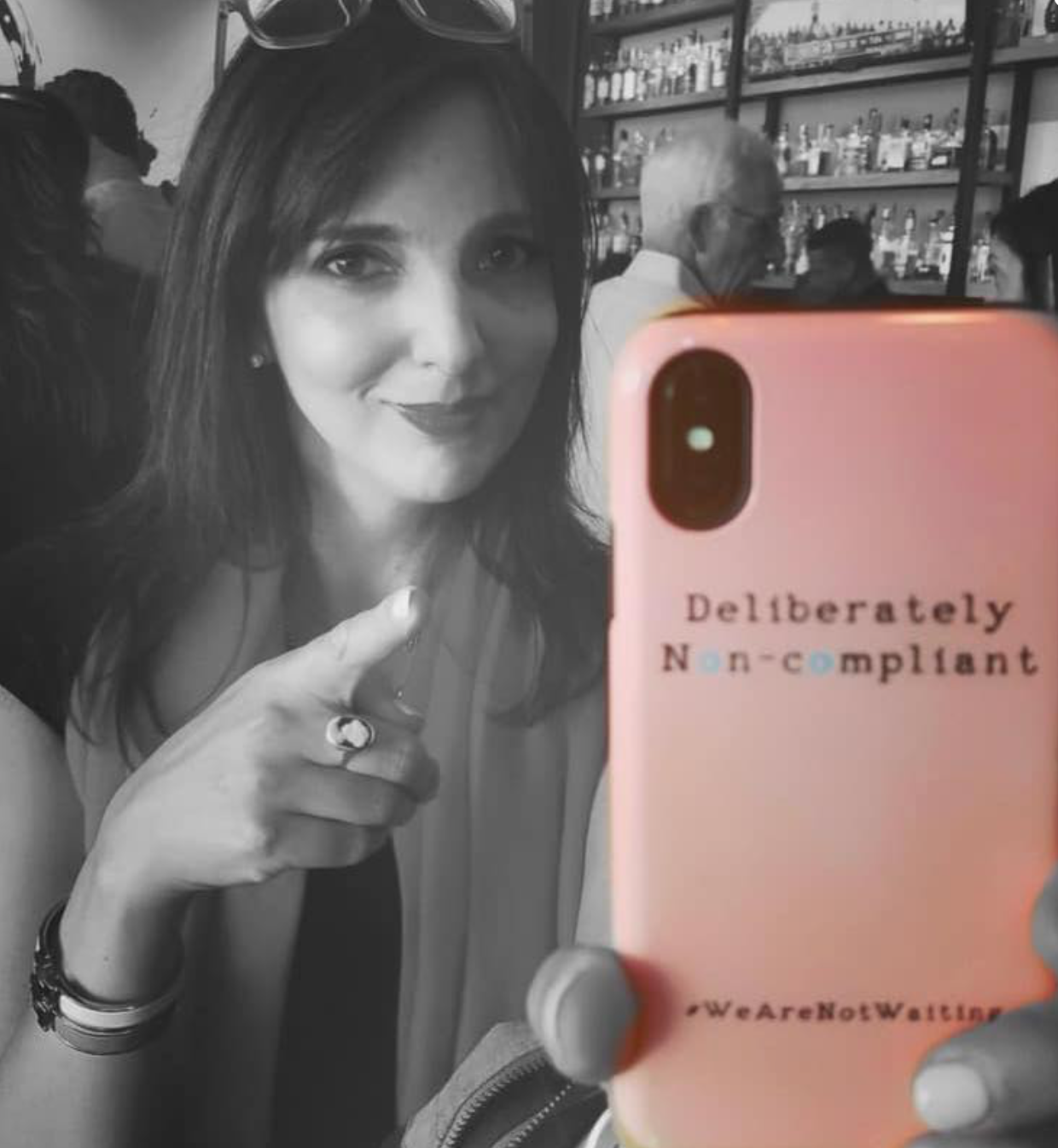
The #WeAreNotWaiting community was established to not just offer advice but develop technologies to improve lives of people with diabetes and continues to do so today. A five minute lurk in any of the online community groups dedicated to open-source technologies is all it takes to see people with diabetes who had been at the end of their tether with conventional care now thriving thanks to community intervention.
And that is replicated in low carb groups where community provides advice and education on how to eat in a way that is often not recommended by HCPs. People share experiences how they are flourishing thanks to making informed decisions to eat this way, and air their frustrations about how they are often derided by HCPs about those decisions. The support that comes from these groups is often just as focussed on how to deal with the healthcare environment when going against the grain (unintended pun) as sharing ideas and advice on how the science behind how low carb diets work.
T1D groups talk about incorporating adjunct therapies into their diabetes management, moving from a glucose-centric approaches to looking at other meds and interventions that can support better outcomes. GLP1s may not be approved for use by people with T1D, but they are increasingly being used off label because of their CVD and kidney protective nature. These community discussions include suggestions on how to have conversations with HCPs to ask about how adjunct therapies might help, including pushing back if there is a blanket ‘no, it’s off label’ response. Before anyone thinks this isn’t a good thing, I remind you that we still need prescriptions from our HCP before we can start on any new drug. We should be listened to when we ask to have a discussion about new and different ways to manage our diabetes.
And there are also businesses led by community that have stepped into spaces that are traditionally organisation or HCP-led. A few years ago, Aussie woman Ashley Hanger started Stripped Supply to fill a massive gap when diabetes supplies could no longer be ordered online and shipped, instead necessitating a backstep where PWD had to go into pharmacies to pick up supplies. Ashley’s start up gave the people what we wanted and meant that, for a small subscription fee, supplies could be straight to our doors again. And it’s run by community – what’s better than that?
There is contention about people with diabetes working with industry, and that is a conversation for another time. But I will say that when we have people with diabetes involved in the development of the devices that we use and/or wear on our bodies every day, the end products are better. That’s just a fact. When you have people with diabetes employed by device manufacturers writing education and instruction manuals for those devices, they make sense because they are written from the perspective of someone who actually understands the practical application of using those devices. It’s a massive opportunity for industry to engage – and employ – people with diabetes. Way to get an edge!
What I would say to everyone here today is that if you are not directly working with people with lived experience of diabetes, you are missing out on the biggest piece of the diabetes stakeholder puzzle. But you have to do it meaningfully and perhaps the biggest challenge I face is dealing with the rampant tokenism that exists in the diabetes ecosystem. For my entire advocacy career I have been urging the implementation of meaningful engagement, and to be honest, a lot of the time I feel that I have failed in those attempts. Every time I see a crappy program or campaign come out of somewhere that claims to work with community, I realise that people with diabetes are being used in possibly the most nefarious way possible: to ‘lived experience wash’ the work of the organisation. I wrote a piece earlier this year about this and was completely and utterly unsurprised to receive comments justifying poor attempts of consultation.
But then, I see something like the video I am going to finish with from Breakthrough T1D in the UK, and I know that there is intent there to do the right thing and do it properly. To involve people with diabetes from the beginning, and centre them throughout the work. The result is a beautiful piece of storytelling that has been shared across the globe. I don’t know the metrics, and quite frankly, I don’t care. All I need to see is the response from the community to know and understand that this hits the spot. And you can too with your work if you engage properly. We’re here to help.
You can watch What a Cure Feels Like, the Breakthrough T1D UK video that concluded my talk here.
Disclosure
I was invited by a health consultancy firm to give a talk to fifty people working on public-facing health campaigns (NDA, can’t say anything more) and then run a workshop about working with lived experience representatives. I was paid for my time to present and prepare for the session, and reimbursed for ground transfers to and from the location of the meeting.

One of the things of which I am most proud is seeing how the language matters movement has really made people stop and think about how we communicate about diabetes. Of course, there’s still a long way to go, but it is very clear that there have been great strides made to improve the framing of diabetes.
One area where there has been a noticeable difference is at diabetes conferences. I’m not for a moment suggesting that there is never negative language used at conferences and meetings, but the clangers stand out now and are likely to be highlighted by someone (i.e. #dedoc° voices) in the audience.
Earlier this month, the 75th IDF World Congress was held in Bangkok. Sadly, there was no livestream of the Congress, but it’s a funny thing when you have a lot of friends and colleagues (i.e. #dedoc° voices) in attendance. It meant that I had my own livestream. Sadly, the majority of what I was being sent were the language clangers.
But let’s step back a week or so to before the Congress even started. I was feeling horrendous and my brain was in a foggy, virus haze, yet I still managed to be indignant and vent at the horrendously titled ‘World Adherence Day’ which was being ‘celebrated’ on 27 March. Here is my post from LinkedIn, which has been viewed close to 12,000 times:

What I didn’t say in my post was that the IDF had eagerly endorsed the day with a media release and social media posts. My LinkedIn post took all my energy for that day, and I didn’t get a chance to follow up with the IDF. Plus, I assumed their attention would have been focused very much on the upcoming Congress.
Also, I hoped that it was a one-off misstep. I mean, surely the organisation had learnt its lesson after the Congress in South Korea when I boldly challenged incoming-president Andrew Boulton for his suggestion that people with diabetes need some ‘fear arousal’ to understand how serious diabetes is. You can see the video of my response to that at the end of this post and read the article I co-authored (Boulton was another co-author) about language here.
Alas, I was wrong. Just days before the Congress started, I saw flyers for this session shared online:

I was horrified and commented on a couple of the posts I saw. I was surprised to see some responses from advocates which amounted to ‘We can deal with it when we get there.’ Here are reasons that isn’t good enough. Firstly – not everyone is there, so all they see is the promotional of an event, comfortably using stigmatising language. It suggests that this language and the meaning behind it is okay. The discussion shouldn’t be happening after the fact. In fact, the question we should be asking is: HOW did this even happen? Where were the people with lived experience on the organising committee of the Congress speaking up about this? Did they get to see it before it was publicised? And how did the IDF miss it? This is, after all, the organisation that launched a ‘Language Philosophy’ document in 2014 (which sadly seems to be unavailable online today). It’s also the organisation that has invited me to give a number of talks about the importance of using appropriate and effective communication to IDF staff, attendees of the Young Leaders Program and as an invited speaker at a number of Congresses.
A major sponsor at the IDF Congress seemed to be very excited about the word adherence. In fact, it appeared over and over in their materials at the Congress. Here is just a couple of their questionable messaging sent to me by people (i.e. #dedoc° voices) attending the Congress:
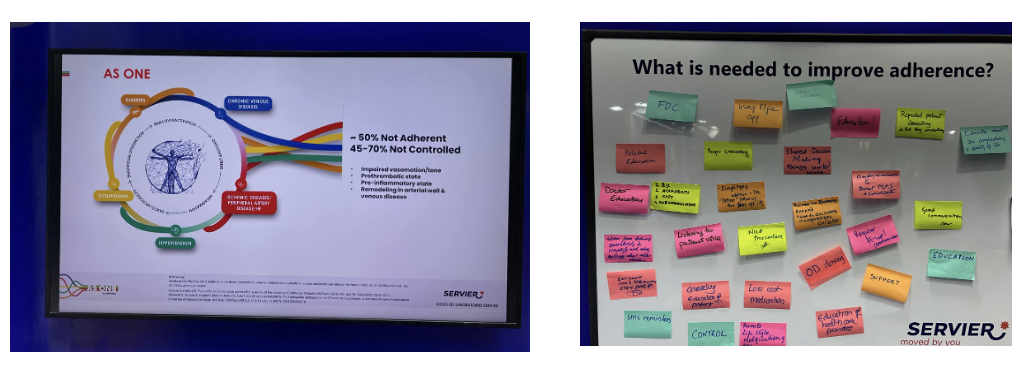
I will point out that the IDF obviously understands the impact of stigma on people with diabetes and the harm it causes. There were sessions at the Congress dedicated to diabetes-related stigma and how to address it. In fact, I had been invited to give one of those talks. But what is disappointing is that despite this, terminology that contributes to stigma is being used without question.
I wasn’t at the Congress but from what I saw there was indeed a vibrant lived experience cohort there. #dedoc° had a scholarship program, and, as usual, there was a Living with Diabetes stream. However, I will point out that the LWD stream was not chaired by a grassroots advocate as has been the case for all previous LWD streams. It was chaired by a doctor with diabetes and while I am in no way trying to delegitimise his lived experience, I am unapologetically saying that this is a backwards step by the IDF. When there is an opportunity for a person with diabetes who is not also a health professional is given to a health professional or a researcher, that’s a missed opportunity for a person with diabetes. There were seven streams at the IDF Congress. All except for one are 100% chaired by clinicians and researchers. Only the LWD stream is open to PWD. I know that when I chaired the stream, the four members of the committee were diligent about looking through the entire and identifying any sessions that could be considered problematic for people with diabetes. It appears that didn’t happen this time.
All of this points to a persistent disconnect. It is undeniable that the language matters movement is growing, but it is still not embedded across the board—even within organisations that should know better. If we are serious about addressing stigma and centring lived experience in diabetes care, then language can’t be an afterthought or a debate to have after the posters are printed and the sessions are underway. It must be part of the planning and the review process. The easiest way to connect the dots is to ensure the lived experience community is not only present, but also listened to, respected, and in positions to influence and lead. We are long past the point where being in the room or offered a solitary seat is enough – the room is ours; we are the table.
Postscript:
I have written extensively on why language – and in particular the word ‘adherence’ – is problematic. It’s old news to me and to many others as well. This piece isn’t about that. But if you want to know why it’s problematic, here’s an old post you can read.
Disclosures:
I was an invited to give a talk about diabetes-related stigma at the IDF Congress in Bangkok, but disappointingly, had to cancel my attendance due to illness. The invitation included flights and accommodation as well as Congress registration. I was also on the program for two other sessions and was due to present to the YLD Program.
Other IDF disclosures: I have been faculty for the YLD Program for the last 10 years; I chaired the LWD Stream at the 2019 Congress and was deputy chair of the 2017 Congress.
When the clock ticked over into 2025, I had no intention of even considering coming up with New Year’s resolutions that would shape my new year. But with all that is going on in the world, I’ve given myself permission to reconsider and do all I can to stick to it. And I’m encouraging everyone I know to make the same resolution.
And that resolution is to do a health literacy check-up and to actively pushback against misinformation. There has never been a time when being health literate is more important. I thought that during the COVID years as we received a daily onslaught of misinformation about vaccines, bogus treatments (bleach, anyone?), outright lies (“it’s just a cold”) and conspiracy theories (“BigVax is behind it all”). But how naïve I was. Those days seems like just a warm-up for what is happening today.
I’m in Australia, but I don’t for one moment think we are immune to the madness sweeping the world. But if you are shaking your head and laughing a little when RFK Jr spews his anti-vax, anti-fluoride, anti-science agenda, or Dr Oz uses his latest pseudoscience claim as the foundation for whatever supplement he is selling, you’re not grasping the seriousness of what is going on. Before we Aussies get too smug, we should remember our own backyard isn’t devoid of charlatans, and it’s only a matter of time before someone like Pete Evans is taken seriously in public health discussions. Think I’m over-reacting? He already made a run for the senate. How long before a conservative party sweeps him into their fold?
I think it’s safe to say that we have moved beyond this sort of misinformation being a fringe issue amongst ‘crunchy’ parents, trad wives and ‘wellness’ influencers. And Gwyneth Paltrow.
Health misinformation is deliberate and it’s mainstream, and protecting yourself against it isn’t optional – it’s essential.
Up until now there have been guardrails in place to protect public health. Boards and regulatory agencies have existed to ensure medical safety and provide us with confidence that there are processes in place to determine the safety of drugs, devices, healthcare programs. Guidelines are based on robust and rigorous research and are developed using evidence and expert consensus. (Side bar: Have people with lived experience been involved in these practises? Absolutely not enough. Could this be better? Absolutely yes.)
Critical thinkers understand that science is not static. We understand that science changes as evidence evolves. We also understand that we don’t have to follow guidelines blindly. We should understand and consider them. And then use them to make informed health choices. I repeatedly say this to anyone who questions off label healthcare (my favourite kind of healthcare!): ‘I understand guidelines and learn the rules so I can break them safely’. That’s what being health literate does – it gives me an understanding of risks and benefits to make decisions about my health and what works best for me. And it gives me confidence to spot and push back on misinformation.
Critical thinkers also know that questioning medical advice is not the same as embracing conspiracy theories. It doesn’t mean throwing the baby out with the bathwater as you hastily reject modern medicine in favour of snake oil salespeople. It certainly doesn’t mean denying the effectiveness of a vaccines. And it doesn’t mean trusting Instagram wellness influencers.
More than ever, now is the time to do some questioning – to question who is spreading health information and consider their motives. What are they selling? (Case in point: Jessie Inchauspe who offensively calls herself ‘Glucose Goddess’ while selling her ridiculous ‘Anti Spike’ rubbish as she spreads fear about perfectly normal glucose fluctuations in people without diabetes). And a question that right now should be front of everyone’s mind: What power grab is behind the way someone is positioning themselves as an oracle of health information?
This post is about health literacy in general, but because this blog is called ‘Diabetogenic’ and I have diabetes, most people reading will be directly impacted by diabetes. And if there is any silver lining in this shitshow, it’s this: We’ve been dealing with health misinformation about our condition for decades, so in some ways, we’re probably ahead of the curve. We’ve had to wade through the myriad cures and magic therapies, the serums and pseudo-therapies. And the cinnamon – so much cinnamon! We’ve been standing up for science, challenging misinformation, and ensuring that diabetes health therapies are based on evidence, not fairytales. We’ve expected truth in our healthcare. It’s seemed the normal thing to do. Now it feels like a radical act to be a critical thinker.
We are a crucial point because health is being weaponised more than ever. Someone told me the other day that my lane is diabetes and health, and I should leave politics out of it. It’s laughable (and terrifying) to think that anyone doesn’t understand that health is political. It always has been. And even more so right now. We are seeing in real time political figures (and rich white men who own electric car companies) weaponise health misinformation for their own agendas, and scarily people are listening to them. They are elevating unqualified voices and aligning with conspiracy theorists, giving dangerous misinformation legitimacy. (And if you think that it’s all eerily familiar, you’re right. It’s already happened with climate change.)
Your radical act is to be smarter, to be more critical, to question sources and motives; follow reputable sources, don’t share viral posts before fact checking (Snopes is super useful here). Don’t reject credible advice and information in favour of conspiracy theories. Stack your bookshelves with books by qualified experts (I’d recommend starting with Jen Gunter’s holy trinity – The Vagina Bible, The Menopause Manifest and Blood and Emma Becket’s You Are More Than What You Eat), including lived experience experts who base their healthcare on legitimate evidence. Follow diabetes organisations like Breakthrough T1D (JDRF in Australia) for research updates and community efforts and be smart about which community-based groups you join. If moderators are not calling out health misinformation, I’d be questioning just how the group is contributing to diabetes wellbeing.
We know knowledge is power. But that knowledge base has to be grounded in fact, not fiction. Health literacy is critical because misinformation isn’t going anywhere, and neither are the people pushing it for profit and power. My resolution is to sharpen my critical thinking skills, ask questions, and refuse to let bad science set us backwards and cast a dark shadow over the health landscape. Who knew something so fundamental could be such a radical act?

Colour me unsurprised they couldn’t back up their claim with evidence.
So often, there is amazing work being done in the diabetes world that is driven by or involves people with lived experience. Often, this is done in a volunteer capacity – although when we are working with organisations, I hope (and expect) that community members are remunerated for their time and expertise. Of course, there are a lot of organisations also doing some great work – especially those that link closely with people with diabetes through deliberate and meaningful community engagement.
Here are just a few things that involve community members that you can get involved in!
AID access – the time is now!
It’s National Diabetes Week in Australia and if you’ve been following along, you’ll have seen that technology access is very much on the agenda. I’m thrilled that the work I’ve been involved in around AID access (in particular fixing access to insulin pumps in Australia) has gained momentum and put the issue very firmly on the national advocacy agenda, which was one of the aims of the group when we first started working together. Now, we have a Consensus Statement endorsed by community members and all major Australian diabetes organisations, a key recommendation in the recently released Parliamentary Diabetes Inquiry and widening awareness of the issue. But we’re not done – there’s still more to do. Last week I wrote about how now we need the community to continue their involvement and make some noise about the issue. This update provides details of what to do next.
And to quickly show your support, sign the petition here.
Language Matters pregnancy
Earlier this week we saw the launch of a new online survey about the experiences of people with diabetes before, during and after pregnancy, specifically the language and communication used around and to them. Language ALWAYS matters and it doesn’t take much effort to learn from people with diabetes just how much it matters during the especially vulnerable time when pregnancy is on the discussion agenda. And so, this work has been very much powered by community, bringing together lots of people to establish just how people with diabetes can be better supported during this time.
Congratulations to Niki Breslin-Brooker for driving this initiative, and to the team of mainly community members along with HCPs. This has all been done by volunteers, out of hours, in between caring for family, managing work and dealing with diabetes. It’s an honour to work with you all, and a delight to share details of what we’ve been up to!
Have a look at some of the artwork that has been developed to accompany the work. What we know is that it isn’t difficult to make a change that makes a big difference. The phrases you’ll see in the artworks that are being rolled out will be familiar to many people with diabetes. I know I certainly heard most of them back when I was planning for pregnancy – two decades ago. As it turns out, people are still hearing them today. We can, and need to change that!
You can be a part of this important work by filling in this survey which asks for your experiences. It’s for people with diabetes and partners, family members and support people. They survey will be open until the end of September and will inform the next stage of this work – a position statement about language and communication to support people with diabetes.
How do I get involved in research?
One of the things I am frequently asked by PWD is how to learn about and get involved in research studies. Some ideas for Aussies with diabetes: JDRF Australia remains a driving force in type 1 diabetes research across the country, and a quick glance at their website provides a great overview. All trials are neatly located on one page to make it easy to see what’s on the go at the moment and to see if there is anything you can enrol in.
Another great central place to learn about current studies is the Diabetes Technology Research Group website.
ATIC is the Australasian Type 1 Diabetes Immunotherapy Collaboration and is a clinical trials network of adult and paediatric endocrinologists, immunologists, clinical trialists, and members of the T1Dcommunity across Australia and New Zealand, working together to accelerate the development and delivery of immunotherapy treatments for people with type 1 diabetes. More details of current research studies at the centre here.
HypoPAST
HypoPAST stands for Hypoglycaemia Prevention, Awareness of Symptoms and Treatment, and is an innovative online program designed to assist adults with type 1 diabetes in managing their fear of hypoglycaemia. The program focuses on hypoglycaemia prevention, awareness of symptoms, and treatment, offering a comprehensive range of resources, including information, activities, and videos. Study participants access HypoPAST on their computers, tablets, or smartphones.
This study is essential as it harnesses technology to provide practical tools for better diabetes management, addressing a critical need in the diabetes community. By reducing the anxiety associated with hypoglycaemia and improving symptom awareness and treatment strategies, HypoPAST has the potential to enhance the quality of life for individuals with type 1 diabetes.
The study is being conducted by the ACBRD and is currently recruiting participants. It’s almost been fully recruited for, but there are still places. More information here about how to get involved.
Type 1 Screen
Screening for T1D has been very much a focus of scientific conferences this year. At the recent American Diabetes Association Scientific Sessions, screening and information about the stages of T1D were covered in a number of sessions and symposia. Here in Australia. For more details about what’s being done in Australia in this space, check out Type 1 Screen.
And something to read
This article was published in The Lancet earlier in the year, but just sharing here for the first time. The article is about the importance of genuine consumer and community involvement in diabetes care, emphasising the benefits and challenges of ensuring diverse and representative participation to meet the community’s needs effectively.
I spend a lot of time thinking a lot about genuine community involvement in diabetes care and how people with diabetes can contribute to that ‘from the inside’. And by ‘inside’ I mean diabetes organisations, industry, healthcare settings and in research. I may be biased, but I think we add something. I’m grateful that others think that too. But not always. Sometimes, our impact is dismissed or minimised, as are the challenges we face when we act in these roles. I don’t speak for anyone else, but in my own personal instance, I start and end as a person with diabetes. I may work for diabetes organisations, have my own health consultancy, and spend a lot of time volunteering in the diabetes world, but what matters at the end of the day and what never leaves me is that I am a person living with diabetes. And I would expect that is how others would regard me too, or at least would remember that. It’s been somewhat shocking this year to see that some people seem to forget that.
Final thoughts…
Recently when I was in New York at Breakthrough T1D headquarters, I realised just how many people there are in the organisation living with the condition. It’s somewhat confronting – in a good way! – to realise that there are so many people with lived experience working with – very much with – the community. And it’s absolutely delightful to be surrounded by people with diabetes at all levels of the organisation – including the CEO. But you don’t have to have diabetes to work in diabetes. Some of the most impactful people I’ve worked with didn’t live with the condition. But being around people with diabetes as much as possible was important to them. It’s really easy to do when people with diabetes are on staff! I first visited the organisation’s office years ago – long before working with them – to give a talk about language and diabetes. One of the things that stood out for me back then was just how integral lived experience was at that organisation. From the hypo station (clearly put together by PWD who knew they would probably need to use the supplies!) to the conversations with the team, community was in the DNA of the place. As staff, I’ve now visited HQs a few times, and I’ve felt that even more keenly. Walking through the office a couple of weeks ago, I saw this on the desk of one of my colleagues and I couldn’t stop laughing when I saw it. IYKYK – and we completely knew!

DISCLOSURES (So many!)
I was part of the group working on the AID Consensus Statement, and the National AID Access Summit that led to the statement.
I am on the team working on the Language Matters Diabetes and Pregnancy initiative.
I was a co-author on the article, Living between two worlds: lessons for community involvement.
I am an investigator on the HypoPAST study.
My contribution to all these initiatives has been voluntary
I am a representative on the ATIC community group, for which I receive a gift voucher honorarium after attending meetings.
I work for Breakthrough T1D (formerly JDRF).





 Diabetogenic