
You are currently browsing the category archive for the ‘Awareness’ category.
‘Why would you bet against the type 1 community?’ That was a question asked in a session at the ISPAD conference a couple years ago. It wasn’t someone with T1D drawing attention to the community. Instead, it was said by someone working in global health who had seen the remarkable efforts such as the #WeAreNotWaiting movement and grassroots, peer-led education initiatives in low-income countries. These efforts have driven change and improved lives of people with diabetes. They have been led by those with lived experience and supported by other diabetes stakeholders. But the starting point is people directly affected by diabetes identifying a problem, solving it and leading the way. In the history of diabetes – from the first home glucose meters, to building systems leveraging off existing technologies, to global advocacy movements – community powered initiatives have been a driving force for change.
And so, here we are today, coming together once again to advocate for better equity and fairness for all people with type 1 diabetes, this time in Australia, and this time advancing access to automated insulin delivery devices (AID).
Insulin pump funding is broken. AID is standard care and yet far too many people are left unable to use the tech because of how pumps are funded in Australia. Right now, unless a person with T1D has the right level of private health insurance, or meets the criteria for the Insulin Pump Program, they must find the funding for an insulin pump. That needs to change.
We know how to do this in Australia. The reason that pump consumables are on the NDSS is thanks to community advocacy efforts back in the early 2000. And more recently massive community noise helped to get CGM onto the NDSS for all Australians. Of course, these wins worked because everyone was involved in advocacy: people with lived experience of diabetes, healthcare professionals and HCP professional groups, researchers, diabetes community groups and organisations and industry. What a lot of noise we can make when we’re singing from the same song sheet!
Right now, attentions are razor focused on improving access to automated insulin delivery systems because the evidence is clear: AID reduces diabetes distress, improves quality of life, and (for those who like numbers!), help with glucose levels. And as an added bonus for the bean counters – it’s a smart, cost-effective investment for our health system.
If AID is standard care, financial barriers preventing people from accessing it need to be eliminated.
And that’s where we would love your help.
Please sign and share the petition that has been started by Dr Ben Nash and supported by a group of people with T1D (including me). Petitions are a great way to get people talking and interested in a topic. It builds momentum and helps contribute to whole of community conversations. While we know the T1D community is already on board, we’ve now seen a number of HCPs, community groups and diabetes organisations share and promote the petition and are keen to get involved with broader advocacy efforts. That’s pretty cool!

Postscipt:
Understandably, there are questions about why this work is specific to T1D technology access. That’s a fair question and I think that our very own Bionic Wookiee provided an excellent explanation of that when he said this in a social media post earlier this week:
‘AID systems were developed for T1D (where they can track all the insulin going into the system without having to cope with the body’s variable insulin generation). So right now they mainly apply to T1D…
Expanding CGM and pump access to people with other forms of diabetes than just T1D is important for the future. Having wider access to AID for the T1D population will be a beach-head for that.‘
And in a conversation I had about this with UK diabetologist Partha Kar yesterday he cautions that there needs to be a starting point because the sheer numbers of diabetes can be daunting and tend to scare policy makers. He also points out that when it comes to outcome modifying interventions, technology is THE thing in T1D, whereas in other types of diabetes there are other options. I’ll add that those other options often have stronger evidence which is why they already have funding.
Hasn’t it been terrific this week seeing a couple of great news stories in the T1D tech world? Our friends across the ditch in NZ have welcomed an announcement from medical regulatory board Pharmac that all people with type 1 diabetes will have access to CGM and automated insulin delivery devices (AID). Meanwhile, this week saw the start of a five-year national roll out of AID in England and Wales which recommends access be granted to children and adolescence (under 18 years) with T1D, pregnant people with T1D and adults with T1D with an A1c higher than 7%.
So, where is Australia when it comes to people with T1D being able to affordably access automated insulin delivery devices?
Let’s start by highlighting the positives. There’s so much to be grateful for here in Australia. The NDSS continues to be a shining light for Australians with diabetes. Syringes and pen tips are free at NDSS collection points and BGL strips are subsidised. Since 2004, insulin pump consumables have been on the NDSS, CGM sensors and transmitters have been subsidised since 2022. Insulin is heavily subsidised by the PBS.
But even with these benefits diabetes remains costly, and the playing field isn’t level. Pumps remain out of reach for many Australians. Without private health insurance or meeting eligibility to apply for the government funded Insulin Pump Program, people with T1D are required to find up to $10,000 for an insulin pump. That’s simply not affordable and it means that Australians with T1D can’t access AID.
With AID providing real life-changing benefits and significant reduction in diabetes burden, now is the time to ensure that the tech is available to everyone with T1D who wants it – not just those who can afford it. And that means that it’s time to equitably fund the missing piece of the AID puzzle: Pumps.
A fire has been lit. From a small meeting at ATTD in Florence to catch ups, coffees and phone calls back home, the groundswell has well and truly started. People with diabetes are central to this, working closely with motivated and determined HCPs and diabetes community organisations. There is a united focus on what needs to be done: affordable insulin pumps so AID is a reality for every Australian with type 1 diabetes who chooses. And excitedly, there seems to be an appetite for this from policy makers.
So what can we learn from the recent successes in NZ and the UK? Well, it’s exactly what we know from our previous advocacy experiences and wins here in Australia. A united stakeholder approach is critical with everyone from individuals with diabetes, community groups, diabetes organisations, professional bodies, researchers, industry all being clear and consistent about the ask. Simple and effective communication about the issue is needed. Community drives the momentum – it always does and recognising that is essential. Using evidence to support why AID must be available to all with T1D is important, and goes perfectly with sharing examples of lived experience to highlight the benefit of the technology. Hearts and minds.
With the push already well established and a number of people powering the charge, it’s inevitable that the diabetes world in Australia is going to be hearing a lot about equitable AID and pump access in coming months. Keep an eye out on community groups for grassroots efforts to elevate the issue and for calls to get involved. We know that we can get this done – just as with getting CGMs funded for all people with T1D, for finding a novel way for Omnipod to be funded, and for Fiasp remaining on the PBS. (And, if we look further back, for getting pump consumables on the NDSS.)
Community will be critical to getting this across the line. Once again, we’ll need people with diabetes to step up and write letters, meet with local MPs, make noise, and show why this is necessary. Every single person with T1D and their families has a role to play here. If you’re already fortunate to be using AID, meet with your local MP and tell them how it has changed your life. If you haven’t had access, write about why you know it will help. For me, I’ll be talking about how much time I have grasped back not needing to do diabetes, how I have far fewer hypos, how I have an A1c in the ‘non-diabetes’ range which evidence suggests reduces my risk of developing costly complications. But most importantly, it has reduced my diabetes burden so much and that makes me a far happier, more productive person. And I want that for everyone with T1 D.
Postscript: a quick word (or two) about language. Media reports, especially in the UK, have incorrectly referred to the technology as an ‘artificial pancreas’. What we are talking about is automated insulin delivery devices (or hybrid closed loop systems). It’s important to get the language right for a couple of reasons: Artificial pancreas is simply not the correct term for what the technology is. It overstates what it does and potentially leads people to think the technology is a cure for T1D. Additionally, it underestimates the work that PWD do to drive the technology. More detail about why getting the terminology right is important can be found in this piece I wrote back in 2015 about the same issue and then again here from almost exactly two years ago.)
I’m introduced most generously by Adrian Sanders, Secretary General of the Parliamentarians for Diabetes Global Network.
The #dedoc° symposium kicked off ATTD 2024 in the most powerful way. Four community advocates from across the globe presented on a variety of topics including access to insulin during humanitarian crises, access to diabetes care and technologies in low income settings, accessibility of technology for people with diabetes also living with disabilities, and access to research findings. You can hear the brilliant talks from #dedoc voices Leon Tribe, Tinotenda Dzitiki, NurAkca and Asra Ahmed here.
During the panel discussion, there was an important discussion about how and why it is critical for people with diabetes to be included in all conversations about diabetes. Meaningful consultation is the golden ticket here, and there were some valuable comments and suggestions about how that happens. Someone asked the question about reimbursement for lived experience expertise, an often ignored issue when it comes to people with diabetes being involved in research, programs, committees and anything else that takes our time. Our unique perspective cannot be provided by anyone else, and yet there is rarely budget to cover the costs of our participation. Sadly, it’s not routine to offer payment for our time, instead we are often made to feel that we should be grateful for a seat at the table. It’s worth reminding those who don’t value us in a financial way that WE ARE THE TABLE and without us, there wouldn’t be a place setting for anyone else.
It was clear from the conversation that diabetes advocates – even those sitting on stage at International scientific conferences – find it difficult to ask for their valuable expertise and time to be reimbursed.
I jumped off stage and made a bee line for Jazz Sethi. We do this thing at conferences that I’ve started referring to as the ‘Jazz and Renz conference special’. (You can see previous efforts here and here.) Within five minutes we’d hatched a plan for our next project, and today, we’re so excited to share it. It was clear that we need some ‘Rules of Engagement’ that provided a clear and easy way for people with diabetes and those seeking to work with us to understand not only why engagement and consultation is essential, but why it’s also essential to pay for our time.
It’s not just about reimbursement though. It’s also about recognition for that work in a multitude of ways including being included as a co-author on publications, included on programs giving presentations and having our expertise acknowledged as just as important as all other diabetes stakeholders.
And so, here are some simple guidelines that can be used by people with diabetes when working with organisations, researchers, healthcare professionals, industry and anyone else who wants out expert knowledge. Use them in your discussions with anyone who invites you to be involved in diabetes work. Print them out and take them with you when you’re meeting with anyone running a project or convening an advisory group. Share them in your networks so as many people as possible can use the information to guide discussions about ensuring our value is truly acknowledged. We hope that this will make those discussions just a little easier.
And for those who wish to work with us, have a read. If you still think that our time isn’t worth your budget, or our expertise worth real recognition, then it can only be considered that you are doing the very least to include people with diabetes. That’s tokenism. We’re not here for that anymore.


Disclosure
I was an invited speaker at ATTD 2024 where I presented on the T1D Index in my capacity as Director Community Engagement and Communications in the Global Access Team at JDRF International. I also chaired a session on access to research. ATTD covered my registration costs. My travel and accommodation were covered by #dedoc° where I am Global Head of Advocacy. I chaired the #dedoc° symposium at the conference.
I stumbled across a book the other day called Women Holding Things. The author and illustrator, Maira Kalman referred to it as ‘love song to those exhausted from holding everything’. It’s quite gorgeous, with beautiful illustrations of all the things women hold – both literally and figuratively.
And I thought about what people with diabetes hold and just how weary and drained the weight of carrying diabetes and all that comes with it can be. I can’t draw, but here are my words that highlight some of the things we hold. It’s a love letter to the strength people with diabetes have gained through holding things, even when we want nothing more than to put it all down.
We hold on because we have no other choice but to do so.
We hold bags carrying around diabetes supplies – right now as I wait to board a flight, I have a separate bag with nothing more than sensors and pumps and alcohol wipes and spares of everything. I will hold it through airports, as I climb on planes, on ground transfer to hotels, and around with me through every step of my journey, a constant companion in my travels.
We hold cups of coffee because sometimes it feels like the only thing that will get us through the day.
We hold a fear of the future and what it can be, a shadow that sometimes stretches longer than we’d like.
We hold emergency hypo snacks ready for those unexpected moments. Or expected… (see: airports).
We hold guilt for some ridiculous reason because we shouldn’t and it is heavy and we would be so much lighter if we could let it go. But it’s there. We hold it.
We hold hope so close to our hearts, trying to balance up the fear or at least make a dent in its weight.
We hold insulin bottles and glucose monitoring supplies and all the little things that are needed to be replacement pancreases.
We hold anxiety and worry, and at times, a quiet uncertainty about what the next day, the next week, the next year holds.
We hold our diabetes friends close because they understand without needing explanations, and we hope that by being there for them as they hold us close, somehow there is a magic law of reciprocity that means we’re all holding less a little less diabetes.
We hold other diabetes stakeholders to account when they fall short of our expectations or fail to understand the nuances of our lived experiences, or underestimate our expertise. Or when they unleash a campaign that instils more fear.
We hold a steady gaze at research to see what our future life with diabetes might hold.
And we hold onto the promises, even the five-more-years promise that we know is a joke, but perhaps, just perhaps if we hold onto it tightly it might, it just might come true.
We hold our heads high as we advocate for better care, more understanding, and greater awareness.
We hold bottles of cinnamon, not because we know it’s a cure, but because it tastes great in the apple cake we’re holding onto for afternoon tea.
For those of us who can remember a before time, we hold on to memories about what life was like before we had to hold onto and carry diabetes.
We hold the hands of those whose diagnosis came after ours because we’re so grateful to those who came before us and held our hands.
We hold the key to lived experience and with it, we hold a unique perspective that must be listened to. Because we hold onto the belief that #NothingAboutUsWithoutUs
We hold a wealth of knowledge that comes from being a world class expert in our diabetes.
We hold a firm grip on the reality of life with diabetes because if we let that slip the consequences are too great to imagine.
We hold an inner strength that often surprises even ourselves.
Sometimes we hold back nothing as we tell our stories and and advocate for what is right.
We hold the power to change perceptions, influence policy, and inspire others.
We hold our spirits high when we feel we’ve had a win because holding onto those small victories carries us on through times where we feel we’re dropping the ball.
We hold our loved ones close, sometimes to protect them, sometimes to draw strength from their support.
We hold the courage to face each day, each challenge, with a bravery we often don’t credit ourselves for.
We hold a steady pace, because we know that diabetes is a marathon, not a sprint.
We hold onto the belief that it will be okay, that we will be okay. Because otherwise, there is nothing at all to hold onto. And that…that is just too heavy to contemplate.

The day after I was diagnosed with diabetes, I found myself in floods of tears, sitting in the stairwell of the Diabetes Victoria offices on Collins Street in Melbourne. I’d fled there from the NDSS shop that was housed on level three after suddenly feeling overwhelmed at the boxes and boxes of curious looking diabetes supplies that were about to be sent home with me. I was slumped against the wall, the emotion of the last twenty-four hours catching up with me. Someone came down the stairs and stopped. She crouched down and quietly said. ‘Hi. Are you okay?’
I wasn’t. Of course I wasn’t. ‘Can I sit here for a minute?’ she asked and somehow, through the tears, I nodded.
As it turned out, she was a diabetes educator working at Diabetes Victoria. And she also had type 1 diabetes. She spoke, I listened. And listened and listened. It was the first time I heard another person with diabetes share her experiences. She told me she too felt overwhelmed at times. And, she told me that right now – so new to it all – it feels so big, and that is perfectly understandable. She assured me that it would feel less big. She told me about bits of her life with diabetes and while she didn’t make it sound like bowls of cherries and puppy dogs, she took away tiny bit of the diagnosis fear that punches you right in the heart. Her stories made no sense at the time, but, as my own diabetes story grew, bit by bit, I understood her experiences.
I continue to search for stories today. I share some of mine – the things I feel comfortable sharing. And sometimes the things that aren’t all that comfortable.
I’m eternally grateful to that diabetes educator I met on 16 April, 1998. I told her repeatedly that her kind reassurance was the only brightness in those dark couple of days. I’m grateful to every other person who has so generously shared their lived experience. I never take it for granted – especially the reliving the trauma of difficult times.
And so tell your story. Only if you want.

Just what is the emotional labour associated with living with a life-long health condition like diabetes? I’ve been thinking about it a lot this week, firstly because I was asked to give a talk about it to a group of researchers to help them understand barriers they may experience with getting participants into their research. It was a great discussion, with plenty of questions and hopefully a new understanding of the burden diabetes unleashes on us. And then, I thought about it when I was feeling the weight of that burden – more so than usual.
The emotional labour of living with diabetes is a complex, often invisible force, shaping our lived experience in profound ways. It’s the mental and emotional effort we put into the never-ending demands of the condition. It’s accompanied by an inner dialogue that asks if we’re doing enough, trying enough, feeling enough, being enough. It comes on top of the physical labour of doing diabetes, which in itself, is significant. It’s an ever-accruing emotional toll of being perpetually alert, constant decision making and wondering how those decisions might impact our immediate and long-term health and wellbeing. The emotional resilience required to do diabetes each day is an additional burden of itself, the sum of all these parts equalling an unforgiving weight that, at times, just feels too damn heavy to carry anymore.
But it doesn’t end there. Living with diabetes is an act of advocacy in itself, even if that advocacy is for ourselves alone and whether we use the word or not. Some people who take on advocacy issues and causes, leading efforts, participating in them, speaking about them. Whether involved in advocacy as a paid day job, consulting-type role, voluntarily, or a hybrid version (me), all of it adds to the emotional labour of diabetes.
Of course advocacy can be energising – striving for better healthcare, pushing for more understanding, and campaigning for supportive policies are endeavours close to our hearts and seeing efforts result in stunning outcomes bolster our energy levels. Working together with others with diabetes to change our communities is motivating. But it can also be exhausting. Each act of advocacy draws from our already limited reserves. The constant need to explain, to justify, to fight for our rights and needs can lead to burnout, leaving us feeling drained and disheartened in a fight that seems unending.
That’s where I spent a lot of this week: drained, disheartened, devastated and frequently teary with the weight of advocacy casting a long, dark shadow.
I know that this is something people with diabetes speak about, and the mental health of diabetes is finally on agendas, but it still needs to be said that being adjacent to diabetes, or being a champion for mental healthcare doesn’t offer a true understanding of just what it feels like. The best allies I know are the ones who recognise this gap in understanding and do all they can to ensure they don’t add to it and try to learn by stepping back and not overshadowing our voices or efforts.
One of the ways people with diabetes have attempted to deal with this labour and resulting burnout is to build peer communities and networks. Solace from the weight of diabetes can be found in others with shared experiences in sanctuaries where our struggles don’t need to be explained but they are deeply understood. These are safe spaces where we exchange stories, share tips, and buoy each other’s spirits. These communities become a wellspring of support and encouragement, where our emotional labour is shared, and our advocacy efforts are collectively bolstered. Safeguarding those spaces is essential if we’re to draw strength from them rather than find ourselves being overwhelmed by them.
In recent years, I’ve found myself becoming more and more selective about where I find that support. Twitter was probably the first to be left behind as I no longer found it a safe space. I’m reminded of that any time I venture back an innocent tweet about my own diabetes choices is attacked from some low carb bro. I replaced the openness of social platforms with closed group chats of others with diabetes, knowing that the support was there without the risk of trolling. Those chats provide the light to guide my way through the shadows.
This week, with the heaviness of all that is diabetes weighing me down, it has been difficult to find that light. The networks I have are always there, but even that is sometimes not enough when everything is overwhelming. Hosting this week’s #docday°, and hearing from advocates from around the world doing incredible things wasn’t enough to help me see clear. I thought of how to push through this, and I don’t have an answer. Except this: One of the things we do so well in our community is lift each other up because our community and other people with diabetes are everything. And so, even while I am feeling weighted down, I can focus on that. And hope that in amplifying and cheerleading my peers with diabetes and their efforts, I’ll rise too.
Two community things you should know about…
Spare A Rose, Save a Life is continuing to accept donations here. Thanks to amazing advocate Tinotenda for driving this year’s campaign.
Sign and share this petition and read the consensus statement initiated by a group of #dedoc° voices which is calling for uninterrupted insulin access in humanitarian crises. Congrats to Lucia for coordinating this work.

On November 14, the world will literally light up in blue to celebrate World Diabetes Day. And here in Melbourne, an event highlighting one of the most important issues in diabetes today will be held. The entire event will be dedicated to how the global diabetes community is coming together to work to #EndDiabetesStigma. And you can be there!
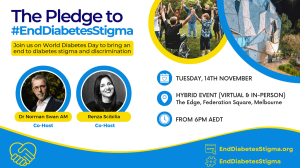
I’m delighted to be sharing the hosting seat with Dr Norman Swan, physician, journalist and host of Radio National’s Health Report. A veritable A-Team of people from the international diabetes community will be part of the event, sharing their experiences of diabetes stigma and why efforts to end it are so necessary and timely. There will be representatives from the global lived experience community, diabetes organisations and health professionals and researchers. You really don’t want to miss it!
For those able to attend in person, you’ll have a chance to catch up with diabetes mates. Any chance for opportunistic peer support is a great thing and I’m so pleased that I’ll be seeing diabetes friends that I’ve not seen for a very long time.
This isn’t only for Melbourne locals. There will be a livestream for people around the world to watch, share and be part of on social media. It’s free to attend and will be a great opportunity to see the diabetes world come together on a day dedicated to us!
Australian airports seem to have become a battleground recently for travellers with diabetes. My own experiences since Australia opened back up to travel have been appalling and each week there are reports in online diabetes pages about some pretty horrendous experiences. Specifically, the problems are to do with full body scanners which have been rolled out across international security checkpoints nationally, and some domestic checkpoints.
This year alone in half a dozen international flights out of Melbourne Airports and a dozen or so domestic flights, all been much more difficult than any travel experience pre-COVID. I documented one particularly brutal encounter at Brisbane Airport last year in this Twitter thread. Sadly, since then, other instances have been just as awful.
It seems that the training modules for security staff have incorrect information about which scanning devices are safe for diabetes devices. In my experience, the messaging is consistent: staff have been told that the metal detectors (the older walk-through screeners) are unsafe while the newer full body scanners (the stand still and be scanned) are safe. This is at odds with information from device companies and health professionals and has resulted in a number of people reporting clashes at security checkpoints.
There’s so much discussion about this, as well as lots of confusion and some pretty dire misinformation across OzDOC socials, some of it coming from diabetes groups. Let me try to break this down with information that is based on advice from device companies and the Department of Home Affairs. This is what I have used to try to help me streamline my own travel experiences – with varying levels of success.
Firstly, let’s start with the Department of Home Affairs. This page has the information you need, but specifically, under the section Travellers who have a mobility aid, prosthetic, medical device or medical equipment is this: ‘If you have a medical device or medical equipment, it may streamline the screening process if you have a letter or medical identification card from your doctor or healthcare professional that describes the device or equipment. It is also recommended that you talk with your doctor, healthcare professional or check the manufacturer instructions for guidance on whether the medical device or equipment is suitable for screening by body scanner technology or X-ray technology, and if not, make the screening officer aware of any restrictions before beginning the screening process.’
Device companies all have their own advice, so familiarise yourself with what their recommendations. I wear a Dexcom, and carry a printed copy of security screening advice. At the end of this post you’ll find links and relevant information about the different devices available in Australia.
Knowing how tricky things are likely to be, I am super prepared for security checks now. I carry a letter from my endocrinologist that states I’m wearing diabetes devices that must not go through the full body scanner, and that my pump cannot be removed (not so relevant these days as I wear Omnipod). In a sign of just how much the times have changed, I now need to show that letter about 80% of the time at Australian airports. Pre-COVID I maybe needed to produce it twice in hundreds of journeys.
I always remain calm and clear about what I need: ‘I am wearing medical devices and cannot go through the fully body scanner. I can go through the metal detector, or I need a pat down. I’m happy to wait out of your way.’ I stand firm with this request, remaining polite and calm even when there is increasingly aggressive pushback. In most cases, security staff will tell me that the training says body scanners are safe and metal detectors are not. At this point, I offer the letter from my doctor and the printed out advice from Dexcom and mention the relevant information from the Department of Home Affairs. If there continues to be pushback, I’ll ask to speak with a supervisor. I truly hate doing this.
While this isn’t applicable to me now, at no point ever would I remove my insulin pump and hand it to security staff for inspection. Disappointingly, some of the device companies’ travel advice (and today I saw advice from a diabetes centre) suggests this. Don’t do it. I am happy for them to swab it while I hold it, but I won’t disconnect and hand it over. Items go missing and handed to the wrong person or could be damaged at busy security checkpoints.
I know others with diabetes are happy to go through whatever scanner they are directed to and have had no adverse issues and that’s great. But this isn’t about individual experiences so much as about how to manage situations according to manufacturers’ advice and knowing what official information from the relevant Government department is. It’s also about being treated respectfully and having our own lived experience and knowledge respected by security staff; something that sadly seems to be repeatedly forgotten.
If you’ve had a lousy experience and have the emotional labour to write a complaint to the airport, please do so. There are online forms you can use.
It would be really great if this additional work didn’t fall to people with diabetes. Device companies could step up here and provide cards to use at security checkpoints, similar to those that have been developed for people with pacemakers and knee and hip replacements. Simultaneously it would be great if there was a form that could be personalised and printed out or a card issued via the NDSS when people register for pump and/or CGM access (this wouldn’t serve people who are self-funding, but it would reach the majority of Australians affected). While I am sure that there are efforts underway to address it, there’s no time to wait and a temporary fix is needed immediately. And any other advocacy groups who are addressing this issue can make sure that the advice they are providing on behalf of their diabetes community is accurate and best serves the needs of people with diabetes.

Advice from device companies in Australia
AMSL has this advice for Dexcom users: ‘Use of AIT body scanners has not been studied and therefore Dexcom recommend hand-wanding or full- body pat down and visual inspection in those situations.’
Insulet Australia has this advice for Omnipod users: ‘The Omnipod DASH® PDM and Pods are safe to go through the x-ray machine and the Pods are safe to be worn through airport scanners.’
AMSL has this advice for Tandem T:Slim users: ‘your Tandem Diabetes Care insulin pump should NOT be put through machines that use X-rays, including airline luggage X-ray machines and full-body scanners.
Medtronic has this advice: ‘Your pump should not go through the x-ray machine that is used for carry on or checked luggage or the full body scanner.’
Abbott has this information for FreeStyle Libre wearers: ‘The FreeStyle Libre reader and the FreeStyle Libre sensor can be exposed to common electrostatic (ESD) and electromagnetic interference (EMI), including airport metal detectors. You can keep your FreeStyle Libre sensor on while going through these. However, the FreeStyle Libre reader and the FreeStyle Libre sensor should not be exposed to some airport full body scanners.’
A very quick post to invite you all to attend a fascinating session being held tonight as part of the Nossal Institute for Global Health’s Navigating Health Globally webinar series. With the beautifully alliterative title, Compassion, Care, Complexity & Culture, we will explore how diverse healthcare approaches can tackle limited access to health systems and fragmented care, focusing on shared care as a means to foster person-centred systems as part of person-centred care.
I’m so delighted that I get to open the event with a talk about compassion in healthcare: what it looks like, my own experience of working with remarkably compassionate healthcare professionals, and also, the impact on our experiences of healthcare when compassion is lacking.
The other presenters are remarkable and I am so honoured to offer the lived experience lens on stage with them. You’ll hear from Professor Victor Montori, endocrinologist, researcher and Professor of Medicine at the Mayo Clinic, Duleep Allirajah, CEO of the Richmond Group of Charities (a coalition of 12 national health and care charities), Dr Guy Fones, Head of Global Coordination Mechanism on NCDs, World Health Organization and James Sanderson, Director of Community Health Services and Personalised Care, NHS England. Expect me to be totally fan-girling when Professor Victor Montori is up, speaking about his Patient Revolution (if you don’t have a copy of his book Why We Revolt, add to cart now).
I know that the healthcare experiences I value the most – the ones that have helped me, left me feeling inspired and supported, valued and listened to – have all been founded in compassion. Sadly, it’s not necessarily guaranteed. I’m looking forward to highlighting the experiences, (and the healthcare professionals behind them), that have been powered by compassion. I hope to see you in the (virtual) audience.
Kick off time is 8.00pm AEST, (or 10.00pm NZST, 6.00am EST, 11.00am BST, 12.00pm CEST). It’s free to attend, but you will need to register (to watch live, or stream later at a reasonable hour). Details are here.
Diabetes stigma is a hot button topic in the diabetes world. It has been for some time. I wrote just last month how stigma was one of the most talked about issues at ADA. That week, we also launched an Open Letter from the Diabetes Community, asking health professionals to join us in our call to stop diabetes stigma.
And behind the scenes, for all of this year, another exciting, BIG, project has been hatching and I’m so excited to share it today.
Earlier this year, in an unprecedented show of unity and determination, a group of 51 experts from 18 countries joined forces to pool our lived, research and clinical experience to address diabetes stigma and discrimination. Together, we’ve reviewed the scientific evidence and established an international consensus on 49 Statements of Evidence and Recommendations. The full report on this review has been submitted and is currently under review.
Excitingly, the group also reached a consensus on a Pledge dedicated to bringing an end to diabetes stigma and discrimination. And that’s where you come in! Everyone can sign to show your commitment stop the ingrained negative judgments, stereotypes, and prejudices that influence attitudes about diabetes, and contribute to the stigma so many of us face. This isn’t just for the community. We know there is sometimes an echo chamber as we say the same things to each other, over and over. We also know that while diabetes stigma is indeed prevalent within our community, we also need to tell the story of its harm outside the diabetes world.
Well, here’s an easy way to do both. Please sign the pledge and share details across your social platforms. You can sign as an individual, and we’d also love for you to see if your place of work, school, community group, hospital, church, sporting team, favourite cafe…basically anywhere that is likely to come into contact with people with diabetes (i.e. literally everyone!) would be interested in signing too.
This is a true community effort, with involvement from stakeholders from across the diabetes landscape, across the world. You won’t see logos anywhere, because this for and about all people with diabetes. The names of the people involved in the work so far is on the website.
Are you with us?





 Diabetogenic