
You are currently browsing the monthly archive for August 2017.
New York in the rain is quite magical. That’s probably something only tourists say, but it’s what I was thinking as I emerged from the subway, way, way downtown on a cold and wet January afternoon early this year.
I hurried along the busy business district streets to my destination – an old cosy pub, chosen by the local I was meeting because of its historical significance (which you can read about here).
I was catching up with a diabetes friend – one of the smartest people in the game – to chat about what was going on in our respective diabetes worlds.
After a while, we started talking about how exciting new tech developments will be finally coming to market in just a few short years. And then, he told me about Loop, showing me his phone and briefly explaining what it was all about.
I was enthralled. ‘Wait,’ I said. ‘So, your iPhone now drives your pump? And basal rates are adjusted automatically?… Whoa! Send me all you can about it,’ I pleaded, after he promised that it wasn’t that difficult to set up.
This was back in January. It’s now August. In the intervening months, I read through the documents and have had conversations both on and offline about Loop and what it does. I searched through my diabetes cupboard for the pump I’d need (finding my old-school Medtronic 522 hidden away).
In May, I bit the bullet and ordered one of the components required to build my rig. About ten days later, a box arrived and inside was a tiny little computer and battery – my RileyLink. I took them out of their packaging, running my fingers over them gently… and then got scared and popped them back in the box, and left the box at the back of my desk.

Hello RileyLink!
Every time I sat down to work, I’d see the box and sometimes I’d take a peek inside again. And then I’d read the documents again, each time a little more committed to get started.
In San Diego, I chatted with a few people who had taken the leap to Loop, everyone telling me that it was life changing and also promising that it wasn’t too hard to set up. I kept having conversations on Facebook, Twitter and Instagram with people from all around the world who were Looping, every one of them urging me to get on the bandwagon and offering to answer any questions I’d have.
I joined Facebook groups, continued to read over the documents, and every time I was ready to go, I freaked out about how technologically advanced it all sounded, and how technologically inept I am, and shut everything away.
Until ten days ago. Ten days ago, I did take the leap. I read through the Loop documents another time. I told myself that I could do it. And I started. Step 1….
I hit a snag a few steps in, but fortunately was meeting a Twitter friend on Wednesday to chat. He is not technologically inept. In fact, he is the complete opposite and answered all my (probably rather silly) questions and didn’t even roll his eyes once.
I went home with Loop installed on my phone and proceeded to enter all my settings into it.
I played around with the app and before I knew it, I was blousing directly from my phone (rather than from my pump):

After a couple of days of running open loop, I took the plunge and switched to closed loop. And waited and watched. The circle on the top left hand corner of the app closed and I waited for the automation to begin. And begin it did!
‘OHMYGOD,’ I squealed to Aaron, as the first basal adjustment was made. ‘LOOK AT THIS! IT’S ADJUSTING MY BASAL RATES ALL ON ITS OWN. LOOK, BABE. LOOK!!! THIS IS JUST LIKE YOUR PANCREAS…Except it’s a mobile phone, mini-computer thingy, insulin pump and Dexcom. BUT I’M JUST LIKE YOU!!!’ To his credit, Aaron nodded his head, pretended he was as excited as me, and agreed that this was EXACTLY the same as a functioning pancreas.
I admit to being more than a little fascinated and obsessed with watching what Loop is doing and the accuracy of its predictions.

This morning’s waking Dex number. And the Loop app showing me how we got there…
I’m only a few very short days in and already, I can see that this is giving me a whole lot more insight into my diabetes. I had a very minor car accident the other morning and seeing the adrenalin spike, and how Loop managed to deal with it, was amazing. I would have rage bolused the spike which would have inevitably resulted in a low. Instead, I resisted the urge to bolus and allowed an increased basal adjustment to bring me back into range slowly and safely.
Obviously, as with everything to do with diabetes, Loop isn’t for everyone. But for me – firmly in a diabetes rut and living in pump limbo – this has been just what I’ve needed to get me re-engaged.

My clever mate David (who is running Open APS) 3D printed me a case for my RileyLink. In pink, to match my pump.
Wait! What is Loop? If you are interested in reading about Loop and how to get up and running, all the info is here.
Not this:
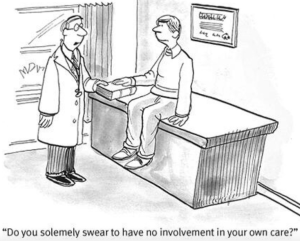
(Source unknown)
Or this:

(Source unknown)
Also, not this:

(Click for source)
And not this either:

(Click for source)
There’s lots happening, but I can’t look away from my Loop app at the moment because I’m so damn excited and obsessed! (I’ll be writing something about it sometime this week.)
But if I wasn’t doing that, I’d be (re)reading these things…
Why it costs so much to see a specialist
I’ve always paid to see my endos privately. In fact, I generally ‘go private’ for all my healthcare needs – I can’t remember the last time I was bulk-billed for a medical consultation.
It does cost a lot, and I am grateful I can afford it, but the excessive costs often discourage people from seeking the right care they need. Of course, we do have excellent public health in Australia. My choice for seeing HCPs privately include wanting continuity of care, and not being subject to frequently very long waiting periods.
This piece in The Conversation looks at why specialist care is so expensive. And what can be done to reduce costs.
Lookiee! A diabetes Wookiee!
For those who participate in OzDOC (and other DOC activities) you may have come across David Burren. I met David last week to talk all things tech (actually, I just fired questions at him about Loop and he patiently answered them without rolling his eyes even once). He’s started a diabetes blog all about diabetes and technology and, thankfully, it is in language that even I can understand.
Check out David’s Bionic Wookiee blog here.
Statues are like tumo(u)rs.
With all the nonsense going on in America at the moment, this piece from McSweeney’s most adequately explains why the ridiculous idea that statues commemorating less than favourable moments in history need to remain. Here’s my favourite part:
I view this tumor as an important symbol of your body’s history and heritage. Removing the tumor would be yet another example of misguided medical correctness in today’s liberal America. I protest this surgery and refuse to whitewash your rich medical history. The tumor must be kept prominently displayed inside your body.
Do better, America. We all know you can.
More on what’s on the inside
Mel Seed’s blog about normalising mental healthcare in diabetes follows on from DX2Melbourne and is well worth a read. Read it here.
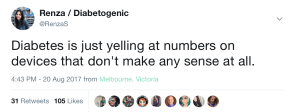
Diabetes is just…
This…
Faster insulin coming to Aus
A couple of weeks ago, I shared on my socials the exciting news that ultra-fast insulin, FIASP, had received TGA registration. No actual ‘launch’ date info as yet, although next week is the ADS ADEA Annual Scientific Meeting, so we may hear more then.
And in news that we already know…
Apparently, CGM is not just for abdomens anymore… File under ‘No Shit Sherlock’.
Swear-y
My blog emails keep getting blocked by the profanity filter at my husband’s work. Every now and then, he forwards me the message he’s received which states that the email was not delivered due to ‘offensive language’. #SwearyWife
This Twitter account definitely wouldn’t make it through, but it’s one of the best things I’ve seen on the interwebs for a while. I’d like to print THIS up poster size and put it on the wall of my office/wear it on a t-shirt, but perhaps that’s not appropriate.
D-parents and sharing the scary parts of their child’s diabetes online
I’ve linked to Moira McCarthy’s writing before because I think that she gets it right every single time she writes about the role of parents in their child’s diabetes.
This piece asks parents to consider if sharing their child’s scary and dramatic diabetes stories online is doing more harm than good. (I rather clumsily explored a similar issue last year in this post.)
Read her piece at ASweetLife here.
4Ts on Diabetes Mine…
Last month, during National Diabetes Week, in an endeavour to get our 4Ts message out as widely as possible, the good folks at Diabetes Mine allowed me to write a little about our campaign. You can read that here.
Living and loving someone with diabetes
As much as I think I am the most delightful and easy-to-live-with person in all the world, I have to admit that diabetes can and does impact on all relationships… and makes me perhaps not the most delightful and easy-to-live-with person. Aaron and I chalked up 23 years together yesterday. Diabetes has been part of the equation for over 19 of those years.
Diabetes advocates Nicole Johnson and Lorraine Stiehl have written a new book which has been called a practical guide to loving a person with diabetes. I’ve ordered a copy and will be leaving relevant pages open for my loved ones to read.
You can get a copy of What To Do When Your Partner Has Diabetes: A Survival Guide from Amazon.
Meme-y and true
There are a lot of diabetes memes out there, but sometimes I see one that just hits the mark so perfectly. Such as this from a TuDiabetes community member:

A few weeks ago, I wrote about the tech rut and pump limbo in which I seem to have found myself. Since then a couple of things have happened to start to move me from a sense of complete and utter inertia about the state of play in diabetes technology in Australia right now.
Firstly, I actually made steps to start Looping. I’ve had all I need sitting here ready to go, but it was only last weekend that I actually started working through the steps to get things going. More on this in coming weeks if I can get it all sorted out and actually understand what the fuck I’m doing.
And the second thing was when Aaron from Medical Specialties Australasia reached out to me with the exciting news that the Cellnovo pump system is coming to Australia. Very, very soon. We arranged to meet at a café so we could chat and he could show me the pump. (For the record, MSA was the Australian distributor of the Deltec Cozmo pump many moons ago.)
According to Aaron, the pump has TGA approval and is listed on schedule 5 of the prosthesis list, meaning those with private health insurance should be covered. Consumables are in the process of being listed on the NDSS and costs will be comparable to currently listed insulin pump consumables.
The Cellnovo ‘kit’ includes two pumps and a nifty looking touchscreen handset which drives the pump and doubles as a glucose meter. The pump is small and is stuck directly to the skin via a Velcro patch. (It’s not a patch pump as there is a small tube that runs from the cannula to the cartridge.)

The cartridge holds a max of 150 units of insulin, so this is not the pump for people who are on really large doses. But, if you’re like me, it’s way, way more than enough for the three days the cartridge lasts.
The ‘consumables’ combine the ‘cap’ for for the pump as well as the cannula/infusion set and cartridge.
Other features that may be of interest: it’s waterproof. It has a built in activity tracker, which for those who are interested in doing activity (i.e. not me), then this may be a super useful little tool; it’s rechargeable, so no need to carry around a spare battery. (You swap over the pumps every three days, charging one while wearing the other.)
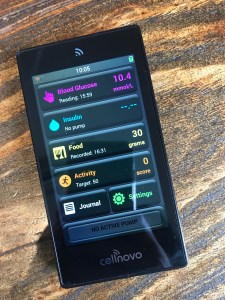
I’ve not used the pump, so I can’t really talk about what it feels like or how easy the handset is to use, but I did play with it a bit the other day and it appeared super easy.
I can talk about the fact that there is about to be another pump on the Australian market, and considering the sad state of affairs at present, I see this as a really positive move. I have always been an advocate for choice. People with diabetes should be offered a smorgasbord of diabetes management options and then be able to customise the devices, drugs and plan that works best for us at that moment. It’s not a static arrangement (because, diabetes isn’t a static health condition) and we should be able to change as we need.
With the current situation, we don’t have a smorgasbord. Instead, we have a very limited set menu that seems to be getting smaller and smaller, and while that may be great for the big players in the market, it is crappy for people with diabetes.
Cellnovo introduces another option that may just be the right choice for some people, and that’s terrific.
WANT MORE?
For more information about Cellnovo click here.
In Australia, the Cellnovo pump is being distributed by Medical Specialties Australia. For details, click here.

DISCLOSURES
None! Although Aaron did buy me a coffee … And when there are pumps available in Australia, I may do a trial. As always, I’m writing in my own thoughts in my own (probably swear-y) words.
Over the weekend, there was a story in a Queensland newspaper suggesting that there is currently a bad batch of insulin in the fridges doing the rounds, causing erratic glucose levels in people with diabetes. The article was a little confusing because some people were saying they’d noticed high levels they couldn’t get down no matter how much insulin they were using, while others were saying they were having nasty hypos out of the blue.
There has been no TGA announcement about it, but I do know that a few people are concerned – enough to have contacted the media.
This post isn’t really about a dodgy batch of insulin – although if you are concerned, perhaps have a chat with your pharmacist, or contact your doctor and get a new prescription filled.
But the article was the catalyst for this post because when I read the article I started to wonder about insulin storage and wondering if that could be contributing to stories of ‘bad insulin’.
I have a very easy insulin storage system. Unopened insulin sits in the fridge until it’s needed. As soon as a vial is opened, it’s popped into my diabetes spares bag and stays in there, refilling my pump as required. My spares bag is always in my handbag and the insulin vial is probably in there for 10 – 14 days.
I can confidently say that I’ve never had a vial of insulin ‘go bad’ on me and stop working. As far as I know, my insulin is just fine! But I couldn’t tell you if my insulin is being stored at optimal temperatures. To be honest, I’ve always had a pretty lackadaisical approach to inulin storage and suspect that’s because I’ve never had an issue, plus refrigeration is never a problem where I live. But for some people, that’s not the case.
Enter MedAngel. This is Amin:
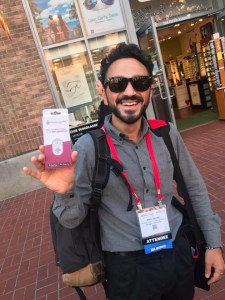
Amin is pretty awesome. I met him last year at the Roche #DiabetesMeetup and then caught up with him again this year at a couple of diabetes conferences. He’s lovely and smart and is the brains behind MedAngel. He has seen firsthand what happens when insulin isn’t stored properly and problems occur.
The idea behind MedAngel is wonderfully simple: it’s a small, wireless sensor and a mobile app. The sensor is placed alongside insulin (or other medications) and measures the temperature, transmitting to the app which alerts if temperatures are too high or too low for your meds.
When I saw Amin in San Diego at ADA, he gave me my very own MedAngel sensor and, over coffee, showed me how to use it, watching me set up the app. (As I said, he’s smart and sensed my frightful lack of tech abilities.)

I now have a MedAngel sensor in my diabetes spares bag. So far, it’s not once alerted, but we’re in the middle of winter still here, so it will be interesting to see what happens once the weather warms up or when I am travelling to warmer temperatures.
I also popped the sensor in the fridge for a few days. I don’t keep insulin in the butter compartment– I actually keep butter in there (weird, I know), instead it’s always in a small, rectangular box on the bottom shelf of the fridge. Also in the box are paper prescriptions waiting to be filled (so I always know where they are), Glucagon and a couple of long acting insulin pens (usually out of date…) in case of pump failure.
I was pleased that my fridge consistently kept my insulin at a suitable temperature and am now completely confidence that it is safe in there.
However, as it turns out, my fridge is actually not ‘all fine’ for storing insulin. I left the sensor on the top shelf of my fridge in the ‘quick cool’ zone for a day and was getting alerts that it was too cold there for my insulin. The variability in the temperature of my fridge would be concerning if I moved my insulin around, which I have done in the past.
Speaking with Amin, I did start to think about the supply chain and what it takes for insulin to actually get from where it’s made to my fridge. There are a lot of opportunities for there to be issues with temperatures, and even if I’m confident that I have it right once it’s delivered to me, I can’t be confident that it has been kept at the right temperature in all the stages it takes to get to me.
I think there really is an application for MedAngel sensors to be packed in with every single vial of insulin from when it leaves the manufacturing plant and travel along with it all the way to deliver to the person with diabetes from the pharmacy.
 Amin gave me with a MedAngel sensor without expectation I’d write about it. I’m writing because I think it’s a useful device. And I also love supporting PWD designing things that make sense for others PWD.
At #DX2Melbourne last week, we had a live webcast in an attempt to include people not invited to be part of the event to hear from some of the bloggers and contribute to the discussion. The hour-long webcast was about diabetes and mental health.
With delusions of Jenny Brockie and Tony Jones, I facilitated the discussion – which was actually quite difficult as there were thirteen of us sitting in a row meaning we couldn’t all see anyone other than who was sitting directly next to us without leaning dangerously forward. Also, I kept nearly falling off my stool, which suggests that I am the most ungraceful creature to have ever been positioned in front of a camera.

I’d put together some questions and discussion points to guide the discussion, but was very open to any tangent the group wanted to take to really navigate and explore the topic of diabetes and emotional wellbeing.
As the discussion flowed, I couldn’t help but feel a sense of déjà vu. Another talk about how diabetes affects us emotionally; another talk about not getting the support from psychologists and counsellors that we need; another talk about how usually it’s not even recommended that we may need to speak with someone about the mental health aspect of living with a chronic health condition; another talk from well-connected diabetes advocates saying that there is more to diabetes than simply being told our A1c, or any other number for that matter.
Amongst all the chatter, I asked myself how many times I’d participated in talks, how many talks I’d given, how many tweet chats I’d tweeted in, how many blog posts I’d written that were about the emotional side of diabetes. And then today, on my TimeHop app came this tweet, from an OzDOC tweet chat about mental health, held exactly 12 months ago today:

I’m not saying this because I think we’ve ‘done’ this topic and should leave it alone now. Not at all. I’m just suggesting that we’ve been having the same discussions about this really important topic for a long time, and yet diabetes care still seems to have this imaginary, yet somehow real, line down the middle, with the physical aspects of diabetes to one side, and the emotional aspects on the other as if the two are not fundamentally connected.
I knew that there would be some people listening in who would be hearing all of this for the first time. It would be the first time that although they had probably worked out that there was something missing from their diabetes care, they weren’t sure what it was. Or, they may have known they needed to speak to a psychologist or a counsellor, but didn’t know who to ask about it…and anyway, they may have thought, surely if this was something that lots of people with diabetes feel, someone would have mentioned it by now, right? Right???
Nineteen years I’ve had diabetes. And for at least seventeen of them, I’ve understood and known the importance of checking in on how the emotional impact of diabetes is contributing to how I am managing my diabetes. Or how I am not managing my diabetes (see above tweet….).
The idea that we can separate our mental health and emotional wellbeing from our diabetes is ridiculous. A condition that permeates every aspect of our life, moves in, makes itself a home and lords over us with terrifying threats of what lies ahead, impacts on our abilities to manage the day-to-day physical things we need to do.
Those watching the webcast at home could submit questions for the panel. A couple of diabetes healthcare professionals were watching and one asked a question that, as I read it, made my heart sink. He said that he sees people with diabetes who he believes would benefit from seeing a psychologist, but he is concerned that they will be offended if he suggests it. He asked the panel for ideas on how to broach the subject without causing offense.
Why did my heart sink? Because the question showed that there is still so much stigma associated with seeing a mental health professional, that other HCPs – on the ball, sensitive ones who know and understand the intersection between diabetes and mental health – feel worried that they might upset someone with diabetes if they suggest referring to a psychologist.
Until we normalise psychological support – until at diagnosis when we’re introduced to our new diabetes HCP best friends and psych support is part of that team – the stigma will continue. I’m not suggesting that everyone will need or want to see a psychologist. But putting it on the list, alongside a dietitian and a diabetes educator and an eye specialist will at least people understand that, if needed, there will be someone there to help with that particular piece of diabetes. (And to be perfectly honest, I really do wish I’d seen a psychologist at diagnosis rather than the dietitian who has scarred me for life with her ridiculously large rubber-mould portions of carbohydrate she insisted I eat at every meal!)
I don’t feel as though I am a failure because I have needed to consult a mental health professional in the past. I don’t think that it suggests that I can’t cope or that I can’t manage diabetes. I see it as important a part of my diabetes management as anything (and anyone) else. A lot of the time, I don’t feel as though I need to see someone. But other times, I do. And that is fine.
DISCLOSURES
Abbott Diabetes Care covered all my costs to attend #Dx2Melbourne, and provided all attendees with two FreeStyle Libre sensors and, if requested, a scanner. There was no expectation from Abbott that I would write about the event or any of their products, and everything I do write about it is my opinion, in my own words, and in no way reflects those of Abbott – or anyone else, for that matter.
On Monday and Tuesday of this week, I attended and facilitated Abbott Diabetes Care’s #Dx2Melbourne event which brought together eleven Australian diabetes bloggers. (All my disclosures can be found at the end of this post.)
(Just a recap – the DX (or Diabetes Exchange) series of events have now been run about half a dozen times. Other than #DX2Sydney and this year’s Melbourne events, the others have been held in hard-to-take cities including Stockholm, Berlin and Lisbon and have been attended by bloggers from the UK and Europe.)
#Dx2Melbourne reunited most of the bloggers who attended last year’s event, with some new faces thrown in for good measure. I was introduced to Alana Hearn for the first time, finally got to meet diabetes yoga guru Rachel Zinman, and caught up with Helen Edwards. (All the links to the blogs of the ‘repeat offenders’ who attended #D2Sydney can be found on this post.)
Some may believe that I am naïve in saying this, but the event is not about product. In fact, apart from a 45-minute presentation – the session that kicked off the two days – there was no other discussion about Libre or any other diabetes product unless it was specifically raised by one of the bloggers. Abbott did not have a new product to push; Libre has been out for over 12 months now in Australia.
(I am not, however, naïve enough to think that events like this are not part of the health industry’s 21st century marketing strategy. But, as I said last year when responding to a comment on my blog about this, this is the 21st century marketing. And I’m glad that consumers have a place in this strategy, because it would be far worse if industry was continuing with 20th century marketing strategies which completely excluded people with diabetes, and did not offer us any opportunity to directly engage and work with industry. Any device company NOT doing this is falling way behind and needs to catch up.)
As the Abbott team stated in their welcome, the idea of the DX events is to continue their commitment to bring together people living with diabetes to share ideas. And for Abbott to get an idea of what it is that is important to people with diabetes and what makes us tick – albeit a very select and privileged sample of advocates.
With this in mind, for me, the most valuable part of the event was the discussions that were completely driven by the bloggers. In an open session where we were exploring ‘why we blog’, I listened carefully as everyone articulated their reasons for going online and sharing their stories with strangers.
Reasons varied – some do it because they simply want to tell their story, some because they love to write, some have specific issues within diabetes they want to open up for discussion, some see it as an advocacy platform. What we don’t hear – ever – is anyone saying ‘Because I want to make money doing it’. I can be all evangelical about it and say it’s because we’re a choir of angels, but mostly I think it’s because we’re smart enough to know the limitations of what it is that we do, as well as understanding the strength is in connecting, not money-making.
We also considered the shortfalls of having an online presence.
I’m an over-sharer and I know that there is a lot I write that many others wouldn’t feel comfortable sharing – and some people have told me that it is sometimes difficult to read. I also write about issues that are of no real concern to others, and they are more than happy to let me know that I’m wasting my time and energy on such irrelevant (language) matters. I also know that as soon as I put something out there, I am opening myself up for comment – both positive and not-so-positive. We had a discussion about how we manage unwanted attention and, in the most extreme cases, trolling.
I have never regretted anything I have written or shared, and have never taken anything down because I’ve felt it was too personal. But I have had some very unwelcome and sometimes nasty comments sent my way.
I found this a really useful, but somewhat challenging, discussion. I have written about some very personal experiences, probably most notably, pregnancy loss. I’ve also written a lot about how diabetes impacts my mental health. These are two topics that are frequently hidden away, surrounded by shame and secrecy – precisely the reason that I am committed to writing about them.
However, the times I’ve been trolled – and fortunately, that hasn’t been often – it has been when I’ve shared very personal stories. They’ve been the times where I have found myself at my most vulnerable, and being so exposed makes any sort of negativity harrowing.
It was reassuring to discuss – and remind each other – that even though we are voluntarily putting ourselves online, we are not inviting people to be nasty and disrespectful. Online is real life, despite what some people may think. This is the space where many of us convene to work together, support each other and share information; it’s not a place for personal attacks.
I left the event on Tuesday feeling utterly exhausted, but also filled to the brim – a feeling that only comes after spending a solid period of time with others treading the blogging and advocacy boards. I was reminded of the similarities as well as the differences we experience living with diabetes. I felt buoyed by the various issues that draw our attention. I felt desperate at the access issues I still hear about – both here in Australia and overseas. But most of all I felt part of something that is much bigger than me, much bigger than my blog and much more powerful that anything I can do on my own.

Abbott Diabetes Care covered all my costs to attend #Dx2Melbourne, and provided all attendees with two FreeStyle Libre sensors and, if requested, a scanner. There was no expectation from Abbott that I would write about the event or any of their products, and everything I do write about it is my opinion, in my own words, and in no way reflects those of Abbott – or anyone else, for that matter.
I’ve spent the last two days at #dX2Melbourne – a two day event bringing together bloggers from across Australia. This was the follow-on from last year’s #DX2Sydney which coincided with the launch of the FreeStyle Libre. The event was hosted by Abbott Diabetes Care and I’ll be writing about it over the next couple of days (and disclosing like nobody’s business on those posts).
Today, I was on a ridiculously early flight to Canberra and on my way to the airport while it was still dark, I thought there is not enough coffee in all the lands to make me smile. But then I remembered my new diabetes spares bag that arrived last night all the way from Copenhagen. It’s bright yellow and made by Monica Vesci from Casualty Girl and it looks like this:

Bet it made you smile too! You can get your own – as well as lots of other fun diabetes-related goodies – on her e-shop, here, where you’ll also find this slightly more G rated version!
I paid for my little bag and the postage to Australia from Copenhagen.
I was slightly mortified at an exchange I heard recently between a person with diabetes and a healthcare professional. The HCP was correcting the PWD, who repeatedly referred to themselves as ‘(a) diabetic’, urging them to not use the word as some find it offensive.
Sometimes, it seems that we forget that the idea of discussing, and hopefully improving, the language used about diabetes is to better the experience of people with diabetes. My personal crusade is not about completely eliminating the word ‘diabetic’, for example.
I know many people with diabetes who use the word – as both a noun and an adjective – and are very comfortable to refer to themselves that way. This piece from Mel Seed at Twice Diabetes explains why she is more than happy to use the word. I appreciated her side of the debate. It all fits neatly into my philosophy of ‘My diabetes, my rules’.
But the point of the whole #LanguageMatters movement is not about people with diabetes defending the language choices we make. It’s about others. The Diabetes Australia Language Position Statement as never intended to be for people with diabetes. It was always for healthcare professionals, the media and the general community.
Rosie Walker, on her Successful Diabetes blog, captured it all perfectly when she said this in a recent post about diabetes language matters:
‘This is not a call for people living with diabetes themselves to ‘mind their language’. Anyone is perfectly free to refer to themselves and their condition however they wish – as in most other areas of life. This is about how other people, and especially health professionals and scientists, use language in relation to diabetes and those with it, and especially when they are not in earshot or attendance…’
When a healthcare professional tells someone with diabetes to not use a word to describe themselves, it’s just another example of trying to control the PWD. In the same way that we want choice about the devices we use or the treatment plan we employ, we demand choice in the words we use to describe ourselves and our diabetes.
I have started a separate page on Diabetogenic about all things #LanguageMatters. Click here or on the link at the top of the page for more.





 Diabetogenic
