I like to think that I am not one of those parents who is always banging on about how perfect their little precious is. My kid, love her as we do, can be a little devil. She is wonderful and gorgeous and clever and kind. But she is not perfect.

However, one of the things that I am incredibly proud of – and brag about like one of those parents – is her good manners. Aaron and I have had a no tolerance policy since before she could speak about the importance of saying please and thank you. She knows to say excuse me (as in: ‘Excuse me, can I please pat your dog?’ – the words she has possibly uttered more than any others in her ten short years) and she knows how to behave in a café, (as in: don’t speak to mummy until she is at least half way through her first coffee).

She doesn’t get it right one hundred per cent of the time, but she is pulled up every time she forgets.

The thing that amazes me is how frequently she is commended on being polite, just because she has said please or thank you. Surely this is simply something that people just do, but I am assured by many that hearing a young child using her manners is not a given.

I probably shouldn’t be surprised by this. Each day on my Facebook feed, there are articles such as ‘Things not to say to a pregnant woman’ or ‘Five questions to never ask someone in a wheelchair’.  Apparently, people still need to be reminded to never ask a woman if she is pregnant. (Here’s an easy rule for that one: Do you see a baby coming out of the woman’s vagina? No? Is there a surgical team performing a C-section removing a baby from the woman’s uterus? No? Then do not ask. You’re welcome.)

There are about a trillion blog posts about the frustrating things that we get asked about living with diabetes.

We need these things to be written, because people seem to have bad manners. That is what it all comes down to.

We can say this is ignorance and that people need to be reminded that there are some issues that are a little sensitive. But I don’t think that is the case.

I think it is just bad manners.

I would never begrudge anyone for not understanding what life with diabetes is about. Unless they are living with it themselves, why would they know?

But asking inappropriate questions or saying silly things is not excused by a lack of understanding. It is explained by a lack of manners though.

Asking someone ‘should you be eating that?’ is just plain rude. And thinking that sharing the story of someone you know who has died a painful, horrific death because of diabetes is not a bonding exercise. It is scary and nasty. Just don’t do it.

Now, I don’t want to be all negative Nancy. No; I’m all about solutions! If you have a friend or loved one with diabetes and want to make conversation about their diabetes, here are some ideas to demonstrate your exceptionally good manners and show how much you understand:

Replace ‘Should you be eating that cupcake?’ with ‘Oh, there’s a Nutella cupcake over there. Can I get you one?’

Replace ‘Does giving yourself a needle hurt?’ with ‘Oh, there’s a Nutella cupcake over there. Can I get you one?’

Replace ‘I once knew someone who died because of diabetes. It was terrible. Are you scared that will happen to you?’ with ‘Oh, there’s a Nutella cupcake over there. Can I get you one?’

Replace ‘I could never give myself a needle.’ with ‘Oh, there’s a Nutella cupcake over there. Can I get you one?’

Replace ‘Did you eat too much sugar as a kid? Is that why you have diabetes?’ with ‘Oh, there’s a Nutella cupcake over there. Can I get you one?’

Replace ‘I saw on A Current Affair last week that if you drink a kale smoothie for breakfast every day, you could cure your diabetes. Have you tried that?’ with ‘Oh, there’s a Nutella cupcake over there. Can I get you one?’

Replace ‘Cinnamon. Cinnamon cures diabetes. Did you know that?’  with …. Actually, this is acceptable as long as you accompany the question with a cinnamon-infused baked good.

There you go. Not too hard at all. And that ends today’s lesson of Manners with Renza.

Cookies!

Cookies!

I’ve just had a wonderful long weekend where pretty much every moment we were home, the oven was on with cakes, biscuits and pies filling the house with beautiful smells.

I spent the time out of the house doing the things that build me up – playing in the park and soaking up the sun, visiting bookshops, going to galleries, drinking coffee. We added artwork to our SHAG collection and I added a couple of new bracelets to my Kate Spade arsenal. I danced to Taylor Swift in the kitchen with my girl and watched Better Call Saul with my boy. Family dropped in, cups of tea were drunk, neighbours were visited. I took a Twitter break. We chased the moon. International Women’s Day was marked.

It was a good weekend – a great weekend.

Now showing on the wall in our living room.

Now showing on the wall in our living room.

And yet.

I start the week with a ball in the pit of my stomach and am incredibly distracted. I have an appointment tomorrow with my endo. And I am terrified.

It’s been too long since I last saw her. And if truth be told, I really don’t want to see her. I don’t want to sit there and discuss diabetes – my diabetes – and talk about how I have really dropped the ball. (Understatement.)

I don’t want to talk about the burnout that has overwhelmed me for so long and even though I feel myself emerging – there are glimpses of brightness – I don’t want to admit just how much it has affected my diabetes self-care.

I don’t want to discuss complications screenings. I don’t want to talk about them. I don’t want to know. I don’t want to face things.

I don’t want to sit in her office and cry, which I know is exactly what I will do the moment I sit down and she asks me how I have been in her incredibly non-judgemental, beautiful, concerned and caring way.

New jangly bracelets.

New jangly bracelets.

Throughout the last few days, in the middle of all the lovely stuff, I have paused and taken stock and thought of my upcoming appointment. I have thought about how it will play out. I have considered how, after the tears and admissions of feelings of guilt, I will leave feeling stronger and more determined – I always do after seeing my endo. But I am still scared and anxious about it all. I know that the truth of what has been going on scares me and the possibility of what has been going wrong. All of this terrifies me beyond belief.

I needed the long weekend to build me up and help with my resilience stores and I feel that it certainly did that. My support network is strong and I have people around me who are so gentle in the way the support and encourage me to live well with diabetes.

So with this in mind, I am focusing on getting through the next couple of days. And what happens after my appointment.

An expensive trip to Readings

An expensive trip to Readings

A full biscuit tin, an armful of noisy bangles, a library of new books and a gorgeous new Josh Agle artwork on the wall are all helping and keeping me grounded. All things I need as I face a tough week.

It’s #DBlogCheck day. Read about it here and go and give some love to – and leave a comment on – some of the diabetes blogs out there that help make up this wonderful community.

I’ve seen a couple of examples recently of some pretty nasty Twitter activity. I don’t know why people feel the need to be anything other than supportive and encouraging of those sharing their personal experiences of living with diabetes and trying to connect in a positive way.

And I certainly don’t know why anyone would want to attack another person because of the way they are choosing to manage their condition – a condition that just plain sucks most of the time. This isn’t about us all agreeing and having the same ideas. Cookie-cutter diabetes is just not a thing. (Now I want a cookie.)

Diversity of opinions is one of the reasons I actually love social media. I really do like to consider things from different perspectives and hear how and why people do things the way they do. Reading about new ideas and perspectives are a great and productive way to consider what I am doing with my diabetes management and decide if perhaps there is something else I could be doing, or something I could be doing differently.

But I would never think that just because someone is doing something different to me they are doing it wrong. And I would never, ever attack someone for what they believe. Slight disclaimer – anti-vaxxers and people spreading false information about health conditions. (Sarah Wilson – I’ve been spending a lot of time really loving myself and I still have autoimmune shit going on. Please explain.)

So, I’m going to just gently park this here.

Emerson quote

Be nice. Really. Be nice. And remember that this journey called diabetes that we are on is not all smooth sailing. And making waves by being nasty to people is not helping anyone.

I should add that these sorts of incidents are isolated. For the most part, Twitter is full of people who support and encourage and lift each other up. And for that, I am eternally grateful.

Friday funkiness comes from the legendary Tower of Power. A couple of years ago, we arrived in San Francisco and two hours later, we were at the Alameda County Fair listening to these guys on stage. No better way to get over jet lag!

It’s the Friday before a long weekend and this chicken is looking forward to three days of nothing! I’ll be back on Tuesday for #DBlogCheck day.

I am on a 7am flight to Adelaide for a day-long meeting. This is just plain rude and given that I’m on about 5 hours sleep (self-inflicted), I am coffee-d up to my eyeballs just so I can stay awake. 

So, on the flight, sitting in seat 15B, I have had a little snooze, (maintaining my ‘only ever been awake for take off twice’ record by being sound asleep as we taxied and took off), and am now staring, zombie-like, at my iPad trying to make sense of the words I am typing. (Good luck to the nosey woman in seat 15C who is totally not surreptitiously reading what I am typing.)
And I’m yawning. A lot.
Recently, I have noticed a new hypo symptom. When low – having dropped slowly, I get very yawn-y. It happens completely out of the blue – a sudden onset of lazy, gaping oscitancy.
The first time this happened, I was with friends and all of a sudden, it started. I couldn’t stop yawning. One after another after another. I kept apologising, saying that the last few late nights must be catching up with me.
Shortly after, I checked my BGL and I was low – not staggeringly so, but low nonetheless. As soon as I treated and my BGLs rose, the yawning stopped and I felt fine.
It happened a few more times before I put two and two together. Sudden yawns = slowly decreasing BGLs.
When it happens, there are absolutely no other symptoms. The shaky, sweaty adrenaline rush hypos that come from either a rapid drop, or waking up suddenly overnight are completely absent. Instead, it’s a listless, snail-like feeling of sluggishness and a realisation that I am yawning. A lot.
This new low symptom is manageable and now that I have worked it out, I can use it quite effectively. As soon as I notice the yawns have started, I treat.
As someone who at times has impaired hypo awareness – love it when a BGL check shows a 2.5mmol/l and I am feeling perfectly fine – I’ll take any symptoms at all. And for me those hypos that sneak up on me are particularly symptom-less. So this is quite a welcome new development.
Of course, on days like today – when my day started on an early morning flight after a night of minimal sleep – it gets confusing. I’m yet to work out how to differentiate if a yawn is a hint I’m low. Or a silent scream for coffee

You know how I’m always saying that I feel very fortunate to have an online community that is so wonderful? And how the DOC gives me so much? And that I get support, love and reassurance? And all that stuff about how I feel connected and part of a global community? I’m always banging on about how I have information about real life with diabetes available and I learn so, so much. All the time. And how lucky I’ve been to meet people from every corner of the world and hear about their experiences.

It’s all true. All of it. And then, it gets taken up a notch with this.

I get sent parcels in the post:

IMG_2839

All the way from the other side of the world:

IMG_2835

Inside, a handwritten note:

IMG_2760-0

And scrunchy pink wrapping:

IMG_2761-0

Underneath was the most wonderful surprise:

IMG_2820

Most, most wonderful!

IMG_2843

And then…

IMG_2848-0

Dinner was served.

A huge thank you to the beautiful and wonderful Annie who I met because my effed pancreas and her gorgeous daughter’s pancreas are both good for nothing slobs. If I have to live with diabetes, knowing people like this make it a hell of a lot better.

IMG_2846

The wonderful Annie (who will possibly want to shoot me and make me return my wonderful gift for posting this photo of her).

I woke up on Saturday morning and for an exquisite 15 seconds, I didn’t remember the night before. Then I moved. Then my body remembered.

Gingerly, I swung my legs to the side of the bed so I could get up and to go to the bathroom. The pain under my left breast was making it difficult for me to breathe, much less move.

My feet gently touched the ground and I pushed myself to standing. I steadied myself and once certain I wasn’t going to fall over, I walked to the bathroom. Flashes from the night before running through my head.

Awake. Asleep. Awake. Asleep.

Forcing food down my throat, falling back to sleep.

Waking and feeling like I was drowning.

Not being able to remember which way to turn from our bedroom. 

Trying to stand up to get to the kitchen and not being able to support myself.

Finding myself in the kitchen staring at an empty bottle of orange juice. 

It was the middle of the night. The kidlet was, thankfully sound asleep and didn’t stir, despite my crashing and clumsy movements. At one point, I dropped a glass on the wooden kitchen floors, but even the loud crash didn’t wake her.

Aaron was at a gig and still hours from home.

After almost two hours, I started vomiting. My BGL was still sitting under 3mmol/l. I lay down on the bed and thought that I would need to get to the hospital.

Eventually, I called my parents and asked them to come over, thinking that one could stay with our daughter while the other took me to A&E.

By the time they arrived, I was a mess. I couldn’t stop crying; I felt nauseous and faint; my heart was beating fast and hard in my chest and I breathing was difficult.

‘Renz, darling. What do you want us to do?’ they asked. ‘Do you want to go to the hospital?’

I didn’t know. I didn’t know what was the right thing to do. I couldn’t concentrate enough to make a decision. I was distracted and kept thinking about what would have happened if I had passed out on the floor in the hallway, crashed to the ground and had the kidlet wake to find me there. I felt guilty for getting my parents out of bed and out of their house in the middle of the night to rescue me – and then not be able to tell them what I wanted and what I needed.

I decided not to go to A&E. The thought of having to spend at least 6 hours on an emergency room bed was even more overwhelming than having to continue to deal with what was going on. The danger period seemed to be over – at least I was remaining conscious now.

At 3am, my BGL had finally hit 3.2mmol/l. It was three hours since I first woke and started eating. I still didn’t feel confident enough to sleep even though I was exhausted. I turned on the television, just in time to see Ryan Reynolds being attacked by a snake in Buried.

At 4am, just as the movie ended, my BGL was 4.1mmol/l. I felt it safe enough to go to bed.

I spent most of Saturday dozing, trying to rid my body of the aching and exhaustion and my mind of feelings of desperation. But they remained.

I had a constant headache that moved in waves from dull to pulsating. I needed to rest after doing anything remotely energetic. I mowed the front lawn – not more than a postage stamp of grass – and needed to lie down for half an hour afterwards. Pushing the hand mower back and forwards caused the pain in my ribs to throb.

I ached all over, I felt fragile and tears kept forming in my eyes. I looked at my daughter and had to keep pushing away the thought of her finding me unconscious.

By Sunday morning, after a good night’s sleep, I felt a lot better. I still had a dull ache in my head and a twinge in my left ribs. But overall, I felt better. My body had started to heal and I felt like I had some energy back.

I spent Sunday afternoon at a local street festival, enveloped by gorgeous food, loud music and bright colours. We sat and watched some Bollywood dancing and then climbed the stairs to an upstairs bar to hear a hard swinging big band belt out some Frank Sinatra (and this). Occasional flashes of being hypo would pop into my head and I’d smother them by distracting myself with the energy around me.

Today, a couple of days later, there are no lasting physical scars. The pain has gone. The nausea has gone. And the headache is no longer there.

But I am so fragile. I feel damaged and I feel broken and I feel beaten. I am frayed with exhaustion.

And yet. It’s another day. And I’m here. On I go.

I’m home today with a bug. Bored out of my brain, I’ve spent too much time scrolling mindlessly through Facebook. This is never a good idea when I have time on my hands.

Usually when using Facebook, I don’t click through on things that are either stupid, or about the colour of a dress. (#TotallyTeamBlueAndBlack) I have learnt that looking at anything that is going to trigger eye rolls and anger in me is better left alone.

But today, with wasting time being about as much as I can manage, I saw something flash up on one of the pages that I follow that I ordinarily would not have clicked on. Ordinarily, I would have muttered under my breath about lunatic posts and moved on.

The post was extolling the evils of coffee. Now, caffeine is my drug of choice. I can’t live without it. Wait, that should probably read insulin. INSULIN is my drug of choice and I can’t live without it.

But coffee is my heart starter; it’s lure is what gets me out the door in the morning. The first sip of coffee each day is a jolt that kick starts me into a functioning, coherent human being. Or, at least the illusion of one.

So, I don’t take kindly to anyone telling me that it is the root of all evil.

This is where the ‘time on my hands’ thing went wrong. I clicked through to the source of this information and found myself in the middle of a site dedicated to telling the world – nay, lying to the world – about how pretty much everything is killing us.

In addition to caffeine being the reason for our untimely deaths, here are just a few other things that are sending us to early graves:

  • Vaccines (especially the HPV vaccination)
  • Medications
  • Antibiotics
  • Red meat
  • Dairy foods
  • Doughnuts
  • Gluten
  • Caesarean births
  • Doctors and other health professionals
  • Hospitals
  • Sugar (of course)
  • Grains

When I got to a lovely poster that the site encouraged we print out and stick on our (nothing but organic kale and kumbucha tea containing) refrigerator, I knew it was time to throw my iPad across the room. The poster claimed that that ‘food is healthcare and medicine is sickcare’.

Every day, more and more of these sites crop up. Once the domain of pseudo-healthcare professionals, now anyone with a green smoothie maker and Internet access can set themself up as a ‘wellness consultant‘, create a website and convince readers of the credibility of the lunacy presented.

After losing about 30 minutes of my life clicking through the site, I put my iPad down. I thought about what I need in my life to feel well and healthy. I thought about how lucky I am to be able to access medication and devices and coffee and fresh food and doughnuts and a flu shot later this month and our healthcare system.

These are the things that are well-making. All these things. The choices I make, the decisions I make, the things I do. Nothing is killing me, there is no conspiracy by anyone to make me sick. It’s just common sense. Something that is sadly lacking from any of these so-called wellness sites.

Although diabetes is not all about numbers, sometimes, numbers tell an interesting story.

TYPE 1 IN AUSTRALIA

Each quarter, the NDSS releases a snapshot of diabetes in Australia.

And each quarter, even though I know it to be true, the numbers referring to people living with type 1 diabetes in Australia astounds me. Type 1 is considered by many as a childhood health condition. But look at this:

NDSS T1

National Diabetes Services Scheme stats – 31 December 2014

Only 11 per cent of the almost 118,000 people living with type 1 in Australia is 20 years or under. In other words, over 104,000 people with type 1 diabetes are 21 years or older.

We need to remember this when we are talking about diabetes in the media and to policy makers. Kids with type 1 diabetes grow up to be adults with type 1 diabetes, so for every support service or program focused on children, we need to think about what adults with diabetes – at every age and stage of their lives – will need.

And we need to  think about painting the whole picture when advocating for people with type 1 diabetes.

ROSES SPARED; CHILDREN SAVED

Here are some feel good numbers for you. The 2015 Spare a Rose, Save a Child campaign has wrapped up and a total of $24,229 was raised. This equates 401 children kept alive this year.

This campaign is coordinated and run using social media. THIS is how social media is used for good. THIS is why social media is about a lot more than Kim Kardashian’s latest haircut. THIS is what people with diabetes do when we come together. THIS is what online communities are about.

DID I TAKE MY INSULIN?

It’s been a long time since used insulin pens, but I can still remember the number of times I would look at my pen with a puzzled look on my face trying to remember if I had bolused for the meal I was eating, or if I’d taken my long acting insulin.

Timesulin is a nifty little device that simply snaps onto your insulin pen, replacing the cap you are currently using. Every time you replace the Timesulin cap, it resets to let you know when you last took your insulin.

And the great news is that it is now (finally!!) available in Australia. Details here.

IF DIABETES WAS A COUNTRY….

This is an oldie, but a goodie. The IDF released this really simple infographic that tells the story of the number of people with diabetes across the world.

IDF Countries

That’s right: the People’s Republic of Diabetes is the third most populous country in all the world! Can we get a flag please? And a national anthem?

THE NUMBER 1

But you know what? Using numbers to explain the diabetes epidemic or pandemic or whatever other word we use to try to convey the magnitude of the issue is a little irrelevant if you are one of those people actually living with diabetes.

Because sometimes seeing how big the issue is only makes us (and everyone else in the world) want to bury our head in the sand, afraid that we can’t deal with a problem so bloody big.

While it’s important to know just how many people are affected by diabetes and what that means, it is also important to remember that it’s individuals, with individual needs, living with this day in and day out.

Sometimes, it’s okay to say ‘it’s all about me.’ Because when living with this condition, it really is.

MY FAVOURITE NUMBER

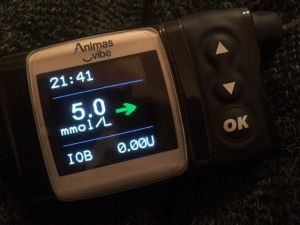
5.5

Ha! Oh, and I checked three times and each result was the same. Which is really important, because while numbers may not matter, accuracy does!

Most days, I wear bangles. Today, I am listening to them too.

Have a look at pretty much any diabetes website, and the instructions for treating a low blood sugar will look something like this:

Eat six jelly beans OR 100ml of lemonade (not diet) OR three teaspoons of sugar. Wait 10 minutes, recheck your BGL and if still low, treat again.

That is lovely and pretty and neat and sensible.

Hypos are not lovely and pretty and neat and sensible.

And hypo-brain cannot compute anything, much less how to measure out 100ml of liquid. Or how to count to six.

Also, waiting 10 minutes when you are pretty sure that you are about to die unless you mainline sugar is not gonna happen.

The reality of treating a hypo is messy, disorganised and agitated. It might look a little like this:

Eat six jelly beans. Then another six. Then another six. Oh, what the hell, eat all the jelly beans in the house.

Find lemonade. Try to open bottle. Cannot open bottle because cannot work out which end is the top and which end is the bottom of bottle. Eventually work that out and with superior hypo-strength, open bottle easily. Because you have been shaking bottle (trying to work out which end is up), lemonade explodes and splashes everywhere. Skull whatever is left in the bottle. Lick counter top of all lemonade. Look at the floor and consider licking the floor, but realise the dog beat you to it.

Open fridge and see that there is a juice popper in there. Unable to work out how to use the straw, so grab a sharp knife (possibly stabbing yourself in the process) and pierce a hole in the top of the box. Throw head back and squeeze contents of juice box into your mouth, and down your face and down your top (all the while convincing yourself that of course you look like a sexy swimsuit model in a soft-drink commercial!).

See a jar of Nutella on the countertop. Open it. Grab a spoon. Look at spoon. Realise spoon is superfluous. Use fingers and scoop chocolate-hazelnut goodness directly into your mouth. And around your mouth. And probably in your hair. And up your nose.

Decide it might be the time to check your BGL now. Meter shows result of 34.5mmol/l. You realise the blood on the strip is mixed with Nutella, lemonade, juice and jelly bean residue and therefore probably not accurate. Wash hands; wipe on legs. Re-check. 2.9mmol/l.

Clearly you are still about to die.

Open pantry door and curse yourself for all the healthy food in there. Grab a bowl of cereal, grab milk from fridge and pour over cereal, and force it down your throat, wishing that you had Crunchy Nut Cornflakes or Coco Pops instead of stupid, healthy high-fibre crap that tastes like cardboard, but you have convinced the kidlet is delicious and the best possible start to the day.

See half-empty packet of dried apricots. Cannot ever remember buying a packet of dried apricots. Cannot focus eyes to see use-by date on packet of dried apricots, but assume they do not ever go off. Eat three of them before realising that dried apricots should probably be orange in colour, not grey. Throw remainder of packet back in cupboard. For use when next time low.

Notice a jar of honey. Open, throw head back, squeeze jar, emptying about 100ml down the back of your throat. Choke slightly.

Eat five nectarines. Swallow stones of two of them.

Pull flower off stem of gladioli in middle of kitchen table. Start to eat. Just because.

Look at sponge on sink and wonder if there would be any glucose stored in there that could help get this effing low over and done with. Consider eating it.

Start spooning sugar directly from sugar bowl into mouth. Lose count at spoon number 15.

Check BGL. 3.4mmol/l. Looking good! Decide to make toast just to be sure.

Eat toast spread 1 inch thick with jam. Also eat a dozen spoonfuls of jam straight from the jar. For good measure.

Collapse on nearest chair, realising you have just eaten your body weight in glucose. But still wonder if you have beaten this low.

THAT is the reality of treating a hypo: the frantic, adrenalin-fuelled grab for anything and everything in sight. There is no concept of having to deal with the aftermath – because we believe that if we don’t eat and eat and eat there will be no aftermath. With our heart thumping, our blood rushing and all our senses on heightened alert, we eat until we either cannot eat another thing, or feel confident that we have eaten enough to bring our BGL back up to a safe level.

To feel safe. That’s all we want. Desperately want. To feel safe.


Last Friday evening, I checked my BGL. As the result flashed on the screen, I stopped for a minute, thinking.

I scrolled back through the results for the last two days. And found there were not many at all: I had four results from Thursday morning; nothing after that on Thursday; one on Friday morning (just before driving my daughter to school); and the one I had just done.

It had been a difficult couple of days. I was distracted, which had resulted in diabetes falling to the wayside.

I took a deep breath. This wasn’t something to worry about. It had been a relatively simple day, diabetes-wise. I hadn’t had any nasty hypos or felt myself going high. I’d barely eaten, which actually would have helped keep my BGLs steady. Nothing terrible had happened.

All in all, I wasn’t worried about the 36 hours of minimal self-care.

But I was worried at how easily I had slipped back into it.

I’ve been working really hard at getting my diabetes management back to a level that makes me feel content. I THINK about my diabetes more; I’ve given it more focus.

And because I truly believe that numbers are nothing more than a snapshot of what is going on at that exact moment in time, the actual results are not the aim of the game for me. The aim is to increase the number of checks and then to respond accordingly.

Out-of-target numbers don’t get me upset or angry. I just deal with them, pleased that I actually know what is going on!

This is progress. And it’s good.

What is not good is the ease in which I just stopped. Or at least, cut back and stopped thinking about diabetes. My mind was overly occupied with other things. Amongst all the background noise, diabetes slipped.

I have come to understand that the continuum of diabetes burnout does not start and end at the point where self-care slips or stops and then starts again. There is a slide towards burnout and coming out of it takes time. And if the burnout has been going on for a while – as in my case – habits need to be broken, or new ones need to be made.

The habits I had formed of minimal self-care come back very easily if I am distracted. Losing focus of diabetes happens effortlessly.

Managing diabetes is about so much more than the numbers and the checking and the self-care. It is about perspective and focus. The positive in this is that I quickly realised I’d started to lose focus. And even more positive is that I wanted to rein it back in.

Follow Diabetogenic on WordPress.com

Enter your email address to follow this blog and receive notifications of new posts by email.

Read about Renza

Archives