I’ve always been a bit of a numbers nerd. I actually find maths quite beautiful – there are patterns to be found and I love how there is a solution to be found. I also love how we apply maths to many everyday activities. It’s something that I have revisited in the last few years with the kidlet, who unfortunately hasn’t inherited my love of maths. She’s actually really quite good at it all, but is clearly more drawn towards literary things rather than the numerical.

I learnt my times table as a kid and have never forgotten them, and it is possibly one of the reasons that I have never found the maths that comes with diabetes particularly bothersome.

However, today, I realised that whilst I know up to my 12 times tables without batting so much as an eyelid, I am lousy at my 18s. I can get up to 18 x 5 and then I need to start using an abacus or my fingers and toes to count. Or a calculator.

But I really need to learn them!

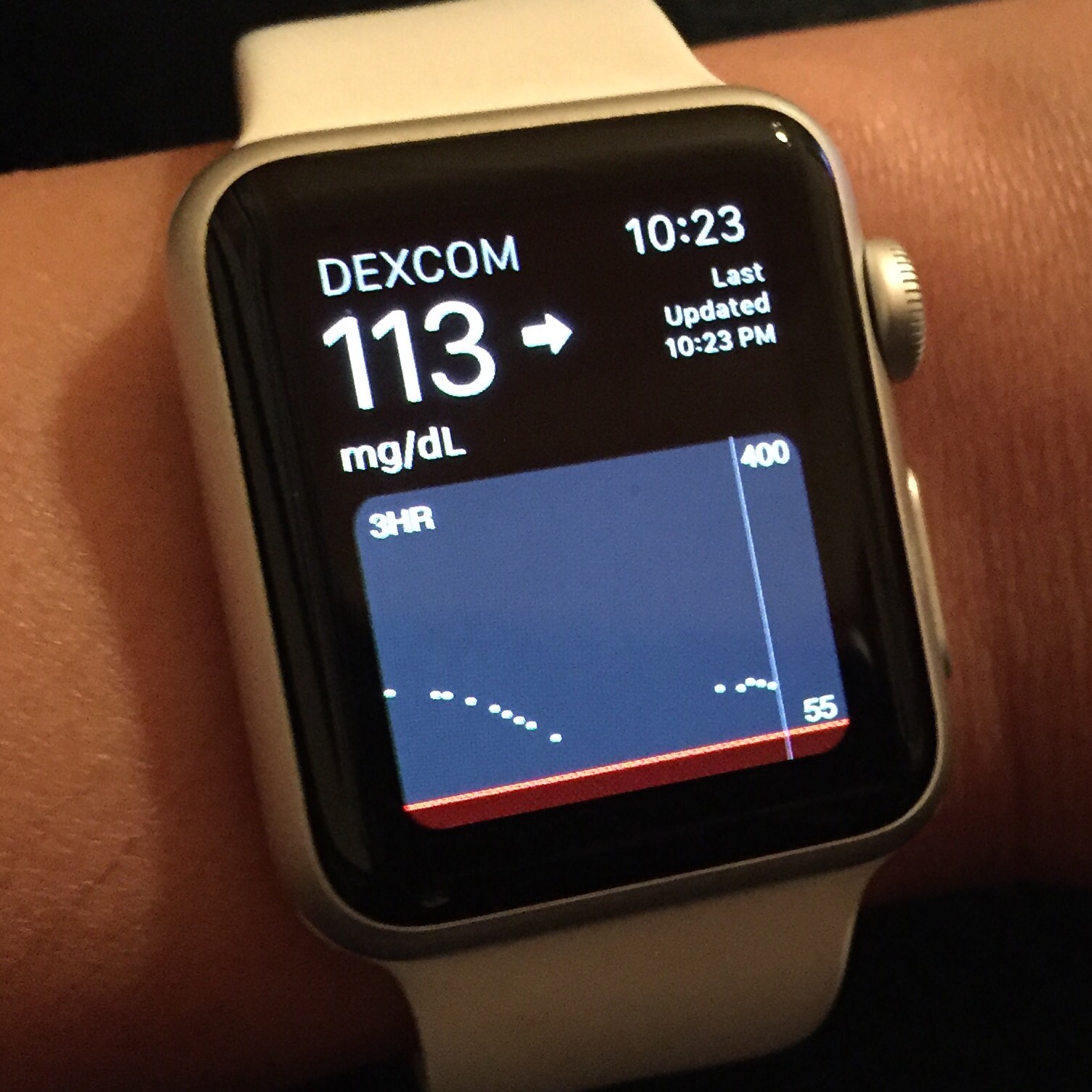
Why? Because today, this is happening:

Yes, my Apple Watch is finally doing what it was intended for. (By me. Probably not by the clever folk at Apple who invented it. I’m sure that their thought process was not exclusively ‘Let’s make this a tool for people with diabetes to see what their glucose levels are doing.’)

Anyway, I spent some time yesterday morning with a couple of very clever blokes, one of whom is possibly the smartest techy person I have ever met, and within the time it took to drink a couple of coffees, he had hooked me, and my Apple Watch, up to the US Dexcom app.

Of course, being an app for the US market, it is reading in mg/dL, instead of the far cuter sounding mmol/l so my head is slightly being done in when I look at it and see numbers that, in a diabetes sense, make no sense. Right now, I am at 91 and I know that I am fine, but I feel like I should be panicking and doing something. Anything!

I have no idea when the app will be launched in Australia – hopefully it will be very soon. But in the meantime, I am simply going to have to learn my 18 times tables. Which is probably going to be all okay until I am low and then I can’t even remember what one plus one equals. Actually, this could be a disaster!

The way that we manage diabetes is certainly changing. Wearable tech means that our diabetes management tools are integrated into our…well…living life tools. At the moment, I can check my glucose levels, my heart rate and see how many steps I have done for the day all on my watch.

Is this a good or a bad thing? Well, for me, I want my diabetes management to be as smooth sailing as possible and as unobtrusive as possible. Being able to quickly and quietly see how my glucose is tracking by simply looking at my wrist is brilliant. I love it! Integrating diabetes into life is wonderful and having to cart around fewer devices is a huge win as far as I am concerned!

While I have never had a problem ‘doing diabetes’ wherever I am, not everyone is comfortable pricking their fingers and drawing blood, or injecting themselves while there are others around. Perhaps they have been made to feel uncomfortable by others around them, or perhaps they feel self-conscious.

For those people, having discreet tools available – tools that are built into everyday technology such as phones and watches – may mean that the ease with which they are able to go about their diabetes tasks equals more doing of those tasks.

So, today, I am happily checking my watch every now and then to see how I am tracking and marvelling at the simplicity of it all. If only I didn’t need to be some sort of maths genius to interpret the number!

18-times-table-multiplication-chart

I remember when absolutely nothing was open on Good Friday. I used to say that it wasn’t a particularly good Friday because there was nowhere to go to get a decent coffee. These days most of our favourite places are open across the Easter weekend. Well, not all…

The DOC boys' excuse for not working on Good Friday.

The DOC boys’ excuse for not working on Good Friday.

This four-day break seems to be mostly about food, which is never a bad thing.

It started like this with a batch of the teeniest-tiniest cupcakes to take into work yesterday.

12321263_10154034145365789_1646494302433049588_n

This morning kicked off with a visit to a café for breakfast (might not mention the bacon I had with my breakfast to my dad…), followed by popping into a favourite bakery for the best hot cross buns in Melbourne.

And the rest of the weekend will wind itself around cups of tea at home, or coffees in cafes with friends, a big family lunch on Sunday and an assortment of chocolate eggs (and bunnies) and baking.

There will be reading and movies and a music gig here and there.

It won’t all be about food. There will be some exercise too. I’m in a basketball battle with a few diabetes friends, so I’m getting a good workout there too… (Annie – this is ALL your fault!)

All in all, a few restful days to look forward to. If you are lucky enough to have the time off: enjoy! And if you are working – thank you!

And don’t forget to Give That They May Grow. No one wants to use the Royal Children’s Hospital. But we are so glad for it if we need to. 

Despite what the media may say every time they herald the ‘end to painful injections’, it has never been the needles, the pump insertions, the finger-pricks or the sensor insertions that cause the most discomfort when it comes to living with diabetes.

They are not even where I feel diabetes most.

I feel it in my heart with an increased heartbeat when I feel the fear of ‘what could be.’

I feel it in my eyes as I see the evidence of diabetes on my body with devices, healing and healed scars, tape residue and a pump hidden in my underwear.

I feel it on my skin with the goose bumps I get when hearing the words ‘me, too’ from someone who understands what living with diabetes is truly about.

I feel it through my veins as I sense blood being pumped faster to alert me to a low.

I feel it in my smile when I see – and feel – the power of support and connectedness.

I feel it in my tears as they roll down my cheeks with the frustration of never seeming to be able to get it right.

I feel it in my fingers as I load insulin into a cartridge, feel for knots in an infusion line or grope around in my bag for my kit.

I feel it in the dark recesses of my mind when I consider the scary things that only get an airing when my defences are down.

I feel it in the pit of my stomach as the guilt that inevitably comes to the surface. Guilt about the burden I am on my family and friends.

I feel it on my lips as the tingling of a low or the dryness of a high remind me that I must attend to my blood sugar.

I feel it in my hip pocket as I fork out more money for more strips, for more pump consumables, for more sensors, for more insulin, for more health insurance, for more medical costs. Because there is always more.

I feel it in my words, as I struggle to articulate exactly how I feel, what I need, what I want.

I feel it my nose as the smell of insulin hits and automatically the words It’s the smell that keeps you alive’ jump into my head.

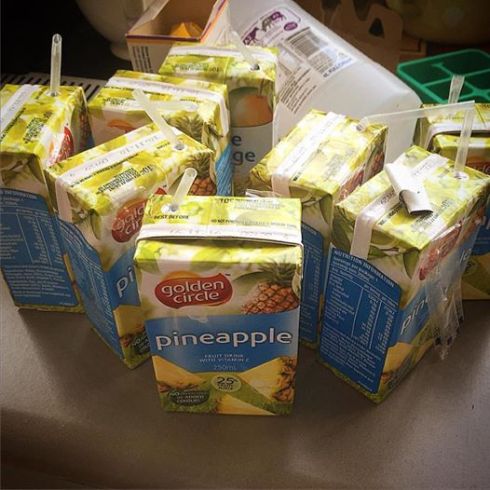
I feel it in my mouth – the sickly sweet aftertaste of the jelly beans or the pineapple juice I have consumed when I just want to sleep.

I feel it in my ears as I hear the click of a lancet device, the beep of an alarm, the ticking of insulin being delivered.

I feel it in my feet as I walk barefoot to the kitchen and there is the sensation of a rogue BGL strip on the floorboards.

I feel it underneath me when I sleep and I roll onto a pump or lie over my sensor.

I feel it. It is everywhere.

I am all for consumer engagement. ‘Ask people what they need,’ I say all the time. ‘Give the people want they want!’ I implore audiences at conferences. ‘By consulting, you get buy in,’ I promise in meetings.

And then, what happens? People are asked. There is a public consultation. There is buy in. And the result?

This. This is the result.

This is why we can’t have nice things!

Thanks to Melissa Lee for posting the link on Facebook earlier today. I was laughing so hard I had to close my office door to hide the tears rolling down my cheeks.

P.S. Regardless, I am still a huge advocate for consumer engagement.

P.P.S. My vote is actually for RRS Pingu.

I speak and write about language a lot.

I will continue to do so, because I truly believe that the words that engulf us when we speak or hear about diabetes have a direct impact on how we feel about our condition. The emotion cannot be removed from it and negative or judgemental, stigmatising or blaming words make us feel…well….negative, judged, stigmatised and blamed.

I frequently point my finger at healthcare professionals for their use of judgemental language and the media for their use of poorly researched facts and sloppy language. And I note lazy jokes where my health condition is considered a punch line.

You may have read it here or heard it when I have given a talk (it will probably get an airing tomorrow!). And if you follow me on Twitter, it is highly likely you will have seen me tweet the link to the Diabetes Australia Language Position Statement to someone who hasn’t quite got it right.

But I have never ever been able to put into words how I feel about the language that some of our loved ones – or caregivers – use when speaking about diabetes and how it can – completely unintentionally – be damaging.

My dad – love him to pieces – sees my diabetes as an illness. He thinks that I am sick. I have spoken with him over and over about why that is not the way I see my diabetes and that I am actually incredibly healthy, and he absolutely means to harm when he uses the words he does. But they do affect me.

I sat in a meeting while low – managing perfectly well, but having explained the reason I was munching on glucose tabs – and my manager at the time asked if I needed a nurse. He was concerned, but I realised he also didn’t trust my ability to look after myself when I am more than capable – something I had demonstrated to him over and over again.

I am not the parent of a child with diabetes, so I don’t get to play in that space and comment. But I do have real concerns at times. I worry about the language that is used around kids and the way that the child’s diabetes is being represented.

So that is why when I woke this morning and read this piece over at A Sweet Life from Moira McCarthy Stanford, my words stopped. I couldn’t even think straight for a moment because every single thing she wrote resonated so strongly. I actually burst into tears. (I was low, so there was that too. But honestly, I just couldn’t believe how clearly and articulately she put into words my thoughts.)

Moira’s blog post should be required reading for anyone around someone with diabetes. She nails it. Perfectly. I urge you to read it. I urge you to share it. If you are part of a family support group, send it to all members of the group and discuss is amongst yourselves. You don’t need to agree with it all, but it is definitely worth having a robust and honest discussion about it.

If you are a parent (my parent!), I hope that you understand why these phrases and words have the potential to be damaging.

At no time would I ever dismiss the difficulty of having a loved one with diabetes. I can’t imagine what it takes to watch us living with it and not really be able to do something. I would never underestimate your role.

But sometimes, the words you use underestimate ours. Moira – thank you for not doing that.

My in-laws gave me a beautiful cherry tree for my birthday last year. We planted it in the middle of our garden so we could see it whenever we are in the back part of our house. A couple of weeks ago, after a particularly brutal day of blistering heat and blustery winds, all the leaves were torn from its spindly branches.

I looked out the kitchen window and saw it standing there completely naked and thought that I had killed it.

Today, it is covered with new growth and is looking gorgeous. I didn’t kill it. It just needed a little time to recover from the nasty weather and some space to regrow.

It’s autumn here, so the colours are starting to turn and as I drive home down a stunning tree-lined boulevard, golden leaves trickle down onto my car. I want to jump out and stand in the middle of the road and twirl in the leaves, which would be dangerous given that there are trams and bikes and cars. But it is so lovely.

I love watching the seasons change. I love that the red-golden-brown of autumn is just hitting here as the spring starts to hit my friends in the northern hemisphere. Friends in the UK are posting photos of daffodils and US friends are showing photos of sprouting gardens, devoid of snow. And I looked at our fireplace the other day, thinking that it wouldn’t be long before it would be crackling each evening.

We’re already over half way through March and I am pretty sure that the year will be over before I know it. And there is so much going on in the world of diabetes all the time, all over the place.

Dexcom app

Earlier this week, my US friends were all abuzz with the excitement of the updated Dexcom G5 App which, amongst other things, displayed BGL data directly to their Apple Watches, rather than the push notifications that we currently get.

I hungrily searched to find if the update had been – or was about to be – launched here in Australia, but unfortunately, it hasn’t as yet.

I am not sure when it will be here. I am not sure if it will be here. But I am bloody frustrated that it is not here now – especially considering I bought my Apple Watch in June last year for this exact purpose.

Diabetes, infertility and pregnancy loss

Kerri Sparling is a dear friend of mine and I was so pleased when she made public her exciting news last week. I couldn’t be happier for this darling girl and her family.

She bravely wrote about the infertility she had been dealing with for a couple of years and the miscarriage she experienced in the middle of 2015. I say brave because pregnancy loss and infertility is still something that is shrouded in stigma and shame. And it shouldn’t be.

When I miscarried for the first time, before the kidlet was in our life, I told no one. I was so ashamed and felt hopeless. But I decided after my second miscarriage that I would talk about it. In some cases, people were quite uncomfortable with the candour and honesty I shared. But for the most part, women were glad I had opened up and they shared with me their stories, too.

While I was certainly doing it to help with my own healing, I was also doing it because I didn’t want others to feel the same isolation and shame that I had felt.

Thanks Kerri for using your considerable reach to bring light to this issue. Infertility is terribly difficult to manage. Diabetes makes it even more so.

Diabetic Living Magazine

Check it out – I’m in there!!

Patterns

I have a love of patterns. Stripes, of course, will be my first love and rarely a day goes by when I am not wearing stripes of some sort somewhere on my body.

But I have also developed a love of many other patterns, including anything with a nautical theme, spots and gingham.

And today, I am rocking a new argyle patterned patch around my new sensor. Rockadex is an Aussie company started by a mum whose child has type 1 and offers a great selection of patches to help keep CGM sensors holding on.

Megan from Rockadex kindly reached out, offering to send me some samples of her product, but I’m a big believer in supporting small business, so I declined. And purchased some for myself. My order arrived within a couple of business days and a pile of gorgeously coloured patches tumbled from the envelope when I tore it open. Today, I’m rocking an argyle patch. Details about the product and how to order can be found here.

Rocking my Rockadex patch.

Rocking my Rockadex patch.

Huge world

We hear all the time that social media makes the world feel very small and how we are connected with people from around the globe at our fingertips. I say it all the time. I believe it.

Except when I don’t. This week, I am really feeling the distance between my friends in the northern hemisphere. Despite tweets and Facebook posts and even a video message, I really wish I could sit down and have a cuppa with them right now. It’s a long time until June – the next time I will be visiting the US – and even longer until September when I will be in Europe. Sometimes, distance does really suck.

For no particular reason, I wish I could feel the embrace of those friends across oceans – literally not just virtually – for a bit. I feel like I need those stores built up at the moment.

Living Well

I’m returning to my old stomping ground on Saturday, presenting at Diabetes Victoria’s first Living Well event for 2016. The event is focusing on going back to basics and there are two separate streams – one for people with type 1 diabetes and one for people with type 2 diabetes. Read all about it over at the Diabetes Victoria blog. And come along and say hi – I’m speaking on a panel in the type 1 diabetes stream!

Beautiful writing

The lovely Annie Coops always writes so, so beautifully over at her blog and this story about her diabetes diagnosis is stunning.

And more

There was an interesting piece in the New York Times over the weekend from Allison Bond, an internal medicine physician at Massachusetts General Hospital. She wrote, most eloquently, about reading patients’ obituaries gives a lot of perspective to treating doctors. There is much to love and quote from her short blog, but this particular thought caught my attention – and my breath in my throat:

‘So when patients do pass away, their obituaries are a gentle reminder that behind the illness lies a story and a unique human being. This is something that is easy to forget, but vital to remember.’

If only it didn’t take death for healthcare professionals to remember that.

Speed. Super fast free-falls. Crazy highs. Your heart races in anticipation of what is around the corner and just when you think you have worked out what is going to happen, you wind up going backwards, or find yourself hanging upside down. In the dark. You plummet without the ability to stop, or you feel yourself going higher and higher and higher – knowing that there will be an inevitable and uncontrollable drop and all you can do is throw your hands up in the air and scream really, really loudly – loving every minute of it!

Sounds awful, but rollercoasters are actually really fun.

Unless, of course, it is of the BGL type. Then they are just repulsive.

Diabetes was really kicking my arse and every other part of me for few days last week.

I couldn’t seem to find a middle ground, and was either struggling to bring my BGL from the yellow zone or up from the red zone. That is how I have come to see my diabetes – the zones on my CGM trend.

I spent far too little time in the comfort of the grey zone – my target range.

And the aftermath of the extended periods spent in yellow (above the target range) or in red (below the target range) was exhausting me beyond belief.

I write a lot about the hypos that won’t quit. I’ve had a few of them in recent times and the sticky, stubborn and stupid lows knock me for six – sometimes for days afterwards.

But the belligerent highs are just as awful. Their aftermath is completely different – a heaviness in my arms and legs, shortness of breath after climbing a flight of stairs and a bone-tired exhaustion that takes a few days to get over – but no less debilitating.

Combine the two of them, and there is an overwhelming sense of defeat. I ache all over, struggle to get out of bed in the morning and fall asleep as soon as I sit down on the couch.

The frustration of pouring juice down my throat, or pumping insulin into my body gets old very quickly. And with the recovery time between the yellow and red seemingly shrinking, bouncing back after an annoying low or high is getting rougher and rougher.

In the never-ending and downright impossible aim of in the zone BGLs, I found myself with no option but to employ the big guns. I sat down and turned on ALL my CGM alarms. To avoid getting overwhelmed and pissed off with the wailing and beeping and vibrating warnings, my basic setting is ‘fall rate’ (which alerts to BGLs dropping too quickly) and low range. The fall rate alert is enough to catch a lot of lows – it does a great job of telling me they are coming and I usually act upon them.

I turn off the repeated high and rise rates because they start to get on my nerves very, very quickly. But I turned them all back on now and found they forced me to at least acknowledge I should do something. And most of the time I did.

I knew this was a short-term fix. I knew that I probably needed to do some basal rate checking – it’s been a while since I really checked to make sure that they were right. I knew that the weather was not helping. I knew that my change of routine with a new job is impacting on my BGLs. I know it all.

And I also know that diabetes, when behaving like this, is a full time job on its own. I felt as though I was barely staying above water. Despite being in a good headspace for dealing with diabetes and using the full arsenal of technology at my disposal, I still found it very difficult to stop this rollercoaster.

This week, things certainly do seem smoother sailing. The rollercoaster seems a little more friendly and a little less horrific. And I feel more equipped to cope and manage. At least for today. Who knows what will be around the corner.

I often think I see diabetes where there isn’t diabetes. But I didn’t realise just how much diabetes has seeped into the subconscious minds of my loved ones, too.

Last night, we were all sitting on the couch watching some TV.

There on the screen, the actress reached down and pulled something out of her bag and held it up. It was her pager. (The show was from a few years ago. Clearly.)

‘Oh,’ said Aaron after a moment, sounding confused. ‘That’s a pager.’ And then he laughed.

‘Huh?’ I said. ‘What?’ I wondered what he meant. If course it was a pager. What else could it be?

‘I thought it was an insulin pump. I thought ‘Of course it’s an insulin pump.’ Because a small box shaped thing someone is holding in their hand has to be an insulin pump.’

So apparently, it’s not just me who sees needles in tall buildings or thinks someone must have high BGLs if they drink two glasses of water in quick succession. Even if I’ve no idea if they have diabetes.

My kid sees me rattling around in my bag for something and automatically asks ‘Are you okay, mum? Are you hypo?’ expecting me to pull out a juice box or some jellybeans, when really, I’m probably just trying to find a pair of glasses.

I yawn and my mum asks me if I had a lousy ‘diabetes night’ which kept me from sleep, when really, I am probably just tired because Aaron and I were binge watching House of Cards the night before. (Oh jeez – could Claire Underwood be anymore awesome and terrifying?!)

I look distracted in a meeting and my colleague asks if she can get me anything, thinking I may be low, when really, I am probably just trying to gather my thoughts and try to pull them into something cohesive.

Or, a black square box in a show from the early 2000s is actually just a pager and not an insulin delivery device.

Normalising diabetes. It’s what happens when it is part of the landscape for almost 18 years. And those around me have had to adapt. I love them for it!

Oh, I love the Friday afternoon before a long weekend! And this morning, as I climbed into my car this was playing, thanks to my husband who was in control of the music last time I was in the car. Great way to kick of the weekend! 

I have never understood why people shy away from the word ‘feminist’. It is one that I have always worn as a badge of honour and one that most of the women around me are not afraid to use. Sometimes, we have roared about it, and other times we haven’t. But it always seems to be a guiding principle in the way we live.

I’ve always loved this Dale Spender’s quote (one that Senator Penny Wong quoted last night on Q&A in her eloquent explanation of why she calls herself a feminist) because it shuts down any ridiculous comments about feminism being something to fear, or ‘against men’, which is a load of bollocks.


I am not sure if the women around me I admire and love and respect would call themselves feminists, but I certainly see them that way. They raise each other up, celebrating successes, commiserating losses, rejoicing in each others happiness.

When I think about the people who have impacted most on my life since diabetes, they are just about all women. Today, my HCP team is exclusively made up of women and I have been seeing all of them for well over ten years. It took me a while to find the right people for what I needed and it just turned out that the ones who were most compatible were all female.

The people I turn to when I am confused or angry or struggling with diabetes are mostly women.

When I was dealing with the devastating aftermath of miscarriage or the exciting and exhausting exhilaration of new motherhood, the people I wanted to talk to were other women with diabetes who understood the extra demands that diabetes threw into the mix. These were the women who provided comfort and love and a (virtual) shoulder to cry on. And the call of ‘You can do this’ resonated strongly through them all.

I am raising a daughter and one of the things for which I am forever grateful is that around her – and me – at all times are women of great strength, intelligence, compassion, bravery, brilliance and talent.

She sees that every single day in my mother, my mother-in-law, my sister, my sister-in-law, an extended family of assorted aunts and cousins, and my circle of friends who are nothing short of genius.

She sees it in many of her own friends’ mothers who speak to their daughters the way I speak to mine, and she, along with many of her own friends are already demonstrating that kickass attitude that some hasten to shut down by calling them bossy and pushy. When really, they are showing they have the skill and courage to lead.

And she is starting to search out her own hero girls and women, admiring and quoting Malala Yousafzai, shouting about girl power, reading books with strong female protagonists and demonstrating utter shock, indignation and disgust to think that girls are not at all times considered equal.

And she sees me. While I may not be the strongest, brightest, most compassionate, most courageous or most brilliant of the women around her, I do set an example of resilience and kindness. And we use diabetes as an incredibly effective teaching tool to show her just how lucky we are, and how she shouldn’t ever take for granted the privileged life into which she was born.

She knows that diabetes around the world is not a level playing field. And, more broadly, neither is women’s health, whether maternal, sexual or reproductive. Where a baby is born impacts significantly on their health outcomes. As does gender.

Invest_in_Womens_Health

It’s International Women’s Day today. While I am using the day to acknowledge amazing women – those who have come before, are here now, and are our future – I am also using it to remind myself that there is still so much for us to do. The gender gap is not closed – not by a long shot. We need feminism, we need activism and we need days like today to remember what still needs to be done before women around the world are truly considered equal.

Women Deliver is a global advocate for women’s health, rights and wellbeing and promotes the importance in investing in girls’ and women’s health. Take a look at see some of their great work, which includes the infographic above.

Last night, after a lovely dinner with a couple of diabetes mates, I rushed home to watch Insight on SBS. The topic was type 2 diabetes and diet, specifically, a very calorie-restrictive diet being promoted by Dr Michael Mosley.

I was particularly interested because the CEO of Diabetes Australia (my boss) was one of the guests on the show.

I don’t really want to write about the diet being presented on the show. I am not a healthcare professional and have no qualifications in dietetics, so I am not going to remark on the ins and outs of the diet being discussed or the claims that it ‘reverses’ type 2 diabetes.

What I am going to comment on is the Twitter commentary that accompanied the show. You can go back and have a read at #InsightSBS and see that some of the armchair discussion was pretty well-balanced, (special kudos to Warrnambool DNE, Ann Morris for her balanced tweets), but unfortunately, a lot of it wasn’t.

A couple of very well-known celebrity trainers* were tweeting along to the show. (*When I say ‘well-known’, I knew of one of them – Michelle Bridges – but had to be told who the other one was. I’d never heard of Commando Steve before last night. Apparently he is Michelle Bridges partner, so I like to think they were sitting together on the couch, tweeting and judging people. Birds of a feather…!)

On the program were a number of people either living with type 2 diabetes or who had been identified at risk of developing diabetes. So, so much credit to these people for going on a national television program to speak about living with a condition that so many know so little about.

I listened to their stories and heard how they were living with a complex and confusing chronic condition. I heard about how some had made changes that they felt they could manage, and others who clearly had so much else going on, that they simply were unable to make the recommended changes that may have positively impacted on their health.

Diabetes Australia CEO, Professor Greg Johnson (again – my boss, so consider the bias when reading this) said the following: ‘We don’t want to put people in positions of failure. Already they are in positions of failure in diabetes.’

And this is where the celebrity trainers jumped in. Firstly, this from Michelle Bridges:

And then this from Commando Steve (who I assume has a proper name?):

Their complete and utter lack of understanding of living with a chronic health condition shouldn’t astound me. Who really knows unless you are living it every day?

But surely they could show a little empathy, or acknowledge how tough dealing with a lifelong condition might me.

I would like them to suggest how we remove the ‘emotion’ from diabetes. It permeates every single facet of life some days, so tell me how we cast aside any feelings or emotion?

Commando Steve tweeted that ‘people will come up with all the excuses in the world not to take responsibility for their own health’ which does nothing other than lay blame, stigmatise and judge.

The simplistic approach offered by people like Bridges and Commando Steve will never address the real issues of diabetes. In fact, all they do is add to the stigma, which is one of the reasons that so many living with diabetes find it difficult to make changes. Way to go, guys. Your lack of ‘insight’ is shocking.

Follow Diabetogenic on WordPress.com

Enter your email address to follow this blog and receive notifications of new posts by email.

Read about Renza

Archives