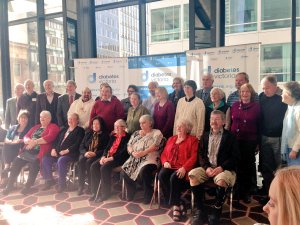
Today I attended the Victorian Kellion Victory Medal Award Ceremony. There before me, sixty-six people were awarded medals for having lived with diabetes for 50, 60, 70 and 75 years.

I write about this event every year, and each year, I write about how much hope and inspiration I feel while sitting in the room.

Because it’s true. I walk away from the Kellion awards full to the brim and amazed at what these people have achieved. I’m never sure if it is despite or because of their lives with diabetes that I feel this way. But, undeniably, it is a special day.

Frequently the stories are the same – a shock diagnosis, sometimes a misdiagnosis. Many are unable to pursue their chosen career, especially in days where teaching or nursing were not possible vocations for people with type 1 diabetes. Many spent a lot of time in hospital as they adapted to their post-diabetes-diagnosis life. And many reminisce about injecting into an orange, which apparently was the done thing for a newly diagnosed person 75 years just as it was 18 years ago when I was diagnosed – and still today!

And they share tales of brutal management instruments and tools that in equal measure terrify me and make me glad of the time I was diagnosed.

The hope exists for me because when I look around the room, and I listen to the stories and I speak directly to the recipients and their families as they proudly hold on to their well- earned medals I don’t see diabetes. I see people.

They don’t all claim that diabetes has been fun or that it has been a breeze. In fact, some of them are really open about just how tough it has made their life. But even those who say they have really struggled, still do not believe diabetes has been the single most defining aspect of their life.

I’ve always said that I wish all newly diagnosed people could meet a Kellion medal so they can see that everything will be okay. But I think that was a little naïve of me and actually undermines just what it has taken for these people to be standing there in front of us, accepting their medal. And it also suggests that diabetes hasn’t actually had some sort of impact on their lives.

These are ordinary lives made extraordinary by diabetes. And while their achievements are not there for my benefit, I am so glad that I get to hear their stories.

Source - @DiabetesVic

Source – @DiabetesVic

On our last full day in New York, we walked down some stairs to the subway. My phone started vibrating and beeping and I knew that I was heading low.

I hadn’t really managed to get the whole hot-weather-walking-a-lot thing sorted out on this trip. I dealt with insane Conference Hypo Syndrome from literally the second I stepped foot into the conference centre in New Orleans, and just managed by setting a lowered temp basal rate and drinking a lot of juice.

And then, we were on holidays and while I know diabetes is for life, not just for X-mas, I couldn’t be bothered ‘doing diabetes’ and being smart about making some changes and addressing the lows properly.

For the most part, I was right. I responded to the rapid fall warnings on my Dex and avoided any super-nasty lows.

But this day in the New York subway, I was already firmly in ‘deal with me now’ hypo territory. I had a bottle of juice in my bag, but walked into a little kiosk on the platform to see what I could use instead. And there before me I saw these:
And I squealed.

‘Oh my god. Babe. BABE. LOOK!’ I said to Aaron as I grabbed a couple of packs and started to open them before paying. I think he fished out a couple of dollars from his pocket to pay the guy who was watching me carefully. ‘I love these,’ I announced loudly. ‘Green apple Mentos! I LOVE these!’

Aaron corralled me back to the platform and we sat down waiting for our train and I started to munch my way through the pack.

Want one?’ I asked him, pushing the tube into his face. ‘No thanks. I don’t like green apple flavour.

This was a fact I knew well because every time I mention how much I love green apple flavour, he reminds me he doesn’t.

‘What? WHAT? Of course you do!’ I said. ‘It is the best flavour ever. EV-ER! Remember? It is everywhere in France. Remember, babe? Remember? And there was that time that I found green apple Mentos in Melbourne at a servo and got so excited that I bought, like, 40 tubes. Remember? Have one… Have one babe.’

‘No, I’m okay,’ Aaron said. He went back to reading something on his phone.

‘Babe. Do you remember that time at the servo? I told you, right? I was really low and I went in and saw them and got excited and was ranting and raving to the poor attendant about how excited I was and how I’d never seen them in Australia. Do you remember? The guy thought I was really weird because I couldn’t stop talking about how excited I was and how much I love green apple flavoured lollies. Do you remember?’

Aaron shut off his phone and turned to me. ‘I guess I’ll read this later,’ he said smiling.

I ignored him and continued. ‘So I told him how green apple flavour was EVERYWHERE in France, but not here in Australia and how you could get green apple gum and soft drinks and heaps of other stuff and how I love it. LOVE. IT! Remember how it is everywhere in France? Yeah? And then I asked him how many packs of Mentos they had and I dumped them all on the counter and bought them. I spent, like, sixty dollars on lollies. Green apple lollies. I was so excited and speaking really quickly. Like, super quickly. Almost ranting. Like the fast talked in Seinfeld. Remember Jackie the lawyer in Seinfeld? I was talking really, really fast. Like that.’

‘Kind of like now?’ Aaron asked.

‘Am I? Am I? I am… Aren’t I?’ I said. ‘Yeah – I guess. Maybe it’s the green apple. Do you think that’s what it is? Do you, babe? Could it be the green apple? I LOVE green apple flavour! I should have bought more. Will I go back?’

‘I think it could be because you are low. And I think maybe you should eat a few more of those Mentos instead of just speaking about them.’ Aaron said gently.

‘Do you want one? They are great! I love this flavour!’ I asked.

The train pulled into the station and we found a seat. I checked my iPhone and saw that I was no longer dropping. I took a deep breath and looked around the carriage.

‘I really like green apple flavouring,’ I murmured to Aaron. He reached over and took my hand.

‘I know. And you’re really funny sometimes when you are low.’

I rested my head on his shoulder and concentrated on my heart rate, which was slowing down. By the time we got off the train I was feeling fine. And happy. Because tucked away in my bag was a yet to be opened packet of green apple Mentos.

My favourite app on my iPhone is Uber. I love it. All the issues of having to stand around on street corners, waiting for a taxi and flagging down empty cabs as they race by you are easily and conveniently eradicated with a simple few clicks of the app on my phone. No need to worry about having cash on you – or dealing with the frequently not-working credit card machine in the car. Get in, get to where you need to go, get out. And sometimes there are snacks!

I have used Uber around the world and I love that it doesn’t matter if I am in Stockholm, New Orleans, Melbourne or New York, it works the same.

I had the most delightful Uber drivers in New Orleans a few weeks ago, including one who picked me up from a burger place in the middle of nowhere (thanks to Fredrik for always finding the most obscure, out of the way local haunts!) and chatted happily with me for our 10-minute ride back to my hotel. She gave me some terrific tips for the city and asked me about Australia.

Another night, also in New Orleans, we were picked up in a red jeep by a funny and friendly guy called Kevin who, if we had said ‘You know, we’re not done yet; how about we go to another blues bar,’ would mostly likely have joined us. And shouted us beers.

When we got to New York, we collected our bags at JFK and walked out to grab a cab. We settled into the back seat for the hour long trip to our hotel and mindlessly watched the little screen on the back of the driver’s seat. And there, we saw that New York’s iconic yellow cabs had a new app, Arro, which allows passengers to hail a cab and pay for their ride using their smart phone.

This was clearly in response to Uber and the convenience and ease it has afforded users.

Uber is an example of disruption in an industry that previously had absolutely no competitors and was happily providing a rut of a service that users simply had to use. It came about because the system was broken.

Healthcare hasn’t had that disruption. And it needs it, because this system is broken.

One of the most interesting sessions I attended at the ADA was an out of hours event hosted by the innovative team at diaTribe. I know that we can always count on to get us thinking.

The Musings Under the Moon session was billed as a discussion on digital health. But it was much more than just a state of play update.

I sat down with some DOC friends at had a good look who was presenting. There in front of us, all together sharing one stage were absolute leaders in digital health and technology, including the CEO of Bigfoot Biomedical, the President of Medtronic Diabetes, the CEO of Dexcom and an Executive VP at Novo Nordisk. And outside the specifically diabetes space we also had the Chief Health Officer at IBM and the VP and Chief Medical Officer at Qualcomm Life. The panel was expertly moderated by diaTribe’s Adam Brown.

To assemble such a panel is one thing. To have them candidly talking about the what is going on in the digital health space – and being challenged on why it is not moving faster – is another.

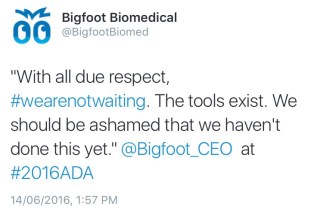
Perhaps the most candid and, for my money, the most interesting commentary came from Jeffrey Brewer from Bigfoot Biomedical. A couple of things he said have obviously resonated with many others in our community because they have been shared over and over on social media. Like this:

He is right and it is no wonder his words were met with such overwhelming support from people with diabetes. Brewer is not backwards in coming forwards and this comment also shared not only his, but many in the community’s, frustrations.


We have become conditioned to simply accept the status quo when it comes to developments in diabetes technology. We accept that the drivers of not only the developments, but the speed in which they arrive in our hands and attached to our bodies, are the companies whose skin in the game is, for the most part, is return on investment. I get that and, as is the case with any business, it to be expected. I also understand approval bodies and their debilitatingly slow processes.

Except it’s not really okay when the result is that we are not moving as fast as we should be.  Or that we begin to believe that what we do have at our disposal is as good as it gets.

Today, we would never believe the idea of sharpening needles or checking urine is an adequate way to to manage our diabetes. Not when there are other tools available.

And yet, we think that it is perfectly acceptable to use BGL checking four times a day (or six or ten or twenty…) as a way to manage our diabetes. This is old technology that gives a snapshot with no more information – no arrows, no suggestions of where we are going or where we have been. How is that still okay when we have CGM and flash glucose monitoring available that we know provides more information, more data, better ability to make smart management decisions?

We do nothing because we can’t or we simply accept that we use what we have. This doesn’t for a moment take into consideration the trailblazing Open APS users (currently 88 people around the world according to this tweet from Dana Lewis), and movements such as #WeAreNotWaiting.

Healthcare needs disruption. The current situation is not okay; the system is broken and it needs fixing. Because right now, we are being shortchanged. And it’s not good enough.

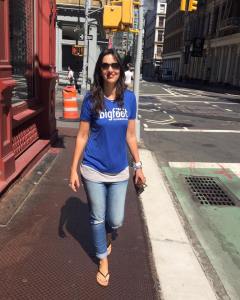
I have absolutely no connection to Bigfoot Biomedical other than I am very fortunate to be friends with Melissa Lee who works for them. But I did win one of their t-shirts in a competition at ADA and I proudly wore it on the streets of New York!

13495182_10154284926760789_117975594106741889_n

Throughout my recent trip, I kept a diary of sorts of some of the diabetes things that happened. Here is a selection of what I noted down.

ON THE KITCHEN BENCH…

…I left all my hypo treatment. Brilliant, Renza. Brilliant. I was reunited with said hypo treatment when Aaron got to NOLA. He took advantage of the situation to snap a pic:

13416938_840969262713333_1318643681110354852_o

And of course, he captioned it ‘Snakes on a plane.’ Oh, yes, he did.

ENDOS ON TOUR

The Qantas Lounge at Melbourne Airport was swarming with local endos. As was the Admiral’s Lounge once I got to LAX. If there was ever a time to have a diabetes emergency, this was it!

HIGH WHILE HIGH

Try as I might, I am hopeless at not rage blousing when high. There I was, 30,000 feet above the ground, relatively comfortable after an airline upgrade (and spare seat next to me) and high as a freaking kite.

I had a temp basal set – a very aggressive temp basal rate.  I had done a correction bolus every thirty minutes. And yet, there are double arrows up on my Dex which was pissing me off beyond belief. I eventually did another correction with a syringe and slowly, but surely watched my glucose levels return to a far happier number. Just in time to get off the flight at LAX…

…AND OF COURSE, THEN I WAS LOW…

…which necessitated this:

13428514_10154242905175789_6227334266100982326_n

I most eloquently ordered it by saying: ‘Can I please have a small iced latte with Half and Half. Because I’m hot and it’s low. Wait…What?…I mean…I’m low and it’s hot…Oh jeez… Can I just have my coffee with Half and Half. Because: HALF AND HALF. I LOVE YOUR COUNTRY.’ (All class. All. Freaking. Class.)

TSA FUN

‘I can’t go through the full body scanner. I’m wearing a couple of medical devices,’ I said politely to the TSA officer as I queued at LAX security. I was tired, felt grotty and getting over my latte-cured low.

‘Well, the wait will be a while,’ he said a little abruptly. ‘It’s very busy.’

‘That’s fine,’ I said. I understand that the palaver of what comes when avoiding the scanner takes extra time and resources. I didn’t appreciate his tone though. Or the follow up comment.

‘You could be waiting a while. You WILL be waiting a while. You could go through the scanner. Or you’ll have to wait,’ he said.

‘That’s not a problem. I can’t go through the scanner – there is a risk my devices will stop working. And then so will I,’ I smiled at him to show that I really wasn’t going to be upset at the wait.

‘Stand over there out of the way. You know you’ll have to wait, right?’ I’m glad he mentioned it again, in case I had missed it the previous times.

I didn’t ask for this condition and I certainly don’t ask for the extra degrees of difficulty it often attracts. Equally, I don’t demand special attention and am prepared to wait and deal with whatever I need to do to.  So I really hate to be made to feel that I am deliberately putting someone out.

As it turned out, I didn’t have to wait too long. A mere three minutes after the call for a ‘female opt out officer’, a lovely TSA official beckoned me to the pat down area and kindly explained the process. I nodded and pointed out where I was wearing my pump and Dex and stood there while she did her thing. And then thanked her and was on my way.

MY ARM KEPT GETTING PAPPED

When you decide to pimp your Dexcom sensor and transmitter in Melbourne while the weather is cold, necessitating long sleeves, you don’t necessarily think about what that will mean once you get to far sunnier climes and are bare armed all the time.

My arm became a mini-celebrity at the conference with complete strangers coming up and commenting and asking if they could take a photo.

(No idea what I'm pointing at...)

(No idea what I’m pointing at…)

Hopefully the lovely folks at RockaDex will see some benefit – I was promoting you guys like you wouldn’t believe! (Yes, they post ANYWHERE!)

THE WAITRESS AT THE DIABETES EVENT

At the end of the fabulous Musings Under the Moonlight event, hosted by diaTribe, a few of us gathered our things and decided that a late night Café du Monde visit was necessary. And as we walked out the door, I was stopped by one of the waitresses. ‘Excuse me, Ma’am,’ she said (because everyone is either Ma’am, Sir or Miss). ‘Can I ask you about the tape around your Dexcom. My daughter has diabetes and is a swimmer. Her Dexcom tape is always coming loose. Maybe this will help it stay on longer.’

I grabbed a pen and wrote down the details of RockaDex and told her how terrific it is. (I am absolutely not on their books, a part owner or even get free supplies. It’s just great stuff!)

‘Can you imagine?’ said Scott. ‘Her mind must have been blown being in that room tonight!

Always – ALWAYS! – love a bit of diabetes in the wild!

NPH ON CROSBY STREET

Walking back to our hotel on Crosby Street in SoHo, I looked up and saw this pasted to a wall:

13528830_10154285676095789_4378220908630796616_n

And my day was made. (Check out Appleton Artworks for more of their diabetes awareness raising street art.)

‘IT’S FOR THE KID. THE OTHER THINGS ARE FOR YOU…’

One of my favourite diabetes people, gorgeous Alecia, lives in NY and one of my favourite things to do in NY is see her. We met for lunch in Murray Hill at Penelope’s and she handed me a Kate Spade bag.

I peered inside and excitedly pulled out a pink box with familiar writing on it. ‘That’s for the kid,’ I was told in no uncertain terms. She was referring to the American Girl Diabetes Kit and I actually squealed when I opened the box and gently pulled out all the teeny tiny pieces.

Sorry hon – I kept the American Girl diabetes set. The kidlet is still trying to convince me to give her the pencil case and I am desperately resisting. But the candle – that’s on my windowsill at work making me think of you.


AND FINALLY…

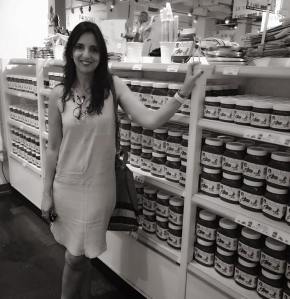
If you need to have a hypo in NY, this is probably the best place to do it:

The Nutella Bar at Eataly.

The Nutella Bar at Eataly.


Oh, Melbourne. How lovely it is to see your gorgeous self and drink your exquisite coffee. How miserable it is to be in your ridiculous Winter and to not be walking the streets of New York still, but I’m moving on….

Yep – I’m back home and, today, back at work and the reality of life is setting back in. Words cannot express how thrilled we were to see our kid after three weeks of being neglectful parents (her words), but on our last day in NY, when I checked the weather forecast for Melbourne, I did think about the logistics of sending for her to join us in the sunny Big Apple, rather than return to her here.

Lots and lots and lots to report back – both from the ADA conference in New Orleans, as well as the two weeks on the road, exploring Memphis and Nashville and returning to the familiar streets of New York. Stay tuned!

But for now, I am getting my head around a few new things on the diabetes landscape – mainly the changes for accessing NDSS supplies is different. I did indeed make sure that I had plenty of pump consumables and strips prior to going to the US, so at this stage, I am okay for supplies. But I do need to get in touch with my local pharmacy and have a chat about their processes for accessing what I need when I need it. I am most curious to see how the new program will work.

Of course, we’re in a position of complete and utter uncertainty as to what is going to happen following our federal election on Saturday. With bipartisan support for CGM subsidies, it is good to know that whoever forms government has pledged to make at least one aspect of diabetes a little more affordable to some PWD. Watching the roll out and implementation will be most interesting.

So for today, I am sorting through the debris from the conference and getting back on track for a very busy couple of weeks. It’s nice to be back. And it’s nice to be writing again. Come back and check in again if you get a chance.

Conference debris

Conference debris

This morning, I sat in a restaurant in New Orleans with three of my favourite people and diabetes advocates. If anyone could bottle the tenacity, passion, determination, guts and cheekiness of these three women, they would make a fortune and be able to solve all the problems of the world.

I listened to Anna, Christel and Melissa – who I am lucky enough to call friends – talk about their work and we discussed the US health system which made me shake my head in disbelief and confusion. I don’t understand it; I doubt I ever will. But these three not only navigate the system themselves, they are doing it for others as well as they trying to improve things.

All week I have been around people who are involved in important and life-changing work in diabetes care. From those who are developing smarter devices, using data better, improving access and doing reseach, the dedication and commitment to improving the lives of people with diabetes has been very visibly on show at this conference.

And I have been reminded that at a conference where there are ground breaking announcements made and new and exciting tools launched, it is not the flashy conference centre and the lights of the Exhibit Hall that tell any of the story. It is years and years and years of work, of people plugging away and just doing what needs to be done, until the excitement of telling the world.

This morning, I walked around New Orleans with a delicious, embargoed secret in my head that I was bursting to shout from the rooftops. Some of the exciting work I have been involved in over the last few years has started seeing results and today’s announcement from ALP health spokesperson, Catherine King (no longer under embargo, hence me writing about it….and shouting it from the rooftops) is an example of what happens when people do the hard yards.

Australians now have bipartisan support for CGM funding. The ALP pledge goes further than the Coalition’s, with access under its scheme being based on clinical need – not just age. This mirrors the submission made by Diabetes Australia, JDRF, ADS, ADEA and APEG in our joint proposal. (Disclosure: I worked on the this submission as an employee of (initally Diabetes Victoria and) Diabetes Australia and am acting as spokesperson for Diabetes Australia in any media.)

Today, there will be press and a media launch and lights and excitement as there should be. This is worth celebrating! And as I sit in my hotel room 33 levels above Canal Street in New Orleans, speaking with Australian news radio staff about the announcmenet and I am incredibly proud of what we have managed to achieve in Australia. This is a slow burn. It takes time, it takes commitment and it takes dedication. I love being surrounded by people who have it in spades.

More?

Here is the Diabetes Australia media release.

And the ALP media release

I am the first to admit that my name is not especially easy to remember. Or spell. Or even pronounce. I blame my parents. They could have called me Cindy. That would have been easier. And I would have managed to find cups, drink bottles, novelty number plates and key rings with my name printed across them. Plus, Miss Helena would have seen me through the Romper Room window.

My first name is pronounced as it is spelt: Ren-za. My surname is a little more difficult. It’s pronounced Shi-bil-ia. This is mighty confusing because it is spelt Scibilia, so people usually think it starts with a ‘sk’ sound. For some unknown reason, they often add an ‘r’ so it becomes ‘Scribbler’.

I have been doing lots of radio interviews in recent weeks and the media monitoring that arrives in my inbox in the last week has reminded me just how tough people find my name.

One day, I was apparently ‘Brenda Chevalier’; another, ‘Peta Shivanya’. Today, I had to correct a radio presenter who was calling me ‘Wendel’. These errors caused much humour and many fabulous comments from friends when I posted them on a couple of my social media pages. (I would like to point out that none these mistakes come close to my all-time favourite: ‘Wendy Lichtenstein’. That chick sounds fierce!)

I get it – my name is not typical. Most people will never have heard my surname before and even I have not met another Renza. But here’s the thing. When I do an interview, the radio station has received an email with my name spelt out. They have probably had a conversation with a media advisor or PR person who has clearly said my name. And then, once I get on the phone I not only say, but spell my name very clearly and explain how to pronounce my surname.

So what does this demonstrate? Well, it shows once again that no matter how much care you take to give the right information, it will be interpreted however people choose to interpret it. This is one of the issues with diabetes in the media. The number of times we see and hear diabetes being misreported is horrendous. In fact, it is a rare occurrence for the facts to be correct, the images to be appropriate and the details finessed.

I take a lot of care to prepare the person interviewing me. They are usually sent the Diabetes Australia Language Position Statement prior to speaking to me for the first time. I make a particular point of clearly stating that I do not want to be referred to as a ‘sufferer’ and would prefer to not be called (a) ‘diabetic’. And yet, it inevitably happens!

When it is important to state the different types of diabetes and explain how type 1 and type 2 differ, I always take great care to do that. And yet, there appears to be an inability (or perhaps, lack of care) from the reporter to actually get the facts right.

I’ve stopped getting annoyed when people in the media get my name wrong. If it happens around me, I politely correct them and move on. I’ve still got a way to go before I stop getting annoyed when people in the media get diabetes wrong but mostly that is because I believe it often contributes to the stigma associated with the condition I live with.

But I have learnt to not take it personally. Even when it is my own name that is being butchered!

My head is full of lists:

  • Packing list
  • Travel checklist
  • Work to do list
  • Hug-the-kidlet-a-million-times-before-we-leave-her-for-three-weeks list
  • Diabetes-supplies-for-three-weeks-away list

And a list of great things I’ve seen online lately…

PLAID

Do you read PLAID – a research journal with a focus on people living with and inspired by diabetes? If not, you should. Why? Because it’s awesome!

Here’s the link to the latest edition. I’m really proud to have contributed to it because it is (as already mentioned) awesome, and this edition is all about the patient perspective. I sit very comfortable in there!

Unspeakably Wonderful

A new movie about Banting and Best and the discovery of insulin is hoping to be made by UK production company AngryMan Pictures. Details for how you can contribute to their crowd funding campaign are here.

Diabetic Living online

The Australian edition of Diabetic Living magazine has relaunched its website with a gorgeous new look. Check it out!

Totally (dia)badass

Cj7caHYUYAE3IFO

Get yours here.

Take 5 minutes…

…and read these great blog posts that have been recently published:

  1. Anyone thinking of starting on an insulin pump and wanting a front seat view into what it’s all about should jump on board Type 1 Writes. Frank is a couple of weeks into his pump start and is sharing lots about what he is learning. I’ve been pumping for over 15 years now so have completely forgotten about dealing the challenges and successes of starting pump therapy.
  2. Lots of posts coming in from people who were at #DXSydney, sharing their experiences of using Libre. This post listed all the people who attended with links to their blogs. Have a read and share your experiences too.
  3. The Grumpy Pumper is a man of few smiles and, it would appear, few blog posts. Here is his first blog for the year. Pop by and leave a comment suggesting he blog more. Then it won’t just be me nagging him!
  4. Awesome pics in this blog from Scott from Rolling in the D. He hacked his Dexcom and this is what it looks like on the inside!
  5. Why do we need online communities? Anna from Glu gives some reasons here. And she’s right on every count!
  6. Also from Anna, this profoundly moving and brave post about her recent pregnancy loss. These stories need to be told. Thank you, Anna, for sharing yours. I am so, so sorry for your loss.
  7. This one is not a blog post, but a podcast. Stacey Simms produces some awesome podcasts over at Diabetes Connections. Do check them out!

Finally, if you’re looking for some more diabetes blogs to read, healthcare social media guru, Marie Ennis-O’Connor, has curated this list for you. There are 50 blogs to choose from. Get comfortable. Get reading!

Myths be gone

Team Novo Nordisk are doing awesome things to dispel myths about diabetes and address the issue of stigma. This latest video is terrific. Watch. And share. Share. Share.

Off to NOLA

It’s that time of year again. The American Diabetes Association Annual Meeting kicks off in New Orleans at the end of this week. I’ll be there, frantically tweeting.

I hit the road – well, air – tomorrow, so I’ll be out of touch for a bit as I embark on the nightmare transit. But I’ll be mainlining iced-coffee and beignets to keep awake and get in with it all.

Follow along at #2016ADA for the latest happenings in the world of diabetes.

New Orleans = Dr John. So here you go!

Twitter is a great source of discussion and yesterday this tweet from a diabetes consultant in the UK certainly did start an interesting conversation that had me thinking.

I should point out a couple of things before going any further. The tweet, asking if lack of guidance in social media is a concern, was in response to a tweet from someone else who shared a post from a Facebook page about insulin omission for weight loss. This is a very serious issue – one that I have written about here, (and elsewhere), and worked on a lot in the last decade or so.

Also, the consultant was absolutely not suggesting that social media is a ‘bad’ thing, and he is actually an advocate and user of online platforms, so this is not about the individual. It is about the issue at large.

Obviously, I am a huge fan of social media. Apart from finding online – and more broadly, peer – support an important part of my own personal diabetes management, I have built a significant part of my career extolling the benefits of online connections and the value of sourcing information and support from others living with diabetes.

The changing landscape of diabetes information and support over the last ten or so years has been significant. With more and more available online, and more and more people being online, there has been a real shift from healthcare professionals being the keepers of information and deciding what people with diabetes SHOULD know to a more egalitarian framework from which to source what we need.

While some may believe this to be the end of civilisation as we know it, (dramatic, I know), I consider this change terrific, because instead of having very controlled and conservative information on offer, there is now a veritable smorgasbord of material – and knowledge – from which consumers can pick and choose. Personally – I love being able to do that. Hearing personal experiences and picking up tips and tricks about day-to-day life with diabetes contribute to me making decisions about how to manage my own condition.

One of the suggestions frequently made about how to safely use SoMe is for it to be better moderated. My argument is that the power and value of SoMe platforms is that it is not moderated. Being free to share my ideas and experiences without fear (or perhaps care?) of judgement is not only useful, but also cathartic. And getting feedback from my peers often provides a different lens through which I can view a situation. Much of what I have learnt would not be found in the pages of a textbook, or offered in the office of a HCP. And that’s fine – there are other very valuable and important considerations that are shared in that context.

The idea of moderating online support – or any peer support, actually – is about control. It can be packaged up into a nice parcel of ‘protecting’ the person seeking the information, but that is not only patronising, but also incredibly demeaning. There is enough of that going on in more traditional settings – peer support is where there is freedom from that control – and a freedom to explore different ideas.

For me, peer support has always been about finding my tribe and learning from them. It has been about finding a source of sustenance and care that makes me feel better about my situation. It’s never been about replacing or substituting what I get from my HCPs.

So what is the role of HCPs in our support space? My belief is that it is a place for them to learn. There are times that it may be appropriate – and even encouraged – for HCPs to step in and share. On Facebook, one of Australia’s leading CDEs frequently comments and adds to conversations in closed diabetes groups. Her professional advice is always spot on – never judgemental – and her personal perspective (she has diabetes herself) shows just how it is possible to blend the ‘What-I’m-told-I-should-do’ with the ‘And-this-is-what-works-in-real-life’.

But not everyone who wants to be involved in this space has diabetes, nor should we expect them to. But I think for me, I have a very clear understanding of online and peer support works – and what everyone’s role is. When this works well, it works because it is being led by PWD; they (we!) are the ones driving the discussion and the focus. It’s not dangerous. We don’t need guidance. Because it is our space and we own it.

What peer support means to me,

What peer support means to me,

How’d your day start? Mine has been a blur of low blood sugar since the early hours. My head is in a fog, and I am confused at the insulin sensitivity that seems to have moved in and made itself at home. I am also slightly buzzy, (and more than a little bloated!), thanks to the 1750milliliters of juice I have consumed since just after 2am. That’s right: a litre and three quarters of pine-orange juice to keep my BGLs above ridiculously low levels and silence my Dex alarms.

It played out like this:

2.30am – After sleeping through 30 minutes of low alarms, I woke with a start and downed a whole juice box, not even thinking that I’d try for half and then see how I was going – because, really, I just wanted to get back to sleep. But with my alarms still screeching, my Dex still sitting below 3mmol/l and the obvious hypo fog settling it, I downed another box quickly. And, after 60 mins of low alarms, another box.

I spent 90 minutes or so desperately watching the Dex app on my iPhone, waiting for the trace to rise, (and wondering how the hell two adults with perfectly good hearing could sleep through the alarms!), all the while engaging in what this morning appears to be a most bizarre Twitter conversation with some UK friends. (Not sure what’s their excuse for the odd and slightly inappropriate exchange; their glucose levels were apparently fine.)

Eventually fell back asleep around 4.00am with three juice boxes spent on my bedside table and my Dex line sitting comfortably and arrow-less in the mid-fives.

7.00am – Morning alarm coincided with Dex screeching at me with an urgent low alarm, which had been going for about 15 minutes. More juice – this time just one box – before gingerly starting the day, keeping a very close eye on my CGM numbers, which refused to go above 4.7mmol/l. But at least they were staying steady and not dropping. Until…

8.50am – As the kidlet was loading herself into the car and I was speaking to my neighbour from two doors down on the street, another alarm. This time, the fall rate alarm showing a BG that was dropping quickly from 4mmol/l. Kidlet unloaded from my car into neighbours car for school run, neighbour shouting at me to stop talking and go get some sugar, me heading inside for another two juice boxes because one wasn’t cutting it.

Each juice box has 27.5 grams of carbs. I’ve had seven of them this morning. That’s a shedload of sugar and I feel nauseous, foggy and exhausted.

This is not the first time I’ve had a day like this. In fact, I’ve had a few.

And I have done the checklist for what it could be:

Lost weight? – Nope.

Weather warmed up? – No; it’s freezing!

Exercising more? – Don’t be ridiculous.

Other health issues? – No (except a head cold and that would not make me hypo).

CURED? – Well, maybe… although probably not.

There is no rhyme or reason to this at all. There is nothing I can point to change or fix. I just lower my basal rates, under-bolus and have stopped pre-bolusing for meals. I also am very cautious with correction boluses because most of the time, they are just not necessary. This is just a weird period of extreme insulin sensitivity. It’s happened before, lasted a month or so and then things went back to normal.

I expect that will be the same here too, although the complicating factor is that on Thursday I am heading to New Orleans, where the heat, conference hypo syndrome and the fun of travelling WILL be a factor in making me go low a lot.

I’ve made some changes to my low alarm thresholds so I am notified of impending lows sooner. I’ve made a couple of little tweaks to my basal rates. I’m making sure my phone is NEVER out of sight so the chance of a Dex signal loss is almost impossible. And I’ll just wait. Because sometimes that’s all there is to do.

A far too familiar sight at the moment.


Follow Diabetogenic on WordPress.com

Enter your email address to follow this blog and receive notifications of new posts by email.

Read about Renza

Archives