Trying to make sense of the weird link between visiting old family homes, coffee, and searching for security and safety in diabetes. Sometimes, my thought process is ridiculous!
real life with diabetes
Trying to make sense of the weird link between visiting old family homes, coffee, and searching for security and safety in diabetes. Sometimes, my thought process is ridiculous!
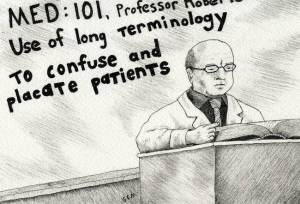
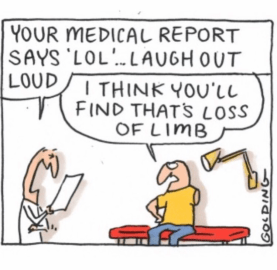
It’s Drop the Jargon Day. Here’s one I prepared earlier about this very topic.
So today, I am taking extra care about the words I use and the things I say and write when talking diabetes.
I know I am guilty of being very lingo-istic at times. I read through this blog and see the jargon sprinkled through posts, abbreviations and slang terms littered everywhere. (Huge thanks to someone who commented on one of my posts last week about how I need to not use anagrams so much!)
I catch myself in meetings using shorthand that makes sense to me, and correct myself by explaining terms may be like a second language to those of us required to speak it fluently, but a foreign language to those who don’t.
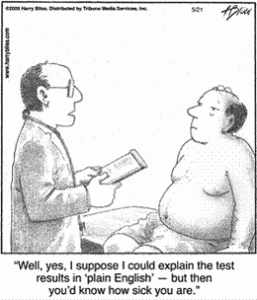
So today, I am going to use pictures to illustrate this issue. Because a picture tells a thousand words. And a cartoonist is far more amusing that I could ever hope to be! (Click on images for source.)
Take the pledge to Drop the Jargon here.
‘Oi!!!!’
‘Hey!! Hey!! Oi!!’
I have a particular look that I reserve for men who yell at me from passing cars. Admittedly, this look is employed far less frequently than when I was a younger lass, but occasionally, it still does need to be used.
And today, the thunderous look of complete and utter disdain was on my face, and the choice words I was going to use to accompany it were forming on my lips as I turned to the person who was shouting at me from their car which was actually stopped at a set of lights as I crossed the road in front of it.
It took me a moment to realise what was going on, but there was a man, half leaning out the window of the passenger side of the car, flailing his arms around and, once he had my attention, yelling ‘Look!!! Look!!!’
I looked.
And there, on his arm, he was sporting a CGM. Just like me – mine circled by a dark blue RockaDex patch; his with a bright green one.
I jumped up and down (by this time I had safely crossed the road) and yelled back. ‘Oh my god!!!! Hey!!! Hey!!! We are totally best friends now!!!’ I was waving my arms around as well, absolutely not caring how ridiculous I looked.
The lights changed and the car took off. He gave me a last smile and yelled good bye. And I waved at the car, standing there on the side of the road, laughing out loud.

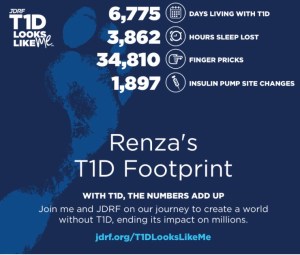
Today is day 6,761 of living with type 1 diabetes. I don’t know why I did the calculations (by ‘did the calculations’ I mean, used timeanddate.com and put in the dates. I didn’t do it myself in my head; that would be weird and impressive), but I did and now I know. My counter is still weighted in favour of days without diabetes, but the difference is slowly but surely eroding.
In the last ten days, I’ve visited houses from my childhood. By some weird coincidence, the house I grew up and lived in until I moved out at 21, and the house my dad grew up in and I spent countless Sunday afternoons with my extended family are both up for sale. I walked through the houses and memories flew around me, launching me back years.

Each day, I drive past the warehouse Aaron and I moved into as students and where we lived for three years, celebrating our independence with a constant flow of friends and dinner parties. Right now, it’s literally a façade and nothing more as it has fallen victim city-fringe developers. No doubt, the eight apartments that were there will be turned into a 15-storey monstrosity with nothing more than the heritage-listed façade to remind us what was once there.
These places are not about diabetes because for all or most of my time there, I did not have diabetes. The 6,761 day counter started after we moved out of our warehouse; I lived in my childhood home for only ten months with diabetes, (when diagnosed, I had moved back home, saving money to buy a house before we got married), and my grandparents’ house also only saw a few years of me living with diabetes. Their day count is heavily balanced in favour of days without diabetes.
And so, these homes are not houses of diabetes. Our apartment never saw a rogue BGL strip on the floor, insulin in the fridge, or a cupboard full of diabetes supplies. There were not huge jars of jellybeans scattered around the house, or empty juice boxes on the bedside table.
The two homes we have owned accommodated diabetes from day one. When we moved into our ‘new’ place three years ago, diabetes moved in too and was given its own space. Just as it has found a pocket of space at my parents’ house now where I open the fridge and see the exact juice box that I use to treat a low in bulk supply (that’s not because I have a billion lows; my parents have always shopped for the apocalypse!).
It settled into my in-laws’ house in the country. We’d arrive at the farm in need of a cup of tea after a long drive and I’d open the fridge for milk to find insulin staring at me. And I’d sigh, slightly startled, as I checked to make sure it was still in date, replacing it with fresh vials from my bag if not.
For 6,761 days, diabetes has moved in with me wherever I live, taking up cupboard space that, let’s be honest, could be far better put to use by housing cashmere sweaters or striped t-shirts. It’s invaded the butter compartment of the fridge which I would prefer to be overflowing with salted Danish butter. It’s littered the floor with BGL strips, the benches with spent pump lines and the rubbish bins with the waste of diabetes consumables.
I wandered around the houses of my childhood and instead of remembering diabetes, I remembered games, and play-dates and hiding places and loud laughter around the table – and stomping, moody teenage years. It’s getting harder and harder to remember the days before diabetes, but as I stood in my old bedroom, I saw the days before the last 6,761, remembering them clearly. And at the same time, not remembering them at all.
Today, I just want to follow up a little about one of the points I wrote about yesterday in my post about the event I attended on Tuesday evening about diabetes-related foot complications, specifically this point made my A/Prof Ramon Varcoe:
He explored how we make people with diabetes know this technique for saving limbs is available, and said that it is really, really important to inform PWD about it so that they can ASK for it and not just accept a diagnosis of requiring an amputation. He said that this was the group that could really drive change here, by demanding that they have the best treatment possible.
This had me thinking long and hard. I agree with A/Prof Varcoe here, but that is not really a surprise. I am so much about consumer-led healthcare, that I dream about it (sad, but true).
Mostly, I thought about it in context of my own diabetes care and how it has happened that I am such a DTech nerd. I decided after about two years of living with diabetes that I wanted to use an insulin pump. I really just could not get the hang of the MDI situation I had been put on at diagnosis and was the living embodiment of why Protophane was referred to as Protopain.
I went to an information session and heard a women speaking about how much she loved using an insulin pump and what a difference it had made for her quality of life. Afterwards, I spoke with her and by the end of our chat, was convinced. I wanted one of those! (Impressionable little thing, aren’t I? #MarketersDream) This woman would become my pump trainer and the only diabetes educator I have ever seen.
At my next endo appointment, I marched in with the research I had done, the questions I needed answered and an expectation that by the end of the consultation, I would leave with details of how and when and where I would be getting my pump. Ha, the naivety!
My endo was absolutely not keen for me to take the pump road, ‘You’ve not had diabetes long enough,’ he told me, which confused me no end, because it already felt like a lifetime. ‘I think we should talk about this again after you’ve had diabetes for about 5 years. Yes?’
Well, no. That was the last time I saw him. I spent the next six months endo shopping until I found one that (I was promised) would agree to helping me on a way to a pump. I walked in and made it very clear why I was there and he nodded straight away. ‘Yep – we can do that,’ and picked up the phone. And about three months later, I was a pumper. This particular endo and I parted ways not long after because I needed someone who was far more expert in the diabetes and pregnancy track I wanted to embark, but I have always been grateful that I found him and his open attitude to diabetes technology.
When CGM was launched into Australia, I spoke to my diabetes educator and asked her to fill in the required paperwork to get me sensing. She sent the form off the day we spoke.
And the same has happened when I have wanted to change or upgrade diabetes devices.
What I am trying to say is that this has all been led by me. So when A/Prof Varcoe spoke about the importance and value of connecting with PWD and telling them about these new vascular procedures to save limbs and prevent major amputations, it made perfect sense. He urged that we needed PWD to be the ones who, if told they needed to have an amputation, spoke up and asked for a second or third opinion, specifically asking about the very procedure he had just discussed.
This ground swell of action is what causes change, but we need to know exactly what to ask for. It’s far more effective to ask the question ‘Can my artery be revascularised? I understand there is surgery than can do that and may prevent the need for a major amputation.’ rather than just ‘Is there nothing more than can be done?’
So many of the people with diabetes I know are using particular drugs or devices because they have asked for them – not because they were recommended or suggested by their HCP. And this is why PWD need to have all the information. This is why device companies should be going straight to the consumer to share information, not expecting it to happen through HCPs. (I know that there has been discomfort from some HCPs at Abbott’s direct to consumer promotion of Libre – and the fact that PWD can order themselves without needing to see a HCP, but why would that be the case?)
But it is more than just making sure the information is there for PWD to know and see. It is a complete and utter reshaping of a system that a lot of times actually isn’t about empowerment. There are still too many ‘old school’, patriarchal attitudes that dictate care choices to the PWD instead of accepting and encouraging us to lead the way for our own care. I think things are changing, but I also think they are changing far too slowly.
Last night, I heard the most amazing talk about diabetes-related foot complications. (There are words I never thought I’d write.)
Because actually, the talk was about PREVENTION of amputations. Now, I’m not talking about prevention in the sense of ‘Check your feet daily, see a HCP regularly for a foot check or if you identify problems, and wear sensible shoes’, advice I have always taken selectively. (Happy to check my feet, happy to have a HCP check my feet. But I just bought these boots…so I guess two out of three ain’t bad.) This talk was about prevention of major amputations, thanks to different surgical techniques that can save limbs.
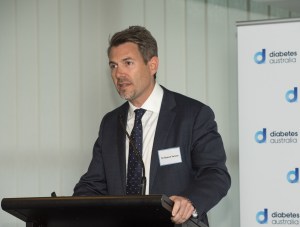
A/Professor Ramon Varcoe, a vascular surgeon from Prince of Wales Hospital in NSW, is my new hero. I listened to his talk absolutely enthralled and amazed. Let me count the ways I adored what he said last night:

A/Professor Ramon Varcoe
This event was coordinated by Diabetes Australia in association with the Parliamentary Friends of Diabetes Support Group, co-chaired by Rowan Ramsey MP and Graham Perrett MP. I work for Diabetes Australia.
I had a low last week that knocked me for six. It certainly wasn’t the worst hypo I have ever had – far from it actually. But it had been a while since I had one like this. In fact, since I started eating low(er) carb. (I’m still reluctant to call it low carb, because I am really not trying to stick to a certain amount of carbs per day. But to give you an idea, it’s a rare day that I eat more than 80 grams.)
But last week, I did. My usual Japanese food takeaway place was out of sashimi which is my favourite quick lunch. So, I ordered a sushi roll and a cup of miso and off I went.
Now white rice is evil to me. It really is. I love it, but have never managed it! In 18 years of type 1, I have never worked out how to bolus for it. I am better (although not great) with pasta and other carb-heavy foods. But rice? Just hopeless! I would just guess, hope that I was close to right and then kept a close eye on my numbers afterwards, correcting as necessary.
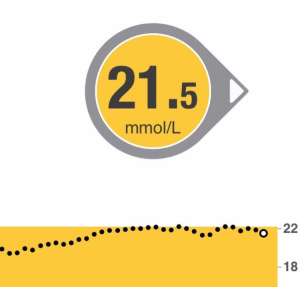
On Friday, I was nowhere near right. No.Where. I watched my CGM line start to rise and rise and rise pretty quickly after I ate, resisting the urge to bolus before I hit the upper limit on my graph. And I am so glad I didn’t because after the spike, came the plummet. Insulin still on board, and two arrows pointing down.
I tried to intervene, but it was too late. Suddenly, my lips starting tingling, I realised I was sweating a lot and my thought process was all over the place. I read the same email five times, started five different responses and had no idea what I was trying to say.
I grabbed a juice box, and drank the lot in one gulp. The desperate low feeling of ‘I.Am.Going.ToDie’ overtook me as I stabbed another straw into another juice box and looked around for what else I could consume that would help, grabbing a handful of jellybeans; spooning honey from the jar and pouring some milk into a bowl with cereal.
And then I stopped. I willed myself to breathe, counting up as I inhaled, down as I exhaled, trying to not get the numbers messed up. I concentrated on my heartrate. I walked away from the food on the kitchen counter and sat at the table, focusing on the artwork above the wood-fire oven that the kidlet and I had done years ago when she was only about 5 years old. I thought about us spreading down a drop sheet on the front veranda of our old house, sitting the large canvas on top of it and emptying tube after tube of paint onto it. ‘It’s like a Jackson Pollock painting,’ she said, signing the finished artwork with her name and then adding ‘and Mummy’ afterwards.
Slowly, my heartbeat returned to normal. I could count my breathing without difficulty. I stopped thinking that I was going to pass out. My clothes were drenched from the sweating, though and now I was shaking because I was cold. I gingerly walked into the bedroom, pulled off my top and put on a thick jumper, wrapping a scarf around my neck for good measure.
I looked at my CGM graph on my iPhone and saw the quick spike and the sudden crash – a sight I’d not seen for some time. I lay down on my bed and closed my eyes for a moment, which became an hour and when I woke, the ‘hit-by-a-bus’ hypo hangover had taken over my body.
All this because of a sushi roll gone wrong. It wasn’t even a delicious doughnut or cupcake, I thought. It took me almost 24 hours to get back on track. The over-treating had to be corrected and I tried to not over correct, but that failed and another low in the middle of the night messed me up a little more.
This was a forgotten low. And I’m not particularly inclined to have another one in the near future to remind me again.

Just gently leaving this here today.

I am very fortunate to have a job that I truly love. But it could not be described as a particularly sexy job. At least, not the regular-day-to-day-this-is-what-I-do-when-I-am-in-the-office side of things.
I worked in recruitment for a while and the constant buzz and thrill of the game was intense. We had an old-fashioned bell in the office that would be rung when we made a particularly lucrative placement. Working on commission meant that there were dollar signs in front my eyes all the time, and I measured success in thousand dollar increments. It was sexy because it was quick, constant and there were constant wins.
Now I have a job that is what I refer to as a slow burn. Things take time, advocacy efforts are often long and drawn out, and the wins are rare. But jeez are they meaningful and worthwhile when they happen! They shoot an injection of momentum right when and where we need it, and it means we very quickly acknowledge the win and then focus on the next issue.
Sometimes people don’t realise just how long things take. When the pre-election announcements about CGM subsidies were made, a number of people commented that we’d had a busy few months to make it happen. I couldn’t help but laugh. And correct them. That particular win had been over four years of hard work.
But we take the wins were we can and this week, we’ve had a win!
The revised Assessing Fitness to Drive guidelines have been released by AustRoads and the National Transport Commission, and it’s a good news story for people with diabetes.
You may recall that there were some real issues with the previous guidelines after the completely misinformed and confusing inclusion of a definition of ‘satisfactory control of diabetes’. An HbA1c of over 9% was defined as ‘unsatisfactory control. Whilst the Commission stated that the A1c value was intended as nothing more than a guide and a trigger to seek professional care, the reality is that many people with diabetes had their licences suspended with their HCPs taking the value as a cut-off point.
As Diabetes Australia consistently argued, there is no evidence to suggest that an elevated A1c makes a person with diabetes more dangerous on the roads. In fact, this focus on an elevated A1c was actually detracting from hypoglycaemia, which is something that does need to be considered.
In the new guidelines, the number has been removed which is an excellent outcome for PWDs. And added to the document is far more focus on impaired hypoglycaemia awareness and keeping safe on the roads.
This change didn’t happen because we asked nicely. In fact, it took four years – from when the last guidelines were launched and we started to hear of people with diabetes having troubles – for the change to be made.
It took a lot of advocacy: letter writing, speaking with people who had been negatively impacted, meetings and teleconferences, and revising documents.
This is what I mean when I say that my job is unsexy. All of the work that was done behind the scenes – the slow burn – is decidedly unsexy! But it has to be done to get the wins.
I’ll admit to doing a very quick victory dance when I heard about this particular win. But the celebrating didn’t last long.
Because there is so much more unsexy work to do. Until people with diabetes are no longer discriminated against; until diabetes stigma is something we only speak about in the past tense; until kids with diabetes in schools are freely given all the same opportunities as their peers who make their own insulin; until access – to drugs, technology, healthcare – is available to all, the unsexy stuff will keep happening. You probably won’t hear about it until there is good news, but the wheels keep turning and the fire keeps burning slowly. As I said in this post here, it’s the reason I do what I do.
The new Assessing Fitness to Drive guidelines can be downloaded here.

Four years ago in Rome, I made Aaron take a photo of me with just about every old Fiat Cinquecento we saw. There are a lot of photos of me with tiny cars!
Disclosure
I was a representative on the Diabetes Working Group revising the diabetes chapter of the new Guidelines. This was part of my role at Diabetes Australia.