Kellion medal day – it remains the most hopeful day of the year. And yesterday, I was lucky enough to attend what I fondly refer to as ‘The Most Hopeful Day of the Year’.

As is typical at these events, once the formalities are over, I find myself gravitating to those in the room who have been awarded their medal for living an extraordinary number of years with diabetes. It’s almost as though I want to stand close enough to them to learn everything they know. Just being in their presence is awe-inspiring, even though they would say that all they re doing is living their lives – lives impacted every single day by diabetes. But to me, these people somehow seem magical and I want to understand how to be too.

A diabetes diagnosis fifty years ago (or sixty, seventy, eighty years ago) was very different to one today. Or event twenty years ago for that matter. The devices, education and information that is available today was very, very different. To see people who not only survived with diabetes, but lived their very best lives with it, in times of the most basic of treatment options, is remarkable.

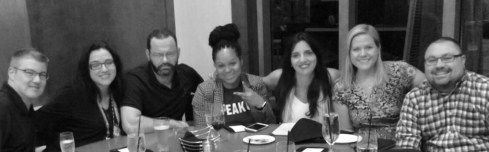
The people in this photo are my peers. They have walked the path I am walking ahead of me and are more than happy to tell their stories. I listen to every word, hoping to unlock some of the secrets to how they have managed for so long with diabetes. My pitiful twenty years of type 1 simply affords me ‘still a newbie’ status; I have nothing remotely useful to share  – I can offer nothing. So I listen. I ask questions. I watch.

It is an honour  to attend the Kellion Victory Medal Award Ceremony each year. And to stand amongst the medalists is a privilege I will never, ever take for granted.

‘That’s a lot of diabetes’. (L-R: 60 years, 70 years, 20 years, 51 years, 42 years of living with type 1.)

I am certain that almost all the people who read this blog are in some way affected by diabetes. (Because, really, if you are not, why would you be reading?) It makes sense that the people who want to hear about my real life with diabetes have their own real lives with diabetes.

Most of the blogs I read are to do with diabetes. Most of my interactions online are to do with diabetes (with the occasional detour down avenues of language, Nutella recipes, Effin’ Birds, and idolising Nigella).

It makes sense and there is nothing inherently wrong with focusing on things that we understand, or that is interesting to us personally. Of course we feel a connection when reading stories by others going through similar experiences, and that makes us feel safe and less alone.

This week, however, I am hoping that a lot of what we are talking about is received by people outside the diabetes world. Because #ItsAboutTime that others know and understand the importance of early diagnosis and treatment of diabetes.

It’s National Diabetes Week (#NDW2018) and Diabetes Australia’s campaign this year is building on the 2017 campaign of raising awareness of the signs and symptoms of type 1 diabetes, and the fact that there are 500,000 Australians with undiagnosed type 2 diabetes.  (Disclosure: I work for Diabetes Australia. I am writing about this because it is an important issue, not because I have been asked to.)

These days, my loved ones and I know all about the symptoms of diabetes. And somehow, I knew them just over 20 years ago when I walked into my GPs office and said ‘I’m thirsty all the time, I can’t stop peeing, I’ve lost weight and I’m exhausted. I think I have type 1 diabetes.’

My GP told me that she thought I was being a hypochondriac, so I’m actually not sure if she would have sent me off to pathology for a fasting glucose check as quickly as she did had I not prompted her with my (as it turns out correct) self-diagnosis. (In hindsight, getting me to pee on a stick would have been an even better idea, but I didn’t know that at the time…)

The rest of the story is that a few days later, I was told I had type 1 diabetes. That’s my whole story. It’s utterly, completely, totally uneventful and, quite frankly, I love that it is.

But that’s not the way it is for a lot of people. In fact, each year 640 Australians end up in hospital because the signs of type 1 diabetes have been missed. In many cases, these people have already been to see their GP one, two or more times because they , or their families, have known that there was something not quite right, and they were not checked for type 1 diabetes.

Is that your story?

Here’s the thing: if you have diabetes, or someone you are close to has been diagnosed type 1 diabetes, you know the signs. You may not have known them beforehand – in fact, you may have your own diagnosis story that mirrors those that we are sharing throughout NDW – but you know them now. You are not the target audience for this campaign.

The target audience is people in the community without a connection to diabetes. It’s GPs who are not routinely asking people to pee on a stick so they can quickly and easily check if a person has glucose in their urine.

We need to tell those people. Because we can talk all about this amongst each other all we want, but then all we are doing is adding to the noise in the echo chamber. We need to step outside of the diabetes world and shout from the rooftops 4Ts of type 1 diabetes:

These symptoms need to trigger people – everyone – to automatically think type 1 diabetes.

Share the poster. And ask everyone you know to share it too – including people not affected by diabetes. #ItsAboutTime we ALL knew the 4Ts so that we can diagnose and treat type 1 diabetes sooner.

Dear Channel 9

Hi. You don’t know me, and to be perfectly honest, I don’t really know you either. My TV tastes run less to the sensationalist and more to the Netflixist, but nonetheless, here I am writing to you.

You see, I want to talk about Drew Harrisberg for a minute.

So, I work for a diabetes organisation and as a diabetes advocate, and one of the best things about my work is that I get to meet people with diabetes from all over the world and from all walks of life.

One of those people is Drew Harrisberg, who I met through some diabetes device events that I have facilitated.

Drew’s on the far left. With the red circle around him.

Drew is an exercise physiologist and a diabetes educator (as well as a singer/songwriter, model and also probably saves kittens from trees/rescues small children from wells/helps grandmothers across the street with their grocery shopping.) Oh – and he happens to have type 1 diabetes.

I can tell you now, Drew and I have very different interests. He’s all about physical activity. I’m all about sitting around drinking coffee and making cookies. But, we both have AWOL beta cells and love dogs, so there’s something in common there!

Just after the latest Abbott DX2 event where we caught up, I was watching TV and there on the screen was Drew’ face. He was on the promotional advertisements for Ninja Warrior.

Okay – full disclosure here: I had to see the ad half a dozen times before I worked out the name of the show and then I had to Google it to work out what the hell it was all about. I’d never heard of Ninja Warrior before. Now I know it’s a reality TV show involving ridiculously athletic and fit people engaging in competitive torture completing obstacle courses. (I know – it’s an absolute fucking miracle I’m not all over this and wanting to be part of the action…)

Anyway, after seeing that Drew was involved, I did get a little interested. While my reality show viewing generally extends to Masterchef (because: Nigella) or Grand Designs (because: Kevin McCloud), I was suddenly keen to know just how Drew would be presented on the show.

Reality TV show producers love a back story. In fact, they’re ALL about the back story. And I figured that Drew’s back story was going to be about the fact that he lives with type 1 diabetes. I could hear the emotive music playing already and see Drew running slow-mo along the beach, his dog beside him, as his voice told the story of his diagnosis and how, despite the obstacles he faced by diabetes, he could still face the obstacle course of Ninja Warrior (and, fuck! I should be writing copy for that show right now; give me a job).

I do love a little bit of diabetes awareness on mainstream TV. If there is an opportunity to bust some myths and smash some stigma, I’m all over it, and I figured that Drew’s appearance on the show could do that. Plus, I’ve been told that kids LOVE this show, and I thought it would be great for kids with diabetes to see Drew not letting diabetes be a barrier to him being his very-best-obstacle-course-beating self.

So, I was resigned to watching the show when it starts (soon, apparently) and cheering on my mate from the comfort of my sofa (while drinking coffee and eating the cookies that I choose to bake in lieu of doing any exercise). I figured that the diabetes community here in Australia would really get behind him, hoping that he would not have to deal with any pesky hypos just as he was…well…doing whatever one does on an obstacle course.

Except, then I noticed that he was no longer in the advertisements. Where Drew’s face had once been, I suddenly saw the perfect smile of someone else (someone, I assume, with a functioning pancreas). I checked the website and he was nowhere to be seen. It appears that Drew has completely disappeared from all Ninja Warrior promotional materials. (Wait! Is this the ninja part of the show? I still don’t really understand it…???)

Although I may be a tiny bit pleased that I don’t need to commit to a three month reality show, I am so disappointed that having someone with type 1 diabetes on prime time TV has been lost.

So, Channel 9 – any chance you can share what’s going on? What have you done with Drew? Why has he disappeared? Why have you completely forsaken this awesome opportunity to showcase someone on your show who is living with a serious and seriously challenging health condition?

Looking forward to learning the full story…

Best,

Renza

Without fail, the first thing I put into my schedule when I am attending either ADA or EASD is the update from Life for a Child (LFAC). It’s usually held on the first day of the conference, bright and early in the morning and, for me, it sets the scene for the conference. It anchors me, so that throughout the remainder of the meeting, while I am wandering around a fancy exhibition hall, or listening to talks about the latest in technology (usually what I am drawn to), I must never forget that for some, access to insulin, diabetes supplies, education and support is incredibly difficult.

At ADA this year, there was no update session. Instead, the LFAC team gathered some of the advocates who were there so we could meet to discuss how we could continue to work together, through initiatives such as Spare a Rose, to raise funds for, and awareness of, the program.

L-R Dr Graham Ogle (General Manager LFAC), Grumps, Emma Klatman (Health System Reform Specialist LFAC), me, Angie Middlehurst (Deputy Manager & Education Director LFAC) and Manny Hernandez.

When I am writing and talking about LFAC, I usually do it in the context of asking – urging – people to consider making a donation. Around Valentine’s Day, the one rose = one month of insulin equation is repeated over and over again to highlight just how little it takes to make a difference to a young person with diabetes in a developing country.

But I’m not sure that everyone knows just how far reaching and important the work carried out by LFAC actually is, or how donations are used. Recently, they released their annual report, highlighting just some of their successes, and I thought I’d share some of them here.

To start with, last year LFAC helped over 18,500 young people from 40 countries.

Support offered by LFAC goes beyond just providing life-saving insulin for young people with type 1 diabetes. Other diabetes consumables, such as syringes and blood glucose monitoring kit is available. A1c checks are provided, providing baselines and ongoing data for centres in developing countries. Services such as education, workshop and resources are developed, translated and distributed, and support for healthcare professionals is offered.

In Haiti last year, 51 children attended a camp for children with diabetes – the first of its kind ever held in that country. (As someone who frequently speaks about the benefit of peer support, I know how amazing this would have been for the children who attended. Meeting other kids who instinctively ‘get it’ would be the same as the feeling I get when I meet and speak with others who are living with diabetes.)

LFAC also has an active research focus which is critically important in highlights aspects of diabetes, (including incidence, prevalence and mortality; cost of, and access to care; success of intervention and care-giving approaches; psychological impacts of diabetes), in young people in less-resourced countries. This research is vital in informing future programs, activities and services. LFAC research can be accessed here.

Life for a Child does all this and more, working towards their vision of a world where no child should die of diabetes. The fact that this should be their (or any organisation’s) vision – 97 years after the discovery of insulin – is heartbreaking.

Being a part of the extended Life for a Child family is one of the most important things in which I am involved. Writing blog posts and talking about the program sometimes seems like such a small thing to do, but I am committed to raising awareness of the issues faced by the young people the program helps, and raising funds so they can do more.

I have only touched on their important work, and despite the great achievements I’ve mentioned here and the number of young people benefiting from the program, there is still a waiting list for support.

Go here for details of how you can make a donation. Please. 

I am a master outsourcer. I outsource as much as I possibly can – from cleaning our home, doing our garden, washing the car and grooming our dogs. I used to feel guilty about this. Then I realised that doing these sorts of things make me irritable and bad-tempered, and it’s better for everyone – mostly and especially me – to just get someone in to do them so I don’t need to a) do them myself and b) get shitty because they are not getting done. (I should add that Aaron feels exactly the same way. He has no desire to do any of those things either, so the outsourcing is a joint decision and one that makes for a far more harmonious home.)

The other day, a new outsourcing device made its way into our home. Despite having someone frequently come and give our place a thorough clean, three dogs and a cat make for grotty floors. Most days, the timber floorboards need a quick going over to gather the dust bunnies and pet hair that collects in corners. Not anymore! This little helper is going to take care of that from now on!

Outsourcing makes sense. And as I have become older, wiser – and some may say lazier – I continue to look for ways to help with the more mundane things in life.

Hello, diabetes…

Many years ago when my diabetes – and I – were not in a great place, I mentioned to an endocrinologist (not my current endo), that I was so overwhelmed by, and over diabetes and I wished that there was a way that someone could do it for me for a week or so. ‘You can’t outsource your diabetes to me,’ she snapped. I’d not suggested her being the one to step in and take over, but she was adamant that it wasn’t going to happen – just in case I was considering asking. (She was promptly sacked after that comment.)

I frequently hear people (myself included) say that the most relentless thing about living with diabetes is not being able to take a holiday from it. It’s true. Even if you have someone helping with caring duties, the toll of having this unwelcome visitor using your body as a guesthouse is unyielding. And even when we manage to find a way to share the load, (for example, partners doing night-time glucose checks, or being responsible for keeping hypo stores replenished, or scheduling HCP appointments, or making sure that insulin prescriptions, glucose strips, pump consumables, sensors etc. are all ready and available at home), there is no sharing or removing the load of the emotional toll of having diabetes.

So with all this in mind, I was a little surprised to hear myself say that I had ‘outsourced my diabetes’ when, at a recent presentation I was giving, a HCP asked me about Loop. I’ve been thinking about that comment quite a lot since I made it. Is it really accurate an accurate thing to say.

I guess that to an extent, it is partially true. I spend less time thinking about diabetes and less time ‘doing’ diabetes. Loop takes over a lot of the things I used to do. This was reiterated in Justin Walker’s talk at Diabetes Mine’s DData Exchange event on day one of ADA last week.

Loop doesn’t make diabetes go away. It doesn’t even take away all the tasks – I still am responsible for making sure that my pump cartridge is loaded, cannula is in working order, sensor is reading. But thanks to the automation, it does take away some of the responsibilities. I guess that the reduced burden comes from the positive results I see every time I look at my Loop app – jut knowing that it is doing its thing and will let me know if something is wrong – takes away some of what I once had to do myself.

Outsourcing is about sharing the load. It’s about handballing some of the tasks and responsibilities of life to someone – or something – else. Loop is the very definition of that!

Our home was built in 1913. It’s a beautiful Edwardian house with a ridiculously high peeked roof and gorgeous ornate features.

I love that although the house still has all its beautiful old world character, it has modern touches that make living in it in the 21st century much easier and far more comfortable than when the house was first built.

I have no interest in living the way the original inhabitants of our home lived. I like knowing that when I walk into the house after work today the hydronic heating will have been programmed to have switched on half an hour earlier to take the chill out of the air. I love that the Aga stove is still nestled into a corner of the kitchen, but the fan forced oven on the other side of the room takes no time to heat up for when I want to bake a batch of brownies. (Or these blondies which I made a couple of weeks ago, and are my new favourite 10 minute bake up!) I love that hanging from the pressed metal ceilings are electric lights that switch on and off as needed.

I am more than happy to give a nod to the old, and admire its loveliness. But I don’t want or need to live that way.

Period features galore.

It’s how I feel about diabetes. I can only imagine what diabetes was like many years before I was diagnosed. But I have no desire to sharpen needles, boil syringes or pee on sticks and analyse the colour that appears after ten minutes to give me a not-especially-accurate idea of how much glucose is floating around in there.

And yet, in most cases, people with diabetes are asked to step back in time with older management options before we earn the right to use newer management techniques. We are told this is done so that we understand the basics. Or have a back-up plan if things go wrong. But surely there is a way we can tick those boxes while still being able to utilise the technologies we choose to use – even the newer ones.

If I were newly diagnosed today, I would want to go straight onto an insulin pump and CGM. Obviously, I would need to learn to do blood glucose checks because CGMs in Australia need calibrating. That should simply be part of the training. And yes, I’d need a back-up plan in case my pump stopped working, but again, providing basic information about how to do an injection and insulin doses could also be part of that training – and repeated at follow up visits.

Why should we have to learn how to use old methods of treatment when there are newer methods that might suit us better?

The other day, my daughter asked me how she would manage diabetes if she was diagnosed. (Her question was the prompt for this post.) After I remembered to breathe again, I suggested that it would be up to her and that I’d support whatever she chose. ‘I’d want to Loop,’ she said. ‘I see how you are and I think that’s what I’d want, too.’

I thought about it and realised that most – all? – people who are newly diagnosed are put on MDI and BG monitoring, and I thought that there is no way that I would want that to be the only option offered to my kid if she were diagnosed. It seems archaic to me.

I would want all the options presented to us, including the ones we’re told we have to earn our stripes for before we are allowed to use them.

Now obviously, I’m coming from this with the perspective of someone who is not new to diabetes. Twenty years of living with diabetes under my belt, a job at a diabetes organisation and a career in diabetes activism and advocacy means that I would be far more in the picture than someone who is completely new to diabetes. I totally get that. But I also know that I think everyone diagnosed with diabetes should have access to the latest and greatest if that’s what would be right for them.

But why can’t that initial training be inclusive of back up plans?

Also, I do wonder if we are setting ourselves up and falsely believing that by having our back-up plans we are all sorted in case of emergency. I have not had a pump break in over seventeen years. I guess I’d be fine doing an injection, but apart from probably half a dozen times where I have injected to bring down a stubborn high, I’ve not had to use a syringe or pen. My back-up plan of long-acting insulin frequently is out of date. How confident would I be if my pump died this afternoon and I needed to go back on MDI for a few days? Not especially confident, I have to say, even though I know how to do an injection. (For the record, I have a spare pump. So MDI is actually the back-up plan for my back-up plan.)

This is just another one of those ‘it’s about choice’ situations. At ADA last week, I attended a CGM update. (Two things to note about this session. Firstly, it is held at 5.30am and I was there at kick off. Secondly, the coffee was shit and I was seriously feeling grumpy. But despite that, I managed to pay attention and hear what the speakers had to say.) Viral Shah MD in his presentation encouraged the use of CGM from diagnosis of type 1 diabetes (with a strong caveat of it must be up to the PWD to make that decision).

And one final point: CGM is not new technology. Neither is pump therapy. These are established, well-researched and safe technologies that have been around for a number of years. So why are they not offered as first line treatments?

The diabetes online community is big place. It is a global network of many, many people, living many, many diabetes lives, with many, many experiences. Those experiences colour and shape the way we react to certain situations and help to focus our attentions on issues that become our ‘thing’. For some, that may simply be to find and/or offer support from  and to others walking the same path. Reducing isolation is one reason that people feel that online support is so powerful, as boarders (of all sorts) melt away.

I have sought great solace in the community many times. This community has seen me through diabetes issues where I have felt lost, hopeless and terrified; they have supported me through times of personal anguish; they have cheered for me when I’ve done something worth celebrating. And they have had my back, shining a light for me until I was able to hold it up myself again to get out of the black tunnel that had engulfed me.

I first joined Twitter back in 2009, but it was in 2011 that I first started to really reach out and connect. It was participating in DSMA chats that first exposed me to the global online community and I was astounded. I truly had no idea that people existed who were genuinely there to support others in truly selfless ways. That support meant different things to different people and was offered in different ways. For some people – well one person – it was starting DSMA and not only asking questions each week as we all came together to share our experiences about a variety of topics but providing a listening ear and helping hand outside that hour of power. For others, it was jumping in when they could to respond to a question, or virtually high five a diabetes victory.

To me, it truly felt like a cocoon of people who were there to do good.

I am not naive enough to think for a moment that it was always perfect or that everyone there was always unflawed. There were the occasional flashes of heat, with disagreements not always being as respectful as they could be. But by and large, I felt that people’s differences were respected.

This community has always been good at outrage. The first time I ever wrote about it was when an Australian comedian misfired a joke about diabetes. I know that this wasn’t the first time the community had used its collective and loud voice to shoot someone down for saying something stigmatising about diabetes, but it was the first time I saw it in such a quick and almost coordinated manner.

But over the years, it seems to happen more and more – perhaps because more and more people have started using online platforms. Or maybe it is because we are getting tired of being the punchline to every poor joke about the latest Starbucks sugary concoction.

Somehow, though, that outrage has turned itself inwards. While many people in the community (and I count myself in there) are spring-loaded and ready to go if someone without diabetes attacks ‘my people’ (i.e. people with diabetes), it seems that these days, a lot of the outrage is directed within the community.

I see that in particular groups: it’s no secret that the first thing that comes to my mind is the LCHF movement, and those within it who believe that the best way to deal anyone not subscribing to their way of eating is to attack, attack, attack. But it would be unfair to suggest that this group has militant outrage all to themselves.

There are also some who are doing work that is genuinely important and critical in supporting those less fortunate, but as they go about their efforts, have become attacking and openly negative about other groups aiming for similar outcomes, but who are choosing to do it in different ways.

But that’s not the only thing that people seem to be antsy about. I’ve had people have a go at me for my decision to use Loop. I’ve seen people choosing not to use CGM be told they’re being irresponsible. I’ve seen people who work with industry – device and pharma companies – be shot down and told THEY are part of the problem when it comes to access to technology and drugs because they are being bought by Big Pharma. I call bullshit on all of, and wish that everyone could remember that there is more than one way to skin diabetes advocacy. (Ugh – that sounds really unpleasant.)

This week while at ADA, I saw one of the people who I have always considered to be a – if not THE – shining light of inclusion (and certainly one of the first people to welcome me into the community) have her integrity publicly questioned. I am, of course, talking about Cherise Shockley. As it turned out, I was sitting next to Cherise as this unfolded, and her calm composure put to shame the rage that was building within me. My trigger finger was itching to fire, but instead, I took deep breaths and waited.

Without going into all the tedious details, Cherise was being accused of not being transparent during a DSMA chat she had moderated a few years ago, the transcript of which was later used in some academic research. Cherise had, of course, disclosed this at the beginning of the chat. At dinner the other night, she sat there until she found the tweet that showed the disclosure, but by the time she shared it online, more and more people had jumped on the outrage bandwagon, joining the choir of accusers. Had any one of these people taken the time to search through Twitter, they would have found the tweet Cherise later shared.

But that’s not how we play in the outrage playground: we just jump on the merry-go-round with everyone else and get faster and faster and faster until the situation is either forgotten (after all, there will be something else to be outraged about tomorrow), or, as in this case, the outrage is shown to be completely unwarranted.

I waited for apologies to follow. They didn’t come. At least, not immediately, and then I decided to stop following what was going on because all I cared about right then was that my friend – a woman I love, who has looked out for and checked in on me more times than I could count – was okay.

I love this community. I have stood up at international conferences and gushed about the value of community, I have written about it and been involved in research about it to help build the evidence base for it, because I truly believe in it. But there are times – increasingly – that I feel I need a time out. And I hate that. Because I need this community: if you are part of this community, I need you.

There is a person at the other end of that Twitter handle, or Facebook profile. It’s easy to forget that sometimes. I don’t know anyone in the community who is actively involved in activism and advocacy who isn’t trying to improve things for people with diabetes. It may not be the way you would do it, it may not be the focus you have, it may not be through partnerships you would encourage.

But that’s okay. Many different approaches are fine. But let’s respect the way we choose to do that. Is it too simplistic to suggest that really, we just need to go back to remembering to be kind? Maybe. Probably. But without any other solutions that I can think of, that’s all I have. Be kind. Always, be kind.

I met someone the other day – a friend of a friend – who had recently been diagnosed with type 2 diabetes.

Within the first 15 minutes of our casual conversation standing in the street as the Saturday morning rush happened around us, I heard these words from their mouth:

‘It’s my own fault. I should have gone to the doctor sooner.’

‘I am not a good diabetic at all.’

‘I am doing a really bad job checking my bloods.’

‘I’m not sure how long I need to keep checking my bloods. Or how often, really.’

‘I was told if I didn’t look after myself I’d need injections. I’m terrified of needles.’

‘I have a list of foods that I should and shouldn’t eat.’

‘I’ve never been sick before. And now I feel as though people think I am sick. But I feel fine.’

‘The doctor said I don’t have diabetes too badly, but then told me all the things that could go wrong.’

‘I am scared. I don’t know anything about diabetes, but I am scared that I am going to go blind. I was told that’s what would happen.’

Here was an incredibly confident, capable and clear thinking person, not much older than me. Until now, their contact with HCPs had involved annual flu jabs (kudos for that!) and a trip to the GP for the occasional virus. They told me they’d never spent a night in hospital.

The diabetes diagnosis came about after their GP suggested routine blood checks on the day they went in for their flu shot. The following week, they were told they had diabetes. This was just last week. So far, this person had spent about fifteen minutes with their GP and 45 minutes with the diabetes educator who works out of the clinic.

And look at how diabetes has been presented in that time. Already, this person feels as though they are a ‘bad diabetic’ and failing in their treatment. And they are scared.

I responded to some of those comments gently:

‘You DID go to the doctor – for your flu shot. And when they suggested you have a blood check, you did it there and then.’  

‘You are doing a great job. There is no such thing as a bad person with diabetes. We do the best we can with the information at hand.’

‘This is all new. You are checking your blood sugar and that’s amazing. Well done. You didn’t have to even think about that two weeks ago!’ 

‘Do you have a follow up appointment? When you go back, as why you are being asked to check at the times they’ve suggested. And if this is something you’ll need to do for the next week…or month…or longer.‘ 

‘It’s perfectly understandable to be afraid of needles. I don’t know anyone who likes them. And you may need insulin one day. But not yet. And if you do, that’s not because you have failed. It’s because diabetes needs to be treated and sometimes with type 2 diabetes, (and always with type 1 diabetes) insulin is that treatment.’   

‘Have you been referred to a dietitian? It’s really hard to change the foods you’re eating if you’re not sure about diet. Ask for a referral.’  

‘I don’t really think of having diabetes as ‘being sick’, so I understand what you mean. But you will need to think about your health differently. That doesn’t make you a sick person, though.’

‘It’s perfectly, perfectly understandable to feel scared. If you think that having a chat with a psychologist or counsellor will help with that, ask your GP.’  

‘Also … find some other people with diabetes and talk with them. Here’s my number. Call me any time.’

Imagine, if instead of feeling the way they were feeling, this person felt empowered, confident and assured – even if there was a bit of fear and uncertainty in there.

On the day we are diagnosed, we walk into the GP’s surgery not having diabetes. And walk out with a diagnosis.

It starts early. Those messages at diagnosis can impact how we feel about our diabetes for a very long times – indeed the rest of our lives.

It never fails to surprise me – that instant connection you make with a diabetes peer.

Today, I had the pleasure of meeting Amira who has lived with type 1 for over 20 years. I flew to Sydney to oversee some filming for a work-related project, and Amira was being interviewed.

I listened to her tell her diabetes story (one I really hope she will write about for here!) and afterwards, we had a coffee and chatted. And there it was: that connection that goes far beyond our lazy beta cells, and far beyond both being diagnosed around Easter.

Amira is one of those dynamic, passionate, smart and funny people who helps to make the lives of people with diabetes better. I listened as she explained to me how she works with people with diabetes and instantly I knew she was one of those people I would want as part of my HCP team.

We spoke about every day things that I would speak with any other woman about. But diabetes adds layers and complexities and frustrations and fears. We nodded at each other as we shared those thoughts. Because they resonated straight away. And I was reminded again: the power of peers. That connection of diabetes that goes so deep that it must somehow be built into the DNA of those first encounters.

A new diabetes buddy makes for a good day. Today was a good day!

Today’s mood:

…Of course this tee is from the awesome Casualty Girl, and you can get your very own by clicking here. (Not sponsored – I happily purchased this myself!)

Follow Diabetogenic on WordPress.com

Enter your email address to follow this blog and receive notifications of new posts by email.

Read about Renza

Archives