My health condition may be invisible, but it absolutely isn’t silent.

Going through security at an airport the other day (I can’t remember if it was Singapore of Heathrow), I set off the metal detector, a loud buzzing sound alerting security that they better check me out.

As I was getting a full body pat down, my handbag, patiently sitting next to me waiting for its own inspection, started squealing. Running through the airport at speed had caused the fall rate alarm on my Dex app to sound. Thankfully I’d already explained that to the security guard who was swabbing my insulin pump at the exact moment it elicited three short beeps. ‘Temp basal rate,’ I explained, knowing full well that would make no sense to anyone. ‘Also – diabetes is quite noisy, isn’t it?

She smiled at me as her own machine, which had finished analysing the swab announced that I was safe, and not a danger to anyone other than myself when near a handbag store at any airport. ‘You’re good to go.’

I’ve customised my Dex alerts to vibrate rather than ring out – except for the fall rate alert (as it is a brilliant way to help prevent lows), and the urgent low alarm, which cannot be turned off or set to vibrate. But even with the vibrate settings activated, there is still noise. And while the urgent low alarm very rarely makes an appearance these days (reason I love Loop #2,394,821), when it does, it’s piercing!

I quite like the comfort of my pump alerting to let me know when Loop has activated a temp basal rate (pretty much most of the time….). It’s not a loud and intrusive alarm, so the three beeps are very much background.

There are the constant sounds of diabetes that have become very much the soundtrack to my life: the gentle clunk of my lancet device; the pop when I open a box of strips and the sharp snap as I close it; the clicks as I push a CGM sensor into my arm, retract the needle, and then place the transmitter into the sensor; the beeps indicating my pump line is priming. There’s the sound of lows: a straw being pushed into a juice box after being released from its plastic wrap, and the subsequent quick slurping; the ripping of paper being unwound from around a tube of fruit pastilles,

I’ve just spent a couple of days with friends with diabetes, and there’s something undeniably comforting about hearing others’ sounds of diabetes. Even more comforting is the way we all generally ignore those sounds. No one ever jumps when we hear the low alarm from someone else’s Dex. We trusting that they’ll deal with it in their own time and way (and also know that the last thing they would want is someone treating them like a child and fussing). We just hear it, maybe look up, maybe not. Although sometimes…

‘Is that you or me?’ one of us will say when we hear a CGM alarm.

‘That’s definitely not me…Is that you? What is that?’ we’ll say when hearing an unfamiliar alert from a device that’s different to our own.

‘That’s not you, or me…’ I said the other night whilst sitting in a restaurant, knowing it wasn’t coming from our table. ‘Does someone else in here have diabetes?’

Often we become immune to the sounds of our own diabetes. Those sounds that are there to alert us to a low battery or the need for more insulin in our pumps easily get ignored, until the urgent wailing which indicates that our portable pancreas needs more juice (of the battery or insulin kind) NOW, and the only way we can stop it is to respond.

I used to sleep through hours of low alarms, only realising they would have been ringing out the following morning when I checked my Dex trace. And Aaron too had become impervious to them after a while, and stopped waking…and then waking me…when I was low at night.

There have been times that I have been going along doing my thing and it’s taken someone to say ‘Do you need to do something about whatever is beeping?’ to even realise that diabetes was talking to me.

And sometimes, it takes hearing another PWD’s sounds of diabetes to acknowledge and respond to our own. (Another benefit of peer support!)

But even if it seems that we stop hearing the sounds of diabetes, it’s indisputable that it is a noisy beast. Which I guess makes sense. Because exactly in the same way that our condition is never really invisible to those of us living with it, it is never silent either.

Shush now.

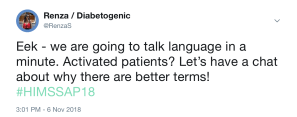
The other week, as I sat on the stage as part of a panel session at the HIMSS conference in Brisbane, a term kept getting thrown around that had me squirming in my seat. It was not said with any malice – in fact I believe it was being used under the perhaps misguided idea that it is represents positive and empowering language. But as I sat there and the term was being used, almost with abandon, I knew that we were going to have to have a chat about it. As per exhibit A:

Exhibit A

Activated patient? No. Just no.

When the moment was right, I took a breath. I’d been asked to comment on the current My Health Record situation, and whether I thought it was something that would benefit people living with chronic health conditions. ‘Before I answer the question, can we just consider the term ‘activated patient’ and how it is being used here today – and often in other contexts too. I’ve heard from people on the stage and in the audience use the term ‘activated patients’. I’m really not a fan of this term. In fact, I think it is really quite problematic.’

Activation is something that is done to something. Think Pete Evans and his activated nuts. Or yeast when making bread or cinnamon buns. Or my pink debit card that came in the mail with a sticker across the front telling me how to activate it. Pete Evans’ almonds were just passive little nuts before he decided to activate them. And before the warm water was added to the yeast, it was just powder sitting in a sachet. My pink card was simply a piece of plastic before I called a number, pressed a few other numbers once the automated message was played and agreed to a heap of terms and conditions, making the card able to work.

Those inanimate objects had something done to them to become activated – it didn’t happen on their own. Beforehand, they were passive.

I was not ‘activated’ to become a participant in my own healthcare. I was not given permission to lead the agenda of how I want to engage. I chose the people I would see; the health service I would use; the devices I wear strapped to me. I have never been a passive participant in my healthcare – or any other aspect of my life, for that matter. I have always been active. Of course there are times that I struggle with motivation and may be less active and pro-active, but getting out of those times was never an exercise in activation by others.

The idea that people become activated because they are given the opportunity reeks of the typical paternalistic attitudes that are still rife in healthcare.

Look, we can have a long discussion about the ‘consumerisation’ of healthcare, and how that is what is to blame for terms such as this. It is business lingo and while many think it probably refers to people being in charge of their health, it actually suggests the opposite.

Words that suggest something is being ‘done’ to a person utilising the health system are not empowering. They are not putting the person at the centre. They don’t indicate that the person is driving their care.

The term ‘activated patients’ provides a narrow interpretation about how a person is in charge of their healthcare, because it always is used to highlight people who are loud advocates for themselves, walking into every appointment with a list the length of their arm of things to discuss, therapies they want to use. But not everyone wants to do healthcare that way. Just because someone prefers – and chooses – to have a healthcare professional drive the direction of their care does not necessarily mean they are not ‘activated’.

Also – consider this: if a person can become an ‘activated patient’, that means there must also avenues for them to become a ‘deactivated patient’. That’s certainly not being person-centred. In fact, suggesting that we become something only because we have been given the right to be that way is the opposite of person-centred.

World Diabetes Day is celebrated each year on Frederick Banting’s birthday. Banting, of course, is credited with co-discovering insulin. That happened back in 1921, so it seems almost unimaginable that people are still unable to access insulin because it is so prohibitively expensive. And yet, that is the reality for children and adults all around the world.

Children like Manuel:

Frederick Banting said ‘Insulin does not belong to me; it belongs to the world’. Insulin belongs to Manuel as much as it does to you and me. But until he, and thousands and thousands of children and adults just like him, can access insulin easily and affordably, Life for a Child will continue to try to bridge the gap.

Read all about Manuel here. His story should be told just like anyone else’s, and in his own words. He is living with diabetes; his diabetes story is his own.

And then, once you have listened to his story, consider making a donation. (Please note that there has been a recent change to where you donate. Start by clicking here.)

Each year, on 14 November, I thank Frederick Banting for my life. I can’t think of any better way to honour his memory than donating to Life for a Child.

I’ve been thinking about resilience. Mostly because recently, I had a few days where mine had gone a little AWOL.

My resilience levels affect a lot of what is going on in my life. When I am feeling super hardy, I think clearly, I am logical and common sense prevails. When faced with a situation, I pause, reflect on different options, try harder to consider others’ points of view and make calculated and deliberate choices. I make less impulsive decisions; I regret less; I feel more buoyant and sure of myself, and confident in how I decide to solve what lies ahead.

When resilience slips, I act without considering all options or potential consequences. And I stop doing a lot of the self-care that usually I do without too much thought. I sleep less; I eat less well. I become less risk-averse, realising – often too late – that the way I acted was not the smartest way, or I do  something that I may regret later. Sometimes I catch myself before it happens, sometimes I don’t.

And it spirals. Because then the worry and concern about the way I reacted starts to play on my mind. And I stop doing what is best for me. I read things into the situation that aren’t there. I second guess myself. Spiral, spiral, spiral…

In diabetes, that reduced resilience plays out in the same ways, just with a diabetes-specific bent. I become a little reckless in the way I bolus – leaving it too late, making guesstimates that I hope won’t cause too many problems, of just plain forget. I ignore alerts and alarms, or silence them by making a quick, but not necessarily smart move. I don’t stop and think and try to understand the situation – I just act. Or I don’t act…I do nothing.

And, of course, in the way of diabetes, that spirals too. Rollercoaster glucose levels prevail as I can do nothing more than chase the impulsive decisions I’ve been making. I stop thinking about the overall picture, instead dealing with the immediate situation at hand.

All of this because I don’t have the resilience stores – the energy, the clarity, the right state of mind – to help guide me through the necessary process, but I need or want to do something … just for the sake of doing something.

I have a wise friend who has provided me counsel during these periods – including this most recent one. As I was jumping in from every which way trying to resolve a situation, she listened, and then gently suggested I take a breath, take a pause and take a step back. ‘Let it marinate. Don’t do anything right now. Just wait a bit.’

This is always great advice. We have all responded angrily to something, wishing that we had taken a few breaths, a few moments and a walk around the block before lashing out; or sent that email that perhaps could have done with the benefit of time, and a bit of editing.

…Or bolused for that high glucose number even though there’s a shedload of insulin on board, and all it needs is some time to work.

The best thing to do in all those cases would have been to stop. Just stop. And wait.

High resilience makes me work smarter, play smarter, sleep smarter and diabetes smarter. The trick is not only maintaining those levels to a point where I make smart choices, but to stop for a moment and try to identify when things start to slip, recognising triggers…and then work out how to remove those triggers for good.

Stop. Wait. And tea.

Happy World Diabetes Day. I made these. (Because of course I did.)

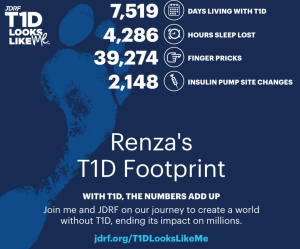
With Diabetes Awareness Month in full swing, many of us will have seen the JDRF’s Type 1 Diabetes Footprintflash up on our SoMe feeds as diabetes friends show just some of the ways diabetes has impacted our lives.

This is my one: accurate as of last weekend:

This is just a sample of the numbers that show how much diabetes influences and affects our day to day (and night to night!). If we’re talking numbers when it comes to diabetes, (which I don’t really like to do), there are so, so many more. Here are just some of them… (all are totally random estimations – don’t take anything as gospel here, folks!):

  • The number of BGL strips found in unlikely places: 4,500,596,098
  • The number of fruit pastilles I can stuff into my mouth at one time whilst in the throes of an ‘I-am-dying-give-me-all-the-glucose’ hypo: 142
  • The number of hours being supported by friends with diabetes: 3 – and that’s just today!
  • The number of times I’ve caught my pump line on a door handle: an embarrassingly significant number (because: #NotGoodAtDiabetes)
  • The total weight I can lift/move when I am having a ‘super-power’ low: 1,450kgs
  • The number of red scarves bought at the ADA meeting ‘Stop Diabetes Shop’ because the bloody aircon is too cold at convention centres and I keep forgetting to bring a jacket: 3

  • The number of hours after my planned bedtime of 10.30pm I actually go to bed because I’m talking to DOC friends on the other side of the world: 2…3…4 (also: time zones suck)
  • The number of times my heart beats per minute when I realise just how low I am, and that there is no easy-to-grab glucose source in sight: 180
  • The number of days a Rockadex patch lasts on my arm: 7-10
  • The number of nights I’ve lain awake fearing what diabetes has in store for me:more than I care to remember
  • The number of handbags I have bought because I’ve convinced myself it will be ‘THE perfect diabetes bag’: 237
  • The number of frocks that are hanging in the cupboard unworn because there is no bra that works underneath it and therefore nowhere to house a pump and RL: 25
  • The number of supermarket aisles wandered around while low trying to decide what to eat: 8
  • The number of jars of Nutella in my house at any one time (for hypo purposes, of course): 4
  • The number of times I send out a tweet urging health writers to please be considerate when writing about diabetes: a few times a year.

  • The number of times I’ve thought a hypo simulator is a good way to explain what it feels to have a hypo to people without diabetes: 0
  • The number of gulps of water it takes to try to quench high glucose levels: 36
  • The number of times I’ve explained why #LanguageMatters in diabetes: 123,890,456…123,890,457…123,890, 458
  • The number of breaths I need to take before explaining – yet again – why I CAN eat that doughnut: 2
  • The number of times I have been grateful that diabetes didn’t stand in the way of me having a beautiful baby girl: every single minute of every single day
  • The number of ‘I know someone with diabetes, they died’ stories I’ve had to listen to: 6,984
  • The number of times I’ve said the words ‘No, it isn’t a pager/nicotine patch, mobile phone, fitness tracker’ etc to explain a piece of diabetes tech strapped to or hidden on my body: 9,465
  • The number of tears that have fallen because I feel overwhelmed by diabetes: countless
  • The number of times I’ve been glad to have been diagnosed with diabetes: 0
  • The number of times I acknowledge just how fortunate I am to have been born into a country where insulin is easily accessible: at least once every day
  • The squirts of surface cleaner needed to remove marks from wherever I’ve accidentally left blood after checking my BGLs: 3
  • The number of days I’ve wished I didn’t have diabetes: every single one of them
  • The number of days I’ve felt so overwhelmed and burnt out by diabetes that I find performing the most basic things (diabetes and non-diabetes) a struggle: Frequently. because diabetes sucks
  • Oh – and the number of times I’ve been wearing a white shirt when I’ve had a gusher: every time
  • The number of times I’ve said or written ‘My Diabetes; my rules’: 566,285 (3 of those have been in the last 20 minutes)
  • The number of times I give thanks to the brains trust behind DIYAPS: hourly
  • The number of alerts or alarms from my phone it takes before I actually take note and do something: 6 (unless sleeping and then: whatever)
  • The number of times I’ve accurately counted the carbs of anything containing rice: not once
  • The number of times I’ve asked ‘Have you spoken with people with diabetes about that?’: lost count…now I just weep
  • The number of lancets I have used in the last twenty years: probably about 18
  • The number of dot points on this inane and silly list: every single one of them!

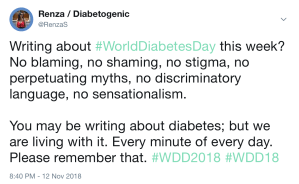
Oh, hello! It’s World Diabetes Day this week. And that means one thing and one thing only: diabetes will be elevated to health condition of the week, and we will see it EVERYWHERE.

I recently wrote that I’d been a little out of sorts a couple of weeks ago. I’m back to my usual robust and resilient self, but on the way back, I seem to have misplaced the filter that usually muffles the directness for which I am sometimes pretty much always known.

I realised it was missing when I was speaking at HIMSS last week and I was pretty direct when talking to some app developers. Instead of doing my usual sandwich feedback (i.e. something positive to begin with; suggestions for how it could be better in the middle; something positive to round it out, all with what could be considered a Dolores Umbridge smile on my dial), I went straight for the filling of the sandwich.

It turns out that without my filter, my comments eschew (rather than chew) bread and are all about the meat in the middle. I become totally low carb in my feedback. And I lose my smile. (A doughnut would probably bring that back, though…)

For this week, we will be banging on about the need for diabetes awareness. Of course, this morning as I was dressing and tucking small vibrating or lighting up boxes and infusion sets into my bra, and checking the tape on the CGM on my arm, while wondering if Loop really did have that downward arrow on my Dex under control, all I could think of was diabetes to the left of me; diabetes to the right. And I’m stuck in the bloody middle with it because it won’t leave me alone. I can’t help but be diabetes aware. All the fucking time!

But this week isn’t about us, (this piece from Tom ‘Diabetes Dad’ Karlya from a few years ago does a great job of explaining that in ways less sweary than my own). It’s about putting diabetes on the agenda for those of us who don’t already think about it morning, noon and night because it’s mailing address is our body.

So, for that reason, local newspapers, news bulletins, online new outlets and everywhere else that is trying to fill a 24-hour news cycle with content will want to talk about diabetes. If previous years are anything to go by, what we see will not necessarily be all that great. But that doesn’t need to be the case.

Last week, I was involved in a news segment about diabetes. When I watched in back on the news that night, I was so impressed with the way the story was presented. I’d managed to chat with the reporter as she was putting together the copy for the newsreader to use when introducing the story, and what she would say. There was no use of words such as ‘sufferer,’ ‘diabetic’ or ‘disease’. Instead, it was a balanced story that presented the facts. It was no less a piece because it left out sensationalist language.

I know that news outlets like a melodramatic take on things, but if you are in a position to help frame the way that diabetes is presented in the media, do it! It’s easy to do (the Diabetes Australia Language Position Statement helps) and mentioning that it takes no more time to use engaging and empowering language rather than stigmatising and negative language may help too.

I’m all about hope at the moment – well always – so here is what I hope for this World Diabetes Day:

In the posts celebrating the theme of this year’s WDD, diabetes and families, I hope that nowhere is a person with diabetes made to feel guilty, or that their diabetes is a burden on their family. I know that diabetes affects my family. I know that diabetes has moments of keeping them awake. I know there are times they may worry. But thankfully, I have never, ever heard them tell me, others, news outlets, social media, one of our dogs that they don’t sleep because of my diabetes, or they spend every minute thinking about how diabetes impacts on us, or that my health condition eats into our savings. Think about what you are saying and how we may feel if you talk about us like that.

In news reports, I hope for accurate reporting that doesn’t make us look pathetic or as though we deserve pity. I hope for language that presents the facts about diabetes without adding judgement or blaming us for our condition.

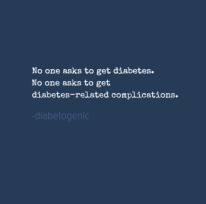
I hope that whoever is thinking, writing, speaking, presenting about diabetes this week remembers that no one asks to get diabetes; no one asks to get diabetes-related complications. Blaming and shaming us does nothing for anyone.

I hope for balance, and that for every story that celebrates an Everest climbing (or similar) we acknowledge the less grand endeavours. Because when speaking about diabetes, we cannot only hear from those at the extremes of the spectrum. Most of us are somewhere in the middle and our stories shouldn’t be left out.

In online groups I hope for no discussions about why we need to change the name of type 1 diabetes to distance ourselves from people with type 2 diabetes. Because: 1. Shut up and 2. Stop it; you’re adding to the stigma.

And more about online groups. If people are sharing news stories that will inevitably show overweight people eating hamburgers, the correct response is not to shame these people and tell them they are pathetic for not eating low carb. Because: 1. Shut up and 2. No one cares about how many grams of fat or how few grams of carbs you ate today, or how much insulin you didn’t need because you ate a bowl of organic kale with some organic tuna with coconut oil for lunch.

I hope that diabetes is presented as a serious health condition that does not discriminate when selecting whose body it wants to hang out with (in?). And that all different body types are represented.

And while we are talking about representation, I hope that we see diversity in diabetes stories from people of different colour, race, religion and sexual orientation. Because factors affecting our diabetes go beyond just the medications we take, and not everyone living with diabetes looks or is the same.

I hope that the voices of people with diabetes are not drowned out by those around us.

I hope to see myths busted.

I hope that somewhere we see that diabetes affects the whole person – body, mind and spirit – and that any solution claiming to help us, addresses each and every one of those parts of us.

I hope to see those who are happy to #MakeDiabetesVisible take whatever platform works for them and shares, shares, shares; and equally those who want to be more quiet ,are given the space to do that too. (Read this beautiful piece from Melinda Seed for more.)

And most of all?

Most of all I hope that no person with diabetes sees anything this World Diabetes Day that makes them feel diminished in any way for having diabetes. Because if that happens, then surely the day cannot be measured a success.

This year for World Diabetes Day, the International Diabetes Federation has decided on the theme ‘Diabetes Concerns Every Family’. According to the WDD website, the aim of the campaign is ‘…is to raise awareness of the impact that diabetes has on the family and to promote the role of the family in the management, care, prevention and education of the condition.’

I get that. I have said it on numerous occasions: it takes a village to live with diabetes.

I was a little nervous when I first saw some of the materials from the campaign, because I was worried that it may focus too much on the negative effects of diabetes and how it burdens the families of those living with diabetes. I know how diabetes impacts my family and I feel enormous responsibility already about that. I don’t need to be reminded of it, and I certainly don’t need to be guilted into being told that if I am not managing my diabetes properly I am doing a disservice to my family.

Although there have been a few little things that hint at those ideas, mostly, what I’ve seen has been positive and focused on celebrating and acknowledging those villagers who help us live with diabetes.

Diabetes Australia has decided on the campaign of #MyDiabetesFamily to highlight the idea of the village, and acknowledge that ‘family’ looks different to a lot of people.  For some people with diabetes, it will be their immediate family – parents, partners, kids etc – who are their main cheer-squad and supporters; for others it will be their friends, work colleagues or maybe gym partner. Someone the other day told me that their dog is their most important diabetes supporter, providing them with comfort – and alerting them to lows.

I was asked to put together a collage of the people who I would refer to as #MyDiabetesFamily. This is it:

#MyDiabetesFamily

Obviously, and most importantly, Aaron and the kidlet feature. They know my diabetes in a way that no one else does because they see it most. They see the difficult days, the frustrations and how overwhelmed I can get, but they also see my celebrate the positives. And they have seen how much my diabetes – and my attitude to it – has changed in the last 12 months. In some ways, they benefit from Loop, too because my diabetes intrudes a lot less into our family’s life.

My parents and my sister are on there too – another obvious inclusion. Their support is never ending.

My gratitude for my family – in the more traditional sense of the word – is unending. They may not have diabetes, but they deal with it in different ways. While they may not understand that feeling of unquenchable thirst that comes from high glucose levels, or the panic of an ‘eat the kitchen’ low, they do know what it is like to be spectator to it all and I know that they all wish that I didn’t have to deal with those things – and everything else diabetes has to offer.

And the photo at the top shows just some of my friends with diabetes. As it turns out, this was the first photo on my phone with a group of diabetes friends, and these fab people are just a tiny number who also make up #MyDiabetesFamily; I am lucky to say that there are so, so many more.

These are the people whose islet cells are as absent as my own; these are the people who ‘get it’; these are the people who intrinsically understand what diabetes feels like – even if each of us have different experiences, and we use different words to explain it, and come from and with different perspectives. These are the ‘us’ in #NothingAboutUsWithoutUs; they are the ‘tribe’ in ‘Find your tribe, and love them hard’.

And in the middle? Well, that would be me. Because I am the one who is so grateful to have them all there as part of my life, helping and supporting me.

Want to get involved and celebrate your own diabetes family?

Have a look at the Diabetes Australia Facebook page (click on the image below to be taken there) to find out how.

DISCLOSURE (because they matter and I always disclose. ALWAYS.)

I work at Diabetes Australia, and had some involvement in the development of this campaign. I am writing about the campaign because I think it is a truly important one – not because I was asked to by any Diabetes Australia staff. Plus – I’ll take any opportunity to highlight the folks who make living with diabetes easier!

Research Wednesday is not a thing. Until now. And probably just for today. But there are a few things across my desk that need input from people with diabetes and diabetes healthcare professionals.

Today seemed like as good a day as any to share.

If you can, please do consider participating in any of these online surveys that are currently open. And also, share any of the surveys with others who you think can provide their experiences too.

One for the women with diabetes

A few months ago, I wrote a piece about the need to really speak about women’s sexual health and diabetes. It was a follow up post to something I wrote on the same topic a couple of years earlier.

These remain two of the most read posts on Diabetogenic. Both of them resulted in a lot of messages from a lot of women – most of whom I didn’t know – saying that for years they had searched for information about how diabetes can impact on their sexual health…and had found very little. They also said it was rarely, if ever, a topic their HCPs discussed or asked about. Conversations followed on online platforms too. Clearly – oh, so clearly – women with diabetes were searching not only for information about these issue, but to connect with other women would had similar experiences. The number of times I read the words ‘I thought I was the only one’ was somewhat heartbreaking.

(Side bar…and true story: after that piece was posted, this happened on a Sunday evening at the local Woolies:

Click for original tweet…and replies

Good to know that someone thought it was a good idea. Even if it meant that I shopped at a different store for a few weeks after that.)

That post coincided with some research Kath Barnard was conducting which has shown that sexual health issues affect three quarters of women with diabetes. The way that women are affected can be different – it may be physical, or emotional, or a combination of both.

Now, there is a follow up survey which is hoping to gather more details of exactly how diabetes impacts on sex in women with diabetes.

One for the men with diabetes

Because diabetes is an equal opportunity employer, there is also currently a survey for men with diabetes which is also looking at sexual health and relationships. While there may be quite a bit of information available about erectile dysfunction, sexual health in men is more than that.

Just as I’ve had conversations with women with diabetes about sex and diabetes, late night conference dinners and drinks often lead to a little more candid discussion about some of the issues around sex that men with diabetes experience too. And it seems that just as women are searching for more information, so are men.

Kath Barnard has stepped up again with a survey for men. This is a last call for this one as it is closing soon.

One for the new mums with diabetes

If you are a woman with type 1, type 2 or gestational diabetes who is pregnant, or has been pregnant in the last year, please consider completing this survey from the NHMRC Clinical Trials Centre at Sydney Medical School (from the University of Sydney).

The aim of this research is to better understand glucose monitoring experiences and preferences of pregnant women with diabetes.

The survey has been open for a few weeks now, and participation rates are not great, so if you are able to spare 20 minutes to provide your input, please do. And also share with relevant networks.

One for the HCPs

This survey is JUST sneaking in as it closes today!

The Diabetes and Schools consultation is continuing, and now, paediatric and adolescent healthcare professionals, and HCPs involved in diabetes education and training of school staff are being asked to complete a short survey.

This will form part of the overall consultation and will help to shape the new, nationally consistent training program being developed by Diabetes Australia, ADEA, ADS, JDRF (Aus) and APEG.

There really is no time to spare on this one. You only have until tonight.


It’s Melbourne Cup Day today and I’m bound for Brisbane for the HIMSS Asia Pacific conference. I’m speaking in the consumer partnership track, which allows me to get on one of my high horses (Cup reference #1) to speak about the importance of including health ‘consumers’ in…well, in everything.

Right out of the gates (Cup reference #2) I will be speaking about how a health conference that doesn’t allow for people living with that health condition to attend is already not partnering properly.

I want to look at the word ‘partnership’, which I actually think is a bit of a misnomer most of the time in healthcare. There remains such an imbalance of power and representation in most cases of the development and delivery of services, activities and resources, yet partnership suggests that everyone is equal. I can’t count the number of times I have been ‘the’ consumer representative in a roomful of healthcare professionals, researchers, administrators, industry reps and policy makers. They will all be there in droves, and there I am a lone voice.

If I’m being honest, I think that the idea of partnership needs to be questioned, because that suggests that everyone’s voice should be equal. Perhaps it’s a little radical to think this way, but quite frankly, I don’t think everyone’s voice should be equal. I think the most amplified voices – yes voices – should be those of the end user – the consumer.

My talk is also going to highlight tokenism in consumer partnerships and engagement. The idea that ‘any consumer will do’ is rife. How do I know that?

Well, I get contacted every week asking me to be a consumer rep on something or other. Most times I say no and recommend someone better suited. Such as the time (just a few weeks ago) I was invited to sit on a committee looking at programs to support men with type 2 diabetes diagnosed in their 50s, living with erectile dysfunction? When I pointed out that finding a few men with type 2 diabetes diagnosed in their 50s would actually make sense, I was told that I would do a fine job representing them. Yeah – no I wouldn’t. Because I know nothing about being a man, being in my 50s, having type 2 diabetes, or erectile dysfunction. How’s that for a quadrella? (Cup reference #3)

But the one issue I want to focus on – because I think it actually is a super easy concept to grasp – is the issue of influence, or rather the consumer’s ‘power to influence’. This is a biggie because for me, it is the cornerstone of engagement, and it is actually quite easy to measure. We can have whatever framework in place – the policies, the procedures, the advisory boards and the teams dedicated to putting the consumer first – but if those consumers do not have the power to influence what is going on, they are being excluded from having any real power and we then we need to question if there is true partnership.

I keep coming back to this – I spoke about it at the co-design session at the Australasian Diabetes Congress this year. I have also written about it a lot here. And I talk about it a lot when I am speaking with organisations and industry about whether their so called engagement program is truly going to matter.

I’m not trying to oversimplify this – I understand there are a lot of factors to consider, and sometimes there is legislation and governance to work through. But governance can be restructured. As can legislation.

But maybe I am. Maybe I am trying to make it easy because too often there is fear and uncertainty about how to engage, and this leads to either things being done poorly. Or not at all. And to be honest, I’m not sure which one is worse.

Follow Diabetogenic on WordPress.com

Enter your email address to follow this blog and receive notifications of new posts by email.

Read about Renza

Archives