Look, I know there are times that engaging with people online who are sprouting a load of bullshit is a bad, bad idea, and really, I should just walk on by. But here’s why I don’t always do that…
real life with diabetes
Look, I know there are times that engaging with people online who are sprouting a load of bullshit is a bad, bad idea, and really, I should just walk on by. But here’s why I don’t always do that…
I’m back from two-and-a-half days in Copenhagen where I was invited to give a talk about diabetes and language matters, and to run a couple of workshops about creating social media content for the 2019 DEEP Summit (please see my disclosures at the end of this post). Lots and lots and lots to write about and share once I’ve been back on Australian time for more than 18 hours, and my brain is less jet lagged and more focused.
But I wanted to share this slide from one of the other presenters because it resonated in more ways than one. I’m interested to know others’ thoughts on this, because mine keep flipping back and forwards.
I’ll be writing about this next week (hopefully), and about how I went from my initial reaction of wanting to cheer #NothingAboutUsWithoutUs, to being a little more considered at just what it is saying when we see it through a lens of inclusion and diversity of voices of lived experience.
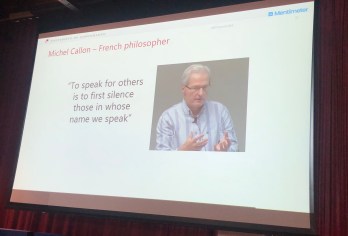
Slide shared by Anna Birna Almarsdottir in her talk about about what it means to be person-centric from the viewpoint of a researcher.
DISCLOSURE
I am a member of the DEEP Program and was invited to participate in the 2019 DEEP Summit. My flights, three nights’ accommodation and other costs were covered by Novo Nordisk. As ever, I have not been asked to write or share about my experience at the DEEP Summit or as a DEEP member. The decision to do so is my own, as are the jumble of words above this disclosure.
I was speaking with someone who is thinking about starting to Loop the other day. I explained my own experiences – how simple the set-up had been (even after I’d delayed it for six months because I thought I wouldn’t be able to do it), how it is completely changed the way I think about diabetes, how much less time I have to dedicate to dealing with the daily frustrations of diabetes, how the highs and lows have been evened out and how glucose rollercoasters are a thing of the past.
‘So, you never have highs and lows? Ever?’ he asked me.
‘No; that’s not completely true,’ I said. I am frequently guilty of being evangelical about diabetes technology, and wanted to be sure that I wasn’t overselling DIYAPS. ‘After all, I still have diabetes!’
I have my range set to 4mmol/l – 8.0mml/l. It’s the mythical range that was presented to me as the ultimate goal the day I was diagnosed. It’s quite a tight range – I know that – and I probably could afford to ease up on that upper range. My target is 5.0mmol/l (it used to be 5.5mmol/l – another mythical number).
The reality is that for the very vast majority of the time, I am within that range, and hovering around that target number. If I was to check my Dex as soon as I woke up each morning, it would be boringly somewhere between about 4.8mmol/l and 5.3mmol/l.
But I still do spent time outside of the target range. The thing about Loop is that in most cases, I can explain the reasons when that happens.
I had a hypo the other night. A pretty terrible one, actually. I can’t remember the last time my Dex read LOW, but that was what I was staring at when I checked the app after my phone started screaming at me. I double checked with a finger prick and sure enough I was low. Really low. I treated (over treated) and was fine a short time later, albeit with a rebound leading to numbers I’ve not seen in a very long time.
How did that happen? Well, let’s start with the double bolus I gave myself. For some reason, I decided that the chicken soup with noodles I was eating for dinner needed not one, but two boluses. That was mistake number one. Mistake number two was not eating as much as I thought I was going to because I had a teleconference starting, so I left about half of my dinner in the bowl. Mistake number three was not realising mistake number one. And mistake number four was not doing anything to address mistake number two.
Following? Diabetes is fun!
The low resulted in an ‘eat-the-kitchen’ hypo that saw me eat six jelly beans, wait fifteen minutes and then recheck my glucose levels. Just kidding. I drank half a litre of juice, ate three bowls of breakfast cereal, chomped on a tube of fruit pastilles and then started attacking a homemade fruit bun my mum had delivered earlier in the day.
Because I was dying and all the carbs in the kitchen were the only way to prevent that happening.
The high that followed could be easily explained (see: juice, cereal, pastilles, fruit bun).
Other highs on Loop can usually also be explained quite simply. If I under bolus, I know pretty quickly, and Loop has already started doing its thing anyway to remedy that.
Stubborn highs generally mean one thing and one thing only: Renza, change your cannula. And as soon as I do, numbers come back into range fairly quickly.
Out of range numbers these days aren’t due to the unpredictability of diabetes. These days, they come down to one thing and one thing only: human error. My human error.
I trust Loop more than I trust myself. It is way smarter, completely and utterly unemotional, and an absolute workhorse, making adjustments every five minutes as required. It doesn’t get tired or busy or distracted. It understands numbers better than I ever will.
This is the cool tech I need to help me keep my diabetes moving. Of course, I still need the warm touch – the human connection – to help me make sense of my life with diabetes. But not having to think or do the diabetes numbers nearly as much gives me time and headspace I didn’t know I had. It keeps my numbers in range for the vast, vast majority of each day. And it means far fewer errors. Errors that I used to make all the time.
I am, after all, only human. Loop, on the other hand, is not.
One of the many highlights for me at last week’s EASD meeting was the satellite event about DIYAPS. It was a Hacking Health event, co-organised by the OPEN Project consortium and promised to highlight the perspective of the #WeAreNotWaiting movement through the eyes of people with diabetes, researchers and clinicians.
It was standing room only, with the event having sold out a few days earlier. I was a little late (I had to present at an event involving early researchers and PWD) so unfortunately missed the always brilliant Dana Lewis kick off the event.
If you ever need someone to warm up an audience and set the scene about the DIYAPS movement, Dana is your person! I have seen her present a number of times now, and always pity anyone who shares the stage with her. Her presentations are always enthusiastic, articulate and engaging, and leave the audience wanting more.
I followed her talk on Twitter as I was in the cab from the EASD conference centre to the Centre Cívic Sagrada Família (bonus of offsite events is actually seeing some of the tourist attractions the city has to offer!) and could see that the audience was enchanted and galvanised with her talk.
The program was packed – and provided a balanced view of not only people using the tech (because honestly, sometimes it can sound like we have all drunk the Kool-Aid!), but also about DIYAPS in clinical practice, and research settings, as well as a session on medical ethics.
There were many stand out moments for me, but perhaps the one that stands out the most was from paediatric endo, and fellow Looper, Katarina Braune where she was able to distil DIYAPS into this single sentence (as tweeted by another Looper, Andrea Limbourg):
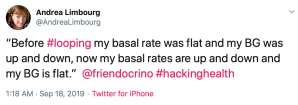
Perfect, perfect summary of looping!
We also heard from Roman Hovorka who presented on the experience of developing the Cambridge closed loop system (CamAPS). Anyone who has been following artificial pancreas technologies and research would know of Roman. I’ve heard him speak a number of times at conferences around the world and have always been grateful for his passion and dedication to advancing technologies to benefit people living with diabetes. So, it was a little surprising that I found his talk a little challenging.
One of the things that I have always admired about the DIYAPS movement is that there is a strong sense that our chosen DIY path sits neatly alongside commercial systems and regulatory bodies. While we may not choose or want to use a commercial system (and, of course, are not waiting for them), that doesn’t mean that there is disdain or derision of other options. In fact, there is admiration and gratitude for industry working to provide this technology to a broader audience. We know that not everyone wants to build their own system, and many ARE happy to wait for a system that will be in warranty, and comes straight out of a box, rather than cobbled together.
I say this knowing that same courtesy is not always afforded to the DIY world from industry, and I can point to every single time someone from a company developing a commercial automated system claims their systems are safe – implying that those of us in the #WeAreNotWaiting world are all cowboys not concerned with safety.
I would so have loved to have heard Roman really highlight all that his system has to offer, and what sets it apart from DIY systems, and how it is one more choice that will be available to PWD, rather than put down the DIY movement. I am all – ALL – about choice and love the idea that with this choice comes a better chance for us to find the tech that works best for our personal circumstances.
We don’t need to be defensive about ‘the other’ in diabetes technology. We need to acknowledge that there is no one right, perfect choice. DIY is certainly one of those choices, and as we heard sprinkled throughout the day, has been life changing for many people. But it is not the only option out there, and few people in the DIYAPS world would even suggest that it is. I guess perhaps that is what challenged me about Roman’s talk – he did seem to throw DIYAPS under the bus a little when it would have been far better to suggest it was just another bus route people may like to take.
So how could this event have been better? Well, I wish it had been part of the official EASD program. There is a lot of opportunity for HCPs to learn from the user-led tech community, and this extends to technologies and treatment options beyond DIYAPS. Reinforcing what is an overarching fact of life with diabetes – that all diabetes is DIY – is important for all working in diabetes to remember.
While DIYAPS technology may be at a far spectrum of the whole DIY diabetes idea, having HCPs and researchers listen to just how diabetes impacts on daily life, and the decisions we need to make is critical in their approach working with us.

Panel session to finish the day.
DISCLOSURES
My airfare and part of my accommodation to attend EASD was covered by Lilly Diabetes so that I could participate in the DOCLab advisory group meeting which took place all of Monday. Another night’s accommodation was covered by Novo Nordisk as I attended their advocate meeting on Digital Health Technologies.
I am part of the OPEN Project Consortium. I did not receive payment for my involvement in the Hacking Health event.
While my travel and some of my accommodation costs have been covered, my words remain all my own and I have not been asked to write or speak about any of the activities I attended, or anything I have seen at the conference. As ever, profanities are also all mine.
Once or twice in the years I’ve been working in the diabetes advocacy space, I have spoken and written about diabetes and language. And by once or twice, I mean rarely a day goes by when I don’t hashtag language matters somewhere on some social network.
You can call me a one trick pony (or Blossom), but I don’t mind, because I think that trick is pretty bloody important, and for the last eight years, I have been more than happy to highlight why the words we use when speaking about diabetes is critically important.
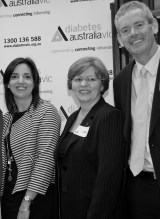
The first time I spoke about this was at the launch of the Diabetes Australia position statement, ‘A New Language for Diabetes’. I stood on stage at the Victoria State Library alongside Diabetes Australia CEO, Greg Johnson and ACBRD Director, Jane Speight as we started what has become a movement, supported by the diabetes community around the world. This was in September 2011 and this photo is from that day.
Now, eight years later, it’s time to revise the statement the started the #LanguageMatters juggernaut, and that’s where you come in.
Diabetes Australia is inviting people living with diabetes, their friends and families and HCPs to complete a survey about to have their say about the words and language used when speaking and writing about diabetes. This is your chance to share what is important to you, what really matters and what doesn’t really bother you at all. We know that the way we communicate about diabetes does matter, but we need your help to shape our revised survey.
Click on the word cloud below to be taken to the survey, and please share in all your networks. We need to hear from you to help build the evidence for why this continues to be a critical issue in diabetes care and communications. Please help us do that!

DISCLOSURE
I work for Diabetes Australia and am on the working group reviewing the Language Position Statement. I was also involved in the development of the initial statement. I have not been asked by Diabetes Australia to share details of the survey which will be used to inform the revision, but of course I am, because how could I not?!
Two things happened that got me excited on the 6 train when I was in New York back in June.
Firstly:

Obviously, every green circle in the world ever is a tribute to Loop. That’s my story and I’m sticking to it, and I refuse to be told otherwise.
And secondly:

Click on pic to be taken to the campaign where you can clearly see this and other images.
I absolutely love this from NYC Department of Health and Mental Hygiene. The campaign is called ‘Choose the Best Words’ and encourages people to speak with their friends and family, and learn how to support those who need it. Ads like this one also highlight a recent city-funded mental health first aid training course that is offered in all five NYC boroughs. The ads, which were all over the subway and other places in the city, point out that using the right words and phrases to support those living with mental illness is really important and can help reduce associated stigma.
I guess this kind of follows on from yesterday’s post. I know that often people say things just because they feel the need to fill a silence…or just to say something, not realising the impact of the specific words they say. But it does matter. The choice of words you make really, really matters. And this beautifully simple campaign shows that.
This is an edited version of a blog post I wrote over three years ago, but refer to frequently. Because it seems that there is a human need to force people to feel that their lives could be worse – so much worse – so they should be grateful that it’s only diabetes they have to contend with. Or that they only have a certain type of diabetes, because the other one is worse. Or that they were diagnosed at a certain age or in a particular decade, which is (somehow) better/easier/less crap than a different age/different decade. Oh, and of course…at least it’s not <fill in the blank>… because that would be worse.
I say, fuck that.
I get that people genuinely are just trying to make others feel better about a situation. Here’s the deal though – no one really expects that. At least, I don’t. I don’t need anyone to try to buoy me up or make me feel better. I don’t need anyone to point out others have it harder (yeah – I know that…). I just need people to nod. Aaron really has it nailed, and I tell everyone that he knows just what to do in those moments when diabetes is pissing me off: offer a cup of tea, some chocolate, and loudly pronounce ‘Diabetes sucks‘. I don’t think he realises just how validating that is and how much more meaningful it is to me rather than insisting I look on the bright side and be all Pollyanna-ish about my screwed beta cells.
Next time you are tempted to say ‘…at least…’ to someone with diabetes (or, for that matter, someone who is having a rough time about anything at all), stop for a minute and think about what you are really saying. Because honestly, you’re not helping at all.
For the sake of my own mental health, I have learnt to not compare myself with others.
I was thinking of this the other day when I was involved in a conversation with a woman newly diagnosed with diabetes. She told me that she was really upset at the response from a close family member who, when told about the diagnosis and how distressed she was, responded with ‘It could be worse. At least it’s not cancer.’
I’ve had that said to me. Several times. And it is one of the most offensive things I have heard. I don’t really know how to respond to it, because it’s true, I don’t have cancer. But I do have diabetes and that is pretty bloody horrible sometimes. (For the record, I equally dislike the idea of responding with ‘At least it’s not cancer? There is a chance of remission with cancer; type 1 is for life…’)
I get just as annoyed when it happens in our community. ‘At least it’s not type 1,’ is something I have heard said to people with type 2, diminishing the challenges they may face. A woman who had just been diagnosed with gestational diabetes told me that people kept telling her that at least her diabetes would go away when her baby is born. Sure, that may be the case, but right here and right now, this woman is pregnant, thinking about her baby and wondering just what diabetes is doing to her growing bub.
When I was anxious about my impending cataract surgery a few years ago, I was told ‘It’s nothing. At least you don’t have to have laser or have your eyeball injected.’ Again, that’s true. But I was still terrified and had every right to be.
When discussing a nasty hypo ‘At least you didn’t lose consciousness and wake up to a roomful of paramedics.’ Sure, I remained conscious throughout that unpleasant and seemingly endless low. But I needed help to treat it and it happened in front of my kid. She was scared, which really upsets me and makes me feel guilty.
When our experiences are belittled or minimised, it means we may stop sharing them. No one wants to be told they are being a drama queen and that it could always be worse. Of course it could be worse, but that doesn’t mean what we are dealing with doesn’t suck.
I have had diabetes for 21 years now. I have not had to deal with debilitating complications. I have not had to spend weeks in hospital because of my diabetes. But does that mean that my fears and concerns and anxieties are any less relevant than someone whose experiences are different?
And that’s why you will never hear me say to someone newly diagnosed ‘At least you have just been diagnosed. Just wait until you have had diabetes as long as me and <this or that> happens,’ because everyone’s experience is different and that newly diagnosed person may have their own concerns at that particular time. Or not. Which is also fine.
I had a healthcare professional once tell me that at least I didn’t have diabetes ‘too terribly’, because I worked, had a child and travelled. It was one of those (incredibly rare) moments where I was stunned into silence. I was torn between wanting to say ‘Well, surely that makes what I’ve achieved all the more incredible‘ and stabbing her with a fork. I said (and did) nothing.
There is no ‘at least...’ when it comes to diabetes. There is no discussion about how it ‘could be worse’. Because the truth is, it could be a whole lot better. I could NOT have diabetes.

The perfect Effin’ Birds response (because there always is one!) if someone says ‘At least….’ about your diabetes. (For more of these wonderful sweary birds, click on the image. And buy the book!)
Firstly, let me start this piece by saying #NotAllHealthProfessionals. There: I got it out there upfront because I know that what follows is likely to garner response from a shedload of healthcare professionals that they would never do the sort of crap I am about to write about.
Sure – I know that there are lots of great ones out there. I get that there are champions for our cause; HCPs who genuinely walk alongside us and truly listen to what we say and what we need.
But here’s the thing. It takes more than that; more than just doing the right thing in your own little world. It takes guts and leadership to take a stand, and it takes standing up to colleagues who are not getting it right. And sadly, even the good ones don’t do that enough.
Last week, I shared a pathetic image from a Facebook page that is, allegedly, a satire site. It seems to be administered by HCPs and most of the comments appear to be from HCPs. (You can see it here if you are on FB. I don’t want to share the image on my blog.)
I shared the image with these words: ‘This isn’t funny. it’s not smart. It’s not clever. Even less funny is that it appears this is a page for and by healthcare professionals. The comments are disgraceful. HCPs are not our allies when they do this sort of shit. Instead, they’re contributing to the distress and shame that many PWD feel.’
The thing that upset me most wasn’t the pitiful attempt at humour. Let’s be honest – there was nothing in there we had not seen before. A million times over. This sort of ‘humour’ is in the DNA of every stigmatising diabetes ‘joke’.
What upset me were the comments that followed. At last count, there were about 1,000 of them, most of them applauding the image. Here’s just a selection from the first few:
‘Brilliant – but no one ever heeds this advice.’ (From a nurse who claims 30 years of nursing experience.)
‘This is how I label things.’ (Pharmacist.)
‘Should be on every diabetes med.’ (Exercise physiologist.)
‘The things you wish you could say to patients without losing your job.’ (Nurse.)
‘Love that!’ (Med student.)
‘Hahahah!’ (Podiatrist.)
‘Legit needs to be on boxes.’ (Nurse.)
‘Sorry…I can’t read that small print on account of my sugary eyes.’ (Doctor.)
‘Hahahah. Great quality labelling.’ (Pharmacy student.)
‘Accurate.’ (Physiotherapist.)
‘I love this so much.’ (Doctor.)
‘Damn, should’ve mentioned patient’s McDonalds intake as consideration for Contrave (a weight loss drug).’ (Doctor.)
‘If only we could write that!’ (Nurse.)
‘Control your diabetes or you’ll lose your feeties.’ (Doctor.)
There were more… a lot more. Predictably, the very few of us who questioned just how this was meant to be amusing were told that we needed to lighten up/see the funny side in it/understand it was satire. Or people doubled down to tell us that we were wrong and then went on to school us with further myths about diabetes. Seriously, these people need to get just a touch of originality and try to come up with a stigmatising meme we’ve not seen several million times already, and then come back at us with inventive comments.
I am willing to bet that pretty much every single one of those HCPs will claim to be all about ‘patient-centred care’. I am sure that they believe that they are truly there for what their ‘patients’ need. If pressed, they would probably say that they would never, ever say something like this in front of a patient – because they care about us so much.
That’s bullshit.
A healthcare professional who is truly there to champion PWD would have called that meme out for every shade of stigma that it is. They would not have shared it amongst their colleagues or wanted to print it out for the tea room (as a couple of people said they had done). They wouldn’t have found it funny; they would have found it offensive, stigmatising and downright wrong. And they would have said that, trying to put a stop to hundreds and hundreds of comments.
And those HCPs who realised that it was a load of bullshit and said nothing? They need to look at themselves too. The standard you walk past is the standard you accept. When you say nothing, you’re implicitly saying that it is okay.
It is not okay.
Who remembers the outrage from HCPs last year when #DoctorsAreDickheads was trending on Twitter? (Here you go: I wrote about it here.) Doctors were outraged, offended and irrate, and urged patients to counter the horror stories that people were sharing with positive stories of their own doctor experiences. And what happened? People – patients – did that. Even I defended my HCP team when I wrote my blog post. And I even prefaced this post with a disclaimer, because I know that some HCPs will read this and be all indignant. If that is your response to this… respectfully, get over yourself!
Because, where are those HCPs now? Where are the doctors getting angry and outraged every.single.time we have to endure another stigmatising, cruel, demoralising and downright wrong ‘joke’ or comment? Where are the HCPs standing up at conferences when a presenter makes some comment about how PWD ‘fake’ our BGL results or ‘forget our meters’ for download or whatever other behaviour gets us a non-compliant mark against our name?
So, here is what I want to say to HCPs – every single one of you.
Please, please be an ally. Stand up for us. Listen to us. Don’t talk over us. Don’t tell us that our experience is wrong or doesn’t matter. Don’t walk by when your colleagues do this sort of crap. Don’t minimise or delegitimise us by saying that it’s ‘just a joke’ or promising us that you wouldn’t do this. Because enough of your colleagues do. (Also, don’t @ me and tell me how much better you are because you are a leader and don’t do this kind of shit or do call it out. That’s great. And thank you. This isn’t about you. But you still can do something.)
We need you to do this for us. Or rather, along with us. Because when we do it alone (and most of the time, it is us doing it alone), we are dismissed as being too emotional or not being able to understand the humour. As much as I wish it was enough for our comments to resonate, it isn’t. So, we need allies. We need you.
It takes courage and leadership. But if you truly, truly want to be there for us for what we need, then you need to step up. Please be an ally. Please.

P.S. There were a couple of HCPs who commented on the FB page that obviously, this meme was about type 2 diabetes and not type 1 diabetes. If you are one of those HCPs who insists on doing things like that, ask yourself just how much you are contributing to the misinformation and stigma about type 2 diabetes. We know that T1D is autoimmune/not preventable, but when you use a broad brush to correct comments about diabetes with ‘You mean T2D‘ you are not really helping. In fact, you’re just adding to the misinformation by suggesting that all T2D is preventable and that is not true. You know that. Do better.




 Diabetogenic