‘A fire has been lit.’ They were the words I wrote in my first post about AID access in Australia earlier this year. 

There are some truths about grassroots advocacy that I have always known to be consistent. It has to come from community. If the issue isn’t important to a significant number of community members, nothing will happen. Advocacy efforts are truly organic. To be real and honest to the consultation process, there cannot be any pre-conceived ideas about the results of that consultation. Or rather, there needs to be an acceptance that agility and swift pivots are necessary if that is what the community directs. And there needs to be meaningful engagement every step of the way, with a genuine belief that expertise lies with all stakeholders, in particular people with lived experience. I am so pleased that this was the foundation and ran through every single step of the way with our AID grassroots advocacy over the last few months.  

After months of working and meeting with the community, it was time to bring all stakeholders together. In May, I was so honoured to co-chair the National AID Access Summit with Professor Peter Colman. Again, this was always part of the plan – a clinician and a person with lived experience chairing the meeting to signpost how critical it is to have input from different cohorts. Unashamedly, we had almost as many people with lived experience as others in attendance, because that’s the way to centre people with diabetes. We also had independent facilitators directing traffic. This was important because we didn’t want there to be ownership of this work by any individuals or organisations. This wasn’t anyone’s show; it wasn’t anyone’s vanity project. This was a community endeavour. You know, with and by for people with T1D, not for us!

The outcome from the Summit, and the work that led to it, is a consensus statement that offers clear, concise recommendations. Stars aligned, and the statement was completed the same week as the Parliamentary Inquiry into Diabetes report was tabled. And that alignment was even more significant, when our recommendations neatly mirrored those in the report. 

The consensus statement can be accessed and shared here, as well as from the survey for equitable access to AID that has been signed by almost 6,000 people. 

Now, it’s over to the community. We have recommendations from the parliamentary inquiry, but that’s not enough. It’s now time to do the work to turn that into policy. And that’s where people in the community come to the fore once again. Today, I wrote to my local MP to ask for a time to meet with him, sharing with him the consensus statement. I am going to highlight just how important this tech is and how it’s not fair that only those of us who can afford it have access. The better outcomes AID delivers should be available to everyone with T1D, not just those who can afford private health insurance, or meet the eligibility for our Insulin Pump Program. 

If you’re interested and able to get involved, please do. It is the groundswell of community efforts that has in the past seen some truly remarkable results. If we look back to the path to CGM access for all people with T1D, the community stepped up in truly remarkable ways. It took time, and it took energy, but we got there because people with diabetes never stopped pushing for it. Being able to access CGM really mattered to people with T1D and their families and that drove the ‘never give up’ attitude to get it done. 

Now, it’s time for all Aussies with T1D to have access to AID if they choose. This update from the Access to AID Survey has some great ideas about how you can get involved. And reach out to me if you want any ideas. 

Screenshot of the front page and summary from the Consensus Statement on Automated Insulin Delivery for Type 1 Diabetes in Australia.
•	Australians living with type 1 diabetes (T1D) need affordable access to life-changing Automated Insulin Delivery (AID). 
•	AID is the standard of care for people with T1D. However, Australia’s current funding model puts AID out of reach for most Australians with T1D.
•	AID systems work by connecting an insulin pump with a continuous glucose monitor (CGM) to automate insulin delivery to suit the person’s glucose levels, minute by minute, maintaining them within target range. This is beyond what anyone living with T1D can achieve manually with currently funded technologies.
•	The research is clear: AID improves glucose levels, alleviates the negative impacts that T1D has on quality of life, reduces the risk of complications and is a cost-effective investment for our health system.
•	CGMs are already Government funded in Australia, but unrestricted access to insulin pumps is lacking. Additional funding is crucial to support pump access, leverage existing investment in CGM access, and ensure equitable and affordable access to AID, regardless of age, financial circumstance, or postcode.
•	A staged implementation strategy for pump funding will ensure feasible, equitable and sustainable AID use in Australia, minimising issues related to product supply and healthcare workforce training and resourcing.
Summary page from the AID Consensus Statement, co-signed by people with diabetes and other diabetes stakeholders.

It’s never hard to find a source of diabetes stigma. Because sadly, it’s all around us. And right now, the source seems to be much of the discussion about the report from the Australian Parliamentary Inquiry into Diabetes. 

Yes, I was very excited about the report last week when I was writing about the recommendations and accompanying content about increasing access to pumps and AID systems. That was incredible news, and it was terrific to see that the community-led efforts were met with such a positive outcome. 

But the messaging more broadly hasn’t been so great and it’s very disappointing. 

Disappointing, but not surprising really. After all, the inquiry was for diabetes and obesity. Last week, I said that people with T2D deserve the same attention as people with T1D when it comes to advocacy efforts and campaigns. Well, so do people living with obesity. When the inquiry was first announced, I remember reading through its terms of reference and feeling my heart sink. These are two separate and equally important health issues that need focused attention. And within that, diabetes itself comprises different types; again, all equally important and requiring specific attention. 

But instead of giving diabetes the attention it deserved with an inquiry purely focused on highlighting what is needed to improve outcomes for those of us living with the condition and enhancing the health system to better serve us, we were given an inquiry that conflated two separate and significant health conditions. Something was going to get lost in this. And it seems that is diabetes. 

Since the report was launched on Wednesday, a lot of media coverage has focused on one specific recommendation: the sugar tax. That was what was on the front page of The Australian, a segment on the Project and in a number of radio interviews. Also mentioned in this coverage was the recommendation about junk food advertising to children. As you can imagine, the commentary from the community has been pretty horrid and completely misinformed. If ever there was a time for not reading the comments, this is it. 

I completely agree that a sugar tax is a good idea and have been saying so for years. I also believe that junk good advertising should be banned completely, especially for children, starting with TV and online advertising and extending to sponsorship of children’s sporting activities. Again, I have been involved in initiatives involving this for years. One of the reasons these measures are important is that they make healthier choices more accessible, which can reduce the risk of people developing obesity. And yes, obesity is a risk factor for T2D. However not everyone who is obese will develop T2D and not everyone who has T2D is obese. Yet this nuance is missed completely with simplistic messaging and grouping the two together. 

And this nuance is important. As is pointing out that obesity is also a risk factor for many other conditions as well such as several types of cancer, liver disease, heart attack and stroke, high blood pressure, high cholesterol, osteoarthritis, sleep apnoea, mental health conditions, fertility problems and pregnancy problems. Not only T2D, so why is it included in an Inquiry about diabetes? 

I shouldn’t be surprised by the media missing the mark completely, but that doesn’t mean that it doesn’t anger and upset me. Because efforts can be made to try to minimise harm and stigma from misreporting. I was asked to contribute to a media release this week about the AID work and I made it very clear that I would not be involved in anything where messaging could be seen as stigmatising. I provided a copy of language position statements and asked to see the release before it went out to make sure that it all aligned. I pointed out to the PR agency that I would publicly call out any media that came from this release if it was in any way stigmatising about any type of diabetes. Sadly, I don’t think there has been that level of care across PR and media groups. Without that care and attention the stigmatising tropes about diabetes, in particular T2D, are in overdrive. 

But it’s not just the media. In the report itself, there is this statement: ‘There is a huge burden being placed on health resources by people with Type 2 diabetes’, a statement that clearly blames people with T2D for needing to use our underfunded, under-resourced, understaffed healthcare system. Absolutely no recognition of non-modifiable risk facts or social determinants of health. More stigma. More misinformation. More throwing people with T2D under the bus. And this impacts on all types of diabetes, whether we like it or not. 

I really wish that as we are all tripping over ourselves to highlight this Inquiry report, we also stop to think about the messages about diabetes we are setting free into the world. So far, very little of what I have seen hasn’t made me cringe. Far too much has been stigmatising and harmful. We all have a role to play in ensuring that we do not contribute to diabetes stigma, especially when participating in commentary about and the media circus of a new shiny report being launched.

Promo for the Pledge to end diabetes stigma. The image is a line drawing of two hands clasping each other in a heart shape.
If you’ve not already taken the pledge to end diabetes stigma, now is the time. And if you have, share with family and friends, and ask them to take it.

Yesterday, the Australian parliamentary Inquiry into Diabetes report was launched. After eighteen months of countless submissions, interviews, and meetings with diabetes stakeholders from across the country, the report has been handed down with 23 recommendations aimed at improving the lives of Australians living by diabetes. There was much discussion and celebration among those of us advocating for increased access to Automated Insulin Delivery (AID) systems, particularly with the recommendation to expand funding for insulin pumps, which would increase the number of people using AID. Inquiry Chair Mike Freelander expressed strong support for this initiative in his report foreword.

It truly has been remarkable to see the community advocacy seed that was planted back in March in Florence absolutely flourish. Being involved with a dedicated group of people who have worked tirelessly, all volunteering our time to develop a single-issue advocacy movement is a wonderful demonstration of community commitment. We were clear from the beginning about what our aim was – equitable access to AID for Australians with T1D, with a specific focus on addressing the AID component that wasn’t already funded: insulin pumps. With the voices of people with lived experience centred in this work, a survey was launched, community discussions ran wild, a summit was convened and run and very soon a consensus statement will be launched to assist with the next steps of lobbying to have the inquiry recommendation transformed into a policy decision. This was for the T1D community, with the T1D community and by the T1D community. Focused and tailored. 

Many of the recommendations in the report focus on Type 2 diabetes (T2D), and people with T2D deserve the same focused and tailored attention. This isn’t about separating the types of diabetes and dividing advocacy efforts. It’s about targeted and impactful initiatives that highlight and address the unique challenges faced by people with T2D. There are undoubtedly considerations specific to T2D, and they should receive the attention and expertise they deserve – not be treated as an addendum to T1D efforts. 

And it needs to be driven by the community. I know how difficult it can seem to find adequate representation and advocacy for T2D. When we look at the #dedoc° voices scholarship program, the number of people with T1D far outweighs the number of people with T2D. If we examine other community groups and initiatives, we see that T1D is overrepresented. But there are remarkable advocates with T2D out there already. I met some incredible advocates when I was involved in the DEEP network. There is a T2D community out there, and there will be people who not only rise to the occasion but will drive it with their passion and lived experience expertise. They may not congregate or use the same channels that the T1D community uses, or they may be less visible, but that doesn’t mean they are not there. It’s laziness on behalf of all of us who have said we can’t find people to speak or be involved in T2D community efforts. We have expected them to be in the same place that people with T1D are. Look further. Look harder. Look better. Remember what Chelcie Rice says ‘You can’t just put pie in the middle of the table. Deliver the pie to where they are.’ Deliver the pie to where they are. 

This is an opportunity to move the discussion about T2D beyond personal responsibility, which is what public-facing campaigns have largely focused on to date. The stigma and blame these campaigns generate are often harmful. And one result of that stigma is community members who are reluctant to come forward. I mean, would you like to be a spokesperson for advocacy efforts about T2D if messaging has blamed you for getting T2D in the first place? I know I certainly wouldn’t. 

This is an opportunity for real, meaningful systemic change that addresses failures in healthcare access, education, and prevention. Junk food advertising to kids, sugar taxes, and finding ways for the healthier choice to be as easy as the less healthy choice are all critical steps. Addressing food insecurity, socio-economic disparities, and providing better healthcare access are also necessary. All of these measures address the root causes on a large scale, rather than pointing the finger at individuals and telling them it’s their fault.

We can do hard things and be bold. But it will need a collective effort and strong leadership.

And while we’re at it, remember where to look for the innovation and advocacy that has driven change. The community. Access to continuous glucose monitors (CGMs), insulin pumps, and other advancements has all started in the community and been picked up and run with by other stakeholders to make things happen.

People with T2D deserve the same level of advocacy and support. Now seems like a fine time to do that. And as a person with T1D, I am here to support and be led by my T2D peers.

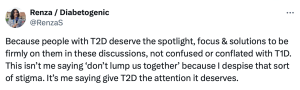
Tweet from me (@RenzaS) that reads: 'Because people with T2D deserve the spotlight, focus & solutions to be firmly on them in these discussions, not confused or conflated with T1D. This isn’t me saying ‘don’t lump us together’ because I despise that sort of stigma. It’s me saying give T2D the attention it deserves.'

There are different types of burnout. Diabetes burnout, advocacy burnout, and just plain life burnout. 

Diabetes burnout rears its ugly head for many of us living with the condition – sometimes starting as diabetes distress before building and building. 

Advocacy burnout seems inevitable the more I discuss it with advocate friends. The living with, working in, supporting others with, diabetes becomes a lot. Too much. So much. 

And life burnout seems to be inevitable in the fast-paced, never-pause-for-a-breath, always-switched-on lives we live. 

When the three collide it’s a triple threat burnout. Welcome to mine. 

The white noise hum of diabetes burnout – always there – slowly, but surely had become amplified. It was little things – I was regularly forgetting to bolus when I ate. Not immediately replacing CGM sensors when one fell off. Ignoring making the follow up diabetes appointments I needed to make, the pathology visit I needed to schedule, the supplies stocktake I needed to do to make sure I didn’t run out of anything. 

I’ve been hovering on the edges of advocacy burnout for some time and found myself plunged into it earlier in the year dealing with the complexities that played out as I offered my help and support in some volunteer grassroots advocacy here in Australia

And life burnout suddenly appeared in the form of exhaustion, but an inability to sleep soundly, and a brain fog that I explained away as a perimenopause symptom. Except it was more than that. It was getting to four in the afternoon before realising I’d not eaten a thing all day. And not remembering if I’d showered, or how many days had passed since I last washed my hair. It was a lethargy that gnawed at me all day long.

I focused on plans for a conference in the US, followed by a few days at work headquarters, knowing that it would be a busy and wonderful time, with a lot of interesting work. I could do it. And I did. The conference was excellent. The diabetes advocates there shone so brightly. And every meeting was a huge success. 

Smile. Breath. Smile. Breathe.

Until I couldn’t. That moment hit like a tonne of bricks last week. 

I’d spent a day in the office at the job I adore, speaking with incredible people doing so much work. I’m inspired daily by the people I work with and learn so much. There were plans set in motion for exciting things to come and I sat in the meeting room I had set myself up in for the day, feeling satisfied and pleased. The workday done, I packed up and stepped out into the street.

And then, a flash, an instant. Suddenly, the pressure bearing down and around on me was so intense and I felt my chest constrict. I struggled to breathe, and my vision blurred. The sounds on the New York streets suddenly seemed to be coming from under layers of concrete, muffled and hushed and yet piercing at the same time. The bright sunlight seared around me, causing me to shield my eyes from the glare. 

‘Breathe. Breathe.’ I felt the rising fright of what I know to be a panic attack, and knew I needed to safely just ride it out. ‘Focus. Focus.’ I looked for something I could hold on to. There it was, a small dog, sitting still, staring dotingly at its human seated at an outdoor café, drinking an iced tea. I stood there, slightly hunched over, my arms wrapped around myself, watching this little dog sitting still. I started to count back from 50, getting to 34 before the dog moved, jumping onto its hindlegs, and resting its front paws on its person’s knee. 

It was though the crush from the last few months had all converged. I’d tried in small ways to stem it. I limited my time online, muting more terms and accounts that sought to do nothing but argue and inflame. I welcomed the calmness that descended when my Twitter feed was devoid of people yelling about food choices, and when my Instagram feed only showed me the images of my nearest and dearest. I focused my outside of work advocacy efforts to AID access, specifically on the helpers. I threw myself into my job because it allowed me to focus and celebrate the work of others. I amplified the #dedoc° voices and other advocacy to keep my own away from the spotlight. I thought these things worked. 

But at that moment, on the streets of lower Manhattan, those attempts didn’t matter or help. ‘But you seemed fine last week,’ said a friend I’d spent time with at ADA a few days earlier. I had been. I was. I thought about how I appear to others. ‘Sometimes, it’s too much. Right now, it’s too much. Forever… it’s too much.’

I felt the uptick in my heartrate. And realised that had been happening constantly. It had happened after the first difficulty with the grassroots advocacy work, and any time I had to face the source of that stress. Sometimes ‘facing’ meant a comment on a LinkedIn post. Sometimes, it meant a somewhat nasty direct message or, even worse, comments that came to me via others. I realised it had happened every time there was some nastiness or other on Twitter. It happened if there was a confrontation of any time around me, even when I wasn’t involved. Anywhere I saw conflict was enough to kickstart an anxiety response

‘I’m okay’, I said to my friend. And then, ‘It feels too much.’ I felt myself and my mind and the space around me shatter into a million sharp, craggy pieces. And felt my skin being cut against each and every one of those shards. 

This is burnout. This is what it feels like. And with it is anxiety and stress and feeling overwhelmed. We all get it to some degree. Diabetes makes it harder. Diabetes advocacy compounds the whole thing even more. Jet lag doesn’t help. Plus there’s a sprinkling of perimenopause over it all. The culmination is a fragility that scares me a bit and leaves me feeling vulnerable. ‘But you seemed fine…’ my friend had said. And I was. Until the burnout took over. And then I wasn’t anymore. 

Very blurry photo of the New York skyline at night.
An accidental photo of the New York skyline, snapped from 21 floors up in the sky. Somehow it captures perfectly how I’m feeling.

Poo, poop, crap, shit – whatever you want to call it, it’s not really a topic for polite dinner table conversation. So, if you’re at a polite dinner table, bookmark this and come back later. If you’re, say, on a flight to Orlando, stick around. I’m writing this on a flight to Orlando. The topic feels somewhat appropriate, but I digress. 

This is the one about bowel cancer screening. 

It all started back at the end of last year. I turned fifty and was suddenly on government watch lists for screening different parts of my ageing body. I wrote about my breast cancer screening a couple of months ago. Bowel cancer screening was next. I’m writing about this because I know people around my age have been putting off doing this. I get it. This sort of stuff scares the shit out of people, so I’m writing about my experience and hope that might encourage others to stop avoiding things.

Let me tell you something about the people who run the Australian bowel cancer screening program. They are stalkers. They start by sending you a letter. It’s friendly enough, just a little heads’ up (tails up?) that you should be on the look out for their next correspondence: a bowel cancer screening kit to do in the privacy of your own bathroom. Sure enough, it arrived a couple of weeks later, just as the silly season was in full swing and we were planning a trip to Italy. 

The kit sat on my desk for a couple of months, and I kept meaning to do it, but travel, work, life and an utter lack of desire to actually collect samples of my poo meant that the kit taunted me every time I sat at my desk. During that time, I received reminders from the bowel screening program. Eventually, I got my shit together and stopped putting it off.  

It was all very easy: you run a swab over your stool (which is sitting in the toilet on a piece of biodegradable, flushable paper) and then shove the whole swab in a little container with fluid and cap it tightly, pop the sample in a zip lock bag and then into a padded envelope. Probably the worst thing about it is that you need to send in two samples, from two different trips to the bathroom meaning you have your sample in your fridge until you next need to take a crap. (Because I’m germ phobic, I wrapped the padded envelop in three more zip lock bags, shoved into a brown paper bag. Totally unnecessary.) 

The next day after collecting the second swab, I posted my sample and rewarded myself for being compliant (ha-ha) by having a massage. 

About two weeks later, my stalkers friends from the screening program sent me another letter. There was blood in my sample, and I needed to urgently go see my GP. On the same day, my GP started sending me text messages and emails urging me to go see him. Now. Today. I was, of course, panicking because of course this meant THE WORST, even though the screening program letter assured me that in most cases there was nothing to worry about. BUT SEE YOUR GP NOW. 

In Australia, we have an awesome public health system, but I decided to go private because it meant that I could see the gastroenterologist my GP referred me to, and I got an appointment within a week. I want to check my privilege here, because this option means there is a co-pay. I don’t know the time frame to see someone in the public system. (My breast cancer screening was all done through the public system and that was super quick, so that may be the case with bowel cancer screening too, but I can’t speak to that.)

The gastroenterologist was delightful. He apologised for being exactly seven minutes late. I laughed in diabetes and with the experience of someone who has spent too many hours in doctors’ waiting rooms told him he was, in fact, early. He looked all of about seventeen years old, but I could tell immediately that this was a doctor who knew his shit. And mine too, based on the report he had in front of him.

This was the sort of consultation that goes perfectly. Sensible questions about diabetes; super clear explanations about what was going to happen, and he did all he could to alleviate my concerns, reiterating what my GP and the screening letter had said – in most cases, a positive result is nothing. But blood in a sample will always trigger follow up, and that means a colonoscopy. He scheduled one for three weeks later. I had it on Monday. 

It’s hard to put a positive spin on needing a colonoscopy, but I tried. I told myself that I would be getting an excellent afternoon nap on a Monday, and I could pretend I was a rubbish influencer doing some rubbish detox. After twenty-four hours of colonoscopy prep, I was reassured that I am no rubbish influencer and rubbish detoxes are, well, rubbish. 

If you’ve not had a colonoscopy, or not familiar with how the prep works, let me explain: The week before the procedure, I was told to stop eating nuts, seeds, beans and red meat, and aim for a low fibre diet. Two days before, my food choices were limited further to white bread, eggs and grilled, skinless chicken and fish. The morning before, I could have breakfast of white bread and then nothing solid after that. But lots of clear fluids including tea and coffee (no milk), lemonade, apple juice, and jelly (but not red or purple). My mum, ever the Italian mamma, made me chicken broth, strained a million times so it was clear and full of nutrients, and that sustained me while I couldn’t eat. 

I started taking the preparation at 4pm the day before the procedure. I mixed the first sachet into a glass of water and drank it down over about 10 minutes. It tasted like a fizzy orange drink. I put on some elastic-wasted trousers (I was warned that I didn’t want to be fiddling around with a belt or buttons), sat down in front of episodes of Grand Designs and waited. ‘You will experience extreme diarrhoea’ said the information leaflet. No shit, Sherlock. (Except, lots of shit. Obviously.) The solution kicked in after about forty-five minutes. 

At 8pm, I mixed up the second sachet in a litre of water and drank that over an hour. I spent about six hours all up needing to head to the loo very quickly as everything was flushed out of me. Unpleasant, but exactly what was meant to happen. 

By 10pm, I felt that I was going to be okay going to bed without having to keep running to the loo, and I slept through until my alarm went off at 7 the next morning. I made up the final prep sachet (same as the first), skulled it and, fasted from 8am until the procedure at 1pm. 

Through it all, my diabetes was perfectly behaved. I increased my glucose target on my AID from 5.0mmol/l to 7.5mmol/l and entered a slightly reduced temp basal. My glucose levels remained steady the whole time. There were a couple of instances when there was an arrow trending down, but nothing that a couple of sips of clear lemonade couldn’t fix.  

At midday on Monday, we headed to the hospital for what was an exceptionally positive experience with wonderful encounters the whole way through from the admission staff and all HCPs. I laughed at the amazed reaction from the anaesthetist when I handed him my iPhone with the instructions, ‘Swipe right to see my glucose levels’.

I walked into the procedure room, climbed on the table, chatted with what seemed like a cast of thousands and the next thing I knew, I was in recovery waking up. The gastroenterologist popped by to tell me everything went well. I love that he didn’t bury the lede: ‘Renza, you don’t have cancer. It all went well. There was one polyp that we removed and have sent away for pathology. I’ll call you in a couple of weeks, and you’ll need another colonoscopy in three years’. He commended me on the way I’d diligently followed the prep instructions. Apparently, I can be deliberately compliant!

The anaesthetist came by too, still slightly enthused with my tech and told me that my glucose levels were steady throughout the procedure. Diabetes was the least of my concerns and, as I do daily, I thanked the very clever people behind Open-Source AID for making things just a tiny bit easier. 

And so, that’s the tale of my bowel cancer screening and subsequent colonoscopy. Absolutely something I would have preferred to not do, but glad that I did. How lucky we are to have these screening programs! It’s the same equation as with diabetes-related complications screenings: early detection, early treatment, best possible outcomes. Plus, peace of mind that comes with knowing there isn’t anything to worry about right now. And isn’t that a really good thing?

Shit yeah!

Yellow pouch with the words 'All my diabetes shit' written in white text
Somehow this seemed appropriate…
Details on this post

In most cases, the answer to the question in the title of today’s blog post would be ‘no’. At best there might be a nod to some sort of involvement of people with lived experience. Most likely, there would have been some avenue for ‘feedback’ and that would be touted as ‘consultation’ and ‘engagement’. Spoiler alert: It’s neither. 

The impact of co-design when done well can’t be underestimated. Have a look at D-Coded Diabetes for one example. This brilliant resource brings together PWD, researchers and clinicians to improve access to and understanding of diabetes research. The development of the international consensus statement to bring an end to diabetes stigma is another example – from its conception right through to the launch event. And this article published in BMJ just last week involved researchers, clinicians and people with lived experience to talk about the importance of uninterrupted access to insulin during humanitarian and environmental crises and was supported by the Patient Editor at BMJ. 

I so often hear that initiatives are co-designed, but a look under the hood suggests otherwise. The same goes for when we are told that there has been engagement or consultation. The three terms get bandied around a lot when the truth is that there is so very little involvement at all with the very people who the work is for or about. (More for and about, rather than with and by.)

I grow increasingly frustrated at claims that PWD have been involved, because it’s simply not true. But even more worrying is how these claims are used to throw people with diabetes under the bus. Let me explain. 

Not too long ago, a diabetes campaign was set free in the wild. It was not received all that well by many people in the community. I remember being alerted to it with messages from a number of advocates, and a quick look on Twitter and on other socials was all it took to see that many in the community were not too impressed, and they had made their feelings known. 

I reached out to someone about the campaign and was told that it was ‘extensively tested with people with diabetes’. That response has stuck with me. Pointing to testing with PWD is, in effect, throwing PWD under the bus. The subtext of that is ‘Don’t blame us. We showed it to PWD.’

The plot thickened when I reached out to a couple of people who had allegedly seen the campaign only to be told ‘I saw it on Facebook this morning for the first time’. While that is troubling, it’s actually not the point. The point is that there is a feeling that ‘testing’ a campaign (or anything else) means that if it doesn’t land well, it’s the fault of the PWD who (probably cursorily) glanced at it. Whoever designed and launched it simply washes their hands of any responsibility. 

I didn’t respond to the ‘extensively tested’ defence. But if I had this is what I would have liked to say: Just how much involvement did those people who ‘extensively tested’ the campaign have? Were they involved in the development or were they only brought in after the whole thing had conceived, story-boarded, filmed, been through post-production and was ready to launch? Were any of their recommendations, concerns, ideas taken on board? How and where? How many times did they see the campaign materials before launch date? Are they recognised or acknowledged anywhere as co-designers? Were they paid for their time and expertise? Getting answers to these types of questions forms a pretty good picture of how much engagement truly happened. 

It shouldn’t need to be said but testing something – extensively or otherwise is no co-design. It’s not engagement. It’s not consultation. It’s an afterthought. 

So is asking for ‘feedback’. By the time there is something to feed back on, too much work without the community has already transpired. My response to being asked to provide feedback these days is ‘No’, followed by an explanation that I am always happy to feed-in when things are being developed, but I refuse to simply feedback to satisfy some token window dressing engagement attempt. 

Also, going to the right people for the right project is also critical. This remains one of the reasons that I feel challenged by the idea of community advisory groups. How is it possible to engage with the same people, regardless of the project. Most advisory groups would have a couple of people with each type of diabetes, a parent or two with a child with diabetes, someone from a rural setting. But really, are those people with T1D the best people to engage if the work that is being done is about older adults with T2D in aged care facilities? Or if the work is to do with gestational diabetes education, are parents of primary school-aged kids the best people to provide lived experience expertise?

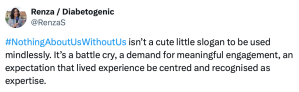
We have a hashtag in lived experience communities that is a rallying cry. I use it constantly because I love it, but I also often use it because I am frustrated. And that frustration led to this tweet a few weeks ago:

Tweet that reads: #NothingAboutUsWithoutUs isn’t a cute little slogan to be used mindlessly. It’s a battle cry, a demand for meaningful engagement, an expectation that lived experience be centred and recognised as expertise.

Saying #NothingAboutUsWithoutUs is how our lived experience community advocates for true community involvement and meaningfully change the status quo. We are the ‘us’ in the hashtag. The #dedoc° team uses it a lot because it forms the basis of so much of our organisation’s work. It is not okay for others to appropriate the term, seemingly hoping that it will lend them some credibility with PWD. It won’t.

There are stellar examples of how co-design works and can be truly branded with the #NothingAboutUsWithoutUs hashtag. The work that has been underway by a community group, to progress equity in access AID is one current example. The meeting in Florence that kicked this work off didn’t actually involve community. And yet, from there, a couple of endos in the meeting reached out to the community to put together a plan to make change that has a seat for everyone at the table. (And the fact that over 4,400 community members have signed this petition suggests that it resonates!)

It can be done! If you need some ideas for where to start, we really can’t make it any easier. Here are some guidelines that were launched earlier this year Jazz Sethi and I collated. It’s a really useful guide for how to kick things off. I think it’s time that we start asking questions when there is a claim of engagement. Let the burden of proof on that lay with anyone making the assertion. Because it’s easy to see when it’s done well. And even easier to see when it’s not.

Eleven years ago on Mother’s Day, my friend Kerry started something on her socials. Kerry’s mum sadly died when Kerry was just six years old. She doesn’t have a single clear photo of the two of them together. And so, Kerry has urged her mum friends to make sure they take a photo with their kids – a really simple and special way to make sure that memories are recorded. (You can search for #KTPhotoForMum to see some lovely shared posts.)

We’re not short of photos in our household – who is in the age of smart phones? – but I especially love the album that I have of Mother’s Day photos of me and our girl. Seeing her on this day for the last eleven years brings a special feeling of joy.

But there’s another feeling in there that I want to recognise, and that’s how proud I am. Of course I’m proud of her – she’s a marvel (excuse my bias). But I’m talking about hoe I feel about myself as a mother living with diabetes. Because pregnancy and parenting with diabetes is not an easy gig.

I struggle with this sometimes. I don’t want to be defined by being someone’s mum. I achieved a lot before I became a mother and have done plenty in the last (almost) 20 years that I am so very proud of. There’s travel and a career, and media work, lots of published writing and a whole lot of standing on stages talking diabetes advocacy. These are usually the things that I point to when thinking about my achievements. For some reason, I’ve felt it’s diminishing to point to motherhood as an achievement.

But the truth is, that motherhood with diabetes is an achievement and it is defining in some ways. Conceiving, growing a baby, bringing her into this world, and getting her to adulthood is something that carries a huge sense of pride. Because, damn, diabetes made that hard. Every stage of it.

I get it: pregnancy is natural and it’s been happening forever and there are bazillions of people who have done it for a bazillion years, but there is absolutely nothing natural about taking on the role of a human organ. Seriously! It’s hard at the best of times. Being pregnant adds a degree of difficulty that is incomprehensible until you’re in the midst of it. Even today with tools that are far more sophisticated than the basic pump that saw me through my pregnancy, it’s still not easy. (And I utterly recognise how lucky I was at the time having a pump. The women sitting next to me at the Women’s Hospital diabetes & pregnancy clinic on Wednesday mornings who weren’t using a pump were real magicians.)

At that time I was just so in the weeds of dealing with all that came with a diabetes-complicated pregnancy that I never thought what an incredible job I was doing just getting through it. After all when was I meant to cheer myself for the remarkable effort? Was it before or after the 20+ finger prick checks I was doing each day? (CGM wasn’t around then.) Or alongside the complex calculations that I needed to complete before pre-bolusing the right amount of insulin at the exact right time? It certainly wouldn’t have been during the thirty percent of the day I was below target because in those moments, I was too busy worrying about starving my brain (and baby) of oxygen.

And then there was no time after she came along, because babies are all encompassing and take up every moment of the day. And diabetes can also be all encompassing and is incredibly demanding.

I had no time to be a cheerleader for myself because every single part of me was focused on making sure my baby’s elbows were growing properly, and stressing about how any out of range glucose level was harming her growing organs. Any spare brain bandwidth was taken up feeling guilty because I never felt I was doing enough. I felt that I was probably already failing my child. Even though her elbows are beautiful (and her organs seem fine), I still carry that guilt. Almost twenty years later.

These days, as more people with diabetes share their pregnancy and parenting stories, I DO cheer. Every time I hear about chaotic first trimester hypos, and managing glucose levels around second trimester cravings, and third trimester insulin-resistance frustrations, I know they deserve a loud ‘Hurrah!’ and so I cheer. Because look at these amazing people! Look at what they are doing – the work, the emotional rollercoaster, the determined effort they are putting in to keep themselves and their baby safe! Diabetes never plays nice, and for so many, pregnancy is the most difficult time in someone’s diabetes life.

Yesterday morning, I looked at our daughter as we had our Mother’s Day breakfast in the sunshine. Having her is the hardest thing I have ever done – the hardest, the most emotionally challenging, the scariest – but also the absolute best and I am so very proud that I did.

This post is dedicated to my dear friend Kati who I am cheering for every day!

Black and white photo of me holding our baby daughter when she was only a couple of weeks old.
She doesn’t look like this anymore!

Is there no limit to what people will blame on diabetes?? Because apparently now it’s being blamed for the death of a woman after she was violently assaulted.

Emma Bates, a 49 year old woman from Cobram (a country town in Victoria) was found dead in her home on Tuesday. She had serious injuries to her head and upper body after being allegedly bashed by a neighbour. 

Friends and family have spoken about Emma and in their tributes, we learnt that she loved cats and was always helping people in her community. She had six siblings and was affectionately known in her family as the ‘crazy cat lady aunt’. It’s important to think about these sorts of things, because while we’re Counting Dead Women in Australia it’s far too easy to get lost in the horror of a rapidly increasing number, and stop centring the women behind each and every one of those numbers. 

Emma also happened to live with type 1 diabetes. And because she lived with type 1 diabetes, the man who allegedly assaulted her has not been charged with manslaughter or murder because there’s uncertainty if it was the horrific injuries he’s been accused of inflicting or her diabetes that caused her death. His 13 charges include intentionally causing injury, recklessly causing injury, aggravated assault of a female and unlawful assault. This from an Australian newspaper

‘… police told the family that murder or manslaughter charges were “off the table” after an early post-mortem examination was inconclusive about Bates’ cause of death.

She said the examination could not confirm whether Bates’ injuries caused her death, or whether her illnesses had played a part.’

Diabetes gets blamed for fucking everything.

Emma Bates. Say her name. Remember her name. She was one of us, one of our community. She lived with diabetes. And now it’s being used to diminish the severity of how her life ended. 

There’s been a lot said about AID equity over the last few weeks. Actually, way longer than that. The momentum may have ramped up since a meeting at ATTD in Florence, but this has been something that the community has been speaking about for ages. In fact, I found a policy document advocating for pump access for all people with T1D from ten years ago, and I spoke at its launch in Parliament House . In there is a direct quote from me: ‘I decided to start using an insulin pump because my husband and I wanted to start a family. I knew of the importance of tight diabetes management prior to and during pregnancy. Insulin pump therapy gave me the ability to tailor and adapt my insulin doses to provide me with the best possible outcome – a beautiful healthy daughter.’ 

For the last six years I’ve been talking about how transformative AID has been with quotes like this: ‘Short of a cure, the holy grail for me in diabetes is each and every incremental step we take that means diabetes intrudes less in my life. I will acknowledge with gratitude and amazement and relief at how much less disturbance and interruption there is today, thanks to LOOP (AID).’

But enough from me. This is an issue that the T1D community owns and is engaged in. Last week at the #dedoc° symposium at the Diabetes UK Professional Conference, brilliant diabetes advocate Emma Doble spoke about patient and public involvement, highlighting how it refers to being with or by the community, not toabout or for them. The AID equity work underway is definitely with and by. It’s something community is calling for as a priority. A visit to any online T1D group will demonstrate that, and spending any time speaking directly with community will provide insight into the number of people who simply cannot access AID because they cannot afford an insulin pump. This is standard T1D care. The evidence is clear.

To get an idea of just how the T1D, and broader diabetes community feels, have a read of their own words. These comments are from the Make Automated Insulin Delivery affordable for all Australians with type 1 diabetes petition. They’re all publicly available, so you can click here to read the comments I’ve shared and many, many more. 

Living with diabetes has made me acutely aware of the importance of screening. Eye screening, kidney screening, neuropathy screening, mental health screening – they’re all part and parcel of my diabetes care. 

In my mind, screening is a non-negotiable because I live with a chronic health condition that refuses to stay in its lane, instead, spreading the love around. And by ‘love’ I mean ‘puts a heap of other things at risk’. Diabetes, the gift that keeps on giving. 

Similarly, I’ve always (mostly) been on the ball on cervical screening. Regular Pap smears were booked in every two years. Cervical screening is different now. It’s done every five years (yay!) and is expected to protect almost a third more people from cervical cancer than the Pap smears of old (also yay!). AND there’s a DIY version for those who would prefer. I love it when progress makes unpleasant medical procedures slightly less unpleasant!

After last year’s BIG birthday, I knew that there would be more screening, and sure enough, almost before I’d blown out the last candle on my drawn-out birthday celebrations, both the Australian and Victoria Governments were sending me love letters to help me protect my health. The Australian Government’s bowel screening program came with a kit to do the screening at home. And the Victorian Government sent me a letter, urging me to make an appointment for a breast check.

Diligently, I did just that and had a mammogram at a local BreastScreen Victoria centre. That was about three weeks ago. I didn’t think about it again until I was about to board a long-haul flight home and opened an email asking me to come back for a follow up appointment. There were changes on my screening mammogram that needed to be investigated further. I had a fun 30-hour transit home imagining every possible catastrophic scenario (because: melodrama) and have spent the last week and a half oscillating between ignoring things and stressing over them.  

And that brings me to today. This morning, I had my follow up appointment, and the short story is all is fine. (The very slightly less story is I had a 3D mammogram, my breasts contorted into expert-level origami configurations, and a million images taken to show that all is okay. Come back in two years.)

Walking back to the car, I took deep breaths, scolded my stupid brain for insisting on making things bigger and scarier than they ever need to be, and then reminding myself that I should be kinder because it’s not just this screening that was influencing how I felt. 

I don’t know what it’s like to not live with a chronic health condition that places so many expectations for regular health checks and pressures on my mental health. Honestly, I wish I did. Because I know that the way that I am feeling – the anxiety, the stress, the worst-case-scenario obsessing – is so shaped by twenty-six years of living with diabetes. I can’t switch off these feelings or react differently. I can’t force myself to think of things through any other lens, because everything I see is through diabetes-coloured glasses. 

This is the reality of living with diabetes. And it’s the legacy of scary images and campaigns and messaging that told me it was all inevitable. Of course I’m going to expect the worst because I heard that all for so very long. It wasn’t a giant leap for me to head straight to thinking the worst thing about a call back following a mammogram.

And so, because community is everything to me, as soon as I could I reached out to a friend who has had breast cancer. I needed to connect with someone with lived experience. Who better to try to talk through things? And the next person was a friend with diabetes who had recently had an experience that pretty much mirrored mine (and the same outcome). Of course I read everything I’d been sent from BreastScreen Victoria, but I needed to humanise the situation. And the only way I could do that was by speaking with people with lived experience, who could climb in beside me and wrap me up in a quilt of understanding and reality. Community really is everything. – whichever community it is.  

WHILE WE’RE TALKING COMMUNITY…

If you’ve not yet shared and signed the petition for equitable access to AID for Australians wth T1D, please do! This is a community-driven initiative, created by people with diabetes in consultation with other stakeholders who have come together to advance advocacy on this issue. It’s getting close to 1,500 signatures already, and I’m seeing it shared widely in community groups and organisations. Thanks to everyone who has supported the community by being part of this advocacy.

Click to sign
Follow Diabetogenic on WordPress.com

Enter your email address to follow this blog and receive notifications of new posts by email.

Read about Renza

Archives