Sometimes it feels as though discussions in the diabetes are seasonal. Like clockwork, we see the same conversations happen at the same times. Without missing a beat, almost as soon as a scientific conference is over, someone will comment about how difficult it is for PWD to get to conferences (true, however this year, #dedoc° voices could have assisted a number of the people who were stating that), and then there are discussions about disclosure by PWD who are fortunate to attend, even though pretty much every advocate I know who attends these sorts of things does a stellar job of disclosing. 

And of course, the nature of the first big meeting of the year, ATTD, means that there inevitably will be noise about the gap in technology access. And you bet this is a discussion that we need to be having on regular rotation. 

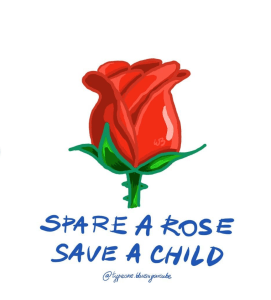
After attending my first ATTD, I wrote a piece about the complete and utter dichotomy of being at a conference that was only talking about the latest and greatest in technology while, at the same time, whilst the community was in the midst of its usual Spare a Rose month of fundraising. I struggled to balance the idea that we were talking about automated insulin delivery at the same time as urging donations so people could just get insulin!

Today, I’m revisiting the piece I wrote after last year’s ATTD, where my worlds of diabetes technology and language matters merged, and combined this with the over-representation of those at the super-dooper-tech-y end of the diabetes technology spectrum. (‘Super-dooper-tech-y’ is, obviously, a very technical term.)

I don’t for a moment think that meetings with a strong tech focus should end, or that those who are innovators in technologies should take a seat and let others speak. I don’t believe that at all. I will be forever grateful to the pioneers who continue to push the envelope and make things better for people with diabetes. But I do think that we need to ensure that there is equal attention to those who – by choice or because of their circumstances – are not walking around with an algorithm driving their diabetes.

If we truly believe that all diabetes stories matter, then we need to hear from people doing diabetes in every way possible. Perhaps if we make more of an effort to find and hear those stories, we will stop minimising our experiences, and starr seeing that whatever we are managing to do is truly enough…

DISCLOSURE 1 (for ATTD 2020) 

I was an invited speaker at #ATTD2020, and my registration was covered by the conference organising committee. My airfare and part of my accommodation to attend ATTD was covered by Lilly Diabetes so that I could participate in the DOCLab advisory group meeting which took place on Friday, Saturday and Sunday. Other accommodation was covered by DedocLabs (I am an advisor for the #dedoc° voices program) and Novo Nordisk (I am a member of DEEP). I have not been asked to write or speak about any of the activities I attended, or anything I have seen at the conference. 


We all do a good job at undermining ourselves at times. We use a four letter word that diminishes what we are doing, and limits the value of our experience and expertise. That four letter word is ‘just’.

In diabetes, we hear it all the time: ‘Oh, I just have type 2 diabetes’ as though it is insignificant and doesn’t have any challenges. ‘I’ve lived with diabetes for just a couple of years’ because we think there is only currency in decades of living with the condition, when really any length of time with diabetes is meaningful.

And we are all about minimising our experience when it comes to the treatment of our diabetes. ‘just use diet and exercise to manage my type 2 diabetes’ or ‘I’m just on tablets’ or ‘I’m just on injections twice a day’ or ‘I’m just on MDI’. The list goes on and on. And on.

I realised just how ridiculous we have become with this when I heard myself, during a conversation with a fellow Looper, ‘Oh, I just use Loop’. (More on that later…)

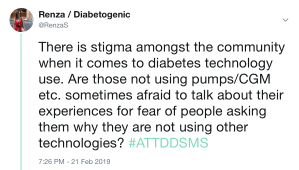
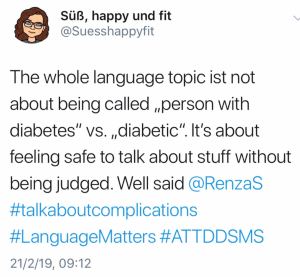
At the Ascensia Social Media Summit at ATTD we spoke about this, specifically how there is almost a stigma within the diabetes for those seen to not be using the shiniest and brightest and newest of technologies. It seems that some people almost feel embarrassed if they are not constantly updating their technology toolkit with the most recently launched product.

The idea that anything that we are using today is ‘yesterday’s technology’ is wrong. Blood glucose monitoring can’t be ‘yesterday’s tech’ if it is what most people are using to track their glucose. And syringes and pens can’t be considered the ‘old way to deliver insulin’ when that is how the vast, vast majority of inulin-requiring people with diabetes get insulin into their bodies. Plus, every single one of us using a pump must be able to deliver insulin this way because machines break.

Somewhere in discussions about our treatment technologies, we seem to have forgotten that, actually, not everyone wants to be using the latest kit. And that is okay. There is a spectrum of diabetes technology, and as long as we are on it somewhere and managing our diabetes the way that works best for us, then elephant stamps all around!

There is clearly an over-representation of people at one end of that spectrum dominating on and off line conversations. Spend a couple of hours in a diabetes Facebook group and it would be a reasonable assumption that most people are wearing pumps and CGM. But that’s not true.

And it could appear that DIYAPS is the way to go for most people with T1D, when the fact is that numbers are relatively low. It’s hard to estimate exactly, but there may be somewhere between 2,000 and 3,000 worldwide how have ‘built their own pancreas’. That is just a drop in the type 1 diabetes ocean.

It’s fantastic for those of us interested in this technology to be able to (virtually) congregate and talk amongst ourselves. I learn so much from my peers in these groups – just as I have with all aspects of life with diabetes. The lived experience continues to trump any other way of learning about diabetes.

Of course, that doesn’t mean that we shouldn’t be talking about technology used by limited numbers. Of course we should. We want others to know about it so they can make an informed choice about whether it may be right for them.  We want our HCPs to know about it and to support those of us using all sorts of technologies and treatments.

Where it becomes problematic is when there is the misconception that this is the norm. Or when those not using the newest technology feel that they are wilfully doing diabetes the ‘old way’. It’s unfair to think for a moment that those who are not using the tech ‘don’t care’ enough about themselves – especially when decisions are made based on a very good understanding of what is available and what they have decided works best for them.

So, back to my ‘Oh, I just use Loop’ comment. It was directed to someone far more technologically advanced than me; someone who runs all sorts of other programs alongside their DIYAPS. They generate lots of reports and make lots of changes and seem to have far more bells and whistles than I even knew were available.

I nodded as they told me all they were doing and then, when they asked me how I manage my diabetes, I answered that I just use Loop. I heard myself saying it and stopped and corrected myself. ‘I meanI use Loop. It works for me. Perfectly.’

We don’t need to make excuses for doing diabetes our own way. If we truly have choice (which I know is not always the case), and we have made the choice based on what we believe to be the best possible treatment and technology for us at that moment, then surely that’s a great thing. We shouldn’t ever be made to feel less committed to our own health and wellbeing. That’s not how it works.

DISLCOSURE 2 (for ATTD 2019)

I was invited by Ascensia to co-chair the Diabetes Social Media Summit at ATTD (#ATTDDSMS). I did not receive any payment or in-kind support from them for accepting their invitation. I have co-written a piece for the blog, however this was not edited (apart from inevitable jet-lag-induced typos) and all words are those of mine and the piece’s co-author. You can read that piece here.  

Happy International Women’s Day!

I usually acknowledge this day with a post about some of the amazing women that we see in the diabetes world. Instead, today I’m going to take a more personal approach and mention some of the women who have so impacted me recently. Some will have been mentioned before – but maybe that’s because they continue to be the women who I look to. (I’ve linked to their Twitter accounts where possible.)

Kerri Sparling

Cherise Shockley

Melissa Lee

Daniela D’Onforio

Georgie Peters

Sana Ajmal

Lis Warren

Johanah Co

Anita Sabidi

Philissa Deroze

Mila Clarke Buckley

Heather Rose Walker

Anne Cooper

Kelly Close

Sofia Larsson-Stern

Stephanie Haack

Anna Sjoberg

Erin Akers

Jo Watson

Dana Lewis

Jane Speight

Katarina Braune

Jasmine Schipp

Katharine Barnard

Bodil Rasmussen

Jane Dickinson

Fauzia Moyeen

Alicia Jenkins

Cheryl Steele

Deb Greenwood

Emma Wilmot

Nina Mills

Marissa Hitchcock Town

Ann Morris

Ashley Ng

Melanie Stephenson Gray

Emma Stendhal

Krystal Boyea

Moira McCarthy

Andrea Limbourg

Melinda Seed

Corinna Cornejo

Elizabeth Snouffer

Kelly Kunik

Rachel Portelli

Antje Thiel

Natalie Wischer

Helen Murphy

Patricia Santos

Pei Yan Heng

Daniele Hargenrader

Lydia Parkhurst

Karen Addington

Melissa Holloway

Lesley Jordan

Taryn Black

Ilka Gdanietz

That’s a pretty long list and it barely scratches the surface. But it serves more than the purpose of just signalling some of the women whose paths I’ve crossed in recent times, or whose work has inspired me in some way. It is a list to show just how easy it is to find women who are experts in diabetes in one way or another. It shows how women can just as easily be singled out to stand on a stage, sit on a panel, be interviewed in front of a camera to talk about diabetes.

Because that’s not always happening as equally as we would like.

Last year, at the IDF, the Women and Diabetes stream was led by a man (as it had been at the previous IDF Congress); there is only one woman on the advisory panel for ATTD; gender balance when it comes to speakers at diabetes events is generally not even close to equal; panels are often dominated by men.

All the women I have mentioned have, in some way, been trailblazers. I know many of them quite well, and I have seen and heard the challenges they face, the looks given around them when they speak and write, and the words that are used to describe them when their challenges hit a nerve. There is no one way that we choose to do our advocacy or our work. But our personality – how loud or quietly we do it – shouldn’t be a measure of anything.

Recently, a couple of people have referred to me as ‘strident’. My views and opinions have also been described that way. For the record, I didn’t ask for an assessment of my personality or my opinions; these were offered up to me (by men) who thought that my confidence and directness – and stridency – was part of the reason that I’ve been having a slightly tough time in some parts of the diabetes world lately.

Strident is a word that mostly seems to be directed towards women who will not go quietly, who stand up and challenge the status quo, who are seen to rock the boat, who want to be heard, who have opinions and are not afraid to share them. Sometimes, our anger and frustration comes to the fore and that is seen as us being unable to control our emotions. We’re not always called out overtly; sometimes instead there is reference to the preference for ‘moderate voices’. Moderate voices and opinions are okay. Strident ones? Not so much.

But you know what? I’m owning it. In much the same way that I have embraced the term ‘deliberately non-compliant’, I am now taking on board the term strident. You bet I’m a strident woman and I am proud to say that. And I’m proud to stand alongside dynamic, passionate, smart, controversial, sassy women who will not, and do not go quietly. Strident women – I know them and I am one of them. I am in outstanding company.

Previous IWD posts

IWD Interweb Jumble (2019)

The Women (2018)

Hear Me Roar (2017)

The F Word (2016)

My head is firmly in the language space at the moment, thanks to a big piece of work I’m involved in. So, I’m sharing this post from last year. I remember being frustrated during a session at ATTD last year where a roomful of diabetes advocates were acknowledging how stigmatising and damaging language could be – and equally, how positive and positively powerful it could be, too. My frustration was because despite some pretty insightful tweets going out from people at the event I was in, the online discussion pivoted it all to being about the diabetic/people with diabetes debate (despite this NOT even being discussed in the session), and then how some people with diabetes don’t even care about the words used. 

So, twelve months on from first publishing this post, some people do occasionally call me Blossom. I’m okay with that. It’s my decision. And as a person with diabetes I get to decide how I talk about diabetes, just as every other person with diabetes can. I’m pretty sure that’s been my personal opinion about diabetes language matters for more than decade now: it’s our diabetes. We get to talk about it however we want. 


These days, it’s impossible to be at a diabetes conference and not have at least one conversation somewhere about language. Sometimes there are sessions dedicated to the topic on the program, but that wasn’t the case at ATTD a couple of weeks ago – a conference solely devoted to advancements in diabetes technology and treatments.

But despite there not being a session about language, it was still a hot topic. My eagle eye was trained when walking through the exhibition centre for examples where diabetes is misrepresented or the language used stigmatises people living with the condition. And in sessions, I immediately heard terms that suggested that we are misbehaving because the results of treatments aren’t living up to their promise. (A new one: I heard the statement ‘People with diabetes on <therapy> were not performing as expected’ which now makes me think that we are being trained, watched and judged by pageant mums/moms.)

At the Ascensia Diabetes Social Media Summit (more on that another day), there was a discussion about language and diabetes-related complications. This event was a follow on from the one we had at the Australia Diabetes Social Media Summit, and took the initial conversations and expanded it with a new group of PWDs.

Once again, as the discussion unfolded, it was clear to see that the PWD in the room all had experiences where the language they were faced with had impacted negatively and positively. One person commented that early on in their diagnosis, a health professional had addressed diabetes-related complications by saying ‘If you are diagnosed with a diabetes-related complication it will not have been your fault.’ What an empowering way to begin the discussion about complications, care and risk reduction!

I’ve been talking about language for a number of years. Some may call me a one trick pony and, honestly, that’s fine. My appetite for the subject matter has not diminished one bit despite more than a decade of speaking and writing about why language is so important and holds such power.

Language is not a one dimensional issue. Additionally it does not necessarily have a ‘right way’ to do it – especially when looking at it from the perspective of the person living with diabetes. The work I have been involved in has never been about policing the words used by people with diabetes, but rather how words used by others affect us.

It’s why the piece Grumps and I wrote for BMJ  was important – it targeted healthcare professionals, explaining to them why the words and language used around diabetes-related complications needs to not make us feel hopeless. Because that is what can happen and when we feel that way, it is all too easy for diabetes to seem just too big and too hard and too much.

I have frequently written about how diabetes can become so overwhelming, that it can leave us unable to attend to even the most basic and mundane of diabetes management tasks. I myself have been paralysed by the detail and demands of this health condition. I understand that there are times when a conversation about language is not possible, because, quite frankly, there is a lot more to deal with. I know that there have been moments when even though I can hear judgement and blame in the words being directed at me, all I want to do is find a way out of what feels like a hole. I’ve heard others say that they have felt harshly treated by HCPs, but simply didn’t have the capacity to try to deal with that because there were other things higher up on the list.

And I am sure that there are people who simply wouldn’t even know where to begin if the words and language being directed at them were disempowering and negative.

But that is exactly why language matters. It is for the people in those situations – for me when I was in that situation – that we need to get the way we communicate about diabetes right.

I am so sick of people trying to delegitimise the language discussion, or, even worse, reduce it to something that is insignificant. It frustrates me when the discussion returns again and again and again to the diabetic/PWD debate. As I said at the Ascenisa event at ATTD when we were discussing the annoying way some try to redirect meaningful discussion back to this single issue: ‘You can call me Blossom for all I care, language is about far more than this.’

And I think that while it is critical that we acknowledge that sometimes the language issue isn’t going to be a priority for some (by choice or otherwise), it seems unfair – and a little counter-intuitive – to diminish its importance, or criticise those of us trying to keep it on the agenda and actually do something about it.

(Click for original tweet)

DISLCOSURE

I attended the 2019 ATTD conference in Berlin. My airfare and part of my accommodation was covered by DOCLab (I attended an advisory group meeting for DOCLab), and other nights’ accommodation was covered by Roche Global (I attended the Roche Blogger MeetUp). While my travel and accommodation costs have been covered, my words remain all my own and I have not been asked by DOCLab or Roche Global to write about my attendance at their events or any other aspect of the conference. 

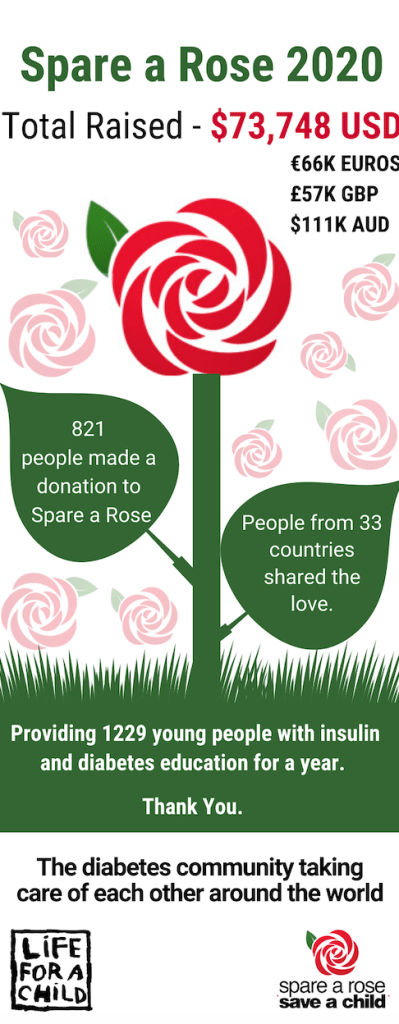
Look what our community did! Here is the just released #SpareARose total for 2020. What a remarkable effort from a remarkable community!

The grand total of USD$73,748 will mean that, through Life for a Child, 1229 children with diabetes in under-resourced countries will have access to insulin for the next year. Amazing!

I guess there’s nothing more to say for this year, other than thank you, thank you, THANK YOU to all who contributed – whether that be through a donation or sharing the campaign.

Spare a Rose, Spare a Child will be back next year. Each year, we promise it will be bigger and better, and I’m sure that will be the case for 2021. Just watch us all go!

‘Art is not a mirror held up to society but a hammer with which to shape it’. (A quote usually attributed to German playwright and poet, Bertolt Brecht, but actually first said by Trotsky.)

Using different artforms as advocacy platforms is not new. In my time working in diabetes (18 years), I’ve been lucky to be involved in a number of different initiatives with foundations very much in creativity and the arts. Perhaps my previous life as a musician – and being married to one for over 21 years – means that artistic approaches are always on my mind when looking at how to tell the story of diabetes.

When planning for the IDF Congress last year, a gap came up in our session on advocacy and diabetes awareness initiatives. Our Living with Diabetes stream committee wanted to look outside the box and move away from traditional awareness campaigns. ‘How about we get Appleton in?’ And that’s how we had a street artist from New York appear on the program in Busan last year in a session with the same title as this blog post!

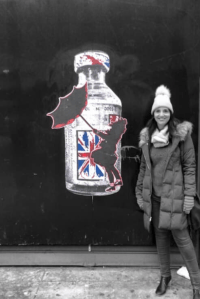
At that time, I’d not met Appleton in person before, but I had come face-to-face with his artwork. (He’s on Insta here.) There is something quite magical when wandering the streets of NY to look up and see a bottle of insulin stuck to the wall of an old building in SoHo, or in Chelsea. I’d snapped photos and shared them to Facebook, wanting to learn more about the artist: Who is he? What is his story? What is the response to his artwork? After meeting him in Busan, and then again at a mutual friend’s place for dinner in NY, Appleton hosted me and my family in his New York studio one rainy afternoon in January and I learnt a lot about his work.

Appleton on W 23rd street.

But even before meeting Appleton, I’d seen the power of how different artforms have the potential to talk diabetes in different ways.

Australian actor and playwright, Alan Hopgood’s play ‘A Pill, a Pump and a Needle’ from a few years ago, told the story of three women living with diabetes. Chatting after a chance encounter in a café over coffee and cake, this was a quintessential Melbourne story! But it was also a great way to start a conversation with those who were lucky enough to see the play. I sat in the audience a number of times, then took to the stage to be part of the panel discussion. Mine was one of the stories that had been brought to life on stage and it was incredible to hear the number of people who watched the play and said that they could see themselves in the women’s stories. ‘Their stories are my stories are their stories,’ I would think to myself.

One year, my team at Diabetes Vic held an art competition for World Diabetes Day, asking children living with diabetes to submit an artwork depicting diabetes. The only requirement for submission was that the artwork needed to somehow incorporate the Blue Circle. I remember the way these pictures offered a most meaningful and impactful representation of life with diabetes – in ways that we’d not seen before. I still have one of those artworks hanging in my office. Its 14-year-old artist managed to perfectly capture the pain of diabetes balanced perfectly with the hope she felt. I’ve been looking at it a lot in the last week, breathing in deeply and letting her feelings of hope wash over me.

A number of years ago, The Diabetes Hands Foundation asked for submissions for an anthology of poems by people with diabetes. Selected poems were compiled in the book ‘No-Sugar Added Poetry’ – a copy of which sits on my bookshelf and is frequently pulled down and perused. In her introduction, Lee Ann Thill says ‘From words, carefully chosen, purposely arranged, emerges a shared experience and mutual understanding’. In other words, peer support through poetry.

And while mentioning Lee Ann… Diabetes Art Day was created by this dynamic advocate and art therapist to encourage people affected by diabetes to use whichever artform they wanted to express diabetes. I remember sitting around the kitchen table with my family, trying to show how we feel about diabetes with coloured paper, glue sticks and rubber letter stamps and ink.

Illustrator, Janina over at Miss Diabetes is absolutely brilliant in her depictions of diabetes. And, of course, comics by Claire Murray are still my favourite diabetes superhero tales. And my friend Weronika at Blue Sugar Cube, creates stunning pieces – her Spare a Rose designs were so gorgeous.

Click to be taken to Weronika’s Insta page.

Australian advocate Jenna’s artwork is nothing short of stunning. I bought one of her beautiful images earlier this year and need to get it framed so I can stare at it endlessly when I should be writing!

Click to be taken to Jenna’s Insta page.

Melissa Lee has combined her beautiful voice, brilliant sense of humour and story-telling powers to sing diabetes in ways that get us thinking, smiling, laughing…and crying.

As for me? Well, I create through baking and have managed to create some pretty damn fun and delicious cookies to mark important days and initiatives in the diabetes calendar.

And of course, storytelling is an artform, and I know that for me personally, that is how I have connected and felt supported by people affected by diabetes from every corner of the globe. Words have a power that can convey the very helplessness, hurt, hope and heartbreak that is real in diabetes, and as I frequently say, the stories people tell have always helped me make sense of my own diabetes.

Art has the power to reach people in ways that other, more traditional methods don’t. Health campaigns are important, but sometimes they seem just one step removed from the reality of real life. Art has the power to bridge that step and bring people together, and provide a fundamental understanding of the story being told, and the people behind those stories.

So back to the quote that opened this post: art can – and does – shape how diabetes is seen within and outside our community; it can influence how people outside the diabetes community understand diabetes, and within the community, offer different ways to think of things. It can start conversations that encourage us to consider others’ ideas; it pushes boundaries and forces us outside our comfort zones; it gives voice to people in the community who don’t necessarily want to use words to express how they feel. Advocacy using art can also cut through the white noise of health campaigns – often they all look and sound so similar that they are easy to ignore. But for me, I think the most powerful thing they give is humanity and hope to a condition that is often so misunderstood.

Diabetes burnout is real, and it takes many different forms. In the past, I have been burnt out to the point of a complete inability to do any sort of diabetes task. Other times, I have just muddled along with low-level haziness and apathy with and at my diabetes. Sometime burnout has been caused by such a deep hatred of diabetes that the very idea of actually managing it is impossible. Focusing on diabetes after a miscarriage ridiculously felt like a betrayal to the baby I’d been unable to keep. My broken body had not been able to carry a baby, and there I was still tending to it – to the very part of it that I held responsible for the loss.

Today, I am burnt out but in ways that are different and if there was such a thing as a burnout spectrum, I wouldn’t think that I am at the really serious pointy end. I suspect part of that is that those diabetes tasks that once seemed impossible during periods of debilitating burnout are far fewer these days. Having to refill a cartridge and change a canula every three days, calibrate a CGM occasionally, and change a sensor even less occasionally is manageable for me even while I am feeling the way I am right now.

The bottom line is that at the moment, I don’t want to do diabetes and that is a big shift from where I have been since using Loop. It is also a big shift from where I usually am after attending a diabetes conferences and being surrounded by friends. This usually gives me a kick of motivation and focus, allowing me to put in a little more effort which generally yields pleasing results.

Instead, I am a mere 48 hours back from one of those occasions of peer support and I am staring at diabetes with that deep-seated hatred that feels unfamiliar these days. This has not sprung on me all of a sudden. It’s been brewing and fermenting over the last few months. It’s a combination of diabetes being diabetes and some advocacy burnout that has hurt me in ways I never imagined possible. I’ve not felt comfortable mentioning it because what the hell do I have to be burnt out from? My automated insulin delivery device that does most of the heavy lifting for me? The CGM on my arm that barely beeps at me? The support of friends and family? The ease of access to any sort of health professional I need? My diabetes isn’t first world diabetes, it’s first class diabetes so why would I possible be feeling crap about it all? (Oh good, let’s add some guilt to the way I’m feeling too then, shall we?)

And I’ve not felt comfortable mentioning it because, apparently, I am so self-confident and resilient that these things aren’t meant to happen to me. Or rather, that is the perception that a number of people have felt the need to share they have of me. (If anyone can locate that resilience, I’d really like some of it back. It is AWOL in the same way my beta cells are, and I am finding this all rather inconvenient.)

This brand of burnout has been joined by something new. I have had a couple of panic attacks over the last few weeks and the repercussion of those has been to suddenly feel very wary about my ability to make decisions about diabetes – my own and how I read things in the wider diabetes world. I am back to second guessing myself – a behaviour that I really had managed to positively change thanks to devices that I trust implicitly. As it turns out, those devices are smarter than me and as much as I was a maths whizz at school, I am no match for an algorithm that knows my diabetes better than I do.

But the bits I need to do? I’m misfiring left, right and centre.

I stared at a low glucose level on my Loop for two hours yesterday, unable to process exactly what I needed to do to deal with it. The low was entirely my fault. I’d forgotten to change the time on my pump when I arrived back into Melbourne because I was dealing with a more pressing matter – namely, staying out of quarantine. (Airport panic attack led to me trying to remember how to breathe properly rather than making that time zone change. I felt it better I focus my efforts on minimising the effects of said panic attack in an endeavour to keep away staff on heightened alert because of a global respiratory virus epidemic.)

I did a sensor change yesterday morning and it bled all over the place and felt terribly painful, and instead of just ripping it out and starting again, I wept – at the blood, the waste of a thrown-out sensor. And having read not long ago someone refer to CGMs as non-invasive.

So here I am. Burnt out, overwhelmed and feeling broken into little pieces. Oh, and terrified to write about it because I am finding corners of the world that I usually turn to when I am feeling like this not especially kind at the moment. (Unlike other times when my tribe has been amazing as I’ve navigated the tricky waters of the burnout continuum.) But I’m sharing anyway, because it’s what I do, and my mess is my mess and this blog is my blog and so somehow this feels the right place to dump the chaos and clutter I am trying to tidy up and make sense of.

Burnout is real. This feels hard and sad and more than a little scary. And it’s a reminder that no matter how well we think we are doing with diabetes – and no matter how we seem to be on top of things to others – there is always the chance that it overcomes us. That seems just so terribly, terribly unfair.

When I first started working for a diabetes organisation, the first big project I oversaw was the development of a booklet providing information to young people living with type 1 diabetes. After approaching a few others out in the community working with and supporting this cohort, I was promptly reprimanded by one person who told me in no uncertain terms that I (and the organisation I was working for) should butt out, because this was not our space; it was this group’s area. I was somewhat astonished at the idea of ‘owning’ a segment of the diabetes community. How did that happen? Who decided that? I was a young person with type 1 diabetes at the time (obviously, this was years ago!), and I didn’t feel especially well-represented by any one group, and I certainly objected to the idea of someone deciding that their group spoke for me and my ilk.

The diabetes community is made up of many, many voices (some louder than others), and each person has different priorities for their own diabetes, and the broader issue of diabetes in general. We see that every day with different campaigns that are driven by people in the community. Some of the most visible are movements or campaigns that employ hashtags such as #Insulin4All, (although the insulin affordability discussion encompasses more than just this hashtag), #NothingAboutUsWithoutUs and #WeAreNotWaiting, and, as we are still in February, #SpareARose. (Not too late to donate, folks!)

Actually, #SpareARose is an excellent example of this. It may have been started by a few incredible advocates, but they never felt the need to identify themselves as the ones who led or created it. They encouraged anyone and everyone to be involved in any way they could – to donate, to share, to write about it, to make vlogs. It is owned by all and by no one at the same time!

At ATTD last week, Chris ‘The Grumpy Pumper’ Aldred and I took to the stage to do a presentation on #TalkAboutComplications, which incorporates the under-discussed issue of diabetes-related complications and its intersection with #LanguageMatters. Our talk was in a session that incorporated presentations focusing on peer support and diabetes online community and technology – all very much ‘user-led’ initiatives and movements.

These campaigns are not about everyone having the same idea and perspective. People approach different issues in different ways. One person’s peer support ideal is another person’s living nightmare! And #LanguageMatters remains a topic with myriad ideas and expectations for just how embedded it should be in the hearts and minds of our community and beyond.

But it is undeniable that no one really claims ownership of any of these movements. While Grumps may have tweeted that hashtag #TalkAboutComplications first, I know that he doesn’t feel that he ‘owns’ it, or discussions around it. Rather, he used it as a rallying cry to bring people together – to find a tribe, so to speak, and to connect people with diabetes searching for information and support about the realities of living with diabetes-related complications.

I (and a couple of others) have been accused of claiming ownership of #LanguageMatters because of our frequent posts, tweets and other commentary on the issue, but anyone who has aimed that accusation at me has either never heard me speak about the topic or read this blog. Whilst I may be extraordinarily proud that I work for the organisation that developed and launched the first position statement addressing this topic, and I have been invited to speak about our work a number of times, I very clearly point out the origin story of this movement, and that is very much a story from the diabetes community.

People with, or affected by, diabetes have been speaking about how words and language impact for a long time. Older online discussion boards frequently held debates about PWD/diabetic for as long as I have been diagnosed (and I’m sure, many years before that).  Parents of kids with diabetes shared how they felt judged and shamed by the words used by HCPs when their kids A1Cs were out of range, feelings echoed by adults with diabetes.

I remember one of the first articles I read in Conquest magazine (Diabetes Australia’s magazine back when I was diagnosed) was by Gordon Bunyan who eloquently wrote about how words matter. Gordon has become a good mate, and over the years I’ve turned to him regularly to talk about this issue. And I remember hearing how teenagers at camps instigated change when it came to the language used when talking about glucose levels, moving from using good and bad, to the more factual high and low. That was back before I was working for the organisation involved in those camps.

Diabetes Australia, in developing that position statement, wasn’t sticking a flag in the issue, claiming ownership – and nor have any of the people involved in its development. It was a response to something that mattered to people living with diabetes – people who told us repeatedly that the words spoken to and about them, the attitudes that those words conveyed and the feelings they had when different words were used had the ability to empower or harm.

Having organisations build programs, activities, resources and services around what people affected by diabetes are talking about unites the community. It also demonstrates a willingness to listen and acknowledge the value of lived experience. That was the thinking behind the development of DIYAPS and low carb position statements. Acknowledging PWDs’ right to choice of treatment truly does put us in the centre of the discussion.

I should say that I am not undermining that leadership that organisations and individuals show when taking on these issues. It does take people to run with the ideas and turn them into something – whether that be a position or guidance statement, or different service or resource. I admit to occasionally feeling a level of frustration that legitimacy of some of these important-to-the community issues only comes when they have been made ‘official’ by an organisation, but I also know that all stakeholders involved is important; that together we are stronger!

Last week we saw on show discussions that have their foundations very much in the community. They may have moved into the realm of HCPs and researchers, and the conference stage. But it is well worth remembering where – and why – they originated.

DIYAPS – started in the community and now on the program at ATTD!

DISCLOSURES

I was an invited speaker at #ATTD2020, and my registration was covered by the conference organising committee. My airfare and part of my accommodation to attend ATTD was covered by Lilly Diabetes so that I could participate in the DOCLab advisory group meeting which took place on Friday, Saturday and Sunday. Other accommodation was covered by DedocLabs (I am an advisor for the #dedoc° voices program) and Novo Nordisk (I am a member of DEEP). I have not been asked to write or speak about any of the activities I attended, or anything I have seen at the conference. 

Nothing to see at diabetogenic today. All the action is over at the Spare A Rose donation page. Watch the diabetes community go, supporting this simple, yet important, campaign. For as little as AUD$7, you can provide a month of insulin   to a child with diabetes in an under-resourced country. I challenge you to tell me of a better way to show your love.

Please do what you can – every single donation helps. Just click to donate and #SpareARose.

What would you change about your diabetes diagnosis?

Mine was almost 22 years ago, but much is still fresh in my mind. While there is a lot I am eternally grateful for, such as the speed and accuracy of diagnosis, and the way I was easily able to access specialist care, there are things that I wish were different.

One of those things is the line-up of HCPs that was offered to me. Making sure I knew the basics of daily diabetes management, the importance of knowing how many carbs I was eating, and the impact of activity, were, of course, critically important to learn before I was sent on my way. But diabetes was presented to me with this very one-dimensional approach. It was all about the magic carb/insulin/activity equation. Get that right and all would be relatively simple.

I had the relevant HCPs that could help me get that equation right – the endocrinologist, the diabetes educator and the dietitian. This was the holy trinity of diabetes care, I was told. This was the team that had diabetes knowledge to share.

And perhaps, if I’d been able to keep diabetes all about numbers, that trio would have been enough. Alas, it didn’t take long for this new-to-me medical condition to move to my head. No one mentioned the anxiety and fear that started to accompany the distress that was due to not being able to meet any of the targets I’d been set, and feeling overwhelmed by just how much diabetes there was to do. Or the disordered eating that may creep into my thinking because of this sudden focus on food in a different way. Or the crippling fear of complications that was keeping me awake at night.

I wish a version of these words had been said to me: ‘Diabetes is not easy. You can do this, but it is not easy. But we are here to help you. And endocrinologist and educator can help you with the practical side of diabetes. Food questions can go through your dietitian. We have an arsenal of allied health professionals to think about when it comes to doing all we can to reduce the risk of diabetes-related complications. And if you ever feel that you are becoming overwhelmed or anxious or distressed, if you ever want someone to talk with someone about how you are feeling to work through what’s going on outside the clinical aspects of diabetes, we have someone here for that too. It is perfectly, perfectly normal for you to feel all of those things. It is also perfectly normal for you to not feel them! We can help with whatever you need.’

Planting that seed would have made those first few years – those years before I found an endocrinologist who did say those words to me – so very, very different. I may not have understood why I might need, or rather want, to see a psychologist straight away – I didn’t understand what diabetes was, let alone how it was going to impact on my emotional wellbeing – but I wish that I had known from the very beginning that I had easy access to a one if and when I needed it. And that it was perfectly understandable if I did.

While I believe that GPs, endocrinologists and educators all have a role to play in talking about emotional wellbeing, they are not experts in this area. Having our diabetes HCPs acknowledge the high mental burden diabetes places on us is reassuring, but they may not be equipped with the strategies to help us lighten that load. But a psychologist can – especially one that works with people living with diabetes or other chronic health conditions. Plus, I repeatedly see HCPs say that they don’t have time as it is to ask about mental wellbeing, because there is already so much to do in the allotted appointment time.

Here’s the thing: so, so many people with diabetes are not reaching targets. Now, while I don’t agree with measuring diabetes success on numbers, that is still the way that it is done in many settings. And with that in mind, so many of us are above recommended glucose levels and our A1cs don’t even closely resemble what guidelines tell us to aim for. Clearly what we are doing now isn’t working, in fact, I’ll be so bold as to suggest that the current standard HCP line up is not necessarily best for PWD. Would adding a psychologist to the mix help? Would the expertise a psychologist can offer to help us learn how to address behaviour change, distress, anxiety result in not only feeling better about diabetes overall, but also improve those other measures?

I am not for a second suggesting that everyone with diabetes should have to see a psychologist. I don’t think that PWD should have to see any HCP they don’t believe is helping. But I do believe that we should be able to access a psychologist as easily and readily as we can any other diabetes HCP. Psychologists should be integral in multidisciplinary teams in diabetes clinics in the same way that educators, dietitians and endocrinologists are.

In my experience, it wasn’t until I started working with a psychologist that I got any benefit from seeing the rest of the diabetes team. Go check out the hashtag #DiabetesPsychologyMatters for some more commentary on this from PWD, psychologists and clinicians. It’s already gaining momentum, but I think it’s time that it really took off…

Tuesday last week, I woke up to find this message in my Twitter DMs. I read it and read it again. It accompanied a tweet or two to me about my blog post from the previous day.

I debated about whether or not I should share this publicly. I wrote some words, walked away, came back to them, walked away, asked a few friends their thoughts, walked away, wrote a bit more and walked away again. I posted it to my closed Facebook page to get some feedback from others and wondered if that was enough.

But then remembered this blog post. #StandUP.

So, here I am, standing up. Because I am upset and angry.

I am not upset and angry that someone didn’t like or disagreed with what I wrote. It would be frightfully boring if we always all agreed with each other and loved the same things.

I am not upset and angry that this message was unsolicited. I believe that people don’t need an invitation to comment when I write and publish things on a public forum. I invite all feedback – good and not so good.

I’m not even upset or angry that I don’t understand what was being referred to in the message. I re-read and re-read and re-read my post, and I can’t see where I ever, ever said that people with diabetes shouldn’t self-manage, or know what meds they’re taking or what their glucose readings are. I couldn’t find it in there. But, people interpret things differently and perhaps my writing wasn’t as clear to them as I thought it was.

I’m not here today to defend the content in that blog post, because that’s not what this is about.

I am upset and angry that I was being told to ‘be mindful of what and how I verbalise’. This is called tone policing. It is telling me that I should moderate the way that I talk and think about my own diabetes. This was an opinion piece. My opinion. People don’t need to agree with it – and they can tell me they don’t. But telling me to moderate the way that I communicate is a very different thing.

I will forever call out and stand up to anyone who tells me, or others with diabetes, to restrain our feelings or opinions, and that is why I am writing this post. Because more than anything, I believe that we have a right to express how we feel about diabetes, in the way we want to, especially when we are sharing our own opinions or experiences. When we are told to be mindful of what and how we are writing/speaking it is a step on the way to censoring and silencing us. We already do that enough.

Often, in clinical settings, we moderate the way we speak. We might minimise how tough things are, or don’t speak out about the way we are treated or the judgement we face. When we are told that we’re not doing enough and are failing, we look down, afraid to stand up for ourselves.

And so, we created spaces where we could be free to share and rant and cry in a way that gave us some comfort. We turned to others who are likely to have had similar – if not identical – experiences. We share our opinions, some of them unpopular, thought-provoking and challenging of the status quo because we feel we have the liberty to do just that.

We have had to be quiet for too long. But that should never be the case in our own space.

The diabetes online community is that space. Twitter, when we use our #xxDOC (or #DSMA) hashtags is that space. Other online and offline support opportunities and groups we have created is that space.

And this blog (and others written by PWD) is that space.

So, back to the message I received last week. I did ask for clarification, and for examples of where I’d used capital letters or words that could be considered harmful, but I didn’t get a response.

Just this message:

No answers, just a threat to mute me. To silence my voice. Sure, it is only being silenced on this one person’s twitter stream, but that was the response to me refusing to be ‘compliant’ and agree with a healthcare professional’s demands that I tone down the way I write about my own opinion. I had not been aggressive, abusive or rude. I had just shared my own opinion and thoughts in my own voice. In my own space.

Follow Diabetogenic on WordPress.com

Enter your email address to follow this blog and receive notifications of new posts by email.

Read about Renza

Archives