diabetes tales THE GRUMPY PUMPER

No. It’s not the “Bad” Type

No. I don’t have it “Really” bad and that’s why I’m on a pump.

No. If you press that button I won’t die. YOU WILL!!


Grumpy

You can read more from Grumpy at his blog, The Grumpy Pumper and follow him on Twitter here.  (He’s actually quite delightful!)

Diabetes Tales is a new thing I’m trying out at Diabetogenic. If you’re interested in taking part, let me know!

Technology in diabetes has come a long way in recent times. In the almost-sixteen years I’ve had diabetes, we’ve seen the advent of ‘smart’ pumps, CGMS and even trials of closed-loop systems that make the artificial pancreas seem a real possibility in the not-too-distant future.

BGL meters are smarter too, with new ones having built-in wizards to help keep track of insulin on board to avoid stacking-induced hypos. Carb to insulin ratios and insulin sensitivity factors can also be programmed to help calculate the amount of insulin required, taking into account how much insulin is still active, the carbs in what you are about to eat as well as your current BGL. These calculations, once the domain of pumps only, can now be used by all people with diabetes with minimal training.

There are aggregate apps that pull together data, make them into pretty graphs and assist with finding patterns, highlighting problems and allowing the user to send the information to their HCPs for online discussions (or follow up at your next face-to-face appointment).

There is data everywhere and we can track, estimate and predict our BGLs, insulin doses, carb intake. It’s all there for the taking.

And it can be overwhelming.

If information is power, then with this much information at our fingertips, we should all be incredibly powerful! But sometimes rather than power, instead I find it’s information overload. I stop responding to the data because there is just too much of it. In the same way that we are bombarded with social media updates so we stop listening, the never-ending data stream become white noise, too hard to distinguish anything of any real meaning.

I mentioned that in an endeavour to keep things simple, I stopped wearing my CGMS. There was no point in attaching an $80 sensor if I wasn’t going to be doing anything with the numbers it was constantly giving me. Instead, it made sense to do whatever BGL checking I felt I could manage and actually respond to the information in a meaningful way.

I’m still enjoying this lower level of data collection and am finding that it has contributed to be staying on track, rather than contributing to a season of burnout. Tailoring the information I can deal with is a smart way for me to ‘cope’ without being the data nerd I am at other times.

You will never hear from me that the technology available in helping manage our diabetes is a bad thing. You will never hear me say that it is a waste of time or pointless or an unnecessary expense. But I will say that I think there needs to be an acknowledgement and understanding that sometimes it’s just too much and can result in feelings of desperation, exhaustion and a sense of it all being just too much!

If you are finding that all the data is excessive and paralysing you into inactivity, think about cutting back the information you are collecting to the basic minimum. This, of course, will be different for everyone and there is no right amount of data for everyone. Being safe, feeling satisfied and being able to cope with what you are getting is key.

It’s Friday! So here are the Pogues.

Also – would you vote for me in the Australian Best Blogs 2014 Competition? Click here to be taken to a short survey and select Diabetogenic (half way down the first page) as your blog of choice. Thank you!!

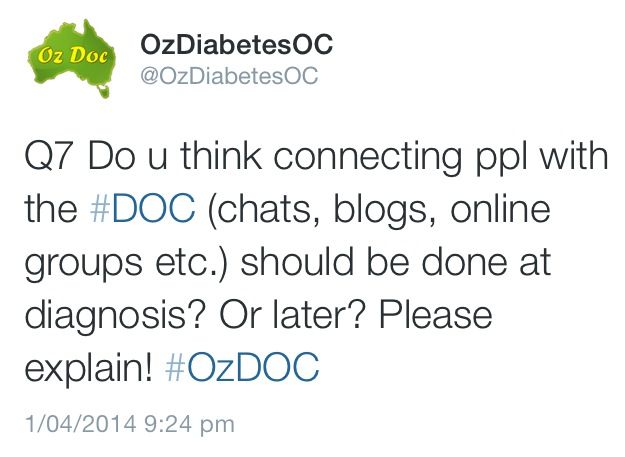
In last night’s OzDOC tweet chat, this question was asked:

OzDOC tweet

Obviously, I am a huge fan of the diabetes online community. I am honoured and lucky to have met so many amazing people both online and in real life. And many of these people, I truly consider to be friends.

But when I was diagnosed, I certainly had no desire to meet anyone else living with diabetes. Surely having nothing more than a faulty pancreas in common wasn’t the basis for lifelong friendships. And that is the truth. When I look at the people in the DOC who I am friends with, we have far more in common than a need to carb count and inject insulin.

While diabetes may have brought us together, it certainly isn’t what has held us together. The reasons the friendship has developed into something more than exchanges on Twitter include similar attitude to life in general; the same (often questionable) senses of humour; a mutual like of travel; kids the same age (many of my friends and I were planning pregnancies at the same time); sympathetic political views; a love of Nutella.

Today, I wouldn’t be without my friends from the DOC. I have been kept company many nights, unable to sleep, by many of my northern hemisphere friends. Our discussions span far more than diabetes, and the advice, comfort and friendship offered has seen me through difficult times as I feel the embrace of those many  thousands of miles away. This community has become my extended family.

We can’t force the DOC onto people. But what we could consider is making sure that people newly diagnosed are at least aware that there is a dynamic and supportive community out there. We can provide the connections and the networks. We can provide the ‘how to’ and allow people to dip their toe in gingerly and remain in the background. But it needs to be up to the individual to decide if and when they want to make the approach. And when they do, we will greet them with open arms and welcome them.

Tomorrow, I’ll be rolling up my sleeves and getting a flu shot as I do each and every year. (And rolling my eyes at colleagues who complain about the needle. Spoon; cement; toughen up!)

Being immunised from contagious diseases is medicine at its best. So why it generates much discussion – half of it rational; the other half madness – is beyond me.

The Australian Vaccination-Skeptics Network (recently forced to change their name from the Australian Vaccination Network) is a group that lives and breathes dangerous rhetoric, ridiculous propaganda and paranoia. And not a shred of evidence. Their tag line is ‘because every issue has two sides’. Sure – let’s go with that. On one side there is science and evidence. On the other there is lunacy. They are the two sides.

This is not an issue for debate.

I am all for people making their own decisions about their health and the health of their children. I really am. If you want to breastfeed your child, go ahead. If you don’t, don’t. Want to give your kids a multi-vitamin with their breakfast? Knock yourself out. Think that seeing a chiropractor eases your back pain? Off you go. Align away.

And when it comes to how you choose to manage your diabetes, you won’t hear any judgement from me. Treat how you want, using the tools you want. Your diabetes; your rules.

Because all of these decisions affect you (or your kids) – not others around you. If you choose to not vaccinate your child against vaccine-preventable diseases, you are putting other people at risk. You are putting me at risk, my family, my friends. It is irresponsible and it is stupid. Because your actions do affect me, I get to make a judgement call here.

Every single myth about how vaccines cause medical conditions has been debunked. There is no evidence – no scientific evidence – that suggests that vaccines cause autism, type 1 diabetes or anything else for that matter. The fruit loops (and I make absolutely no apology for using that term) who claim that vaccines are the root of all evil are dangerous and lying. That’s it. That’s the truth.

There are many aspects to living with a chronic health condition and one of them is the fear I carry each and every day that I have passed on my deficient genetic matter to my daughter. I am terrified that the autoimmune mess that is my, my mother’s and many other family members’ MO has been filtered down to her beautiful DNA.

One day, there will be a vaccine to protect against type 1 diabetes. I wonder if anyone who lives with diabetes (themselves or in their family) would hesitate for a moment to have their loved ones vaccinated.

Vaccines exist for one reason and one reason only. To protect us. There is no agenda by Big Pharma. Health care professionals are not in the pockets of Big Pharma or governments or anyone else for that matter.

If only there was a vaccine for stupid. Then this debate would be over once and for all.

Just in case you need this explained to you in very plain, eloquent and simple terms, click here to understand how vaccines cause autism.

When I was growing up, our family GP was a crotchety, tiny man who seemed old to me when I was a kid. Given that he is still working today, he can’t have been much older than I am now (eeek!). The main things I remember about him is that he prescribed antibiotics at pretty much every visit, wore lifts in his clunky shoes to make himself taller and chain smoked during appointments.

As soon as I was old enough to choose my own doctor, I found a GP who I was comfortable with. She was the doctor I saw that April in 1998 when I told her my symptoms and asked to be tested for diabetes. She was the doctor I saw the day after Easter to get my blood test results. And she was the doctor who diagnosed me with type 1 diabetes with the words ‘Fuck. You’ve got diabetes.’ She was a good GP, but had an unhealthy interest in anti-ageing medicine and plastic surgery. I let her go after a consultation where she had to kneel on a seat for the entire visit because she’d just had liposuction and couldn’t sit down. Dealing with my own body image issues, I wasn’t sure that having a GP who was so focused on improving her body using surgery was sending me the right message.

After that, I spent some time drifting from clinic to clinic, rarely seeing the same doctor. It wasn’t ideal, but it did the trick.

A couple of years after I got married and a couple of years into my diabetes journey (the never-ever-ever-ending journey of diabetes) I was living across town and thought it time to find a local GP. Dr H had been recommended by a few people, so struck down with a virus that wouldn’t quit, I called to make an appointment.

‘Dr H is not taking new patients at the moment,’ said his incredibly officious gatekeeper. ‘We’re one doctor down for the next month. He won’t be seeing new patients until then.’

‘Great! I’ll take his first free appointment he has next month,’ I said.

‘And what will you be seeing Dr H about?’

‘Well, probably nothing then. But I want to get my name on the books. Plus, I have an exciting (i.e. senseless and convoluted) medical history. I’ll need some time to explain it to him’.

The next month, with absolutely nothing wrong with me, I sat in the waiting room avoiding the sniffling, coughing masses as I waited to see him.

I was pleasantly surprised to meet a doctor who understood that his role in my diabetes was not to manage it in any way. After providing satisfactory answers to his questions about the HCPs I worked with to help me with my diabetes, he explained that he saw himself as the traffic cop of my general health who could direct me in the right direction if I needed to see someone other than him.

I showed him my insulin pump – it was the first time he’d seen one. (This was 13 years ago now and pumps were still quite uncommon.) He asked me lots of questions about it and my other medical things and I left feeling that I now had a GP who would understand what I needed.

About eight months later, I made an appointment to see him. He called me in and followed me into the waiting room. Before I’d even had a chance to sit down he said ‘Where’s your insulin pump? Don’t you wear it anymore?’ The first time I’d seen him, it was strapped to the belt of my jeans. Since then, I’d started wearing it down my top, hidden from view. ‘Oh, good! I have a lot more questions,’ he said. ‘I’ve done some reading up and I was wondering if you could explain a few things to me.’ At that point, I realised he was a keeper!

I see Dr H only a couple of times a year. He always asks general questions about any correspondence he’s received from my endo or other HCPs. I am sure next time I see him, he will ask me about my recent cataract surgeries. But he knows that in my case, diabetes is not his concern – I have that taken care of.

I frequently hear stories of GPs who simply don’t understand diabetes. I hear of misdiagnosis after misdiagnosis and, quite frighteningly, of GPs who have such minimal understand of type 1 diabetes that it puts their patients in danger. Dr H has enough understanding of type 1 diabetes to know that it’s not his place to manage it. He says he always refers people with type 1 to an endocrinologist as they, along with the PWD, are the ‘content experts’. He doesn’t ‘blame’ diabetes for every medical complaint I present with. As I said, he’s a keeper. If only it wasn’t so bloody hard to get an appointment with him!

The other day, I visited my daughter’s classroom because she wanted to show me some work she had on display. This term, the class has been speaking about healthy minds and bodies and one of the activities was to draw a poster about a magic medicine of their own invention.

There was hers: colourful and bright, beautifully drawn, neat handwriting. This cure-all had the ability to get rid of pimples, chicken pox and under-eye bags. All by just adding water! Her medicine comes in a variety of flavours and offers a money back guarantee if you are not satisfied with the results. Also, it is recommended by doctors. And Prince Harry. Don’t ask – I couldn’t even hazard a guess why!

I was chuckling away at the before and after pictures she’d drawn (I think that the developers of this particular preparation are more Ponds Institute rather than CSIRO) when I saw something extra she had added.

There, in a break out box was an extra special cure. This magic medicine will also cure diabetes – type 1 and type 2 (she’s nothing if not inclusive). I looked at it and smiled, my heart breaking a little. No other kid had added anything about curing a parent’s broken body. But my little girl had. Because diabetes lives with us and she would like to be able to fix it.

So she did. In a magic medicine of her own creation, she cured diabetes (as well as the dark circles under my eyes). All this with Prince Harry’s endorsement. What a kid!

Just add water


It’s Friday! Here’s some The Eastbeats for your listening and dancing pleasure!


diabetes tales

Kim

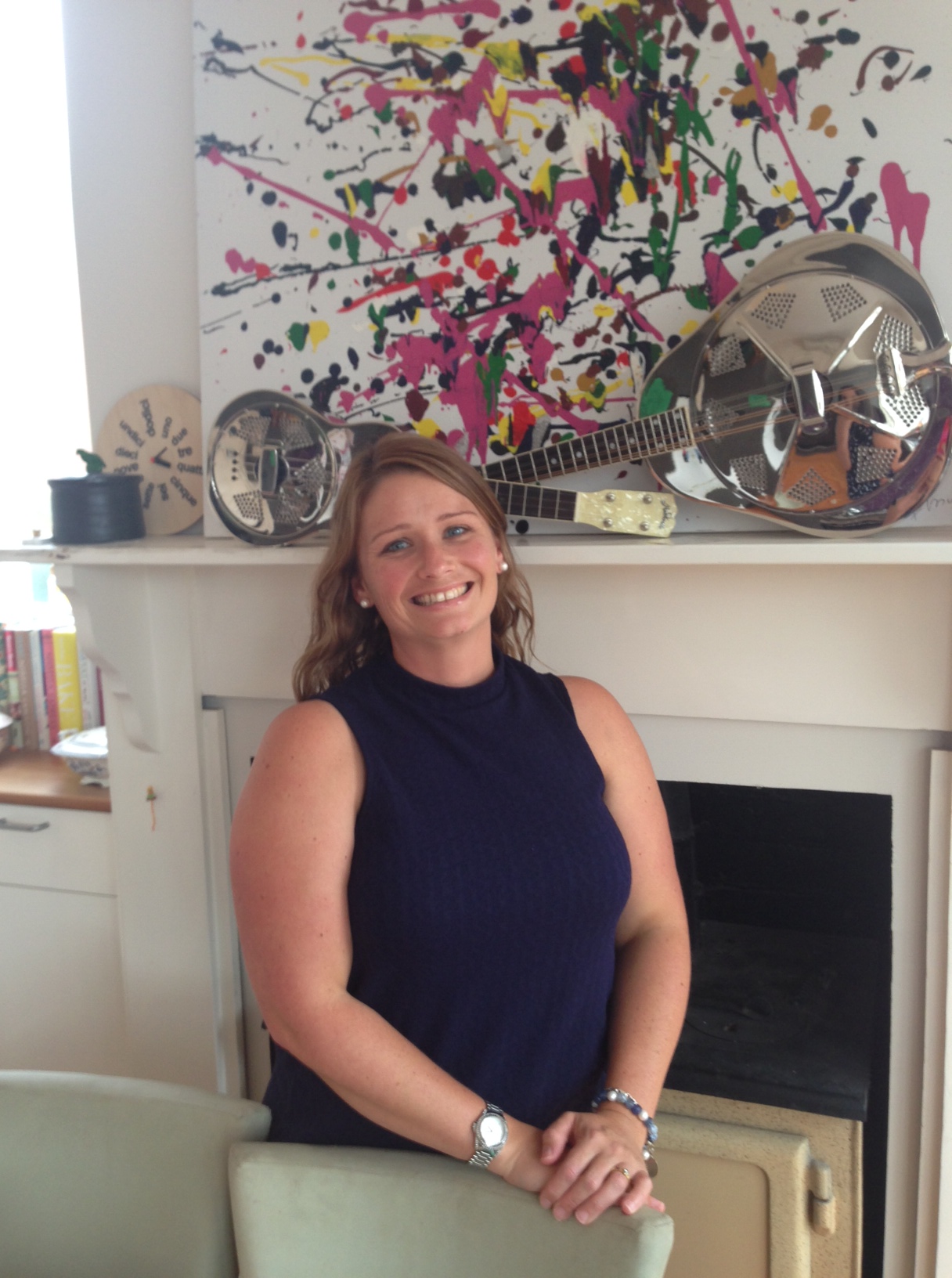
Don’t let this smile fool you. Diabetes is giving me the shits at the moment!

photo


You can read more from Kim at her blog, 1 Type 1.

Diabetes Tales is a new thing I’m trying out at Diabetogenic. If you’re interested in taking part, let me know!

Next month, it will be 16 years I’ve lived with diabetes (in case anyone is looking for gift ideas, wax or peridot are the suggestions). And as someone who at the best of times has a memory like a sieve, I have some trouble remembering much before my diagnosis. It was a long time ago, my life looked very different to now and I was a very different person. But there are some things that I miss…

  • I miss my stomach not looking like a pin cushion
  • I miss walking around the house with little on not having to worry about getting infusion sets caught on door handles
  • I miss not knowing about carbohydrates
  • I miss not having to stick fingers with a lancet dozens of times each week
  • I miss drinking a glass of juice without considering the graph on my CGM
  • (I miss not knowing what a CGM is)
  • I miss not worrying about long term health complications
  • I miss not feeling guilty about numbers, food, my actions
  • I miss being able to leave the house with a tiny clutch bag
  • I miss suitcases without diabetes supplies
  • I miss knowing nothing about diabetes
  • I miss not thinking about how what I was eating/doing/drinking/thinking impacts on numbers
  • I miss stress just being stress and not meaning a spike in my BGLs
  • I miss feeling healthy – or at least being seen as someone who lives with a health condition
  • I miss not being different to my sister
  • I miss not worrying that my sister will also get diabetes. And while my daughter wasn’t born when I was diagnosed, I miss the possibility of not having to worry that my daughter has inherited my faulty genes.
  • I miss never being hypo

There are many blessings that have come from being diagnosed with diabetes – pancreatically-challenged friends, a great job, travelling the globe talking about diabetes. All of those things – I’d miss them terribly. But diabetes? No. That is the one thing that I wish I could miss.

What do you miss about your life before diabetes came along? Are you too young to remember?

There has been a lot of hoopla on social and mainstream media about a mum who posed in a crop top and shorts, surrounded by her gorgeous three young boys, showing off her body, with the words ‘What’s your excuse’ emblazoned atop the picture.

The image is lovely (they’re all in red; Photoshop in a couple of reindeer ears and a Santa hat and she could use it for her 2014 family Christmas card). But what is not so lovely is the accusatory and more than slightly judgemental text that comes with it. What’s my excuse for what? I’m not really sure what she’s asking. Is she asking what my excuse would be for not having a body like that? That’s an easy one to answer. I don’t like exercise and just the thought of doing sit ups makes me want a bacon sandwich. Also, I don’t care. And also, I don’t particularly see that I need an excuse for looking the way I do look. Or don’t look.

Can you imagine if I put up a photo on this blog of me surrounded by the things I do (family, friends, work, baking cupcakes, eating cupcakes, going to music gig, drinking coffee, writing, watching ‘House of Cards’, enjoying the latest anime movie at home with our nine year old, dancing around to Billy Bragg*) holding a lab result with an A1c of 6.5 per cent with ‘What’s your excuse?’ above my head?

My A1c is not 6.5 per cent right now, and quite frankly, I don’t look for excuses as to why that’s the case. But even if I was sitting in that sweet spot, it’s not my job to question others as to why they are not. It’s none of my business and it also promotes that ridiculous idea that as long as my A1c is in target then I’m a success.

I think of the times when my A1c has been what is considered ‘perfect’ and I know that it hasn’t signified that I’m winning at life. Or even diabetes for that matter.

When I was pregnant (with my daughter as well as other times when I miscarried) my A1c sat in the mid 5s – low 6s. But I was checking my BGLs every 20 minutes and any result above 8mmol/l had me in tears as I worried about what I was doing to the developing baby. I would panic as I waited for my A1c results, fearing a number that would suggest I wasn’t being the best mum-to-be I could.

Periods of extreme stress when I don’t eat much also result in much lower A1cs, but the stress and anxiety I’m experiencing don’t really suggest to all else in my life being great.

We can’t point to a number (whether that be a diabetes number or a number on the scales) or how we look in a crop top as a measure of success.

I am all for celebrating people’s successes. I love it when my friends with diabetes have been really working hard at reducing their A1c and tell everyone about it. It’s great news and it should be celebrated. But that’s because it’s about them and what they have done. Not about why others are falling short.

Enough with the judgement folks. You want to rejoice in something you are proud of – knock yourself out! I’ll celebrate with you. Just don’t do it at the expense of others.


*It’s Friday. Dance around to Billy Bragg!

I tell my story for many reasons – most of them selfish. Plus I’m an over-sharer and I like the sound of my own voice (in my head, for real, in 140 characters or less and any place people will listen to or read me).

But more than that, I tell my story (here, in social-media land, in interviews, at conferences) because I am trying to connect with others. I want to know how YOU deal with days you can’t get your BGL above 3.5mmol/l despite mainlining glucose (or the days you’re high for no reason and are shoving insulin into you like there’s no tomorrow).

No one has diabetes all worked out and no one is a pin-up child for this stupid condition. But everyone has their own story which is real, honest and something they are trying to make sense of.  Everyone has tips and tricks and ways to make diabetes more manageable. Everyone has tales of soaring highlights and terrible hardships. But not everyone wants to share them.

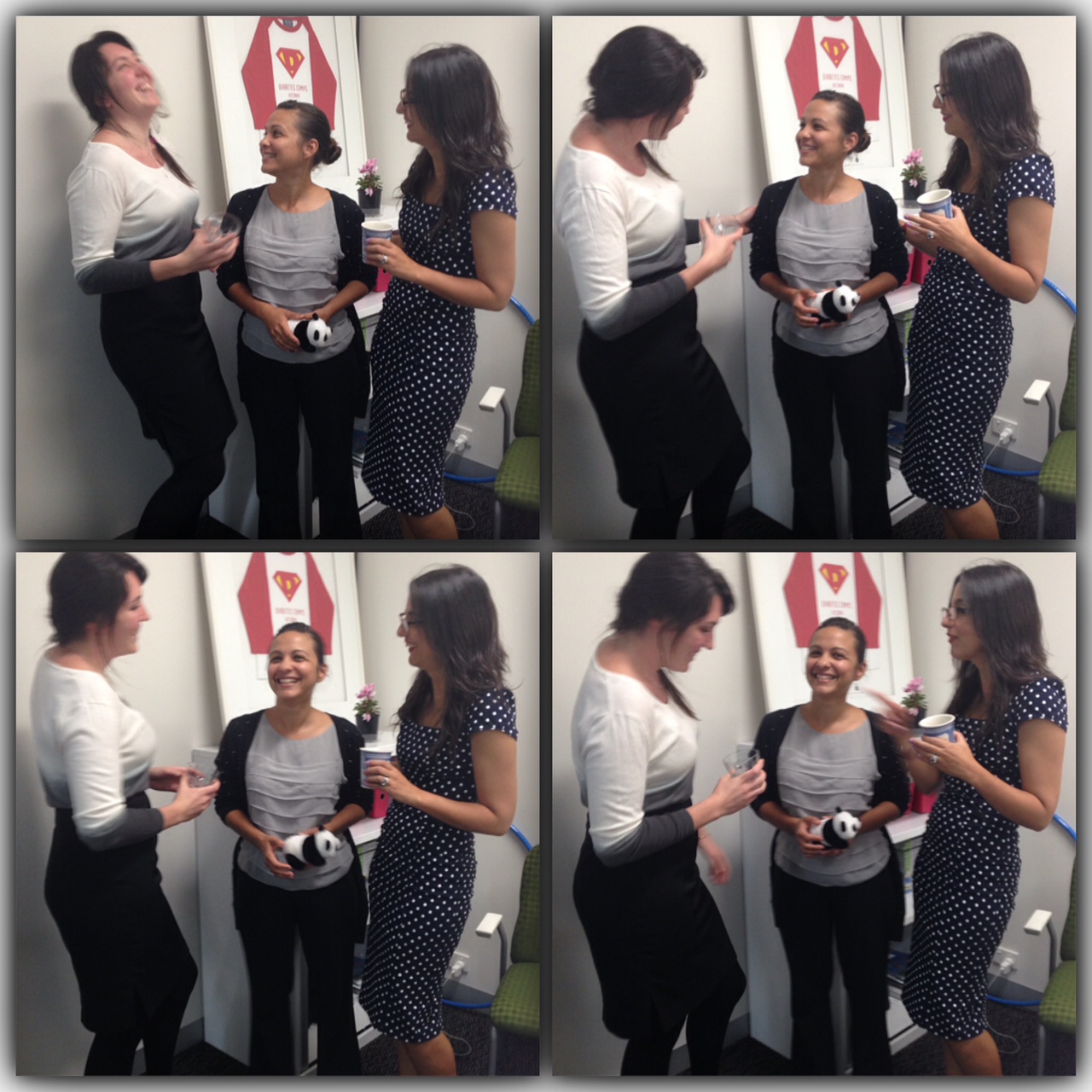
I am so blessed to be surrounded by friends who live with diabetes. Just walking into my office means I have an in-real-life support group of people with diabetes (see below). My gorgeous friend Jo is also my two-doors-down-neighbour. We have been known to share meters, strips, pump supplies and insulin. (We also tried to get our endo to buy the house in between us when it was up for sale, but for some reason she didn’t like the idea. Perhaps it could have been the suggestion that we remove the back fences so we could pop in for private consults whenever we felt like it.)

This is not, I now know, typical. The number of times I’ve met people with diabetes who act a little overwhelmed because it’s the first time they’ve been in the same room as another PWD. I know what that feels like! Even though I’m surrounded by people with diabetes, I still can’t help but get excited when I meet someone new with a faulty pancreas. DO YOU HAVE DIABETES TOO? SO DO I! HOW LONG HAVE YOU HAD IT? IS THAT YOUR INSULIN PUMP? HOW LONG HAVE YOU BEEN PUMPING? CAN WE BE FRIENDS NOW FOR EVER AND EVER AND EVER AND SHARE STORIES OF MIDNIGHT HYPOS AND THINGS THAT HAVE NOTHING TO DO WITH DIABETES TOO? is how I say hello. Once, I had to be restrained from throwing myself across a table at a café when I saw a man pull an insulin pump from his pocket to bolus for his morning fruit toast and coffee. ‘He may not want to talk about diabetes with you, Renza’, I was told. My response? ‘Of course he does. He just doesn’t know it yet.’

But the truth is that sometimes people really don’t want to talk about it with others. They hold their diabetes cards very close to their chest (I hold my insulin pump close to mine) and are not inclined to give out every private detail with complete strangers (or even their closest friends).

We need to make sure the quiet ones have a voice too and that the loud ones (that’s my hand you see waving in the air) are not seen as the only ones whose stories count.

You don’t need to be out there with your diabetes to have a voice. There are ways that you can silently make a difference. I just hope that everyone realises that their story and their voice is important and significant. And I also hope that no one thinks that reading the stories from the over sharers like me means that we have it all worked out. I know I don’t. And that senseless 18.9mmol/l my meter just threw at me after a lunch of no-carbs proves just that!

Today in the office.....

Today in the office…..

Follow Diabetogenic on WordPress.com

Enter your email address to follow this blog and receive notifications of new posts by email.

Read about Renza

Archives