
You are currently browsing the category archive for the ‘Wellbeing’ category.
Yesterday, as I sat in the waiting room to see my endo, I couldn’t help but feel that I was walking into a wasted appointment. I had seen her about six weeks earlier and left with promises to myself of being more engaged with my diabetes care. I promised I would have my blood work done. I thought about goals and how I could work to achieve them.
And yet, there I was, waiting to go in and wondering what the hell I had to say to her. There would be no discussion of lab results. I haven’t gone to pathology to have the checks done. There wouldn’t be any pulling out of data for me to show her – I hadn’t been logging anything. I was pretty much in the same state of mind about my diabetes as I had been last time I sat waiting to go in to see her.
I was wasting her time and I felt really bad about it. Not that she would ever tell me that. In fact, not that she would even be thinking that. But it’s how I felt. I have such respect for this endocrinologist, and I felt that in some ways I was actually being disrespectful in showing up so unprepared.
There were no tears yesterday. But there was an honest and open admission from me that I need help. I have tried everything I know to try and pull myself out of the motivation slump I have been in for so long. There are been periods where things seem to be better and I am able to make more of an effort, but they are fleeting and before long, I am back to feeling burnt out.
Let me be clear – I am not completely ignoring my diabetes. I am bolusing insulin at all the appropriate times; I check my blood sugar, albeit nowhere near as much as I know I need to – or that I would like to; I have started seeing my endo again. I eat well. At no time has diabetes completely fallen off the radar. But it certainly has deviated from being as much of a focus as I would like.
It’s not the mechanics of diabetes that is the problem. It is the trouble-shooting and problem solving and thinking about diabetes in a way that makes me feel confident that I am dealing with my health and wellbeing as much as my blood sugars. But I’m not doing that. I’m in a fog of burnout from which I now know I am unable to emerge without some real help.
I can pinpoint the source of the burnout; I can trace its progression; I can see why it happened. I understand all of that. I understand that dealing with the loss of our baby following a miscarriage and all the things that happened around it were often all I could deal with – both at the time and for periods since then too. But even though I have words to explain how this has happened, I don’t have actions to get me out of it.
I’ve tried. I’ve tried everything I could think of – all the techniques that have worked in the past. But I suspect that the combination of grief and the longevity of this burnout have resulted in me simply not being able to fix it alone. I need help.
I also believe that tied up in all of this is the way that I am feeling about my body and its failings. Because I do feel I have failed. Or at least my body failed me – again – when I miscarried. I really did think that I was ‘over’ it and was moving on, but not a day goes by where I don’t, in some way, feel sad and broken about it. I don’t know how to stop feeling this way. Again, I need help.
So, I asked for a referral to someone who can help me work though things – someone to help with strategies. I have been in therapy before; I know that it will help. It’s not a quick fix – I know that too.
I am trying to be all Pollyanna-ish about this and make grand ‘the first step is the hardest’ statements. And I am being positive and saying that it is certainly a step in the right direction. It’s going to take time. It’s going to take effort. Perhaps I am ready for that now. I know I certainly haven’t been to date. But maybe – hopefully – I am now.
 Last night, I had the privilege of attending the fifth anniversary celebrations for the Australian Centre for Behavioural Research in Diabetes. The event was held at my favourite Melbourne building – the State Library – so I was able to get my geek girl on and wander the stacks before heading to the reception.
I have written frequently about the ACBRD because I am a huge fan and supporter of their work. Before the Centre was established, there was very limited attention being given to the psychosocial impacts of living with diabetes. Diabetes was presented as a numbers game. People with diabetes were talking about what living with diabetes actually meant – we understand the day-to-day implications and the distress and the burnout and the fear and the anxiety. But there was no one dedicated to researching these things.
Much work has been completed since the Centre started. All of it is of great value, but there are certainly some stand-out pieces for me:
- The Diabetes Australia Language Position Statement, led by the ACBRD, which was launched back in 2011, is a much-needed ‘guide’ to assist journalists and HCP understand how to speak about and to people with diabetes. I can’t think of the number of times I have emailed, tweeted, handed-out a copy of this report to someone who has referred to PWD as non-compliant, a ‘diabetes sufferer’ or something equally damaging!
- Dr Jessica Browne, Research Fellow, has been leading a world-first program researching the social stigma of diabetes. Reaching far and wide (Washington Post, anyone?) it is so wonderful to have evidence supporting what we have heard from PWD for so long – diabetes is stigmatising and that we often feel blamed and judged for having this condition. I’ve said it a million times and I will continue to say it until the stigma stops – ‘No one asks to get diabetes.’
- The Diabetes MILES report still remains an important body of work. It was the first time that the psychological wellbeing of people with diabetes was investigated and the results confirmed what people living with diabetes already knew – emotional problems associated with living with diabetes are common, considerable and a very real part of living with diabetes.
The thing I love about the Centre is that in addition to conducting research and publishing articles, they actually provide practical tips and advice to HCPs about how to address these issues and concerns. And most pleasingly, they speak directly to and consult with people with diabetes.
As I explained in my talk last night, I have been lucky enough to present alongside Foundation Director Jane Speight on numerous occasions. The way this works is that I get up, rant, rave, wave my hands around and talk about the ‘living with it’ experience and then Jane gets up, speaks incredibly eloquently and provides the evidence to support what I have said. (So, thanks for making me look good, Jane!)

The always eloquent Professor Jane Speight. And me. Waving my arms around.
It was an honour to be able to celebrate the Centre’s first five years’ successes last night. Congratulations to all the ACBRD staff. Looking forward to seeing what you all do next!
‘You bake a lot for someone with diabetes.’ These words came out of the mouth of someone not all that bright who may read this blog, but has clearly not taken on board anything I’ve ever written.
It wasn’t the first time that I have had people express surprise at my love of baking and baked goods considering that I have diabetes. I’ve even had other people with diabetes say they were told baking was an absolute no-no for the pancreatically-challenged when they were diagnosed and, as such, have never baked anything in their lives.
I do bake a lot – regardless of my diabetes state! I bake several times a week. On days when I don’t bake, I read cookbooks and plan what I’ll bake next. I bake when I am happy, sad, anxious, excited, content, angry. And I bake a lot when I am stressed because I find it to be calming, peaceful and satisfying.
My neighbours know when I am feeling particularly stressed because those periods involve baking EVERY SINGLE day which equals home-deliveries around 7pm of whatever is still warm out of the oven. I think the neighbours sneakily like it when I am stressed.
I love baking because it is reliable, predictable and practical. Mix the right quantities of the right ingredients for the right amount of time at the right temperature and you will, inevitably, end up with something beautiful and delicious. And as you get better and know how certain ingredients work with other ingredients, you can mix things up and be creative.

In other news – I need an apron.
Plus, baking gives me an excuse to make a mess.
Baking is reliable. Except for the rare complete balls-up, the results are exactly what you expect. The end product almost always looks more or less like the picture. If you start out making a cake, you will end up with a cake at the end of the process.
Baking is the exact opposite of diabetes! Diabetes is unpredictable and unreliable and most of the time, you have no idea how you ended up with whatever it is you ended up with. (Case in point: lunch of poached chicken salad containing zero carbs and a dressing of nothing more than olive oil and lemon juice, pre-prandial BGL – 7.8mmol/l; 2 hour post-prandial BGL – 18.9mmol/l.)
The unpredictability of baking only ever comes to the fore when bolusing for whatever it is that I’ve baked. Sometimes I get it right. Other times I don’t. It can be a little hit and miss. Correction boluses were invented for this exact thing! If you don’t like baking, that’s fine. But don’t let diabetes be the reason you don’t bake.
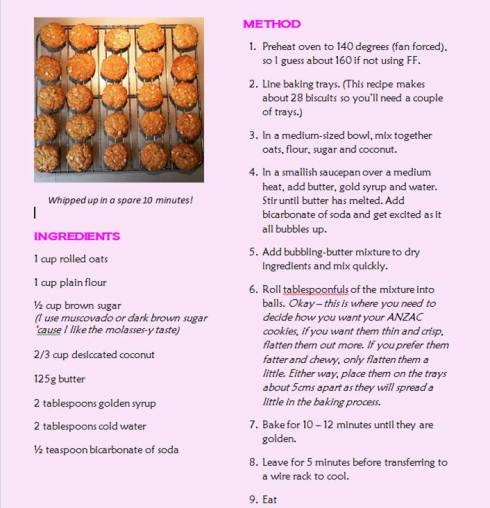
It’s ANZAC day this Saturday and I did a trial run the other day of my tried and true ANZAC biscuit recipe that I scribbled out in my recipe notebook a number of years ago. This is a fail-safe recipe and takes no more than ten minutes to throw together and then only a short time to bake. For those of you who don’t know what an ANZAC biscuit is, have a go! They are absolutely delicious and because they have oats in them, you can fool yourself into thinking they are a health food. Each biscuit (cookie) for those in the US has about 12 grams of carbs.
I have always known that stress affects my diabetes. Stressful situations – particularly prolonged ones – have the potential to send my BGLs into the stratosphere. Regardless of constant rage-bolusing or the complete avoidance of any food containing a scrap of carbohydrate, getting numbers in range when feeling stress is almost impossible.
The thing though that surprises me is how even small stresses can affect BGLs. Wearing a CGM gives great insight into this. Often, I see sudden rises in BGL that almost as suddenly drop back to within range.
After a day with a few unexplained (or unexplainable) spikes on my CGM graph, I decided to see if I could work out what was going on. These spikes didn’t seem to correlate with meal times, so I knew it had nothing to do with food intake.
As explained previously, I was wearing CGM under some duress, really. Aaron was away for work and it was on only for my peace of mind. To minimise feeling overwhelmed, I basically had my settings so that the only alarms and alerts I’d receive would be when I was dropping too quickly or when I was low. The high alarms were effectively turned off.
But after seeing spikes, I started to wonder what was happening. I turned the high alarms back on the next day and started paying attention to when I was starting to go high. Each and every time, it was because I was in a situation with some element of adrenaline-causing stress.
One time it happened when I was caught in traffic and I wasn’t sure I would make to school before the bell rang. I started getting more and more anxious that I would be late.
Another time, I was in a meeting that was running overtime and I needed to move my car before the parking meter expired.
And then, there was the time that I walked in the door to find the letter from VicRoads informing me that my medical review was fine and that my license wasn’t being suspended. And that I did not need to provide an eyesight report. (The outcome here was good, but before I read the letter, just seeing the logo on the front of the envelope, thinking about the difficult phone calls to VicRoads staff and taking a few minutes to consider what could be inside had my stress levels increasing.)
The adrenaline response is so clear on the graph. In all of these instances, there was a spike (not always huge, but definitely visible) that only lasted a short while. Often the blip would be only half an hour or so.
Stress isn’t always bad though. Had I been wearing a CGM when I jumped out a plane last year, I am sure that the stress response – from the excitement, the anticipation and the outright fear! – would have been reflected on the graph.
Excitement – from all sorts of things – may make you feel great, but it can still cause a spike. Managing stress-causing situations – especially those out of your control is sometimes impossible. And sometimes, you want to do things that are going to cause that blip. Some adrenaline-releasing activities can be very, very fun!
Keeping an eye on the leaps and bounds of my CGM graph reminded me (yet again) of the complexity of diabetes and how pretty much everything impacts on it in some way. I turned the high alarms off after a couple of days. I was starting to get concerned about the number of uncontrolled stress-inducing situations that I was having that particular day and the alarms themselves were starting to stress me out. So off they went. Because that was ONE thing I could control!
Yesterday, I woke up to this tweet from the fabulous health psychologist, Dr Katharine Barnard (who, apart from being quite brilliant is also incredibly lovely and fun to have a cuppa with!):

I didn’t have to think about it. I immediately replied with this:

I am very lucky when it comes to having a supportive network around me to help me manage my diabetes. Ultimately, the decisions are mine, but that doesn’t mean that my family is excluded from the discussions.
And it also doesn’t mean that I don’t consider my family when making decisions. This has been especially true when considering technology that costs a lot of money.
When I first started on a pump, there were no subsidies for consumables. As such, I needed to think about where the $300 per month ongoing costs would be coming from. It was 14 years ago; we were newly married with a mortgage. $300 each month was (and still is!) a lot of money to find in the household budget.
We worked out that we would be able to afford it (the pay off was fewer shoes for me), but we were also really lucky to have been told by both our families that they would help out if there were months that we couldn’t afford the supplies.
In later years, the same issues needed to be considered with CGM consumables. Again, with no subsidies, could we find the money to cover the costs of the consumables.
But the financial is not the only thing that impacts on family. What about the impact of having a loved one constantly attached to medical equipment?
When I first started pumping, I wondered what it would mean having a device stuck to me all the time. Would it be a constant reminder to me of my diabetes (not that diabetes is something that is easily forgotten)? But even more than that, I was also worried about how other people would see me. What would my friends and family think when they saw this little box permanently attached to my belt, or shoved down my top? What would they think when they saw me pull it out to press a few buttons? Would it change anything? Would they think differently of me? Would they think of me as ‘sick’?
I worried about how my husband would react to the infusion set taped at all times to my stomach.
In my case, it turned out that none of this mattered. In fact, no one made a big deal out of it; instead everyone was really supportive of me using the technology to manage my diabetes and congratulated me on my decisions.
So it surprised me a couple of years ago when I trialled the Dexcom CGM. I had been wearing CGM for a number of years already without feeling particularly self-conscious.
But the Dexcom sensor, with its different shape to other CGMs flung me back to the uncertainty and insecurity about wearing a(nother) device on my body. As I put in the first sensor and pushed on the transmitter, I felt queasy in the pit of my stomach. Again, I worried about what people with think of the thing protruding through my clothes. And would Aaron start to think that his wife was turning into a cyborg in front of his very eyes, with more and more buttons and beeping machines keeping me running?
As it turned out, I was, again, worrying for nothing. No one said anything. My parents and in-laws show only kind concern and support; my sister hasn’t made any comments about any of the tech (which is a little disappointing because I am sure that she would come up with some brilliantly hysterical snipe that would have me doubled over laughing – this is, after all, the woman who gave me this birthday card for my 40th); my friends ask general questions about how things are going. And Aaron and the kidlet just take the tech of what it is – life saving.
All of their support and encouragement of my diabetes will never, ever be taken for granted – I will be forever grateful. And accepting me for who I am – robot parts and all – is a gift they give over and over and over again. I was reminded of that with Kath’s tweet to me yesterday.
It absolutely doesn’t matter if you are a fan of Coldplay or not (I’m not) but this cover of ‘Yellow’ is possibly the most beautiful thing I have heard in a long time. I can’t stop listening to it. We were lucky to see Petra Haden and Bill Frisell play when we were in New York in an absolutely stunning gig. Enjoy – and check out their other stuff too.
Yesterday, I looked out the kitchen window into the back garden and out over the back fence on the other side of the laneway, and I noticed that our neighbours’ beautiful big tree was starting to wear its Autumn colours. The green leaves were giving way to the most beautiful deep reds and I know that in just a couple of weeks, the branches will be bare, letting in the pale Winter sun.
I don’t think I’ve ever been so aware of the seasons changing as I have in the last couple of years. Perhaps it’s because with more friends overseas I see their seasons change in opposition to ours – we swelter whilst they curse snow; we shiver while their Summer blazes.
But with each season that passes, I am more and more conscious of the time I’ve lived with diabetes.
In the middle of this month, I will have lived with type 1 diabetes for seventeen years. I know that in the grand scheme of things – and when I think of celebrating Kellion medallists – seventeen years is nothing more than a drop in the ocean.
But to me, it feels like a long time. In fact, it’s the first time that I’ve thought the number and it has felt big. While in single figures, it was tiny and even hitting ten or twelve years didn’t seem much. Neither did sixteen.
Seventeen, however, seems big. Really big.
I always plan to celebrate my diaversary and mark it in some way. Sometimes it’s just a cupcake with the family or friends. But I mark it and recognise it as something I want to acknowledge and celebrate. I celebrate that I am living well with diabetes and that I am still doing all the things I love. I celebrate the minimal impact diabetes has had on the previous year.
This year though, I am not feeling like that. It’s not that I don’t want to celebrate (I’m not one to pass up cake), it’s just that I’m not sure what I am celebrating anymore. I’m still living well, but the impact over the last 12 months has seemed greater than ever before.
I have always been proud of the position diabetes has held in my life. And I have always been proud of the way that I have never let it stop me doing anything. But in recent times, I’ve come to wonder and worry – if the reason that things have been that way aren’t so much of my doing, but rather because that’s how my diabetes has been.
The privilege of being able to say ‘diabetes hasn’t stopped me from (insert whatever)’ is because my diabetes has been manageable, and well behaved. What if that really changes? What if things suddenly mean that I am stopped from doing what I want?
I feel like diabetes is, in some ways, stripping me bare with its relentlessness. Feeling like I am managing and coping has become a desperate pursuit and feel overwhelmed and overcome more easily.
I’m not sure if is purely the emotional toll, which has in recent times been more significant, or if is that combined with difficult lows that seem to be becoming more frequent.
But whatever it is, I’m feeling exposed – although to what, I’m not sure.
I thought of all this as I stood at the kitchen window and looked at the tree. I thought about how exposed the branches would be soon. But I also thought about how it was only for a few months. Come Springtime, the branches would be covered in pretty blossom and after that, full again with bright green new growth. The seasons are so defined and clear.
Perhaps the way I feel about diabetes is all cyclical and seasonal too. Maybe the impending cold is why I am feeling exposed at the moment. Maybe I just need to batten down for a few months, wrap myself up and keep myself warm until the season changes again.
And in the meantime, gently and quietly recognise my diaversary, give a nod to the year that has passed and just keep going on.

It used to be hard to find a café open on Good Friday. Not any more. Last Friday, we had breakfast at Marios in Brunswick Street, enjoying excellent coffee and awesome food. It set the scene for the weekend which was basically four days of cooking, baking and eating.
We had two family Easter celebrations – a picnic at a country airfield on Saturday and brunch at our place on Sunday morning. And then a wedding celebration on Sunday evening.
The four day weekend was finished off with a home made chocolate self-saucing pudding (because I need to somehow – ANY WAY POSSIBLE – use up the kilos and kilos and kilos of Lindt Easter Bunnies in our house).
I can’t think of a more perfect way to celebrate – family and food. And a rabbit that visits in the middle of the night leaving chocolate. What’s not to love?!
After breakfast on Friday morning, we popped next door to the bookstore, and as I wandered down the store, browsing the shelves, I saw this:

‘You should buy this,’ said one of my family because they (wrongly) think they are amusing.
No. No I shouldn’t.
In between all my weekend carb loading (not sure for what) I spent some down time reading and learnt all about orthorexia nervosa – yet another reason why self-styled health gurus and the rubbish they sprout is dangerous.
People with orthorexia nervosa are so consumed (no pun intended) by the thoughts of the quality of the food they are eating, they start to refine and restrict their diets. In the endeavour to only eat foods considered ‘pure and healthy’, people with orthorexia nervosa may become malnourished because of the strictly limited food they will eat.
The minefield of ‘wellness experts’ gets bigger and more treacherous every day. Whether it is clean eating, raw food, Paleo, quitting sugar or any diet that needlessly insists on restriction of foods or food groups, we need to see this industry for what it is: dangerous and incredibly harmful.
Orthorexia nervosa is not currently a recognised eating disorder, however there is a push to have it classified in the DSM-V, the classification and diagnostic tool used by mental health workers to diagnose mental illness.
Maybe a recognised eating disorder will be what it takes to finally realise and accept the danger and hazard posed by these charlatans.
It takes me somewhere between 12 and 25 minutes to drive to work in the mornings. I drive down a terribly busy road which carries trams, cars, trucks and bikes. People dash across the road whenever they can. It is hectic!
Yesterday morning, I was sitting in traffic, mentally counting down how long it would be before I got to my morning café for my take away coffee.
I yawned. ‘Need coffee,’ I thought. I yawned again. And again. ‘Oh, shit,’ I thought. Even though I felt fine, the incessant yawning gave it away. I was low.
I reached into my handbag and pulled out the pink and red Marimekko purse and, taking advantage of the banked up traffic, pushed a strip into the bottom of the meter, pricked my finger and wiped the drop of blood across the strip.
2.8mmol/l.
I swore. Loudly. So loudly that the woman in the car next to me looked over at me. We both had our windows closed.
The road is a clearway in the mornings; I couldn’t pull over. I put on my indicator, silently begging the traffic to move so I could turn left into the street ahead.
I grabbed a handful of jellybeans from my bag, and shoved them down my throat, chewing furiously as the cars in front of me inched forward.
Finally I could turn left. I pulled into the side street and parked. Turning off the engine, I sat there chewing and gulping.
How had this happened? I scrolled back through my meter and saw that less than 20 minutes earlier, just before I left the house to drop the kidlet at school, my BGL was 5.9mmol/l.
My eyes filled with tears at this point – typical response when I think about how diabetes impacts on those I love. I swiped my hand across my eyes, cursing (again) as I saw my mascara had run.
Involuntarily, my hand moved to my stomach where my CGM was fastened. As I was rushing around getting ready that morning, my pump pulsed and squealed, telling me that the sensor was dead after having been in for seven days. I knew I just needed to reset it – it was still reading beautifully.
But I didn’t. I didn’t restart it. I just shoved my pump away, thinking that I’d maybe, maybe, not sure, perhaps start it later in the day. If I felt like it.
I swore again – this time at myself.
I need this. At the moment, I need this. I am already feeling so lousy at diabetes – second guessing everything – I need whatever help I can to help me.
I looked at myself in the rear-view mirror. ‘I need this,’ I told myself, tears welling again.
After about ten minutes, I rechecked my BGL and it was back up over five. I was good to drive and make my way to work.
I went to start the car and stopped. I pulled my pump out from my bra and scrolled through the menu until I found what I was looking for. ‘Start CGM Sensor Session’.
I pressed start.

I’ve been thinking about the word chronic recently. It’s a word that gets thrown around a lot in health. Simply put (although there is nothing simple about it!), when used in relation to health conditions, it means ‘ongoing or constantly recurring’.
Diabetes fits quite nicely into the definition. It’s a bit of both – and ongoing component with a constantly recurring nature too. As far as I’m concerned, the ‘ongoing’ part of diabetes is a given.
Undeniably, it gets me down; of course I get sick of it. But to a degree, I just have to accept it. It’s there and it’s not going anywhere.
The real issue – the thing that makes it extra rough – is the ‘constantly recurring’ side of things. I am really not so good at this stuff; the things that go away and then reappear. That is the part that makes it difficult.
With diabetes, those recurring things – whether it be a round of nasty hypos or high BGLs that won’t go away and are really tough to understand or explain – are always harder for me to manage after a period of diabetes just chugging along.
Perhaps I get lulled into a false sense of security and the sudden ‘crap-ness’ throws everything into chaos. Perhaps I have this ridiculous idea that with almost seventeen years under my belt I should be better at diabetes than I am. Perhaps it’s the fact that I like routine and once I’ve settled into one, I don’t like to have to change for any reason. (Perhaps that last sentence could be condensed into two words: ‘I’m stubborn’.)
I’m not sure, but what I do know is that, in amongst the crap, I can – at least, I need to – summon up an attitude of ‘this too shall pass’. Because I know it will. It may take longer than I’d like, it may be harder to get through. But I know that it will pass.
And then, I will be left with the ongoing stuff. The life-long, never-ending, forever nature that is a chronic health condition like diabetes.





 Diabetogenic