
You are currently browsing the category archive for the ‘Real life’ category.
The Merriam-Webster word for 2020 was, perhaps unsurprisingly, ‘pandemic’. But I do think it could have just as easily been another word that we were seeing absolutely everywhere, and that word is unprecedented.
I started to despise that word. Everything about the COVID-19 pandemic – indeed the pandemic itself – came with the descriptor ‘unprecedented’. From the (unprecedented) stockpiling of loo paper, to the (unprecedented) times in which we were living, we were firmly reminded at every turn that we had never, ever, ever seen anything like this before. It was all novel.
Which is the opposite of diabetes. Diabetes is always precedented. There is nothing novel about diabetes on a day-to-day basis. Sure there is the occasional curveballs thrown at us, but the normal, daily routine of diabetes is mind-numbingly not new!
Variable glucose levels with no rhyme or reason? Precedented.
Frustrations at constant lows or stubborn highs? Totally precedented.
Plummeting glucose levels just before bedtime? Precedented.
No two days of diabetes the same? Precedented.
An inability to bolus correctly for rice (or whatever your food nemesis may be)? Precedented.
PWD being left out of conversations and decisions about our own condition? Oh-so-precedented!
Running out of jellybeans when hypo? Precedented.
A pump cartridge running out just before bed? Annoyingly precedented.
Stigmatising comments about diabetes? Boringly precedented.
The monotony of diabetes – the complete Groundhog Day of it all – is the antithesis of what we have witnessed over the last year and a bit.
But whether it is all new (unprecedented!) or mindlessly boring (precedented!) pandemics and diabetes are both pretty damn crappy.

Last week, I posted this on Twitter:

I take no credit for these numbers or that straight CGM line, or the first thing in the morning number that pretty much always begins with a 5. Those numbers happen because my pancreas of choice is way smarter than me. Actually, in a perfect world, my pancreas of choice would not be outsourced, but what are you going to do when the one you’re born with decides to stop performing one of its critical functions?
Anyway. I should know by now that any time diabetes thinks I’m getting a little cocky or too comfortable, something will happen to remind me not to get used to those lovely numbers.
And so, we have Tuesday this week. I woke up with a now very unfamiliar feeling. I reached over and looked at my CGM trace which immediately explained the woolly-mouth-extreme-thirst-desperate-to-pee-oh-my-god-I’m-about-to-throw-up thoughts running through my head. I found the culprit for that feeling very quickly – a pump with an infusion set that had somehow been ripped out overnight.
I didn’t get a screenshot of that number in the high 20s to share, because my head was down the loo. Ketone-induced vomiting is always special first thing in the morning, isn’t it?
I put in a new pump line, bolused and waited, all while resisting the urge to rage bolus the high away. Because that’s all there is to do, isn’t there? I hoped that just waiting and allowing Loop to do its thing would work, and that everything would settle neatly – especially my stomach which was still feeling revolting.
And as I lay there, I had another feeling that is somewhat unfamiliar these days: the feeling that I absolutely loathe diabetes. Beautifully mimicking the waves of nausea were the waves of my total hatred for this condition and how it was making me feel and the way it had completely derailed my morning’s plans.
I don’t feel like that most of the time anymore, because diabetes so rarely halts me from taking a moment out to deal with it. Hypos are so infrequent, and so easily managed; hypers that need real attention just don’t happen; sleep is so seldom interrupted because of diabetes anymore. Life just goes on and diabetes drones on in the background – annoyingly, but not too intrusively.
But this morning was completely handed over to diabetes to wait it out for my glucose levels returned to range – thankfully with a gentle landing and no crash – and for my stomach to stop lurching. Ketones were flushed and the feeling of molasses-y textured blood running through my veins subsided.
By the afternoon I was feeling mostly human, with nothing more than a slight hangover from the morning. But the feeling of diabetes hatred had been reignited and was flashing through my mind constantly.
A couple of days later, with a full day of decent numbers behind me, there is no physical aftermath of those few hours of diabetes trauma. But there is a whisper of the absolute contempt I feel towards diabetes. It’s always there, I guess. It just had reason to rear its ugly head.
Living a positive, sanguine life with diabetes is not impossible. And by and large, I don’t spend most of my time thinking about the scary stuff and asking myself ‘what if?’. But it’s not always easy, even for those of us with a mostly Pollyanna-ish disposition. Whether it’s hearing difficult stories or seeing a crappy diabetes health promotion campaign, I find myself frequently triggered and start to think about how that very first introduction to diabetes that so many of us receive, sets us up to believing that there is nothing more than doom and gloom ahead of us.
But with all the worry about what diabetes could bring tomorrow, how much happiness and light are we sacrificing today?
I worry about things and I know they may never happen; things that are not even hinted at today when I have my annual screening checks. But even as I breathe a deep sigh of relief after seeing my ophthalmologist, or receiving the results from my kidney check, I don’t stop worrying. The ‘All is good’ in this snapshot moment is reassuring, but somehow never enough.
Perhaps it’s because diabetes has a way of never just being about the here and now. The way it’s often spoken about means there is so much pressure to do right today in order to be right tomorrow.
The ‘What if?’ questions that I seem to have on repeat cast a constant cloud, sometimes more thunderous than at other times, over so many of my days.
Over the years, this has been one of the issues I’ve addressed with my psychologist. I have learnt to respond to ‘What if?’ questions with ‘What if it doesn’t happen?’, or to be practical rather than theoretical. This has been hugely helpful. As has saying ‘You are not at that bridge right now; you don’t need to know how to cross it.’
Just how much am I robbing myself in the here and now when I spend too much time thinking of hypotheticals of the future? How much happiness have I already lost to those hypotheticals? How much time and energy have I wasted being drawn into moments of doom, when the reality is that, in the moment – in my diabetes present – there are no clouds? No clouds at all…just blue skies.

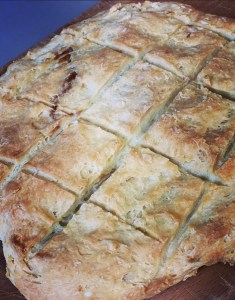
One evening this week I made pizza scima, a flatbread from Abruzzo.
Baking bread became a pandemic hobby for me. I love it, but the process takes time. Time to knead and time to rise. Time to punch down before the second rise. It’s a slow and calming practice that I have learned to appreciate. Baking bread became abeautiful way to mark the hours of a lockdown afternoon and I delighted in stopping in between work calls to take a peek under the cloth that was covering the dough, as it was snuggled – and getting ever more snuggly – in a bowl by the heater (in winter) or sunny window (in warmer weather). The oven would heat up the kitchen and as we sat down to dinner, a golden, crunchy loaf would emerge, ready to accompany whatever was being served up.
But days are returning to somewhat (new) normal here and there is less time. No lockdown means a different pace during the day, because I now inevitably rush out during lunch hours to run errands or stop off for a quick visit to the fruit and veg market before work gets started. Or I’m slowly venturing back into the office for a day here or there. All this means that those minutes that lent themselves to slow food activities now run into each other again: time is not as leisurely as it was, and suddenly it’s dinner time without time to make a loaf of bread.
But on this day, I wanted bread; fresh, homemade, just out of the oven, bread.
And so, I made pizza scima! It’s a five-minute process where all the ingredients: 00 flour, olive oil, salt, bicarb soda and white wine get tossed into a bowl, mixed together and then flattened on a tray. The dough is scored, and the oven does the rest. No kneading, no proofing, no resting, no rising.
Half an hour later, a stunning crispy on the outside, chewy on the inside flatbread emerged and honestly, it is the best bread hack there is to know. (Plus, the recipe calls for only a little wine in the dough meaning you have something to drink with dinner!) Viva gl’Abruzzesi!
There’s nothing like adding a sneaky little shortcut to your repertoire – whatever that may be. I think that often people with diabetes become super smart at finding these sorts of little techniques that become a snappy solution to a diabetes problem.
Yesterday, I learnt a new diabetes hack thanks to Kelly Kunik, DOC old-timer who writes at Diabetesaliciousness. Here is what she shared via a collaboration with Ascenisa*:

This reminded me of one of the topics for Diabetes Blog Week. For newer folks to the DOC, DBlogWeek was an initiative of Karen Graffeo who used to write at Bitter~Sweet Diabetes (seriously, check out all these people and their blogs). Each year, Karen would coordinate this monster effort, coming up with different writing prompts and then setting up a platform for them to all be collated in one space.
Back in 2014, one of the topics was diabetes hacks and ninety-five diabetes bloggers all wrote posts sharing tips and tricks they have discovered that goes towards making their diabetes a little easier. Here’s what I wrote. I’m so pleased to find that all the other contributions are still all together on this link, and I’ve just spent a delightful hour scrolling through and re-reading some of them, getting a refresher on some super ideas from super people!
Call them hacks, call it inspired improvisation, but MacGyvering the fuck out of diabetes is a talent worth cultivating, because you never know when a diabetes moment will call for it.
DISCLAIMER
I am on the Editorial Board for Ascensia Diabetes. I am paid for the pieces I write that appear on their blog. Kelly is also on the Ed Board. Sharing this for no other reason than it blew my mind!
I found myself in A&E in the early hours of Saturday morning, and for the first time in more than two decades, that visit was not because of diabetes. I make it sound as though I am a frequent guest at local emergency departments, but that is not the case. I can’t remember the last time I was there, but I do know it was thanks to the unholy trio of diabetes, gastro and ketones. That would be the only reason I’ve visited in the last two decades.
But before that – back in my pre-diabetes days – the reason was something different. I used to have seizures in my sleep. And at 2am on Saturday morning, I woke up realising I’d just had a seizure.
The first thing I did as I was coming to was check my CGM trace. A neat line that had barely wavered between 4.2mmol/L and 5.6mmol/L. This wasn’t diabetes related.
The last time I’d had a seizure in my sleep was 16 years ago when I was pregnant with my daughter. But that one was because I was low. I knew what to do, I knew why it had happened, I knew that it was just one of those things, I knew it was a pregnancy low that I had read about.
This one had nothing to do with diabetes and that left me in a very confused space. I wasn’t sure what to do. Did I need to go to the hospital? That’s what used to happen. But was that still the drill? We made a few calls and we decided that it would be best for me to go into A&E and take it from there.
There is no good time to need to go to A&E. There are just bad times and worse times. Turns out this was a worse time. I arrived at 2.30am, exactly two hours and 31 minutes after Melbourne went into lockdown after a COVID-19 outbreak. Aaron wasn’t allowed to come in with me because new restrictions were in place, so he left me at the door. The waiting room was filed with people who appeared a little worse for wear after their last hurrah before lockdown went askew.
The triage nurse saw me straight away and I explained why I was there. She looked up after asking me if I had any other conditions and I said ‘Yes, I have type 1 diabetes.’ I waited for her next question, jumping in after it didn’t come for a couple of beats. ‘I wasn’t hypo. My glucose levels were steady and between 4 and 6 the whole night. I wear a CGM. It wasn’t from hypoglycaemia.’ She typed that into her computer and then told me to take a seat and someone would be with me. She smiled at me, ‘It’s foul tonight. You’ll be here for a while.’
This is where things diverged from my last A&E visits. I was sent back to sit down and wait. And wait, and wait. There are few upsides to living with diabetes, but one of them is that when it’s the reason for a visit to an emergency department, you are given the VIP treatment and seen straight away. At least, that’s been my experience. Ketones are not to be messed with and as soon as I’ve ever mentioned the word, I have been whisked away behind the locked door and seen straight away.
But not this time. This time I was with the ketone-typical people, and sat quietly until, about two hours later, it was my turn. Blood was drawn, a CT scan was ordered and done, a consult with a neurology registrar happened. I was asked by everyone I saw if I was having a hypo when I had the seizure, but other than that, no one paid any attention to my diabetes. Which was just fine, because Loop was taking care of that for me and I didn’t really feel like having to do a DIYAPS tutorial to explain why I didn’t want anyone managing my diabetes for me while I was there.
After a couple of hours of outstanding care and attention, I was able to leave the hospital and go home with instructions of what to do next, an appointment for an MRI and EEG scheduled for the next couple of weeks, and a subsequent consult with a neurologist. And with a slightly fuzzy head … and a heavy sense of dread forming in my chest.
It’s a couple of days later, and I’m feeling less fuzzy. The only physical remnants I have are achy ribs from the actual seizing. Emotionally I’m more than a little wrecked, and in a state of uncertainty which is never good. I’m terrified of going low and checking my CGM trace every 23 seconds, stupidly jumping at anything that hints that I could be heading into hypo territory – even though Loop is more than capable of taking care of it.
I’m scared that this is not a one off, and instead the start of something else that is chronic and going to take up energy. I’m worried that my usual scatterbrain and forgetting words is actually something more sinister. These are the thoughts that have been going through my head from the moment I woke after the seizure.
On Saturday morning I walked out of the hospital to meet Aaron, the sun was rising, and Melbourne was starting to wake up. I climbed into the car feeling grateful to be going home. And sad. I thought about how over the last three years I’ve managed to get my diabetes to a place that requires little effort and with that managed to claw back so much mental effort that I’d needed to dedicate to my broken body. Was that all about to be redirected to something else? Was I going to have to learn a whole new language for a whole new part of the health system that I am already sick of having to use? Was this my broken body reminding me that I don’t get to feel comfortable in it? That while I may have thought I’d found the magic key to putting diabetes in its place, other things could and would pop up. Not diabetes. But there could always be something else…
Apparently, diabetes blogs are dead. At least, that’s the proclamation that seems to made every month or so. You should very much consider my bias when I say that I don’t agree with that sentiment at all. I mean, I have a shitload of content on this here site – including new and re-visited posts that for me have some relevance to my diabetes life in the moment.
Newer and shinier platforms are here now, so surely that means it’s time to retire WordPress and Blogger. Or is it? Newer and shinier platforms are great, so I’m not here to claim that that they’re a waste of time. Podcasts and vlogs are great tools for sharing diabetes information. YouTube and Reddit are great places to learn. And then there is Tik Tok, but I am too old to be allowed to even log into that platform. (Not true, and I have loved some of what’s been shared there. It can be a brilliant storytelling and info-sharing format!)
I’m here to say that every single platform for sharing a diabetes tale has its place. And blogs are still very relevant: the long-form post is not dead. Not yet anyway.
It is from blogs that I learnt, and continue to learn from others with diabetes. I revisit old posts I’ve read because they remain relevant today, and have many bookmarked and saved because the information shared is so spot on! I use them as research for pieces I’m writing and presentations I’m giving. I send links to old (and new) blog posts to others with diabetes when they ask questions that I know someone has answered so beautifully. And I send posts to HCPs to give them an insight into real life diabetes that they may otherwise have not understood – a glimpse into the things we are hesitant to share with them – and how our interactions with them can leave a lasting impression: both good and bad.
Blogs are also where we hear from those who are adjacent to actually living with diabetes. Reading posts from parents of kids with diabetes and partners of loved ones gives me a perspective that I simply don’t have firsthand.
Advocacy and awareness efforts have been described and fought through blog posts. I’ve used this blog to advocate increased funding for products, research and healthcare. It helps get the message out to people, with simple calls to action so they can get involved too. And the first time I ever heard about Spare a Rose was via this post (the links in the post are not current), and from there so many in the diabetes blogosphere – myself included – jumped on the bandwagon to support this important campaign. We knew that while donating was important, getting the word out was critical too. Since 2013, dozens and dozens of posts have been shared, raising awareness about how this ‘by the community, for the community’ grassroots initiative.
Blogs are where some of those deep and scary issues that we only whisper about or hide away are discussed. It was in blog posts that I first read about just how diabetes impacts on mental health. Experiences about diabetes-related eating disorders were shared without judgement and shame. It was through my writing about infertility and diabetes that I connected with so many other people going through the same thing.
Diabetes blog posts – old and new – are a patchwork quilt of lived experience gold, with the common thread that no one’s diabetes story is more valuable or important, but that everyone has a story to share that is worthwhile.
Some believe that blogs posts are just a way for people to ramble and navel gaze and seek attention. Well to them, I say please enjoy (or don’t) exhibit A – the 1100+ posts here that may be navel gazing to some, but paint a picture of my 22 years of diabetes. It’s not everyone’s experience; it’s not everyone’s cup of tea. And I’m okay with that! If you don’t like the blog format, move on. No one is forcing anyone to read a blog post. Or to get on any other format for that matter. Because, of course, your preferred diabetes info mode may vary (#YPDIMMV).
Someone said to me that reading new blog posts these days is boring because there is nothing new – it’s already been said. And you know what? That could well be true. Diabetes is boring and even though everyone’s diabetes is different, many of us write about similar situations. But actually, that’’s okay. Because for some people, it may be the first time they see or read a post about a particular topic – even if there are five million others! – or perhaps there is a different outlook in there.
I think that people write for different reasons. I write for a creative outlet and writing provides me with a way to explore different ideas about not only my own diabetes, but the diabetes landscape. But mostly, I write to connect with others. I don’t think anything I have to say is particularly erudite or mind blowing. I don’t have any revelations that will help someone else’s diabetes make sense. My own diabetes makes no sense to me, so the chance of it making sense to someone else is very unlikely.
I found most diabetes blogs because their writer shared them on Twitter or on Facebook. Or, others in the community shared them, which is one of the truly wonderful things about the DOC – the way some people elevate others in the community. There used to be an annual event called #DBlogWeek which was a brilliant opportunity to learn about others writing about diabetes. Diabetes Mine’s monthly blogosphere wrap up keeps me updated with some wonderful pieces. (And for German speakers, here you can find a curated collection of blog posts by Bastian from deDOC : I run posts through Google translate to understand them.)
And so, here are some of the brilliant pieces written by PWD I’ve read in recent times. I hope that you enjoy them too.
Corinna Cornejo writes at Type 2 Musings, and is also a contributor to the Ascensia Editorial Board (disclosure: I am too and am paid for my contributions). This great piece about power imbalance in the clinic room.
One of my favourite Aussie bloggers, Frank Sita, wrote this insightful piece about taking a pump break over the festive season:
Diabetes and pregnancy and baby blogs have always been a favourite of mine. I cannot tell you how many I read back when I was at that stage of my life! New mamma Ashley has shared this gorgeous post while (literally) awaiting the arrival of her baby girl.
I loved Dave Sowerby’s 2020 look back in this post.
Kerri Sparling may have retired her blog a couple of years ago, but I was so grateful for this new post on September last year while Melbourne was in the depths of lockdown. I’m sharing it here for others who are locked down at the moment. (And Kerri’s fourteen years of posts are still available at SixUntilMe.com)
Tim Street’s blogs are not for the faint hearted! They are often super technical, but non-techies (my hand is raised) will definitely get a heap out of them. His latest blog post from just a couple of days ago has me thinking about what I need to do to jiggle my basal rates a bit.
I haven’t watched the video that accompanies this blog post from Jen Grieves, but the words expressing how she is feeling in the midst of lockdown resonated so beautifully.
Holly Allen’s post from the end of 2020 about imposter syndrome hit a little too close to for comfort! It’s a recurring theme from some diabetes advocates (and my hand is raised for this one too!)
This from Molly at Hugging the Cactus had me aching as I read it. I miss my diabetes mates so hard and mourn all the opportunities we’ve missed to catch up.
And finally, I’ve not been able to stop thinking about this piece from Cherise Shockley that she wrote for diaTribe recently, and the idea of a carb glass ceiling. I realise that I have a very similar way of thinking when it comes to counting carbs and I love how she has explored the psychology behind why people may think this way.

Last year, a lot of the work I did centred around mental health and diabetes. It’s funny how things happen – we had always planned for it to be the focus for our National Diabetes Week campaign at Diabetes Australia (disclosure: I work there), and then COVID-19 happened, and it seemed all the more important to make sure that we were flagging just how much people with diabetes’ mental health was being impacted by the pandemic. Spoiler alert – the answer was, and still is, a lot.
Last year also happened to be the year that my own anxiety went from being something I’d dealt with mostly in the past to something that became very much in the present and a bigger issue for me than living with diabetes. I had a few panic attacks that terrified me and had the domino effect of adding to my anxiety as I’d wait for the next one to strike. But it wasn’t just those acute moments that made me feel anxious. It was a low-grade hum that became the soundtrack to every waking moment, sometimes exploding into a roar.
Of course, COVID-19 contributed to it all, because how could it not? But I also knew that these feelings of disquiet and unease had started well before the pandemic was firmly on my radar, before our first lockdown, and before Melbourne’s second lockdown – the longest and strictest is the world.
Trying to keep it all in check was tough but at the time I thought that the fact that there was just so much going on with work was a good thing. I simply couldn’t examine too closely what was going on with my mental health because work was just so, so intense, and anyway, of course I was feeling fretful and anxious because who wasn’t?! Hindsight, of course, suggests that it probably would have been better to stop for a moment and address that hum rather than try to explain it away or drown it out with more and more noise that actually only made it worse.
And so, I started putting words to what I was feeling because that was a first step to acknowledging that I needed to do something. And that I needed help. I started to check in on my anxiety levels each morning. Or when something significant, (or even not all that significant) happened, I’d stop and ask myself how anxious I felt. Starting to be able to name how I was feeling, and rate it, meant I could do something about it.
I had occasional telehealth appointments with a psychologist, to work through and to help develop strategies for coping. And to spend time working out where this anxiety had stemmed from. This is something that has always been important for me to do. When I have had periods of extreme anxiety before, there has been no coming out of it without being able to pinpoint where, when and how it started.
Sometimes that’s not all that easy to do, other times it’s glaringly obvious. When diabetes has been acknowledged as the cause of my increased anxiety, it’s never enough to just say ‘diabetes’ – it’s usually something more nuanced and specific. And so down the rabbit hole I go as I try to pinpoint exactly what I need to work through to start feel better.
But this time, it was clear. It wasn’t having diabetes; it was being in diabetes. I know that sounds ridiculous, but it makes sense to anyone who has ever worked in a diabetes-related job, or spent a lot of time in the diabetes community. It was the latter that was making me very, very anxious. I’d already been aware that I was experiencing diabetes advocacy burnout, but anxiety is different to burnout. It was more than just the sense of feeling overwhelmed and nervous every time I raised my head above the parapet (which is a lot because of my job and advocacy work). So, I had a head start on what needed attention even before speaking with the psychologist, but we did work at narrowing down just what the triggers were for me that increased my anxiety levels, how to avoid them and how to cope if I couldn’t.
I learnt to ‘catch the fall’. That’s why checking in became important to me. When I could start to verbalise how I was feeling, and isolate when anxiety levels were increasing, I could do something. Breathing exercises, grabbing a book – any book – from the bookshelf and focusing on a page of words, going for a walk around the old laneways of our old neighbourhood. These all acted as circuit breakers, allowing me to catch the fall before I started to feel really, really anxious. And managed to catch most panic attacks. In fact, the rare times I actually did have something resembling a panic attack was a trigger that hit me in the face without warning. It happens – those triggers pop up despite best efforts to avoid them.
I’ve just returned to work from almost five weeks of holidays. It had been twelve months since I’d taken any time off, and (again: hindsight) I should have been smarter and taken a break when my anxiety was really starting to affect my day-to-day existence. Because right now, of course I feel like I can breathe freely and as though my head is clear. The dread I’d wake up with – a pressing down feeling that came at me from every angle – slowly lifted. It wasn’t just work that I took the break from. I removed myself from social media completely. Actually, that’s a lie. I doom scrolled my way through Twitter for about two weeks following what was going on in the US, but I had every single diabetes term, hashtag and phrase muted.
I am still anxious. I still do my regular check ins to see just how anxious I am feeling about different situations (the one I did yesterday morning where I asked myself I how I was feeling about actually going into my office for the first time in almost a year resulted in tears, so I rated that as ‘quite anxious’, but I was easily about to understand where that was coming from! COVID-19 is still here, even in Melbourne.)
Unsurprisingly for me, the most anxious I felt (rating: really, really, really anxious right now and can I please crawl under a blanket on the sofa with a doggo at my feet) was when I checked in after spending an hour on Twitter after unmuting the word diabetes. I muted it again, because baby steps and still steps.
And so, this rambling, messy post exploring just how I’ve been feeling in my head has no answers or solutions or ideas. Except I know that 2020 was tough. And I know that I am not alone in having felt that way. I also know that in the scheme of things, despite anxiety, despite COVID-19 and despite…well…everything, I’m mostly okay. And I’m starting 2021 in a place of some clarity and freshness, which I hope means that if that anxiety hum starts to get louder again, I’ll be able to hear that happen. And catch the fall before it’s too late.

My email autoreply is on and I have a glorious four weeks of holidays to look forward to. The last time I took any time off was back in January when my family travelled to NYC. There is no travelling this year. We have a new, beautifully landscaped back garden to camp out in over the next month instead. (By ‘camp out’ I mean sit comfortably on a sun lounger and drink Pimm’s.)
My plans are simple – do as little as possible. I’ve rallied against taking any time off this year because I’ve not seen the point. Why would I take time off to simply stay within the walls that I’ve stayed within for most of the year?
That was a mistake. I should have taken some time off. I should have stepped away from the computer and from work – even if it were just for a couple of days.
And so, I’m going to truly try to log off, to not stare at my computer, or open my laptop to just write a quick thing, revise something I’ve been working on, message a friend. I’m going to remove SoMe apps from my phone so that it’s not all that simple to quickly check for an update of what is going on in the Twitterverse or the world of Facebook and Instagram.
I wanted to finish the year on a positive by highlighting some of the people who have made the DOC truly remarkable. So, this is a little Interweb Jumble of the folks in the DOC who have made the place safe, happy and continue to truly be about community. Check them out if you already don’t. Expanding your view of the DOC is important if you want to learn about more than just your part of the world.
Cherise Shockley has a new podcast…
…and you should subscribe! It’s called ‘Don’t Keep it to Yourself’ and it’s my favourite new diabetes podcast which is completely not about diabetes! Instead, Cherise is pushing people outside their comfort zones and asking them to share things that others may not know about them. I’ve loved hearing the episodes she’s already shared and had an absolute ball chatting with her.
The thing about Cherise is that she IS community. Even though her podcast is not about diabetes, it is still about people supporting and looking out for each other. Because that is who this woman is! Subscribe and listen from wherever you subscribe and listen to podcasts.
DOC friends who have made me uncomfortable – but in a good way.
First up is wonderful Steffi from Pep Me Up whose Instagram stories challenged me to look at what was going on in the world in different ways. She has been absolutely relentless in her efforts to elevate the stories of people who are forgotten or left behind and highlight the bias we inherently have. You can find Steffi on Instagram here.
And secondly, the also wonderful Tine who you can find on Twitter at @SayTine. We’ve known each other for a number of years now and we bonded over a mutual love of food. We have been allies in the language matters movement. Tine’s feminism has always been aligned with my own, but she has introduced me to different people and ideas that have made me consider some of my own ideas.
Accessible Dtech information…
…from the always enthusiastic and excited Nerdabetic. I met Kamil for the first time a year or so ago and discovered that he is every bit as awesome and lovely in real life as he is online. I love the way he makes the latest in diabetes tech accessible and relevant to tech-imbeciles like me while also making it relevant to people whose interest in and understanding of technology generally makes my brain synapsis short circuit. It’s great to see Kamil appearing in the global DOC more with appearances on diaTribe. Kamil’s YouTube channel is here.
Brilliant photography…
…from a DOC stalwart. Mike Durbin was one of the first people I noticed in the DOC when I started participating in DSMA tweetchats over ten years ago. I’ve never met him, but am always interested in what he has to say, and his thoughtful takes on the diabetes world. Mike appears in every single presentation I give about diabetes peer support and the DOC because I always share this picture. It speaks community to me.
On top of being such an integral and wonderful part of the DOC, Mike is a truly outstanding photographer and this year, I have found myself absolutely obsessed with what he has shared. You can see his work on Twitter here.
More Clever creatives
I adore the gorgeous artwork Nicole Buchanan shares on her Instagram. She absolutely nails diabetes moments with stunning designs and clever captions. I’ve shared so many of her posts because it’s like she has climbed into my head and then perfectly explained the mess in there with a beautiful illustration. You can follow her on Instagram here.
Another favourite diabetes creative is Katie Lamb, another talented illustrator who manages to capture diabetes in her lush drawings. She’ll even draw you for a small fee! Find her here.
Aussie Jenna Cantamessa continues to share beautiful drawings on her Instagram here, and she has just opened an Etsy store so you can own one of her beautiful pictures.
Special mention to dedoc for keeping PWD at conferences…
…because it would have been all too easy for us to have been forgotten with conferences going online. Bastian has done a stellar job getting DEDOC Voices up and running, offering scholarships to PWD to be part of ATTD (the only IRL large-scale conference this year), EASD and ISPAD.
CWD keeping people connected
Children with Diabetes did a herculean job of not only running hugely successful Friends for Life conferences online, but also churned out relevant content all year, and seemed to run a bazillion meetups to keep people connected. In case you missed the fireside chat hosted by Kerri Sparling about #LanguageMatters, you can play catch up here.
Spare a Rose…
…will be back next year, but I just wanted to mention the amazing efforts of the community this year as we smashed all previous records and delivered a magnificent USD$73,748 straight to Life for a Child. How remarkable is it when the DOC stops looking inwards??
The offline DOC friends who kept me going…
…are the reason that I have reached this stage of this year with some sense of balance. A huge thank you to the squad of four friends from the US & UK who have shared their lives with me throughout this clusterfuck of a year in an endless message thread that has kept me going. And the IRL friends too – with special mentions to Georgie and Jo. I am so grateful we live close to each other.
And don’t forget…
…please do consider making a donation to Insulin for Life’s Secret Santa Campaign.
Finally…
…that’s all from me for 2020. I’ll be back in the new year, but for now I am switching off and doing everything in my power to be less busy, less online and less engaged. Probably the only downside I see with Loop is how reliant it is on being close to my iPhone at all times, because honestly, I would like to let my phone battery run flat and not charge it up again until the end of January! But I am making a concerted effort to turn off and ignore notifications and be more present with the people I am so, so lucky to spend my life with. To those celebrating, have a wonderful festive season. Thanks to everyone who has stopped by. See you in 2021.
Last year, at the IDF Congress, after a full and busy day of talks and sessions, there was a night of fun with a group of diabetes mates at a Korean BBQ restaurant. As we sat around the fiery pit, we were talking about some tricky things with diabetes and what helps and what doesn’t when we’re having one of those days.
Wielding a pair of tongs and other cooking implements as I pretended to have superior BBQ skills (I don’t), I explained to the table my cup of tea theory, how it is exactly what I need on one of those crappy diabetes days, and how my husband has absolutely mastered it.
‘I don’t need anyone to help, or try to fix the situation – especially as often the situation cannot be fixed. I want someone to tell me that diabetes sucks and then bring me a cup of tea.’ Two of the men sitting opposite me had a complete and utter Venus/Mars look on their faces. ‘A cup of tea? What’s that going to do?’
‘It’s not meant to ‘do’ anything,’ I said, flipping over some steak, and trying to not burn myself or others sitting near me. ‘Because he can’t ‘do’ anything about my diabetes being there or what is pissing me off. It just makes me feel less stressed out.’
‘Okay – well, if I ever see you on the side of the highway with a flat tyre on your car, I won’t stop and help. I’ll make sure to drive on past, find a café and come back with a cup of tea for you,’ one of them said with a cheeky smile.
‘That would be lovely,’ I told them. ‘By the time you got back, I’d have changed the tyre over and be ready to drive off, so tea would be great. Bring some wipes too to clean my hands. BUT, that’s not what I am talking about anyway, and you know that!’
This isn’t about not wanting help and thinking I can do everything by myself. Or that I need to be some sort of superhero, (because there are no superheroes in diabetes). It’s that most of the time there is no way to make things better or actually fix things.
I hate to be gendered, but in my personal experiences, it is men around me that quickly jump in to offer suggestions and offer solutions. I understand why. My dad struggles with the idea that I’m doing things tough and doesn’t like to not be able to help. He doesn’t really believe that sometimes the act of just being there provides me with bucketloads of support and reassurance. When I was first diagnosed, Aaron wanted to stop or fix the crappy moments because he didn’t want me to have to experience them. While I always appreciated people wanting to ease the distress, frustration and annoyance of diabetes, I also knew that their ideas and suggestions were something that I’d either already tried, or thought of and knew wouldn’t work.
And sometimes, the truth about diabetes is that there is just no fixing the situation. Instead, it’s a matter of riding it out.
These days, when I’m going through those shitty diabetes moments (or hours, or days or weeks, or 2020s…), Aaron is likely to gently set down a freshly brewed cup of black tea and a biscuit, accompanied with a back rub and the proclamation ‘Diabetes sucks’. And for me, that is worth more than troubleshooting or trying to work out why diabetes is behaving particularly nastily right now.
I talk about this often to loved ones of people with diabetes. Obviously, this is my experience and what works for me, but it is also mixed with plenty of tales from friends who speak about how when low they don’t want someone asking them how they got that way, of if high why they forgot to bolus. They don’t want someone suggesting they call their diabetes HCP or try something different or eat a different diet. They would rather notdiscuss diabetes right then.
I know that burnout happens for those around diabetes as well as those of us living it. It’s different and it impacts people in distinctive ways. But I suspect that some of that burnout may come from the constant desire to make the crappy diabetes stuff stop or not happen in the first place, even though that is not really a likely outcome. Perhaps one way to address that loved one burnout is to step back for a moment and not try to swoop in and repair what has gone wrong, or what is upsetting us, but instead to let us know that you are there for us in whatever way we need. And sure, for some people that may be going through a checklist of what happened during the day and talking through, step by step, how to make it different next time.
But for me? It’s a cup of tea and a shared understanding of the complete and utter suckiness that often accompanies diabetes. It may not seem like much; it may not seem to solve anything, really. But it gives me time to breathe and not have to talk or think about diabetes, or feel as though I have done something wrong. A cup of tea. (And maybe don’t forget the Tim Tam…)
This post is dedicated to my friend Amin who I am missing terribly, even though he teased me mercilessly in that Korean BBQ restaurant about my cup of tea theory. But I do want to thank him for the many virtual cups of tea he has sent me this year when I’ve really needed one.





 Diabetogenic