
You are currently browsing the category archive for the ‘Real life’ category.
I generally don’t do my best work at 2am. I’m just not the spring chicken I used to be, and being awake, engaging and remotely coherent when I am usually in the middle of some decent REM sleep is a big ask these days.
But living in Australia, and wanting to remain as active as possible in global diabetes work and activities has meant that I have had to suck it up and learn to get on with it. I’ve become expert at stealthily getting up about so as not to wake my family, moving like a ninja about the house. I make a pot of tea, have hypo supplies handy, and layer on red lipstick to create the illusion of being alert and awake, completely together and impossibly glamourous (I fear I am only fooling myself) before settling into do whatever it is that I am needed to do in the wee hours.
Last night, it was a 1.30am call for a 2am event. I’d snuck in a couple of hours sleep ahead of the rude alarm that woke me. When I logged onto the event platform, I still had my ‘morning voice’ on, but the hot tea helped lubricate – and wake up – my vocal cords. Thankfully I was only required to speak and not sing an opera. (Silver linings!)
But despite grumbling about the hour, I’m glad I did it. Because the following couple of hours was a discussion about hypoglycaemia that combined lived experience stories from people with diabetes, peer support, all articulated with fabulous input from clinicians and researchers. It really was an exercise in how to put together an online diabetes event!
The event was the Lilly Hypo Summit, and I co-hosted with Bastian Hauck who is an absolute pro in any hosting seat. When I was asked to be involved, I had visions of a very staged and scripted event. I have worked with industry enough to understand that their compliance rules often means that events are required to be defined to the nth degree with all content being scrutinised by legal eyes, leaving little room for spontaneity or free discussion. How could we possibly get the true experience of hypos across if we were constrained by needing to stick within a pre-planned programme? I mean, hypos don’t do that, so discussions about them surely shouldn’t have to – and simply couldn’t if we were to do it justice.
Amazingly, we managed to put together an engaging and somewhat impulsive and free-formed event with full support from the global engagement team. They trusted the PWD who were shaping the event enough to understand that what we were trying to do was be respectful to the people telling their stories by not in any way censoring them. Plus we promised no one would throw caution to the wind, and talk about replacing their traditional diabetes management with bathing under a full moon and dancing to the beat of an inner drum (or something), which considering last night was a full moon, was a pretty important promise to make. We created a space for PWD to share their stories and highlight the incredibly complex challenge that is hypoglycaemia, and we punctuated those stories with research and clinical advice.
I knew that it was going to be a good event, because the speakers were remarkable. When it was over, I had dozens and dozens of messages from people congratulating me on my hosting, but there is a secret that I feel I should share. Hosting is impossibly easy when you are interviewing brilliant people. And it was programme overflowing with brilliant people. The PWD who spoke had fascinating tales to tell, and told them in wonderfully disarming ways. I’d not met them all and it was great to be just as surprised as the audience when hearing their stories. And then we had two remarkable researchers who I respect greatly, and I know to be incredible communicators.
I really want to write more about what was discussed at the event, and will try to do that in upcoming posts, but for now, I just want to share this world cloud. We asked people to describe their hypos in one word. I’ve done exercises like this before and they never, ever reveal the same words. This is what the group came up with last night:
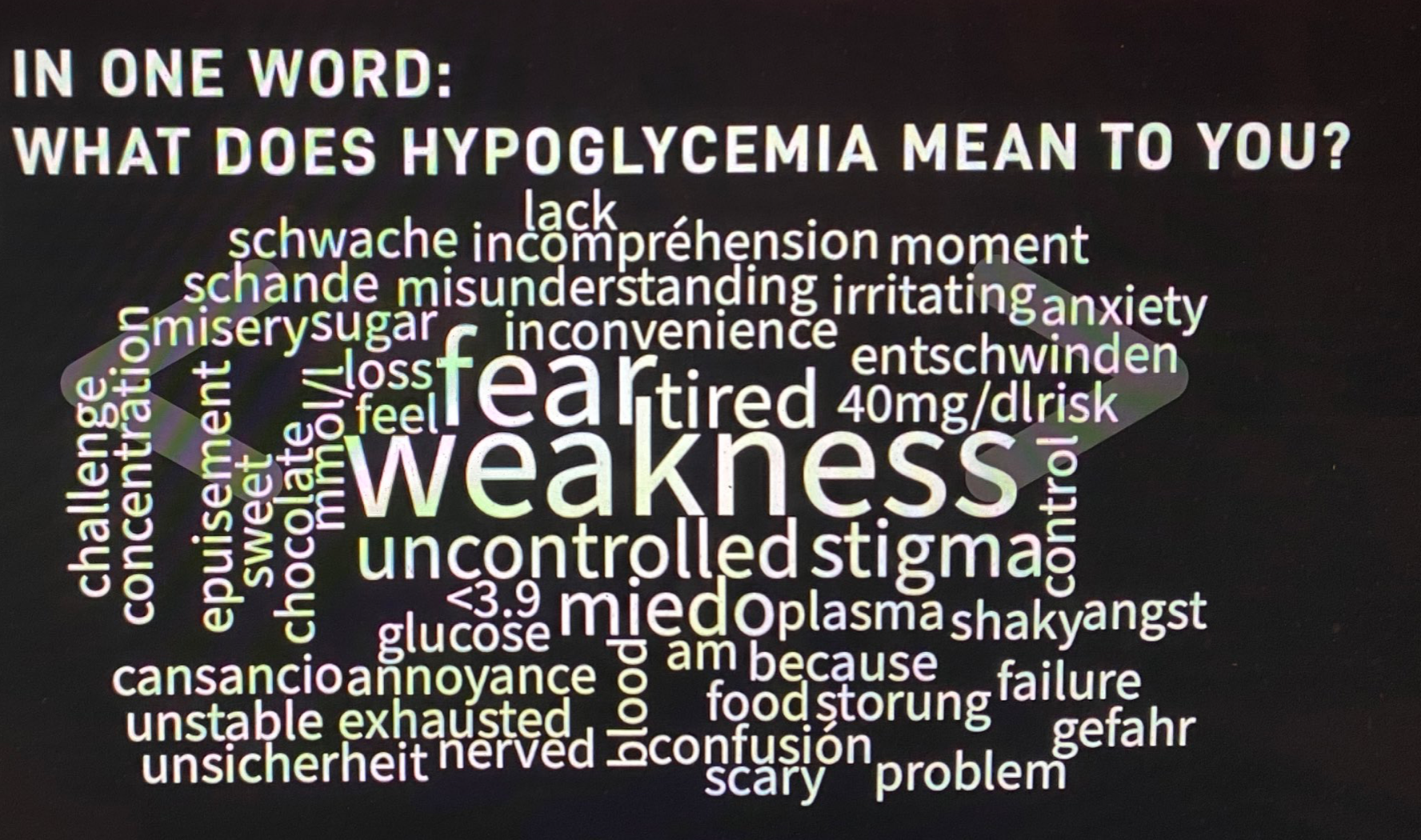
But to finish this post, I want to ask the question that one of last night’s HCPs, Pratik Choudhary, from the Leicester Diabetes Centre in the UK, asked us: ‘Do you see hypos as a slope or a cliff face?’ I can’t stop thinking about this, because I’ve never been asked about hypos this way, but it makes so much sense to consider them in this context. Of course, there are so many factors at play, but this either / or scenario does perfectly capture the in-the-moment way that I feel about hypos. I wonder what you might think about your hypos. Does it fit in here, or is it something completely different?
DISCLOSURE
I was an advisor to Lilly Diabetes for the Hypo Summit. I have been paid for my time. I have not been asked to write anything about the summit, but am sharing because there was so much amazing content at the event. No one has reviewed this post prior to publication.
Today, I had my second COVID jab. I feel grateful, happy, relieved. I recognise how privileged I am to be living somewhere where I was able to access the vaccine. And I feel lucky. My tee wasn’t a deliberate choice when I threw it on this morning, but jeez, it sure does feel appropriate right about now.*

I also feel…
One step closer to not being so anxious.
One step closer to not worrying all the time.
One step closer to not calculating how close someone is standing.
One step closer to avoiding lockdowns.
One step closer to not having to check in everywhere we go.
One step closer to not thinking every sniffle, every cough is a sign of something more sinister than just a sniffle, just a cough.
One step closer to stressing less about my parents getting the virus.
One step closer to walking into places without first counting how many others are there.
One step closer to being free to meet up with friends in crowded bars.
One step closer to not assessing risk at every step, every move, every breath.
One step closer to not scrutinising testing numbers, vaccination numbers, virus numbers.
One step closer to borders opening.
One step closer to crossing borders.
One step closer to the Qantas Business lounge.
One step closer to getting on an aeroplane.
One step closer to walking the streets of New York.
One step closer to hearing Mike Stern at the 55 Bar on a Monday night.
One step closer to cinnamon buns in Copenhagen.
One step closer to more in-person diabetes peer support.
One step closer to presenting on a stage instead of a zoom room.
One step closer to IRL #docday°.
One step closer to hugging friends from far flung places.
One step closer to thanking my squad in person for keeping me going.
One step closer to kisses on the cheeks say hello.
One step closer to not having to get up at least once a week for 3am meetings for projects run outside of Australia.
One step closer to walking the halls of diabetes conferences again.
One step closer to this being over.
One step closer to life as we knew it, even if it will never be the same again.
*My tee wasn’t a deliberate choice when I threw it on this morning, and it wasn’t until I was on my way to getting my jab that I really though about it. There’s a story to that tee, and today, it feels pretty special.
In January 2020, I was in my favourite store in Melbourne (shout out to Sian at RMP Melbourne), and there, on the racks, was a white t-shirt, from Rabens Saloner, with ‘Lucky one’ printed across the front. Startled, I took in a sharp breath and lifted the shirt from it’s hanger, holding it up to me. And I flashed back the last day of EASD in Barcelona just a few months earlier, remembering…
I remembered how on that last day of the conference, walking between the hotel and the conference centre, I saw a stencil of the words ‘Lucky One’, the paint dripping from the words. It was on a concrete wall with nothing else around it. It summed up perfectly how I was feeling, so I snapped a pic to remind me.
Here is that photo…

Trawling Instagram today, this jumped out at me:

This is a fact. No correspondence will be entered into. It doesn’t matter if you like it some other way. There is no ‘But I like it with parsley’ or ‘I substituted chicken for the guanciale’, or ‘It tastes better with cream’. Because no. No, it does not. Or, if you believe it does, that’s fine, but what you have cooked is not carbonara. You’ve made up something different. Enjoy. Just don’t call it carbonara.
Italians are very strict with their food rules. Which is hysterical, because in my experience (from, you know, my own family), Italians generally don’t really like rules all that much. I remember hearing about a time when there was a lucrative cottage industry in Italy of tee-shirts with diagonal black lines across the front for people to wear instead of buckling up when seatbelts became mandatory. I am, in equal measure, amused, astonished and appalled at the audacity of it all (and alliterative too).
Anyway, back to carbonara. The ingredients for the recipe are not open to negotiation. If you want to make it for dinner tonight, you need eggs, guanciale, pecorino, black pepper and bucatini. È tutto!
Thank fuck diabetes isn’t that rigid!
I break rules, ignore rules and make up rules all the live-long day. Because that’s how I do it. Diabetes is an opinion. Work out yours, change it as you like, add different things, or change change them out. And go for it. And don’t let anyone – even loud, passionate Italians – tell you otherwise.
Totally irrelevant postscript of my favourite ever story of Italians breaking rules (which, by the way, I think would make a brilliant series)
Years ago, while in a very long queue at the Santa Maria de Monserrat monastery, Aaron and I got chatting to a nonna-aged Italian woman. After five minutes, she’d had enough, announced that Italians don’t queue and pushed her way to the front, ignoring the stern rules that were clear to everyone else. She returned ten minutes later to tell us the statue was a gorgeous sight, and that we were stupid for not following her. Two hours later, while still diligently lining up, we realised she was right.
Last night, my gorgeous friend Andrea tweeted how she had seen someone wearing a CGM on the streets of Paris. When she rolled up her sleeve to show him her matching device, he turned and walked away. ‘Guess you can’t be best friends with every T1D’, she wrote. ‘Diabetes in the Wild’ stories have been DOC discussion fodder for decades – including wonderful stories of friendships being started by a chance encounter, and less wonderful stories such as Andrea’s most recent encounter. I was reminded of the many, many times pure happenstance of random diabetes connection has happened to me.
There was the time I was waiting for coffee and another person in line noticed my Dexcom alarm wailing, and the banter we fell into was so comfortable – as if we’d known each other forever!
And that time that someone working the till at a burger flashed her CGM at me after seeing mine on my arm and we chatted about being diagnosed as young adults and the challenges that poses.
Standing in line, queuing for gelato, is as good as any place to meet a fellow traveller and talk about diabetes, right? That’s what happened here.
And this time where I spotted a pump on the waistband of a young woman with diabetes, and started chatting with her and her mother. The mum did that thing that parents of kids with diabetes sometimes do – looking for a glimpse into her child’s future. She saw that in my child, who was eagerly listening to the exchange. But I walked away from that discussion with more than I could have given – I remember feeling so connected to the diabetes world in that moment, which I needed so much at the time.
I bet that the woman in the loos at Madison Square Garden wasn’t expecting the person who walked in at the exact moment she was giving herself an insulin injection to be another woman with diabetes. But yeah, that happened…
I’ll never forget this time that I was milliseconds from abusing a man catcalling me out his car window, until I realised he was yelling out at to show me not only our matching CGMs, but also the matching Rockadex tape around it. My reaction then was ridiculous squealing and jumping up and down!
Airports have been a fruitful place to ‘spot diabetes’, such as the time my phone case started a discussion with a woman whose daughter has diabetes, except we didn’t really talk about diabetes. And the time another mum of a kid with diabetes was the security officer I was directed to at Amsterdam’s Schiphol Airport. She was super relaxed about all my diabetes kit, casting her eyes over it casually while telling me about her teenage son with diabetes.
The follow up to this time – where I introduced myself to the young mum at the next time who I overheard speaking about Libre, and saying how she was confused about how it worked and how to access it – but not really being all that sure about it, is that she contacted me to let me know that she’d spoken with their HCP about it, had trialled it and was now using it full time. She told me that managing diabetes with toddler twins was a nightmare, and this made things just a little easier.
Sometimes, seeing a stranger with diabetes doesn’t start a conversation. It can just an acknowledgment, like this time at a jazz club in Melbourne. And this time on a flight where we talked about the Rolling Stones, but didn’t ‘out ourselves’ as pancreatically challenged, even though we knew …
But perhaps my favourite ‘Diabetes in the Wild’ story is one that, although I was involved, I didn’t write about. Kerri Sparling wrote about it on her blog, Six Until Me. Kerri was in Melbourne to speak at an event I was organising, and one morning, we met at a café near my work. We sat outside drinking our coffees, chatting away at a million miles an hour, as we do, when we noticed a woman at the next table watching us carefully. We said hi, and she said that she couldn’t help listening to us after she heard us mention diabetes. She told is her little girl – who was sitting beside her, and was covered in babycino – had recently been diagnosed. I will never forget the look on the mother’s face as two complete strangers chatted with her about our lives with diabetes, desperately wanting her to know that there were people out there she could connect with. I also remember walking away, hoping that she would be okay.
Five years later, I found out she was okay – after another chance encounter. I was contacting people to do a story for Diabetes Australia and messaged a woman I didn’t know to see if she, along with her primary aged school daughter would be open to answering some questions. Turns out, this was the woman from Kerri’s and my café encounter. She told me how that random, in the wild conversation made her feel so encouraged. She said that chance meeting was the first time she’d met anyone else with diabetes. And that hearing us talk, and learning about our lives had given her hope at a time when she was feeling just so overwhelmed.
I know that not everyone wants to be accosted by strangers to talk about their health, and of course, I fully respect that. I also know there are times that I find it a little confronting to be asked about the devices attached to my body. But I also know that not once when I’ve approached someone, or once when someone has approached me has there been anything other than a warm exchange. I so often hear from others that those moments of accidental peer support have only been positive, and perhaps had they not, we’d all stop doing it. It’s a calculated risk trying to start a conversation with a stranger, and I do tread very lightly. But I think back to so many people in the wild stories – the ones I’ve been involved in, and ones shared by others – and I think about what people say they got out of them and how, in some cases they were life changing. A feeling of being connected. The delight in seeing someone wearing matching kit. The relief of seeing that we are so alone. The sharing of silly stories, and funny anecdotes. And in the case of that mum with a newly diagnosed little kid, hope.
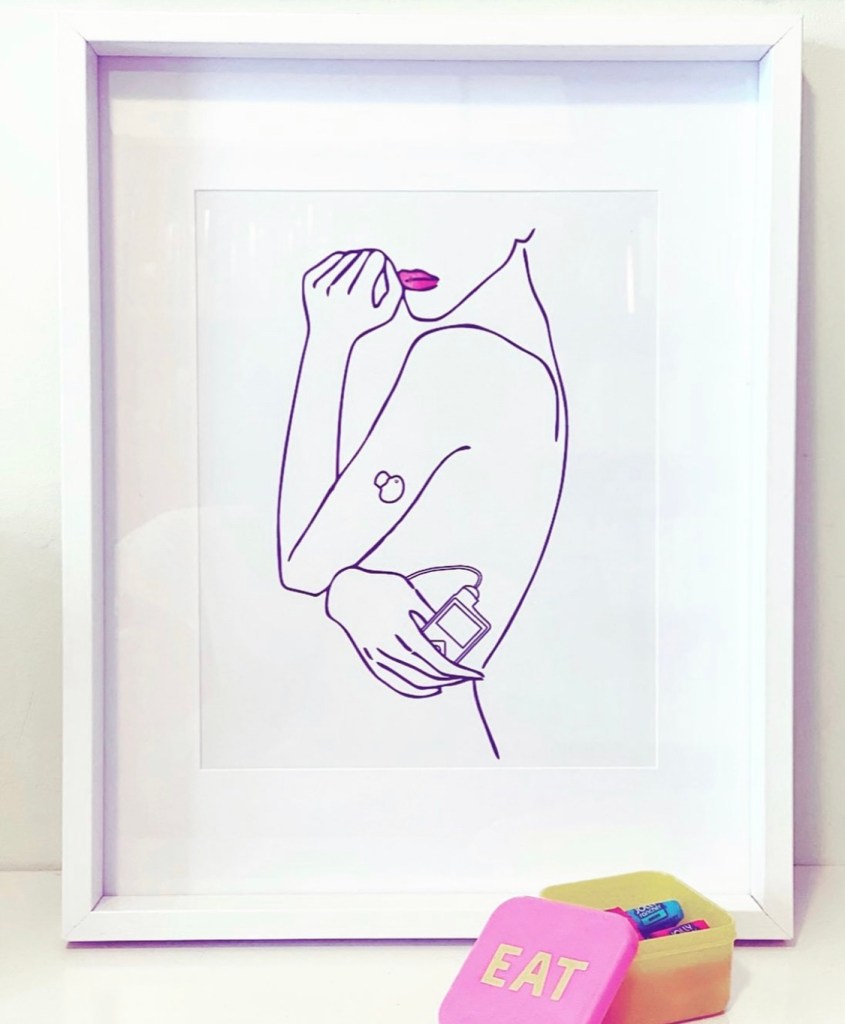
Today’s post is dedicated to Andrea whose tweet kicked off this conversation in the DOC last yesterday. Thanks for reminding me about all these wonderful chance meetings, my friend.
I searched for this blog post the other day after a Zoom catch up with a diabetes friend who mentioned that they were feeling really guilty because diabetes seemed to impact so much on those around her.
It’s hard to not feel that guilt, and when we feel guilty we often apologise. Apologising for diabetes is like apologising for lousy weather on a day we planned a garden party. We didn’t cause the rain. We didn’t cause our diabetes, or the parts of it that interrupt our day and mess up our plans.
I sent this post to my friend and she called me straight away to say that it helped her understand that she doesn’t need to constantly say sorry when diabetes throws a spanner into the works. It’s a hard habit to break. I realised that it was four years ago I resolutely wrote this post, mostly as a reminder to myself. I wish I could say that I’ve managed to nail it and have stopped apologising for diabetes being an inconvenience. But I’d be lying if I suggested I get it right all the time – perhaps I just need a prompt every now and then.
And if anyone else needs a reminder too, here it is for you…
________________________________________________
Recently, I heard myself saying to a friend with diabetes that she really didn’t need to – and shouldn’t – apologise for diabetes, specifically, for needing to stop to check her BGL while we were mid-conversation.
‘Don’t apologise,’ I said to her. ‘It’s just part and parcel of diabetes.’
And then, I heard how often I do it.
‘Sorry – I just need to treat this low.’
‘Sorry, darling. Would you mind just grabbing me a juice box from over there?’
‘Sorry – I had a lousy night with crap high BGLs and hardly slept. Would you mind repeating what you said? I missed it. Sorry.’
‘Sorry – my pump is wailing at me. Let me just see what it wants.’
‘Sorry – my CGM is alarming. I need to calibrate…hang on a sec…’
‘Damn. I’m out of insulin. Sorry. I just need to refill my pump.’
‘Sorry for munching on these glucose tabs. I’m okay – just trying to ward of a low.’
‘Sorry. My brain is foggy! I think I might be low….’
Sorry. Sorry. Sorry. Sorry. Sorry. Sorry. Sorry. Sorry…
Why am I apologising for my messed up beta cells? I didn’t destroy them. (Actually – technically I guess that’s not true. My own body did kill them off. But it wasn’t deliberate on my part…This is all getting rather confusing, so let’s just agree that it’s not my fault that I have diabetes.)
Why do I say sorry for having to treat or manage or address the health condition I live with all day, every day, and do things that I only do to keep me well…and alive?
I’m not alone here. Many others do the same. I’ve sat in rooms with friends having nasty lows and heard them apologise over and over again as they treat and will their glucose levels to rise. We do it amongst ‘friends’ – others from our pancreatically challenged tribe who get it better than anyone else, and we do it with those who are not living with it.
When I apologise for my diabetes, I am making it sound like I have done something wrong – intentionally or accidentally. And that is never the case. I’ve never intentionally been low or high. And even if it could be considered an accident or something I could have prevented – perhaps over- or under-bolusing or forgetting to refill my reservoir before leaving home – it was never done with the aim of being disruptive to others. Or myself for that matter.
What I am also doing is apologising for diabetes inconveniencing others. And I am also saying it is something shameful. But I can’t do anything about having diabetes. And it is not shameful. I am certainly not ashamed of having diabetes.
I wonder if it is a case of good manners going too far. Manners are very important to me – I have instilled this in our kidlet who is frequently complimented for her beautiful manners. But manners are about courtesy and respect – and that respect is for yourself as much as others. I think I am actually being quite disrespectful to myself when I apologise for having to ‘do diabetes’.
My body, which really doesn’t like itself, is not a reason for me to say sorry. I do enough managing diabetes without having to feel the need to repent all the time. So I’m not saying sorry anymore. Well, I’m going to try, anyway!

I can’t believe I wrote this piece almost seven years ago. I had turned 40 the year before and as often happens around the occasion of ‘big’ birthdays, I’d started to think about just what getting older means. I didn’t seem to have any feelings of regret or stress that I was ageing though, I was fully embracing just where I was going, the wisdom that I felt, and the absolute excitement of what was coming next. Seven years later, I can see that I was right to feel that way.
At the moment, I’m spending time thinking and reading about menopause and I’m lost in language that is tied up with this ‘next stage’. There seems to be so much loss, regret, and looking back, and feeling scared about what people are losing and leaving behind as the next stage of life hits. But I don’t feel that way. I feel that I can look back with pride and achievement and happiness and pain and love and hurt and longing. There are things I wish I had done differently, but nothing I wish I hadn’t done. I don’t want do-overs. Looking ahead, there is just more to look forward to, possibilities that I have no idea about yet.
This year, with so much about insulin’s centenary, thinking about getting older seems more poignant. Because a short century ago, diabetes was a death sentence. Ageing was only something we could even dream about. What a privilege to wear my age in years alongside my age in diabetes!
And so today, I’m sharing these words from 14 October 2014 (with a few edits) because they still ring true for me. They still feel real. And in seven years time, I’m hoping I revisit this post again, and feel the same way.
______________________________________________
I really should be careful what I read and where I read it! The other day I sat at a gate lounge at Sydney Airport crying as I read an incredibly candid piece on the Huffington Post that inexplicably told my story so honestly and accurately that I wondered if I had written it and not remembered.
And then I read this piece by Rebecca Sparrow and again, floods of tears as I nodded at everything she wrote.
I remember one day sitting with a group of other women all around the same age and we were speaking about skin care products (and then we giggled about boys, plaited each other’s hair and painted our toe nails). I was the only one who had not been using so-called anti-ageing products for a number of years. Because that’s the thing – we’re meant to be anti-ageing and do things to turn back the clock.
I am forty years old. (EDIT: forty-seven) This is not something I feel the need to hide nor be ashamed of. I celebrated last year with a week of parties and lovely gifts. I wanted to celebrate this milestone – just as I do every milestone. Next month, I turn 41 and have every intention of celebrating that too.
Rebecca Sparrow writes that ageing and getting older is a privilege as she tells the story of a friend of hers who, at 22 years has been diagnosed with terminal cancer. This young woman is not going to be afforded the opportunity to age and get wrinkly and turn grey. She is going to die at an age where most of us feel completely immortal.
Ageing is a privilege – I understand that more and more every day. With our daughter growing up – she’s going to be 10 next month – I can easily measure time. We see how she has changed and how, with each passing month, she is becoming an incredible young girl we are so proud of. And we are so lucky to be able to watch this.
I am over the idea that ageing is something that we should hide from and do everything in our power to avoid. I am forty years old. I look older than I did when I was 17 and doing year 12, or when I was 25, or when I was 30 and pregnant, or even than I did a couple of years ago. Of course I do. And if truth be known, I really don’t want to turn back the clock – on how I look physically or how I feel emotionally. With age comes wisdom – it may be a cliché, but it is true. But even more – with age comes experiences and confidence and a sense of self that only seems to grow each year.
Ageing is a privilege. It is normal. And devastatingly, for some, they never will age.
Less than 100 years ago, being diagnosed with type 1 diabetes was a death sentence. Think about that for a moment. If I had have been diagnosed prior to insulin being available, I would have died before I was 25 years old. I never would have travelled, worked in a job that gives me incredible joy, spent so much time with friends and family, seen Tony Bennett live, learnt what an octothorpe is, watched the West Wing, attended my 20 year school reunion – or my 10 year school reunion for that matter, danced on the turf of the MCG as The Police sang, seen the Book of Mormon, read Harry Potter, gone to (and fallen in love with) New York City, met Oliver Jeffers, used an iPhone, gotten married or had a daughter. (2021 EDIT: AND …revisited and revisited and revisited New York, watched my girl turn into the most amazing almost-adult, stood on the stage at conferences around the world, extolling the value of the lived experience, stood alongside three amazing women as we put together the fantastic programme for the 2019 IDF Congress, Living with Diabetes stream, celebrated 20 years of marriage, road tripped across the US with Aaron, visited Graceland, sat in ABBA’s Arrival helicopter, ‘built’ my own pancreas, gone back to Paris another few times, and finally been able to sit on the grass at Place des Vosges, taken my family to Friends for Life, seen the language matters movement grow from the seed we planted into a global movement, lived through (and continue to…) a pandemic…)
My life would have ended before any of these things. Just because I’d been diagnosed with type 1 diabetes. Which makes me understand and feel the privilege of ageing more and more. Every diaversary, every diabetes milestone is worth celebrating.
I want to look forty (EDIT: forty-seven) – I want every battle scar I’ve earned to be visible; every success – and every failure – to be shown on my face; the story of every victory and disappointment to be told. Because these are part of who I am and I am so, so lucky to be here to keep telling my story.

And Zooming. So fucking much Zooming.
There have been a number of times here on this blog and in other online platforms that I have been critical about the low carb community. Actually, let me be more specific. I have been critical of the response from certain corners of that community, particularly the corners that are free with their fat shaming, and accusing people with diabetes who choose not to eat low carb as not caring about their health, and attacking others for daring to suggest that there could possibly be more than one way to eat. This has come from a long list of incidents I’ve either seen or have been involved in, such as the time I was fat shamed for saying that intermittent fasting is great for some, but not for everyone, and the time that people in the LC community got angry at the idea of saving the lives of children with diabetes from developing countries.
I guess I shouldn’t have been surprised really at what happened earlier this week just before I published a post on diabetes and menopause. As I often do, I look to the community for others’ experiences. And so, I tweeted (and shared on Facebook) this:

The responses were many and great. One aspect of the generosity of the DOC is the willingness and openness to share not only experiences, but to offer tips and tricks for what has worked for them. I’ve always found that so amazing, especially when addressing issues that are considered a little taboo. Menopause is one of those issues. But even so, there were so many replies from people who have either gone through menopause, or started to think about it.
And then, out of the blue, came a reply from a nutritionist. A nutritionist I have never encountered before. I don’t follow him on Twitter, I have no idea who he is. Which is all fine. My Twitter is public and if I ask a question everyone is free to offer their input. Here is his reply:
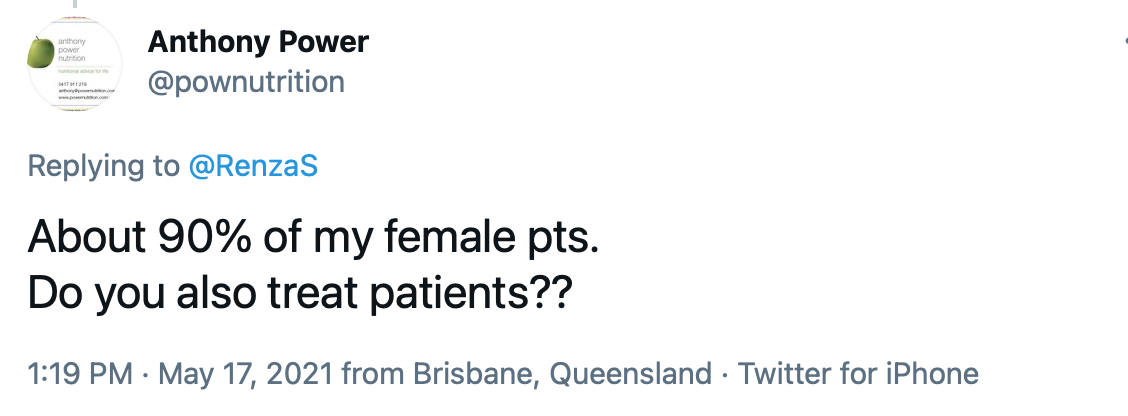
I replied that I am not a healthcare professional. And then came this:
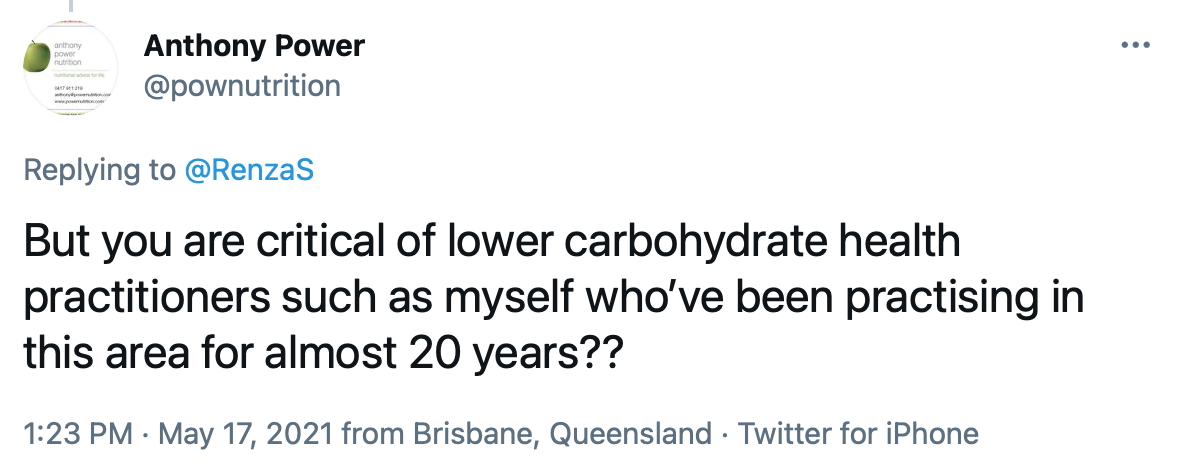
Followed by this from me:

(I’m not going to share anymore of the tweets in what turned out to be a rather long back and forward thread, but if you click on any of the tweets above you will be able to find the whole mess.)
He kept going, demanding to know why I am critical of low carb diets and health professionals who promote them (which he apparently had deduced from reading through my Twitter feed). I’m not. Which is what I repeatedly tweeted to him in responses to his continued demands that I explain my stance on diets and diabetes, and, as a healthcare professional, I must stop giving ‘personality-driven healthcare advice’. I reminded him that, a) I am not a HCP (which I had already stated), and, b) I share my experiences, not give advice. He helpfully suggested that my blog posts read that way.
I had asked about menopause. I asked people with diabetes who had either been through menopause, were going through it now, or thinking about going through it. I asked whether it had been a topic of conversation with their HCPs.
This bloke – who doesn’t have diabetes and has never experienced menopause – had nothing to offer, other than attacking me for my choices. And my choice is that I believe in choice.
It’s not okay for a healthcare professional to enter into a discussion with a person with diabetes seeking peer support, and telling them what it is that they do and don’t do in that community. I am so over this sort of paternalism in healthcare. I’m over HCPs bullying their way into our community and trying to shape it into what they want.
I’d also add that a man hijacking a conversation started by a woman about menopause is pretty shitty behaviour. I’m also over misogyny and the way male healthcare professionals centre themselves in discussions that are not about them. It happens all the time. It happened on Monday.
A tweet about menopause. And not even about food and menopause! It sounds somewhat ridiculous really. I don’t look for this sort of reaction, and I certainly have never baited anyone from the LC community. I don’t post photos of high carb meals accompanied by a ‘dare you to say something’ comment. (But I should say, that even if people are doing that, there is still no valid reason to criticise what another person is eating** or criticise the way they choose to eat.)
I understand that there will always be difficult people in any community. Unfortunately, it is people like this who are often the most seen from the LC community. And it’s why I am critical. But be clear – I am not critical for the advice they are giving, or the eating plan they are following. I am critical of, and will continue to call out, this sort of behaviour.
**Okay, I know that I said that there is no valid reason to criticise what another person is eating. But I am adding a caveat to that because I do (and probably will continue to) criticise anyone who wants to drink flavoured coffee. Or instant coffee. Or coffee from a bag. I fully acknowledge and accept my status as a Melbourne coffee snob and will not be entering into any discussions that caramel, pumpkin spice or unicorn flavourings are okay. They are not. Don’t @ me.
Today I’m talking menopause, because for fuck’s sake, why don’t we do that more?
Actually, I know why. It’s because it’s considered an exclusively ‘women’s issue’ and has been the butt of jokes from male comedians and talk show hosts, and really, who gives a fuck anyway?
This post is likely to continue being sweary, because as I’ve tried to find information on diabetes and menopause it seems that the road is similar to pretty much any other issue about diabetes and women’s health. Sure, there’s quite a bit out there about pregnancy – and you bet I take some credit for that because back in 2001 when I started working in diabetes organisations the very idea of lived experience-led information about diabetes and pregnancy was not typical at all, but we wrote a resource and it is still (in a very updated format) still available) – but it’s up there with trying to find details about women with diabetes and sexual function and sexual health.
I am literally counting down the days until Dr Jen Gunter’s new book, The Menopause Manifesto, makes its way to our bookshelves, because I know it is going to be an absolute wealth of no-bullshit, evidence-based, straight-talking information. Her previous book, The Vagina Bible, (known in our house as ‘The Vible’) delivered that in spades as it busted myths, is easy to read and matter of fact, and suggested just where Gwyneth Paltrow might like to shove her $300 jade eggs (spoiler: not up her, or anyone else’s vagina). I was so pleased that when she mentioned diabetes a few times in her book, the information was spot on. In fact, I think that her explanation as to why women with diabetes may experience yeast infections more commonly was one of the clearest I’ve ever read.
Now, Jen Gunter has turned her full attention to the issue of menopause. This great piece is an excerpt from the book (due out at the end of the month and available for pre-order now), and the part that stood out for me was the bit where she said that often, menopause gets blamed for everything any time a ‘woman of a certain age’ has symptoms they take to their HCP.
Sounds a little familiar, doesn’t it? I guess I’ll have to add ‘Sometimes it’s not menopause’ to my lexicon, right there alongside ‘Sometimes it’s not diabetes’. How easy, and convenient, it is to simply dismiss someone’s concerns simply because there is something easy (and perhaps obvious) to blame it on.
Of course, with diabetes and menopause, there is the bit I have learnt where some of the symptoms of aspects of menopause look very much like the symptoms of aspects of diabetes. Looking into patenting a game called Hypo or Hot Flush in the coming years. I think it might be popular with PWD of a certain age. The winner gets a cold compress and a jar of jellybeans.
Here’s the thing. I’m not actually menopausal. I don’t even know that I’m necessarily peri-menopausal yet. But in the same way that I wanted to know all there was about diabetes and pregnancy before I was ready to get pregnant, I’m trying to prepare myself as much as possible for the somewhat mythical period of menopause. Forewarned is forearmed or whatever that saying is. The problem with that is that there is so little info out there that arming myself is proving a little difficult. And it appears that I am not alone in my thinking.
In much the same way as speaking about sexual health when I’ve found myself in a room with a few of my female diabetes friends (and wine), it seems that once we hit our mid-40s we start wanting to talk about menopause as well, searching out any titbits of information that may just help us know what we need to get ready for. We’re desperate for tips and tricks and a glimpse into what we have in store. And it seems that very few of us is having these conversations with our healthcare professionals.
Lucky for me, my endo has spoken with me about it a little – after I’ve asked. She tells me that the mean age of the start of menopause is 47 years, which is smack bang my age, so I’m expecting to have some firsthand experience soon. And when it comes to sharing that experience, I am already committed to writing about it in a way that moves from the focus on loss that seems pervasive in most of what I’ve read about it – the loss of fertility, the loss of libido, the loss of vitality. #LanguageMatters in menopause too, and the idea that we are writing off those going through it when it’s possible they still have half their life ahead of them sounds a little grim.
So, my question is, what do people with diabetes need to advance discussions around this? What do we want to know? And when and how to we want that information? Is it a matter of just starting to talk about it more in public forums? Do we routinely start asking our HCPs for information so that slowly (because everything in healthcare takes time) it is on their radar? Do we need more research? (Yes, the answer to that is a resounding yes.) Do we need a snappy hashtag? Is that hashtag #HypoOrHotFlush? (No, I think not.)
If you’d like to join the conversation, please respond to this tweet. Or to this post. Or send me a message privately. And I’ll follow up with another post in a few weeks.
Looking for more?
Great post here by DOC legend, Anne Cooper.
Sarah Gatward has written a terrific series of her experiences of menopause on her blog here.

I want to acknowledge that not only women experience menopause. Thanks to this brilliant website, Queer/LGBTQIA+ Menopause, that I kept referencing today, which provides fantastic advice for how to speak about menopause to capture the experience of people who are not cisgender and/or not heterosexual.
Today, there was an article in online publication, The Limbic, which reported on a recent study conducted out of Westmead Hospital Young Adult Diabetes Clinic
The top line news from this research was that there is a high discontinuation rate of CGM in young people (aged 15 to 21 years).
Let me start by saying I know that CGM is not for everyone. I don’t believe everyone should use it, have to use or even necessarily be encouraged to use it. As with everything, your diabetes technology wishes and dreams may vary (#YDTWADMV really isn’t a catchy hashtag, is it?), and there is a lot to consider, including accessibility and affordability. In Australia, affordability is not such an issue for the age group that was studied in this research. Our NDSS CGM initiative means that access to CGM and Flash is fully taxpayer funded (with no out-of-pocket expenses) for pretty much all kids, adolescents and young people up to the age of 21, provided a healthcare professional fills in the relevant form.
The top-level findings from this research are that within the first week of starting to use CGM, almost 60% of study participants stopped. The decision to start CGM was made after a one-hour education program that was offered to 151 young people with diabetes, and 44 of them decided to start CGM. Of those 44, 18 young people continued using it. They happened to be the 18 young people who were more connected with their HCP team (i.e., had more frequent clinic appointments) and had a lower A1c, which the researchers suggested meant that they were struggling less with their diabetes management. The 26 young people who chose not to continue cited reasons for stopping such as discomfort, and inconvenience.
I had a lot of questions after I read about this research. (These questions arose after reading the Limbic’s short article and the research abstract. I will follow up and read the whole article when I can get access.)
If the young people who chose to not continue were already struggling with their diabetes management, is adding a noisy, somewhat obvious (as in – it’s stuck to the body 24/7), data-heavy device necessarily a good idea? Was this discussed with them?
Was any psychological support offered to those young people having a tough time with their diabetes?
Was it explained to the young people how to customise alarms to work for them? If diabetes management was already struggling and resulting in out-of-range numbers, high glucose alarms could have been turned off to begin with. Was this explained?
What education and support had been offered in the immediate period after they commenced CGM therapy? Was there follow up? Was there assistance with doing their first sensor change (which can be daunting for some)?
In that one-hour education they were offered before deciding to start on a CGM, did they hear from others with diabetes – others their own age (i.e., their peers) – to have conversations about the pros and cons of this therapy, and learn tips and tricks for overcoming some typical concerns and frustrations?
What was in that one-hour education program? Apparently, 151 young people did the program. And only 44 people chose to start CGM. Now, as I’ve already said, I don’t think CGM is for everyone, but 29% seems like a pretty low uptake to me, especially considering there is no cost to use CGM. Did anyone ask if the education program was fit for purpose, or addressed all the issues that this cohort may have? Why did so few young people want to start CGM after doing the program?
Were they using the share function? Did they have the opportunity to turn that off if they felt insecure about others being able to see their glucose data every minute of every day?
What frustrates me so much about this sort of research and the way it is reported is that there is a narrative that the devices are problematic, and that the people who have stopped using them have somehow failed.
CGM may not be for everyone, but it’s not problematic or terrible technology. I remember how long it took me to learn how to live with CGM and understand the value of it. It took me time and a lot of trial and error. I didn’t want to wear CGM, not because it was lousy tech, or because I was ‘failing’, but because I hadn’t been shown how to get it to work with and for me. I had to work that out myself – with the guidance of others with diabetes who explained that I could change the parameters for the alarms, or turn them off completely.
And these young people are YOUNG PEOPLE – with so much more going on, already struggling with their diabetes management, and not connected with their diabetes healthcare team as much as the young people who continued using CGM. Do we have any information about why they don’t want to connect with healthcare professionals? Could that be part of the reason that they didn’t want to continue using CGM?
I don’t think we should attribute blame in diabetes, but it happens all the time. And when it does, blame is usually targeted at the person with diabetes, but rarely the healthcare professional working in diabetes. If a person with diabetes is not provided adequate, relevant education and support for using a new piece of tech, there should not be any surprise if they make the decision to not keep going with it.
The positives here is that there is data to show that young people who are already struggling with their diabetes management may need other things before slapping a CGM on them. Cool tech can only do so much; it’s the warm hands of understanding HCPs that might be needed first here. Someone to sit with them and understand what those struggles and challenges are, and find a way to work through them. And if CGM is decided as a way forward, work out a gently, gently approach rather than going from zero to every single bell and whistle switched on.
I am a huge supporter and believer in research and I am involved in a number of research projects as an associate investigator or advisor. I’m an even bigger supporter in involving people with diabetes as part of research teams to remind other researchers of the real-life implications that could be considered as part of the study, offering a far richer research results. Growing an evidence base about diabetes technologies is how we get to put forward a strong case for funding and reimbursement, increased education programs and more research. But sometimes there seems to be a lot of gaps that need filling before we get a decent idea of what is going on because the findings only tell one very small chapter in the diabetes story.

Imagine if the only emotion we felt when we ate something was joy. How different that would be.
A more detailed post about language a food can be found here.





 Diabetogenic