You are currently browsing the category archive for the ‘Real life’ category.
With the weather changing, I find myself starting to rethink what we are eating at home. The delicious and warming braises and casseroles that have been a staple of the cooler months are replaced with lighter options such as salads and grilled chicken or steak. The oven is rarely turned on – instead we need to think about buying a barbeque for the back garden so we can grill and eat outside.
My trusted and well used Le Creuset heavy-based casseroles seldom come out from their cupboard. But large salad bowls and platters are on frequent rotation, piled high with lighter food.
Fruit is no longer stewed, instead cut up and eaten fresh. The selection in the fruit bowl and in the fridge moves from mostly citrus and apples and pears, to stone fruits – nectarines, peaches, mangoes. Grapes get popped in the freezer; melons are cut up in Tupperware in the fridge for easy-reach snacks and we start to count down until cherry season hits.
And fruit is also thrown into salads – mango mixed with chicken, avocado, walnuts and rocket; white nectarines sliced and sprinkled over platters of cooled freekah, fresh tomatoes, herbs, artichoke hearts and prosciutto.
If only I had a green thumb, I’d get into planting vegies too. Alas, an overflowing pot of basil is usually all I can manage – meaning an easy meal of fresh pesto stirred through pasta is never more than 10 minutes away!
Mimicking the change of seasons with a change of our menu is one of the most wonderful things about food. It reinvigorates meal planning which can get in a rut and helps keep things interesting. And it’s easy for me – with easy access to farmers’ markets, fresh food stores and the Queen Victoria Market just across the road from work.
I’ve been thinking about this a lot recently because, as many of you may know, the IDF’s campaign for World Diabetes Day this year centres on healthy eating and, more specifically, access to fresh and healthy foods.
Because the food we eat does impact on the ability to manage our health. And diabetes is part of our health.
Some people with type 1 diabetes are a little pissed off at this message. They are banging the ‘type-1-has-nothing-to-do-with-what-you-eat-and-this-is-mixing-up-the-messages-and-what-I-ate-had-nothing-to-do-with-why-I (-my-child) –got-type-1’ drum and have been annoyed that the IDF is daring to suggest that there is a link between food and the wellbeing of people with type 1 diabetes.
But the food we eat does impact on our diabetes management, something that sometimes does get lost in our ‘but-I-can-eat-anything’ protestations.
Of course we can eat anything. We have tools to help us to do that and to do it safely. We can bolus for the doughnut we choose to eat for lunch, just as easily as we can bolus for the sandwich we eat.
But that’s not the point. No one is saying that. What this campaign is about is how the food we eat contributes to healthy living. We need insulin to survive, tools to manage our BGLs and access to food to treat lows, sustain energy and be healthy.
In just the same way that there are people in some parts of the world who do not have access to insulin or diabetes consumables, there are places where there is no access to affordable, fresh, healthy food. Of course all of this impacts on a person’s ability to live well with diabetes. It impacts on their ability to live well. Full stop.
The IDF is strongly suggesting that healthy eating is a right, not a privilege. And no one can disagree with that. Surely.

Last night – as a last hurrah to pie weather (and the need to use up the leftovers from a roast chook) a final pie was baked. With a little maths-nerd humour thrown in for fun.
I am all about facts. So when writing to the Commonwealth Health Minister, Sussan Ley, asking her to make CGM available to Australians living with type 1 diabetes choosing to use this technology, I left the emotion behind and concentrated on the realities. I can’t say that it has saved my life, because I don’t know that is the case. I do know it makes my life easier, better, happier and healthier. And that has to count for something. This is my letter about my real life with diabetes and how I choose to use CGM. I urge anyone else who believes this technology should be available more broadly to write to the Minister and share your story. My post on the Diabetes Victoria Blog from last week has some tips about what – and how – to write.
_________________________________________
Dear Minister Ley
On Tuesday, I attended an event at Parliament House about type 1 diabetes and new technologies. The aim of the night was to highlight the importance of developing pathways to ensure that new technologies make it onto the Australian market in a timely manner (in the first instance) and, once approved, are available and affordable to as many people as possible.
Unfortunately, you were unable to attend; however, I did spend some time speaking with one of your advisors and shared a little about my experience of using CGM.
This is not new technology. It has been available in Australia for the better part of the last decade. And yet, it is still out of the reach of most people living with diabetes. This needs to change.
Availing this technology to people with type 1 diabetes who want it is well overdue. Please understand, however, there will be a lot of people not interested in using CGM. But it should be a choice for everyone.
I have worn a CGM on and off for the last eight or so years. There are many reasons I don’t use it all the time. Fortunately for me, I can afford the $5,000 or so it takes each year to use CGM. The reasons I don’t use the technology continually include not feeling like I need the constant data feed, or simply not wanting to use the technology all of the time. Sometimes, I feel it won’t benefit my diabetes management.
Other times, however, I wouldn’t be without it. If my BGLs are more variable than usual (such as when I have an infection or am particularly stressed) or if I am travelling alone, having a CGM provide me with information is very important to me. It keeps me safe, it improves how confident I feel about my diabetes and it means that I stay as healthy as I possibly can.
For me, wearing a CGM is not so much about saving my life. It is about living my life the best I possibly can – despite diabetes; it is about being able to identify, react to and remedy impending high or low blood glucose levels; it is about having information that means diabetes impacts far less than it otherwise would.
Minister, we need sensible pathways that ensure diabetes technology is available equitably. But even more so, we need consistent and transparent processes that expedite the release of new and emerging diabetes technologies onto the Australian market.
I am grateful to use CGM alongside my insulin pump. I believe that it has certainly assisted me to live a healthy and productive life. It is not a luxury. It is a necessity in my arsenal of living well with type 1 diabetes – in the same way that insulin, other devices and their consumables, access to healthcare professionals, and support from my friends and family are necessary.
Minister Ley – it is time to make this technology available to any Australian child or adult with type 1 diabetes who chooses to use it.
Thank you
Renza Scibilia
‘How’s that working for you?’
‘Sorry?’
I’m at Parliament House in Canberra preparing for a type 1 diabetes and technology event being held later today. Walking through security, three security staff honed in on my upper arm.
‘Your patch, is it doing the trick?’
I was confused. ‘I’m sorry. Excuse me?’
‘Are you an ex-smoker?’
‘Oh! This? It’s not a nicotine patch. It’s a continuous glucose monitor. I have diabetes.’
I don’t know if they believed me. I gathered my bag and moved on through the security area. ‘Diabetes,’ I said again. ‘It checks my blood sugar.’
My invisible illness is pretty visible today.
I made the decision yesterday morning to site my sensor on my upper arm rather than my stomach. The last two sensors I have worn left my skin slightly irritated, so I though I would give the skin around my belly a rest. I also haven’t been thrilled with how long the sensors have lasted – the last two survived a mere 10 and 12 days which is not great when I have been known to get closer to three weeks. (I know, I know, they are meant to work for 7 days. But at over $80 a pop, I do everything in my power to make sure they last as long as bloody possible!)
Before I got to work yesterday morning, three different people had asked what the thing on my arm was. Once I got into the office, another couple of people asked (…don’t even want to remind you all that I work for a diabetes organisation…)
Waiting for a coffee at my local this morning, the barista asked about it and yesterday, at the cafe near work, I could see the people around me looking at my arm and heard them guessing what it was.
At the airport today, a security guard asked if it could be removed and then wanted to engage in a conversation about it, and the woman sitting next to me also asked about it.
It’s been very confronting.
I have never hidden my diabetes. I used to inject at the dinner table before starting pump therapy. And since using a pump, I pull it our from under my clothes to bolus, or see my CGM graph without a second thought. I check my BGL whenever and wherever I want.
But while these diabetes chores occasionally attract a comment, it is nothing like the last two days.
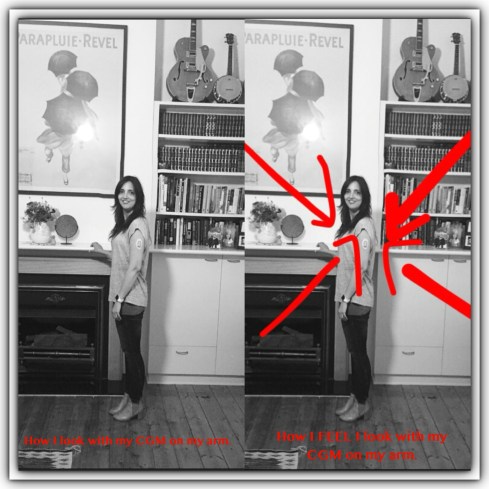
I found myself sitting at lunch today with my right arm cupping the transmitter and sensor to hide it from view. I’ve been cursing the beautiful weather that means I don’t need to wear long sleeves to cover the device. And I’m terrified that people think I am wearing it on my arm to attract attention.
I have always been able to see the pros and cons of having an invisible health condition. Sometimes, the fact that there are no obvious signs of diabetes means that people don’t understand how significant a role it plays in day to day life. But the flip side is that it can be neatly packed away; it can be private. I actually love that about it.
But right now, I don’t have that luxury. Right now it is out, loud and proud for all to see. And I am not comfortable with it at all.
Clearly, jet lag, daylight saving and time zone confusions have meant that any creativity left in my pea-sized brain has been zapped to non-existence. As has the ability to order the million things that I have read in the last couple of days.
So, with a slight inability to organise my thoughts clearly, here are some things on my mind today.
Stephanie Rice is not a medical professional (that piece of information is more for her than anyone else)
Yes, another C grade celebrity has been at it again: providing medical advice and pretending to be an expert of everything. Aussie Olympic swimmer, Stephanie Rice, has come under fire for starting a Q&A style section on her Facebook page, where readers could seek medical advice.
Now, part of me wants to say that if you think that asking an Olympic swimmer for anything other than advice about, I don’t know, swimming, you get what you get and you don’t get upset. But this isn’t really about Rice’s readers. This is about the arrogance that she is demonstrating in thinking that she actually has anything to offer here.
I was talking about this yesterday with someone and she looked a little surprised at how annoyed I sounded. ‘But isn’t that kind of what you do on your blog,’ I she asked.
I would like credit here for the incredible restraint I demonstrated in not stabbing her with a (blunt) lancet. I would also like credit for speaking to her with respect as I pointed out that no, this is no what I do here.
What I do here is talk about my experiences (such as my experience of getting annoyed at swimmers who think that you shouldn’t have a medically-prescribed MRI because ‘there is so much radiation’), but never, ever telling people what they should do (such as suggesting that you shouldn’t have a medically-prescribed MRO because ‘there is so much radiation).
Of course, Rice responded with an ‘I’m hurt – I’m only trying to share what I have learnt and how much I now know’ post that is defensive and naïve.
Also, it is where she has it wrong. And it’s where Sarah Wilson and her ‘I-live-with-autoimmune-disease-(as if it is a singular thing)-and-therefore-can-give-medical-advice’ also gets it wrong.
Your advice is worthless. You have no qualifications in medicine, so stop giving medical counsel.
What does have some worth, however, is sharing your story. People connect with that. They hear what you are going through and feel supported. It makes them feel less alone. It is not your job – any more than it is my job – to provide medical information to people.
So stop it. Just stop it.
Live longer
Yesterday, MJA (The Medical Journal of Australia) published an article – Recent advances in type 1 diabetes – authored by some of Australia’s leading clinical experts in type 1 diabetes.
There were some really interesting points mentioned including that, in Australia, the incidence of type 1 diabetes has doubled over the past 20 years.
But for me, the most interesting and hopeful point (which was also the focus of the media release) was the following statement:
Although T1D is still associated with considerable premature mortality, recent findings show that a significant improvement in life expectancy has occurred.
I have always had in the back of my head that my life expectancy will be shortened by fifteen years due to my diagnosis of type 1 diabetes. It’s not all roses and I am not in denial that there will be challenges as my diabetes – and I – get older. But there is some good news in here. And for that, I do have some hope.
Do this survey
Abbott Australia has a series of surveys live at the moment for adults with type 1 and insulin-using type 2 diabetes.
YourSAY (Self-management And You) asks what it is like to live with diabetes each day, specifically looking at the behaviours and attitudes to diabetes self-management and glucose monitoring.
The survey takes about twenty minutes to complete and is open to anyone who meets the following criteria:
- Live in Australia
- Be aged 18-70 years.
- Have been diagnosed with type 1 or type 2 diabetes
- Be currently using insulin injections or an insulin pump
- Not currently be using a continuous glucose monitor (CGM)
Sound like you? Then hop to it by clicking here.
New look
Go check out The Parents’ Voice. Here, you’ll find the new name and new look of The Parents’ Jury. And while you’re there, considering signing up and becoming a member. The Parents’ Voice is all about improving the food and activity environments of Australian children.
#DOCtober
Grab your phone – or, if you’re old school, a camera – and join this month’s #DOCtober photo challenge. Kerri Sparling is documenting the month in photos on Instagram and on her blog and is asking you to join in. The idea is to find something diabetes-related and post it in social media land for all to see.
I’ve been pretty lax…as in have not posted a single thing…but here is my contribution for today. This is my desk at work with all the found objects from EASD.

Things I’m missing about Scandinavia
Cinnamon buns. Recipe found; baking planned. As soon as the weather cools down and I can consider turning on the oven!
Tick tock
As I’ve mentioned before, I often use the stat that we spend approximately six hours a year with HCPs working on managing our diabetes. It works out to about 0.07% of the year.
On his blog, Manny Hernadez has broken it down and wrote this great piece. He reckons that it is even less, with his calculations coming in at 0.007% of the year.
Whichever what you look at it, it’s not much time at all! And, it serves as a reminder of just how much little time we have professional assistance when dealing with diabetes.
So, remind me again who the expert is?
That’s cruel
I wore a green dress yesterday.

One of my (very frequent) criticisms of diabetes conferences – especially here in Australia – is that there is not enough input from people with diabetes. The very people who are the reason that these conferences exist are largely silent and very, very invisible.
This year, however, I am so pleased to say that even though there may not be many of us storming the halls of the Adelaide Convention Centre, the voices of people with diabetes are being heard very, very loudly.
The day kicked off with a breakfast celebrating the 10th anniversary of the OzDAFNE program. There, in between discussions about the program was a video showing people who had completed DAFNE sharing their thoughts about the course.
I then headed to an often-challenging session on hypoglycaemia, where Dr Christel Hendrieckx from the ACBRD, in her session about the emotional and behavioural consequences of hypoglycaemia, dedicated a slide to quotes from this Diabetogenic post about the language we use when referring to mild and severe hypos. I am not sure that I have ever been prouder. (I also completely broke the no photos rule with this, but they are my words, so I thought I would be safe!)

In the next session , diabetes educator, Virginia Hagger (also from the ACBRD), spoke about the TEAM T1 Program. Once again, interspersed between stats and explanations of the program, quotes from teens who had attended TEAM T1 were read out, highlighting how the course helped them.
Virginia spoke again later in the day, this time about the Diabetes MILES Youth report and played the video used at the launch of the report (and shared on this post) for the audience. The words used to explain how young people feel about living with diabetes are powerful and their impact is significant.
Amelia Lake from the ACBRD (you’ve noticed the common theme here, right?) spoke about the development of a resource about young people with type 2 diabetes and retinal screening. She too provided great insight into how young adults with type 2 diabetes feel about eye checks by sharing quotes of their experiences.
While it would indeed be wonderful to have people with diabetes sitting in sessions, and standing on the podium lending their voice to provide the practical side of the theory often being discussed, incorporating the words of many into talks is a powerful and effective way to hear from us. Plus it means that there is never only one voice – which can at times seem tokenistic – being heard. Instead there are many – every single one important as the next.
Being fiercely independent about my health is something that I cherish. I have a strong need to own my own health and well-being and direct the course taken to manage my diabetes as best as I possibly can. I do this with full disclosure that the mess ups are mine as much as the successes. The buck starts and stops with me.
But sometimes – always, actually – it helps to know that there is support at hand when needed.
That help might be in the form of someone to accompany me to appointments (thanks dad, who has chauffeured me to almost every single ophthalmologist appointment I have been to in the last 17 years), someone to meet me afterwards over coffee so I can debrief and share what happened, or someone to actually sit alongside me whilst in the consulting room, taking note of what is being said. Having a second set of ears is always a great idea, especially if what is being covered off is challenging in any way.
I usually attend appointments with my endo alone, although sometimes, my mum may be with me to keep my company. We use it as an excuse to then catch up for coffee and cake. Other times, when there has been something ‘big’ to discuss, Aaron comes along and listens intently, rarely commenting unless he can see that I am uncertain about something. And then we go for coffee and cake.
I pretty much always see the GP alone, but truly, my GP appointments are always super quick and about something so specific – and usually simple – that I don’t need to take someone along for the ride.
Most of the time, I am happy to be on my own. I relish the time in the waiting room – all alone, nice and quiet, and usually a trashy mag or two to catch up on.
The day I was diagnosed with diabetes, I was squeezed into an end of day appointment with an endocrinologist. I asked Aaron and my mum to come along to help me understand what was happening. The next day, as I saw the dietitian and diabetes educator and endo again, they were there, and together we took in all the new information, letting it swirl around us and settle uncomfortably. A new health reality that involved needles and numbers and thinking about food in a different way. This needed a team approach.
It was incredibly useful to be able to ask them questions about things I had only half heard or half understood as my mind tried to take in all I was being told. I found myself turning to mum for suggestions around food, and to Aaron about how I was feeling and what I was worried about.
As I got used to ‘having diabetes’ I asked fewer questions and learnt to focus on what I needed to know. These became the things that we would discuss in appointments and afterwards, blocking out the ‘white noise’ of the things we didn’t need to know.
I have people around me who know a great deal about diabetes; people I can call on when I need to for advice and company and a friendly face in the waiting room. Someone on my side; someone by my side. My own personal wingmen.
A friend I’d not seen for many years contacted me the other day. Apart from occasionally seeing her name pop up on my Facebook feed, we have had no contact for over ten years.
Out of the blue, she got in touch because she had recently had a miscarriage and was feeling pretty down. She wanted to speak with someone who had been through the experience and she had seen some of my posts about how I felt immediately after I miscarried a couple of years ago, and some follow up posts since.
As we spoke – well, I mostly listened, because I knew that was what she needed – it struck me that it is always the subjects that are taboo that are the ones we need the most support with.
In diabetes, it is still complications that seem to be a topic we are uncomfortable speaking about. We speak about them in hushed tones, as if by not giving them a name we don’t give them weight.
We are scared to ask questions, because we are afraid we will say the wrong thing. We don’t want to upset people and we don’t want to look like we are prying.
But perhaps that is what we need to do a little. We need to pry.
And we can do that in sensitive, caring ways that can and do help.
I learnt how valuable having someone gently pry could be back in 2003 when I had my first miscarriage. As I was enveloped in grief and trying to work out what to do and get through the days, a friend picked me up and took me out for a coffee. She had her new baby boy with her, which was just what I needed. A gorgeous little smiling poppet, who was happy to sit on my lap and be cuddled and have his chubby cheeks kissed.
‘Renz,’ she said. ‘Tell me what happened.’
It was the first time that someone had actually asked me that. Most people asked if I was okay, which clearly I wasn’t, but that wasn’t the answer they wanted, so I would smile through my tears and nod.
But here was someone actually asking me to tell them exactly what had happened. And I did. She listened, reached out and held my hand when the tears gently started and hugged me at the end. She didn’t offer any advice, didn’t tell me it was ‘for a reason’, (seriously – the worst response ever), or tell me that everything would be okay.
She just listened. And then she said, ‘I am really sorry’. It was just what I needed, and I nodded through that too, thanking her for giving me permission to tell my story, even if it was difficult for her to hear.
I have employed this tactic over the years – not only when I hear about pregnancy loss, but other things too. It is really hard to stay silent sometimes, because we want to reassure people, we want them to know that they will be okay and we want to take away their pain.
However, I have found that that is not what people want. Often, they are just looking for an outlet; a way to tell their story and be heard.
It doesn’t even need to be something really big for this technique to work. When I tell people that I have had a hypo, I don’t want them to look for solutions. I don’t want then to workshop what happened leading up to the low or to talk to me about what I had (or didn’t have) for lunch. I just want them to listen.
I really don’t expect them to fix things. I know for me, I just need someone to legitimise how I am feeling. And acknowledge that it is tough.
My husband has the best response when I tell him I’ve had a crappy diabetes day. ‘Diabetes sucks,’ he says to me, leaving it at that. And he’s right. It absolutely does.
This weekend, I gave a talk about finding good support to a group of people living with type 1 diabetes. I can’t remember the last time I stood up in front of PWD and just chatted about life with diabetes. Recently, all the presentations I have given have been for HCPs and the tiny few I have given to PWD have focused solely on social media and technology. It was kind of nice to go back to basics and talk about supporting each other more broadly.
So, here is my secret admission: I always feel like a fraud when I am about to give a talk. Seriously, who am I? I live with diabetes and all I can do is share my (frequently clumsy) experiences. I always prepare, but my talks rarely, if ever, end up how I planned. I wind up taking weird tangents, sharing far-too personal stories and then when the anecdote comes to end, I stand there a little shocked with nowhere left to go other than to sheepishly say, ‘Right…so where were we?…’
Anyway, I was talking about how we can work with our HCPs to get the best support – and finding support outside our HCP team. And how great families and friends can be with their support, but somehow, there is nothing like being around others with diabetes because they just ‘get it’.
There was lots of nodding and chatter and laughter in the room. It was really informal – just a (large) group of people sitting around chatting. These are my people; this is my tribe!
This was my favourite kind of talk. The audience was really engaged and wanted to share their stories. I love that for a number of reasons – one of them being that it means I have to do less work! But mostly, because I always learn something new. Because there before me is a room full of experts!
Someone came up to me afterwards and thanked me for my talk. And I thanked them. Because as much as I love sharing and talking about my diabetes, I love hearing from others even more.