
You are currently browsing the category archive for the ‘Real life’ category.
‘Your body is not broken.’
I received this message from someone who reads my blog. They were not being aggressive or rude, but there was an element of frustration in their words to me. The messenger was trying to get me to focus on the things that do work, rather than the things that don’t and she reminded me that the odds are strongly in favour of things that function as they were intended!
I am so tied up with how my body behaves and what it doesn’t do that sometimes I do forget what it can do. And I am (to a lesser degree, but still too much) concerned with how my body looks, and attribute the things I don’t like to the ‘broken-ness’ of it. I spend too much time seeing what I don’t like, leaving me unhappy and miserable with not only the malfunctioning inner parts, but also the outer shell.
I thought about this as I was eating dinner the other night – home cooked chicken noodle soup with heaps of veggies. But then I remembered I’d eaten a doughnut and a coffee and not much else for the rest of the day.
I thought of this as I climbed into my car this morning, but made sure I parked a distance from work so I could walk a little bit further than I if I had driven pretty much to the front door and found a space there.
I thought about this as I sat curled up in front of the television, mindlessly watching a movie, but remembered that I had been on my feet all day, rushing around, racing through the airport and on my feet for all but the hour I was strapped into a seat on my flight back home.
I thought about this as I lay awake at 2.30am, working on my iPad, knowing I should be asleep. But I remembered that I’d managed a nap that afternoon so my sleep debt wouldn’t be too horrendous.
I thought about this as I rushed around this morning getting ready for work, late as usual, and pulled on a pair of new and very high boots. There will be a time I’ll need to start wearing sensible shoes. ‘That day is not today,’ I said to myself as I stood up tall in front of the mirror, admiring the heels and buckles and leather.
I thought about this as I had a glass of champagne and then a second to celebrate a night out, reminding myself it was the first drink I’d had all week.
I don’t treat my body as a temple. I don’t do what’s needed to keep it ticking along as best it can. I don’t worry about things such as the number of serves of vegetables I eat each day; the fact that I don’t eat breakfast most days; that I eat bacon on Saturday and Sunday most weeks or how on the rare occasions I eat bread, I slather it an inch thick with real, salted butter.
I know my BG pretty much every minute of the day, but other numbers that contribute to the measure of health – weight, BP, cholesterol – I have no idea about, unless they’re fresh in my mind from a recent blood check.
I wonder if I should feel bad about how I treat my body. But I don’t and I don’t really think that if I did more, the things I consider ‘broken’ would be fixed. I know that if I were to look at the balance sheet, I would certainly be engaging in more healthy than unhealthy behaviours.
I also know that the things that may not necessarily be best for my body (high heeled boots, doughnuts and coffee for breakfast etc.) give me pleasure. My broken body allows for that. In fact, it makes me realise that perhaps it is not so broken after all. And that has to count for something.
The DOC is a moveable feast. I thought about this the other night during the OzDOC tweetchat, when Frank directed us through a series of prompts about what the community offers us.
When I first dipped my toe into the world of DOC, I was cautious. What was this world and who were the people who populated it? As it turned out these were ‘my people’ in that they understood the daily challenges of living with diabetes. Most of the online discussion was diabetes and I lapped it up.
I jumped in – completely and unashamedly – a short time later, desperate to connect with as many people as possible and hear as many stories as possible. I participated in tweetchats every week, I read blogs and commented on them, and, if the opportunity presented itself, I met up with people that I only knew from a small avatar and their Twitter handle.
Before long, I had a huge network of new friends who were, in some ways, living parallel lives, faced the same challenges and frustrations and wanted to celebrate the same victories.
I’ve been part of this world now for a few years and have always been grateful for the support and love that I receive. After yesterday’s post, so many people reached out to check that I was okay, offer their support and even ask if there was something they could do.
But the way I interact does change at times. Sometimes, I am more diligent about participating and encouraging dialogue. Other times, I just put things out there and leave them, not really wanting to engage in discussion.
As much as the online world is wonderful, it can be overwhelming. A need to pay forward – and pay back – the love and support is compelling. I feel guilty when I don’t respond to comments on my blog, reply to tweets or answer Facebook messages or emails. But there are times that I simply cannot interact as much as I would like to. And that is okay.
I have come to realise that my online world is similar to my in real life world where I have started to consolidate the people I regularly see and hold near and dear. As I have gotten older, I have realised the importance of having a few really close and trusted friends rather than a huge number of more casual friends.
One of my best friends is on secondment in France at the moment and I feel a huge and sometimes aching gap because she is so far away, even though we message frequently and I bullied her into joining Instagram so I could see what she was up to. That’s the way it is when you tighten the network of people who know everything – losing one (even just for a few months; even in digital times) is very noticeable.
Sometimes, the two worlds (the online and the IRL) cross over. Some of my nearest friends – the ones I need like I need air – are DOC friends. We may have met on Twitter, but after a few, or even just a couple, of face-to-face catch ups, their friendships are invaluable. I cannot imagine a week where Annie and I are not messaging furiously, or Cherise doesn’t send me some random photo and a quirky comment, or Kerri doesn’t reply to a rant of mine with #RageRenza. Grumpy’s irreverent comments occur most days making me laugh, and Alecia’s messages make we want to start a countdown to the next time I’m in NYC so we can hang out together, drink orange flavoured drinks and take photos with shaggy-haired jazz musicians.
These women (and Grumps) are flung far and wide. We may have been connected by diabetes, but that is certainly not why I consider them friends. Diabetes was the catalyst, but I know that if that were the only commonality, the friendships would have fizzled out by now.
This exchange with the wonderful (and offline as much as online friend) Georgie explains it (with a complete lack of eloquence from me, of course)…
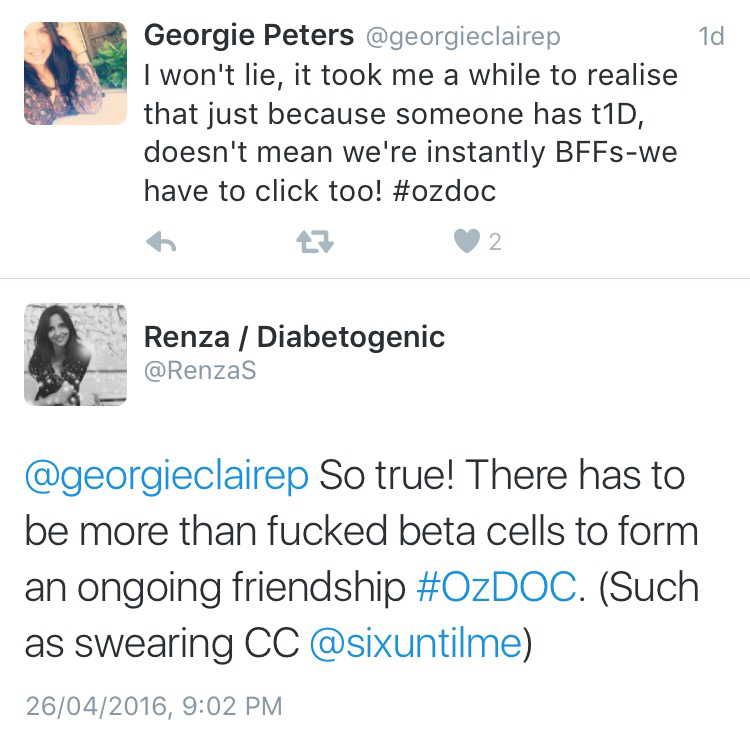
I realised the other night in the tweetchat that after throwing myself into the DOC, I have backed off a bit. I don’t join into every discussion as I once would have; I still read lots of blogs, but don’t comment much anymore; I don’t ask all that many questions anymore; I really only to the #OzDOC chat, and I sometimes go weeks without popping in to say hi. This may be temporary – it may be just where I am at the moment. But I am getting what I need. And I am lucky the community allows for that.
For a couple of weeks now I have been feeling well below par. I am exhausted. I’ve not been sleeping particularly well, which is unlike me, and yet, all I feel like doing is sleeping. I’ve felt nauseous and not been interested in food, and even coffee has lost its appeal. (As I am a woman of particular age, when explaining these symptoms to others I see eyebrows rise questioningly, heads tilt and the words ‘Could you be…’ start to form on their lips. No. I am not.)
On Monday, my sister and I did some shopping – something we could both do for Australia our skills are so impressive – and I had to sit down in the stores while she was doing her usual trick of finding clothes marked down to a quarter their usual price in her size that looked perfect on her.
I went out for breakfast on Monday morning and when I got home, I had to sleep for a couple of hours just to be able to face the thought of going shopping.
As soon as I started mentioning that I wasn’t feeling great to those near and dear to me, they immediately suggested I go see the GP. But I dismissed it as being because I am busy at work with lots of deadlines looming / we just lived through a bathroom renovation / We’ve been binge-watching a new TV series and should be going to bed sooner / <Insert excuse here>.
I even told myself in a moment of spectacular denial ‘I have diabetes. It’s a chronic health condition and sometimes it makes me feel crap’, when the truth of the matter is that my diabetes has been somewhat quiet and manageable over this period and I would be furious at anyone who dared to automatically assume the reason for me not feeling a hundred per cent is due to my pancreatically-challenged state.
However, two weeks later, I think they may have been right. I probably should go to the GP and get checked out. I am sure it is just a low-grade virus and all it needs is time and rest. (Oh look – there I go again with the denial….)
As much as I hate to admit it, I do blame diabetes when I am not feeling well. I hear myself say things like ‘I had a couple of hypos yesterday’ or ‘I woke with high BGs’ to explain away anytime I feeling out of the ordinary.
I remind people all the time that ‘sometimes it’s not diabetes’ and yet I seem to be happy to use it as an excuse to myself when convenient.
When your body is broken to a degree, it is difficult to know what to do when the usual ‘not feeling well’ things come up. For people who don’t live day in, day out with a chronic health condition, they see it as irregular and react. Those of us with bodies that are a little rogue at times just decide that it is part of being broken.
It took my mum saying something for me to realise that I might want to delve a little deeper than deciding it was just more ‘system failure’. Where others would jump in and suggest I go to the doctor the second I mention not feeling well, mum gets that it could just be part and parcel of the tiredness we sometimes feel living with a chronic heath condition. She gets it – she lives it.
So when she told me the other day that I was ‘looking gaunt’ (proving yet again that at the core, she is (wonderfully) a true Italian nonna), and that she was a little concerned, I snapped to attention.
So – tomorrow I plan to go to pathology and have blood drawn, using the full blood work path request my endo sent me a couple of weeks ago as a precursor to my annual diabetes screening. I will do it and then I’ll follow up with my GP (who is sent a copy of the results) and see where I go from there.
It could just be a low level virus. It could be just tiredness or an iron deficiency. It could be something different altogether. But I am pretty sure it’s not diabetes even though I have been stubbornly trying to convince myself otherwise.
On this day in 1923, insulin became commercially available.

Fast forward 75 years to 1998, and on this day, I was given a shot of insulin as I sat in the offices of an endocrinologist. That morning, I was diagnosed with type 1 diabetes.
As I watched the doctor quickly and proficiently inject my arm, I had no idea just how precious, effective and dangerous this magic elixir could be. And I had no idea just how lucky I was.
I am not lucky because I have diabetes. Despite being one of those eternal (and annoying) glass-half-full types, I struggle to see the positives in being diagnosed with diabetes.
But I am lucky that if I have to have diabetes, it is here in Australia where I am afforded the luxury and ease of access. Getting insulin is as simple as asking a doctor for a prescription, calling the pharmacy to order it in and the next day picking up a couple of months’ supply for the grand cost of $40, after which I take it home, leave it in my refrigerator and use it as I need.
I have been doing this now for 18 years. My diabetes has come of age. It can drive, vote and drink (three things I should definitely not do if my glucose level is low.)
Diabetes is not a blessing. I don’t think I have ever hated something more and doubt I ever will. I despise the way it has intruded into my life and has eaten away at things I once took for granted. I detest that my loved ones have had to become experts, and are now fluent in the language of ‘diabetese’. I loathe the fear and terror that it has caused me at times.
On this day in 2016, I am thinking about having lived with diabetes for a significant part of my adult life. I am thinking of how it has shaped me, the times it has forced my hand, the way it has influenced the direction my life has taken. I see how it has made me think certain ways, re-evaluate aspects of my short- and long-term decision making and made me advocate for something in which I once had no knowledge (or interest).
But mostly, I am thinking about how I get to celebrate my diaversary as a day of success and triumph. And that many do not. My privilege is starkly obvious as I celebrate with a piece of cake, and, coincidentally, pick up a waiting insulin prescription from the pharmacy up the road.
So, today, I am making a donation to T1International to commemorate this day and those far less fortunate when it comes to living life with diabetes. If you have a spare few dollars – perhaps even just 18 of them – maybe you could, too.
I remember when absolutely nothing was open on Good Friday. I used to say that it wasn’t a particularly good Friday because there was nowhere to go to get a decent coffee. These days most of our favourite places are open across the Easter weekend. Well, not all…

The DOC boys’ excuse for not working on Good Friday.
This four-day break seems to be mostly about food, which is never a bad thing.
It started like this with a batch of the teeniest-tiniest cupcakes to take into work yesterday.

This morning kicked off with a visit to a café for breakfast (might not mention the bacon I had with my breakfast to my dad…), followed by popping into a favourite bakery for the best hot cross buns in Melbourne.

And the rest of the weekend will wind itself around cups of tea at home, or coffees in cafes with friends, a big family lunch on Sunday and an assortment of chocolate eggs (and bunnies) and baking.
There will be reading and movies and a music gig here and there.
It won’t all be about food. There will be some exercise too. I’m in a basketball battle with a few diabetes friends, so I’m getting a good workout there too… (Annie – this is ALL your fault!)
All in all, a few restful days to look forward to. If you are lucky enough to have the time off: enjoy! And if you are working – thank you!
And don’t forget to Give That They May Grow. No one wants to use the Royal Children’s Hospital. But we are so glad for it if we need to.
Despite what the media may say every time they herald the ‘end to painful injections’, it has never been the needles, the pump insertions, the finger-pricks or the sensor insertions that cause the most discomfort when it comes to living with diabetes.
They are not even where I feel diabetes most.
I feel it in my heart with an increased heartbeat when I feel the fear of ‘what could be.’
I feel it in my eyes as I see the evidence of diabetes on my body with devices, healing and healed scars, tape residue and a pump hidden in my underwear.
I feel it on my skin with the goose bumps I get when hearing the words ‘me, too’ from someone who understands what living with diabetes is truly about.
I feel it through my veins as I sense blood being pumped faster to alert me to a low.
I feel it in my smile when I see – and feel – the power of support and connectedness.
I feel it in my tears as they roll down my cheeks with the frustration of never seeming to be able to get it right.
I feel it in my fingers as I load insulin into a cartridge, feel for knots in an infusion line or grope around in my bag for my kit.
I feel it in the dark recesses of my mind when I consider the scary things that only get an airing when my defences are down.
I feel it in the pit of my stomach as the guilt that inevitably comes to the surface. Guilt about the burden I am on my family and friends.
I feel it on my lips as the tingling of a low or the dryness of a high remind me that I must attend to my blood sugar.
I feel it in my hip pocket as I fork out more money for more strips, for more pump consumables, for more sensors, for more insulin, for more health insurance, for more medical costs. Because there is always more.
I feel it in my words, as I struggle to articulate exactly how I feel, what I need, what I want.
I feel it my nose as the smell of insulin hits and automatically the words ‘It’s the smell that keeps you alive’ jump into my head.
I feel it in my mouth – the sickly sweet aftertaste of the jelly beans or the pineapple juice I have consumed when I just want to sleep.
I feel it in my ears as I hear the click of a lancet device, the beep of an alarm, the ticking of insulin being delivered.
I feel it in my feet as I walk barefoot to the kitchen and there is the sensation of a rogue BGL strip on the floorboards.
I feel it underneath me when I sleep and I roll onto a pump or lie over my sensor.
I feel it. It is everywhere.
We frequently say that diabetes is twenty-four hours, seven days a week, three hundred and sixty five days a year. And it’s true. It absolutely is.
But this year – a leap year – we have an extra day. I thought that the most wonderful way to celebrate it would be to take a day off – to have a day where I don’t think about it; don’t talk about it and don’t write about it.
But that’s not possible. Even if I decide to have a ‘low-diabetes-activity’ day, there is no way that I can’t take the day off completely. My pump is still attached to me, as is my CGM. I still need to eat food and that needs to be considered. My CGM needs calibrating, so I’ll need to do at least a couple of BGL checks. And I’ll need to respond to any highs or lows as they are thrown my way.
So, instead of ignoring, I decided that I needed to mark my diabetes in some special way and decided that an extra lancet change would be the way to do it. Actually, I’d be lying if I said that this was my choice. This morning, it took 8 stabs to actually draw blood (I know, I know…probably could have been changed sooner).
So, I replaced the lancet and have done a couple of lovely, easy checks with free-flowing, easily accessibly blood.
I was most pleased – and couldn’t stop laughing – to see that the team at Diabetes Mine were on the same page with this week’s Sunday Funnies cartoon.
So, there you go. That’s the way I am acknowledging this extra day of diabetes.

#LeapYearLancetChange
OzDoc tweetchats are fertile ground for posts on this blog! Often, as soon as the chat is over, I start to write because some that was discussed has triggered a wave of ideas, or thoughts or, as was the case after last night’s chat, wanting to know more.
This week’s chat was all about food – one of my favourite topics in the world, and one that I could, quite honestly, speak and write about full time. I think about food a lot. A. Lot. I have been known to ask the question ‘What will we have for dinner?’ as we sit down to start to eat lunch. I have rushed home, desperate to turn on the oven and bake a cake and then sit in front of the oven, watching it cook.
There is a lot to love about food. But clearly, from last night’s discussion and from many discussions with others, food is not all about bowls of cherries. (I am counting down until November when cherry season is upon us again….)
Guilt and food are two words that are frequently used in the same sentence. This is not only for people with diabetes. It is entrenched in our way of thinking.
We are almost conditioned to feel guilt when we eat certain things and this in turn forces us to think that what we are eating – and could be enjoying in the moment – is a bad, bad thing.
I’ve written about how language and food get intertwined and mixed up. But what I really want to know is where the guilt comes from. Why do we feel it? How did we learn to feel that way?
I don’t ever feel guilty about what I eat. Ever. I’ve no idea why – I just don’t. (There’s plenty of other stuff I feel guilty about, so I don’t feel guilty about not feeling guilty about food!)
Is it what we hear from those around us? Cutting comments from family members, shaming comments from friends or judgemental comments from health professionals can all take their toll.
I have heard them all. I have had family members comment on what I am eating (especially when I was younger and ate like a proverbial horse). I have been asked if I should be eating that. I have had healthcare professionals judge what I eat (when I bothered to tell them).
But besides annoying me, (and visualising hitting them on the head with a spoon I have recently been using to scoop Nutella directly from the jar), I’m not bothered. No long lasting effects and certainly no feelings of guilt.
That’s not the case for everyone. And that’s what I am interested in. Why is it that in some people guilt-inducing comments are like water off a duck’s back, yet for others, result in hours of anguish, hurt, tears and stress?
I watched the response to last night’s chat with great interest. The questions were all very thought provoking and generated a lot of discussion. But not once, was the word ‘guilt’ mentioned in the questions. And yet a lot of answers did.
It seems that the two just do go together for a lot of people. I know that is the case for people without diabetes. But undeniably, it is worse for many of us who do live with it.
This morning as I was buzzing around getting ready for work, I suddenly stopped. I realised something that had obviously been creeping up on me so incrementally that I had not noticed it before.
I looked around the bedroom and saw empty cannula packaging from the line change I had done when I got out of the shower and the empty sensor pack with the date written on it so I would remember when it was inserted. I went back through my CGM trace and pump history, noticing where I had bolused for a high BGL, set a temp rate for an impending low and calibrated at the appropriate times. I checked the history on my BGL meter and saw that I have been checking regularly and that the numbers were not as crazy as they have been.
I looked in my bag and saw a spare bottle of strips, my fully stocked ‘emergency’ kit, and a juice box and a small container full of glucose tabs ready in case I needed them.
When I got into work, my desk was prepared for all contingencies – more glucose tabs on the desk, a couple of spare cannulas in the top draw, as well as a few syringes. And a few single portion packs of Nutella.
I was – I am – managing my diabetes – well and without any stress at the moment. The burnout fog that had enveloped me for a long, long time seems to have lifted without me even noticing, and the diabetes tasks that form part of my day and had been so, so difficult to manage, have become routine. I do them without thinking. Checking my BGL and calibrating my CGM just happens. Bolusing for meals or my morning milky coffee is done before I take that first taste rather than half an hour later because my CGM is blaring at me that I am high.
Am I feeling motivated? I’m not sure that is the right word. I don’t have a desire to do these things. I am not so focused on diabetes that I think about it all the time.
But I am doing what I need to. Routinely. Just like brushing my teeth, combing my hair and putting on a necklace in the morning.
Perhaps that’s the thing about managing diabetes well. It’s the balance between getting the things done and not panicking about them. Or feeling so anxious and guilty because they are not getting done.
I don’t know the secret to this change. I do think that a big part of it is wearing my CGM all the time. Once I managed to hurdle feeling overwhelmed by the data and just accepted the numbers for what they are and acting accordingly, I feel much more driven to ‘do diabetes’. And perhaps as I see that things are not as dire as I often imagine them to be, I feel that I can just get on with things.
This is the roller coaster of diabetes. The ebbing and flowing of motivation and being in the headspace to get things done. I’m in a good place for now. I just have to work out how to stay here.

Emergency stash at the office (for lows or as required….)
I produce a lot of waste. (There’s a lovely first sentence….) Perhaps I should clarify and say that diabetes produces a lot of waste. And as such, I am very conscious of reusing, recycling and reducing wherever I can, especially in a society where so much is so easily disposable.
Over the weekend, we found ourselves wandering the aisles of our local Officeworks store. The reason for our visit was to buy some cartridges for our (rather old) printer at home. We print virtually nothing. In fact, the only reason that we needed to buy cartridges was because the kidlet is back at school and it’s project time, which means printing things.
What we discovered was not only that the cartridges for our 10 year-old printer were no longer stocked (probably shouldn’t have really been all that surprised!), but that it would be cheaper to buy a whole new printer than it would have cost to replace the two cartridges we had planned to buy.
I was even more horrified when the very helpful sales staff told us that a lot of people simply buy a whole new printer instead of replacing the cartridges when they run out because it is cheaper.
‘But it’s so…so…wasteful,’ I said to him. He nodded. ‘Oh, but we recycle old printers, so you can bring your old one in to us. That’s what most people do.’
I didn’t want to point out that as wonderful as that may be, it still takes a lot of energy and resources to produce a printer in the first place – especially if it is to just be thrown out after a few months, or however long it takes to work through the ink.
I am very conscious of this as (as previously stated) someone who produces a lot of waste – waste that I can’t do anything about because the products with the waste are keeping me alive.
Between pump line and sensor changes, BGL strips that litter like glitter and empty juice boxes and jellybean packets, there is a lot of packaging and used product that winds up in the bin.
The only reason for all this stuff is diabetes. And it annoys me that a lot of it seems superfluous. Every time I open a pump line, there is a little round disc that is meant to be used whenever I disconnect the pump to cover the exposed knob of the infusion set. How many times do I use that disc? Never. As in: not once. In fact, most of the time, it winds up on the floor and the cat plays with it or the puppy chews on it or I step on it in my bare feet and swear. But it is in every single pack.
All this stuff creates (even more) diabetes guilt.
There are things I do try to recycle in some way. When I upgrade my pump, I donate my old pump to either someone who is interested in trying one out or to a clinic (although that is less likely to happen these days because of warranty issues). I don’t take endless BGL meters from device companies or HCPs, just because they are free. And I try to reuse where and when I can. (I refill cartridges in my pump a couple of times and refill strip cartridges with hypo portions and spent pump lines tie up plants in the garden.)
Yes, I know that we can refill the cartridges with ink ourselves. ‘You just need to use a syringe and ink. You’re good at that. You know, drawing things up with a needle and shooting them into things,’ said Aaron helpfully – a suggestion that was rewarded with a look that suggested that was one of those comments best kept to oneself. But no, we won’t be doing that, because: mess. I have, however, looked online to see where I can source cheaper cartridges and will order them.
I also just want to say that I am absolutely not guilt-free when it comes to using throwaway products. I more than happily, and without any shame, used only disposable nappies when the kidlet was little. When someone told me that each nappy took one hundred years to break down and I should consider using cloth nappies, I nodded and said cheerfully, ‘Yep, but if I start having to wash nappies, I reckon it will take me about five minutes to break down. And the baby is kind of expecting me to be functioning enough to feed her. She’s demanding like that. So, disposables it is!’
But somewhere in there, there has to be a happy medium between taking the easier route to save one’s sanity, and throwing out a printer when the ink runs out.





 Diabetogenic