
You are currently browsing the category archive for the ‘Real life’ category.
We frequently say that diabetes is twenty-four hours, seven days a week, three hundred and sixty five days a year. And it’s true. It absolutely is.
But this year – a leap year – we have an extra day. I thought that the most wonderful way to celebrate it would be to take a day off – to have a day where I don’t think about it; don’t talk about it and don’t write about it.
But that’s not possible. Even if I decide to have a ‘low-diabetes-activity’ day, there is no way that I can’t take the day off completely. My pump is still attached to me, as is my CGM. I still need to eat food and that needs to be considered. My CGM needs calibrating, so I’ll need to do at least a couple of BGL checks. And I’ll need to respond to any highs or lows as they are thrown my way.
So, instead of ignoring, I decided that I needed to mark my diabetes in some special way and decided that an extra lancet change would be the way to do it. Actually, I’d be lying if I said that this was my choice. This morning, it took 8 stabs to actually draw blood (I know, I know…probably could have been changed sooner).
So, I replaced the lancet and have done a couple of lovely, easy checks with free-flowing, easily accessibly blood.
I was most pleased – and couldn’t stop laughing – to see that the team at Diabetes Mine were on the same page with this week’s Sunday Funnies cartoon.
So, there you go. That’s the way I am acknowledging this extra day of diabetes.

#LeapYearLancetChange
OzDoc tweetchats are fertile ground for posts on this blog! Often, as soon as the chat is over, I start to write because some that was discussed has triggered a wave of ideas, or thoughts or, as was the case after last night’s chat, wanting to know more.
This week’s chat was all about food – one of my favourite topics in the world, and one that I could, quite honestly, speak and write about full time. I think about food a lot. A. Lot. I have been known to ask the question ‘What will we have for dinner?’ as we sit down to start to eat lunch. I have rushed home, desperate to turn on the oven and bake a cake and then sit in front of the oven, watching it cook.
There is a lot to love about food. But clearly, from last night’s discussion and from many discussions with others, food is not all about bowls of cherries. (I am counting down until November when cherry season is upon us again….)
Guilt and food are two words that are frequently used in the same sentence. This is not only for people with diabetes. It is entrenched in our way of thinking.
We are almost conditioned to feel guilt when we eat certain things and this in turn forces us to think that what we are eating – and could be enjoying in the moment – is a bad, bad thing.
I’ve written about how language and food get intertwined and mixed up. But what I really want to know is where the guilt comes from. Why do we feel it? How did we learn to feel that way?
I don’t ever feel guilty about what I eat. Ever. I’ve no idea why – I just don’t. (There’s plenty of other stuff I feel guilty about, so I don’t feel guilty about not feeling guilty about food!)
Is it what we hear from those around us? Cutting comments from family members, shaming comments from friends or judgemental comments from health professionals can all take their toll.
I have heard them all. I have had family members comment on what I am eating (especially when I was younger and ate like a proverbial horse). I have been asked if I should be eating that. I have had healthcare professionals judge what I eat (when I bothered to tell them).
But besides annoying me, (and visualising hitting them on the head with a spoon I have recently been using to scoop Nutella directly from the jar), I’m not bothered. No long lasting effects and certainly no feelings of guilt.
That’s not the case for everyone. And that’s what I am interested in. Why is it that in some people guilt-inducing comments are like water off a duck’s back, yet for others, result in hours of anguish, hurt, tears and stress?
I watched the response to last night’s chat with great interest. The questions were all very thought provoking and generated a lot of discussion. But not once, was the word ‘guilt’ mentioned in the questions. And yet a lot of answers did.
It seems that the two just do go together for a lot of people. I know that is the case for people without diabetes. But undeniably, it is worse for many of us who do live with it.
This morning as I was buzzing around getting ready for work, I suddenly stopped. I realised something that had obviously been creeping up on me so incrementally that I had not noticed it before.
I looked around the bedroom and saw empty cannula packaging from the line change I had done when I got out of the shower and the empty sensor pack with the date written on it so I would remember when it was inserted. I went back through my CGM trace and pump history, noticing where I had bolused for a high BGL, set a temp rate for an impending low and calibrated at the appropriate times. I checked the history on my BGL meter and saw that I have been checking regularly and that the numbers were not as crazy as they have been.
I looked in my bag and saw a spare bottle of strips, my fully stocked ‘emergency’ kit, and a juice box and a small container full of glucose tabs ready in case I needed them.
When I got into work, my desk was prepared for all contingencies – more glucose tabs on the desk, a couple of spare cannulas in the top draw, as well as a few syringes. And a few single portion packs of Nutella.
I was – I am – managing my diabetes – well and without any stress at the moment. The burnout fog that had enveloped me for a long, long time seems to have lifted without me even noticing, and the diabetes tasks that form part of my day and had been so, so difficult to manage, have become routine. I do them without thinking. Checking my BGL and calibrating my CGM just happens. Bolusing for meals or my morning milky coffee is done before I take that first taste rather than half an hour later because my CGM is blaring at me that I am high.
Am I feeling motivated? I’m not sure that is the right word. I don’t have a desire to do these things. I am not so focused on diabetes that I think about it all the time.
But I am doing what I need to. Routinely. Just like brushing my teeth, combing my hair and putting on a necklace in the morning.
Perhaps that’s the thing about managing diabetes well. It’s the balance between getting the things done and not panicking about them. Or feeling so anxious and guilty because they are not getting done.
I don’t know the secret to this change. I do think that a big part of it is wearing my CGM all the time. Once I managed to hurdle feeling overwhelmed by the data and just accepted the numbers for what they are and acting accordingly, I feel much more driven to ‘do diabetes’. And perhaps as I see that things are not as dire as I often imagine them to be, I feel that I can just get on with things.
This is the roller coaster of diabetes. The ebbing and flowing of motivation and being in the headspace to get things done. I’m in a good place for now. I just have to work out how to stay here.

Emergency stash at the office (for lows or as required….)
I produce a lot of waste. (There’s a lovely first sentence….) Perhaps I should clarify and say that diabetes produces a lot of waste. And as such, I am very conscious of reusing, recycling and reducing wherever I can, especially in a society where so much is so easily disposable.
Over the weekend, we found ourselves wandering the aisles of our local Officeworks store. The reason for our visit was to buy some cartridges for our (rather old) printer at home. We print virtually nothing. In fact, the only reason that we needed to buy cartridges was because the kidlet is back at school and it’s project time, which means printing things.
What we discovered was not only that the cartridges for our 10 year-old printer were no longer stocked (probably shouldn’t have really been all that surprised!), but that it would be cheaper to buy a whole new printer than it would have cost to replace the two cartridges we had planned to buy.
I was even more horrified when the very helpful sales staff told us that a lot of people simply buy a whole new printer instead of replacing the cartridges when they run out because it is cheaper.
‘But it’s so…so…wasteful,’ I said to him. He nodded. ‘Oh, but we recycle old printers, so you can bring your old one in to us. That’s what most people do.’
I didn’t want to point out that as wonderful as that may be, it still takes a lot of energy and resources to produce a printer in the first place – especially if it is to just be thrown out after a few months, or however long it takes to work through the ink.
I am very conscious of this as (as previously stated) someone who produces a lot of waste – waste that I can’t do anything about because the products with the waste are keeping me alive.
Between pump line and sensor changes, BGL strips that litter like glitter and empty juice boxes and jellybean packets, there is a lot of packaging and used product that winds up in the bin.
The only reason for all this stuff is diabetes. And it annoys me that a lot of it seems superfluous. Every time I open a pump line, there is a little round disc that is meant to be used whenever I disconnect the pump to cover the exposed knob of the infusion set. How many times do I use that disc? Never. As in: not once. In fact, most of the time, it winds up on the floor and the cat plays with it or the puppy chews on it or I step on it in my bare feet and swear. But it is in every single pack.
All this stuff creates (even more) diabetes guilt.
There are things I do try to recycle in some way. When I upgrade my pump, I donate my old pump to either someone who is interested in trying one out or to a clinic (although that is less likely to happen these days because of warranty issues). I don’t take endless BGL meters from device companies or HCPs, just because they are free. And I try to reuse where and when I can. (I refill cartridges in my pump a couple of times and refill strip cartridges with hypo portions and spent pump lines tie up plants in the garden.)
Yes, I know that we can refill the cartridges with ink ourselves. ‘You just need to use a syringe and ink. You’re good at that. You know, drawing things up with a needle and shooting them into things,’ said Aaron helpfully – a suggestion that was rewarded with a look that suggested that was one of those comments best kept to oneself. But no, we won’t be doing that, because: mess. I have, however, looked online to see where I can source cheaper cartridges and will order them.
I also just want to say that I am absolutely not guilt-free when it comes to using throwaway products. I more than happily, and without any shame, used only disposable nappies when the kidlet was little. When someone told me that each nappy took one hundred years to break down and I should consider using cloth nappies, I nodded and said cheerfully, ‘Yep, but if I start having to wash nappies, I reckon it will take me about five minutes to break down. And the baby is kind of expecting me to be functioning enough to feed her. She’s demanding like that. So, disposables it is!’
But somewhere in there, there has to be a happy medium between taking the easier route to save one’s sanity, and throwing out a printer when the ink runs out.
Tomorrow is Ash Wednesday, marking the beginning of Lent, and when I was a good Catholic kiddie, I used to do what Sister Mary-Magella expected and give up something for Lent as a form of atonement. Or something. I am a little sketchy on the details.
Inevitably, I would give up chocolate. All the kids gave up chocolate. (I remember once saying that I was going to give up wine, but that didn’t fly with Sister Mary-Magella because I was only about nine years old at the time and she figured that excluding vino from my diet wouldn’t be too much of a sacrifice. Clever nun.)
Here’s what I can tell you about my experiences of giving up something for Lent: I sucked at it.
I would announce that I was giving up chocolate in my 9am religion class and as soon as the words slipped from my lips, it was all I could think about. Suddenly, I wanted chocolate; I needed chocolate. Everything looked like chocolate and everywhere I turned, I saw chocolate. Chocolate. Chocolate.
But here’s the thing. We rarely ate chocolate when I was a kid. In fact, the chance of me actually eating chocolate on that day – a Wednesday – was slim to non-existent.
And yet, it was all I could think of. I couldn’t concentrate on learning about long division for all the thoughts of chocolate running through my mind.
Of course, I never, ever made it the full forty days without eating chocolate because the very next time it was offered to me – as that occasional treat, or at a friend’s place or at a party, I would dive straight in.
I think I learnt pretty early on that restriction is not a good idea.
But giving things up is still a big thing – and you don’t even need Catholic guilt to get in on the game these days. You may know it’s FebFast which is a month-long campaign to give up either alcohol or added sugar.
I understand that the idea of FebFast is to get back on track after the silly season of excess. But to me, I see that there is too much guilt associated with these sorts of campaigns. I don’t like the ‘You have been bad, now do your penance and atone’ attitude behind it.
Or perhaps, it’s just that, clearly, I have no self-discipline or willpower. As was demonstrated when I was nine and tried to give up chocolate for the first time.
Nowadays, I don’t do Lent. In fact the only reason I know that tomorrow is the start of Lent is because I know today is Mardi Gras and I am dreaming of being in New Orleans, eating beignets. And Mardi Gras is also Shrove Tuesday, which means that we will be eating pancakes at some point. Which I will be celebrating with flipping glee!

Heart-shaped pancake treats, made last week to celebrate World Nutella Day.
This morning, I drove my car straight into the tyre shop across the road from work. By the time I had turned off the ignition and stepped out of the car, a kind looking mechanic was standing next to me.
‘Morning, what can we do for you today?’
‘I haven’t made a booking, but I was wondering if you could help out. I need a tyre replaced and, while it’s in here a wheel alignment. Any chance you could do it today?’
‘Not a problem,’ he said. He walked around the car slowly. ‘You know, both those front tyres could do with replacing. Would you be happy for us to do that?’
We had a chat about options – he showed me photos of all the different tyres that would work on the car (all looked the same to me) and discussed the pros and cons of each. After I decided, I walked out of the shop, with the mechanic promising to call if there were any problems.
Service with a smile!
As a customer/client/stakeholder/friend/’insert latest buzz word here’ I like to feel that I am somewhat valued. I like to feel that I am not inconveniencing the person offering the service and I like to feel like my custom is appreciated.
Which was how I felt this morning as I walked out of the tyre shop.
And it’s exactly the opposite of how healthcare frequently makes us feel. It’s a system that is set up to be customer-unfriendly. And it’s what we – the users of the services – have come to expect. And sometimes, to accept.
From trying to get an appointment, to actually walking in the door, to collecting test results, the process can be difficult, convoluted and confusing, with roadblocks at every turn. Here are just a few things that you may come across as a user of healthcare.
- You need to see a new specialist, so you call to make an appointment. Most likely, the first thing you are told is that there will be a wait before the specialist can get you in. Possibly a long wait. A very long wait. Sometimes, you are told that new patients are not even welcome at this point in time. Sometimes you are told that you cannot actually make an appointment until your referring doctor has faxed (yes, seriously, FAXED!!!) across a referral.
- If you are lucky enough to actually get an appointment, a barrage of Things You Must Do are read out to you: Referral letter (if you have been allowed to make the appointment without one); get there early to fill in the forms; bring test results; bring x-rays etc. etc.
- You may be warned that if you do not show up or call within 24 hours (once I was told within a week!), you will still be charged for the service.
- If you have managed to get through all of that and still decide to go, then once you arrive, you are faced with a frequently unfriendly and unwelcoming receptionist who is there to basically act as a buffer between you and the doctor.
(Side note: I am going to say that I know that this is a thankless job at times. Many people think they are the most important person in the world and these same people think that the doctor should be bending over backwards to accommodate them. However, in my experience, most people do not think that way. I know I certainly don’t. Also, I have had many experiences of wonderful support staff greeting me when I have an appointment. The staff at my endo’s office are friendly, polite and delightful. At my GP, it is touch and go – some are lovely, one in particular makes me start to sweat in fear!)
- At first-time visits, you are given a clipboard with a wad over a paperwork and told to fill it all in. (This is where I weep a little and just wish that a centralised electronic medical system that worked was available and easily accessible so that I could simply write down my details and pass that over and all my information could be magically brought up on a magic computer.)
- Eventually, after having filled out the forms and provided information about every aspect of my life, the file gets returned to the reception desk and is often greeted with the words: ‘The doctor is running late. About 30 minutes.’ At this point, I sigh and possibly ask (as politely as I can) why I wasn’t told this when I called before going in to make sure that the doctor was running on time – a call that I made only 30 minutes earlier. Steely silence. No answer.
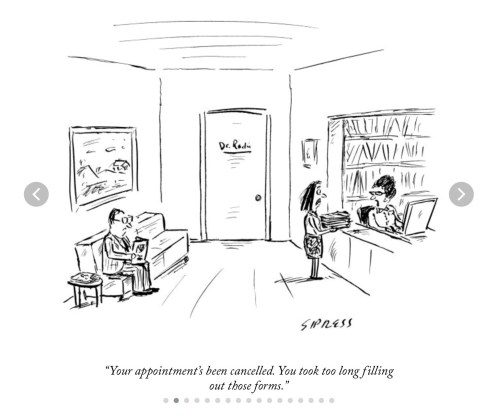
(From this week’s New Yorker’)
So, let’s just recap. It has taken months to get into see this doctor and I wasn’t even granted an appointment until I had jumped through so many hoops that I now also needed to see a physiotherapist because I had put my back out; when I eventually get there, I spend ages filling in information that I know is hardly going to be relevant. And now I am told that after having arrived early so that I could fill in the forms that the doctor is running about 30 minutes late and that I just have to deal with it.
(I’m not going to write about the actual doctor experience, because we know it can be good, it can be bad, it can be disastrous ‘This isn’t going to work, but thanks for your time. I’ll just go pay my bill…..’ which is something that happened when I was interviewing endos a few years back.)
- You leave with another ream of paper – prescriptions, test requests, perhaps another referral letter and are told to call back in a week’s time to get the results.
- But a week later when you call, a new dance starts. ‘No, you can’t speak with the doctor,’ you are told, when you say that you are calling – as requested – to get results. ‘The doctor speaks to people between 1 and 1.15 Monday and Thursday. You’ll need to call back then.’
- You ask if the doctor could either call you back or even email me the results, which gets a response of horror, ‘No we do not correspond via email. The internet is not safe.’ (I at this point, do not say what is going through my head – ‘I do all my banking on the internet and I am not concerned about privacy there. And I am certainly not likely to care who knows what my hand X-ray shows.’ Because there is no point.
- After about four attempts, you eventually get to speak with the doctor who will probably (hopefully) tell you that all is clear and to make another appointment for 12 months’ time.
- It seems that every part of the system is designed to keep apart the two people who actually need to be in the same room, looking at each other and truly engaging.
And this is deemed okay?
It’s not. How many of us would return to a shop if we were treated this way. Even if the people we are speaking with are lovely – which is usually the case – the system is ridiculous. It’s broken, seemingly beyond repair. And I can’t think of any other service where the customer is considered an annoyance. Can you think of any other service where the customer is treated this way?
I just had a call from my friendly tyre mechanic. My car is going to be ready an hour later than he thought and he wanted to let me know. I thanked him and commented on how much I appreciated the phone call. I was probably a bit gushy as I am when impressed with the service I’m receiving. ‘Not a problem at all,’ he said. ‘We like happy customers.’
And I like to be a happy customer!
It’s 7.25pm on Sunday evening. I am battle-scarred from a hypo that hit me like a ten tonne truck. It was 6 hours ago now, but I am still foggy and so fatigued.
We were out – at our local shops picking up a few things. All of a sudden, I felt like I was going to fall over. One of my legs gave way, I was dizzy and I couldn’t find the words I needed. Focusing hard, I looked at the kid and said ‘We need to get out of here.’ I passed her my phone and she called Aaron who was in another shop nearby, asking him to come and find us.
Where had this come from? My CGM started wailing at the moment that Aaron joined us. But when I looked over the previous few hours, I could see that I had been sitting around 4mmol/l for the whole time. Until I dipped – suddenly – and it seemed the CGM trace took a little while to catch up. The wailing continued as I gulped back orange juice and groped for my pump to silence the alarm.
It was almost fifteen minutes later before I was ready to move. As I sat there, I very consciously started to notice the fuzziness in my head, the overwhelming and all-encompassing exhaustion hit. My eyelids began to droop and my eyes were having trouble focusing, my hair was wet at my neck making me shiver, and my hands were shaking a little. The noises around me sounded like they were coming through a tunnel – everything echoed, but sounded muted and fluffy.
Eventually, we got up and got home and I went straight to bed. I took off my shoes, lay down, and was shivering as I fell asleep, almost instantly. And I slept – a deep, heavy, dreamless sleep. Two hours later I woke up and was ready to move again – slowly and gingerly at first.
And now. Six hours later. I am sitting on the couch, and in between writing I stare out the front window onto our street. It’s a gorgeous night – warm, but not too warm, with a gorgeous cool breeze blowing through our open front door. I hear the leaves flutter in the trees in the garden, people walk by, chatting to each other, and the folk across the road are having a band rehearsal. It’s peaceful; it’s Sunday night and I’m starting to think of the week ahead.
And in my thoughts about school lunches, and work schedules, and everything else, I have another thought. I don’t have it often, but when I do, it’s always the same.
I feel a pull at the bottom of my stomach.
My breath catches in my throat.
Tears spring to my eyes.
I wish I didn’t have diabetes.
Almost fourteen and a half years ago, I took up a very part time job at Diabetes Victoria.
The diabetes world was a little different back then and today, as I packed up my office and was farewelled by a group of amazing women I have been honoured to call my team, I reflected back over the years.
- I had been using a pump for about five months when I started working there. It was the first time that many people in the organisation had ever seen one and there were a lot of questions.
- The pump situation in Australia was a little different to today. If you wanted a pump, you had a choice of a Medtronic 507C or a Disetronic DTron.
- Smart pumps were not a thing yet!
- There was no DAFNE yet either.
- The few of us who were pumping had to self-fund the consumables to the tune of about $300 per month.
- It was in May 2004, after a lot of lobbying, that the Government announced that pump consumables would be listed on the NDSS, reducing their costs to about $30 per month. This was the first taste I ever had of political lobbying and advocacy and I loved it!
- Within my first three weeks of being in the job, about half a dozen different women called saying they wanted information about diabetes and pregnancy. We didn’t have anything, so together with some like-minded groups, we set about developing a resource that provided all the information women wanted in a format they liked. That was my first taste of realising how important it was to listen to the ‘consumer’ and it became the overarching philosophy of my work.
- No one was talking prevention of type 2 diabetes. And when that started, it started a discussion about a huge issue.
- No one was talking about diabetes and mental health – except those of us living with the condition. We knew that it was real; we knew that burnout was debilitating; we knew that our mental health directly correlated with our ability to manage our diabetes. Seeing the Australian Centre for Behavioural Research in Diabetes become a real thing has been a game changer for people with diabetes as it has opened the discussion in ways we could only have imagined!
- People with diabetes at diabetes conferences? Not really, but we have made some strides there! (Psssst….but not enough!)
- Social media? Not a thing back in 2001. Now, online support, which was fledgling to say the least back in 2001, is everywhere and accessible by many, many people.
What a change a (almost) decade and a half makes! The diabetes landscape is very different. I’m glad I get to still be a player in this space in my new national job.
But today, it’s about saying goodbye.
And with that, I want to acknowledge a group of women. These women:
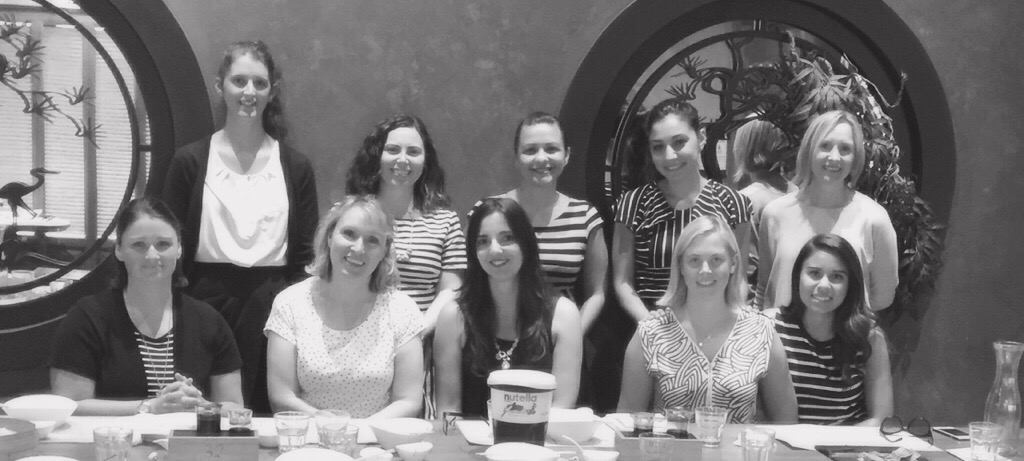
To (in alphabetical order), Alice, Angela, Anika, Carolyn, Elise, Elizabeth, Jane, Kelly, Kim and Kristina: thank you for making my last day so lovely. But more so, thank you for being the people who ‘do’. Each and every day, you come into work and do things alongside – in partnership – with people affected by diabetes to improve their lives in some way. Your commitment to people living with diabetes is second to none, there is no other team like this one in Australia and the work that you do each and every day is, in fact, life changing. We hear that frequently.
I am so fortunate that I got to lead you in my clumsy and sometimes ranty way, and I thank you all for indulging me as you have. I wish you all the best and will be watching – very closely – all your future successes.
With a mixture of sadness and excitement in equal measure, next week I am leaving Diabetes Victoria after over fourteen years. It was a difficult decision to make – I resigned from a job that I genuinely love and from working with a team of women I greatly admire. But fourteen years is a long time to be in one place and the time felt right.
I resigned just before going on three weeks of leave, and even though I didn’t really have any plans beyond finishing up at the end of January, I felt a great sense of calm.
As one of those people who likes to plan everything, have to-do lists and know what is around the corner, this was incredibly out of character for me. What was I thinking leaving one job without having another lined up? And what was I doing leaving something that I love so very, very much? This was nothing short of madness. Where was the plan? Where was the pros and cons list? Where was the back up? (Actually, now I am hyperventilating….)
I’ve always thought this control freak tendency is a response to living with a health condition that doesn’t actually allow you to plan all that much. It also laughs in the face of to-do lists, probably because my to-do list would look like this:

Living with diabetes has meant that I really like to have a safety net in place when I can. So, jumping from one job without another to go to was a huge, huge decision and quite unusual. I did know that I wanted to stay working in the diabetes space, but that was pretty much it.
As it turns out, the planets aligned and I am not going all that far. I will be taking up a national role with Diabetes Australia which is terribly exciting. It’s a part time job, meaning that I will have more time to dedicate to writing – for myself and others – as well as doing some consulting work.
I feel that it’s the right time in my life to broaden what I do, and I feel very fortunate that I will be working in job with a focus on diabetes advocacy and activism. I love change – one of the reasons I stayed so long at Diabetes Victoria was that my role continually evolved and transformed – so I am really excited to see what happens next. Come along with me for the ride!
For work, I signed up to a new healthcare app that would magically and algorithmically measure my health. Health apps frequently annoy the bejeezus out of me. You can tell the ones that have never met a real person and that the boffin who is developing the app lives a lonely life in a cave without regular contact with anything with heartbeat. (Shout out five million to my fave app, MySugr, because it is developed BY people with diabetes FOR people with diabetes so it, you know, works.)
Anyway, to sign up for this one, I had to fill in a few details about my health and wellbeing and then I got a final health score. It was pretty thorough. I added things like my most recent blood pressure, cholesterol reading, height, weight, food (which, despite ridiculously frequent mentions of cupcakes and doughnuts on this blog is mostly fresh, home-cooked and healthy), exercise (ha!) and health conditions. I ticked the ‘no’ box for every single one of those, except, of course, type 1 diabetes.
My overall score came back at 65%. I then was given a list of measures that I could take to increase my health, most of which I already do (other than exercising to which I am a conscientious objector).
I decided to test this little app and re-entered all my data with one little change. This time, I ticked the ‘no’ box for every single health condition.
The magic little algorithm spat out a new result. Suddenly, I was now 90% healthy. The suggestions to improve this number focused solely on doing more some exercise.
So, here’s the question. Am I significantly less healthy because I have type 1 diabetes?
My answer to that question is no. When I consider the level of attention I give to my health today as compared with before being diagnosed with diabetes, I would say that I am a lot more in tune and interested in my health now. I couldn’t tell you what my blood pressure or cholesterol was before I was diagnosed. Can now! I have regular check-ups and screening for things that probably would have slipped under the radar before.
And when I think about friends the same age as me – an age where we start to be reminded of the sorts of things about which we might want to speak with our doctor – I know that I definitely more on the ball than most of them.
Perhaps I have had to reshape what being healthy really means. Maybe pre-diagnosis I would have considered needing to medicate myself each and every day while monitoring my health closely would equal being unhealthy. But that’s not how I think. I think that I am healthy – and part of that is because I do those things. I am not ‘healthy even though I have diabetes.’ I am just … ‘healthy’.
Am I in denial? Have I rewritten what healthy means to accommodate my health condition?
Or is it true. I am healthy. And sure, I could be healthier, but that has to do with laziness and I don’t mean the laziness of my beta cells.
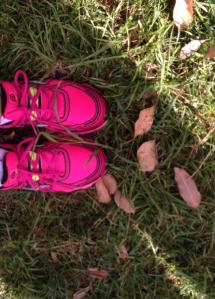
That time I exercised.





