
You are currently browsing the category archive for the ‘Peer support’ category.
I was in Sydney last Friday for a day of meetings, and once they were done, I met up with a new diabetes friend, Amira, who I met only a couple of months ago, but had instantly connected with in that way that only those dealing with messed up beta cells do.
I met her at work and then we walked to have a coffee and a chat. After a while, our conversation turned to her work as an optometrist. Amira told me about the camera she uses to do retinal scans.
I mentioned that I’ve never had a retinal scan as part of my eye checks. My ophthalmologist always dilates my pupils and spends a good amount of time looking at the back of my eyes for any changes. This is how my eye care has been managed and I have always been happy with it (and by ‘happy’, I mean: ‘it makes me cry just thinking about it, but I do it anyway’).
‘Would you like me to take a photo of your eyes?’ Amira asked me. ‘You can send the images to your ophthalmologist to keep on file.’
I thought about it for a moment and took a deep breath before answering. ‘Sure,’ I said. ‘Let’s do that! Thank you!’
We walked back to her office and Amira explained how the camera worked and how I needed to position my eyes. After scanning both my eyes, she sat with me and explained exactly what she could see. She pointed out each part of the eye and what she was looking for and patiently answered my questions. She showed me how she could see the artificial lens that had replaced my own when I had my cataracts removed. (And she clarified that the black spot that I was the first thing I saw was actually a mark on the camera – not my eye.)
She told me exactly the same thing I’d heard back in May when I most recently saw my ophthalmologist: ‘Looks great. There’s nothing to be concerned about.’
I wish that THIS was the first time I had ever seen the back of an eye of someone with diabetes, instead of the frightening image shown to me less than eight hours after being diagnosed, when my first endo showed me a photo of an eye with – apparently – diabetes-related retinopathy. I say ‘apparently’ because I had no idea what I was looking at and had no idea what anything meant.
But that image, accompanied by the words ‘This is what happens with high blood sugars,’ has resulted in years and years of seeing an out of range number on my glucose meter and automatically imagining my retina decomposing…behind my very eyes.
This, combined with other scary images used as part of diabetes awareness campaigns, not to mention the occasional poster in the waiting rooms of various HCPs, is why I am so terrified about anything to do with eye care.
And when we also add the blame and shame that inevitably accompanies discussions about complications, using language that disempowers, it is no wonder that my response to Amira asking if I wanted a photo of my eye was to automatically panic.
Despite twenty years of regular checks, with positive outcomes and a supportive ophthalmologist, the legacy of that initial encounter and subsequent frightening images have taken their toll.
Amira emailed me the images of my eyes, and I’ve spent a long time looking at them – because I know what I am seeing (plus, my eyelashes look awesome!). This is information. It is a snapshot in time and, thanks to Amira’s explanations, I understand what is going on .
‘Come and have another scan next year,’ Amira said. I might just do that. While it will be great to have annual images as a comparison, the best part will be I get to spend time with my awesome new diabetes friend!

Amira has provided me with this explanation of the camera she uses and what it does:
‘Ultra Wide Daytona Plus provides contrast and both red-free and green-free filtering, as well as autofluorescence modalities (so we can see layers in front and behind the retina and assess which part is affected).
Photo documentation means we can monitor and track overtime, allowing for early detection. 200 degree retinal scan compared to a standard scan that often gives around 45 degree view.’
Part of my work involves attending diabetes conferences both here and around the world. Sometimes I have a speaking gig, other times I’m there for meetings, and always I’m there to learn as much as I can about the latest in diabetes.
I love this part of my job in equal measure with not loving it. The ‘love it’ part is because I get to meet with and hear from some absolute superstars in diabetes research and get front row preview seats to what they’re working on. And I love it because I get to see other advocates who are there for the same reasons I am.
The ‘not love it’ part is because I spend a lot of time away from my family and ‘real life’. I feel enormous mother guilt (this time I missed the kidlet’s Winter Music Concert) and feel lousy for leaving lists of plans and schedules for people other than me to manage. Plus jet lag. I talk about jet lag so much because these days it is absolutely kicking my arse as it turns me upside down and into a bumbling, confused, unintelligible mess.
I realised when I was at ADA in Orlando that all my overseas DOC friends have only ever seen me at my jet lagged, time-travelling worst. They get exhausted, grumpy, vague, annoyed me. And they get me doing weird things like falling asleep in front of them only to suddenly get a second wind and become almost hyperactive where I speak a lot – and really quickly – about weird things such as Australian-isms that I believe they absolutely must start to use in their day to day vernacular. (Only click on this tweet if the eff word and spiders don’t offend you…)
And then, I reach a point where I abruptly stand up and say ‘That’s it!’and just leave and head to bed, often mid-conversation. Why they still want to talk and hang out with me is actually a mystery!
But I am glad they do want to spend time with me, because sometimes, being at a diabetes conference is really hard going emotionally.
We sit there listening to some pretty tough stuff; scary stuff. We hear ourselves being spoken about as ‘subjects’ in research which takes away our ‘human-ness’ and makes us sound like rats in a lab.
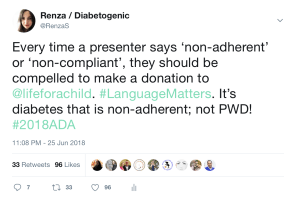
We are referred to with words that make us sound like petulant children (‘non-compliant/non-adherent/failed’ etc.) and all we can do is tweet our frustration (and language positions statements) begging that presenters be considerate in the words they use.
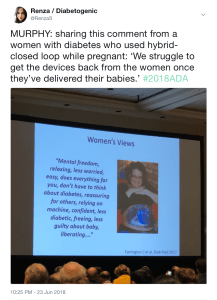
We hear scary, scary tales of all the things that can go wrong with diabetes in a variety of different situations. I reluctantly walked into an 8am session on diabetes and pregnancy, and even though that ship sailed a few years ago for me now, I still brace myself for the research showing that diabetes can and will impact on our developing babies, and children once they are born. That mother guilt I spoke of early is gets turned into mother-with-diabetes guilt which is a monster of proportions all to itself. (Of course, the wonderful Helen Murphy’s talk at 8am was not scary or mother-with-diabetes-guilt-inducing. Instead it was full of interesting facts about how APS impacts positively on diabetes pregnancies. Hurrah!)
Diabetes-related complications are spoken about in matter-of-fact ways that zone in on specific parts of our body and suddenly we stop being whole. ‘The diabetic foot/eye/kidney’ is still attached the rest of us, and yet whole sessions dissect them from our bodies and focus solely on that part of us, forgetting how connected we are to them (literally and figuratively!)
We are told about how diabetes increases the risks of so many, seemingly unrelated problems that can only make me feel as though the cards are stacked so against us that, sometimes, diabetes just isn’t fair. (See also – or maybe don’t – this released today…)
We sit there listening to advice on how things could be improved and sometimes, shake our heads at the disconnect between what is reality to those of us actually living diabetes and the ideas from researchers and clinicians. We wonder what – if any – engagement there has been with the people this advice is meant to serve.
It can be – it is– emotionally draining, exhausting, frustrating.
Those moments when a friend’s sideway glance, or eye roll, or a snarky comment in response to yet another kick in the gut because diabetes is all bad news, is a reprieve from feeling a little shaken. (Of course, it’s not all like this. Often we sit in sessions and feel that those presenting are truly championing our efforts and we do high five through those presentations.)
And those evenings when the sessions have finished, and the official dinners are over and we simply sit together, debrief, refocus and put diabetes back in perspective, make me whole again. It’s the same at every conference. The people may change depending on the location of the conference, but there are always people there. And I’m grateful for that, because I may return home exhausted and jet lagged, but I’m not overwhelmed at what I have seen and heard. Which I fear is how I would be if it wasn’t for the caring, smart, understanding, wonderful people in this tribe .
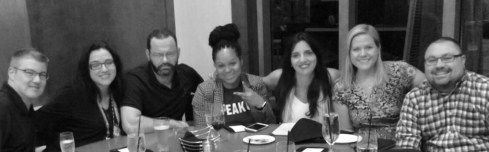
Tribe at ADA
Dear Channel 9
Hi. You don’t know me, and to be perfectly honest, I don’t really know you either. My TV tastes run less to the sensationalist and more to the Netflixist, but nonetheless, here I am writing to you.
You see, I want to talk about Drew Harrisberg for a minute.
So, I work for a diabetes organisation and as a diabetes advocate, and one of the best things about my work is that I get to meet people with diabetes from all over the world and from all walks of life.
One of those people is Drew Harrisberg, who I met through some diabetes device events that I have facilitated.
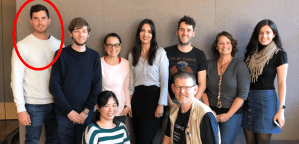
Drew’s on the far left. With the red circle around him.
Drew is an exercise physiologist and a diabetes educator (as well as a singer/songwriter, model and also probably saves kittens from trees/rescues small children from wells/helps grandmothers across the street with their grocery shopping.) Oh – and he happens to have type 1 diabetes.
I can tell you now, Drew and I have very different interests. He’s all about physical activity. I’m all about sitting around drinking coffee and making cookies. But, we both have AWOL beta cells and love dogs, so there’s something in common there!
Just after the latest Abbott DX2 event where we caught up, I was watching TV and there on the screen was Drew’ face. He was on the promotional advertisements for Ninja Warrior.
Okay – full disclosure here: I had to see the ad half a dozen times before I worked out the name of the show and then I had to Google it to work out what the hell it was all about. I’d never heard of Ninja Warrior before. Now I know it’s a reality TV show involving ridiculously athletic and fit people engaging in competitive torture completing obstacle courses. (I know – it’s an absolute fucking miracle I’m not all over this and wanting to be part of the action…)
Anyway, after seeing that Drew was involved, I did get a little interested. While my reality show viewing generally extends to Masterchef (because: Nigella) or Grand Designs (because: Kevin McCloud), I was suddenly keen to know just how Drew would be presented on the show.
Reality TV show producers love a back story. In fact, they’re ALL about the back story. And I figured that Drew’s back story was going to be about the fact that he lives with type 1 diabetes. I could hear the emotive music playing already and see Drew running slow-mo along the beach, his dog beside him, as his voice told the story of his diagnosis and how, despite the obstacles he faced by diabetes, he could still face the obstacle course of Ninja Warrior (and, fuck! I should be writing copy for that show right now; give me a job).
I do love a little bit of diabetes awareness on mainstream TV. If there is an opportunity to bust some myths and smash some stigma, I’m all over it, and I figured that Drew’s appearance on the show could do that. Plus, I’ve been told that kids LOVE this show, and I thought it would be great for kids with diabetes to see Drew not letting diabetes be a barrier to him being his very-best-obstacle-course-beating self.
So, I was resigned to watching the show when it starts (soon, apparently) and cheering on my mate from the comfort of my sofa (while drinking coffee and eating the cookies that I choose to bake in lieu of doing any exercise). I figured that the diabetes community here in Australia would really get behind him, hoping that he would not have to deal with any pesky hypos just as he was…well…doing whatever one does on an obstacle course.
Except, then I noticed that he was no longer in the advertisements. Where Drew’s face had once been, I suddenly saw the perfect smile of someone else (someone, I assume, with a functioning pancreas). I checked the website and he was nowhere to be seen. It appears that Drew has completely disappeared from all Ninja Warrior promotional materials. (Wait! Is this the ninja part of the show? I still don’t really understand it…???)
Although I may be a tiny bit pleased that I don’t need to commit to a three month reality show, I am so disappointed that having someone with type 1 diabetes on prime time TV has been lost.
So, Channel 9 – any chance you can share what’s going on? What have you done with Drew? Why has he disappeared? Why have you completely forsaken this awesome opportunity to showcase someone on your show who is living with a serious and seriously challenging health condition?
Looking forward to learning the full story…
Best,
Renza

The diabetes online community is big place. It is a global network of many, many people, living many, many diabetes lives, with many, many experiences. Those experiences colour and shape the way we react to certain situations and help to focus our attentions on issues that become our ‘thing’. For some, that may simply be to find and/or offer support from and to others walking the same path. Reducing isolation is one reason that people feel that online support is so powerful, as boarders (of all sorts) melt away.
I have sought great solace in the community many times. This community has seen me through diabetes issues where I have felt lost, hopeless and terrified; they have supported me through times of personal anguish; they have cheered for me when I’ve done something worth celebrating. And they have had my back, shining a light for me until I was able to hold it up myself again to get out of the black tunnel that had engulfed me.
I first joined Twitter back in 2009, but it was in 2011 that I first started to really reach out and connect. It was participating in DSMA chats that first exposed me to the global online community and I was astounded. I truly had no idea that people existed who were genuinely there to support others in truly selfless ways. That support meant different things to different people and was offered in different ways. For some people – well one person – it was starting DSMA and not only asking questions each week as we all came together to share our experiences about a variety of topics but providing a listening ear and helping hand outside that hour of power. For others, it was jumping in when they could to respond to a question, or virtually high five a diabetes victory.
To me, it truly felt like a cocoon of people who were there to do good.
I am not naive enough to think for a moment that it was always perfect or that everyone there was always unflawed. There were the occasional flashes of heat, with disagreements not always being as respectful as they could be. But by and large, I felt that people’s differences were respected.
This community has always been good at outrage. The first time I ever wrote about it was when an Australian comedian misfired a joke about diabetes. I know that this wasn’t the first time the community had used its collective and loud voice to shoot someone down for saying something stigmatising about diabetes, but it was the first time I saw it in such a quick and almost coordinated manner.
But over the years, it seems to happen more and more – perhaps because more and more people have started using online platforms. Or maybe it is because we are getting tired of being the punchline to every poor joke about the latest Starbucks sugary concoction.
Somehow, though, that outrage has turned itself inwards. While many people in the community (and I count myself in there) are spring-loaded and ready to go if someone without diabetes attacks ‘my people’ (i.e. people with diabetes), it seems that these days, a lot of the outrage is directed within the community.
I see that in particular groups: it’s no secret that the first thing that comes to my mind is the LCHF movement, and those within it who believe that the best way to deal anyone not subscribing to their way of eating is to attack, attack, attack. But it would be unfair to suggest that this group has militant outrage all to themselves.
There are also some who are doing work that is genuinely important and critical in supporting those less fortunate, but as they go about their efforts, have become attacking and openly negative about other groups aiming for similar outcomes, but who are choosing to do it in different ways.
But that’s not the only thing that people seem to be antsy about. I’ve had people have a go at me for my decision to use Loop. I’ve seen people choosing not to use CGM be told they’re being irresponsible. I’ve seen people who work with industry – device and pharma companies – be shot down and told THEY are part of the problem when it comes to access to technology and drugs because they are being bought by Big Pharma. I call bullshit on all of, and wish that everyone could remember that there is more than one way to skin diabetes advocacy. (Ugh – that sounds really unpleasant.)
This week while at ADA, I saw one of the people who I have always considered to be a – if not THE – shining light of inclusion (and certainly one of the first people to welcome me into the community) have her integrity publicly questioned. I am, of course, talking about Cherise Shockley. As it turned out, I was sitting next to Cherise as this unfolded, and her calm composure put to shame the rage that was building within me. My trigger finger was itching to fire, but instead, I took deep breaths and waited.
Without going into all the tedious details, Cherise was being accused of not being transparent during a DSMA chat she had moderated a few years ago, the transcript of which was later used in some academic research. Cherise had, of course, disclosed this at the beginning of the chat. At dinner the other night, she sat there until she found the tweet that showed the disclosure, but by the time she shared it online, more and more people had jumped on the outrage bandwagon, joining the choir of accusers. Had any one of these people taken the time to search through Twitter, they would have found the tweet Cherise later shared.
But that’s not how we play in the outrage playground: we just jump on the merry-go-round with everyone else and get faster and faster and faster until the situation is either forgotten (after all, there will be something else to be outraged about tomorrow), or, as in this case, the outrage is shown to be completely unwarranted.
I waited for apologies to follow. They didn’t come. At least, not immediately, and then I decided to stop following what was going on because all I cared about right then was that my friend – a woman I love, who has looked out for and checked in on me more times than I could count – was okay.
I love this community. I have stood up at international conferences and gushed about the value of community, I have written about it and been involved in research about it to help build the evidence base for it, because I truly believe in it. But there are times – increasingly – that I feel I need a time out. And I hate that. Because I need this community: if you are part of this community, I need you.
There is a person at the other end of that Twitter handle, or Facebook profile. It’s easy to forget that sometimes. I don’t know anyone in the community who is actively involved in activism and advocacy who isn’t trying to improve things for people with diabetes. It may not be the way you would do it, it may not be the focus you have, it may not be through partnerships you would encourage.
But that’s okay. Many different approaches are fine. But let’s respect the way we choose to do that. Is it too simplistic to suggest that really, we just need to go back to remembering to be kind? Maybe. Probably. But without any other solutions that I can think of, that’s all I have. Be kind. Always, be kind.

It never fails to surprise me – that instant connection you make with a diabetes peer.
Today, I had the pleasure of meeting Amira who has lived with type 1 for over 20 years. I flew to Sydney to oversee some filming for a work-related project, and Amira was being interviewed.
I listened to her tell her diabetes story (one I really hope she will write about for here!) and afterwards, we had a coffee and chatted. And there it was: that connection that goes far beyond our lazy beta cells, and far beyond both being diagnosed around Easter.
Amira is one of those dynamic, passionate, smart and funny people who helps to make the lives of people with diabetes better. I listened as she explained to me how she works with people with diabetes and instantly I knew she was one of those people I would want as part of my HCP team.
We spoke about every day things that I would speak with any other woman about. But diabetes adds layers and complexities and frustrations and fears. We nodded at each other as we shared those thoughts. Because they resonated straight away. And I was reminded again: the power of peers. That connection of diabetes that goes so deep that it must somehow be built into the DNA of those first encounters.
A new diabetes buddy makes for a good day. Today was a good day!
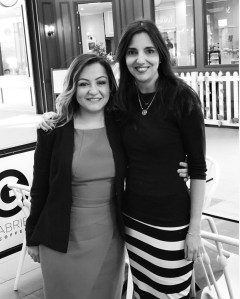
I’m in London for a couple of days of meetings before flying to Copenhagen….for another couple of days of more meetings. But I was smart this time, managing to set aside a whole day before the meetings start to do this:

These three women – these wonderful women – are part of the lifeline I have to help me manage diabetes. It may have been faulty pancreaes that brought us together, but what ties us together is support, friendship and love.
Thank you Annie, Georgie and Izzy for coming to meet me in my jet-lagged state in London. Thank you for building me up, and filling my jar. I couldn’t do this diabetes shit without you all.
We have a beautiful tree over the back laneway at our place. Usually at this time of the year, it is in full autumn brilliance. The red and gold leaves catch the gorgeous afternoon sunlight, and where the leaves have already littered to the ground, the branches are bare.
But this year, things have been a little different. Our tree brought out its autumn clothes a much later than usual, but sure enough a couple of weeks ago, we noticed that the leaves were beginning to turn. Every day, I’d look over the fence to see a deeper red, a more golden glow. Sure, we hadn’t needed to turn the heating on inside the house yet, and my really warm knits were still tucked away in the cupboard, but the tree was promising winter and cooler days.

Blossom buds. In May…
Over the weekend, as I sat in the kitchen, the back door open letting in a lovely breeze, I looked up at our tree. And there, on the bare branches, I could see something shooting. I went outside to have a closer look and realised that what I could see was the start of the blossom that comes out in the middle of springtime.
Our poor tree was looking mighty confused. I was confused. This isn’t how things go. The seasons are meant to be somewhat regulated and ordered. I like order. Order makes sense. This didn’t make sense at all to my brain, which likes things to be as they should be!
This wasn’t the only confusion I dealt with this week. Last Friday, I spoke about DIY diabetes technology at a health professional event and there was a lot of confusion.
I only had ten minutes (seriously not long enough to talk about something that is a completely novel concept to most of the audience), so I spoke fast, waved my hands around faster and tried to simplify the whole idea of looping into about 8 slides. ‘Renza will be around afterwards if you have questions,’ the emcee announced to the audience who all looked slightly bamboozled and winded after I finished.
There were questions. Lots of them about how Loop works, what it really is and who can use it.
But the one thing that seems to garner the most confusion is the cost. ‘You didn’t say how much has cost you,’ a few people said to me once the event was finished. Actually, I did. (Admittedly, very quickly, because: 10 minutes!) ‘Well, you need to source a pump that works, so that may be costly. And if the person using it is over 21, they will need to fund CGM themselves. Plus, the Riley Link is about $150 and there is a cost associated with becoming an Apple developer,’ I repeated what I’d said in my talk. (Obviously, I was talking Loop, but there was an OpenAPS user in the room too and I think he may have answered a couple of questions about the cost of his set up.) ‘No, no…what about the actual cost to use the app? How much does that cost?’
I have had this question asked probably more than any other. For some reason, people don’t seem to understand the concept of open source information sharing. No one is making money through this. The clever people who have developed DIY diabetes solutions place the details online for anyone to see and use. For free.
But this seems to be a confusing concept for a number of people.‘Wait. So no one is making in money from this? What about the people who worked it out in the first place? They are. Right?’
‘Nope,’I always reply, wondering how many ways I need to say it (along with wondering why I am so lousy at communicating things and also, if my hands waving around are distracting people).
Inevitably, the next comment is ‘Well, I’m not sure why someone doesn’t try to commercialise it. That would get it through regulations, wouldn’t it?’
At that point, it’s my turn to look confused. Why is it so difficult for people to understand that there are actually people in the world who genuinely want to do something good for others? Or that the WHOLE point of the #WeAreNotWaiting ‘movement’ is the fact that there is no waiting for regulations that are inevitable with commercialisation?
I guess that unless you are part of this community, it could be difficult to understand. But the generosity of those in the community is on show all the time. Whether that be the people doing the grunt work behind the scenes to make the dreams of DIY diabetes a reality, or the people who are then writing the step by step instructions so even fools such as me can follow those instructions, or the incredible community members who are ready to jump in any time to answer SOS calls for help when something doesn’t seem to be working, these people are doing it all for nothing more than the gratitude of those of us who are reaping the rewards of their cleverness and kindness.
The confusion – and disbelief – about this community is confusing to me, because every day I see how incredible it is. I only wish I was smart enough to give back even a fraction of what I have received from those brilliant folks who are there for the rest of us. And I really wish I was able to do a better job explaining what a marvellous bunch of people they are!

I don’t know where I would be if it wasn’t for the support, love, friendship and sustenance I get from my peers with diabetes. A long time ago, I wrote that the two most powerful words in the English language are ‘me too’. Realising that others understand, have experienced and know what I am going through means that I never feel truly alone. It doesn’t matter what time of the day it is, I know I can always find someone – a diabetes peer – to talk to and help me through.
I wish I knew this from when I was diagnosed. I felt really alone for the first few years I lived with diabetes. To be honest, I don’t think I necessarily wanted to meet anyone with diabetes as soon as I was diagnosed, but I certainly did a short time later, once I realised that diabetes wasn’t just for Easter (when I was diagnosed)…it was for life.
Today, I couldn’t be without those I have come to know because of our shared lazy pancreases. I am so lucky to have them in my life.
- What this tweet says:

- At diagnosis, being made aware of peer support is a really good idea and I so wish that I had been told how to find other people like me when I was diagnosed and felt so alone.
- There is no right way to do peer support. Whatever works for your – that’s your peer support model!
- Peer support may be catching up with a mate for a coffee or a beer, or it could be sitting in a room while someone speaks to you. Or a walking group, or a sports group (allegedly). Or a diabetes camp. It can be a formal structure or something more akin to a casual book group. For my money, I’m all about the informal, unstructured model. That is what works best for me. But just as with everything to do with diabetes, there is no one size fits all and it’s important that all options are available so people can find out what works best.
- So, yes – this works when it comes to peer support too.
- I promise you – what you learn from your peers will be as important, if not more important, than anything you will ever learn from a diabetes healthcare professionals. It will probably be more relevant and practical too.
- You don’t need to love everyone you meet – just because they have diabetes. Dodgy beta cells can’t be the only thing you have in common.
- The connection you find with the people you do ‘click’ with and love could be to do with your life stage, personal experiences, philosophy about living with diabetes or mutual love of Effin’ Birds.
- AKA:

- There is an undeniable feeling of luck, love and gratitude when meeting someone that is in your tribe. And that extends to when you introduce their family to yours and you realise that you have made family friends forever. AKA: This time in New York City.
- Sometimes, there is no need for words. Support, love and encouragement can all be said in one glance.
- I have found some of my closest diabetes friends online. The DOC is a diverse and varied community. You just need to work out the people and activities that work for you!
- Online peer support can be just as valuable – and sometimes more so – that face-to-face peer support. There is nothing scary about meeting diabetes friends online.
- So with that in mind, be open to meeting new people. You can easily get stuck in a peer support rut with people you once really connected with, but, for whatever reason, are ready to meet new people. That’s okay.
- And with THAT in mind, remember that involvement in peer support can be transient. Just because your ideal peer support model looks one way today, doesn’t mean you need to do it the same way forever.
- There may be times that really, you’re not interested in speaking with others with diabetes, or feel you don’t need support from other panreatically-challenged folk. That’s okay too. (You can always come back if and when you are ready.
- For peer support to work and be truly effective, it needs to be a safe, judgement free environment. (Which is pretty much how everything to do with diabetes needs to be for it to work…)
- Linking and connecting with other people with diabetes can be life changing and life saving. Search Simonpalooza in Google to see what I mean. Or read the Pumpless in Vienna story here.
- Peer-led support groups are most successful when the person doing the leading clearly has no agenda other than wanting to build a community. If you want to look at a beacon of someone who is all about community, building people up and being nothing other than inclusive, look no further than Cherise Shockley who started and continues to oversee the first diabetes tweetchat!
- Peer support can happen anywhere. Diabetes in the wild moments often provide the most incredible opportunities to connect. Just remember though, not everyone is necessarily open to sharing all their diabetes tales with a complete stranger you meet while waiting for a coffee. (That last point is mostly for me.)

Peers.
The three most important women in my life are forces of nature: My mother, president of union, has instilled in me a desire to do work that helps others. My sister, the fiercest, feistiest, smartest person I know, who constantly challenges me to think outside my comfort zone. And my daughter – my amazing, miracle kid, (and kids like her) – is why I feel that the world is actually going to be okay.
The supporting cast of close family – mother-in-law who just happens to be an Australian aviation pioneer, my sister-in-law, aunts, cousins – and friends means that I am constantly surrounded by brilliant women doing brilliant things. I am astounded, daily, at the challenges they overcome, their triumphs, the lives they change, the impact they are making.
And in my diabetes life it is women – the incredible women – who keep me going and keep me motivated. My diabetes healthcare team is made up exclusively of women who truly breathe the whole person-centred care belief system, building me up and then supporting me as I do the best I can with diabetes. The women I have worked with, and continue to work with, in diabetes organisations who champion those who would otherwise be forgotten have become friends, mentors and daily cheerleaders.
It is people like Cherise Shockley, founder of DSMA; Dana Lewis, creator of Open APS; Susan Alberti, philanthropist; Jane Speight, diabetes language forerunner; Taryn Black, Diabetes Australia policy director and champion for having the voice of PWD heard; Riva Greenburg, journalist, changing the way we see people living with diabetes; Annie Astle, advocate and speaker, and the person I am most grateful to have come to know because of diabetes; Monique Hanley, cycling legend; Christel Marchand Aprigliano, advocate leader; Cheryl Steele, CDE extraordinaire and leader in diabetes technology education; Kerri Sparling, author, blogger and incredible advocate; Anna Norton, Sarah Mart and Karen Graffeo, the women behind Diabetes Sisters; Melissa Lee, incredible communicator, singer, former leader of DHF and now at Bigfoot Biomedical; Kelly Close, founder of diaTribe and Close Concerns; Georgie Peters, speaker, blogger, diabetes and eating disorders advocate…
And you know what? I haven’t even scratched the surface. The diabetes world is shaped by women, built by women, sustained by women. Advocacy efforts are often the brainchild and then led through the blood sweat and tears of women. And how lucky the world is!
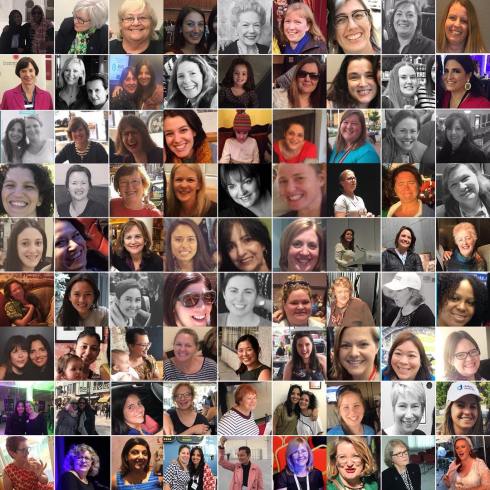
I celebrate these women today and every day!
More writing about women and diabetes, and women’s health.
This is what Diabetes Privilege Looks Like
One Foot in Front of the Other
There is an indescribable feeling I have following a diabetes conference. Swirled in amongst the exhaustion, information overload, jet lag (because conferences are always in ridiculous time zones that are not AET), and memories, I come back galvanised in a way that can only happen when spending time with those in my tribe: others living with diabetes.

I returned from three days in Vienna bone-achingly exhausted. After being reunited with my family and not being able to stop hugging them, a few days of not-great-but-okay sleep and bucket-loads of Melbourne coffee under my belt, and time to process and write about what I learnt, I find myself recalibrated and ready for what’s next.
The hours of travel is a memory, the conference sits comfortably alongside all the others I’ve been too, my conference name badge is hanging in my office with all the others, and I’ve plans already underway from successful meetings.
In a lot of ways, the status quo has been restored and I am back to my real life after a few days of conference life.

But what is not the same is the level of vitality I now have, my veins pounding with the vigour that comes only from spending time with the people who are working to and for the same things because they get it at a personal level that is only apparent to those of us whose very DNA is affected by this condition.
I came to realise a few years ago that I have an invisible jar in my mind, and how empty or full that jar is depends on the time I’ve spent with likeminded diabetes friends. When the jar is nearing empty, I find it difficult to focus my energies on the advocacy and support issues that often are front and centre of my mind. I feel myself flailing and falling short because I don’t have the support of those I need to boost me up.

Of course, I am lucky enough to have others with diabetes around me even when I am in Melbourne (hello neighbour!), but it is those I see at these sorts of conferences – the ones whose minds and hearts are full of similar ideas, similar frustrations and find similar reasons to celebrate– that fill that jar right up. It is when I can simply turn to someone because they are sitting right there, have an animated conversation and high five each other with our enthusiasm that I feel capable and able to take on the world.
Those people who share my pancreatically-challenged existence, who breathe the same health condition, and struggle, celebrate and despair in similar ways to me, are the ones who fill up the jar ways to sustain me until the next time. My motivation is high, the momentum fast, my mind is working overtime. And my jar is overflowing right now with those people who may have beta cells that don’t work, but they make up for it in ways you couldn’t even begin to imagine.
Tine – who inspires me every time we speak.





 Diabetogenic