You are currently browsing the category archive for the ‘Peer support’ category.
Sometimes, the best diabetes meetups involve a few people with diabetes just sitting around having a chat. Perhaps it’s over dinner, or maybe over a coffee. There’s no formal agenda, there are no official speakers. It’s just people with diabetes catching up and talking.
Now, multiply that by … a lot. In fact, put about 40 diabetes advocates in a room together. Throw in a few HCPs as well. And some people from industry. Hell, there may even be a few people from professional and consumer diabetes organisations in there as too.
Now you have #DOCDAY; a diabetes meetup on steroids!
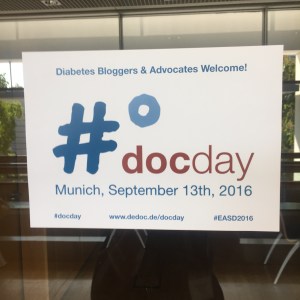
The second annual #DOCDAY event was coordinated and hosted by Bastian Hauck at EASD in Munich. Last year, he had this idea and organised what he thought would be a few people in a café in Stockholm. He underestimated how many people would want to attend, and the room was overflowing with advocates from Europe (and the usual Aussie ring-in).
Dr Andrea Orecchio, right, with Danela D’Onfrio from Portale Diabetes (an Italian diabetes peer site).
This year, he got smart. He hired a room at the conference centre which was a genius move because it not only meant it was so simple and convenient to get to, but it also meant a whole heap of HCPs came along too. (Big hat tips to the divine trio from AADE, Hope Warsaw, Deb Greenwood and Nancy D’Houln, Aussie Dr Kevin Lee, and the delightful Dr Andrea Orecchio from Switzerland who impressed me with his ability to speak (and tweet in) four different languages. Perfectly fluently.)
There was no real structure to the meeting, apart from the insistence that all attendees have their photo taken on an old-school Polaroid camera to be placed on the attendee wall. Bastian kicked off the afternoon, saying a few words and he also asked some people to talk about any exciting diabetes initiatives they’ve been involved in. He asked me because he knows that in my jetlagged state I’m likely to say something inappropriate which will lighten the mood.
I was absolutely enthralled and excited to hear of some of the work other diabetes advocates have been up to lately. Here is just a taste:

Cannot wait to see this book published!
I simply cannot wait for the release of this new book from the team at Anna PS. Anna Sjoberg and Sofia Larsson-Stern from Sweden have collected stories from 20 people with diabetes and will share their personal experiences of lives with diabetes. The Swedish version of I Can, Want and Dare will be out in time for World Diabetes Day, and the English-language edition will follow shortly after. You can pre-order here. What a brilliant Xmas stocking filler! (Disclosure – Anna and Sofia invited me to contribute to the book. I have no financial interest in the book.)

Med Angel.
Did you know that 93% of people using temperature-sensitive medications are doing it wrong? Neither did I! Amin Zayani has created a very nifty smart sensor and app to help you know if your insulin is being kept at a safe temperature. This is a super easy device to use and is all about safety. I know I can certainly be accused of being very relaxed about keeping may insulin at optimal temperature and (touch wood) have never had a problem. But just at this conference, I was speaking with someone whose insulin had been affected by temperature and was absolutely not working. At all. This is something that will be very handy for a lot of people! Follow Med Angel on Twitter here.
IDF Europe has introduced a social media prize in diabetes. Quite frankly, the DOCDAY room was full of worthy recipients. Nominate someone now!
Peer networks in France with Paul-Louis Fouesnant.
I always love hearing about grass-roots diabetes support initiatives, and Paul-Louis Fouesnant from France spoke about Diab’ Mouv peer events he organises regularly.
So what did I speak about?
I spoke about driving and diabetes, specifically the advocacy win we have just had with the launch of the new Australian Assessing Fitness to Drive Guidelines. (More about that later this week.)
I spoke about CGM subsidies, a hot topic everywhere, but particularly in Germany where a reimbursement program had just been announced.
And finally, I spoke about language, because EASD is one of the most challenging conferences when it comes to language. I spoke about why language matters and why the real changes that are being made in this space are driven by people with diabetes. We have been talking about this for years and years now and it is terrific to see it (finally) on the agenda.
By the end of the afternoon, I was overwhelmed by all of these incredibly inspiring folk. For most of them, this is a labour of love with little, if any, financial reward. We blog because we want to share our stories and connect – nothing more. We come together to share our successes and our frustrations because we know that this is a sympathetic group who ‘get it’. Between now and when or if we next get together, we will keep in touch and continue to share our stories because that’s what we do. Thanks to everyone there for being so generous with this bumbling, jet lagged mess.

Just some of the advocates, activists, bloggers and HCPs in the #DOCDAY room!
My disclosures for my attendance to EASD2016 can be found on this post.
We watched the movie Looking for Alibrandi with the kidlet the other night. I remember when the book came out. I’d left school, was in first year at Uni, and still trying to work out who the hell I was. My mum, sister and I all read the book and couldn’t stop talking about it.
That book was one of the most important things I read when I was younger, because it resonated so much. The idea of not understanding where I belonged had shaped a lot of my adolescence, and was continuing to confuse me as a young adult. I know I wasn’t the only one feeling like that – many kids of post-war migrants felt the same way. Not that we really spoke about it, which was why Looking for Alibrandi was so important. It put into words the jumbled thoughts in my head.
My parents moved from Italy to Australia in the late 1940s (my dad) and early 1950s (my mum). They both grew up here – all their schooling was in Australian schools. They speak English perfectly without a hint of an Italian accent.
We didn’t speak Italian at home, and weren’t particularly involved in the Melbourne Italian Community. Most of my parents’ friends were not Italian, and I only had very, very few Italian friends. At secondary school, there were a number of Italian girls whose families would have been similar to mine, and yet they weren’t the girls I hung out with.
I wasn’t really sure where I fit. I didn’t belong with the Italian girls, because their parents were all a lot stricter than my kinda strict parents; they all spoke fluent Italian – often to each other – and were more involved in the Italian community. Equally, I didn’t really feel that I belonged with my ‘Aussie’ friends because they totally didn’t get the overprotective Italian father thing I had going on at home. Or my love of Fiats. (Or that we had Nutella in the cupboard at home!)
I was in this kind of middle ground that left me wondering where I belonged. And it is a position in which I find myself again today in the diabetes world.
I am a person with diabetes. But for the last 15 years (so, for all but 3 of my diabetes life) I have worked for a diabetes organisation. It leaves me in a unique position that brings great opportunities and privilege, but also makes me feel like a complete outsider at times.
HCPs are confused by me and sometimes suspicious of my vocal advocacy on engagement and the power of peer support; others with diabetes are sometimes wary because they wonder just how free I am to be open and honest about my diabetes; within diabetes organisations I am seen as someone who has fingers in many, many pies; global advocates are curious about how I manage to write this blog while still being in paid employment with a diabetes organisation. To avoid confusion (frequently my own), I speak differently depending on the audiences I stand before, and adapt my tone and language and stories slightly to suit HCPs, PWDs, industry reps or government people.
But essentially the stories are all the same and it is my voice telling the stories.
Next week, I’ll be in Munich at the European Association for the Science of Diabetes (EASD) Annual meeting. The EASD conference is an interesting one. It is very ‘rats and mice-y’ – the term I use for conferences where I look confused in most of the sessions because I have pretty much no idea what is being said, however understand enough to know that someone, somewhere has managed to cure diabetes. In mice.
Despite it’s very science-focused content which attracts very science-focused folk, I feel very ‘right’ at this particular conference, because there is a wonderful advocate, blogger and consumer satellite program that means the city is full of ‘my people’. And that is why I am there – for those events.
If I feel as though I don’t belong at EASD, it’s because I am the only Australian advocate there. I have travelled the furthest distance, I am jet lagged for most of the time and people have trouble understanding my accent. But the Italian contingent at the advocate events claim me as one of their own (albeit one of their own who doesn’t speak the language), so at least I feel that I fit somewhere.
So at least for next week, I’ll know my place. And it will be alongside some of the most dynamic, clever, passionate and dedicated people I know. My people. They will teach me a lot as I learn what they’ve all been up to since we last met and I’ll clumsily share what’s been going on here in Australia. That’s where you will find me.
(And you’ll also find me sitting down the back of science-y sessions looking confused. And wishing I was a mouse.)

I’d already returned home to Melbourne on Friday morning when Dr Kevin Lee gave his talk on on healthcare social media. I wrote about his planning for the talk here after Kevin engaged OzDOC for some advice on important topics to cover. I’m really sorry I wasn’t there to hear his presentation, although felt there in spirit after I saw this! (Thanks, Ash!)
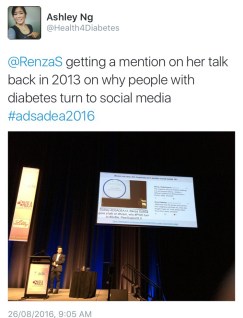
I reckon that this is the fourth or fifth year the ADS ADEA have spoken about social media and how healthcare professionals can use it safely. I remember seeing diabetes educator Natalie Wischer give a great talk back in 2012 highlighting the different social media platforms available and how they are being used in diabetes. This was just after we launched the weekly #OzDOC tweetchats and I stood up and gave a plug for our weekly online get-together, urging the HCPs in the room to have a look – to lurk – and see what we were so excited about.
I gave a talk the next year (that’s the photo Dr Kevin Lee used in his talk), encouraging HCPs to engage with the online community. And last year at the Roche Educators Day, I ran two practical workshops about how HCPs could use SoMe to connect, enhance and support diabetes care.
It has been on the agenda for a few years, and now it is time to stop talking about it and actually do it.
As mentioned last week, Symplur highlighted just who was talking online at the conference. As usual, the ACBRD team was doing a stellar job live tweeting sessions and promoting their excellent work. And, of course, advocates on the ground were doing their (our?) best to share and engage. There were over 2.7 million impressions on Twitter for the duration of the conference, which is certainly an increase from previous years.
I would really love the ADS and ADEA to be proactive about encouraging social media. I would love for them to look at what happened a couple of weeks ago at the American Association of Diabetes Educators conference and see how meaningful social media interaction between people with diabetes and healthcare professionals can and does happen. Safely. The real engagement and collaboration between the organising professional body and advocates saw impressions on Twitter of over 17.5 million, and over 860 people engaging online.
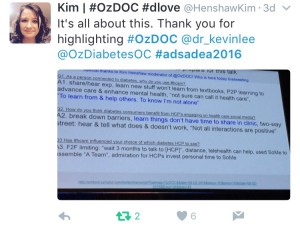
So, how do we go here in Australia about increasing online presence and discussion? In the room for Dr Kevin Lee’s talk were two of Australia’s most prolific and well-known patient advocates – both high-level users of HCSM. I’m referring to Kim Henshaw and Ashley Ng. I wasn’t in the room, yet was actively participating, re-tweeting and engaging – as were many others during sessions that I was sitting in earlier in the week. Having more consumers in sessions provides that connection with PWD not at the conference to hear and see what is going on.
I also think there was, perhaps, a missed opportunity at the session speaking about social media use. Having an advocate on the panel or chairing the session (and remember: Kim and Ashley were in the room!) would have added significant value to the discussion. Dr Kevin Lee went straight to the source when he was putting together his talk. Think about how great it could have been had one or two of those who helped him pull together his information were on the stage elaborating on their comments. Perhaps next year.
I’m back home after three days on the Gold Coast for part of this year’s Australia Diabetes Society – Australian Diabetes Educators Association conference. More to come next week, when I’ll try to pull together my very messy notes.
For today, here are some pictures!

As I took the stage to chair one of two sessions at the Roche Educators Day in Tuesday, I realised I had already been up for seven hours. It was only 11am. Sentences were difficult until my fourth coffee of the day kicked in!

On the job. Professor Steven Boyages’ talk: A connected ecosystem for healthcare professionals & their patients’ was full of practical tips about using technology to support people with diabetes.
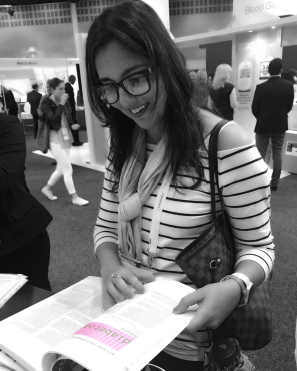
This was the moment I opened the new NDSS Diabetes and Emotional Health Handbook (for health professionals supporting people with diabetes) and I saw Diabetogenic on page 24! Thanks for capturing, Professor Jane Speight!
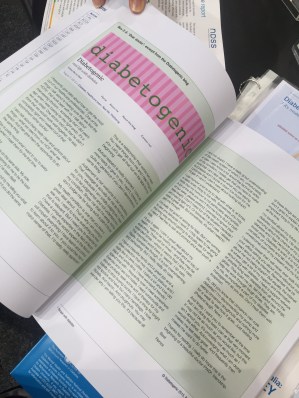
Proud moment!
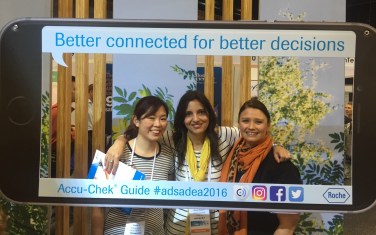
Advocates running amok. We actually behaved ourselves quite well. Mostly.

Although, we were mighty busy! Three of the top four influencers at the conference happen to be consumer advocates, sharing information from the conference specifically with the intention of reaching other PWD who could not be in the room.
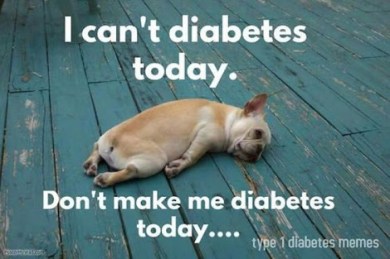
Martha Funnell used this in her talk on day one. Sums up many, many days!
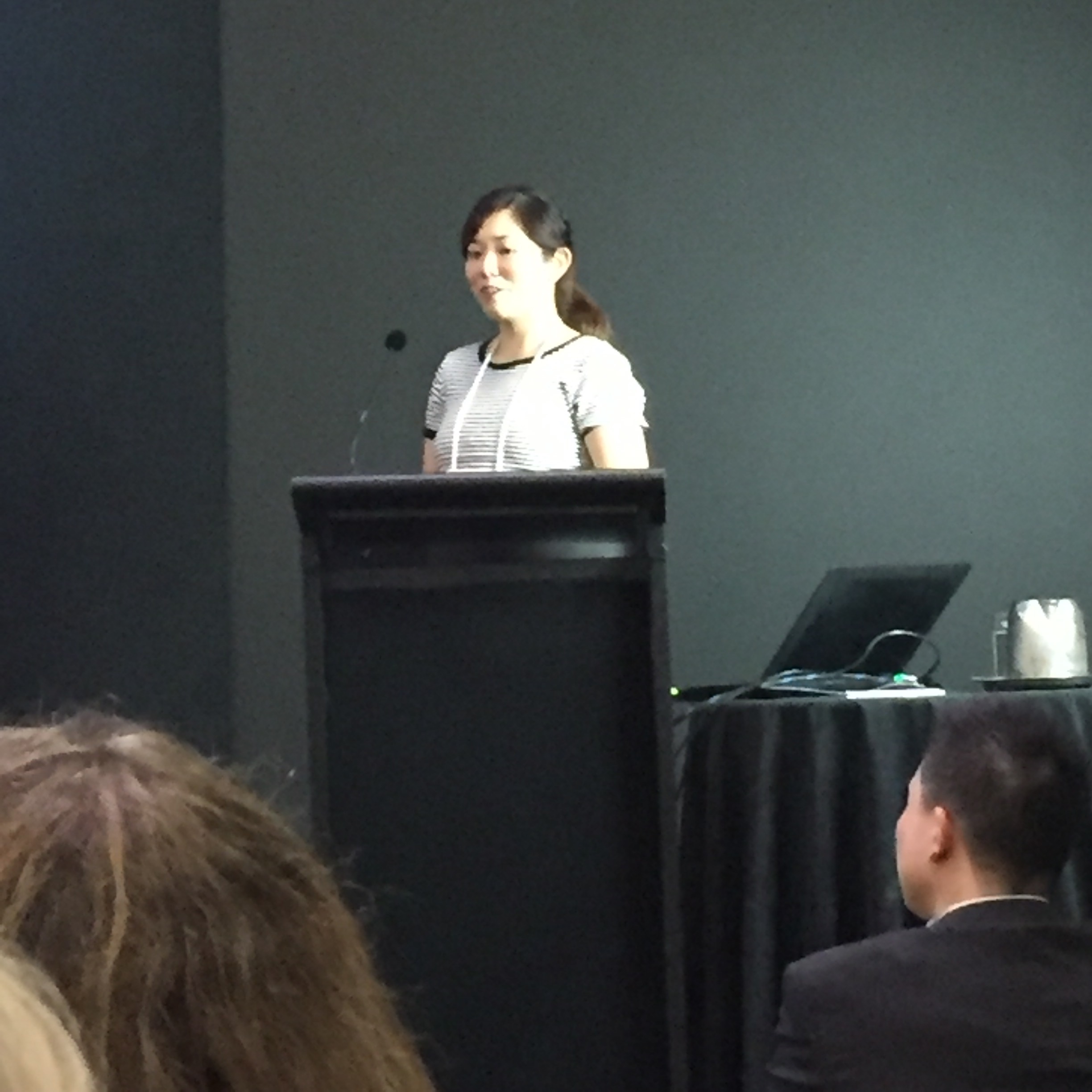
Rather proud of this special young lass. Here’s Ashley presenting on her work focussing on the needs of young people with type 1 diabetes.
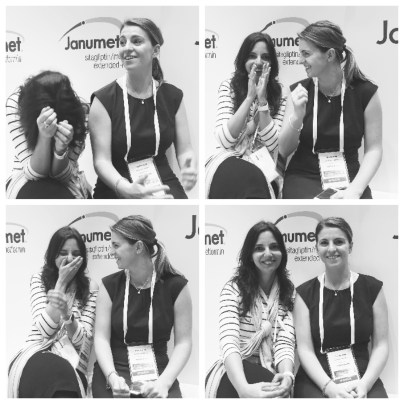
This is a combination of jet lag and exhaustion. (Jet lag belonged to Harriet.)

The NDSS stand looked very bright thanks to these beautiful resources from the Young People with Diabetes Program.
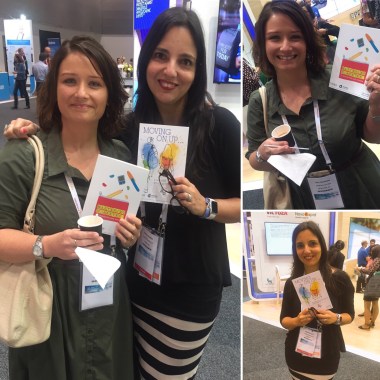
And another proud moment. Kim’s outstanding work on the national roll out of Mastering Diabetes means this resource is in the hands of those who need it most: children with type 1 diabetes, their families and schools. Well done, Kim! (And I’m holding Moving on Up which I am equally proud of!)
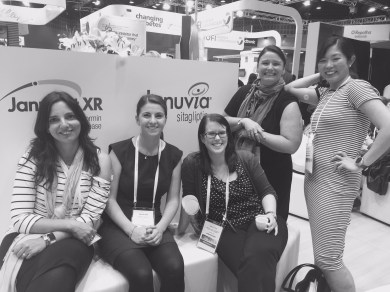
Spot the diabetes devices….

Gold Coast.
Proper wrap up coming next week. Enjoy your weekend. I know I certainly will! (But you can play catch up by checking out all the #ADSADEA2016 tweets.)
So many things on my radar at the moment. Here is just a taste!
Gila Monster and diabetes
Over the weekend, federal health minister, Sussan Ley announced the drug Bydureon would be listed on the PBS from 1 September 2016. Bydureon is a once-weekly injection used in conjunction with oral medications for people with type 2 diabetes.
Fun fact: Bydureon is the brand name for exenatide, which is a synthetic form of a substance found in the saliva of a lizard – the Gila Monster. (Please can we talk about how someone worked out that this would be a good treatment for diabetes?)
News from ACBRD
The team from the Australian Centre for Behavioural Research in Diabetes don’t sleep. At least, I am pretty sure they don’t. My office is on the same floor as them and I can tell you that I’ve never seen any of them asleep at their desk. Instead, they work really hard and produce things like these:
Centre Foundation Director, Professor Jane Speight, is straight talking at the best of times, and her commissioned article published on Monday in the Medical Journal of Australia pulls no punches in putting forward a strong case highlighting the need for behavioural innovation in the treatment of type 2 diabetes.
Dr Jessica Browne from the Centre has been leading work on diabetes and stigma, and this piece published recently in Diabetes Care is about the development of the Type 2 Diabetes Stigma Assessment Scale.
Over-achievers the lot of them. And how grateful I am! (If any of you are reading this, stop it now and get back to work!)
AADE / DSMA / diaTribe / Language
I cannot even begin to express how excited I was last week to see so much focus on and discussion about diabetes and language at last week’s American Association of Diabetes Educators conference.
I sat in my office in Melbourne last Friday morning in tears as on the other side of the world in San Diego (where it was Thursday evening) Cherise Shockley directed a tweet chat about language and diabetes. (And a huge thanks to Cherise for reaching out before the chat!)
In this piece from diaTribe, Kelly Close also wrote about language. Check out this BRILLIANT ‘Diabetes: Starting the Conversation’ infographic. I love this SO much!!

Rachel Soong – Diabetes Infographic @DiaTriibeNews
Molly’s blog
I am always on the lookout for diabetes blogs to read and share and this one is just brilliant! Molly Schreiber’s blog, And Then You’re at Jax, is about living with not only type 1 diabetes, but also rheumatoid arthritis. (Another one of us who collects autoimmune conditions…)
For beautiful, sensitive and honest writing, this is where it’s at! Check it out here.
ADS ADEA next week
Next week is the Australian Diabetes Society – Australian Diabetes Educators Association Annual Scientific Meeting on the Gold Coast. Program is live here.
I’ll be writing and tweeting from there for a couple of days next week. Keep an eye out on the #adsadea2016 hashtag to follow along!
New resources for young people from the NDSS
There is little more satisfying that seeing the end result of something that has taken a lot of effort, time and expertise. I am thrilled to show off these beautiful resources that have been produced out of the NDSS Young People with Diabetes Program that I manage as part of my day job.
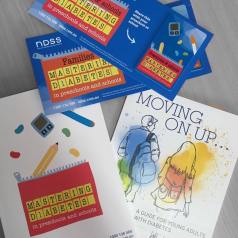
They look beautiful (the graphic designer is an absolute gem!) but even more importantly, they are full of important and useful information
An online version of Mastering Diabetes can be found here.
And an online version of Moving On Up can be found here.
More about the inclusiveness of the DOC…
My post about the DOC from earlier in the week has generated a lot of really interesting and valuable comment, both on this blog, on Twitter and Facebook and with many messages sent to me privately. Thanks to everyone who has contributed and, mostly, thanks to everyone for being so positive and respectful in their comments.
The purpose for writing was to try to encourage a discussion about how and why some people feel more included than others. I know this is not the first time this has come up and I doubt it will be the last.
I have noticed some common themes in how people feel and am trying to write something about that, but keep feeling clumsy and inarticulate. I’ll keep trying and see if I can make sense of anything – mostly in my head!
Banjos, banjos, banjos
Last week I went to two concerts at the stunning Melbourne Recital Centre. Both showcased banjo players and both were brilliant. One of the concerts was TWO banjo players and nothing more. I don’t know who I am anymore…
But I can’t stop listening to this at work.

The Melbourne Recital Centre stage ready for Punch Brothers.
She called me because someone had told her to get in touch. ‘Speak with Renza. She gets it.’ Is what she was told. She we organised a time to meet and over coffee we talked. And she searched my face for reassurance as she told me how scared she was feeling.
When I meet someone who has recently been diagnosed with diabetes, I say very little. I listen. I ask questions and gently try to find out what is going on in their head. I don’t say much about my own diabetes, because I don’t want to imprint my experience in their mind. Everyone feels different at the time of diagnosis and working out exactly what they are feeling needs some time.
I listen and sit there quietly and try to reassure and be positive. I nod a lot, and let them talk and vent and, if they need to, cry. Usually people cry. And I let them know it is okay. I did all of this with the woman who called me. She did cry and she did vent. And then she cried some more. And I said hardly anything.
But this is what I wanted to say:
- It is okay to feel scared and uncertain. Or angry. Or completely and utterly ambivalent.
- Because, you see, there is no right way to feel right now – or ever – about living with diabetes. And equally, there is no wrong way to feel.
- You don’t have to work this all out this week. Or next week. Or next year. In fact, you never have to work it out.
- But do work out what you can manage today and do that. And whatever it is, it’s enough. It. Is. Enough. And well done you for doing it!
- Find your tribe. In fact, this is what I want you to know more than anything. Others who are also ‘doing diabetes’ will help you make sense of this new world. You have to be ready to do that, but do be open to the idea. I wish that someone had introduced me to others with diabetes when I was first diagnosed. It took me over three years to meet another PWD and I felt so alone in those three years.
- And when you do meet people, don’t think that anyone has this diabetes thing worked out completely. Even those who say they do…
- …because, there is always more to learn, which is daunting and exciting in equal measure.
- I promise you – whatever you are feeling, whatever you are thinking, someone has had that same feeling and same thought. You are not alone. (Reading diabetes blogs will prove that to you!)
- Diabetes may feel like it is about to take over your life and it probably will for a little bit. And there may be times that it does again. But it will not define you for the rest of your life or determine who you are. It can be as much or as little of your identity as you choose to let it.
- You will be okay. You will be okay. You will be okay. (And, yes, I am saying that for your benefit as much as my own!)
- There will not be a cure in the next five years. Or even ten. I am not saying that to be pessimistic, I just want you to understand that hope is really important in living with diabetes. But unrealistic expectations that won’t come true are not going to give you that hope; they will destroy it.
- Ask questions. All of them! You may not like the answer (i.e. see previous dot point), but ask anyway. You will be amazed at the things you learn.
- Your diabetes; your rules. This will become more and more apparent the longer you live with diabetes. You don’t need to explain, apologise or justify anything you do to manage your diabetes. Ever.
- Anyone who makes you feel crap about your diabetes – whether it be the fact you have diabetes, or how you are living with it – needs to fuck off. (And if you can’t tell them that, find someone in your tribe who can! I am happy to be that person. Truly! I have the mouth of a trucker and I’m not afraid to use it.)
- Do not watch Steel Magnolias. Ever.
- Right now, this probably seems like it is the worst thing that will ever happen to you. This may sound odd, but actually, I hope it is. Because I know you can get through it.
- You will laugh again. And smile and feel light. You will not think about diabetes for every minute of the rest of your life. It will be there, but it does not have to rule your very being. It certainly doesn’t rule mine. You will learn where to place it in your world, and that is where it will sit.
- You do not need to feel grateful that you have been diagnosed with diabetes and not something else. Because it does suck. It’s good to remember that and say it every now and then. Or shout it out. While drunk.
- Go buy a new handbag. Trust me! If you want, I can help you to justify it as needing a new bag to cart around all your diabetes crap, but just do it for yourself. And while you’re at it, a new pair of shoes. Just because!
- Call me. Anytime. If you want. Only if you want. And even if it just to hear me tell you that you will be okay.
But I didn’t say those things. I only said this: You will be okay. I know this to be true because you are strong and resilient and capable. I know this to be true because many others have walked this path and worked out how to make it okay for them. You will do that too. It will be okay for you.
And I hope that was enough. Or, at least, enough to start with.
I was super late for last night’s #OzDOC tweetchat, coming in for the second half of the lively discussion. The questions were about how HCPs can engage on healthcare social media (HCSM), and the answers were to assist physician Dr Kevin Lee who is presenting this very topic at the ADS-ADEA conference on the Gold Coast later this month.
In recent years, I have given and heard many talks about why HCPs might want to consider using SoMe as a tool to engage with PWD (or, more broadly – people with any health conditions), and also how they may find SoMe useful to engage with other diabetes HCPs.
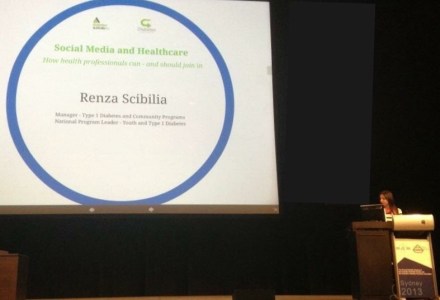
Presenting at the 2013 ADS-ADEA meeting about social media and healthcare.
Maybe it’s just me, but I am bemused that usually these presentations are targeted at such an ‘entry’ level. Social media is not new. Healthcare social media is not new. And yet, the presentations about HCSM at most medical conferences all have a ‘101’ feel to them, as though it is emerging technology and a revolutionary and new way to communicate. It is neither of these!
In fact, communities gathering on social media is just peer support 2.0. (Which is what I wrote here. Three years ago….)
And yet, the anxiety around it is still present.
I suspect that there are several reasons for this nervousness.
Firstly, by its very nature, SoMe is unregulated, and I will fight to the death to say this is a good thing, not something to fear. Its organic, unstructured and unpredictable nature is part of its power.
Even in a facilitated forum, (such as as tweetchat), there is only limited control held by the moderator – and a good moderator knows that their role is sometimes to sit back and watch (and encourage) the flow of, and tangents in, the discussion – that is often where the magic happens!
HCPs considering venturing into the patient-held HCSM space (different from interacting with their peers) need to consider what they plan to do once there. Are they going to be providing advice? Or do they want to engage in discussions? Perhaps they just want to quietly lurk, using it as a learning experience.
Whatever they choose do to, simply stepping in and having a look around will, hopefully, alleviate many of the concerns and fears they have about HCSM – especially once they understand there is no mystery to this way of communicating.
But I really do think that it is not our role as PWD using HCSM to provide a comfortable space for HCPs. And we shouldn’t feel the need to moderate our discussion for fear of who is listening in.
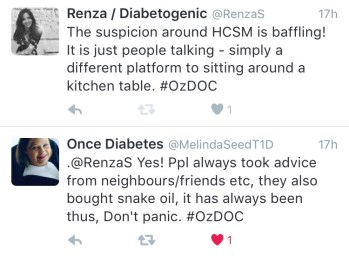
I have always considered social media to simply be a different way for having a conversation. There is no mystery behind it and there is nothing to fear. This thread from last night’s tweetchat sums this up perfectly! (Thanks, @MelindaSeed!)
Twitter is a great source of discussion and yesterday this tweet from a diabetes consultant in the UK certainly did start an interesting conversation that had me thinking.
I should point out a couple of things before going any further. The tweet, asking if lack of guidance in social media is a concern, was in response to a tweet from someone else who shared a post from a Facebook page about insulin omission for weight loss. This is a very serious issue – one that I have written about here, (and elsewhere), and worked on a lot in the last decade or so.
Also, the consultant was absolutely not suggesting that social media is a ‘bad’ thing, and he is actually an advocate and user of online platforms, so this is not about the individual. It is about the issue at large.
Obviously, I am a huge fan of social media. Apart from finding online – and more broadly, peer – support an important part of my own personal diabetes management, I have built a significant part of my career extolling the benefits of online connections and the value of sourcing information and support from others living with diabetes.
The changing landscape of diabetes information and support over the last ten or so years has been significant. With more and more available online, and more and more people being online, there has been a real shift from healthcare professionals being the keepers of information and deciding what people with diabetes SHOULD know to a more egalitarian framework from which to source what we need.
While some may believe this to be the end of civilisation as we know it, (dramatic, I know), I consider this change terrific, because instead of having very controlled and conservative information on offer, there is now a veritable smorgasbord of material – and knowledge – from which consumers can pick and choose. Personally – I love being able to do that. Hearing personal experiences and picking up tips and tricks about day-to-day life with diabetes contribute to me making decisions about how to manage my own condition.
One of the suggestions frequently made about how to safely use SoMe is for it to be better moderated. My argument is that the power and value of SoMe platforms is that it is not moderated. Being free to share my ideas and experiences without fear (or perhaps care?) of judgement is not only useful, but also cathartic. And getting feedback from my peers often provides a different lens through which I can view a situation. Much of what I have learnt would not be found in the pages of a textbook, or offered in the office of a HCP. And that’s fine – there are other very valuable and important considerations that are shared in that context.
The idea of moderating online support – or any peer support, actually – is about control. It can be packaged up into a nice parcel of ‘protecting’ the person seeking the information, but that is not only patronising, but also incredibly demeaning. There is enough of that going on in more traditional settings – peer support is where there is freedom from that control – and a freedom to explore different ideas.
For me, peer support has always been about finding my tribe and learning from them. It has been about finding a source of sustenance and care that makes me feel better about my situation. It’s never been about replacing or substituting what I get from my HCPs.
So what is the role of HCPs in our support space? My belief is that it is a place for them to learn. There are times that it may be appropriate – and even encouraged – for HCPs to step in and share. On Facebook, one of Australia’s leading CDEs frequently comments and adds to conversations in closed diabetes groups. Her professional advice is always spot on – never judgemental – and her personal perspective (she has diabetes herself) shows just how it is possible to blend the ‘What-I’m-told-I-should-do’ with the ‘And-this-is-what-works-in-real-life’.
But not everyone who wants to be involved in this space has diabetes, nor should we expect them to. But I think for me, I have a very clear understanding of online and peer support works – and what everyone’s role is. When this works well, it works because it is being led by PWD; they (we!) are the ones driving the discussion and the focus. It’s not dangerous. We don’t need guidance. Because it is our space and we own it.

What peer support means to me,




 Diabetogenic
