
You are currently browsing the category archive for the ‘Peer support’ category.
On Monday and Tuesday of this week, I attended and facilitated Abbott Diabetes Care’s #Dx2Melbourne event which brought together eleven Australian diabetes bloggers. (All my disclosures can be found at the end of this post.)
(Just a recap – the DX (or Diabetes Exchange) series of events have now been run about half a dozen times. Other than #DX2Sydney and this year’s Melbourne events, the others have been held in hard-to-take cities including Stockholm, Berlin and Lisbon and have been attended by bloggers from the UK and Europe.)
#Dx2Melbourne reunited most of the bloggers who attended last year’s event, with some new faces thrown in for good measure. I was introduced to Alana Hearn for the first time, finally got to meet diabetes yoga guru Rachel Zinman, and caught up with Helen Edwards. (All the links to the blogs of the ‘repeat offenders’ who attended #D2Sydney can be found on this post.)
Some may believe that I am naïve in saying this, but the event is not about product. In fact, apart from a 45-minute presentation – the session that kicked off the two days – there was no other discussion about Libre or any other diabetes product unless it was specifically raised by one of the bloggers. Abbott did not have a new product to push; Libre has been out for over 12 months now in Australia.
(I am not, however, naïve enough to think that events like this are not part of the health industry’s 21st century marketing strategy. But, as I said last year when responding to a comment on my blog about this, this is the 21st century marketing. And I’m glad that consumers have a place in this strategy, because it would be far worse if industry was continuing with 20th century marketing strategies which completely excluded people with diabetes, and did not offer us any opportunity to directly engage and work with industry. Any device company NOT doing this is falling way behind and needs to catch up.)
As the Abbott team stated in their welcome, the idea of the DX events is to continue their commitment to bring together people living with diabetes to share ideas. And for Abbott to get an idea of what it is that is important to people with diabetes and what makes us tick – albeit a very select and privileged sample of advocates.
With this in mind, for me, the most valuable part of the event was the discussions that were completely driven by the bloggers. In an open session where we were exploring ‘why we blog’, I listened carefully as everyone articulated their reasons for going online and sharing their stories with strangers.
Reasons varied – some do it because they simply want to tell their story, some because they love to write, some have specific issues within diabetes they want to open up for discussion, some see it as an advocacy platform. What we don’t hear – ever – is anyone saying ‘Because I want to make money doing it’. I can be all evangelical about it and say it’s because we’re a choir of angels, but mostly I think it’s because we’re smart enough to know the limitations of what it is that we do, as well as understanding the strength is in connecting, not money-making.
We also considered the shortfalls of having an online presence.
I’m an over-sharer and I know that there is a lot I write that many others wouldn’t feel comfortable sharing – and some people have told me that it is sometimes difficult to read. I also write about issues that are of no real concern to others, and they are more than happy to let me know that I’m wasting my time and energy on such irrelevant (language) matters. I also know that as soon as I put something out there, I am opening myself up for comment – both positive and not-so-positive. We had a discussion about how we manage unwanted attention and, in the most extreme cases, trolling.
I have never regretted anything I have written or shared, and have never taken anything down because I’ve felt it was too personal. But I have had some very unwelcome and sometimes nasty comments sent my way.
I found this a really useful, but somewhat challenging, discussion. I have written about some very personal experiences, probably most notably, pregnancy loss. I’ve also written a lot about how diabetes impacts my mental health. These are two topics that are frequently hidden away, surrounded by shame and secrecy – precisely the reason that I am committed to writing about them.
However, the times I’ve been trolled – and fortunately, that hasn’t been often – it has been when I’ve shared very personal stories. They’ve been the times where I have found myself at my most vulnerable, and being so exposed makes any sort of negativity harrowing.
It was reassuring to discuss – and remind each other – that even though we are voluntarily putting ourselves online, we are not inviting people to be nasty and disrespectful. Online is real life, despite what some people may think. This is the space where many of us convene to work together, support each other and share information; it’s not a place for personal attacks.
I left the event on Tuesday feeling utterly exhausted, but also filled to the brim – a feeling that only comes after spending a solid period of time with others treading the blogging and advocacy boards. I was reminded of the similarities as well as the differences we experience living with diabetes. I felt buoyed by the various issues that draw our attention. I felt desperate at the access issues I still hear about – both here in Australia and overseas. But most of all I felt part of something that is much bigger than me, much bigger than my blog and much more powerful that anything I can do on my own.

Abbott Diabetes Care covered all my costs to attend #Dx2Melbourne, and provided all attendees with two FreeStyle Libre sensors and, if requested, a scanner. There was no expectation from Abbott that I would write about the event or any of their products, and everything I do write about it is my opinion, in my own words, and in no way reflects those of Abbott – or anyone else, for that matter.
On Saturday, Medtronic Australia hosted their first Diabetes Advocates Day. Ten or so advocates from across Australia came together to hear about new technologies and talk about real-life application of technology in our diabetes lives.
There were some familiar faces and some newbies too which is always great to see. I, most opportunistically, used my role as facilitator for the day to get book recommendations from as part of the ice–breaker session. (Truthfully, this is always one of my favourite parts of these events, but it can also be a challenge when the people in the room are all over-sharing bloggers!)
There were a couple of standout moments throughout the day worth sharing.
Melbourne endocrinologist, Professor David O’Neal, gave a great talk on the future of diabetes technology.
David is one of those endos who after you meet and hear speak, you want to make him your endo for life. He is ridiculously tech savvy and his knowledge of diabetes technology is hard to beat. If you Google him, you’ll see that he is a regular contributor to diabetes journals and is involved in a lot of diabetes tech research.
Which is all good and well, but the real reason David is so wonderful is because he completely ‘gets’ diabetes and what technology can actually offer us. As a tech geek, it’s easy to be completely and utterly captivated by the technology, but David readily admits it has limitations.
This is really important to remember. Too often we forget that the tools we have today are not perfect, and cannot seamlessly mimic a fully functioning pancreas. Most importantly, this is not the fault of the person using the tech. David acknowledged both of these points in the opening to his talk.
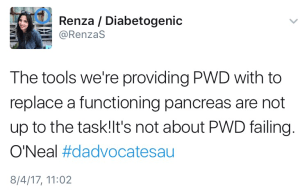
I really love that David mentioned this because so often when technology doesn’t work the way it is meant to, there is an assumption that it is the fault of the user. We mustn’t have pressed the right button, at the right time, in the right order, with the right calculation.
But actually, the tools are just not smart enough to account for the daily changes and variabilities and inconsistencies that play a pivotal role in life and impact our diabetes. As David said, insulin requirements overnight can fluctuate by up to 200%. There is nothing available at the moment that is equipped to deal with that sort of variation.
Add to that, the effect of exercise, food, stress, hormones, illness or pretty much anything else, and there is no way the tech can keep up – or those of us using it can work out how to factor it all in.
This constant need to makes changes is what sets diabetes technology apart from other medical technologies which are often ‘set and forget’ for the wearer. With diabetes devices, there is no such luxury, which is why we need to remember that often, technology actually adds work to our already significant list of diabetes tasks.
Another absolute gem from the day came from blogger and advocate Melinda Seed. During a discussion about HCPs reticence to deal with PWD’s research online, was her comment (as tweeted by Georgie Peters):
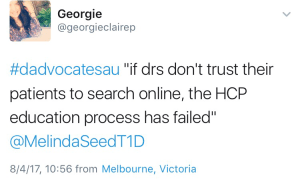
This really is turning the whole ‘Dr Google’ thing on its head. Instead of fearing the internet – and PWD who use it to research and better understand our health condition, surely HCPs could engage to discuss safe ways to do that research. Being part of the solution rather than just fearing it makes a lot of sense.
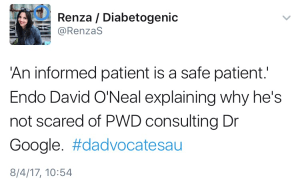
And perhaps, look at it the way David O’Neal chooses to:
In a roomful of tech-heads, there was also a moment where we considered those who have no interest in using any sort of newer tech available. With the dawn of new hybrid closed-loop systems that take even more control away from the user, how do we make that leap to completely trusting the device? And is this particularly difficult for those of us who identify as control freaks when it comes to our diabetes management?
Affordability and access also came up, reminding me – and hopefully those from the company producing the devices – that this needs to be a consideration at all steps of the conversation. There is no point in developing and releasing onto market whiz-bang tech if people can’t afford to use it. (And we also must remember that as every new piece of tech is released, the divide between the haves and have-nots becomes more and more cavernous – especially when you remember ‘have-nots’ refers to not only the unaffordable tech, but also to basic needs such as insulin…)
DISCLOSURE
The Diabetes Advocates Day event was hosted by Medtronic Australia and was supported by Diabetes Australia. I am employed by Diabetes Australia as Manager of Type 1 Diabetes and Consumer Voice, and attending and facilitating the event was part of this role.
There was no expectation by Diabetes Australia or Medtronic Australia that I would write about the event, and my words here and in other online spaces are mine and mine alone. For more, check out the #DAdvocatesAU hashtag on Twitter and keep an eye out for blogs by other attendees.
Brutal. That’s the way I’ve been describing my week. It’s been super busy and there is no hint that will change any time soon.
But there is so much stuff out there to read. Here’s just some of it…
CGM
Oh, did you hear? CGM is now funded for children and young people under the age of 21 who meet eligibility criteria. It’s been ALL OVER the interwebs, but for the most up-to-date info, go here!
(And yes, I know, people 21 and over need CGM and need support. This isn’t over yet…!)
A psychologist who knows diabetes? Yep!
A good psychologist is worth their weight in gold. A good psychologist who understands the impact of living with diabetes on our overall wellbeing is like a unicorn – rare and magical.
So, I was delighted when someone from my office who has been a Research Fellow with the ACBRD for a number of years came to tell me that she is starting a private psychology practice. Dr Adriana Ventura’s research has focused on the psychological, social and behavioural aspects of living with type 1 and type 2 diabetes.
Adriana understands that living with diabetes (and other chronic health conditions) can be challenging. And she understands that these challenges can make it tough to take care of our health the way we would like.
Details about Adriana’s practice can be found here. (Adriana works with adults and older adolescents – 16 years and over)
Really? REALLY?
Seems that we’ve all been doing diabetes wrong. That lancet thing that we joke about never changing? This is how you use it according to the pic accompanying a BBC Radio 2 tweet.

Apparently it is really hard to do some decent research. (And if the image wasn’t enough of a deterrent, the article looks shit too, so didn’t bother reading it.)
My maths teacher was right
So, as it turns out, I do use maths every single day. Diabetes has certainly put my algebra skills to good use!
This article from The Conversation is all about how an applied mathematician developed an algortithm to help treat diabetes. As you do.
Words that over-promise
I can’t remember the number of times I’ve heard that a diabetes cure is ‘just around the corner’ or any other version of ‘five years away’.
But how do these promises affect people living with health confitions? This article from Medivisor asks just that.
March for Health
While we were celebrating the CGM announcement on Saturday, I was very mindful that my US friends were getting ready to continue their battle for fair healthcare. March for Health was held across the US on 1 April calling for affordable access to quality health care for all people. I don’t know about you, but that doesn’t sound unreasonable to me.
Check out more at the website here.
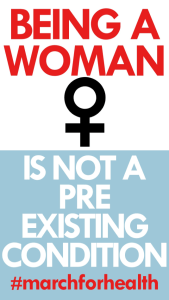
And this, by the way, is possibly one of my favourite promotional posters from the March.
Women’s Health Survey … Quick!!!
And while we’re talking women’s health…There are still a few days left to do the annual Jean Hailes Women’s Health Survey, which identifies gaps in current knowledge when it comes to women’s health.
College Diabetes Network
There are some really wonderful groups out there supporting people with diabetes, and my friend from the US, Mindy Bartleson emailed me with some really useful information about the College Diabetes Network (CDN). The Network empowers and connects young people with diabetes and their are CDN Chapters on college campuses across the US.
The Network is certainly US based, but some of the information will be relevant to those in Australia (and elsewhere). Their resources provide information about how to prepare for the transition from high school to college or university. Do have a look!
Information for students can be found here. And information for parents can be found here.
Peanut butter cookies
I made these cookies and jeez were they delicious!

They are gluten free, which I know is important for many people. For me, I need cookies that take no more than 10 mins to mix together and then taste perfect. Honestly, they are possibly the best tasting biscuit/cookie I have ever made… and I bake a lot.
The recipe can be found here. (I used smooth peanut butter as the recipe suggests, but I reckon they would taste awesome with crunchy. Also, do pop the mixture in the freezer before trying to shape the cookies. The dough is mighty-soft and sticky, and this step helps to get the dough from the bowl onto your cookie tray. AND DON’T SKIP THE SALT ON TOP!! This is what ties it all together and makes the magic happen!)
And finally……
… a little New Yorker Cartoons funny, which may not be directed at diabetes, but boy it certainly shows how I feel most days living as a diabetes tech cyborg!

Last Friday, I flew to Sydney to take part in the first Australia HealtheVoices Conference coordinated and run by Janssen (disclosure at the end of this post).
 I’d followed along the US versions of this event, which have been running now for a couple of years, always with diabetes health advocates attending. So I was thrilled when I received an invitation to take part.
The event was run on Saturday with a dinner on Friday evening featuring Turia Pitt as the keynote speaker. I’m going to write something about that another time. Today I want to focus on some of the actual conference. This is just the first post – the rest will come over the next week or so.
I was extraordinarily excited about being in a room with advocates from outside the diabetes space. (But also pleased for the safety of the diabetes advocate bubble! We were well represented – four of us seated at the same table, occasionally nodding at each other as we recognised the stories others were sharing, even if their health condition was different to the one we navigate.)
Anytime I am surrounded by health advocates (diabetes and other) I have a weird contraction of feelings: surprise and absolute no surprise. Surprise that experiences are so similar and yet absolutely no surprise that our experiences are different! I read this article from the SMH (written as a follow up to the event) and so much resonated about Luke Escombe’s story, despite his peers not living with diabetes.
The speakers at the conference were diverse and covered a lot of different issues. And holding it all together was journalist and TV presenter Shelly Horton, whose fabulousness I cannot even start to describe! As well as making sure everything ran to time, Shelly shared stories of her own health experiences of living with PCOS.
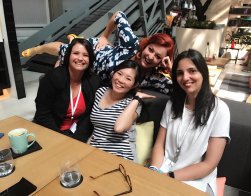
HealtheVoices emcee, Shelly Horton, hamming it up with some diabetes advocates.
We started with Samantha Jockel from Aldi Mum. She was a terrific speaker, however I found that not everything she said sat easily with me, mostly because at times I struggled to see the parallels between what I do (write a rambling little blog about about my own experiences of my health condition) and what Sam is doing (building a community which generates income).
I also realised I’m a crap blogger! As Sam eschewed the benefits of knowing your analytics and stats – she is an analytics ninja! – I realised that I rarely if ever look at the stats on my blog or other social accounts. Facebook sends me a weekly roundup and I categorically ignore the email; Twitter wants me to check the activity of different tweets, but I don’t; Facebook also tells me when I a post is doing better than usual and I get annoyed at the alert thinking that it was someone posting a cute cat meme: LinkedIn tells me how many people are looking at my profile, urging me to go and see who they are, but I’m seldom interested.
I know these are tools that can help me grow my audience and build my following, but I still have this idea that the only people reading are my mum and the guy from Romania who used to message me every day. (Perhaps if I looked at my stats, I’d know that’s not the case…)
Sam also spoke about boosting posts and ‘throwing some money’ at them if they could do better. I’ve never spent a cent on promotion of my blog and can’t see that I ever will. Once I hit publish and share what I have written on my social feeds, I don’t do anything any further. Occasionally I repost the link on Twitter, but only when I remember that there are people living in different hemispheres and were probably asleep when I posted it the first time so may have not seen it.
I guess the difference for me personally is this: My blog is not my job. I make no money from it and I have no intention of it ever becoming a money maker for me. I have a job – this is not it, despite the significant time and energy I spend writing. I blog for very selfish reasons – to find my tribe!
But there was much that did resonate with Sam’s talk and the overarching message that I took away was this: be authentic. As she spoke about the importance of finding our own voice online, she kept coming back to the need to be relatable, honest and real.
That did make sense to me, because I know that the only reason that I write is to tell my story about living with diabetes – the good, the bad, the ugly, the real. I know that when I read about people living with diabetes, I want to read the genuine experience. The blogs I read – and keep going back to – are the ones that are undoubtedly honest and authentic. Real life. Real stories. Real people.
DISCLOSURE
Thanks to Janssen (the pharma arm of Johnson and Johnson) for covering my travel and accommodation costs to attend the #HealtheVoicesAU conference. There was no expectation by Janssen that I would write about the event and everything expressed here (and on Twitter Facebook and other social feeds) is mine and mine-alone! To read more, check out the conference hashtag, #HealtheVoicesAU, on the socials.
Happy International Women’s Day!
This year, more than ever, it feels like we need this day. In fact, sometimes, it seems that the world is not a great place for women and that rather than advancing and continuing in our quest for equality, we are actually going backwards.
When we have governments – usually led by men – still thinking that they have a say with what women do to and with our bodies, making decisions about, and placing restrictions on our reproductive options and confusing health reform with the limiting of choices, we know that we’re not even close to things being fair for women.
My world is very shaped by women. Exhibit A: just a few of the women and girls who I’m lucky enough to call friends, family and colleagues, many of whom I’ve met through my diabetes life.
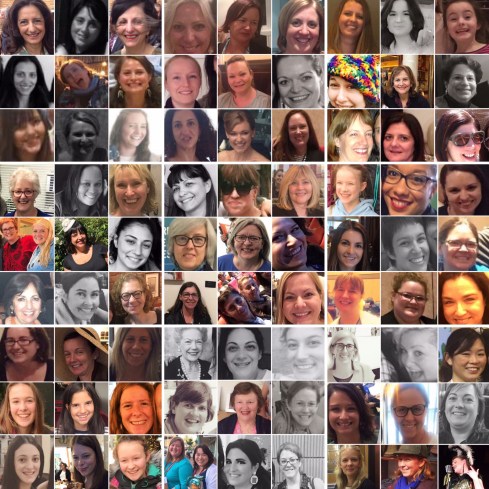
Exhibit A
But for me, International Women’s Day is about far more than my own world.
This year, the International Diabetes Federation has decided that the theme for November’s World Diabetes Day will be Women and Diabetes. In an effort to draw attention to the specific challenges faced by women with diabetes across the globe, the IDF will develop a range of materials to support women. There will be an entire stream at the IDF Congress in Abu Dhabi at the end of this year dedicated to women and children’s health.
Currently, there are almost 200 million women across the world living with diabetes and 40% of them are of reproductive age. That is a lot of pregnancies potentially impacted by diabetes. The need for safe, evidence-based, pre-pregnancy care for women with pre-existing diabetes is essential to improve outcomes for women and their babies. And this needs to start early. With half of cases of hyperglycaemia in pregnancy occurring in women under 30 years, girls and young women with diabetes need to have access to education and information about the importance of pregnancy planning.
Women’s health and diabetes has always been a special interest area of mine. My first big project when I started working in diabetes organisations was to help develop a diabetes and pregnancy booklet.
But pregnancy is not the only health issue for women with diabetes. There are a lot of other concerns and issues that need to be addressed, and I am looking forward to what the IDF do later in the year.
So today I’m celebrating – and saluting – women around the world – especially my own daughter who sent me a clip of the women teachers from her school performing ‘I am Woman’. And checking out some really important women’s health-related sites (some links below). Go get your green, purple and white on and celebrate the day!
Diabetes Sisters is a fabulous organisation based in the US and run by two of the women who appear in the collage above. It’s led by Anna Norton (CEO) and Sarah Mart (Director of Operations) who are exactly the kind of women you want on your team. I’m lucky to call them friends.
T1 International has this piece about the Sonia Nabeta Foundation.
And, today is the perfect day to do the The Jean Hailes annual Women’s Health Survey and help shape women’s health in Australia.
Paris was, as always, wonderful. The mild weather, meant it was lovely to walk everywhere. With only three and a half days in one of my favourite cities, I was grateful for the daily 40-minute stroll from the hotel near the Eiffel Tower via the Trocadero to the conference centre so that I at least get to see some of the city.
Even early morning meetings were bearable with views like these. (Hashtag: not photoshopped!)

Sunrise behind the Eiffel Tower.
On my first full day in the city, I attended an event hosted by Roche (all my disclosures are at the end of yesterday’s and today’s posts, as always). The Blogger #DiabetesMeetUp brought together almost 40 bloggers from across Europe. And me.
The day’s activities were a continuation of their event at EASD last year (read about that here), although attendance was expanded to also include a contingent of fabulous women from Italy. It was actually the fourth #DiabetesMeetUp event hosted by Roche with many of the attendees having been to all of them. (There was a comment when I tweeted a photo of the day that the group didn’t look particularly diverse. I’m flagging that here because I acknowledge the privilege in the room. I do think that it is important to ask how better representation can be achieved. The flip side is that the event targets bloggers, so there is already a bias for well-connected and informed people. I have no answers….)
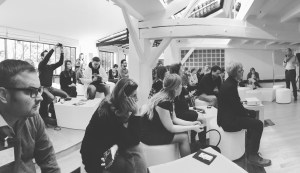
Just some of the bloggers…
The day was busy and very interesting. I have been an extremely vocal critic of device companies failing to engage with consumers in the early stages of device and software development. It frustrates me no end when I hear of the limited and barely tokenistic engagement undertaken by device companies so Roche’s approach is truly a breath of fresh air.
It was also pleasing that while some of the day was dedicated to showcasing product, there was a lot more than that on the agenda. Plus, all product presentations were an opportunity for the bloggers to provide feedback, plus there was plenty of frank discussion from both attendees and Roche staff.
So, what devices where on show? There was some more about the Roche Insight CGM, mostly about the app that is being developed to accompany the device. When this was discussed at the EASD #Diabetes Meetup last year, there were many suggestions and recommendations about how to improve the app platform. It was utterly brilliant to see a lot of those changes integrated in the new design. Obviously it’s a lot easier to make changes to software rather than hardware, but still this focus on gathering feedback and then making the changes is commendable.
One of the most exciting aspects of the discussion for me was the discussion around the Insight systems alarms, specifically the language being used. Some of the words and phrases were flagged as not being quite right, and there was an opportunity to wordsmith just what language would be used. For example, the term being used was ‘warning system’ and I questioned if that was really the best word available. I think of ‘warnings’ as something connected to inclement weather or danger on the roads, not really ideal when thinking about data I use to help manage a health condition each and every day.
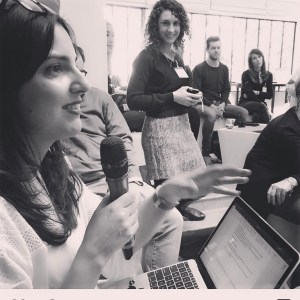
Talking language. It was hard to get the microphone away from me.
The customisation of this system is outstanding. Other than the super-low (safety) alarm, all others are fully customisable, can can be activated for certain times of the day, use different sounds for different alarms for different times and the user can build up to ten daily profiles. The objective for such thorough customisation is to work towards reducing alarm fatigue as well as create a more flexible, individualised and intelligent alarm system
As yet, there is still no integration with the Insight CGM and the Insight pump – a criticism and recommendation from the group back at EASD last year, however I believe this is on the radar. Undoubtedly, the feedback from the group was that this is essential, so I hope that the Roche team find a way to make it happen!
The other product that was (very briefly) discussed was the Senseonics Eversense system – a ninety day implantable CGM sensor and data management system. This tech is currently in trial stage and more information can be found here.
Roche gave all the Blogger #DiabetesMeetUp attendees a press pass to ATTD which meant that throughout the remainder of the conference, there was a significant consumer contingent roaming the halls and sitting in sessions. Considering that this is a group of highly connected, tech-savvy and smart individuals, it was terrific that there was the opportunity to be part of the conference amongst the health professionals.
I’m really grateful to have been offered the opportunity to attend the day – a very big thank you to Ute and the team from Roche for extending an invitation to me (I promise, I am not always the jet lagged mess you see at these events!) and for your ongoing commitment to engaging the community. As well as participating in the agenda set by Roche, I was able to speak to some amazing and activists who each day are advocating for people with diabetes in their own countries. The level or excitement and commitment to what they do simply never wanes.
Disclosures
My flights and accommodation costs to attend the Roche Blogger #DiabetesMeetUp were covered by Roche Diabetes Care (Global). They also provided me with press registration to attend ATTD. My agreement to attend their blogger day did not include any commitment from me, or expectation from them, to write about the day or their products, however I will be sharing my thoughts on the event here. Plus, you can read my live tweets from the event via my Twitter stream.
Yesterday, on her first day of school, the kidlet’s English class was about autobiographies. So, we had a long chat about some biographies and autobiographies we’d read – and ones we wanted to read – and why they are a really important way for people to share the stories of their life.
Story telling is one of the most powerful ways to record events, emotions and life experiences. Others who may be going through similar experiences can feel great comfort knowing that others have not only lived through certain situations, but stuck around to tell the story! And it is also a fabulous way to share stories with those not familiar with different places, circumstances or surroundings.
Our stories have the ability to inspire, offer an opportunity to learn, and help make sense of things around us.
So, it took me no time at all to respond with a resounding ‘YES!!’ when I was contacted by Anna Sjöberg from Anna PS and Sofia Larsson-Stern from Diabetesia, asking me to be in their book about people living with type 1 diabetes.
The e nd result of their hard work is a fabulous book – ‘We can, want and dare …and we have type 1 diabetes!’ – and it features people from all over the world telling their stories of life with type 1 diabetes.
When putting together the book, Anna and Sofia wanted to provide real-life stories from people with type 1 diabetes from all walks of life: from kids and teens
(such as this one who is, quite simply, AMAZING!) to adults doing all sorts of amazing extraordinary, and every-day things. There is a Brooklyn-based chef, an incredible young advocate from Sweden and another Swede whose Instagram profile describes him as a Multisport Team Ninja Warrior! Oh, and a Melbourne blogger and activist.
The books was launched it its original Swedish-language version last year on World Diabetes Day and the English-language version has just been launched and is now available.
This book is not just for people with type 1 diabetes, although, with its stories of hope it certainly would be a wonderful thing to give someone newly diagnosed! It is also for friends and families of those living with type 1, and people who really have no significant connection to type 1 diabetes, because it provides an understanding of the complexities of the condition that we live with and offers a very personal insight into life with type 1.
You can order your copy of the book here.
GIVEAWAY GIVEAWAY GIVEAWAY
I have three copies of ‘We can, want and dare …and we have type 1 diabetes!’ to give away to Aussie-based readers of Diabetogenic, thanks to the team at Anna PS. Just click here and send me a message telling my why you would like a copy. Keep it short – brevity is key here!
DISCLOSURE
I was invited to provide my profile for the book and received no payment for my contribution. I will receive a signed copy of the book for my bookshelf, though, and can’t wait to see it!
Back in 2012 when we were thinking of starting the #OzDOC weekly Twitter chat, Kim, Simon and I were committed to making sure that it was a safe place, welcoming to all who wanted to use it. We encouraged people to actively participate, lurk in the background, jump in and out as they needed.
I had always been so impressed with the non-toxic and inviting place the #DSMA chat was, welcoming people with all types of diabetes as well as a few health care professionals, and I hoped that we could replicate this environment, albeit on a smaller scale, with #OzDOC.
Pleasingly, that’s the way it started and now, it continues to be that way. While I’m no longer involved in the running of OzDOC, or moderating its weekly chats, whenever I do drop by to participate, it is clear that the safe and inclusive model that formed its foundation continues.
It has been great to see that the encouragement of healthcare professionals to join in – lurk at first to get the idea and then respectfully participate – has continued, and frequently, a DNE or dietitian or endo will pop in and contribute.
But last night, during the chat, there was an intrusion that was not respectful. In fact, I likened it to someone bursting, uninvited, into my house and yelling that they didn’t like the way we’d decorated it and then offering to fix it as long as I paid them. I bristled immediately. And felt protective of the people in the #OzDOC room who had been so candidly and honestly sharing their thoughts.
This was a particularly delicate chat. Ashley had more than expertly navigated the sometimes tricky waters of a discussion about the place diabetes fits in our lives, and ended the chat with a question about burn out. It is a testament to the space that is #OzDOC to just how candid and honest people were in their responses.
So, the idea that someone tweeted something about how so many participants were clearly living with ‘out of control’ diabetes and then linked to her fee-for-service website, was not only inappropriate, but also insensitive, thoughtless and showed a true lack of understanding of what people with diabetes are dealing with.
My mother hen instinct kicked in. I had just laid myself bare as I used words that describe burn out to me, and others had as well. This was absolutely not the moment to promote a business and, at the same time, tell people they were doing a crappy job at managing their diabetes. And there is no place for judgement in this chat, especially from someone so clearly out-of-touch.
While my response was somewhat reflexive and probably could have done with a moment away from the keyboard before hitting the ‘tweet’ button, I don’t regret that I did it. And the responses from others in the chat suggested they too were feeling uncomfortable about the intrusion to the discussion.
I was furious that someone had so aggressively and judgementally invaded the safe space that has been so carefully cultivated. ‘Out of control’ diabetes? Really? Fuck off. (Actually, that was the response I wanted to type, but kept myself nice, so maybe I wasn’t as harsh as I thought.)
My concern about this intrusion was twofold. Primarily, I would hate for any person with diabetes to feel afraid of participating in any sort of peer-based activity for fear of being judged. We get enough of that outside of the spaces we create for ourselves and certainly shouldn’t have it forced upon us in our own groups.
But also, I would hate for any HCPs to think that they are not welcome to participate. They most certainly are, however the respect, lack of judgement and kindness expected by participants is expected of everyone. If they are unable to demonstrate that, stay away.
I’m not naming and shaming the person who tweeted last night. The tweet has been removed anyway. But, I would absolutely encourage them to come back next week and the week after and the week after that to learn. Watch what goes on in these chats, listen to what people are saying, understand the real-life sensitivities of diabetes.
And then, feel free to softly, softly join in. Respectfully ask questions (after asking if it is okay to ask questions) if there is something that needs clarifying. Gently share ideas that may be of benefit. But absolutely do not try to sell something. And check your judgement at the door.
What a week. World Diabetes Day (WDD) is over for another year, but there is still lots going on in the diabetes space and in my life in general. Here are just some of the things making my brain a minestrone soup of dot points.
Mayo Clinic in Oz
I was lucky enough to win a scholarship to attend the Healthcare and Social Media Summit run by the Mayo Clinic earlier this week. I haven’t even started to pick apart all the amazing things I learnt during those two days, but there will be more to come soon.
Crown
Downtime is bloody hard to come by these days (because: November). BUT!!!! Binge watching a new show helps with some mindless entertainment and winding down at the end of the day. And Netflix has come to the rescue with The Crown. I admit that this is just a space filler until the REAL EVENT…But in the meantime, it will do and is actually super enjoyable.
Talking diabetes without being rude
We often see ‘Things to not say’ lists. I wrote one here where I suggested the only thing to say to someone living with diabetes was to offer them a Nutella cupcake.
I still stand by that advice, however thought I’d use WDD as an opportunity to write a more comprehensive list and it was published on the Mamamia Women’s Network. You can read it here – and may want to consider sharing it widely.
One of the things that we need to aim for is talk diabetes OUTSIDE our diabetes world. This article was not written for people affected by diabetes – we already know to not say most of these things. It is for those who say the annoying things because they don’t really understand diabetes.
So – have a read. And then share it around. And add your own ideas in the comments section on the Mamamia page. Let’s see just how far this can go to stopping some of the comments we hear over and over and over again!
Gilmore Girls
One week to go. We are ready!

WDD Twitter Marathon
The force of nature that is Cherise Shockley managed to pull off (once again) a 24 hour tweetchat for World Diabetes Day that included moderators and participants from all over the globe with an impressive variety of topics.
There was a bit of national Aussie pride in there with 4 hours of the chat being moderated by advocates from Down Under. I moderated an hour – with a focus on diabetes stigma – at 5pm ET which was 9am (Wednesday 15 November) AEDT, meaning I was into hour 27 of WDD when it was my turn to ask the questions.
Blue fatigue
My hand is a pretty damn good indication of how I am feeling right now. Still hanging in there with the whole ‘go-blue-diabetes-awareness-rah-rah-rah’ thing, but only just. Half way through Diabetes Awareness Month; World Diabetes Day is over and I am really feeling a lot of blue fatigue.

It seems that I am not the only one. Kerri wrote this on Six Until Me the other day and it resonated with a number of people, me included.
But the people; the people!
I was lucky enough to spend World Diabetes Day with some great diabetes people. We had house guests from Germany with us and my neighbour Jo popped in for a bit too. And my Amazing family were also there and, you know what, we hardly spoke diabetes at all!

It reminded me that my diabetes world is about people – those I’ve met; those who support me through it all; those I connect with online and in real life. And I know that I couldn’t do this without them to help me through.
#IFLGseesawchallenge
And finally, diabetes is such constant balancing act, and I don’t know about you, but I rarely manage any semblance of equilibrium!
So, I love the Insulin for Life Seesaw campaign – as both a metaphor for diabetes and also as a way to raise funds for an important cause.
Get involved by uploading your photo depicting the seesaw challenge of living with diabetes. Add the tag #iflseesawchallenge to your pic and Medtronic Australia will donate $1.25 to Insulin For Life Global. $1.25 is the amount it costs to transport a week’s worth of insulin to someone in need in a developing country.





 Diabetogenic
