You are currently browsing the category archive for the ‘Engagement’ category.
Last night, I had the honour of speaking at the World Health Organisation Informal Consultation on Diabetes, which is currently taking place as a virtual event. It’s a three night/three day (depending on where you are in the world) event that has brought together people living with diabetes from all corners of the world.
This was a widely advertised event, and anyone could apply. The expression of interest call out was all over Twitter, Facebook and diabetes community groups. Unlike some other initiatives and programs, PWD didn’t need to be nominated by a diabetes organisation or HCP to be part of it. You just needed to fill out the application form (which didn’t take too long), and submit. Clearly a lot of people with diabetes saw it and thought it was something they wanted to be involved in! I’m not sure of the overall numbers, but there is certainly terrific representation from a number of communities.
On my Zoom screen I could see a combination of familiar faces, faces of people I know of but have never met or engaged with, and a whole lot of new faces. Hearing their stories, and reading the discussions that are filling up the chat box are enlightening. And reassuring. Because once again I was struck by how strong, vulnerable, admirable and strong-willed others treading the diabetes path can be. There are striking similarities and glaring differences. But common threads that run through the narratives we heard And mostly? There is support and gratitude to be there and to bear witness to others sharing their stories, ask questions and learn. Not a single snipy comment or passive aggressive remark – not because we all agree or are a homogenous group. But rather because we respect and value and admire the people who have the courage to stand up and be present.

I was invited to speak in a session about diabetes advocacy. The session’s title was ‘Strategic communication in global diabetes advocacy’, and it included Christel Marchand Arpigliano from Beyond Type 1 and Lauren Carters-White, a research fellow from the University of Edinburgh. Christel spoke about how when we tell our diabetes stories, we are translating the language PWD use – language that makes sense to us – into words that reach a broader audience.
Lauren used some terrific examples from around the world to show the impact data and evidence can have in advocacy efforts.
And I rounded out the session by talking about how when we bring the two together, we win the hearts and minds of the people we are trying to influence – decision makers, legislators, policy makers, educators, healthcare professionals and researchers. Because when we have the emotional pull of how diabetes impacts on daily life, combined with the evidence to show what that means, we can’t be ignored! I highlighted how working with healthcare professionals and researchers to further our messages means that our lived experience can’t be dismissed.
I also spoke about how the power of stories is magnified when there are many voices and many different narratives. I have rarely, if ever, heard someone share their diabetes with the pronouncement that they speak for all with diabetes, or that their story is THE story. But they are all experts in their own lived experience and that certainly should be celebrated. And its power should not be underestimated.
I think the thing I have felt most strongly in that Zoom room is the camaraderie and solidarity – again, not because we are all on the same page and all want the same things. But rather, everyone truly supporting each other and bringing others into the conversation has been an overarching quality of the meeting. No one dominates; no one is more important than anyone else; no one claims to be THE advocate. We are all advocates working together, and supporting each other for a bigger cause.
Of course, we want, and expect, to see action come from the three days of meetings and workshops, and I have confidence that will happen. But in the meantime, to have such large group of dynamic people come together whose only agenda is community and to build each other up, rather than tear each other down, reminds me that THIS is what diabetes advocates can do and what the community is mostly about. Those snippy voices who try to minimise people who are truly trying to improve outcomes for people with diabetes aren’t present. Because what a waste of time that would be!
I may have spoken about, and given tips about how to win others’ hearts and minds in my talk, but it’s my own heart and my own mind that have been won over by my peers in this event.
(You can follow along the discussion by using the hashtag: #WHOPLWDs)
Disclosures
None. I am not being paid to attend this event, and have not received payment, honoraria or in kind donations for my presentation, and am attending in my own time. I might need a nap later today though, because the 11pm-3.30am time for Aussies on the east coast is tough going!
During a recent briefing call for a grant assessment committee I’ve been invited to join, I got a little sassy. My role is that of ‘consumer advisor’ – that is, someone who can lend their lived experience knowledge to assess the real-life application of the grant proposals, and the research methods outlined.
So far; so normal. I’ve sat on a number of similar committees over the last decade or so. The committees I really enjoy working on are when I am not the only non-HCP present. I love it when there are a number of people there for their real-life experience.
Today, I think I may have been the only non-HCP on this call, but there may be others involved who simply couldn’t be there at the nominated time.
The call today was pretty stock standard – timelines were explained, the IT system we’ll be using was described and the roles and responsibilities of the different people on the committee were clarified. And that’s where things diverted from what I’m used to.
As a consumer advisor, I am able to provide feedback about the different applications – just as all the HCP committee members do. There are primary and secondary spokespeople for the committee (both HCPs), and during the meetings to decide the outcomes of grant applications, they will provide most of the comments. After that, all others on the committee offer anything further. And then it’s time for the committee to score each assessment.
Everyone except the consumer advisors that is. My role will be to provide a ‘consumer perspective’, but I don’t get to provide a score. The scoring is what determines the success (or otherwise) of a funding application.
I sat through this meeting, listening carefully to the process being outlined, wanting confirmation that I had read the information accurately. Was the role of consumer advisor limited to just being able to make a comment?
When it was time for questions, I politely asked if I had understood correctly.
Unfortunately, I had.
I was given an explanation that this the process, set out by the governing department believes that consumer engagement and involvement in the assessment process is crucial and very important to the process, and that consumer comments are invited, but our vote is not.
There was a pause. A long pause. And then a longer pause. Thankfully, this was not a zoom call – it was an old school teleconference – so the others on the call couldn’t see the thunderous expression that had settled on my face. The pause still hadn’t ended.
So, I jumped in.
‘That sounds like the definition of tokenism, doesn’t it? We are there to provide comment and put forward our thoughts, but we cannot actually contribute to the part of the process that actually determines outcomes.’ I knew the next words that would be coming out of my mouth. ‘We have no real ability to influence. I find it difficult to understand how this can be considered meaningful engagement if we have no authority in the scoring process. That’s not how engagement works, it’s just…’ (Window dressing. That’s what I wanted to say.) ‘…it’s just a tick the box exercise.’
That was when the patronising comments came from others on the call. I should say that I don’t think they intended them to be patronising. But they were.
‘Oh, can I just say that I have been involved in similar processes and we always were happy to listen to the consumer advice consider it in our scores.’
‘The consumer feedback is important and has been very useful in the past.’
‘The consumer advisors are able to provide comments and they do. That’s really valuable feedback for us to consider.’
I said nothing. Because I honestly couldn’t care less how much I was listened to. And I know that what I – and others in the same role as me – have to say is valuable. It doesn’t matter which way it is spun, without a vote, I am not an equal member on that committee. That is the actual and perceived reality of the way it is structured
And more frustrating is that in the minds of many, there would be the perception that consumers had been effectively consulted. The lived experience is represented, they can add that to their report (because, undoubtedly there is a KPI that says consumers must be consulted) and all is okay. That tick the box exercise of inviting consumers onto the committee would be considered enough.
It’s not. In fact, it’s more problematic that not inviting us in the first place. I have said this before, and I keep saying it: without the ability to influence, without the means to be part of decision-making processes, strategic planning, governance structures, then all that is happening is tokenism. It is window dressing. And that is not good enough.

This week, it’s EASD. It’s is the first year since 2012 that I have not been in Europe for the meeting. EASD was the first large diabetes professional meeting I had ever been to, and I remember being struck at that very first one in Berlin by the stark absence of people with diabetes on the program and involved in the actual meeting.
My, how things have changed.
Except, of course, they haven’t. Sure, these days you will see growing numbers of PWD wandering the conference centre and attending sessions, but that really is only because we created opportunities for PWD to attend. And once we found a way to get there, we then made sure that we were visible in different ways such as leading social media charges and holding events open to all attendees.
There has been some very well placed and relevant conversation on twitter about the lack of diversity in the EASD organising committee. Too few women; too many white faces. But when we talk about inclusion, surely, surely we need to look at other groups that are significantly and obviously absent. Where are the advocates on there? Where are the BIPOC with diabetes? Where are people living with both diabetes and disabilities? Where is there representation from the diabetes LBGTIQ community? All of these factors impact on diabetes management, so wanting to see presentations that address them makes sense. And where is the lived experience on the program to underline, and provide real relevance, to the work that is being presented by HCPs, researchers and academics?
You bet there should be more women and more BIPOC on the organising committee for EASD. But if those on the committee, those doing the research, those HCPS seeing PWD truly want to beat the ‘person-centred’ drum, PWD need to be part of the group of people putting the conference together, and then strongly represented on the stage too.
#NothingAboutUsWithoutUs seems to STILL be missing from this whole meeting – from the organisation right through to the actual delivery of information. (I suspect that there may be some PWD on the program who are HCPs. While that is terrific, it is very different from having advocates who are not HCPs up on stage.)
So, this week, if you can, please support initiatives that do highlight the people who are actually living with diabetes. Please check and double check the times. I’ve tried to work out the AEST start time for all of the events, but don’t take my word for it! (Disclosure statement at the end of this article.)
#docday° & #dedoc° voices
This is the eleventh (I think??) #docday° event and I am so proud to say that I have been involved in every single one of these events. The first one was held in the back room of an overheated and overcrowded café in Stockholm five years ago. It feels like yesterday, and a lifetime ago all at once. Organiser, Bastian Hauck, asked me to say a few words, and this is what I wrote in a blog post about the event:
‘I highlighted for me what is the most important thing when we are talking about the DOC: No one owns this community. No one is more important or more relevant or more powerful. Sure, some of us are very fortunate that we get to actually meet IRL and attend conferences, but we do it as part of our jobs – whether it be like me (through my work at a diabetes organisation mixed with my online work) or through independent consulting or other work. But regardless if you are in the room or following along on Twitter, everyone has the same right to be here and to be part of it.’
We have livestreamed #docday° events in recent years, and I have written about most of them, and done all I could to encourage as many people as possible to come along and join in. This year, it will once again be livestreamed from the #dedoc° Facebook page from Tuesday (today) 12pm CET tonight, which is 8pm AEDT.
Also, make sure you keep an eye out for all the terrific advocates who received a scholarship to attend EASD via the #dedoc° voices program. They are sharing what they are seeing at the meeting on a variety of social platforms.

SOLVABLE PROBLEMS IN DIABETES
A few hours later, diaTribe will be continuing the Solvable Problems in Diabetes events which have been regular satellite events at European diabetes meetings in recent years. During COVID times, these events have been kicked off with a community focus event, showcasing diabetes advocates, which is a brilliant (and necessary) addition to the HCP discussion that follows. I’m a huge fan of diaTribe, and have been for a long time, but it has been the addition of Cherise Shockley to their team as Community Manager that has seen a wonderful increase in representation of PWD in their activities. But, of course it has. Cherise is all about community and the way she has been able to weave her magic to make diaTribe even more relevant to PWD – and more representative – is what she does best. You’ll need to register for this event (it’s free) here, and it kicks off at Tuesday 11.30am ET, which is (gulp) Wednesday 1.30am AEDT.

SEPTEMBER SESSIONS
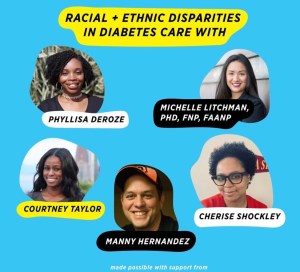
While not part of EASD, Beyond Type 1 is hosting the next in their Summer Sessions and this week it’s focusing on racial and ethnic disparities in diabetes care. There is an absolutely stellar line up in this webinar. Please do follow along if you can – this event will also be via Facebook Live over at Beyond Type 1, and is on Wednesday 8pm ET, which is Thursday 10am AEST.
DISCLOSURES
- I am ad advisor to the #dedoc° voices program. I do not receive any payment for this role.
- I am speaking at the Solvable Problems in Diabetes Community Focus Sessions. I am not receiving any payment for my involvement. I am a regular contributor to diaTribe, and I am paid for commissioned articles.
- I am on the Leadership Council for Beyond Type 1. I do not receive any payment for this role.
Look what our community did! Here is the just released #SpareARose total for 2020. What a remarkable effort from a remarkable community!
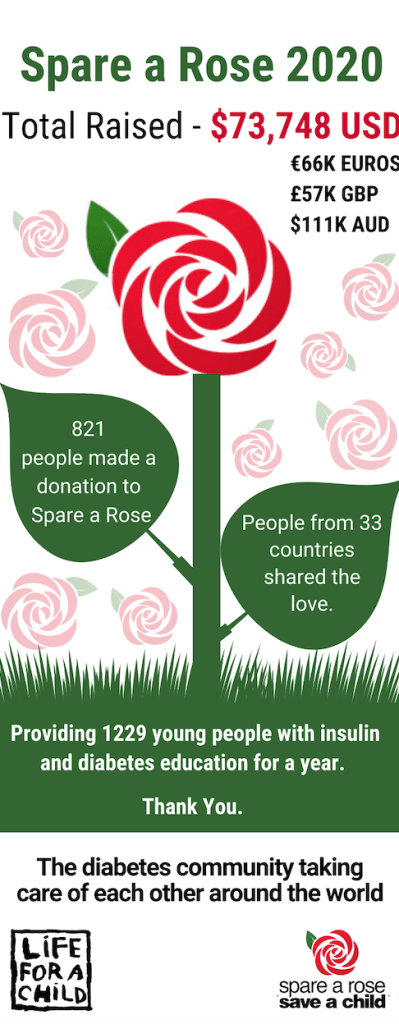
The grand total of USD$73,748 will mean that, through Life for a Child, 1229 children with diabetes in under-resourced countries will have access to insulin for the next year. Amazing!
I guess there’s nothing more to say for this year, other than thank you, thank you, THANK YOU to all who contributed – whether that be through a donation or sharing the campaign.
Spare a Rose, Spare a Child will be back next year. Each year, we promise it will be bigger and better, and I’m sure that will be the case for 2021. Just watch us all go!
‘Art is not a mirror held up to society but a hammer with which to shape it’. (A quote usually attributed to German playwright and poet, Bertolt Brecht, but actually first said by Trotsky.)
Using different artforms as advocacy platforms is not new. In my time working in diabetes (18 years), I’ve been lucky to be involved in a number of different initiatives with foundations very much in creativity and the arts. Perhaps my previous life as a musician – and being married to one for over 21 years – means that artistic approaches are always on my mind when looking at how to tell the story of diabetes.
When planning for the IDF Congress last year, a gap came up in our session on advocacy and diabetes awareness initiatives. Our Living with Diabetes stream committee wanted to look outside the box and move away from traditional awareness campaigns. ‘How about we get Appleton in?’ And that’s how we had a street artist from New York appear on the program in Busan last year in a session with the same title as this blog post!
At that time, I’d not met Appleton in person before, but I had come face-to-face with his artwork. (He’s on Insta here.) There is something quite magical when wandering the streets of NY to look up and see a bottle of insulin stuck to the wall of an old building in SoHo, or in Chelsea. I’d snapped photos and shared them to Facebook, wanting to learn more about the artist: Who is he? What is his story? What is the response to his artwork? After meeting him in Busan, and then again at a mutual friend’s place for dinner in NY, Appleton hosted me and my family in his New York studio one rainy afternoon in January and I learnt a lot about his work.
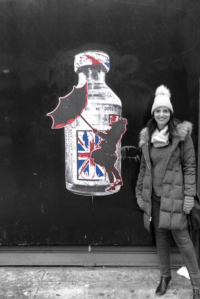
Appleton on W 23rd street.
But even before meeting Appleton, I’d seen the power of how different artforms have the potential to talk diabetes in different ways.
Australian actor and playwright, Alan Hopgood’s play ‘A Pill, a Pump and a Needle’ from a few years ago, told the story of three women living with diabetes. Chatting after a chance encounter in a café over coffee and cake, this was a quintessential Melbourne story! But it was also a great way to start a conversation with those who were lucky enough to see the play. I sat in the audience a number of times, then took to the stage to be part of the panel discussion. Mine was one of the stories that had been brought to life on stage and it was incredible to hear the number of people who watched the play and said that they could see themselves in the women’s stories. ‘Their stories are my stories are their stories,’ I would think to myself.
One year, my team at Diabetes Vic held an art competition for World Diabetes Day, asking children living with diabetes to submit an artwork depicting diabetes. The only requirement for submission was that the artwork needed to somehow incorporate the Blue Circle. I remember the way these pictures offered a most meaningful and impactful representation of life with diabetes – in ways that we’d not seen before. I still have one of those artworks hanging in my office. Its 14-year-old artist managed to perfectly capture the pain of diabetes balanced perfectly with the hope she felt. I’ve been looking at it a lot in the last week, breathing in deeply and letting her feelings of hope wash over me.
A number of years ago, The Diabetes Hands Foundation asked for submissions for an anthology of poems by people with diabetes. Selected poems were compiled in the book ‘No-Sugar Added Poetry’ – a copy of which sits on my bookshelf and is frequently pulled down and perused. In her introduction, Lee Ann Thill says ‘From words, carefully chosen, purposely arranged, emerges a shared experience and mutual understanding’. In other words, peer support through poetry.

And while mentioning Lee Ann… Diabetes Art Day was created by this dynamic advocate and art therapist to encourage people affected by diabetes to use whichever artform they wanted to express diabetes. I remember sitting around the kitchen table with my family, trying to show how we feel about diabetes with coloured paper, glue sticks and rubber letter stamps and ink.
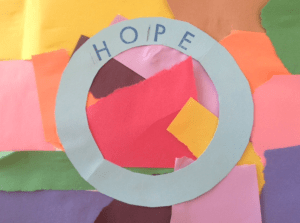
Illustrator, Janina over at Miss Diabetes is absolutely brilliant in her depictions of diabetes. And, of course, comics by Claire Murray are still my favourite diabetes superhero tales. And my friend Weronika at Blue Sugar Cube, creates stunning pieces – her Spare a Rose designs were so gorgeous.
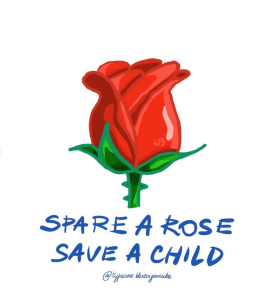
Click to be taken to Weronika’s Insta page.
Australian advocate Jenna’s artwork is nothing short of stunning. I bought one of her beautiful images earlier this year and need to get it framed so I can stare at it endlessly when I should be writing!
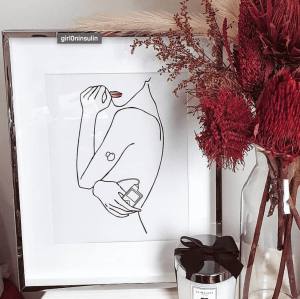
Click to be taken to Jenna’s Insta page.
Melissa Lee has combined her beautiful voice, brilliant sense of humour and story-telling powers to sing diabetes in ways that get us thinking, smiling, laughing…and crying.
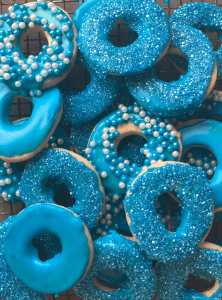
As for me? Well, I create through baking and have managed to create some pretty damn fun and delicious cookies to mark important days and initiatives in the diabetes calendar.
And of course, storytelling is an artform, and I know that for me personally, that is how I have connected and felt supported by people affected by diabetes from every corner of the globe. Words have a power that can convey the very helplessness, hurt, hope and heartbreak that is real in diabetes, and as I frequently say, the stories people tell have always helped me make sense of my own diabetes.
Art has the power to reach people in ways that other, more traditional methods don’t. Health campaigns are important, but sometimes they seem just one step removed from the reality of real life. Art has the power to bridge that step and bring people together, and provide a fundamental understanding of the story being told, and the people behind those stories.
So back to the quote that opened this post: art can – and does – shape how diabetes is seen within and outside our community; it can influence how people outside the diabetes community understand diabetes, and within the community, offer different ways to think of things. It can start conversations that encourage us to consider others’ ideas; it pushes boundaries and forces us outside our comfort zones; it gives voice to people in the community who don’t necessarily want to use words to express how they feel. Advocacy using art can also cut through the white noise of health campaigns – often they all look and sound so similar that they are easy to ignore. But for me, I think the most powerful thing they give is humanity and hope to a condition that is often so misunderstood.
So, this is 2020? How are you going? I returned from overseas to a country literally burning and choked in smoke; a government that is refusing to accept that climate change is real; and a news organisation making up the narrative to suit themselves (arsonists are everywhere, apparently).
Bet you didn’t expect me to get so political before midday on a Monday!
Today is my first day back at work after three weeks of holidays in New York with my family. We spent the time basically relocating our Melbourne life to New York: finding a favourite café that served decent coffee, drinking great quantities of said coffee, wandering the streets, playing with (other people’s) dogs, warming up in bookstores and catching up with friends. It was the perfect way to farewell 2019 and welcome 2020.
As I have mentioned a million times before, I don’t do resolutions. You may not know this, but I live with diabetes, and that in itself gives me enough reasons to not reach goals and targets. I don’t need to add another list of things of which to fall short.
For the last three years, I’ve chosen a word that I’ve hoped would oversee and direct my way of thinking and acting for the year. As it turns out, that was a load of rubbish. Because each time, as I searched for the word that I wanted to guide me, the one I settled on went against the very grain of who I am.
The words were pause, focus and reset – and behind them was the idea that I would respond in ways that were really out of character; words that would silence or calm my natural responses.
But that’s not me. I walk towards things (usually at pace), I’m impulsive, I’m reactive. Sure, these may not necessarily be the best traits for a mindful, calm existence, and they can be exhausting, but welcome to my life: Hi, I’m Renza.
This year, I’m ditching the word idea, and using a phrase that better suits me, and that phrase is Stand Up.
We are living in a world that does not need people to be silent. Manners are all very important, but it is very possible to have manners and be polite, but still challenge things that we see as not right. We don’t need to be told how to think, how to feel, how to respond to something that upsets us. We don’t need to tone police ourselves – or others. We don’t need to accept what we are given.
And in the diabetes space, we don’t need people to be meek and mild. We need people who are disrupters and who speak their minds and who call out the bullshit. We definitely need to make sure that the voice of PWD is the loudest in the room, and that anyone who tries, even for a second on any platform, to tell us to pipe down is called out for it.
We do not need people to go quietly, and I am somewhat horrified that I did just that at the end of last year when I was feeling intimidated and vulnerable online. If I’m honest, I don’t recognise the person who switched her Twitter to private and wrote this thread to explain it to the people who were asking why.
Being angry is okay because there is a lot to get angry about in diabetes care. Not standing up means that we accept the situation for how it is. We can do it in a way that is nice and friendly, but sometimes it takes more than that. And that is okay.
I have never cared about being popular in the DOC or being considered one of the cool kids. I have never worried about follower numbers. I searched for this community because I needed support and I needed to feel part of something amongst people who were just life me. Other people with diabetes.
When I re-read my twitter thread from before Xmas, my heart broke NOT at what had happened; but at how I felt that the only way for me to stop feeling so unsafe was to turn away from the community – MY community. It was this tweet that set my tears running again:
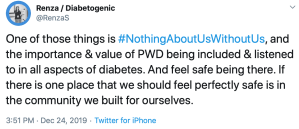
I thought that if I had wandered into the DOC for the first time instead of the welcoming place it was, I saw PWD being challenged, I would have run away. THAT was what broke my heart – the very idea that I would not have discovered people like Kerri, Georgie, Cherise, Melissa, Mike, Dana, Grumps, David, Manny, Jeff, Mel, Frank, Alanna, Kelly, Ashleigh, Scott, Annie, Alecia, Bastian, Daniela and so, so many others. I don’t know how I would have navigated the murky waters of life with diabetes without those people: MY people for whom diabetes actually invades our DNA and the DNA of our loved ones. People there for the right reasons – not for the accolades, not for increasing follower counts. They are community-minded, open to opposing ideas and thoughts, and don’t consider themselves superheroes.
If I had have gone quietly, I would never have learnt from them; never had the support of people who understand; never had people like that at my back when I do stand up.
So, I don’t go quietly ever again. I stand up as I always have. I accept that doing that will send me into periods of advocacy burnout; I’ll deal with that when it happens, surrounded my friends and peers who get it.
So yes, this is 2020. I’m back. It’s really nice to see you here.
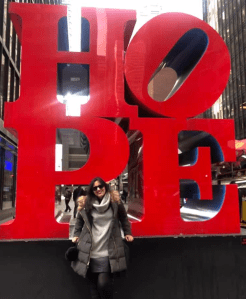
Each year, as we stop, look back and take stock, the reason that we are feeling so tired becomes apparent. This year is no different for me; my work travel calendar was the most intense it has ever been, with nine long haul trips, some for only a day or two. Combined with regular domestic travel, I can truly say that I have seen the inside of airports far too much. I stopped adding up the trips I did once I passed 100 walks down airbridges to board planes because it was making me weepy.
But on top of the usual exhaustion this year, there seems to be an extra element of fatigue that goes beyond what I’ve experienced before.
But first, let’s talk highlights, because there have been many of them.
The year kicked off with Spare A Rose and whoa, did we start the year with a bang! With the true philosophy of SaR at the forefront (an initiative for the community, by the community), we not only reached our rather audacious target, we smashed it! A cheeky and opportunistic little extra push saw a smiling Grumpy Pumper unleashed to the whole world for just a moment The DOC didn’t break, but the final tally of for the campaign meant that 939 kids in under-resourced countries would be receiving insulin for a year. Amazing!
My favourite issue, #LanguageMatters, only went from strength to strength, and the publication of this piece in BMJ, followed by this podcast, was a brilliant way to get it outside of the diabetes echo chamber. The importance of language featured on the programs of major conferences such as ADA and #IDF2019 with stellar panels speaking about why it really does matter.
My diabetes turned 21 and tied up in all the emotion of that, my pancreas’ performance review didn’t go all that well. Maybe next year? (Unlikely.)
Possibly the most exciting, heart-warming, rewarding and humbling thing I did this year was co-facilitate a workshop in Manila with some of the most dynamic, compassionate and enthusiastic young diabetes advocates I have ever met. I’m thrilled have had a chance to catch up with a couple of the people from this meeting and can see the wonderful work they are doing in more than trying circumstances.
Peer support was never far away. One of my favourite digital campaigns came from Diabetes Australia (remember – I work there so consider my bias) with our The Lowdown campaign. What a brilliant way to showcase how a digital campaign can reach and connect people from all over the world, and encourage them to safely speak about a topic that doesn’t seem to get anywhere enough coverage. I spoke about the campaign’s success in a number of places this year.
My own personal peer support experiences happened all around the globe at conferences, advisory board meetings and other opportunities to see friends and colleagues with diabetes. These moments ground me and help me make sense of what I am seeing and hearing, and are critical for keeping me balanced.
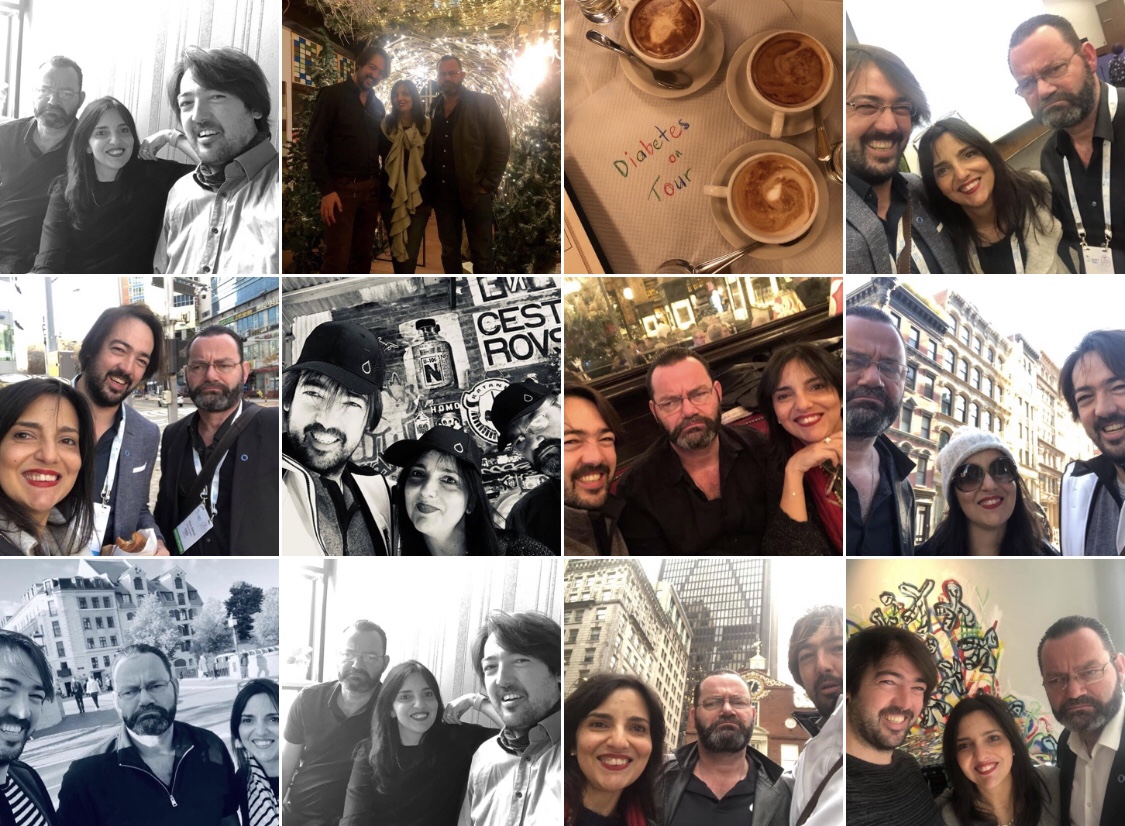
A special shout out to these two peers and dear, dear friends: Bastian and Grumps. We saw each other an inordinate number of times this year, literally all over the globe, travelling on planes, trains and automobiles for our #DiabetesOnTour. I do think we should launch a calendar of the 2020 pics. (Admittedly, we may be the only ones remotely interested in that idea.) When I talk about my diabetes tribe, it’s friends like these two. We’ve celebrated through some pretty amazing things this year, stood up to elevate the lived experience over and over, and also counselled each other through the tough bits. We’ve held post-mortems of long days, sitting in hotel foyers and bars, trying to make sense of what has happened, working out how to always improve, and plotting and planning more and more and more. I am so grateful to them for being the scaffolding holding me up when I’m away from home and feeling overwhelmed.
So, now the reason for that elevated exhaustion…
When I first wrote about advocacy burnout back in January this year, I had no idea at the time that it would set the scene for a difficult and sometimes troubling theme for the year. I get tired and overcome at times throughout the year, but 2019 was different and I’m not really sure why.
There were moments this year where I did honestly wonder how much more energy I have to stand up over and over again to a lot of what I was seeing. I don’t like using war and battle analogies in diabetes, but I did feel that I was fighting a lot of the time. Diabetes advocacy is a tough gig to begin with. Adding burnout on top of it makes it seem shattering.
Being attacked by HCPs for daring to voice my thoughts and challenge their behaviour, or getting it from certain, more confrontational parts of the diabetes community, or having industry reps tell me I don’t know what I’m talking about for daring to suggest that maybe their lame attempts to simulate diabetes in gameshow-style gimmicks at conferences could be better directed at actually engaging and listening to PWD all added up.
Or perhaps it was the repeated examples of ‘diabetes for laughs’…and realising that we are a long way away from HCPs truly being allies in our daily encounters with stigma.
Or perhaps it was feeling that we needed to justify just how important the #LanguageMatters movement, and the decade of work we’ve done really is. I can’t even begin to tell you how upsetting this little incident was.
It added up and several times I’ve felt overcome. I feel like that today. Which is disappointing because on measure, the highlights, the positives and the amazing community should overshadow the negative encounters.
And that is why I’m taking a break from Diabetogenic. I need some time away from feeling as though I want to analyse what is going on and comment on it. I have a wonderful holiday planned with my gorgeous family where we will see friends and wander wintery streets, rugged up in pompom hats. And then, will warm up once back in Australia to finish recharging my seriously diminished batteries, ready for a new year that’s already shaping up to be so, so busy.
Until then, I hope you have a wonderful holiday season, celebrating however you see fit. Thanks for popping by. And I’ll see you in 2020, clapping my hands and raring to go!
Busan is a very different city today than it was last week. There won’t be warmly dressed people hurrying into BEXCO with IDF2019 lanyards around their necks, eager to learn about diabetes. The word ‘diabetes’ won’t be uttered in almost every language of the globe. There won’t be Melbourne diabetes people loudly lamenting that Starbucks seems to be the coffee of choice in the city.
And you won’t see groups of people from all around the world standing together talking about what it’s like to live with diabetes. Most of us have gone home to our respective corners of the world, back to our families, back to our jobs, back to our real lives. But we will always have Busan and the incredible week of the IDF Congress.
By the time I arrived in Busan on Monday, the IDF was already a different beast. There was a new President and Board in place and some of the concerns that we’d had about the handover had melted away to nothing. This paved the way for what we really there for: a week of learning, networking, hearing different perspectives and truly uniting for diabetes.
We did that.
Was it a perfect conference? Of course not; they never are. There were hiccoughs and AV fun. There were controversies that played out online very differently to the way they actually happened in real life. There were sessions – critically important and brilliant sessions from all streams– with disappointing turnouts.
But these are all minor concerns that are the reality of every conference I have ever attended. There will be a time for post-mortems and evaluations and planning for improvements to future conferences. That time, however, is not now. Now is the time to celebrate.
IDF 2019 was a brilliant showcase of diabetes from around the globe. As expected, I only attended sessions from the Living with Diabetes stream and every single story was beautifully presented, and enhanced by the professional expertise of the HCPs who shared the stage. Amongst the incredible tales were moments of discomfort. It’s challenging to hear of the struggles many of my sisters and brothers with diabetes face in their day to day lives. I was forced to confront my privilege in a way that demands more than just acknowledging it there.
Also, difficult to accept is realising that sometimes the chasm between what people living with diabetes want and need and what HCPs and researchers think we want is gulf-like. For every HCP who ‘gets us’ and understands the value of lived experience in the healthcare space dialogue, there are many others who just don’t accept it, and, despairingly, don’t want to listen.
But more on that another day. Because for now, I’m focused on the people who did such a stellar job. So here are just some of them!
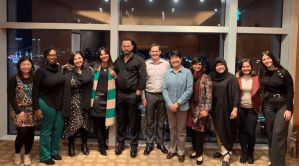
Two hours after touching down in Busan, and we kicked off the sixth Ascensia Social Media Summit with these gems.
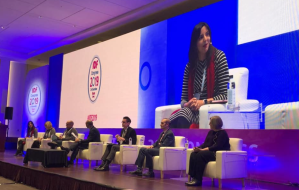
Bright and early on day 1 of IDF2019, and the auditorium was packed to hear about diabetes and tech.

Always, ALWAYS, pleased to share the stage with Jane. Here we are just before the panel session.

Georgie excited to TALK ABOUT HYPOS! (We couldn’t understand why there was an explanation mark at the end of that sentence.)
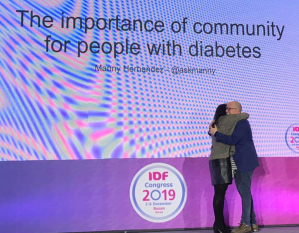
Manny Hernandez gave the LWD Stream Award Lecture and there is no one more qualified to talk about the importance of diabetes community. How honoured I was to introduce him!

Celebrating Manny! (Photo courtesy of Boudewijn Bertsch)

From Melbourne to Busan. Neighbours at IDF2019. Jo was speaking about living with a rare type of diabetes and Andy was there for support (and photos from rooftops).

This woman! Sana, deputy lead of the LWD Stream and a bright, fierce force.

Anita eloquently explaining the challenges of living with diabetes-related complications in Indonesia.

Apoorva highlighting #LanguageMatters in her talk.
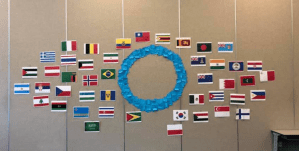
Some of the most dynamic young people I have ever met at the Young Leaders in Diabetes Training Summit.

Cherise can always be relied upon to ask thoughtful questions.

I’ve lost count of the cities we’ve done our #DiabetesOnTour this year, but these blokes have made all my travel so much better! Thanks Bastian and Grumps.

My favourite people at IDF2019? The two baristas running this uber-hipster coffee van.

We were all surprised to see the room packed full at 8.30am on the last day of the Congress. Sex sells. Or people just want to talk about it…
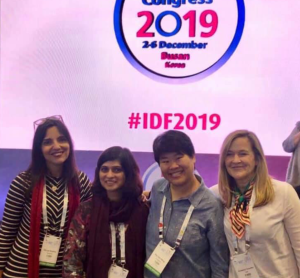
One of the best pieces of advice I was ever give was this: surround yourself with smart women. This is the LWD stream from IDF2019. I truly was surrounded by the smartest of women! Thank you Sana, Pei Yan and Elizabeth.

The final session in the LWD and my highlight of the whole congress was my neighbour, Sol, talking about living with MODY 3. We could not have scripted a closing remark better than his: ‘Being at this conference has made me feel part of something and with people that understand.’ Welcome to the world of diabetes peer support, Sol. You are so, so very welcome here.
DISCLOSURE
I was the Chair of the Living with Diabetes Stream at the IDF Congress in Busan. My flights to Busan were covered by Ascensia Global (in order for me to get to Busan in time to co-facilitate their Social Media Summit). Flights home and accommodation were covered by the IDF.
My first endocrinologist was a really nice man. He was very kind in the way that he acknowledged that I was dealing with something quite scary – a new diagnosis of type 1 diabetes.
I remember he was nice. In fact, when people asked me what my new doctor was like, it is highly likely that I actually used that word to describe him.
What I remember more was the way that he told me about diabetes-related complications, and the way that he told me that if I didn’t look after myself, and follow his instructions to the letter, that I would get those complications. If I was a good girl and did as I was told, I would be right. If I didn’t, every one of those terrifying, horrible, distressing complications would occur and it would be my fault.
Now, he didn’t say this in an ‘un-nice’ way; he wasn’t mean, he wasn’t cruel, he didn’t yell. He was saying it as if it was an absolute, and I quickly came to understand that being compliant was what was expected, and that there was a good and bad way to behave in diabetes, and that resulted in good and bad numbers. If I did what he said, I was good; if I didn’t, I was bad. And if I was bad, terrible things would happen and I would have no one to blame but myself.
That was twenty-one and a half years ago, and I can still hear those words in my head. The language he used set me on a course of not coping with my diagnosis and feeling intense fear about my future – a fear that sometimes paralysed me into inaction.
This week, there has been discussion on Twitter about what the #LanguageMatters movement is all about. It started with this tweet from a diabetes consultant in the UK, which suggests that it is ‘..mostly about being nice…’.
Eight years ago, when Diabetes Australia launched the first language position statement, the response from many was that this was not an important issue and that perhaps we should put our efforts into other things; things that matter. This was seen as a little bit of fluff that was a waste of time. It’s political correctness gone mad, was the reaction from many.
We’ve become smarter at showing the evidence to support just how destructive words and language can be. We hear stories from people who explain how damaging language resulted in them not seeking help when needed, and how the fear of being blamed kept them away from their healthcare team. We can show that diabetes gets fewer research dollars; that it’s harder to get people to put their hands in their pockets to donate to a diabetes charity, and that the general community does not understand just how serious diabetes is.
The timing of things is interesting, and it seems that last night someone on the TV show The Great British Bake Off referred to a dish as ‘diabetes on a plate’. The host’s reference to the sugary confection in that way wasn’t about him not being nice. It was about him using a phrase that has been thrown around by many for years, because it is accepted that diabetes is something to make fun of.
Now sure, the way people responded to this incident could be termed as nice and not nice. Nice would be ‘Please don’t refer to my health condition like that’; not nice would be ‘Don’t be an arse’. Obviously, I lean towards the latter. (Also, not especially nice is using an example like this to explain the different types of diabetes, because it is not relevant to the discussion and only adds stigma to type 2 diabetes. Don’t do that!)
As I read the tweets responding to this tired ‘joke’ from people in the diabetes community, what I saw was not people urging the TV host to be nice. It was for him to understand the seriousness of diabetes, to stop shaming people with diabetes, to not fuel the misconception that sugar causes diabetes, to not make diabetes a punchline.
People make diabetes ‘jokes’ because the words and language used around diabetes for years has given them permission to do so. And with that, attitudes were formed and the construct that diabetes is self-inflicted and free game for comedians and TV hosts became accepted.
And that’s where we are now and what we have to undo.
Perhaps part of the problem is that we don’t have an ‘ist’ or ‘ism’ word that we can attach to the language matters movement. We understand that when we challenge racist or sexist conduct, we are not asking people to simply ‘be nice’. We are trying to make a culture shift away from such damaging attitudes and to change behaviours. When I call out a bloke for making a sexist comment, I’m asking him to reconsider the way he thinks about women, change his behaviour and be respectful. I’m not asking him to ‘be nice’. I’m asking him to stop being sexist.
When someone makes a comment about someone based on the colour of their skin or the country they were born, we don’t dismiss it as them not being nice. We (rightly) expect them to stop that rhetoric because it is wrong and no acceptable.
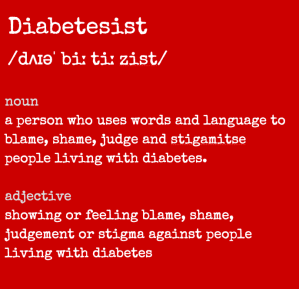
So, I’m making up a word (and I hate made up words…). If you use words and language that judges, shames, blames, and stigmatises people with diabetes, you are being diabetesist. Diabetesism is not okay and should not be tolerated, and we need to challenge people behaving in that way. Perfectly nice people could still be diabetesist; their attitudes are long-held and seemingly socially acceptable. It’s what they have heard all their lives. We need them to stop doing that.
Here’s the thing: I don’t actually consider myself as being a particularly nice person a lot of the time. Nice people are agreeable, and don’t challenge others or their ideas; they accept them. They don’t call people out on Twitter. They’re not the person who rocks the boat. I am the boat rocker, and I do that because I believe that there are institutional, systematic problems that need to be changed in diabetes and diabetes care, and one of those is the way that the language used around diabetes.
So, back to where this all began and this tweet. I agree that berating HCPs is not the way to get the message through. #LanguageMatters is not only looking at HCPs attitudes and behaviours, anyway. My strongest criticism has been aimed squarely at the media and industry. I also believe that it works best when all stakeholders are involved.
But while I accept that there are different approaches, I don’t accept – and really don’t appreciate – that all the work, the research, the education and the efforts about this issue can be distilled into the concept of good manners and niceness.
I also believe in taking a harder line. That doesn’t mean haranguing or being aggressive. But it does mean understanding that there is a (real or perceived) power imbalance in healthcare, and those with influence should be held to account when it comes to the way they speak to and about people with diabetes. It means calling out HCPs and researchers when they stand up at conferences use language that hurts us by reinforcing wrong attitudes; correcting the media when they get it wrong, and calling out industry when their marketing teams misfire.
And I also believe that this is personal. Living with diabetes is not a bit of ‘fun stuff’ or something that we chose to do. It is incredibly personal for me and every single person with diabetes who has been made to feel not enough, or blamed or shamed, or judged or mocked due to beliefs about diabetes – beliefs that have been formed and accepted over time because of the language and attitudes about our health condition. The concepts of non-compliance, of good and bad numbers, of ‘bringing this on myself’, of ‘diabetes on a plate’, of grading A1cs have all been thrown at me, and affected me in ways, varying from feeling a little annoyed right through to deciding diabetes care was an exercise in futility so I was simply not going to bother anymore.
That is why #LanguageMatters and I would ask – and urge – everyone working in this space to listen to those of us living with diabetes, hear us. And sit down and learn. Sure, we can all be nice, because being nice is a good thing to aim for (and I promise that I will endeavour to do better there, too), but accept that language matters much, much, much more than that.




 Diabetogenic