
You are currently browsing the category archive for the ‘DOC’ category.
It’s 42 degrees Celsius today – or about a million and a half degrees Fahrenheit. We can all agree that it is hot.
So, obviously, it’s a great day to move offices.
As I have unpacked and started to set up my new space I’ve been piling together bits and pieces collected from DOC get togethers. Which means that as I sit here in my office overlooking the city skyline, I actually have around me friends from all over the globe.
And my world once again feels that little bit smaller. And I, in my corner of Melbourne, feel part of something so much bigger.

Last week, I received an email informing me that the weekly #OzDOC tweet chats would be coming to a close. Obviously, I thought of it as a sad announcement, but what a fantastic five years and five months of weekly conversations and support!
It takes a lot of dedication to run a diabetes support group, and the regular tweet chat format of #OzDOC meant that it was a once-a-week commitment, requiring a roster of interesting and engaging topics, and someone to direct the conversation and make sure that there was someone welcoming anyone who wanted to participate each and every week.
It takes work, time and effort, and, in most cases, support groups are run by volunteers who already have jobs and busy lives and families. The support group administration and activities are run in someone’s own time.
But despite what it takes – the planning, the commitment and the energy – there has been someone there since the beginning, taking responsibility to make sure that the #OzDOC tweet chat bus kept going. And that person is Kim Henshaw.

Kim talking #OzDOC at last year’s #MayoInOz meeting.
When the #OzDOC tweet chats started, there were three of us involved: Kim, Simon and me. We took it in turns each week to moderate the chat, come up with the questions and run ideas by each other. But circumstances change, and first I, then Simon needed to step back from being part of the moderating team.
Kim stayed on and has been the one responsible for herding the #OzDOC kittens and creating a safe, fun, supportive, reassuring online space for people in the Australian diabetes community to come together on Twitter each week. With a team of moderators, the chats continued.
Kim’s commitment to #OzDOC could never be questioned. In the very first tweet chat, back in July 2012, she was sent to Twitter jail for tweeting and retweeting too many times in the hour! She wanted to share as widely as she could, acknowledge as many comments from others as possible and encourage conversation at every turn. Until she was cut off from Twitter:

Oops…
Kim never wavered from her pledge to build and support the community. I shared the power of #OzDOC every chance I had – any time I was speaking about diabetes peer support, #OzDOC got a mention; I’ve written about it here over and over and over again. And I defended online channels and Twitter as a support platform, using #OzDOC as an example of just how a community could be developed.
But times change, and with Kim stepping aside and no one else available to take on the coordination of the group, next week will be the final time that the @OzDiabetesOC account is used for the #OzDOC hour of power.
I wanted to say a huge thank you to everyone who has been involved in the OzDOC tweet chats for the last (almost) five and a half years. I have met some incredible people through the chats, made some wonderful friends and learnt so, so much.
And mostly, I wanted to say thank you to Kim for delicately, dedicatedly and devotedly running the group. What a wonderful thing you created, Kim. Well done! Enjoy your quiet Tuesday nights – you deserve it!

I flew into Lisbon, arriving at my hotel just after midnight on Monday. I get that Australia is a long way from everywhere, but the 38 hours’ transit was a record for me and as I tumbled into bed, I dreaded the alarm that would sound a mere 6 hours away.
However, I’ve done this enough times now to know a sure-fire way to overcome jet lag is to organise a relatively early morning meeting that involves coffee and local pastries. (Hello, Pastelaria Versailles and thank you for your beautiful baked goods.)
The main reason for this trip was to attend the Roche #DiabetesMeetup. (Disclosures? Yep-all at the end of this post….) This is the third one of these meetings I’ve attended (read about the first one at EASD2016 here and the next at ATTD2017 here) and, as always, it was great to see the familiar faces of dynamic diabetes advocates doing dynamic diabetes advocacy.
This year, there were a whole lot of new faces, with over 60 diabetes bloggers from across Europe having been invited to become part of the conversation. As well as attended the dedicated satellite ‘consumer’ events, the bloggers are all given press passes to attend all of EASD.
This is astounding. It means that it is impossible to walk around the conference centre without seeing other people with diabetes. Arms adorned with CGM or Libre are not startling – they’re everywhere. The beeps and vibrations of pumps can be heard in sessions, causing heads to bob up, and knowing glances to be shared. Our presence here is undeniable.
On the first official day of the EASD meeting, the third annual #DOCDAY event was held. While Bastian Hauck (the event organiser) starts by inviting bloggers to the event, he warmly and enthusiastically extends the invitation to HCPs and industry too.
On Tuesday, the room was full of people, discussion and enthusiasm
#DOCDAY has become a platform for anyone who attends to take the stage, and five minutes, to share what they’ve been up to in the diabetes advocacy and support space. I stepped down from my usual language soap box, proving that this pony does indeed have more than one trick.
Instead, I spoke about the role of people with diabetes at diabetes conferences. I couldn’t think of a more appropriate time, or a more suitable room to plead my case, even though I knew that I was preaching to a very converted choir!
Two weeks ago, in Perth, there were a few of us wandering the #ADSADEA conference as part of the Diabetes Australia People’s Voice team. And at one point, on Twitter, where our presence is felt more than anywhere else, an interesting, frustrating and downright offensive (if I’m being honest) discussion started.
It was said that diabetes conferences are the safe place of diabetes healthcare professionals and that perhaps a day at the start of the conference could be dedicated to people with diabetes, but the delegate program (delegates being only HCPs) start the next day.
As you can imagine, that didn’t go down too well with some of the diabetes advocates in attendance.
I am actually unable to provide you with the arguments offered as to why people with diabetes should be excluded, but I think it included reasons such as HCPs need a space to be among peers, these are scientific conferences, HCPs need lectures without people with diabetes (not sure why – are we really that terrifying?).
I’m not into preventing people with diabetes attending diabetes conferences. Melinda Seed’s vision of 1000 people with diabetes at the conference is far more aligned with mine. We are not asking that the conference we ‘dumbed down’. I don’t want the sessions to be any different than they are now (with the exception of having PWD as part of the speaker list – but that is regardless of who is in the audience).
Here’s the thing. Organising a team of three consumers to attend (as happened in Australia) required someone to provide funding and coordination. That was Diabetes Australia and I’m really proud that the organisation I work for created this initiative.
To have over sixty advocates supported takes a commitment. I won’t for one moment suggest that I am naïve enough to believe that we are part of industry’s marketing strategy. But we absolutely should be part of that strategy. I am more than happy to give Roche the shout out and kudos they absolutely deserve for bringing us all together. I don’t use any of their products at the moment (although, in the past have used their meters), so I’m not in any way spruiking their devices or suggesting you go and update your meter with one of theirs.
But I am grateful that as part of their engagement with people with diabetes involves bringing us together at a diabetes conference.
What’s the role of people with diabetes at diabetes conferences? Our role is to share from inside with those not here. We’re here to remind attendees that using language that diminishes us and our experiences and efforts in living with diabetes is not okay. We’re here to tell industry they’ve messed up when they design is not spot on, or their marketing misses the mark. We’re here to challenge the idea that we should be quiet, ‘compliant’ and do what we are told.
As I said at #DOCDAY, we have a responsibility to share what we learn. I acknowledge – every single minute of every single conference day – that I am privileged to be here. And that comes with responsibility to share what I see, hear and learn.

DISCLOSURES
My flights and accommodation costs to attend EASD2017 have been covered by Roche Diabetes Care (Global). Yesterday I attended the Roche #DiabetesMeetup (more on that to come). Roche also provided me with press registration to attend ATTD. My agreement to attend their blogger day did not include any commitment from me, or expectation from them, to write about the day or their products.
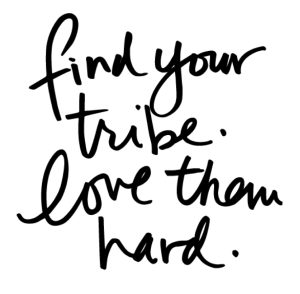
Last week, I was invited to speak as the consumer in a peer support symposium at ADS ADEA. My talk was called ‘People like me’ because more and more, I’ve come to understand that the real value for me in peer support is the combination of the masses with diabetes – as accessed through the DOC – as well as those who form a part of my ‘inner circle’, or tribe.
So, obviously, my first slide was this one:
And then, I introduced the audience to my tribe from last week:
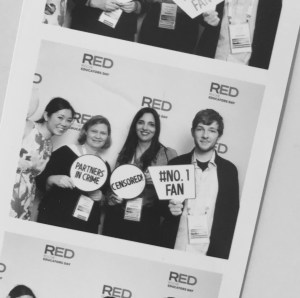
People like me! The #DAPeoplesVoice Team (L-R) Ashley, Melinda, Renza, Frank
The peer support symposium was coordinated by the ACBRD. Last year, they produced this report for the NDSS. They brought together four speakers, each speaking about different considerations of peer support.
After I gave my personal perspective on the peer support that works best for me, Professor David Simmons from Western Sydney University spoke about the evidence. The idea (as outlined in the symposium abstract) was to ‘…identify ways in which they are in synergy and/or tension with one another’.
David began by speaking about the Peers for Progress model, highlighting its four core functions of peer support:
- Assistance in daily management
- Social and emotional support
- Linkages to clinical care and community resources
- Ongoing support, extended over time.
I can only speak for myself and my own experiences, but the peer support I have carved out for myself meets all these points. While points 2 and 4 are probably the most relevant to me, I certainly have used my peers to assist with the day-to-day grind of living with diabetes and have also found connections with clinical support through my peers.
My experience is certainly not structured or formal in any way, however, for me, it works and it works superbly. Which was another point that I made – we need to find the right sort of peer support and that may be different for different people.
Some PWD may prefer to have something that is very organised. I prefer a more ad hoc, dip-in-and-out-as-I-need-it approach, and focus my energies on what I require at specific times. I also love the online community and the support it offers because it meets many of the things I’m looking for: flexibility (there’s not a meeting on the first Monday of each month to attend and if I can’t make that, I miss out); broad reach and a variety of people (which means that I will always find someone to provide support, no matter what the issue; diversity of experiences so my own understanding of what is going on with others is constantly growing, evolving and, often, challenged; all over the world allowing me to connect with people whatever the day of day – or wherever I happen to be (speaking of which…anyone in Lisbon next week?).
Another discussion point during the symposium was to do with the need for evidence to strengthen the case for peer support, which will ensure adequate funding to run programs. I find this a slightly double edged debate, really. I understand that with limited funding, those holding the purse need to know that money is going to go to programs that are known to work. But equally, I know peer support works. People with diabetes know peer support works. Melinda Seed, clearly frustrated (as am I) at the constant need to defend the value and importance of peer support, posed an interesting question, here:
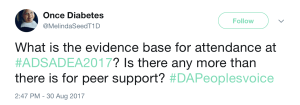
Now, I don’t doubt for one moment that HCPs get a lot of benefit from attending diabetes conferences. Of course they do – they hear from leading experts, learn about the latest research finding, network with colleagues, speak with industry about new diabetes technologies and treatments. The leave feeling inspired, have improved knowledge, feel supported by others doing what they are doing, and have new tips and tricks up their sleeves top improve their practice. They know that. We all do. And yet where is the evidence to support it?
(For the record, someone did point out on Twitter to Melinda that the difference is that conferences are privately funded and therefore do not stand up to the same scrutiny that programs seeking public funding do. Melinda responded (quite correctly) that this argument doesn’t really hold water as many attendees there attend on the ‘government dime’. It is an interesting discussion….)
I think one of the problems we might have is that we narrow the definition of peer support sometimes, and perhaps some people think that it’s too fluffy and feel-good, and just about sitting around someone’s kitchen table and chatting. But as I said in my talk, there is much more than mere ‘tea and sympathy’, (although, I’m reticent to dismiss the power of such interactions because I know that sometimes those moments do produce a lot of support from people who are otherwise feeling very isolated and alone.)
I am speaking at the World Diabetes Congress at the end of this year and will be challenging the notion that peer support is all about group meetings. It is more than the traditional ‘support group’ model. One example I gave was the Pumpless in Vienna story (yeah – I’ll tell that whenever I can!). It was through peer connections that my friend Jo found a pump. It can also be seen and found in other ways – camps, information sessions, structured education programs. Peer support can be found in a lot of places, even if that’s not the term we give to it.
CEO of Diabetes Australia, Greg Johnson, and me talking peer support after last week’s symposium.
Disclosures
Roche Diabetes Australia has covered my travel and two night’s accommodation for my stay in Perth as I am a presenter at the Roche Educators Day (RED). There is no expectation from Roche that I will write anything about the RED, but I expect I will because it’s always such an interesting and enjoyable day!
The remainder of my time in Perth is part of my role at Diabetes Australia.
There’s lots happening, but I can’t look away from my Loop app at the moment because I’m so damn excited and obsessed! (I’ll be writing something about it sometime this week.)
But if I wasn’t doing that, I’d be (re)reading these things…
Why it costs so much to see a specialist
I’ve always paid to see my endos privately. In fact, I generally ‘go private’ for all my healthcare needs – I can’t remember the last time I was bulk-billed for a medical consultation.
It does cost a lot, and I am grateful I can afford it, but the excessive costs often discourage people from seeking the right care they need. Of course, we do have excellent public health in Australia. My choice for seeing HCPs privately include wanting continuity of care, and not being subject to frequently very long waiting periods.
This piece in The Conversation looks at why specialist care is so expensive. And what can be done to reduce costs.
Lookiee! A diabetes Wookiee!
For those who participate in OzDOC (and other DOC activities) you may have come across David Burren. I met David last week to talk all things tech (actually, I just fired questions at him about Loop and he patiently answered them without rolling his eyes even once). He’s started a diabetes blog all about diabetes and technology and, thankfully, it is in language that even I can understand.
Check out David’s Bionic Wookiee blog here.
Statues are like tumo(u)rs.
With all the nonsense going on in America at the moment, this piece from McSweeney’s most adequately explains why the ridiculous idea that statues commemorating less than favourable moments in history need to remain. Here’s my favourite part:
I view this tumor as an important symbol of your body’s history and heritage. Removing the tumor would be yet another example of misguided medical correctness in today’s liberal America. I protest this surgery and refuse to whitewash your rich medical history. The tumor must be kept prominently displayed inside your body.
Do better, America. We all know you can.
More on what’s on the inside
Mel Seed’s blog about normalising mental healthcare in diabetes follows on from DX2Melbourne and is well worth a read. Read it here.
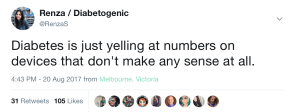
Diabetes is just…
This…
Faster insulin coming to Aus
A couple of weeks ago, I shared on my socials the exciting news that ultra-fast insulin, FIASP, had received TGA registration. No actual ‘launch’ date info as yet, although next week is the ADS ADEA Annual Scientific Meeting, so we may hear more then.
And in news that we already know…
Apparently, CGM is not just for abdomens anymore… File under ‘No Shit Sherlock’.
Swear-y
My blog emails keep getting blocked by the profanity filter at my husband’s work. Every now and then, he forwards me the message he’s received which states that the email was not delivered due to ‘offensive language’. #SwearyWife
This Twitter account definitely wouldn’t make it through, but it’s one of the best things I’ve seen on the interwebs for a while. I’d like to print THIS up poster size and put it on the wall of my office/wear it on a t-shirt, but perhaps that’s not appropriate.
D-parents and sharing the scary parts of their child’s diabetes online
I’ve linked to Moira McCarthy’s writing before because I think that she gets it right every single time she writes about the role of parents in their child’s diabetes.
This piece asks parents to consider if sharing their child’s scary and dramatic diabetes stories online is doing more harm than good. (I rather clumsily explored a similar issue last year in this post.)
Read her piece at ASweetLife here.
4Ts on Diabetes Mine…
Last month, during National Diabetes Week, in an endeavour to get our 4Ts message out as widely as possible, the good folks at Diabetes Mine allowed me to write a little about our campaign. You can read that here.
Living and loving someone with diabetes
As much as I think I am the most delightful and easy-to-live-with person in all the world, I have to admit that diabetes can and does impact on all relationships… and makes me perhaps not the most delightful and easy-to-live-with person. Aaron and I chalked up 23 years together yesterday. Diabetes has been part of the equation for over 19 of those years.
Diabetes advocates Nicole Johnson and Lorraine Stiehl have written a new book which has been called a practical guide to loving a person with diabetes. I’ve ordered a copy and will be leaving relevant pages open for my loved ones to read.
You can get a copy of What To Do When Your Partner Has Diabetes: A Survival Guide from Amazon.
Meme-y and true
There are a lot of diabetes memes out there, but sometimes I see one that just hits the mark so perfectly. Such as this from a TuDiabetes community member:

Back from the ADA conference after whirlwind few days in San Diego which basically involved 19-hour days sandwiched between the first day (and 8-hour meeting) and the final day (a couple of short meetings before heading to the airport to fly home). Unsurprisingly, I slept most of the way home.
There were some absolute standouts of the meeting and here they are in super quick dot points. Some I’ll write about in more detail when I’ve finished hugging my family and infusing Melbourne coffee back into my exhausted body.
PR Fail
The ADA’s PR machine needs attention after the completely misjudged way they dealt with objections to their misplaced and archaic ‘photo ban’. It became the story of the first few days of the meeting and they really will need to reconsider what they do next year. (More on this another time, but here is a good summary from Medscape.)
Innovation away from the conference
While the conference is always full of late-breaking research and an exhibition hall of diabetes technology, the satellite events are often where the real innovation is at! On Friday afternoon, I went to the Diabetes Mine DData-Exchange event and was lucky to see and hear some of the latest and most innovative tech advances happening in diabetes, including lots in the DIY/#WeAreNotWaiting world.
Mostly, the room was full of those who knew what was going on in this space, so there really were only a few people who were surprised that there are many walking around with their own DIY kits, (which always makes me chuckle, especially if it’s a HCP having their mind blown by something PWD have known about and been doing for a while…)
(A bit of a watch this space from me as I am about to embark on my own build, which is slightly terrifying. The only thing giving me any confidence is that I have these two Wonder Women to call on if (when) I am completely lost!)
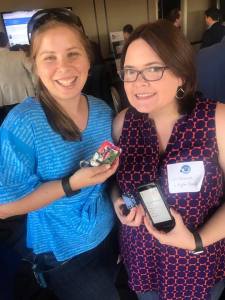
Wonder Women! Dana Lewis and Melissa Lee and their magical machines.
Life for a Child
The IDF Life for a Child update, annually held at the start of the meeting, was, in equal measure, enlightening and despairing.
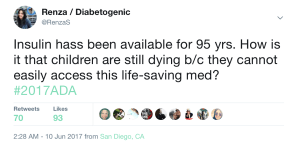
In this video, hear from Life for a Child Education Director, Angie Middlehurst, who recently visited the Diabetes Association of Sri Lanka and met some young people benefitting from the Program.
If you would like to consider helping Life for a Child, it costs only $1 per day to provide full diabetes care for a child. That’s right, one dollar a day. If you can, please do donate.
With Life for a Child’s Education Director, Angie and Health Systems Reform Specialist, Emma.
Who has a meeting at 5.30am?
Anyone who believes these meetings are junkets would reconsider the first time they need to be dressed, coherent, communicative and respectable for a 5.30 session. That’s 5.30am. And on the Saturday morning of the conference, I found myself in a room with a lot of other people (also foolishly awake at that time), to listen to the latest in CGM studies.
Thankfully, the session was super interesting with a lot of very valuable information being shared. (I really would have been pissed if I got up and it was a waste of time…)
Dr Steven Edelman from TCOYD was, as always, enlightening and added a most important ‘personal touch’ as he shared some of his own experiences of CGM. And some brilliantly relevant sound bites to remind the audience that while they may be focused on the machines and the algorithms and the clinical outcomes, this is about people living with diabetes.
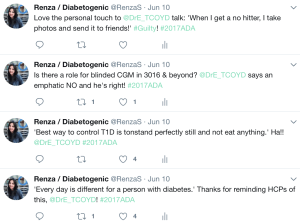
Trying to tweet everything Dr Steven Edelman was saying…
Diabetes Hands Foundation wake
The news about the closure of the Diabetes Hands Foundation, and the move of its forums to Beyond Type 1 was met with sadness, but also a lot of optimism. Innovators in the online community, DHF was the first online diabetes network I ever felt a part of. It spoke to me, but mostly, it was inclusive. That’s what happens when you have people like Manny Hernandez, and later Melissa Lee, at the helm, and a team around you of people like Mila, Corrina, Emily and Mike.
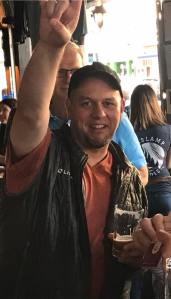
DHF founder, Manny Hernandez.
We farewelled the DHF at a wake in a bar on 5th Ave in San Diego on Saturday evening and the love and gratitude for DHF was overwhelming. Melissa asked us to recall DHF’s Word in Your Hand campaign as a tribute to Manny and DHF.
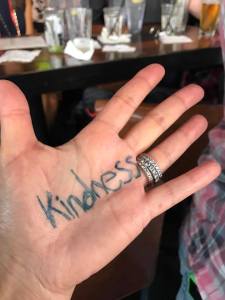
My word on my hand… We can always use more of this.
I’m honoured to have been a part of it.
Language
Oh yeah, there was a language session at #2017ADA and I have PLENTY to say about it. Maybe next week….
Sex, Insulin and Rock ‘n’ Roll
The team from Insulet threw an event on Sunday night way up in the sky, overlooking Petco Ballpark, home to the San Diego Padres, and we were presented with a panel of diabetes advocates prepared to talk about anything and everything. Brilliant in the way it was candid, unashamedly open and, possibly for some, confronting. Well done to the panel members who really were prepared to answer every question with personal insight and experience. This format really should be rolled-out as widely as possible to as many people as possible to help breakdown any embarrassment, or idea that there are taboo topics in diabetes.

Children with Diabetes
I was lucky enough to be invited to attend the annual CWD-ISPAD dinner on Monday night and speak with a number of healthcare professionals working to improve the lives of children living with diabetes.
Jeff Hitchcock, founder of CWD, is a personal friend now. I guess that’s what happens after you attend a Friends for Life conference and are welcomed into the family. FFL Orlando is taking palce in three weeks and my family’s time at FFL remains one of the most overwhelming and positive experiences of my life with diabetes.
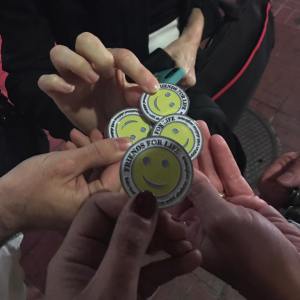
I caught up with Jeff a few times throughout the conference to speak about the organisation’s work. He gave me a CWD medallion, which is now firmly wedged in my wallet as a reminder of not only my FFL experience, but also value of Children with Diabetes.
diaTribe
I could complain about my 19-hour days, but then I think about Kelly Close from diaTribe and then feel sheepish for even suggesting that I’m working hard! On the final night of the conference, diaTribe hosted three events and I attended the later two: Musings Under the Moon and Musings After Hours.
These events bring together leaders in diabetes technology and innovation and digital health and offer an opportunity to ask questions and challenge (and be challenged!) in a far less formal situation that the official ADA conference. For me, this is where I learn the most as the speakers are prompted by hosts Kelly and Adam Browne to really reflect on where we are going in diabetes innovation. My only misgiving about these events is that there are not enough people attending. That’s not to say that the spaces were not packed to the brim – they absolutely were. But I do wonder if perhaps it’s the people who really need to hear the realities of diabetes technology are not in the room…

MedAngel
I meet Amin from MedAngel as part of my time with the European Roche Blogger Group. Amin has created an easy-to-use sensor and app to help people with diabetes ensure insulin is kept at the right temperature. More about this another day, but in the meantime (after I’ve been using my sensor for a while), you can read about it here.
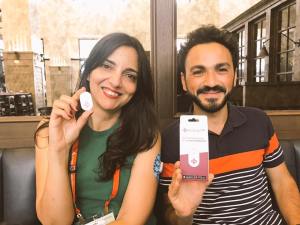
Learning all about MedAngel, with Amin.
Take aways
ADA is a very large conference. There is a lot going on, there are a lot of people around and I always leave with a lot to think about. Over the next few days…weeks…I’ll start to gain some clarity about a lot of what I saw, heard and learnt. It’s always the way after a big meeting like this one.
Someone asked me if I enjoyed the meeting and I suggested that was probably the wrong word to use. It was very worthwhile. I learnt plenty. I was able to catch up with advocates in the space who continue to push boundaries and lead the way in insisting that all work in the diabetes space is ‘person-centred’. People with diabetes are expected at this conference and seeing us as just being there – rather than having to fight for our place – inspires me to keep working better and harder.
Disclosures
I attended the ADA Scientific Sessions as part of my role at Diabetes Australia who covered my expenses, except for my first two nights’ accommodation which were covered by the International Diabetes Foundation so I could participate in meetings for the World Diabetes Congress where I am Deputy Lead for the Living with Diabetes Stream.
Brutal. That’s the way I’ve been describing my week. It’s been super busy and there is no hint that will change any time soon.
But there is so much stuff out there to read. Here’s just some of it…
CGM
Oh, did you hear? CGM is now funded for children and young people under the age of 21 who meet eligibility criteria. It’s been ALL OVER the interwebs, but for the most up-to-date info, go here!
(And yes, I know, people 21 and over need CGM and need support. This isn’t over yet…!)
A psychologist who knows diabetes? Yep!
A good psychologist is worth their weight in gold. A good psychologist who understands the impact of living with diabetes on our overall wellbeing is like a unicorn – rare and magical.
So, I was delighted when someone from my office who has been a Research Fellow with the ACBRD for a number of years came to tell me that she is starting a private psychology practice. Dr Adriana Ventura’s research has focused on the psychological, social and behavioural aspects of living with type 1 and type 2 diabetes.
Adriana understands that living with diabetes (and other chronic health conditions) can be challenging. And she understands that these challenges can make it tough to take care of our health the way we would like.
Details about Adriana’s practice can be found here. (Adriana works with adults and older adolescents – 16 years and over)
Really? REALLY?
Seems that we’ve all been doing diabetes wrong. That lancet thing that we joke about never changing? This is how you use it according to the pic accompanying a BBC Radio 2 tweet.

Apparently it is really hard to do some decent research. (And if the image wasn’t enough of a deterrent, the article looks shit too, so didn’t bother reading it.)
My maths teacher was right
So, as it turns out, I do use maths every single day. Diabetes has certainly put my algebra skills to good use!
This article from The Conversation is all about how an applied mathematician developed an algortithm to help treat diabetes. As you do.
Words that over-promise
I can’t remember the number of times I’ve heard that a diabetes cure is ‘just around the corner’ or any other version of ‘five years away’.
But how do these promises affect people living with health confitions? This article from Medivisor asks just that.
March for Health
While we were celebrating the CGM announcement on Saturday, I was very mindful that my US friends were getting ready to continue their battle for fair healthcare. March for Health was held across the US on 1 April calling for affordable access to quality health care for all people. I don’t know about you, but that doesn’t sound unreasonable to me.
Check out more at the website here.
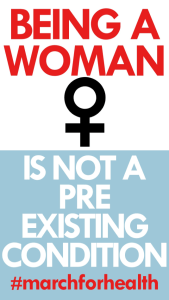
And this, by the way, is possibly one of my favourite promotional posters from the March.
Women’s Health Survey … Quick!!!
And while we’re talking women’s health…There are still a few days left to do the annual Jean Hailes Women’s Health Survey, which identifies gaps in current knowledge when it comes to women’s health.
College Diabetes Network
There are some really wonderful groups out there supporting people with diabetes, and my friend from the US, Mindy Bartleson emailed me with some really useful information about the College Diabetes Network (CDN). The Network empowers and connects young people with diabetes and their are CDN Chapters on college campuses across the US.
The Network is certainly US based, but some of the information will be relevant to those in Australia (and elsewhere). Their resources provide information about how to prepare for the transition from high school to college or university. Do have a look!
Information for students can be found here. And information for parents can be found here.
Peanut butter cookies
I made these cookies and jeez were they delicious!

They are gluten free, which I know is important for many people. For me, I need cookies that take no more than 10 mins to mix together and then taste perfect. Honestly, they are possibly the best tasting biscuit/cookie I have ever made… and I bake a lot.
The recipe can be found here. (I used smooth peanut butter as the recipe suggests, but I reckon they would taste awesome with crunchy. Also, do pop the mixture in the freezer before trying to shape the cookies. The dough is mighty-soft and sticky, and this step helps to get the dough from the bowl onto your cookie tray. AND DON’T SKIP THE SALT ON TOP!! This is what ties it all together and makes the magic happen!)
And finally……
… a little New Yorker Cartoons funny, which may not be directed at diabetes, but boy it certainly shows how I feel most days living as a diabetes tech cyborg!

Yesterday, on her first day of school, the kidlet’s English class was about autobiographies. So, we had a long chat about some biographies and autobiographies we’d read – and ones we wanted to read – and why they are a really important way for people to share the stories of their life.
Story telling is one of the most powerful ways to record events, emotions and life experiences. Others who may be going through similar experiences can feel great comfort knowing that others have not only lived through certain situations, but stuck around to tell the story! And it is also a fabulous way to share stories with those not familiar with different places, circumstances or surroundings.
Our stories have the ability to inspire, offer an opportunity to learn, and help make sense of things around us.
So, it took me no time at all to respond with a resounding ‘YES!!’ when I was contacted by Anna Sjöberg from Anna PS and Sofia Larsson-Stern from Diabetesia, asking me to be in their book about people living with type 1 diabetes.
The e nd result of their hard work is a fabulous book – ‘We can, want and dare …and we have type 1 diabetes!’ – and it features people from all over the world telling their stories of life with type 1 diabetes.
When putting together the book, Anna and Sofia wanted to provide real-life stories from people with type 1 diabetes from all walks of life: from kids and teens
(such as this one who is, quite simply, AMAZING!) to adults doing all sorts of amazing extraordinary, and every-day things. There is a Brooklyn-based chef, an incredible young advocate from Sweden and another Swede whose Instagram profile describes him as a Multisport Team Ninja Warrior! Oh, and a Melbourne blogger and activist.
The books was launched it its original Swedish-language version last year on World Diabetes Day and the English-language version has just been launched and is now available.
This book is not just for people with type 1 diabetes, although, with its stories of hope it certainly would be a wonderful thing to give someone newly diagnosed! It is also for friends and families of those living with type 1, and people who really have no significant connection to type 1 diabetes, because it provides an understanding of the complexities of the condition that we live with and offers a very personal insight into life with type 1.
You can order your copy of the book here.
GIVEAWAY GIVEAWAY GIVEAWAY
I have three copies of ‘We can, want and dare …and we have type 1 diabetes!’ to give away to Aussie-based readers of Diabetogenic, thanks to the team at Anna PS. Just click here and send me a message telling my why you would like a copy. Keep it short – brevity is key here!
DISCLOSURE
I was invited to provide my profile for the book and received no payment for my contribution. I will receive a signed copy of the book for my bookshelf, though, and can’t wait to see it!
Today, I gave a talk to healthcare professionals at a hospital in outer Melbourne. I was invited months ago after the organisers heard me speak at another event, and they wanted me to speak about living with diabetes.
As I said in the introduction to my talk, I am dead boring. Plus, I am only one voice. So, to create some balance and some interest, I reached out through Facebook and asked this:

As usual, the online community didn’t disappoint. I had over forty responses and weaved them into my presentation, adding real impact to what I was saying, reinforcing my comments with the comments of others walking a similar path of life with diabetes.
I started by asking the audience a question…
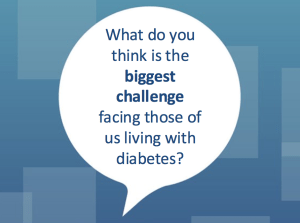
And then I said that I would be talking about life with diabetes. Except, I reminded the audience that life with diabetes was very different depending on where in the world you were diagnosed and that my story is about my ‘first world diabetes’ and I checked my privilege almost as a disclaimer.
I used that point in my talk as an opportunity to speak about those who cannot access or afford insulin and how this is simply, not okay. I could sense the surprise in the room as I said that people are dying because of lack of access.
Then I spoke about what diabetes is to me and here is what I said:

It’s boring and tedious and frustrating.

It’s made me an expert. And that we need our HCPs to acknowledge the hours and hours and effort we put into managing our own brand of diabetes and the expertise we develop from living so closely with this condition.

It’s about humour – because laughing is a tool I use to get through this and that’s okay.
 It’s about words, because language matters and sticks with us forever.
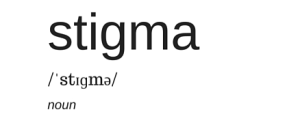
It’s about stigma. I asked if they could think of another condition that was so stigmatised and surrounded by blame – and that while we experience it with type 1 diabetes, I said that I believed my brothers and sisters with type 2 diabetes have it so much worse.

It’s invisible – despite the bright blue patch surrounding my Dexcom, most of the time it is hidden away and not on show for all to see.

It’s about people and community and the DOC and the people that are like the air I breathe – without whom I would not be managing at all.

It’s about my family. And then I explained, fighting back tears, that this is the hardest part of life with diabetes for me. I’ve written about it a lot, spoken about it often. But thinking about how diabetes impacts on Aaron and the kidlet breaks – absolutely shatters – my heart into pieces. The worry I cause my parents makes me feel guilty and resentful. And every day I regret the time I told my sister that my life expectancy had been cut thanks to my type 1 diagnosis because I will never forget the look in her eyes indicating the pain I had just caused her.
I answered a couple of questions and then my talk was done. I thanked the audience for listening, stepped down from the stage, took a deep breath. Someone came up to me as I was gathering my bags and said that she learnt more about real life with diabetes in that talk than in all her years nursing.
This is the power of story telling. The comments I read out and shared have so much power in them. We need to keep telling our stories, turning the way we talk about diabetes on its head. It’s not about the numbers, the tools or anything else. It is about people.
Thank you so much to everyone who shared their comments with me on my Facebook post yesterday and today.




 Diabetogenic