
You are currently browsing the category archive for the ‘Diabetes’ category.

It’s Diabetes Blog Week thanks to Bitter~Sweet Diabetes. This week, over 150 diabetes bloggers from all over the world are taking part and sharing stories about their lives with diabetes. This is the second year I’ve participated and I can’t wait to read what everyone else is up to. So, here we go with Friday‘s topic……
I’m afraid that I have no desire to swap type 1 diabetes for another chronic health condition. I’m not interested in starting all over again and becoming an expert in something I had no real desire to learn about in the first place. ‘At least it’s not cancer,’ I’ve had people tell me in an excellent example of apple/orange comparison. I’m sorry, but I don’t like the idea that one condition is a consolation prize. Diabetes certainly may be a manageable condition but, unless a transplant is involved, there is no opportunity for remission. It’s also a condition that doesn’t understand the concept of taking a break or letting up on the care required to look after it as best I can.
For me, the silver lining in this whole diabetes palaver has always been the people I’ve met.
The DOC has been an amazing source of support– there is never a time of day when I can’t log onto something and find another PWD up and ready to shout out a word of encouragement. There have been many times a middle-of-the-night low has been accompanied by someone from the other side of the world chatting away and then checking in on me. Feeling alone when you join the DOC family is impossible.
One recurring theme in the DOC is annoyance aimed at people who don’t get what we’re going through and those who say stupid things. I see this again and again and it is one of the reasons that I am a lot more careful about what I say to people I know, or meet for the first time who are living with a different medical condition to mine. I have no idea what someone living with a condition like Parkinson’s or cystic fibrosis goes through, so it would be ignorant of me to think I could understand and start offering advice on how they could better manage. I like to think that I am far more sensitive to the sensibilities of living with a chronic health condition and while I will never say ‘I know what you’re going through’, I can appreciate the frustration of having to consider your health at times when you would rather just be enjoying a cupcake.
I do wonder if my approach to other people with health conditions is because of my personal experiences or just plain common sense and good manners. The things people say are sometimes insensitive, thoughtless and plain stupid. But you know, you can’t cure stupid; which is certainly one chronic condition that I wouldn’t trade diabetes for.
Follow Diabetes Blog Week on Twitter by searching the #DBlogWeek tag.
It’s Diabetes Blog Week thanks to Bitter~Sweet Diabetes. This week, over 150 diabetes bloggers from all over the world are taking part and sharing stories about their lives with diabetes. This is the second year I’ve participated and I can’t wait to read what everyone else is up to. So, here we go with Thursday‘s topic……
It’s very easy when we’re talking about our accomplishments with diabetes to think only of the ‘big stuff’. Yesterday, I wrote about the day my daughter was born and when it comes to diabetes achievements, that day and the nine months leading up to it get a huge tick.
But I think that for me the greatest achievement has been learning to live side-by-side with this condition. It took me a while to understand where diabetes fit into my life and it wasn’t until after I’d actually accepted that I needed to grieve for the life that was that I realised that I could live, live well and be happy despite diabetes.
I am really pleased that I can honestly say that diabetes hasn’t stopped me from doing anything. I have never used it as an excuse (okay – those times I pushed in line at a cupcake shop don’t count, right?) and I have never felt that I should be pitied for having diabetes. It’s part of my lot in life and as crap as it can be at times, it’s become part of the fabric of my life.
I never thought that I’d be able to see diabetes as ‘just there’ rather than a big, scary thing that needed to be controlled. Perhaps it was when I gave up the need to micro-manage every aspect of living with a chronic health condition that I worked out how to co-exist with it. This absolutely doesn’t mean that I don’t hate it at times and wish it wasn’t there – of course I do. Accepting that it’s here forever was tough and made me angry for a while. And of course, I get frustrated and pissed off when it rears its stupid head when I just don’t have time for it, but that’s the nature of diabetes.
I can’t change the fact that my beta cells took a permanent holiday without me. I can’t change the fact that for the rest of my life I will be living with diabetes. I can’t change what’s around the corner – even though I can do what I can do try to minimise risks. I can’t change that there are no guarantees.
But I have accepted that it’s here. And I feel pretty proud of the life I am living because of and despite diabetes.
Follow Diabetes Blog Week on Twitter by searching the #DBlogWeek tag.
It’s Diabetes Blog Week thanks to Bitter~Sweet Diabetes. This week, over 150 diabetes bloggers from all over the world are taking part and sharing stories about their lives with diabetes. This is the second year I’ve participated and I can’t wait to read what everyone else is up to. So, here we go with Wednesday‘s topic……
They may be few and far between, but there have been days where I feel that I have conquered diabetes and none more so than the day my daughter was born. Even though it was eight-and-a-half years ago, I can still remember every detail of her delivery and first day in my arms so clearly.
Even though the day was all about meeting her, diabetes was prominent. It was because of diabetes that she was delivered at just under 38 weeks. It was because of diabetes that I decided to have a caesarean delivery. It was because of diabetes that the operating theatre was full of medics including a paediatrician. It was because of diabetes that the moment she was lifted from my body and briefly held up for me to see, she was whisked off to have her heal pricked to check her BGL. It was because of diabetes that she was later taken to the Special Care Nursery because her BGLs had dropped.
But despite diabetes – despite all the things I’d been warned about and the things I read – I had a beautiful healthy baby girl. She is my greatest achievement and these memories are my most precious. Despite diabetes, I was up by the afternoon visiting her in the nursery and breastfeeding her as I muddled my way through my own low blood sugars.
I wonder if I will ever forget the details of the day. The way Aaron and I looked at each and gasped when we heard her voice for the first sound; the way I tore away at her swaddling so I could feel her skin against mine when I first held her in the minutes after she was delivered; the way her hands opened and closed around my finger; the way that Aaron looked as he held her when I was wheeled back into my room after recovery. Everything seemed right – our much wanted baby was with us and she was healthy.
I don’t think of this day as a ‘diabetes day’. It’s the day of my daughter’s birth. But as with all my days, diabetes is there. This particular day makes me so proud because of the way I was able to manage my diabetes; deal with it in a way that worked and then get on with the important things. The most important thing ever – meeting my daughter.
Follow Diabetes Blog Week on Twitter by searching the #DBlogWeek tag.
It’s Diabetes Blog Week and this is my Tuesday post which was first published at the Diabetes Australia – Vic blog.
I am lucky when it comes to my diabetes support network. I know this and I will say it several times in this post. I also know that I am likely to come off as being ungrateful which is not the case at all. Today, I want to explore the idea of how these support people are identified, either by themselves or by people living with diabetes. Specifically, I want to talk about the term carer.
The Oxford Online Dictionary defines carer as:
a family member or paid helper who regularly looks after a child or a sick, elderly, or disabled person.
I don’t have a carer. I am the person responsible for living with my diabetes, but I do not have a disability and I certainly don’t consider myself sick. And, although I’m pushing a ‘significant age’ I am not yet elderly.
I understand and completely believe that there are people who are really and truly carers. There are people who are responsible for feeding, toileting, bathing, communicating for another who is unable to do it themselves. I am not referring to instances like this. I am referring to, I guess, diabetes.
I don’t consider my husband, who is involved in my life with diabetes to be my carer. He’s my husband, my partner.
Living with diabetes is not a solo game for most and this is a truly wonderful thing. We get support and help from people and I for one feel very fortunate to know that I have people (family, friends, healthcare professionals), I can rely on if I need them.
But I don’t consider any of them my carer. I would refer to them as my support network. In the case of my HCPs, they’re paid to help me with the things I need.
My husband would never say that ‘we’ are a family with diabetes. He would say that I (his wife) have diabetes. Not for one moment would he consider himself to be living with this condition even though he regularly is part of it. But as far as ‘ownership’ goes, it’s mine. He will step up as much or as little as I ask and in the few times it’s been necessary, he’s taken over, done what’s needed to be done and then, when safe, stepped back.
My independence and confidence in my ability to self-manage comes from being given the space from those around me to do what it is I need to do. I know there have been times when Aaron would like to sit me down and force feed me glucose because he can see that I am low. As I stand at the open fridge and in my hypo-fog state try to calculate the carbs in a cucumber (yes, I know!) he has had to just step back and let me work it out myself, stepping in if asked.
I see this like watching my daughter do something in a way that is frustrating to me. I would love to jump in, show her how to do it far more effectively (or do it myself) and then move on. But her self-confidence and her ability to trust her decision making process needs to be encouraged, not overshadowed by a parent who insists on taking over all the time which suggests that she cannot do anything herself.
To me, the term carer implies helplessness. I get that diabetes is a lifelong condition and that there are stages in a person’s life when they may need extra care. For example, children with diabetes are reliant on their parents for the day-to-day management tasks. But is that being a carer or is that called parenting albeit with an incredibly extra degree of difficulty? Or what about an adult with diabetes who is having a period of hypo unawareness and their partner is required to, at times, inject them with glucagon? Is this being a carer or is this just doing what partners do – look after each other at a time of illness or need?
What about when I am lying in bed, unable to move because my BGL is high, I have mild ketones and am vomiting? As I decide whether or not I need to take myself off to A&E, my husband is holding a bucket in one hand and my hair in the other. I don’t consider him to be my carer, any more than I considered myself to be his carer when he hurt his back and I was warming up a heat pack and giving him pain killers every four hours.
I don’t in any way want to undermine the importance, help or value of the support I receive. I don’t for a minute want to say that I don’t need it or resent it. But equally, I don’t want to be considered as being helpless. The relationships I have with people where diabetes is sometimes considered are based on incredible respect – from both parties. They respect that I am the one who is living with this and dealing with it and I respect the way they allow me to do that.
Okay, over to you. Do you consider the people in your life to be your carers when it comes to diabetes, or do you consider yourself to be the carer of someone with diabetes? Is there another term that you use or prefer?
Diabetes is the natural enemy of the frock. Yes, it is! There are countless discussions on Facebook and other diabetes forums that could all pretty much be headed ‘where the fruitcake do I put my pump?’ I know of pockets sewn into dresses, invisible hooks added to wedding gowns and incredibly-difficult-need-instructions-to-use contraptions whose only purpose is to keep the pump hidden, yet accessible.
This is the dilemma I was faced with the other night as I frocked up for the gala dinner celebrating Diabetes Australia – Vic’s 60th anniversary. Alas, where to put the pump. Due to a very low cut back, the dress had in-built supports as a bra couldn’t be worn. (I could now go into a discussion about how I’ll need therapy for the Hollywood tape I was required to wear, but let’s stay on topic.)
I toyed with the idea of leaving my pump home and using pens for the night, but the thought of calculating basal insulin, then blousing made my head explode a little bit. I thought about not worrying about dealing with basal insulin and doing tiny corrections every hour or so, but I knew that I’d remember for the first hour and then completely forget about it for the rest of the night – or, at least, until I realised I was spending a lot of time running to the loo and chasing down waiters to fill my water glass.
So, I started thinking about a holster for the pump. I used to have one made of stretchy material that was held in place with a Velcro catch. There was a little pouch for the pump and the whole thing was meant to sit snugly on the thigh. And it did…until it started to slide down the leg and I was left doing some sort of weird two-step, trying not to trip over the pump tubing while attempting to reconnect the whole thing. Please, just picture the elegance, if you will.
Despite my husband kinda liking the idea of me wearing a holster, the thigh thing was a failure.
A woman I work with – who for the purposes of this will be known as Brilliant Sue (because she is brilliant and her name is Sue) suggested Tubigrip which is a stretchy, tubular bandage.
It worked a treat. The pump stayed exactly where I wanted it (inner thigh, so no tell-tale ‘pump bump’ showing through the dress, and was easy to access when I needed to bolus or check my CGM.
Unfortunately, the flesh coloured stretchy fabric didn’t look too hot, but given that the only two people who saw it were me and Aaron, it did the trick.
So while to everyone else there, I looked like this…..
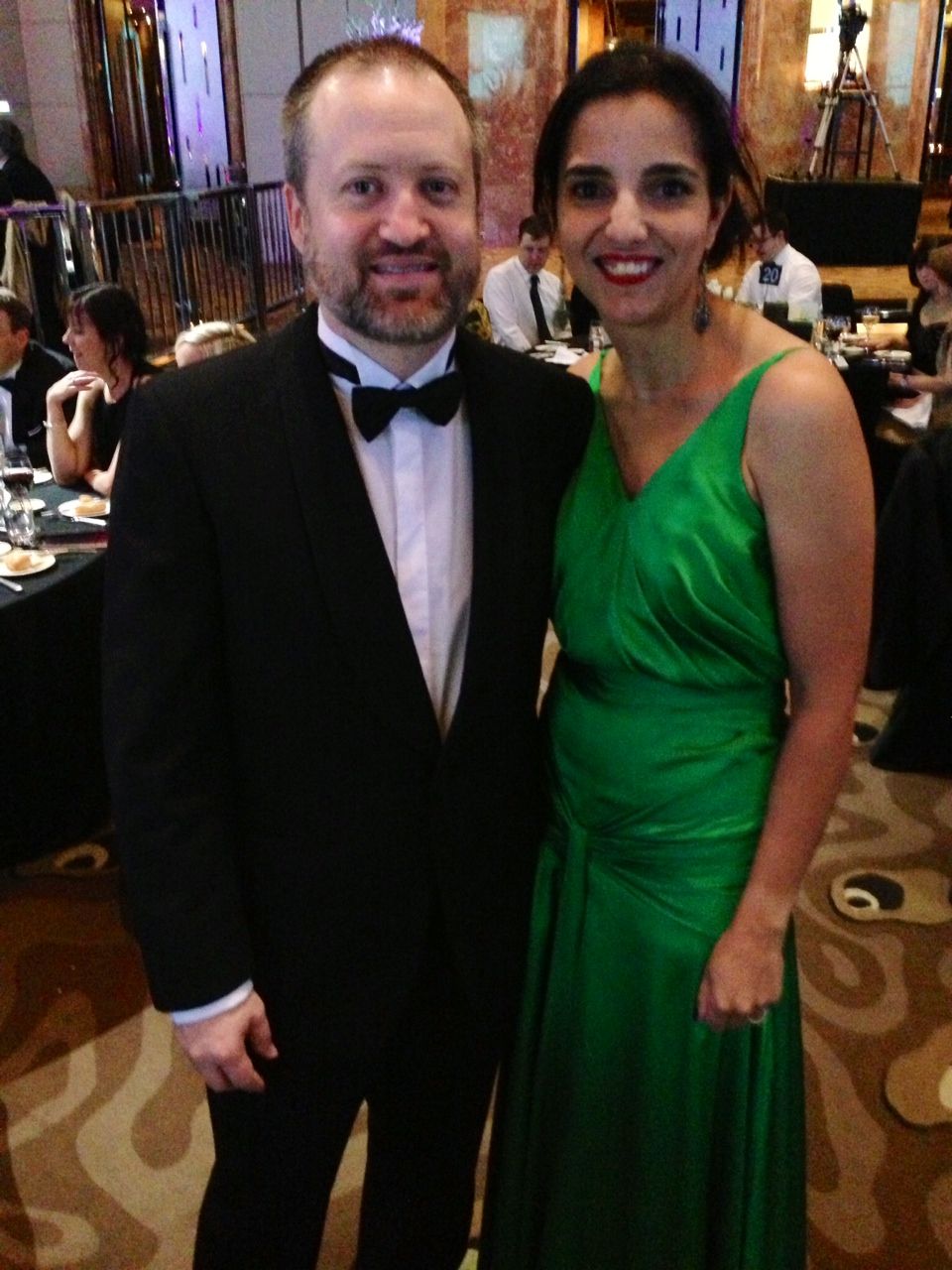
…..all I could think about was how diabetes manages to take the glamour of dressing up down a notch, thanks to this:
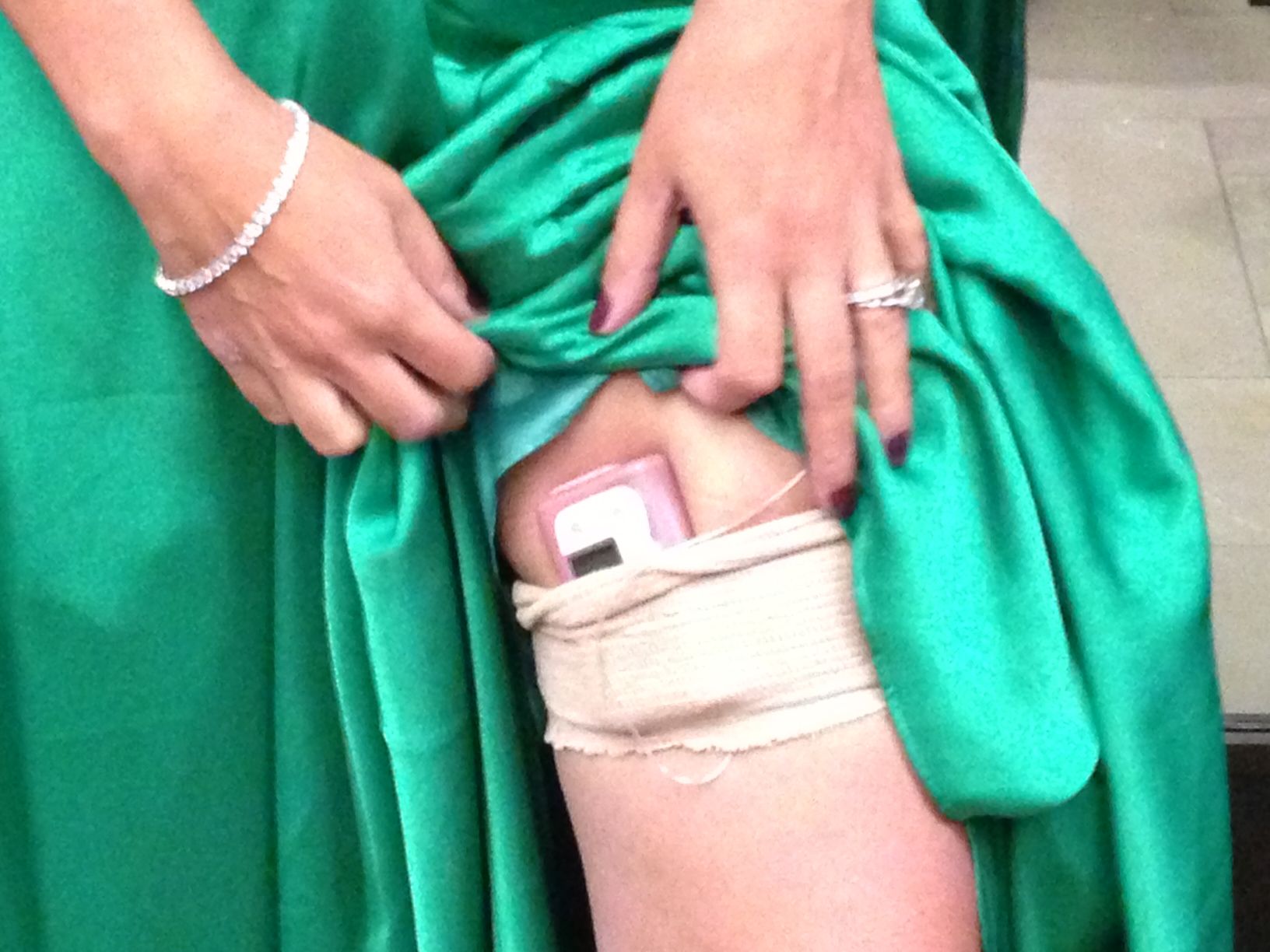
But despite the delightful flesh-coloured bandage, I had a great time. And if truth be told, the most traumatic part of the night was the Hollywood tape. Now that is the stuff nightmares are made of!
I hate to jump on any bandwagon, but I’m jumping on this one – boots and all! Some of you may have seen the petition that is going around at the moment about changing the name of diabetes, or rather revising the names of type 1 and type 2 diabetes to better reflect the nature of the conditions.
Yesterday, I read a most thoughtful and well-considered commentary on the issue by Queen of Diabetes Art Lee Ann Thill. (I don’t know Lee Ann personally, but I adore the work she does around Diabetes Art Day and her brilliant project the VIAL Project.)
Lee Ann suggests that changing the name of type 1 diabetes to better distinguish it from type 2 diabetes is not going to do anything when it comes to public understanding of diabetes. She’s right. Stop for a minute and think back (if you can) to a time where diabetes wasn’t part of your life. How much did you truly know about the condition? Did you even know there were different types of diabetes? Could you identify the myriad ways type 1 diabetes is treated?
Did you know that there are four types of multiple sclerosis? No, neither did I until I asked Dr Google. (Although, I did know that there was one called relapsing-remitting MS because that’s what Jed Bartlet had in The West Wing, so naturally, I’m an expert on that!) And is it really important that as a person who has no connection to anyone living with MS that I have an in-depth knowledge about it? Or understand how it impacts on the life of a person with MS? Should I be expected to understand that primary-progressive MS is different to progressive-relapsing MS? My tiny little brain is already pretty full of information I need (location to closest decent coffee shop) and useless info (being able to quote Marx Bros films), so I’m not sure that I have room for minute details about living with MS or any other health condition other than the one I have to deal with daily.
I understand how frustrating it is to have people tell me that they can cure my diabetes if only I’d stand on my left foot under the full moon on a Tuesday in November and lots of other things. But I don’t think that changing the name of diabetes is going to stop people offering these gems.
What we really want to fix are the people who are being stupid and insensitive. And I’m afraid that’s just not going to happen.
Diabetes sucks – I think that’s one thing upon which we can all agree. And there are some really significant and important issues that people living with this condition face on a day-to-day basis. Such as access to healthcare and to technology; inadequate healthcare; kids being safe while at school; discrimination in the workplace; emotional wellbeing;
None of these issues will be solved or made better for people with diabetes by changing the name of the condition. More funding is needed to improve access to technology and increase the number of HCPs (especially in rural and remote areas); better education and training is needed to improve HCPs’ knowledge about diabetes and real-life with diabetes; more training – compulsory training – is needed by the people who are charged with looking after kids in school and out of school hours care; tougher penalties may stop discrimination in the workplace; regular screening is needed to identify the emotional health of people with diabetes.
Surely, but surely we should be directing our energies towards these issues. I have accepted that when it comes to diabetes I am going to spend the rest of my life dealing with ignorant, stupid and insensitive comments from people who could be described using similar adjectives. Changing the names of type 1 and type 2 diabetes won’t magically make people stop being so ignorant. It would simply add another layer to the confusion.
Yesterday, the same question was posed to me twice: ‘How would you like health professionals to deal with people living with diabetes?’
The first time was after a short presentation I gave to a team of physicians visiting Australia from Thailand. I am incredibly privileged in my role at Diabetes Australia – Vic because I get to meet some amazing people from all over the world. The visiting doctors were very interested in our program and asked some great questions about how we run things – especially around the value and importance that we place on peer support and peer networks.
The second time was as part of last night’s OzDOC tweetchat. I was moderating the hour of rapid-fire diabetes cyber-chat, but it was Kim Henshaw who had come up with the ingenious topic of swapping places with our HCPs. Kim had posed some really thoughtful questions about how we would like our HCPs to respond in certain situations. The answers were amazing.
When I was asked the question for the first time -almost as I was walking out of the room after my presentation yesterday – I didn’t hesitate to answer.
‘Without judgement,’ I said. But then I felt that I needed to qualify that with, ‘And for them to realise that I live with this 24/7 without an opportunity for a break. I am doing all I can and there are going to be times that it is just too much.’
‘Thank you,’ the doctor who asked the question said.
‘Oh, and that it’s not all about numbers,’ I added quickly. ‘My A1c, blood pressure, weight, cholesterol – all my numbers – don’t give you anything more than a snapshot of a particular metabolic thing. I am much more than that.’
‘Good – that’s great. Thanks,’ said the doctor
‘And,’ I jumped in (guessing by now he wished he hadn’t asked the question), ‘It’s about more than the clinical side of things. My emotional wellbeing is just as important and if I am feeling burnt out emotionally, it’s highly likely that I’ll be struggling to get the day-to-day physical tasks done.’
‘Right. Thank you. Our next speaker is here,’ he said.
What he didn’t realise was that the next speaker was the fantastic Professor Jane Speight from the Australian Centre for Research in Diabetes. Later on she thanked me for setting the stage for her and what she was about to talk about. I thanked her for so eloquently providing the evidence to support my rantings!
I was more than ready for that question last night at the tweetchat!
Recently, I bought my husband a book called Three Wishes – An Intimate Look at Jazz Greats. I was in a local book and music shop looking for a copy of a documentary about the Baroness Pannonica de Koenigswarter who was a fascinating woman. She was a jazz patron and writer who moved to New York in the 1950s. Unfortunately, the DVD wasn’t in stock, but the bookseller suggested this book instead. I’m so glad he did.
The book is gorgeous – beautiful, archival photographs of jazz musicians. And each of them was asked the following question by the Baroness (who also took the photos): ‘If you were given three wishes, to be instantly granted, what would they be?’
How delicious! You can only imagine the responses she received from these great men and women of jazz.
I inscribed the book for Aaron with my three wishes and I’m afraid they weren’t anything ground breaking – health, happiness and something about New York. Quite generic, really. A lot of the responses in the book were about the musicians’ musical hopes, wishes and dreams.
So I decided to reframe the question and ask it in a diabetes context: ‘If you were given three wishes regarding diabetes, to be instantly granted, what would they be?’
Would we need three wishes? Surely for just about all of us, the first wish would be ‘cure diabetes’ and then we could be done with it! No more diabetes, and I’d be writing about cupcakes and coffee. And maybe doughnuts to keep things interesting.
But I think there is more. Because surely, if our first wish is a cure, we need to qualify that – it must be for everyone. It must be achievable, available and affordable. And surely, but surely, we should also be asking for a vaccine so that never again does anyone have to live with this condition. `
Today, there is no cure and, even more, there is no cure just around the corner. So maybe, with this in mind, my wishes would be a little more realistic. Perhaps those three wishes would like this:
- I wish the technology we have today was available to everyone. I wish every single person who wants access to the latest insulins, devices, treatment options can have it at their fingertips;
- I wish every person with diabetes could have access to a team of health professionals who are smart, sensitive, non-judgemental and understand what life with a chronic health condition like diabetes is all about. And that mental health screening was available to everyone – with proper follow-up treatment.
- I wish everyone knew about and had access to the DOC and peer support networks.
Again, maybe not ground breaking. But equality of care? I think that is certainly something worth wishing, hoping, praying, dreaming about.
I put the first question to Thelonious Monk….
“If you were given three wishes, to be instantly granted, what would they be?”
He was pacing back and forth, and he paused for a moment to gaze out across the river at the New York skyline. Then he gave his answer.
- To be successful musically
- To have a happy family
- To have a crazy friend like you
And I said, ‘But Thelonious! You have those already!”
He just smiled and began pacing again.
Three Wishes: An Intimate Look at Jazz Greats
What are your three wishes when it comes to diabetes?
I’m feeling rather drained today after a restless night of little sleep. For once, the reason is not diabetes. Rather, it’s my poor husband and his neck/back/shoulder. He’s been in a world of pain for a couple of weeks now thanks to a middle-of-the night visit from Miss 8-year-old who woke after a nightmare and wanted to cuddle and feel safe. She crawled into our bed without either of us realising and situated herself comfortably right between us – we’re sure in one of these positions. This resulted in me sleeping with one foot on the floor and poor Aaron being scrunched up in a corner. He woke in pain and it’s been getting worse ever since.
She quite often runs into our bedroom in the mornings when Aaron has gotten up to go to the gym or to jump in the shower, and dozes, cuddling up next to me until it’s time for us to get up and face the day. Or on weekends when we’re enjoying a sleep in, she might jump on the bed, promise to be quiet and then wriggle, whisper (LOUDLY) and be very, very rowdy peaceful until we give in and get up.
But this night was different – she was in there for a good part of the night and the result was not a fun morning of cuddles and tickles. Instead, Aaron has been dealing with this horrid pain.
Last night, for the first time, the pain actually woke him from his sleep. And at 4am, his tossing and turning as he tried to find a position that didn’t cause excruciating pain woke me. We got up to find some pain-killers and then I located a heat pad and warmed it up for him to see if it would help with the pain. It didn’t. Neither of us got back to sleep. So today, tiredness is reigning supreme!
I can’t remember the number of times I’ve woken Aaron up in the middle of the night, asking him to grab me some juice or jelly beans to treat a low BGL. Or the times when for some reason (looking at you, dislodged pump lines) my BGL is sky-high and has woken me and we’ve lain there together as I will the nausea to bugger off.
I can’t remember the number of times my CGM alarm has woken him, but not me. Or the number of times a pump alarm has sounded demanding a cartridge to be re-filled or a battery replaced. (Yes; yes I know I should pay more attention to the low battery/cartridge warnings!)
In my experience it’s the night-time diabetes things that impact more on Aaron than the day-time things. Even when I don’t need his help, I do turn lights on, drop things, walk into walls etc. as I stumble from my sleep to deal with the errant low.
So there is absolutely no complaining from me as we get through our day today. Because for once, I was helping him out in the middle of the night. It’s kinda nice to be able to give back even if it was only one night.





 Diabetogenic