
You are currently browsing the category archive for the ‘Diabetes’ category.
I’ve been thinking a lot about diabetes burnout lately. A lot.
I have been burnt out for a long time now – it’s been 18 months. I can see how it started – I know the trigger. I miscarried in terrible circumstances and, after the constant monitoring and intense management that comes with trying to get pregnant and then conceiving, losing the baby allowed me to ‘take a break’.
I’ve not come back from that break.
My question is this: When does it stop being ‘diabetes burnout’ and become something more? And what is the ‘more’?
We use the term burnout so much in diabetes; I feel that I’ve become a little desensitised. It’s the norm – most people go through periods where they are so unmotivated that they can’t deal with their diabetes, or pay less attention than they typically would. But how long is ‘normal’? How long can we go on like this?
My burnout is scaring me because it has been going on for so long. I fear I’ll never get my mojo back and actually get to a point where I am able to care for my diabetes in a capable way.
I go through periods of so few BGL tests that my meter resets itself. I have not seen my endo for far too long and I’m way behind in my complications screening. The only thing I am up to date with is eye screening because I had cataract surgery in the last twelve months.
A button on my pump has been playing up for over 3 months – half the time taking three or four attempts to get it to work – and instead of getting straight on the phone to the company’s customer service team and organising a replacement, I let it slide until Monday, when I realised that next week I am getting on a plane and going away for 6 weeks and if I don’t get it sorted I’ll end up with a dead pump while overseas.
I’m taking my insulin, although haven’t basal tested for a long while and know that the rates need adjusting. I ‘blind bolus’ a lot of the time. Wearing a CGM is useful because it gives me an idea of my glucose levels, but I don’t actually do anything constructive with the data I am receiving.
I keep in touch with the online community which is my link to seeing and hearing how others are coping. While I don’t participate in every week’s OzDOC chat, when I do get there I feel supported and know that I have people to turn to if I need them. I guess I’m not completely disengaged.
A nasty hypo often gives me a shock and I get a few days of decent and frequent monitoring out of it, but this is short-lived and I fall back into minimal self-care pretty quickly.
And I feel totally and completely shit about the whole thing. And guilty. Of course I feel guilty.
In a couple of years of some pretty difficult stuff, diabetes is the thing that I can let go of. At least, I feel I can. I mean, I can’t stop being a mum. I can’t stop being a wife, daughter, sister, friend. I can’t stop coming to work. I can’t stop doing the things I need to do to be a functioning human. But I can stop with the self-care.
And because I am an idiot, or in denial, or just plain over it, I can’t see just how short-sighted this thinking is. I may be getting through the day and doing all those things that I tell myself I can’t stop doing. But how is all that going to work if something actually does happen as a result of my minimal self-care?
I honestly don’t know where to go from here. I feel paralysed and unable to make decisions that I know may help me start with some baby steps to get back on track. Is it a matter of re-engaging with my HCPs and talking to them for strategies? Do I try to set myself tiny goals, like a morning BGL check each day – or even every second day – that is achievable and will start to give me some data to work with? Do I go back to seeing a psychologist again and discuss ways to get back on track?
I don’t know.
It all seems too exhausting. It all seems too damn hard.
Is this burnout? Or is it something more?
I really don’t know.
This isn’t really a Christmas song, but I still think it’s a good song for this time of year. The wonderfully gorgeous Joni Mitchell and River.
Do you think of diabetes as a struggle? In my ongoing (frequently failed) attempt to spin positivity into life with diabetes, and my love of language, I keep coming up with different words to use: challenge, undertaking, effort, opportunity, experiment, endeavour, complete and utter shitness…
But I guess when push comes to shove, at the end of the day and what it all comes down to is (cliché, cliché, cliché!) there are days when it just really is a struggle. Sometimes I think that living with something that is just so damn difficult and unpredictable all the time means that we just start to accept it. We accept the struggle. The struggle becomes our norm.
I saw this little poster on a friend’s Facebook page the other day and straight away, it resonated:

I got very ‘rah rah’ about the sentiment on the poster, thinking that I should get it on a t-shirt. I do feel that living with diabetes has made me realise my strength.
But when I re-read it a couple of days later, I read the second word.
Thankful.
Am I thankful for my struggle, if my struggle is diabetes? I don’t know. I’m not sure.
Has diabetes made me a stronger person? Has diabetes made me understand my strength – just how tough and resilient I can be?
Perhaps it has. Perhaps it has made me realise that I can deal with pretty much anything that is thrown at me. If I can deal with the ‘never-ending-ness’ that is diabetes, the short term stuff – the things that are not chronic – seem more manageable.
So with that in mind, maybe it is not so much the diabetes that is the struggle. Maybe living with something that never ends, but never giving up; continuing to plug along and deal with it is the real struggle. And the real strength is in accepting it.
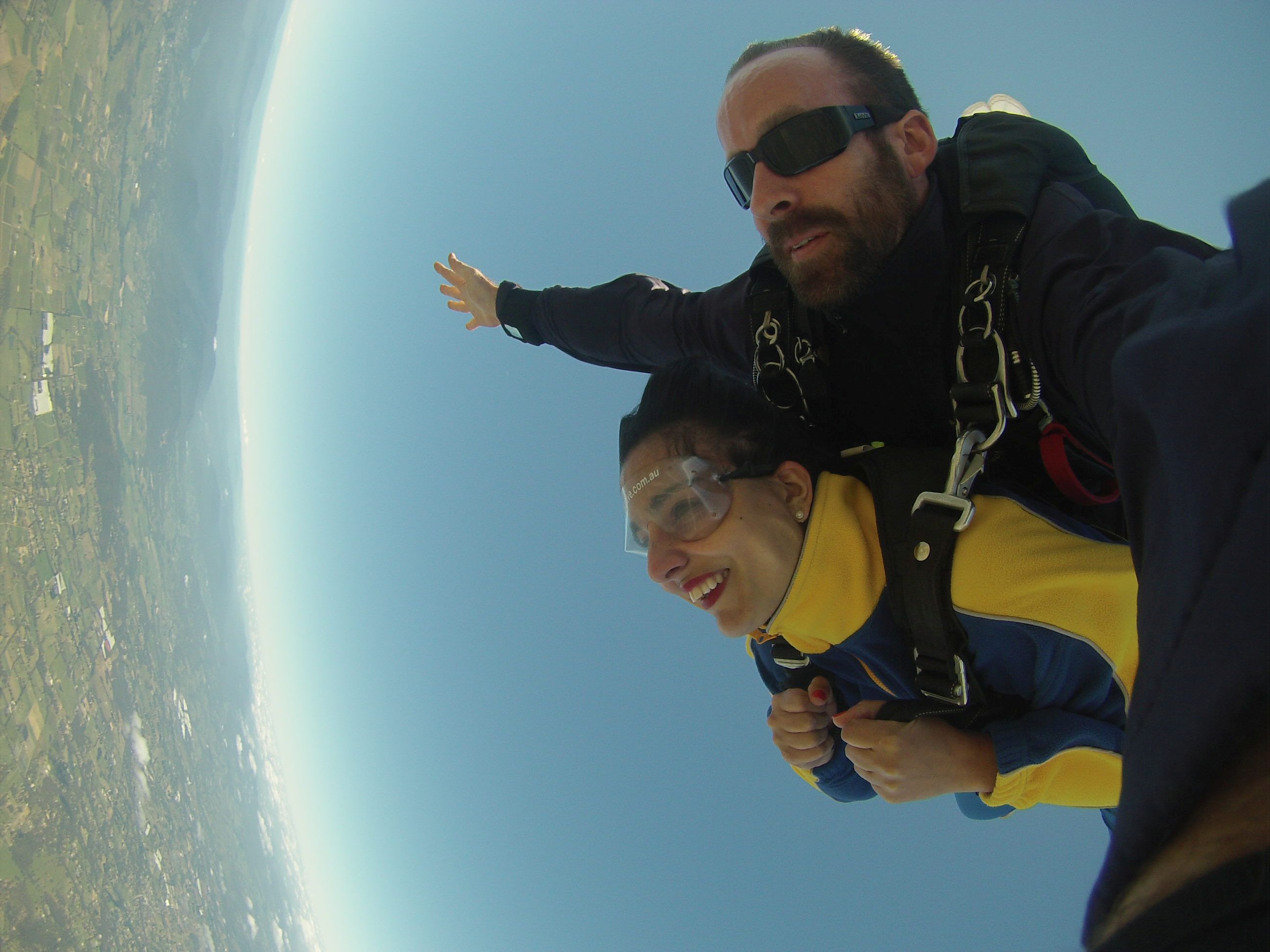
Free falling!
Over the weekend, I jumped out a plane. I didn’t mean to – it was completely unplanned. I had intended to go cherry picking while my husband went sky diving, returning just in time to see and photograph him landing safely. But as he was checking-in for his adventure, the lovely woman passing him some paperwork said to me ‘Do you want to jump?’ and inexplicably, I heard myself saying ‘Yes. Yes I do.’
Wait? What? I was meant to be picking cherries!
Instead, I found myself at 12,000 feet above the ground in a tiny Cessna, strapped to and sitting on the lap of a young man I’d met only half an hour earlier. We traded in clichés: ‘How long have you been doing this for?’ I asked him. ‘Today is my first day,’ he joked (I think…I hope…). ‘Shouldn’t you have bought me dinner first?’ I said as he strapped himself very tightly to me, pressing his body hard up against mine. Oh, how we laughed! Considering he was about to push himself out of a plane with me strapped to his front, we were very relaxed and chilled!
Let me tell you what jumping out of a plane does to ones blood glucose levels.
Just before I got out of the car – where the highest I planned to get for the day was up a ladder in a cherry orchard – my BGL was sitting nicely around 7.0mmol/l. Quite good, I thought, considering I’d eaten a lime brulee doughnut a mere 50 minutes earlier.

Floating….
Just before I climbed into the plane to fly into the sky and then hurtle to the ground, my BGL had crept up to 12mmol/l. I gave myself a correction bolus before disconnecting my pump and leaving it on the ground.
I have no idea how high my BGL got, but I suspect that if I had checked the moment I was sitting half out of the plane, with my legs hanging somewhat lifelessly over the edge of the step, about to tumble into the sky, free-falling to the ground at around 200 kilometres an hour, it would have been stratospheric and my meter would have expoded!
When I got to the ground and finished screaming with absolute, unabashed joy, and jumping up and down, and high-fiving anyone near me, I checked again to see a nice 17.9mmol/l.
I was running on pure adrenaline. I could feel the blood pulsing through my veins, the bright blue sky was vivid, people’s voices were crystal clear. It was as though my senses had all been heightened and I was feeling everything with an increased, crisp intensity. It was like nothing I had ever experienced before.
Apart from being interested in my BGLs, diabetes was completely insignificant in this little adventure. I filled in a few forms, one of them asking the requisite medical questions. I told the woman behind the counter that I have type 1 diabetes and use a pump. ‘Disconnect it and leave it with me,’ she said. ‘Same with your meter. Just check your sugars before you jump.’ I must have looked surprised. ‘A friend has diabetes. She’s jumped heaps of times. But never with her pump – she leaves it with me. They are worth a bit, aren’t they?’

Still floating…
I have never had a burning desire to sky dive; it’s not been on my bucket list – actually, I don’t even really have a bucket list. So perhaps because I hadn’t been thinking about it for years, I didn’t really have any expectations. I know deciding to do it was simply a spur of the moment decision – I wasn’t doing it to prove anything or to feel like a daredevil. It was just something to do because I was there at that moment.
I wasn’t nervous, I wasn’t scared. I just was. I hear all the time that people do things like this to shake up their lives or when they feel they are in some sort of rut. Was that why I did it?
As I was floating back to the ground, I thought about what I had just done and I realised that perhaps I hadn’t jumped to escape any feelings of boredom. I was not doing it to distance myself from feeling I was in a rut. I was jumping, and now floating, towards something. Towards my life. A life where, if I decided to, I would – and could – jump out of a plane. A life where nothing stopped me from doing things out of the ordinary; not even diabetes could stop me!
We headed to a cherry farm later the day. But picking our own fruit sounded like too much work, so we just walked up to the packing shed and bought a couple of kilos to take home with us. ‘I was going to pick my own,’ I said to the woman at the farm. ‘But instead I jumped out of a plane.’
I heard how strange that sounded and laughed, popping a cherry into my mouth. I had just jumped out of a plane. I had just jumped out of a plane.
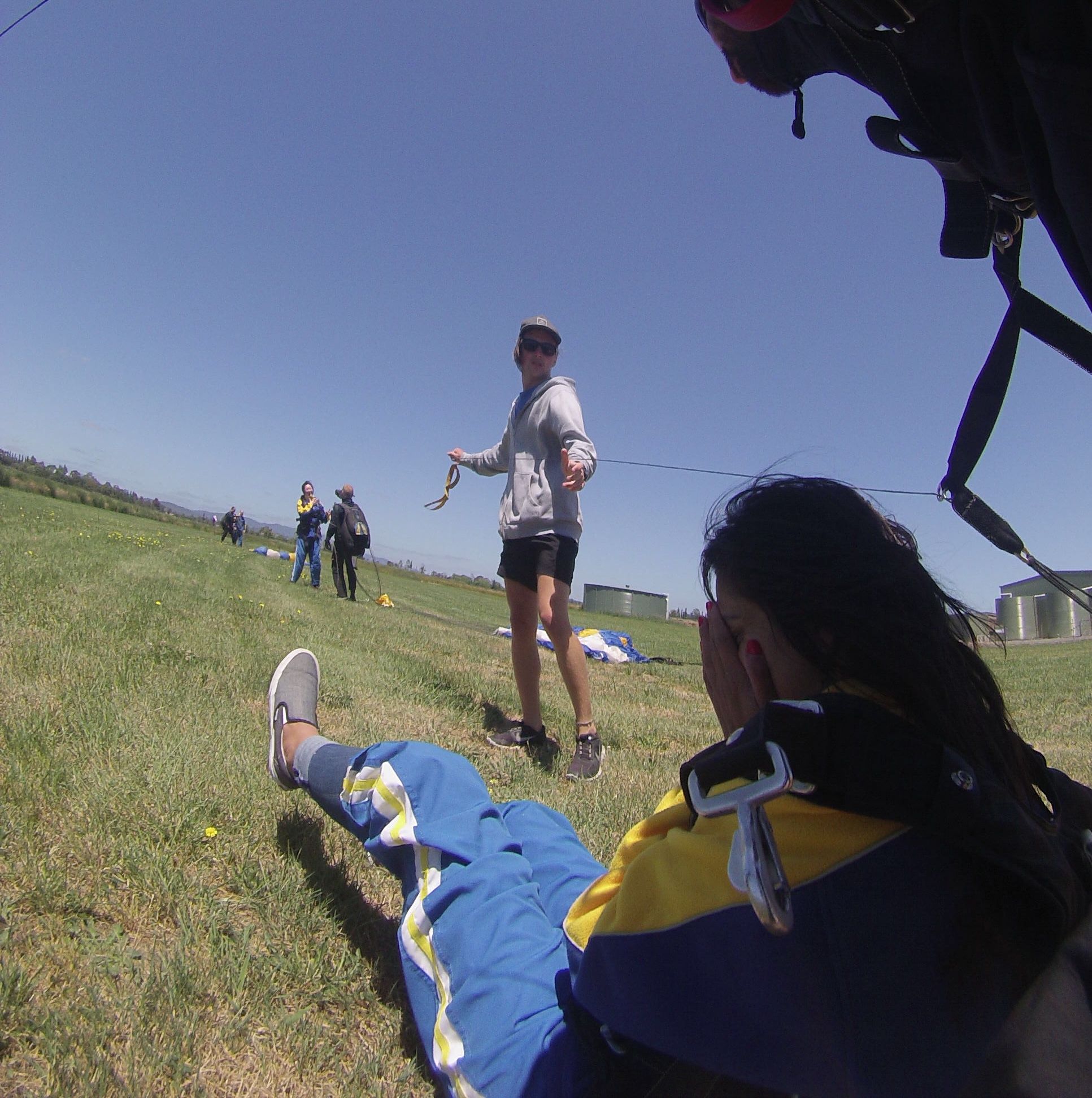
Landed.
If you are looking for somewhere to go cherry picking around the Yarra Valley, I suggest you head to Lanidale Orchard in Wandin. Awesome cherries and friendly staff.
There is much about me that is odd. And much of this oddness can be explained by knowing that I am an Australian-born-and-bred-Italian.
It has taken me some time to understand this, possibly because I spent the first 30 years of my life trying to deny my ‘Italian-ness’, or at least minimise it. Take one look at me, remember that my name is Renza and see me around a plate of spaghetti and you will understand how futile this was.
I am so Italian that there is espresso running through my veins. I talk with my hands and get ridiculously passionate when talking about food. My dream car is a vintage FIAT 500 and I own a Vespa. The ‘Italian-ness’ is somewhat overwhelming.
Italians have a weird way of dealing with physical illness. Actually, before this descends into some sort of cultural stereotyping, I should say the Italians I’ve been around have a weird way of dealing with physical illness.
Often, it is worn as a badge of honour. A conversation between two of ‘my people’ may sound like this:
‘Oh, you have a cold? I have pneumonia.’
‘Oh, you have pneumonia? I have pleurisy and bacterial pneumonia.’
‘Oh, you have pleurisy and bacterial pneumonia? I have Ebola. I am practically dead. Get me a hearse.’
You get the picture.
I grew up spending a lot of time with my extended family. My cousins were like close friends. I saw my grandparents pretty much every single week and aunts and uncles were a very present part of my life. I didn’t realise it at the time, but I was incredibly lucky to have been exposed to this. I took it for granted – actually, I thought that everyone had this sort of connection with their extended familia.
No one in my family has really had any significant health conditions. Well, my mother has lived with lupus for a long time, but her approach to having a chronic health condition is the same as mine – acknowledge it’s a shit and get on with life. She’s been a spectacular role model, really. But apart from mum and me, the rest of us are relatively unscathed by nasty health conditions.
My grandparents who always seemed old to me – even though they would have been quite young when I was little – were pretty healthy. It really wasn’t until they were elderly – and getting towards the end of their lives – that they were unwell.
But despite this, there was always talk about being sick, because they traded in the currency of illness. They constantly spoke about how unwell people were, and the closer the person to them, the higher the value. They could – and would – trade on close family members being sick. So when I was diagnosed with type 1 diabetes, I became a pretty valuable commodity!
‘Oh, your niece has asthma. That’s terrible. My grand-daughter has diabetes – the one where she has to stick needles into her skin. I win. Pass me the grappa.’
I have always been uncomfortable with using illness as a way to get one up on someone, or to use it as an excuse. Equally, I hated the constant talk of people being unwell or in hospital. One night, not long after I was diagnosed, I was at my grandparents’ sitting around a table laden with food, having our weekly family dinner. We were good naturedly laughing at each other and commenting on how much one of my cousins eats. And poking fun of my aunt’s driving abilities. And my sister and I were yelling at anyone making sexists comments.
Typically, the talk eventually turned to a distant cousin/the butcher/next door neighbour/family member in the old country who was unwell.
I’d had enough. I put down my cutlery.
‘I’ve had enough!’ I said (probably waving my hands around). ‘Until I hear of someone actually being close to death – as in actually dead, as announced by a qualified medical practitioner – enough of the sick talk. Enough! I have type 1 diabetes – I win! No one gets to be sicker than me unless they are actually a corpse. Got it?’
I suspect someone translated for my grandmother. Everyone else just looked at me like I was mad.
I reached over and grabbed another cotoletta and kept eating. The subject was changed. We went back to gently joking and laughing at each other – most likely, my sister, cousins and I were making fun of my dad for being short.
The sick talk was a lot less after that. I won. And yet, somehow, I really, really didn’t.

In Roma with my dream car.
Today, I am feeling particularly giving, so I am going to give you some advice that may help you cure or prevent diabetes. Or both.
Here goes:
- Eat yoghurt
- Sleep naked
- Love yourself
- Eat cinnamon
If you are a multi-tasker, I suggest eating cinnamon flavoured yoghurt in the nude while telling yourself how awesome you are.
Or.
You can ignore all the ridiculous claims, phoney promises, snake oil, COCONUT oil (I am so looking at you and your activated nuts right now, Pete Evans) and do the following:
- Follow your management plan that has been put together by you and your healthcare professional/s. And for the purpose of this, we are going to say that a healthcare professional is someone who has studied for a number of years and gained some sort of qualification – as in a Bachelor degree – not a certificate they have printed themselves after doing a six week online course. A healthcare professional is not someone who writes a blog / is a TV personality / is a personal trainer / has ever appeared on a reality TV program / thinks they understand ALL health conditions because they have one themselves etc. etc. (Hence – I am not a healthcare professional. I am not even professional when push comes to shove. But then, I’m not telling you to eat Nutella while naked to cure your diabetes, (you can trust me on this one – it doesn’t work…). BUT, if I tell you to go eat some chocolate, you should. Because it tastes good.)
- Be nice to yourself. Because you are an awesome person and having a health condition does not diminish who you are or your self-worth in any way.
- Food doesn’t have a moral compass, so if you want to eat a doughnut, knock yourself out. Or don’t eat a doughnut if you don’t want to.
- Remember that you did nothing to cause your condition. No one deserves to be diagnosed with any crap condition. No one is to blame. No one asked for it. (Really, no one writes in their letter to Santa ‘This year for x-mas I would really like an incurable autoimmune condition. I have been super good, so if you could give me two that would be great.’ Seriously. Santa never received that letter!)
- You can look for things to blame because I know how great it would be to point at something and say ‘damn you for screwing up my pancreas’ but that isn’t going to make diabetes go away. Perhaps you could consider using your energy for doing something that makes you feel good. Like patting a puppy dog or eating a piece of cake. Or go cherry picking.
- Surround yourself with people who make you feel good about life – not people who suck the life out of you and make you feel worthless.
- Accept that it is absolutely, positively, completely and utterly okay to feel crapola sometimes about having a health condition that you didn’t ask for. It’s your diabetes and you can cry if you want to.
- If you have the energy, put on some music and dance around your kitchen. I promise when I tell you it will make you feel good. Plus, you can claim it as exercise (quick – log a Big Blue Test – extended until today!) which will make you feel even better about yourself.
- Read something by David Sedaris. Aloud if you can.
- Stand in the sunshine for 10 minutes
- Or, stand in a downpour and get totally soaking wet – a bit of Belinda Carlisle will make you feel fabulous! (Ideally, do this in your back or front yard so you can go inside and dry off. By all means, do it at work, but you will get strange looks from co-workers if you squelch back to your desk looking like a drowned rat, leaving a puddle in your wake).
- If you are the hugging type, find someone to hug (ask first; it’s polite).
Now, none of these things is going to cure or prevent diabetes. I could claim that they will, but I’d be lying. Because nothing – NOTHING – will cure your diabetes. But doing whatever you can to make you feel good is a worthwhile thing to do.
Any other ideas? Go!
Ten years ago, I was waiting very impatiently for an arrival. My little girl was only three days from being delivered and I was counting the hours with a mixture of fear and excitement.
Her arrival would be the culmination of years of planning, hard work, heartbreak and promise. And her arrival would mean that beautiful sentiment ‘First we had each other. Then we had you. Now we have everything’ was coming true for our little family.
Pregnancy was also the time where I came to fully understand the concept of diabetes adding a degree of difficulty to a situation. The planning prior to even thinking about getting pregnant, and then the maintenance of impossibly near-perfect BGLs was relentless. For those years – and it was years for me – my life was all about numbers and charts and graphs.
Of course, I was lucky and all the planning and hard work was all worth it. The moment I first held our baby in our arms and looked into her perfect little face with her full cheeks and tiny button nose I knew that I would do it again in a heartbeat for her. All the planning meant that I had the best chance for a healthy pregnancy and baby.
This year, I have been on the Expert Reference Group for the NDSS Diabetes in Pregnancy Program. This program is looking to improve and develop resources for women with type 1 or type 2 diabetes planning to have a baby.
 At the moment, a survey is being conducted to better understand the kind of information currently available and provided to women with diabetes about contraception, pregnancy and women’s health.
If you are an Australian woman aged between 18 and 50 years with type 1 or type 2 diabetes, you can take place – and go into the draw to win an iPad Air! The survey will take you about 20 minutes to complete and is completely anonymous.
Click here to take the survey. You have until 30 November.
Women with diabetes deserve to have the best chance of having a healthy pregnancy and this work will go towards providing information and resources to help.
Want more?
Years ago, I was involved in the development of Can I Have a Healthy Baby? a booklet about diabetes and pregnancy. In subsequent years, I was involved in the review of this resource. This year, the Diabetes and Pregnancy program has reviewed, revised and rewritten this booklet. It will be relaunched as Having a Healthy Baby and will be specifically for women with type 1 diabetes. The Type 2 diabetes version will be developed and launched in coming years. The new resource will be available electronically from 3 December 2014. Keep an eye out for it!
DISCLAIMER
The Diabetes and Pregnancy National Develop Program is funded by the NDSS. I am a member of the Expert Reference Group. I do not receive any payment for sitting on this group, however it is part of my role at Diabetes Australia.
The other day, I, (possibly stupidly), weighed in on a Facebook conversation. A friend was taking a battering for having said that she really didn’t think that having diabetes was all that dire, and that she tries to focus on the positives.
My friend is a smart cookie and she certainly didn’t need anyone to swoop in to defend her. I just wanted to add my opposition to the growing number of people who were having a go at her for daring to say that, in her opinion and experience, diabetes is not that bad.
I frequently say that diabetes doesn’t stop me from doing anything. I acknowledge that sometimes, there is a little extra work that goes in – some extra forward planning. But diabetes hasn’t stopped me from much at all.
Is this one of those incredibly privileged-white-ivory-tower comments from someone who is living without diabetes complications and can access whatever care she chooses to manage her diabetes?
Maybe.
But does that make my experience and they way I feel any less important or real?
I know that I am very fortunate when it comes to the diabetes care available to me. And with my support networks and a healthcare system that provides me with affordable insulin and subsidised supplies. I know that all of this makes my opinion of life with diabetes different to many others in the world.
But, quite frankly, I don’t think that this is what those in this particular conversation who were complaining about how hard it is to live with diabetes were talking about. I don’t think they are talking about the problems with access to healthcare. The thing that kept coming out in the conversation the other day was how awful it is that people in the general community don’t understand what it’s like to live with diabetes each day; that they have to deal with ignorance about diabetes. Oh, and that they can’t be an astronaut.
I am not belittling or minimising how others feel about their particular life with diabetes. And at no time did I (or my friend) say that diabetes doesn’t suck. Of course it does – we all would love a cure and for diabetes to go away.
The thing that struck me was how my friend was expected to justify her positive feelings. It was almost that she was not allowed to say that she felt okay about living with diabetes. Or that her experience – her positivity – wasn’t as valid as those who don’t feel so good. When I jumped on board, I felt that I was treated the same way.
There is no right way to feel about living with diabetes. Some people feel okay about it and their experience is that it impacts minimally on their life. Others feel it is a great burden. Some of us oscillate between the two, depending on how we are coping and feeling at one particular time.
But no one has the right to say that anyone else’s feelings are less acceptable.
For the most part, I don’t think that diabetes has impacted all that much on many aspects of my life. Sure, if my beta cells hadn’t decided to run off to the Bahamas or wherever they have gone, I wouldn’t be writing this blog, but I’d probably be writing another one (about a far more interesting topic like, I don’t know, ‘baking with bacon’*). And I might not be working for a diabetes organisation, but I’m pretty sure I’d still be doing the same sort of work – just with a different focus.
I can be accused of looking at diabetes through rose-coloured glasses, or not really understanding just how tough it can be. I can be told that until I develop complications that make me consider how limiting this condition can truly be, I should just keep my happy thoughts to myself.
But it’s how I see it. My glass is half-full.
At least it is today.
*Note to self – register blog: ‘Baking with Bacon’.

Generally, I need a bloody good excuse to consider exercising. It’s been well-documented here on this very blog that I am exercise averse and would do pretty much anything to avoid donning a pair of runners to be physically active.
Little inspires me to keep fit and I really have never, ever understood the attraction of a workout.
However, guilt doing something good so that I can boast and be supercilious is a motivator.
Enter, the Big Blue Test.
This is the fifth year the Diabetes Hands Foundation (DHF) is running this campaign which raises diabetes awareness and funds. Since it started in 2010, DHF has donated about $250,000 to charities helping people with diabetes. This year, the aim is to raise $35,000 which equate to 35,000 Big Blue Tests being logged.
In case you need a feel good reason to exercise – there it is!
BUT! There is no time to waste. YOU ONLY HAVE TODAY!
It’s easy, easy, lemon squeezy to take part in. There are only four steps:
- Check your BGL
- Exercise for between 14 and 20 minutes
- Check your BGL
- Log it – here. (Or, to be a fancy Nancy, get the iOS or Android app.)
Could. Not. Be. Easier.
By the way, exercise doesn’t necessarily mean running or walking or getting on a bike. Think out of the box. Gardening, vacuuming, walking the kids to school, washing windows can all count as physical activity. I know that I hypo anytime I so much as look at a vacuum cleaner!
And, ahem, for another out-of-the-box idea, a morning, afternoon or evening quickie could not only be the perfect interlude in your day, but also a nice way to log a Big Blue Test. Plus, it’s nice to do charity work with a loved one.
By the way, the Big Blue Test is for EVERYONE – not just people with diabetes. Those with working pancreata (it’s the plural – look it up) simply log their exercise. (And that’s ANOTHER good idea to consider the quickie idea – you get two Big Blue Tests for your buck! Oh, stop it. I said BUCK!)
What are you waiting for? Go!
It’s World Diabetes Day and everyone is talking diabetes. Or so it seems.
Do we need another awareness-raising day?
Yep. We do.
We know the numbers. We know that diabetes is serious. We know that prevention is the key – prevention of type 2 diabetes (where possible) and of complications in those already living with diabetes. I could write how World Diabetes Day can draw attention to these facts.
But instead, I’ll tell you why I – a person living with diabetes – need World Diabetes Day.
I need today because it gives an opportunity to talk about real life with diabetes.
On Wednesday, (also known as ‘I hate diabetes day’) I spoke at the Austin Hospital’s Grand Rounds. Most hospitals have Grand Rounds – it is a learning opportunity for doctors and other healthcare professionals to hear presentations and ask questions about different medical conditions – sometimes outside their area of specialty.
Wednesday’s session had a World Diabetes Day focus – the lecture theatre was adorned in blue balloons and just about everyone in the room was wearing an item of blue clothing.
I gave my talk which consisted a discussion of the consumer-focused program we run at Diabetes Australia – Vic; how healthcare professionals can use social media to interact with people with diabetes and how PWD use social media to connect.
At the end of my planned talk, I looked around the room. I think my talk had been well received – I know that I am certainly different to the usual healthcare professional presenting and I also knew that the next speaker – the wonderful Professor Joe Proietto – was giving a talk on type 2 diabetes medication.
‘Just before I go, I want to say something,’ I said. I took a deep breath. ‘I hope you have enjoyed my talk. I hope that it has given you a better idea of some of the programs and activities available to be people with diabetes. I hope you are thinking about what your Twitter handle is going to be because I really want to see ALL of you in the Twittersphere next week!! But I just want to add something.’
I moved away from the lectern and stood in the middle of the stage.
‘I look okay today, right?’ I saw heads nodding around the room. ‘My dress is neat, my hair is clean. I have make up on and I know I have matching shoes on – I checked before I left the house. My lipstick is on straight. I just gave you a twenty minute talk, and I think it all made sense….I think? The words did form coherent sentences, right?’ More nods from the people in the theatre.
‘I look okay.’ I paused again.
‘But let me tell you how I am feeling. I had a terrifying hypo overnight and was awake for a good part of the night. I needed help to deal with it, and my daughter, when she woke up this morning, had to see me feeling pretty damn crap. My dad is sitting over in the corner there because I was just too tired to drive here from Brunswick, and he kindly offered to chauffeur me so I wouldn’t need to take a cab.’ I looked over at my dad and smiled. And then kept going.
‘Why did this happen? Well, I guess if we want to find a reason, we could say it was because before I went to bed last night, I didn’t check my blood sugar. You see, I just couldn’t be bothered. Now, before you think ‘how stupid’ or ‘serves her right’ or start to judge me, know that I had already checked my BGL about 15 times throughout the day and the thought of doing another BGL check was just too much for me. And I thought that I was okay based on the previous check and knowing that I had no insulin on board.
‘But you know what? It doesn’t matter why it happened and if I wasn’t telling you this now, you would never know. You wouldn’t know that I really would like to curl up under one of the seats and fall asleep; you wouldn’t know that I am still dealing with the hypo-rebound and my BGL is sitting somewhere in the mid-teens. You wouldn’t know that my arms and legs are heavy from being post-hypo-exhausted. You wouldn’t know that I kind of want to cry because today, my diabetes is other people’s problems. Not just my own.
‘Now, I’m not telling you this because I want you to feel sorry for me. I’m not telling you this because I want you to pity me because I have diabetes. It’s crap and that’s all there is to it. I’m telling you this because I want you to remember this story next time you are sitting opposite one of your patients who is living with diabetes – or any other medical condition for that matter – and they look all great. Don’t assume. Don’t ever assume that everything is all fine. Because I can tell you for sure that while I will be blogging about this to share with other people with diabetes, I certainly won’t be sitting in my next appointment telling my endo about it.’
I stopped again. The room was silent – no one moved.
‘Thank you so much for having me here today. And happy World Diabetes Day for Friday.’
I walked off the stage.
I love Joni Mitchell. And I love this song – Blue – which is, of course, perfect for today.

There are some very clever people in the diabetes world and today I want to write about the incredibly astute and hip crew from mySugr who look for innovative and fun ways to help ‘tame the monster’ that is diabetes.
I met Fredrik Debong from mySugr at the first EASD Blogger Summit where I heard about his diabetes-focused start-up and saw first-hand some of the things they were developing. Fredrik kept saying that we need to bring sexy back to diabetes – he and his team do it incredibly well! (Seriously – have a look at them all!)
Since then, I’ve been fortunate enough to meet others from the team – including Marlis Schosser, (who will forever be known as the saviour in the Pumpless in Vienna story I keep sharing in conference talks), and Ilka Gdanietz who has been at all three Blogger Summits. (Ilka is wonderful for a number of reasons, one of which is she shares my love of Nutella!) This year, Ilka gave us a sneak preview of some of the exciting things happening at mySugr headquarters. mySugr launched in the US last year and the team there is headed up by Kyle Rose and Scott Johnson.
The mySugr Companion app has been around for a few years now and I would really encourage you to have a look at it. As far as a logbook app goes, it is pretty damn perfect, and the version for kids is adorable! I guess that’s what happens when you have real people with diabetes creating tech for real people with diabetes. It just works!
But wait! There’s more.
Just this week, mySugr has launched their new initiative: mySugr Academy. The Academy will offer online training programs for people with diabetes and the curriculum has been developed by healthcare professionals and people with diabetes. The first course to be offered has been designed specifically for people with type 2 diabetes. Have a look at this teaser clip to give you an idea of what to expect.
Coming courses will be for people with type 1 diabetes.
mySugr is all about diabetes education and information, but it does it in an incredibly fun, interesting, accessible and cheeky way. It is groups like this – with a first-hand understanding of real life with diabetes – that make products that I want to use. Great, great stuff!

Monster-taming at mySugr HQ in Vienna.





 Diabetogenic